• Skip to primary navigation
  • Skip to main content
  • Skip to footer
Chaminade University of Honolulu

Chaminade University of Honolulu

  • VISIT
  • APPLY
  • GIVE
  • STUDENTS
  • PARENTS
  • ALUMNI
  • FACULTY/STAFF
  • Admissions
    • Admissions Home
    • Undergraduate Students
      • First-Year Students
      • Transfer Students
      • Admitted Students
    • Graduate Students
    • Flex Online Undergraduate Program
    • Military Students
    • Non-Degree/Visiting Students
    • Experiential Honors Program
    • Early College Program
    • New Student Orientation
  • Tuition & Aid
    • Financial Aid Home
    • Tuition & Expenses
    • Federal Updates & Changes
    • Scholarships
    • $5,000 Graduate Scholarship
    • VA Education Benefits
    • Net Price Calculator
  • Academics
    • Academics Home
    • Academic Programs
    • Office of Student Success
      • Academic Advising
      • Records and Registrar
    • Kōkua ʻIke (Support Services)
      • ADA Accommodations
      • Career Services
      • Proctoring Services
      • Tutoring Services
    • Sullivan Family Library
    • Undergraduate Research & Pre-Professional Programs
    • Commencement
  • Campus Life
    • About Campus Life
    • Student Engagement
    • Student Government Association
    • Residence Life and Housing
      • Summer Conference Housing
    • Health Services
    • Marianist Leadership Center
    • Counseling Center
    • Campus Ministry
    • Campus Security
    • Dining Services
    • Bookstore
  • Athletics
  • About
    • Chaminade University News
    • Our Story
    • Leadership
    • Chaminade University Strategic Plan 2024-2030
    • Mission & Rector
    • Association of Marianist Universities
    • Facts & Rankings
    • CIFAL Honolulu
    • Accreditation & Memberships
    • Montessori Laboratory School
Search
×

Search this web site

Innovation

Sustainable Entrepreneurship

April 2, 2024

New ENV 490 Sustainability Innovation class stimulates paradigm shift

Aside from being tongue twisters when said in succession, the terms sustainability and entrepreneurship are indeed big words, as pointed out by ’Inana Sustainability Entrepreneurship Program’s coordinator, Mariane Uehara. Tasked with creating a curriculum for the inaugural ENV 490 Sustainability Innovation course, Uehara admitted that she “jumped into the unknown” when she joined the United Nations’s CIFAL Center at Chaminade University.

At the core of the ENV 490 is a student-driven project that’s in partnership with a local company. The goal was to balance the triple bottom line—people, planet and profit—while addressing the long-term impact of business activities on the environment and society. Sustainable entrepreneurship recognizes the interdependence of economic development, social well-being and environmental health, and seeks to create value in a way that is responsible and ethical.

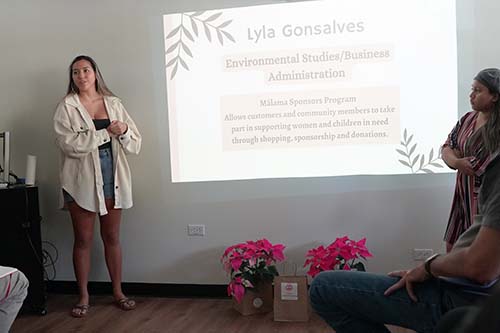
Lyla Gonsalves, left, and Jasmine Mondelo discussed possible solutions for Ten Tomorrow to become more sustainable.
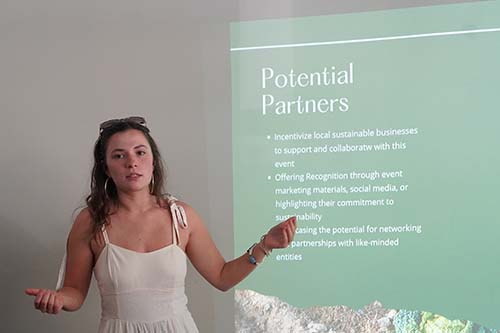
Sarah Carroll '25 identified potential partners that could help Re-use Hawaii and its sustainable efforts.
Sarah Carroll identified potential partners that could help Re-use Hawaii gain greater community support.
Ten Tomorrow designer Summer Shiigi, center, liked the ideas presented by Chaminade students, from left, Ka‘I‘inipu‘uwai “Mini” Keli‘iho‘omalu-Holz ’24, Lyla Gonsalves ’25, Jasmine Mondelo ’25 and LaVelle White ’26.
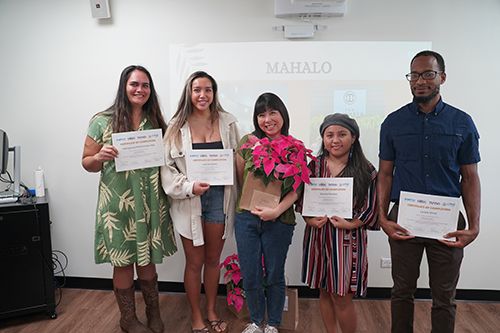
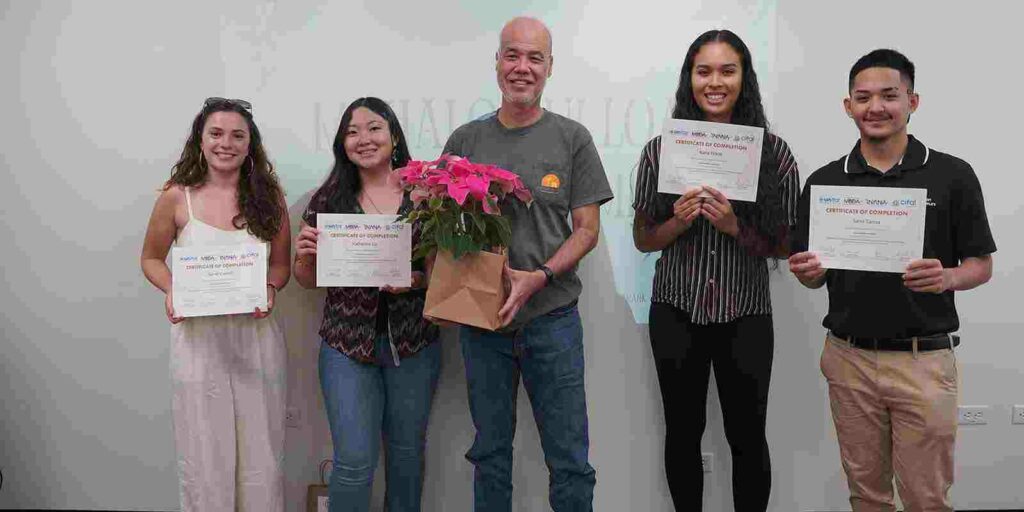
Re-use Hawaii's Workforce Development Coordinator Nathaniel Pak saw value in Chaminade student's sustainable efforts for the nonprofit. Team members included, from left, Sarah Carroll '25, Katherine “Kat” Liu ’26, Kaila Frank ’24 and Sano Tanna ’24.
Re-use Hawaii’s Workforce Development Coordinator Nathaniel Pak saw value in Chaminade students’ sustainable efforts for the nonprofit. Team members included, from left, Sarah Carroll ’25, Katherine “Kat” Liu ’26, Kaila Frank ’24 and Sano Tanna ’24.

“All the students’ projects had to align with at least one of the United Nations’s 17 Sustainable Development Goals (SDGs),” Uehara explained. “Although the vision was blurry at first, we figured out the puzzle together, and we had fun while doing so.”

According to Uehara, the three goals of the ’Inana Program are: 1) To develop and implement programs for the education and training of undergraduate students in subjects directly relating to successful entrepreneurship; 2) To support minority business enterprises (MBEs), including building a diverse entrepreneurial pipeline to grow the number of MBEs; and 3) to create a UN Certificate program in sustainability entrepreneurship.

Divided into three teams, 14 students presented their final entrepreneurial projects, working alongside with Ten Tomorrow, Re-use Hawaii and Plantoem. Under the mentorship of Uehara, and Cort Isernhagen and Jamie Lui of Diamond Head Research—a company that helps small companies track and assess their activities to identify trends and innovative business models that best support Corporate Social Responsibility, Environmental, Social and Corporate Governance, and philanthropic initiatives—the aspiring entrepreneurs demonstrated their ability to think outside the box.

“First of all, who are you guys,” rhetorically asked Lui after listening to the students’ presentations. “You’re a completely different group from when we started this class a few months ago.”

Exuding confidence, Sarah Carroll ’25 proposed a “Hanau Hana Aloha Event,” which would advertise Re-use Hawai’i as a community-based nonprofit worthy of long-term patronage and donation. Additionally, it would also pose these solutions: Engage an eco-conscious audience; showcase Re-use Hawaii’s mission beyond social media; and connect with long-term donors through a captivating experience.

“Hosting an upcycle consignment event for Re-use Hawaii would present an innovative solution to address several pressing challenges,” the Data Science and Visualization major said. “It would help Re-Use connect with the community and give it more visibility, as well as broaden its donor pool.”

Other Re-use Hawaii members included Katherine “Kat” Liu ’26, Sano Tanna ’24, Lihau Keoneula ’24 and Kaila Frank ’24.

Pairing with Ten Tomorrow designer Summer Shiigi, Jasmine Mondelo ’25, Ka‘I‘inipu‘uwai “Mini” Keli‘iho‘omalu-Holz ’24, Lyla Gonsalves ’25 and LaVelle White ’26 aligned their entrepreneurial proposals with the local clothing company’s line of modern resort wear. An Environmental Studies major, Keli‘iho‘omalu-Holz identified the problem of having to bring in fabric, which contributes to carbon emissions, microplastics and landfills.

Keli‘iho‘omalu-Holz’s solution was to source fabric that would be less harmful to the environment. She cited such alternatives as hemp, organic cotton, bamboo, recycled material and Tencel fabrics, which are produced with environmentally responsible processes from sustainably sourced natural raw wood fibers. Tencel textiles are also certified biodegradable.

“I have a really keen interest in fashion, which is why I chose Ten Tomorrow ,” Keli‘iho‘omalu-Holz noted. “I wanted to find cost-effective solutions and sustainable fabrics that didn’t have a negative impact on our environment.”

Alexandra Zingarelli ’24, Sydney Danielson ’25, Pūnohu Keahi ’25, Aleeyah Lemons ’24 and Conor McMahon ’24 partnered with Zoe Zhang of Plantoem, a portmanteau of plant and poem, and suggested a “Plantoem’s Appreciation March 2024.” Each week would tackle a different aspect, from the significance of native plants and “Aloha ʻĀina: Environmental Health Talk Story Event” to carbon offset, plant therapy and sustainable living workshops.

“They really listened to what I had to say,” said Zhang, who founded Plantoem because of her love for plants and poetry. “Their proposal to me is highly viable. Since we came up with the awareness month idea during their second visit, I have already been in touch with some of the speakers who are interested in participating. The basic structure of the event month has already been sketched out. And the students are coming back to help work on the events in March.”

In his closing remarks, Isernhagen commented on the diversity of ideas and the prototypes the students developed. “I liked the fact that you met the businesses where they were,” he concluded. “Your lenses were all sharply focused around sustainability. And I liked the fact that you collectively approached one problem but each of you came up with your own individual solution.”

Posted by: University Communications & Marketing Filed Under: Business & Communication, CIFAL Honolulu, Diversity and Inclusion, Featured Story, Hogan Entrepreneurial Program, Innovation, Institutional Tagged With: CIFAL, CIFAL Center, Hogan Entrepreneurs Program, School of Business and Communication

Higher Education in Prison

March 15, 2024

Program helps with reintegration into community

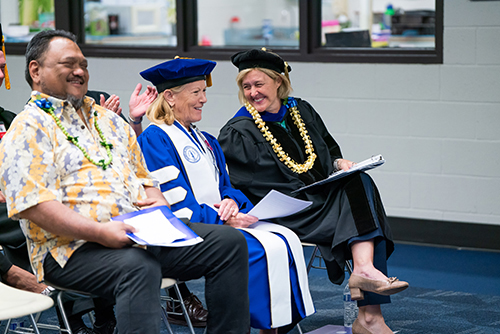
Drs. Janet Davidson and Lynn Babington share a light-hearted moment. Seated next to them is Mark Patterson, Chair Hawaii Correctional Oversight Commission and Hawaii Youth Correctional Facility, Warden.

It was the best news that Dr. Janet Davidson could have ever received on a Friday morning. After receiving an email message from Gabrielle Schechter, Health Policy Advisor with the Office of U.S. Senator Brian Schatz, Chaminade’s Vice Provost for Academic Affairs and a leader in criminology couldn’t believe what she was reading.

“I had to ask Jacki (Sanqui) to come to my office and read the message to make sure that I was reading it correctly,” said Davidson, who has spearheaded Chaminade’s Higher Education in Prison program. “She told me this was really great news and I was reading it correctly. The note said, ‘Your Higher Education in Prison Program earmark request to Senator Schatz’s office for FY24 was funded at $1.5 million!’ I was shocked.”

With the successful graduation of the pilot class, the second cohort of students from Halawa Correctional Facility includes 11 inmates, three more than the inaugural graduating class. Studies have clearly shown that higher education in prisons offers a multitude of benefits, particularly concerning re-entry into society and reducing rates of recidivism. Research further indicates that individuals who participate in educational programs while incarcerated are significantly less likely to return to prison upon release. Specifically, those who attain an associate’s degree have notably improved odds of successfully re-integrating into society compared to their counterparts without such credentials.

Yet, in our legal system and legislative practices, mass incarceration remains deeply entrenched. Despite efforts over the past half-century, initiatives such as the war on drugs have failed, leading to a troubling escalation in sentencing, probation and pretrial incarceration. But there is hope. In March, the U.S. Senate passed the second half of a bipartisan government funding bill that includes $31.8 million in new congressionally directed spending, also known as earmarks, secured by U.S. Senator Brian Schatz (D-Hawai‘i), chair of the Senate Appropriations Subcommittee on Transportation, Housing and Urban Development. The new funding follows nearly $400 million in earmark funding for Hawaii secured by Schatz in the first half of the appropriations deal signed into law earlier this month. Chaminade University of Honolulu was awarded $1.5 million, which will be used to build capacity of the prison education program.

“At Chaminade, one of our primary Marianist values is to advocate for social justice for transformative change,” says Chaminade President Lynn Babington, Ph.D. “We support a rehabilitation-through-education narrative, which we know is essential to incarcerated individuals finding a pathway to a second chance and a better future.”

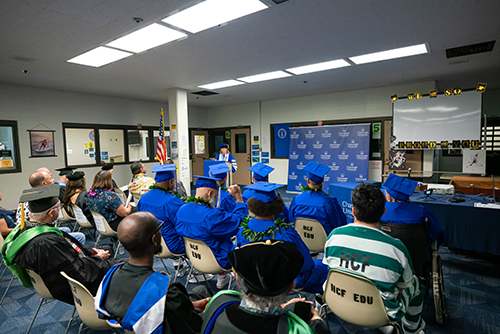
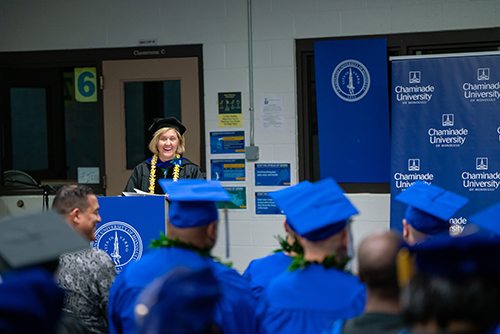
Last year's first graduating class attended a commencement ceremony at Halawa Correctional Facility.
Chaminade President Dr. Lynn Babington congratulated graduates during a commencement ceremony at Halawa Correctional Facility.

Hawaii’s correctional facilities epitomize the challenges the state face, grappling with chronic overcrowding and deteriorating conditions. In 1978, Hawaii’s incarceration rate stood at one per 1,000 people. Since then, national rates have skyrocketed, with Hawaii’s incarceration rate at 439 per 100,000 people (including prisons, jails, immigration detention and juvenile justice facilities), meaning that it locks up a higher percentage of its people than almost any democratic country on earth, according to the non-profit, non-partisan Prison Policy Initiative, whose research and advocacy is at the center of the national conversation about criminal justice reform and over-criminalization.

Following its re-designation, the Hawaii Department of Corrections and Rehabilitation underscored the importance of transitioning away from punitive justice, making rehabilitation a core aspect of its mission. With a staggering 95 percent of incarcerated individuals eventually returning to society, this shift is deemed crucial for achieving successful reintegration. As part of its restructuring, law enforcement functions previously under Department of Public Safety were transferred to a newly established Department of Law Enforcement. The move reflects a broader commitment to address the root causes of criminal behavior and promote long-term societal wellness. By prioritizing rehabilitation and reintegration programs, the Department of Corrections and Rehabilitation aims to create safer communities and support individuals in their journey toward positive change.

“The motto for our department is ‘He Au Hou,’ which means ‘a new era,’” said Tommy Johnson, Director of the new Department of Corrections and Rehabilitation, which re-establishes the Hawaii Department of Public Safety. “We’re able to focus our full attention, resources, and energy on rehabilitation and restoration to support those in our custody and care. We envisioned this over two years ago and it’s exciting to see this coming to fruition. We may not see changes occur overnight. We know there is always room for improvement, but I’m confident we’re headed in the right direction.”

Chaminade Vice Provost for Academic Affairs, Dr. Janet Davidson, addressed graduates during last year's commencement ceremony at Halawa Correctional Facility.
Chaminade Vice Provost for Academic Affairs, Dr. Janet Davidson, addressed graduates during last year’s commencement ceremony at Halawa Correctional Facility.

Davidson shares Johnson’s optimism, and she hopes to expand Chaminade’s Higher Education in Prison program to include an interdisciplinary bachelor’s degree program and a new women’s program at Women’s Community Correctional Center. The commitment to these educational programs reflects a fundamental paradigm shift towards a justice system focused on rehabilitation rather than punitive measures. By providing access to education, prisons foster a culture that prioritizes personal growth and skill development, ultimately empowering individuals to become productive members of society upon release.

This non-punitive approach not only benefits the individuals directly involved but also contributes to broader societal outcomes, including reduced crime rates and enhanced community safety. Embracing higher education within the prison system signifies a commitment to justice that extends beyond punishment, striving instead for meaningful rehabilitation and long-term societal transformation.

“I don’t know how to do life out there,” one of the Halawa students told Matthews, referring to re-entering society after being released from prison, adding that they feel that she talks to them, and that she understands them. Empathy is indeed a powerful message for those incarcerated, who often say they don’t “feel treated as human beings.”

“I feel like a ‘wounded healer,’” says Matthews, quoting a term coined by Shadd Maruna, Ph.D., the dean of the School of Criminal Justice at Rutgers University Newark. “Many prisoners and former inmates express a desire to receive mentoring from formerly incarcerated persons who are ‘making it’ in conventional society.”

Prison reentry is a complex process that requires comprehensive strategies involving legislation, regulations, support programs, and community involvement. By prioritizing rehabilitation and reintegration, society can help individuals leaving incarceration rebuild their lives and become productive members of society. Through concerted efforts and collaboration, we can bridge the gap between prison and society, paving the way for successful reentry and reducing recidivism rates in the long run.

Posted by: University Communications & Marketing Filed Under: Diversity and Inclusion, Education, Featured Story, Innovation, Institutional Tagged With: Andrew W. Mellon Foundation Grant, Education in Prison, Marianist, Second Chance Pell

Ocean Protection

February 22, 2024

Martina Sagapolu ’88 helps enforce ocean regulations

When she first entered Central College in Pella, Iowa, in the early 1980s, Martina Sagapolu’s interest was largely in political science. However, as she quickly found out from one of her professors, she was woefully behind in her knowledge of current events, and it would require a lot of hours to get on par with most of the other students on campus.

“I grew up in American Samoa so our AP News and television broadcasts were all pre-recorded and two weeks late,” says Sagapolu ’88. “So, when I arrived on campus, I learned for the first time that a woman (Kathryn D. ‘Kathy’ Sullivan) had just gone to space, yet that happened at least a month prior to my arrival.”

Sagapolu, though, wasn’t late in choosing a major. Because her heroine was the fictional teenage sleuth Nancy Drew when she was growing up in Pago Pago, she decided to pursue a degree in Criminal Justice. After spending a bitterly cold winter in Iowa, the American Samoan native decided to leave Central College for Chaminade University of Honolulu.

“Central College was in the middle of nowhere,” Sagapolu says. “I remember there were only 19 minorities on the entire campus. One of the first mornings I woke up in the dorm, I could smell someone cooking SPAM and rice, and I knew that person had to be from Hawaii. It turned out there were three girls from Kauai and we’ve all kept in touch ever since.”

NOAA's Assistant Director of the Office of Law Enforcement helps enforce ocean regulations in the Pacific Islands region.
NOAA’s Assistant Director of the Office of Law Enforcement helps enforce ocean regulations in the Pacific Islands region.

Now wholly committed to the Criminal Justice major, Sagapolu decided to participate in a U.S. Department of Justice co-op program that the then-Immigration and Naturalization Service (INS) had just rolled out. The program was designed to attract talented individuals—particularly college students—to gain work experience and potentially pursue careers in government service as civil servants. Students were provided with opportunities for internships or part-time employment during the academic year, as well as full-time employment during summer breaks.

“The pilot program started in San Diego and then came to Chaminade,” Sagapolu recalls. “There were seven of us who decided to participate, and we first had to travel to Arizona for a one-week training period.”

With the mentorship of such professors as Dr. Greg Mark and Dr. Mel Masuda who helped Sagapolu with her writing skills, the future Criminal Justice graduate was well on her way to becoming part of the law enforcement field. Meanwhile, she was nearing graduation and eyeing a position with INS. Because of her participation in the co-op program, she could be fast tracked through the usually slow federal hiring process, skipping the civil servant exam, interviews and other required bureaucratic steps.

“I graduated on December 8, 1988,” Sagapolu recalls, “and I was sworn in on January 3, 1989. There was no time to holoholo.”

Five years in as an INS agent, Sagapolu received a call from one of the students who also participated in the same INS co-op program, asking if she was interested in working in the Field Office of the National Fisheries Service, a division of the National Oceanic and Atmospheric Administration (NOAA), in American Samoa. Returning home had always appealed to Sagapolu but she had her reservations about moving from one federal agency to another.

“It was going to be a huge learning curve,” Sagapolu says. “I was going to go from chasing illegal immigrants to investigating infractions in the ocean. Going to fisheries was definitely intimidating.”

But as dedicated Sagapolu was to INS, she has been fiercely entrenched with NOAA for more than two decades. As the Administration’s Assistant Director for the Pacific Islands Division’s Office of Law Enforcement, Sagapolu oversees the protection and management of the largest geographic area of NOAA’s five divisions. The Pacific Islands, comprised of American Samoa, Guam, Hawaii, the Northern Mariana Islands, and other U.S. Pacific Islands, span a total of 583,000 square miles of ocean, teeming with marine wildlife and dotted with sanctuaries, including Papahānaumokuākea Marine National Monument.

“In concert with the Coast Guard, and other federal and state agencies, our mission is to ensure the laws and regulations protecting and conserving our nation’s marine resources are followed,” Sagapolu says. “I also serve as an enforcement advisor to domestic and international stakeholders on enforcement-related matters.”

She’s now also updated on the world’s current events.

Posted by: University Communications & Marketing Filed Under: Alumni, Behavioral Sciences, Diversity and Inclusion, Homepage, Innovation, Institutional Tagged With: Alumni, Criminology and Criminal Justice

Peer-Reviewed Paper

February 12, 2024

International journal accepts paper from Professor David Carter and colleagues

David Carter, Ph.D., literally wrote the book on forensic microbiology so, it was only natural that he was invited to co-author a published paper that will appear in Nature Microbiology. Completely comfortable discussing an issue that is often squeamish for many, the Forensic Sciences Program director casually speaks of cadavers and PMI (Post Mortem Interval) as if he’s talking about the weather.

“There’s definitely increasing interest in PMI (or the time that has elapsed since an individual’s death),” Carter says. “It’s critical information that could be key to solving a crime—or providing an alibi—in absence of any witnesses … or insects.”

Dr. David Carter holding his AAFS Pathology/Biology Section Award for Achievement in the Forensic Life Sciences.

The microbiomes associated with decomposing human cadavers are universal regardless of location or environmental conditions, the paper published in Nature Microbiology suggests. The findings show a conserved and predictable sequence of microbial interactions that break down organic matter, which could have implications for forensic science.

Decomposition is essentially nature’s recycling system. It is a fundamental process that recycles dead biological material to fuel biological processes, such as plant productivity and soil respiration. Microbial fungi and bacteria are predominantly responsible for decomposition, and although this process is well studied, research has focused predominantly on the breakdown of dead plant biomass. In contrast to plants, animal carcasses, including those of humans, are enriched in readily decomposable proteins and lipids, but their impact on biogeochemistry and community ecology are poorly understood.

In their research, Carter and his colleagues tracked the decomposition process in 36 human cadavers, which had been willed to science. The bodies were placed in three locations with either a temperate or semi-arid climate, with three cadavers placed at each location for each of the four seasons, and the researchers took samples of the cadavers’ skin and surrounding soil throughout the first 21 days postmortem. Their study found that decomposing human cadavers had a universal consortium of microbes, regardless of the location, climate or season, that are rare in non-decomposition environments and appear unique to the terrestrial breakdown of flesh.

“Jessica Metcalf of Colorado State and Rob Knight of UC San Diego and I initiated this research in 2011,” Cater says. “Our findings are a sign of success, but we’re still not quite there.”

With metagenome-assumed genomes and metabolomic profiling of soils adjacent to cadavers, Carter and his co-authors reconstructed a network of interaction that revealed how fungi and bacteria share resources as they metabolize decomposition products. Carter and his colleagues suggest that insects may serve as vectors that disperse these microbes from one decomposing animal to another.

According to Carter, using data on the microbial timeline of cadaver decomposition, combined with a machine learning model, they were also able to predict the time since death, which could have potential future applications for forensic science.

“We now have techniques that we didn’t have 20 years ago,” Carter asserts. “It’s also a lot easier for new science and other developments to get in the hands of lawyers and investigators, which makes for a stronger working relationship with criminologists to achieve criminal justice.”

Posted by: University Communications & Marketing Filed Under: Faculty, Homepage, Innovation, Uncategorized Tagged With: Faculty, Forensic Sciences, Honors and Awards

Environmental Science

January 25, 2024

After earning her bachelor’s, Casidhe Mahuka joins CRAG in American Samoa

In recent years, scientists, world leaders, politicians and environmentalists have been warning us about a dire existential threat, noting that climate change poses a grave risk that needs to be urgently addressed and mitigated. As an invasive species coordinator (ISC) at the Coral Reef Advisory Group (CRAG) in American Samoa, Casidhe Mahuka ’22 is doing her part in monitoring and protecting the waters encircling the small U.S. territory.

Since graduating with a BS in Environmental Sciences, the American Samoa native has used her Chaminade education to make an impact in her community. As the ISC for CRAG, Mahuka collects ocean data and implements bi-monthly phytoplankton monitoring in association with the National Oceanic and Atmospheric Administration’s National Phytoplankton Monitoring Network (PMN), which is a community-based network of volunteers who monitor marine phytoplankton and harmful algal blooms (HABs).

Mahuka explains that she has three overarching goals: 1) Integrate community-based methods to restore village-level ecosystems using ridge-to-reef approach in Aua and Fagasa; 2) increase invasive species management policy and activity coordination in and among local and regional organizations; and 3) bolster invasive species management in other priority sites.

“Other priorities include monitoring ballast water, biofouling, reef flats, and testing the water’s salinity, turbidity and overall quality,” Mahuka further describes. “I also work with the US Coast Guard to stay informed on stony coral tissue loss disease, the Vessel Incidental Discharge Act (VIDA) and other regional biosecurity issues.”

Covering more than 70 percent of our planet, the world’s oceans play a crucial role in regulating climate and supporting diverse ecosystems. However, the alarming rise in ocean temperatures due to climate change is threatening marine life, particularly the delicate balance of coral reefs.

Casidhe Mahuka prepares to tie an Anchor Bend knot.
In the summer of 2018, Casidhe Mahuka participated in the SEA Semester, which is Boston University’s Study Abroad Program. The ship traveled from Tahiti to the Hawaii islands.

Primarily driven by human activities such as the burning of fossil fuels and deforestation, climate change has led to a significant increase in global temperatures. As a result, the world’s oceans are also experiencing warming trends, the consequences of which are far-reaching and affect marine ecosystems in various ways.

“Our ecosystems are fragile,” Mahuka says. “Although they cover only a small fraction of the ocean floor, coral reefs support about 25 percent of all marine species. The intricate structures of reefs provide habitats and food for a vast array of marine life, including fish, invertebrates and microorganisms.”

Furthermore, coral reefs act as natural barriers that protect coastlines from the impacts of storms, hurricanes and erosion. The complex structures of coral reefs also dissipate wave energy, reducing the intensity of waves that reach the shore.

Mahuka has had a passion for ocean science ever since she visited the National Marine Sanctuary of American Samoa in the 7th grade. It was the first time that she discovered that she could not only breathe underwater, but she could also breathe underwater for a living.

“That was it; I was totally hooked,” Mahuka says. “I was determined to be an ocean scientist because I have always loved being in the water. And to get paid for it, I was all in.”

As a member of the first cohort of students who majored in Environmental Science at Chaminade, Mahuka mirrors a growing trend among students who are pursuing their degrees in this field, marking a 24 percent increase in degrees awarded since 2016. Data from the U.S. Department of Education shows a steady uptick over five years. In the 2017–2018 academic year—the most recent year for which aggregate data is available—a total of 6,697 students earned bachelor’s degrees in environmental science. That means 1,155 more graduates earned such degrees than did five years earlier.

The trend is illustrated by Chaminade’s School of Natural Science and Mathematics’s introduction of an Environmental Science major four years ago. While a major in Environmental Studies has existed since 2000, the decision to focus on hard sciences was a natural progression for such programs.

While there is an overlap that exists between the two majors, Environmental Science is an interdisciplinary science-based major, which combines biological, ecological, chemical, geological and mathematical principles often used to solve environmental challenges or manage natural resources. Conversely, Environmental Studies is an interdisciplinary social science and humanities-based major. It focuses on the human relationship with the environment, and how environmental challenges intersect with politics, economics, society and culture. 

For 10 days in November, Mahuka was aboard the Exploration Vessel Nautilus surveying previously unmapped seafloor in U.S. waters south of the Hawaiian Islands. She was selected as a Seafloor Mapping Intern by Ocean Exploration Trust (OET), an organization that works to explore the ocean, seeking out new discoveries, while pushing the boundaries of STEAM education (Science, Technology, Engineering, the Arts, and Math) and technological innovation.

“It was a great experience after I found my sea legs,” Mahuka says. “I definitely chose the right career because marine science allows you to travel around the world, where you get to meet and learn from amazing and intellectual people who have the exact same passion as you do!”

Posted by: University Communications & Marketing Filed Under: Alumni, Diversity and Inclusion, Homepage, Innovation, Natural Sciences & Mathematics Tagged With: CIFAL, CIFAL Center, Environmental Studies

Artificial Intelligence

January 18, 2024

Embracing the use of AI in education

Dr. Denise Dugan believes that AI will only continue to progress and evolve as new data flows in.
Dr. Denise Dugan believes that AI will only continue to progress and evolve as new data sets flows in.

Long before it was reduced to an uppercase two-letter acronym, artificial intelligence (AI) was already present in education with early systems focused on using simple algorithms to automate certain educational tasks. In the 1970s, the emergence of Intelligent Tutoring Systems (ITS) was designed to provide personalized instruction based on individual student needs, more commonly known today as Individual Educational Plans. These days, OpenAI dominates the conversation and headlines.

“AI has been in education in some iteration for decades now,” says Denise Dugan, Ph.D., Assistant Professor of Special Education and Elementary Education. “The danger of AI these days is that current students have too much reliance on it, rather than simply using it as another available resource.”

In an op-ed to the “Chicago Tribune,” Chaminade Provost Lance Askildson opines that recent advances in artificial intelligence have given rise to hyperbolic predictions of the decline of many human roles and professions.

“In fact, purported AI platforms such as ChatGPT will never be meaningful replacements for writers, educators or people in general,” Askildson writes. “To understand why this is true, it is critical to remind ourselves of what ChatGPT is and how its architecture and capabilities relate to the science of human learning and the arts of writing and teaching, respectively.”

The conversation around AI didn’t just begin in 2023. The U.S. Department of Education initiated a project exploring the use of generative AI in 2020, partnering with Digital Promise to collect information and insights. Recently, the outcomes of that work were released by the U.S. Department of Education Office of Educational Technology. Titled “Artificial Intelligence and the Future of Teaching and Learning: Insights and Recommendations,” the new report addresses the clear need for sharing knowledge, engaging educators, and refining technology plans and policies for artificial intelligence (AI) use in education.

The report further describes AI as a rapidly-advancing set of technologies for recognizing patterns in data and automating actions, and guides educators in understanding what these emerging technologies can do to advance educational goals—while evaluating and limiting key risks. This paper also explains AI in education and gives a pros-and-cons summary, and suggests districts develop a policy defining parameters for AI use in education.

During an educator workshop hosted by Hawaii Education Association, Dugan and Chaminade students Abigail Eli ’23 Gabe Zapata-Berrios ’24 were among the attendees who discussed not only the ethical dimensions of AI, but also its legal ramifications.

“I can see how AI is having an impact on educators and students,” says Eli, who is pursuing her master’s in counseling psychology at Chaminade and is one of three Community Homeless Concerns liaisons with the Hawaii Department of Education in the Nanakuli-Waianae Complex Area. “I think it could be beneficial for our Waianae students who struggle with the concept of writing. I think they can learn from seeing something that’s well written.”

Starting his student teaching in Kailua, Zapata-Berrios has experimented with AI in his own studies, using it, for example, to create lesson plans, which typically take a lot of time.

“AI will write a complete lesson plan in less than 10 seconds,” Zapata-Berrios says. “This lesson plan is typically pretty good as a first draft. If I want I can ask the AI to revise it for me or I can just take that draft and revise it myself. I would always recommend revising it yourself because AI is not perfect.”

Abigail Eli '23 is now pursuing her master’s in counseling psychology at Chaminade.
Abigail Eli ’23 is now pursuing her master’s in counseling psychology at Chaminade.

While academic dishonesty tops the list of educators’ concerns about AI in education, teachers also worry that increased use of AI may mean learners receive less human contact. It’s a valid point that Askildson succinctly affirms in his letter to the editor, noting that “the science of human learning has shown us that students learn not only through their abilities of reasoning, interpretation and creative expression—which ChatGPT lacks— but also with the help of teachers who engage them in a two-way dialogue accompanied by feedback that is adjusted to their understanding and overall needs.”

From a student’s perspective, the use of AI in education comes with both benefits and potential pitfalls. Some view AI-powered tools as a way to provide additional support to students with diverse learning abilities, making education more inclusive. It can then assist in addressing specific challenges students may face.

Others are skeptical about its accuracy and its susceptibility to spread misinformation and disinformation. It’s also biased since AI can only be as smart or effective as the quality of data it is provided, and algorithms can be manipulated and skewed.

“Some of the teachers we heard from said they wanted to stay away from AI all together, that it was too controversial,” Dugan says. “They were afraid of plagiarism and cheating, and not being able to detect it. But I say AI is here to stay; it’s not going to go away and it will only progress.”

“AI is going to keep growing and infiltrating more parts of our lives,” adds Zapata-Berrios. “It’s already all over the place and constantly analyzing and improving. It will become more prevalent in classrooms, however, I don’t think it will become something that the students use to outsource their thinking. I think it’ll be present without the students knowing it’s there.”

Posted by: University Communications & Marketing Filed Under: Education, Faculty, Homepage, Innovation, Institutional, Student Life Tagged With: Elementary Education, Master of Arts in Teaching, Secondary Education

  • « Go to Previous Page
  • Page 1
  • Page 2
  • Page 3
  • Page 4
  • Page 5
  • Page 6
  • Interim pages omitted …
  • Page 12
  • Go to Next Page »

Footer

Chaminade University Logo

3140 Waialae Avenue
Honolulu, Hawaii 96816

Contact Us
Phone: (808) 735-4711
Toll-free: (800) 735-3733

facebook twitter instagram youtube linkedin

Visit

  • Plan Your Visit
  • Campus Map (PDF)
  • Events

Resources

  • Campus Security
  • Student Consumer Information
  • Concerns, Feedback, and Reporting
  • Institutional Review Board
  • Title IX / Nondiscrimination Policy
  • Compliance
  • Emergency Information
  • Careers
  • Institutional Statement

People

  • Students
  • Parents
  • Alumni
  • Faculty & Staff

Policy

  • Privacy Policy
  • Terms and Conditions of Use


© Chaminade University of Honolulu