• Skip to primary navigation
  • Skip to main content
  • Skip to footer
Chaminade University of Honolulu

Chaminade University of Honolulu

  • VISIT
  • APPLY
  • GIVE
  • STUDENTS
  • PARENTS
  • ALUMNI
  • FACULTY/STAFF
  • Admissions
    • Admissions Home
    • Undergraduate Students
      • First-Year Students
      • Transfer Students
      • Admitted Students
    • Graduate Students
    • Flex Online Undergraduate Program
    • Military Students
    • Non-Degree/Visiting Students
    • Experiential Honors Program
    • Early College Program
    • New Student Orientation
  • Tuition & Aid
    • Financial Aid Home
    • Tuition & Expenses
    • Federal Updates & Changes
    • Scholarships
    • $5,000 Graduate Scholarship
    • VA Education Benefits
    • Net Price Calculator
  • Academics
    • Academics Home
    • Academic Programs
    • Office of Student Success
      • Academic Advising
      • Records and Registrar
    • Kōkua ʻIke (Support Services)
      • ADA Accommodations
      • Career Services
      • Proctoring Services
      • Tutoring Services
    • Sullivan Family Library
    • Undergraduate Research & Pre-Professional Programs
    • Commencement
  • Campus Life
    • About Campus Life
    • Student Engagement
    • Student Government Association
    • Residence Life and Housing
      • Summer Conference Housing
    • Health Services
    • Marianist Leadership Center
    • Counseling Center
    • Campus Ministry
    • Campus Security
    • Dining Services
    • Bookstore
  • Athletics
  • About
    • Chaminade University News
    • Our Story
    • Leadership
    • Chaminade University Strategic Plan 2024-2030
    • Mission & Rector
    • Association of Marianist Universities
    • Facts & Rankings
    • CIFAL Honolulu
    • Accreditation & Memberships
    • Montessori Laboratory School
Search
×

Search this web site

Innovation

Early College Exposure

December 21, 2023

High school students earn college credit

For the past two years, Kapaa High School seniors, Tatum Harper and Taeani Largusa, have taken several synchronous online courses with Chaminade University professors, earning college credit while simultaneously fulfilling their high school requirements. The hours of studying and discipline paid off. Learning she just got into Columbia University, Harper was ecstatic.

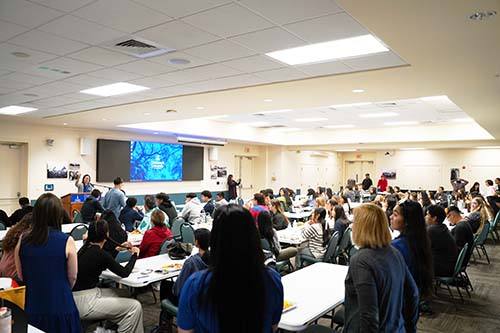
“It’s my dream school,” said Harper, during Chaminade’s inaugural Early College Summit, which was attended by a mix of 70 students from Kapaa High School, Sacred Hearts Academy and Saint Louis. “Participating in this program has really prepared me for college.”

Largusa echoed the same sentiment, adding that she expects to hear from Syracuse University soon. “When I took the virtual campus tour I fell in love with it,” says the first generation, soon- to-be-college student. “This program has given me confidence in knowing that I can handle the demand of college courses.”

Early college programs can provide several benefits, including the opportunity for students to accelerate their education, which can lead to the completion of college degrees at an earlier age. There’s also the perk of cost savings, reducing tuition costs for future higher education.

Sacred Hearts Academy counselors Ashley Luke and Sharlene Chock both agreed that Chaminade’s early college program will help students become familiar with the expectations and rigor of college-level coursework, easing their transition to full-time college later on.

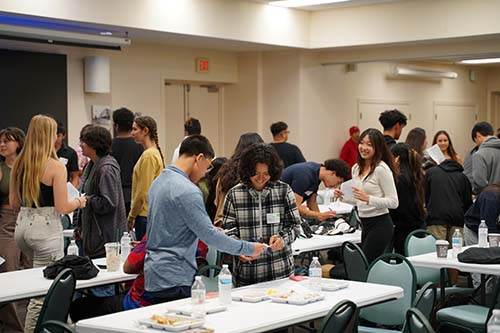
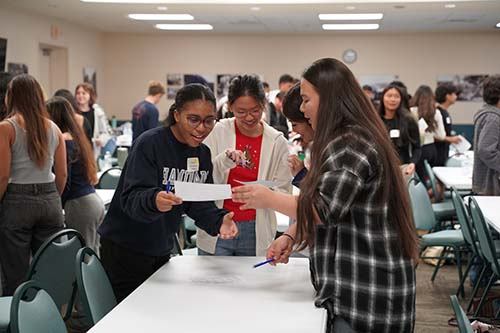
Students circled the room to fill out their bingo-like cards.
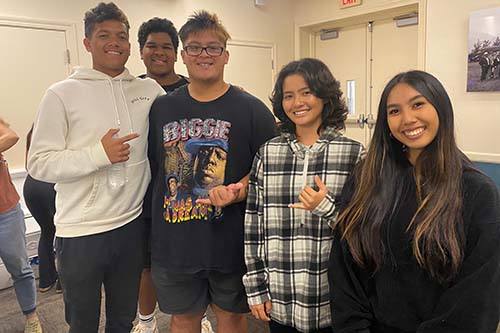
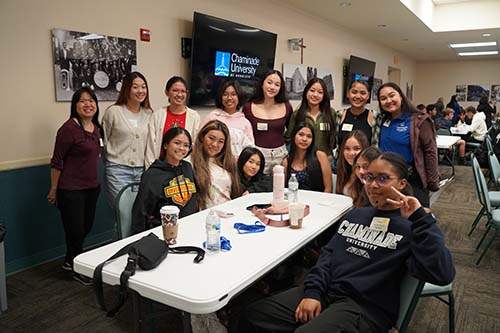
Saint Louis and Kapaa High School students mingled during the Early College Summit.
Sacred Hearts Academy students played a bingo-like game, with the first one to fill all 25 boxes with the right answers winning the grand prize.
Chaminade’s Early College Director, Kim Baxter, addressed the students at the T.C. Ching Conference Center in Eiben Hall before they set off to visit other campus locations.
Sacred Hearts Academy juniors completed their first semester of college courses.

“Some struggled initially with the transition because of the extra studies involved in taking college-level courses,” said Luke, who counsels 10th and 11th graders. “Even our top students were stretched because they didn’t understand process versus perfection, which they’re used to achieving in high school.”

With this first cohort of 17 Lancers, Chock believes the college exposure will help them navigate the waters of post-secondary education. “They have already been individually challenged,” said the 12th grade counselor. “I think the experience shows them that college is attainable.”

Saint Louis School students Landon Dimaya, Cash Acorda and Kevin Simmons will begin their college courses next semester. The three Crusaders cited different reasons for participating in the program. Dimaya is a fraternal twin whose sister Lindsey is already a Sacred Hearts Academy participant. “I want to reduce the financial burden on my parents,” he said. “It would be really expensive to have to pay tuition for me and my sister at the same time.”

“I want to get ahead,” offered Acorda, who plans to apply to Stanford, with Simmons further noting that the experience would look good on his application.

Research demonstrates that early college programs show strong and lasting evidence of effectiveness for all students. It promotes both post-secondary access and success. The data is undeniable that students who participate in such programs will be ahead of their peers and graduate from a four-year university either debt-free or with very little federal student loan debt. The latest data further supports the claim that students who participate in these programs are better prepared to transfer to a four-year university than students who attend the university without prior college experience. 

Moreover, encouraging students to attend college improves individuals’ earnings over a career, increases the amount of taxes the government collects, and reduces government spending on federal assistance programs. 

“This program is such a great opportunity for these high school students to earn dual credits,” said Kim Baxter, Chaminade’s Early College Director. “And it gives them that real college experience.”

Posted by: University Communications & Marketing Filed Under: Campus and Community, Catholic, Diversity and Inclusion, Early College, Featured Story, Innovation, Institutional Tagged With: Campus Event, Early College Experience

Cybersecurity Workshop

December 8, 2023

Expert warns of maintaining healthy online hygiene

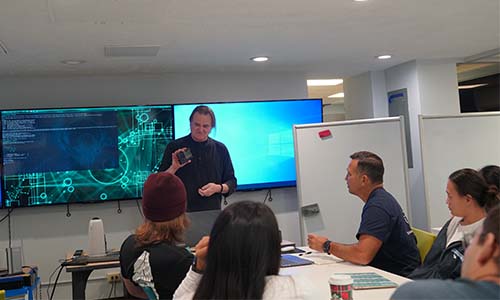
Similar to what you would hear at a dentist office, Liam Wesley dispensed advice about the importance of daily hygiene during a Cybersecurity Workshop at the Data Science Center in Tredtin Hall. But for the cybersecurity expert, this means never using the same username nor the same password ever! Just like you would never keep using the same strand of floss.

In an era dominated by digitization, Wesley described the importance of robust cybersecurity measures that cannot be overstated. As online users navigate an increasingly interconnected world, the guardians of our digital realm are facing new challenges and adapting strategies to protect against evolving cyber threats. Wesley is among them fighting the digital perils.

The 90-minute Cybersecurity Workshop was hosted by the National Science Foundation ALL-SPICE Alliance, which includes the United Nations CIFAL CENTER of Honolulu, Information Technology and Services Department (senior director Jules Sukhabut), the Networking Department (director Joseph Rosario), Data Science, Analytics and Visualization Program (director Rylan Chong, Ph.D.) and the Computer Science Department.

Liam Wesley—a penetration tester and cybersecurity engineer with High Tech Hui, LLC and Cyberruptive—demonstrated some of the tools that professional hackers keep in their arsenal.

“We brought in Liam to demonstrate real cyberattacks, and discuss how a student can protect themselves for educational purposes and build awareness,” said Chong, Co-Principal Investigator of the National Science Foundation’s Alliance Supporting Pacific Impact through Computational Excellence (ALL-SPICE) grant. “Joe and I plan to pilot this cybersecurity workshop to Natural Sciences and Mathematics students to gauge interest. This will help us understand if there is interest for future workshops, larger workshops and/or a need for a cybersecurity course or program.”

Cybersecurity experts, like Wesley—a penetration tester and cybersecurity engineer with High Tech Hui, LLC and Cyberruptive—warn of the escalating sophistication of cyber threats, ranging from ransomware attacks that cripple essential services to targeted phishing campaigns exploiting the remote work landscape. The proliferation of Internet of Things (IoT) devices—AI voice assistants like the Amazon Echo and Google Home—coupled with the rise of artificial intelligence in cyberattacks, adds a layer of complexity to the battlefield.

In the face of these evolving threats, organizations are doubling down on best practices to fortify their defenses. This includes regular employee training to recognize and thwart phishing attempts, implementing multi-factor authentication, and keeping software and systems up-to-date with the latest security patches.

“Patching is absolutely necessary,” Wesley said. “But wait a few days to avoid the potential for buffer overflow, which are memory storage regions that temporarily hold data while it is being transferred from one location to another.”

Initially limited to Rosario’s computer science networking class, the workshop was eventually opened to all Natural Sciences and Mathematics students due to the importance of the topic and the large interest from Chong’s previous presentation on the topic.

One of the workshop’s primary goals was to bring awareness and introduce education innovation. Chong explained that the topic is very important for the University’s DSAV, CS and NSM students, as many of them are doing research, working with data and sensitive data at various organizations for jobs and internships, and using computers.

“Instead of traditionally just bringing in someone to talk about cybersecurity in general, our goal was to make this relevant to the students to build awareness, address on the national security level the lack of cybersecurity education in schools, and an approach to work on better securing our campus,” Chong said. “In addition, we are planning to take an innovative educational approach by actually demonstrating how easy it is to hack and simulate how bad a cyberattack can be to an organization.”

The landscape of cybersecurity is indeed dynamic and ever-evolving. Experts agree that a collaborative, proactive approach—comprising technological innovation, regulatory compliance and ongoing education—is essential to safeguarding our digital world against the relentless tide of cyber threats.

“There was a lot of information, which was hard to keep up with,” said data science and visualization major LaVelle White ’26. “He explained pretty well how hackers get into systems, even though I can’t hack, but I understood the concept.”

Posted by: University Communications & Marketing Filed Under: Campus and Community, Center for Strategy and Innovation, CIFAL Honolulu, Homepage, Innovation, Institutional, Natural Sciences & Mathematics Tagged With: Campus Event, Data Analysis & Visualization, Data Science, Guest Speakers

Ocean Science

November 20, 2023

Professor Sean Chamberlin credits Chaminade for lifetime experience

Dr. Sean Chamberlin has treasured his Chaminade acceptance letter to a science program that he received 50 years ago.

Akin to someone cherishing a handwritten love letter for a lifetime, Sean Chamberlin, Ph.D., covets a Chaminade acceptance letter he received more than 50 years ago. He even kept the envelope it came in. Five decades ago, the Florida native had applied to then-Chaminade College’s Science Training Program (STP) for high school students. The experience would forever change his life.

As an aspiring oceanographer, Chamberlin was among 36 students from across the nation who were invited to participate in the six-week program. To this day, he can vividly recall falling in “love with Chaminade University in May 1973,” the month he received his acceptance letter from Dr. Ruth Haines, Chaminade College’s then-STP project director. 

“I was 17 years old and I had never been away from home by myself,” exclaimed Chamberlin, during a phone interview. “Now I was going to Hawaii for six weeks—by myself! Chaminade made that happen. The school even paid for most of my room and board, which was about $60 per week in those days. Needless to say, I was super stoked.”

He has never forgotten the experience and the mentorship he received from Dr. Ron Iwamoto, biology professor emeritus with Chaminade. At the time, Chamberlin admitted he was carefree, staying up late at nights, coming to class barefooted, hanging with college students who were living on the top floor of the dorm and having his first pizza with pineapple at St. Louis Drive In.

“Despite my shenanigans, Dr. Iwamoto took me under his wing,” said Chamberlin, citing Iwamoto as one of the most influential people in his life. “Students in the program were required to carry out a research project as part of their studies. I didn’t realize it at the time, but Dr. Iwamoto devised a project for me that would require lots of energy, and would take me as far away as possible from the other students.”

Iwamoto’s strategy paid off.

The research project involved building an artificial reef in a bay where Iwamoto liked to fish. Like a MacGyver, Chamberlin creatively improvised by filling a few old tires with bricks and hauling them out to a channel between the reefs. Every day, he swam out to the spot and made frequent observations of the organisms that came to live there.

“I remember screaming through my snorkel when I saw the first fish inhabitants,” Chamberlin said. “The project didn’t amount to much scientifically, but it meant everything to me personally. I fell in love with field work, a passion that would propel my career as an ocean scientist for the next several decades.”

Dr. Sean Chamberlin received a lei upon his arrival on Oahu.

Chamberlin is careful in choosing his words to describe the courses he teaches in the Department of Earth Sciences at Fullerton College. He substitutes ocean science for the term oceanography, the scientific nomenclature more commonly used among scientists who study the properties (temperature, density, etc.) and movement (waves, currents, and tides) of seawater and the interaction between the ocean and the atmosphere. He also prefers to use the term weather and climate science to describe meteorology.

“Some students get intimidated about science because they may not have been exposed to it at a younger age,” Chamberlin explained. “Personally, I was always fascinated with science and living in Florida, I was exposed to the space program at an early age. I could see rockets go over my head in my own backyard. However, my parents weren’t too keen on me becoming an astronaut, but when I was 10 years old I learned about Scott Carpenter, an astronaut who became an aquanaut, and that was OK with them.”

After attending Chaminade’s STP, Chamberlin followed his passion and attended the University of Washington, a national leader in oceanographic research and education. Four of his peers in the Chaminade summer program also decided to enroll at UW.

At UW,  the aspiring scientist landed opportunities as a work-study student to carry out undergraduate research. By his junior year, he was regularly sailing aboard oceanographic vessels in the North Pacific. After graduating with bachelor’s degrees in oceanography and English, Chamberlin decided to attend graduate school at the University of Southern California.

He pursued his research aboard Jacques Cousteau’s Calypso in Tahiti, where he tested a new optical tool for measuring how fast ocean plants grow. He has also been to the Arctic where he sailed with Norwegian oceanographers in the Barents Sea. In 1988, Chamberlin spent five weeks aboard a polar research vessel in the Antarctic. He even got to walk on the sea ice in the Weddell Sea. His postdoctoral research with Lamont-Doherty Earth Observatory in Palisades, New York, led him to Iceland, the Azores and Portugal on research expeditions in the North Atlantic.

Dr. Sean Chamberlin still enjoys conducting field research.

“All of these paths originated from Chaminade,” Chamberlin said. “My experiences on a reef in a Hawaiian bay—thanks to Dr. Iwamoto—inspired me to pursue field science. “Perhaps because of that experience, my textbooks—“Exploring the World Ocean” (Chamberlin and Dickey 2008) and “Our World Ocean” (Chamberlin, Shaw, and Rich 2023)—draw from Hawaii’s countless examples of ocean features, processes and scientific achievements.”

But this story isn’t really about Chamberlin, it’s about the thousands of young people who have benefitted from his experiences at Chaminade. Although, he is not Hawaiian, he gained a profound respect for the  Hawaiian culture and its people, thanks to Chaminade. 

A few years ago, Chamberlin read a post on Chaminade’s Facebook page about the Ron Iwamoto Teaching Fellowship in Biology, which brought back fond memories for him—especially of Dr. Iwamoto and the once-in-a-lifetime opportunity afforded to him by Chaminade. 

“I smile when I think of how Dr. Iwamoto and Chaminade shaped my life as a young man,” Chamberlin said. “My choice of colleges, my pursuit of oceangoing research, my respect for diverse people and their cultures, and my love for Hawaii are rooted in my experiences under his mentorship. As an ocean educator, writer and scientist, I can only hope that my contributions are a fraction as impactful as Dr. Iwamoto’s were on me.  After all, it only takes a few bricks, a tire and a passion for life to make a beautiful reef.”

Posted by: University Communications & Marketing Filed Under: Campus and Community, Diversity and Inclusion, Faculty, Featured Story, Innovation, Natural Sciences & Mathematics, Undergraduate Research & Pre-Professional Programs

Student Research Project

November 17, 2023

Pam Oda presents her research findings in Texas

It’s just the beginning stages of her research, but Pam Oda ’24 has already presented her preliminary findings at the Society for Police and Criminal Psychology (SPCP) in Arlington, Texas, thanks to monies from the Alliance Supporting Pacific Impact through Computational Excellence (ALL-SPICE) grant. Standing in front of her presentation board, Oda explained the importance of education in the law enforcement field, which has long been debated. While many agencies have historically required little to no college coursework for entry-level positions, research suggests a positive correlation between education and job performance at all levels of law enforcement.

With the mentorship and encouragement of Dr. Kelly Treece, Criminology and Criminal Justice director and associate professor, Oda’s study evaluated disciplinary actions taken against Honolulu Police Department officers. With access to open records, Oda was able to obtain the types of allegations of police misconduct, which are divided into four sections: administrative investigation, criminal investigation, quality assurance and accreditation.

“Most of the violations were for administrative reasons,” said Treece, a former sergeant and trainer with the Pewaukee Police Department in Wisconsin. “Pam did a really good job with her presentation, and she handled herself very well in front of a lot of professionals.”

Pam Oda stands next to her poster board in Arlington, Texas.

The recent calls for police reform—combined with mounting evidence that an educated police force can have positive effects—have sparked a nationwide conversation about raising education requirements for police officers.

“Currently, the minimum qualification to become an HPD officer only requires having a high school diploma or your GED,” Oda said. “I think we need to raise that standard in Hawaii.”

In her presentation, Oda noted that 51.25 percent of officers received a High School Diploma or GED, 27.5 percent held a bachelor’s degree and 15 percent have received their associate’s degree or completed 60 semester credits or more. The numbers are consistent with national statistics, which show that only one percent of local police departments across the U.S. require their officers to hold four-year degrees and only eight percent call for officers to have attended any college at all.

Oda further noted that early research indicates that there is a broad performance difference between officers who have a college education and those who do not.

Citing a paper written by S.M. Smith and M.G. Aamodt (1997) in the Journal of Police and Criminal Psychology, the co-authors found that police officers who possess college degrees are better performers than those with only high school degrees, including overall performance, communication skills and decision-making ability. 

According to Oda, this type of research has been ongoing yet most departments are not implementing these findings into policy and practice. In addition, in a study conducted by the Police Executive Research Forum (2019), officers with a four-year college degree had significantly fewer civilian complaints than those with only a high school diploma. 

Oda also pointed out that research shows higher education has significant benefits for law enforcement officers, including the ability to navigate the complexities of modern-day policing, which consists of critical analysis, enhanced communication abilities and a comprehensive understanding of the criminal justice system (S. Christopher, 2015, in Policing: A Journal of Police and Practice). 

Now in her fifth year at Chaminade, Oda will complete a double major in Criminology and Criminal Justice and Data Science, Analytics and Visualization with minors in Computer Information Systems and Psychology in December. The Hilo native hopes to continue her research with Treece at Chaminade while pursuing her graduate degree in Criminal Justice.

“That’s the plan right now,” said Oda, who serves as the president for the Chaminade Student Government Association, as well as the president of the Restauranteers Club. “Since starting in fall 2019, I have taken advantage of the countless opportunities that Chaminade has to offer, from student clubs and organizations to research and internship opportunities to student employment and the ‘ohana spirit.”

Treece, too, plans to expand the research to include the Sheriff Division of the Hawaii Department of Public Safety, which will then include statewide statistics and a broader representation. By doing so, she and Oda will be able to capture a more robust picture of the correlation between education and law enforcement.

“The next step is to write a paper, which I’ve asked Pam to help me co-author,” Treece said. “She’s a little hesitant and nervous about it, just like she was when I first approached her about presenting in Texas. I think she’ll do great.”

Posted by: University Communications & Marketing Filed Under: Behavioral Sciences, Diversity and Inclusion, Featured Story, Innovation, Student Life Tagged With: Criminology and Criminal Justice, Master of Science in Criminal Justice Administration

Yin and Yang

October 23, 2023

Thirty years later, two middle school besties will graduate in ’24

The last time they graduated was in 1994 from Mililani High School. And when May 2024 comes around, Rita Aponte ’24 and KerryLynn Vea ’24 will again don their caps and gowns, as they prepare to cross the stage of the Waikiki Shell to receive their bachelor’s degrees.  

BFFs since high school, Aponte and Vea were able to pursue their university degrees, thanks to Bank of Hawaii’s College Assistance Program (CAP), which allows its employees to get back on the path to obtaining their first four-year undergraduate degree with tuition reimbursement.  

Draped with lei, Rita Aponte, left, and KerryLynn Vea posed for their graduation photo from Mililani High School in 1994.

“The Bank started this program in 2016, and I started the following year,” says Aponte, Manager of Loan Operations with Bank of Hawaii. “And my bestie, KerryLynn, is also on this journey with me since we both always wanted to get our degrees.”  

Both Aponte and Vea chose to start their families at a young age, hindering them from attending college. The two friends since middle school always had plans to return to university, but family obligations and full-time jobs prevented them from entering the college system.

“I get emotional when I talk about CAP,” says Vea, who was in the credit union industry for 20 years before joining Bank of Hawaii in 2016 and is now its Assistant Vice President-Mortgage Compliance Analyst. “Before CAP, I was resigned not to get my college degree, rationalizing to myself, ‘Oh well, I don’t need a degree since I already have a career.’”  

The American Council of Education estimates that approximately 20 percent of graduate students and six percent of the much larger number of undergraduates receive some financial assistance from their employers to attend school. As many as a third of undergraduates in fields like business and engineering also receive tuition aid, which, on average, covers about one-third of the annual cost paid by post-secondary students.  

Initially, when Aponte and Vea enrolled in Bank of Hawaii’s CAP initiative, they were limited to four specific start times a year (January, April, July and October). Today, new applicants have the flexibility to enroll for courses on a monthly basis throughout the year, which is consistent with Chaminade’s online Flex program.  

“I’ve worked at credit unions where tuition assistance was always included in the employee manual book, but I never once saw it used,” Vea says. “Bank of Hawaii, on the other hand, vigorously promotes CAP and they champion it, putting funding behind it with no strings attached. The program is a 100 percent benefit to all employees.”  

Bank of Hawaii’s executives said they needed a partner that understood the Bank’s vision of what they wanted to achieve with its CAP program. However, they also wanted to make sure that the online learning experience was customized to the specific needs of the Bank’s employees since they wanted CAP to be “a real pillar and cornerstone of what Bank of Hawaii is all about.”

“We thought it was not only important to train our employees in specific banking-related issues, but also to help them expand their overall educational base,” says Peter Ho, Bank of Hawaii’s Chairman, President and Chief Executive Officer, in a video release. “From an education standpoint, the important thing is to really help shape the individual’s mind and spirit—and that’s what education is all about; that’s what college is all about.”  

Although, Aponte and Vea didn’t experience the traditional campus setting, they were able to take their classes online, via Chaminade’s Flex program model, allowing students to take one or two courses at a time—or more if they choose—as they work toward their degree. And the pace of coursework rests with them. They can complete online courses in as few as six weeks. Or, they can take their time, wrapping up a course in six months. Flex students are also able to complete courses wherever they are, even on the go.  

“It was a real struggle during the holiday season,” Aponte recalls. “Even when we went on vacation to Disney World, algebra came along with me.”  

KerryLynn Vea takes a break from her studies with her new son.
KerryLynn Vea takes a break from her studies with her six-week old granddaughter Ellie in 2018.

The Flex Online Undergraduate program is WSCUC-accredited (WASC Senior College and University Commission) and has a broad range of study disciplines, including business administration, criminology and criminal justice, historical and political studies, education and psychology. It is designed with working adults in mind, distancing itself from rigid term schedules and due dates to give students the flexibility they need to achieve a work-life-school balance and make progress toward reaching their goals.  

“I started at Leeward Community College for a semester and a half, but scheduling was really difficult,” Vea says. “I just couldn’t do it all with a full-time job, a family and attending classes; it was a lot.”  

Nor could Aponte.

“I didn’t think a college degree was in the books for me,” Aponte asserts. “It was always nagging at me to get my bachelor’s, but I used time and cost as excuses not to pursue it. And now I’m motivated to finish this and I can’t wait.”  

Thirty years will have elapsed by the time Aponte and Vea attain their bachelor’s degree, and through the three decades, they’ve raised families, enjoyed successful careers and supported each other through both good times and bad.  

“Getting the bachelor’s degree with Rita couldn’t get any better,” Vea says. “I always say I’m the Yin because I’m more subdued and quieter, and she’s the Yang because she’s more outgoing and vocal. We might be opposites, but through this college process, we’ve depended on each other and have been each other’s greatest cheerleader.”      

Posted by: University Communications & Marketing Filed Under: Business & Communication, Diversity and Inclusion, Featured Story, Innovation, Institutional, Student Life Tagged With: Business Administration, Financial Aid, Scholarship

Online Education

October 16, 2023

Angie Cabreira enrolls in Flex to become an ECE teacher

As a 17-year-old senior in high school, Angela “Angie” Cabreira ’16 started to panic whenever she was asked about her college plans. Admittedly, she didn’t have any. So rather than attend university, she decided instead to move from Idaho to Molokai to be with her sister, the late Julie Marie Pierson Place.

“Two years later, in 1988, I relocated to Hilo on the Big Island where I have lived ever since,” said Cabreira during a phone interview. “All I wanted at that time was to get married, have 12 kids, bake, garden and take care of all the neighbors’ kids.”  

Dreams of obtaining a bachelor’s degree quickly faded, and Cabreira became more impassioned about motherhood, eventually having three of her own kids and raising a hānai daughter, now between ages 22 and 38. She deliberately chose to be a stay-at-home mom “for a long time,” raising her keiki and establishing a childcare service for local families.

“I love being around kids,” Cabreira said. “So I got a job at Waiakea Elementary School, where I worked for 13 years, mostly as a student activity coordinator and for a few years I was with the Parent-Community Networking Center.”

Cabreira, though, wanted more. She began taking early childhood education (ECE) classes at Hawaii Community College while serving as a teaching assistant with Keiki Steps. She then started a new full-time position with Tūtū and Me, and continued to take ECE classes at Hawaii Community College while now also taking online courses at Chaminade University to obtain her Associate in Science (AS) degree in ECE.

“When I began working full time for Kamehameha Preschools in 2015, I transferred to Chaminade’s online program so that I would have the ability to work full time and still go to school,” Cabreira recalled. “This was not an option at Hawaii Community College since they didn’t offer evening classes nor online classes for the degree I was seeking. Chaminade was ideal because I didn’t have to be in a classroom at a certain time and that was what I needed.”

Angie and Albert Cabreira pose for a selfie.
Laura is one of two Cabreira daughters.
A hānai daughter, Laura Tanaka is the eldest of Angie Cabreira’s kids.
Dustin is one of three kids.
Dustin Toma is 32 years old.
Nichelle is the youngest Cabreira daughter.
Nichelle Toma is Angie Cabreira’s youngest birth daughter.
Trevor is the youngest Cabreira son.
Trevor is the youngest Toma son.

When Cabreira entered college in 2011, online courses and degrees were just beginning to gain popularity and become viable options for working adults. Today, advancements in technology, course design and high-speed internet availability are moving online learning forward.  

Chaminade’s Flex Online Undergraduate program is WSCUC-accredited (WASC Senior College and University Commission) and has a broad range of study disciplines, including business administration, criminology and criminal justice, historical and political studies, education and psychology. It is designed with working adults in mind, distancing itself from rigid term schedules and due dates to give students the flexibility they need to achieve a work-life-school balance and make progress toward reaching their goals.  

“I love the Flex program because there are no deadlines,” Cabreira said. “It’s the reason I decided to pursue my bachelor’s degree at Chaminade.”  

In fall 2022, Cabreira enrolled in the University’s early Early Childhood Education bachelor’s program, which is aligned with state requirements and National Association for the Education of Young Children standards, and was ranked by Best Colleges as #8 Best Online Early Childhood Education Programs of 2023.  

“I want to be a positive voice for kids and parents,” Cabreira said. “I thought I was satisfied supporting teachers and families. But if I could be a lead kumu, I could make more of an impact.”  

As she started the program, her sister, Julie, was diagnosed with a blockage in an artery that supplied blood and oxygen to her intestines. Treatment included 11 surgeries, but it was too late. Her intestines had shut down.

“When she passed, I was sad, depressed and unmotivated to do my homework,” Cabreira said. “During this time, Bro. Allen Pacquing encouraged me to keep going, and gave me time to grieve. All my other professors didn’t give up on me, either, and I knew that my sister would not have wanted me to quit.”  

This past September, Cabreira took a single course. In October, she enrolled in four courses. And in February 2024, she will take another four classes. By July, she hopes to be doing her practicum. However, because of her age, she can’t simply skim readings like her younger peers, and she has to watch every assigned video.  

“It takes me longer,” admitted Cabreira, 57. “I want to pass with all As, but my daughter—who earned a BA in Psychology from UC Irvine—reminds me that Bs also get degrees.”  

Cabreira may not have been able to birth 12 kids, but now she has 20—in her classroom.  

“I can’t be a lead kumu without my bachelors degree, and that’s the goal,” Cabreira said. “The plan is to graduate in January 2025. Yes, it will take a very long time, but I’m determined.”        

Posted by: University Communications & Marketing Filed Under: Alumni, Education, Featured Story, Innovation, Institutional Tagged With: Center for Teaching and Learning, Early Education

  • « Go to Previous Page
  • Page 1
  • Interim pages omitted …
  • Page 3
  • Page 4
  • Page 5
  • Page 6
  • Page 7
  • Interim pages omitted …
  • Page 12
  • Go to Next Page »

Footer

Chaminade University Logo

3140 Waialae Avenue
Honolulu, Hawaii 96816

Contact Us
Phone: (808) 735-4711
Toll-free: (800) 735-3733

facebook twitter instagram youtube linkedin

Visit

  • Plan Your Visit
  • Campus Map (PDF)
  • Events

Resources

  • Campus Security
  • Student Consumer Information
  • Concerns, Feedback, and Reporting
  • Institutional Review Board
  • Title IX / Nondiscrimination Policy
  • Compliance
  • Emergency Information
  • Careers
  • Institutional Statement

People

  • Students
  • Parents
  • Alumni
  • Faculty & Staff

Policy

  • Privacy Policy
  • Terms and Conditions of Use


© Chaminade University of Honolulu