• Skip to primary navigation
  • Skip to main content
  • Skip to footer
Chaminade University of Honolulu

Chaminade University of Honolulu

  • VISIT
  • APPLY
  • GIVE
  • STUDENTS
  • PARENTS
  • ALUMNI
  • FACULTY/STAFF
  • Admissions
    • Admissions Home
    • Undergraduate Students
      • First-Year Students
      • Transfer Students
      • Admitted Students
    • Graduate Students
    • Flex Online Undergraduate Program
    • Military Students
    • Non-Degree/Visiting Students
    • Experiential Honors Program
    • Early College Program
    • New Student Orientation
  • Tuition & Aid
    • Financial Aid Home
    • Tuition & Expenses
    • Federal Updates & Changes
    • Scholarships
    • $5,000 Graduate Scholarship
    • VA Education Benefits
    • Net Price Calculator
  • Academics
    • Academics Home
    • Academic Programs
    • Office of Student Success
      • Academic Advising
      • Records and Registrar
    • Kōkua ʻIke (Support Services)
      • ADA Accommodations
      • Career Services
      • Proctoring Services
      • Tutoring Services
    • Sullivan Family Library
    • Undergraduate Research & Pre-Professional Programs
    • Commencement
  • Campus Life
    • About Campus Life
    • Student Engagement
    • Student Government Association
    • Residence Life and Housing
      • Summer Conference Housing
    • Health Services
    • Marianist Leadership Center
    • Counseling Center
    • Campus Ministry
    • Campus Security
    • Dining Services
    • Bookstore
  • Athletics
  • About
    • Chaminade University News
    • Our Story
    • Leadership
    • Chaminade University Strategic Plan 2024-2030
    • Mission & Rector
    • Association of Marianist Universities
    • Facts & Rankings
    • CIFAL Honolulu
    • Accreditation & Memberships
    • Montessori Laboratory School
Search
×

Search this web site

Innovation

Online Education

October 16, 2023

Angie Cabreira enrolls in Flex to become an ECE teacher

As a 17-year-old senior in high school, Angela “Angie” Cabreira ’16 started to panic whenever she was asked about her college plans. Admittedly, she didn’t have any. So rather than attend university, she decided instead to move from Idaho to Molokai to be with her sister, the late Julie Marie Pierson Place.

“Two years later, in 1988, I relocated to Hilo on the Big Island where I have lived ever since,” said Cabreira during a phone interview. “All I wanted at that time was to get married, have 12 kids, bake, garden and take care of all the neighbors’ kids.”  

Dreams of obtaining a bachelor’s degree quickly faded, and Cabreira became more impassioned about motherhood, eventually having three of her own kids and raising a hānai daughter, now between ages 22 and 38. She deliberately chose to be a stay-at-home mom “for a long time,” raising her keiki and establishing a childcare service for local families.

“I love being around kids,” Cabreira said. “So I got a job at Waiakea Elementary School, where I worked for 13 years, mostly as a student activity coordinator and for a few years I was with the Parent-Community Networking Center.”

Cabreira, though, wanted more. She began taking early childhood education (ECE) classes at Hawaii Community College while serving as a teaching assistant with Keiki Steps. She then started a new full-time position with Tūtū and Me, and continued to take ECE classes at Hawaii Community College while now also taking online courses at Chaminade University to obtain her Associate in Science (AS) degree in ECE.

“When I began working full time for Kamehameha Preschools in 2015, I transferred to Chaminade’s online program so that I would have the ability to work full time and still go to school,” Cabreira recalled. “This was not an option at Hawaii Community College since they didn’t offer evening classes nor online classes for the degree I was seeking. Chaminade was ideal because I didn’t have to be in a classroom at a certain time and that was what I needed.”

Angie and Albert Cabreira pose for a selfie.
Laura is one of two Cabreira daughters.
A hānai daughter, Laura Tanaka is the eldest of Angie Cabreira’s kids.
Dustin is one of three kids.
Dustin Toma is 32 years old.
Nichelle is the youngest Cabreira daughter.
Nichelle Toma is Angie Cabreira’s youngest birth daughter.
Trevor is the youngest Cabreira son.
Trevor is the youngest Toma son.

When Cabreira entered college in 2011, online courses and degrees were just beginning to gain popularity and become viable options for working adults. Today, advancements in technology, course design and high-speed internet availability are moving online learning forward.  

Chaminade’s Flex Online Undergraduate program is WSCUC-accredited (WASC Senior College and University Commission) and has a broad range of study disciplines, including business administration, criminology and criminal justice, historical and political studies, education and psychology. It is designed with working adults in mind, distancing itself from rigid term schedules and due dates to give students the flexibility they need to achieve a work-life-school balance and make progress toward reaching their goals.  

“I love the Flex program because there are no deadlines,” Cabreira said. “It’s the reason I decided to pursue my bachelor’s degree at Chaminade.”  

In fall 2022, Cabreira enrolled in the University’s early Early Childhood Education bachelor’s program, which is aligned with state requirements and National Association for the Education of Young Children standards, and was ranked by Best Colleges as #8 Best Online Early Childhood Education Programs of 2023.  

“I want to be a positive voice for kids and parents,” Cabreira said. “I thought I was satisfied supporting teachers and families. But if I could be a lead kumu, I could make more of an impact.”  

As she started the program, her sister, Julie, was diagnosed with a blockage in an artery that supplied blood and oxygen to her intestines. Treatment included 11 surgeries, but it was too late. Her intestines had shut down.

“When she passed, I was sad, depressed and unmotivated to do my homework,” Cabreira said. “During this time, Bro. Allen Pacquing encouraged me to keep going, and gave me time to grieve. All my other professors didn’t give up on me, either, and I knew that my sister would not have wanted me to quit.”  

This past September, Cabreira took a single course. In October, she enrolled in four courses. And in February 2024, she will take another four classes. By July, she hopes to be doing her practicum. However, because of her age, she can’t simply skim readings like her younger peers, and she has to watch every assigned video.  

“It takes me longer,” admitted Cabreira, 57. “I want to pass with all As, but my daughter—who earned a BA in Psychology from UC Irvine—reminds me that Bs also get degrees.”  

Cabreira may not have been able to birth 12 kids, but now she has 20—in her classroom.  

“I can’t be a lead kumu without my bachelors degree, and that’s the goal,” Cabreira said. “The plan is to graduate in January 2025. Yes, it will take a very long time, but I’m determined.”        

Posted by: University Communications & Marketing Filed Under: Alumni, Education, Featured Story, Innovation, Institutional Tagged With: Center for Teaching and Learning, Early Education

‘Inana Innovators Program

October 13, 2023

Chaminade students participate in sustainability entrepreneurship

Madison Makishima ’25 was able to make adaptive surfboards out of recyclable materials and ocean plastics so people —like her—with disabilities could have access to the ocean. As part of Chaminade University’s ‘Inana Sustainability Entrepreneurship Program, Makishima and eight other fellow students, including Aleeyah Lemons ’24 and Carly Wieczorek ’24, were able to participate in a 10-week summer program that paired them with businesses that align with the United Nation’s Sustainable Development Goals (SDGs).  

“I learned a lot, especially how to effectively network,” said Makishima, whose project was titled Surf Sesh. “The mission of the project—which aligns with the UN’s SDGs—was to help people with disabilities gain access to surfing while recycling and reusing ocean plastic, and educating everyone about living sustainable lives.”  

After winning a two-year $600,000 Minority Colleges and Universities Grant Competition from the U.S. Department of Commerce’s Minority Business Development Agency (MBDA), a hui of Chaminade professors developed the ‘Inana Sustainability Entrepreneurship Program, which aims to spark minority entrepreneurial innovation among Hawaii-Pacific undergraduates.

According to ‘Inana Sustainability Entrepreneurship Program’s coordinator, Mariane Uehara, the  three goals of the program are: 1) To develop and implement programs for the education and training of undergraduate students in subjects directly relating to successful entrepreneurship; 2) To support minority business enterprises (MBEs), including building a diverse entrepreneurial pipeline to grow the number of MBEs; and 3) to create a UN Certificate program in sustainability entrepreneurship.  

With the help of Rhea Jose, outreach coordinator for CIFAL Honolulu at Chaminade, Aleeyah Lemons ’24 pursued a project titled “Gender Equity through Malama Mai” or, cleverly, GEMM, and provided menstrual products in the women’s restrooms at Chaminade University.  

“GEMM is a program developed to provide resources, care and education on menstrual health to those at Chaminade University, its surrounding community and across the Pacific,” wrote Lemons in her final report. “We aim to end period poverty on campus, and allow our students who menstruate to feel comfortable and supported by GEMM and their peers.”  

Meanwhile, Carly Wieczorek ’24 designed a sustainable rooftop hydroponics system. “One major aspect of my activities was actively participating in exchanging ideas with local experts on hydroponics farming, visiting hydroponics farms on Oahu, and entrepreneurial skill workshops with industry professionals,” Wieczorek noted. “I’ve also been investigating innovative business approaches to urban agriculture, such as rooftop hydroponics, and examining how these practices align with the UN’s SDGs.”  

The focus of the ‘Inana program is to nurture sustainability entrepreneurs in Hawaii, who will develop businesses that diversify and grow our economy while attending to the health of the planet. This, of course, is consistent with Chaminade’s United Nations CIFAL Center, which is focused on supporting progress toward the UN’s 17 SDGs in Hawai‘i and the Pacific region.  

Three of the 17 SDGs in particular are addressed within the program: Promote sustained, inclusive and sustainable economic growth, full and productive employment and decent work for all; build resilient infrastructure, promote inclusive and sustainable industrialization and foster innovation; and improve education, awareness-raising and human and institutional capacity on climate change mitigation, adaptation, impact reduction and early warning.  

“Our first cohort consisted of nine students,” said Uehara, a Certified Health and Wellness Coach and former co-founder and director of Lanikai Juice Co. “This second cohort will focus on App creation with eight students. It’s great to see students—who all come from different disciplines—collobarate and solve problems.”

Posted by: University Communications & Marketing Filed Under: CIFAL Honolulu, Featured Story, Innovation, Institutional, Students Tagged With: CIFAL, CIFAL Center, Grants

Andrew W. Mellon Foundation Grant  

October 6, 2023

New funding will help expand HEP Program

With support from a $750,000, three-year grant from the Andrew W. Mellon Foundation, Chaminade University of Honolulu will now be able to expand its Higher Education in Prison (HEP) program, which aims to be a pathway for participants to leave incarceration with new identities, perspectives and goals to help them thrive in society.  

“At Chaminade, one of our primary Marianist values is to advocate for social justice for transformative change,” said Chaminade President Lynn Babington, Ph.D. “We support a rehabilitation-through-education narrative, which we know is essential to incarcerated individuals finding a pathway to a second chance and a better future.”  

Chaminade’s current HEP program only serves males who are incarcerated at Halawa Correctional Facility. However, moving forward, the University plans to extend its cohort model HEP program to the Women’s Community Correctional Center (WCCC), as well as to those men serving time 3,000 miles from home at the Saguaro Prison in Arizona.  

The goal is to expand degree offerings, starting with the men in Halawa, to include an AA in Liberal Arts that can be extended to a BA in Interdisciplinary Studies. The coursework for the three degree programs will emphasize a humanities and liberal arts curriculum, and will be offered in a culturally responsive and trauma-informed way that will resonate with the overly-represented indigenous prison population.  

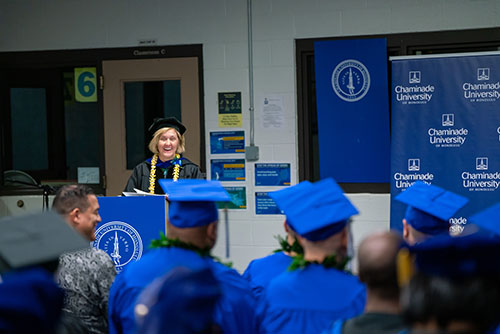
Dr. Janet Davidson addresses the new graduates during a Commencement Ceremony at Halawa Correctional Facility.

“If we want safer communities, if we want healthier families, if we want people who are incarcerated to have a chance when they come out, these are the types of rehabilitative programs we should be offering,” said Dr. Janet Davidson, Chaminade’s Vice Provost for Academic Affairs and a leader in criminology. “The idea is to shift the mindset. It will cost society less in the end.”  

Citing racial equity as a primary condition that makes HEP programs urgently necessary, the grant underscores the over-representation of Native Hawaiians in the criminal justice system. According to data collected by the Office of Hawaiian Affairs, Hawaii’s incarceration rate increased by 403 percent from 1978 to 2016, with Native Hawaiians affected disproportionately. Though accounting for only 18 percent of the state’s adult population, Native Hawaiians represent 37 percent of those incarcerated. This statistic includes Native Hawaiian women who make up 44 percent of the incarcerated women in Hawaii.  

While imprisoned women already have access to some college courses, they don’t have degree options. This Mellon grant will change this. “Since women are more likely than men to be the primary caretakers of dependent children prior to incarceration,” Davidson said, “their success after leaving prison will have a positive impact on their children and families, multiplying the effects of a single college degree.”  

Providing education in prison has indeed proven to reduce recidivism rates, and is associated with higher employment rates, which will improve public safety and allow individuals to return home to their communities and contribute to society. Moreover, a 2018 study from the RAND Corporation, funded by the Department of Justice, found that incarcerated individuals who participated in correctional education were 48 percent less likely to return to prison within three years than incarcerated individuals who did not participate in any correctional education programs. RAND also estimated that for every dollar invested in correctional education programs, four to five dollars are saved on three-year, re-incarceration costs.  

“The success of this pilot program—between Chaminade University of Honolulu and the Hawaii Department of Public Safety—demonstrates that partnerships can lead to transformative change,” Davidson said. “With the support and guidance of Chaminade’s distinguished faculty and support staff, and the cooperation and backing of Halawa Correctional Facility, these individuals have embraced the opportunity to redefine their futures. This program is part of Chaminade’s mission to educate for service, justice and peace. We hope that with their newly gained education, these students will have the skills needed to rebuild their lives upon reintegration into society.”        

Posted by: University Communications & Marketing Filed Under: Catholic, Diversity and Inclusion, Homepage, Innovation, Institutional Tagged With: Andrew W. Mellon Foundation Grant, Education in Prison, Transformation

Grant Expectations

October 5, 2023

Grant help via the Office of Sponsored Programs

Newly restructured and expanded, Chaminade’s Office of Sponsored Programs (OSP) will advance the university’s commitment through excellence in research administration, according to Claire Wright, Ph.D., who recently assumed the role of Senior Director with the Office of Sponsored Programs. It will also ensure that all grants are in compliance with federal, state and local regulations.  

Office of Sponsored Projects timeline

The Office’s primary and most visible mission is to serve the University community in the successful pursuit of external funds to support research and campus programs. Wright will  collaborate with faculty through every step of the pre-award process to submit highly competitive proposals.  

“The office helps faculty members finance the research and projects that they want to do,” said Wright, who completed all of her undergraduate and graduate training in the U.K., and joined the Chaminade faculty in 2011. “This a change for me from teaching, but I want to help faculty members realize their dreams.”  

Although she’ll continue with her teaching duties with the School of Natural Sciences and Mathematics, Chrystie Naeole, Ph.D., now has the added responsibility of being the Director of  Office of Sponsored Projects.  

“As a federal grants specialist, I’ve undergone extensive federal training to be able to assist grantees with the development, interpretation of federal language, and submission of these grant applications,” Naeole said. “I will also help with the execution of grant subcontracts, sub-awards and the management of grant-maintained studentships.”  

Lynn Haff, Director of Proposal Development and Andrew Perez, Grants Financial Specialist; and Helen Turner, Ph.D., Senior Advisor on Sponsored Projects make up the remaining OSP team. A private funding specialist, Haff helps to identify and match grant seekers with potential funding sources of all kinds. She also helps to craft ideas for proposals, editing and drafting of proposal narratives, and the gathering of additional materials for submission, including bio sketches and letters of support. If the proposal submission is from a private source, Haff will also help with the submission process and the reporting requirements during the award period.  

Office of Sponsored Programs support

Perez is a staff member of the Business Office with an abundance of experience in grants financial management for both private and federal grants. He helps grantees generate grant budgets for application submission, and assists with the management of all financial reporting and compliance issues.  

“I was hired by Chaminade to fill this specific role more than nine years ago,” Perez says. “There are lot of moving parts to a grant, and our role is to make sure that nothing is overlooked and that all the details are complete.”

Recruited by Chaminade because of her past successes in winning grants with the National Institutes of Health (NICHD) and local foundations, and her progressive translational research, Wright takes on this new role as the university develops its 2024-2029 Strategic Plan.  

“Grants can help determine what the vision is for the school,” Wright said. “I’m here to help them write their grants, whatever that grant may be. And it’s not just for academic research; it could be for a study abroad program, student scholarships, community outreach or service learning. I’ll help them work through the process and their announcements, as well as with their reporting of outcomes.”  

Driven by an idea, a product, a concept or a cause, faculty members conducting research or off-campus activity are often dedicated to their project, but they might lack the experience or access to funding sources needed to effectively carry out that project. In most cases, faculty research projects require outside funding that often comes from federal and state agencies, foundation grants or fellowship programs.  

“And that’s where many universities’ Offices of Sponsored Programs play a critical role,” Wright said. “The office is the support system for faculty members who are trying to get a grant for their work in their respective disciplines.”    

Posted by: University Communications & Marketing Filed Under: Campus and Community, Faculty, Featured Story, Innovation, Institutional Tagged With: Grants, Honors and Awards

Leading Role

September 29, 2023

Dr. Lynn Babington Recognized among “Most Admired Leaders”

President Dr. Lynn Babington has been named a 2023 “Most Admired Leader” by Pacific Business News, recognized for her achievements and successes in leading Chaminade University forward and contributing to the community. Serving as president since 2018, Babington is admired for her inspiring and empowering leadership style, ability to build teams, and execute strategies to reach goals. During her tenure, she has elevated the position of Chaminade, the University’s partners, students, faculty and the community at large, all while fulfilling the University’s mission as a community-first institution. 

Dr. Lynn Babington was chosen among Hawaii's "Most Admired Leaders" by Pacific Business News.
Dr. Lynn Babington was chosen among Hawaii’s “Most Admired Leaders” by Pacific Business News.

According to an April 2023 article in Higher Ed Drive, only 33 percent of college presidents at all levels are women, which is only a three percent increase since 2016.  Babington brings a perspective and voice to higher education that is vital and needed. She leads the only Catholic university in the Pacific, and some examples of the positive difference her leadership has made include: 

  • When Argosy University closed in 2019, eliminating the then-only PsyD program in Hawaii, Babington and her leadership team brought its 100 faculty and students to Chaminade ensuring that students could seamlessly continue their studies.
  • Working with the deans of Chaminade’s schools, she collaborated to develop crucial new programs needed in our community, including a Doctor of Nursing Practice, Doctor of Education in Organizational Leadership, One Year MBA and a MS in Counseling Psychology for neighbor island students.
  • Working with community leaders, she contributed to the establishment of partnerships to greatly benefit Hawaiʻi, including with Kamehameha Schools to offer 150 Muʻo Scholarships over three years for the online BS in teaching degree to alleviate the teacher shortage in Hawaiʻi and with the United Nations CIFAL Center to host the only Pacific regional training hub to address global issues.
  • With her support, Chaminade launched the Economic Education Center for Excellence with the Hawaiian Council for Economic Education.
  • Forming committees, Babington helped to steward Chaminade University’s 2019-2024 Strategic Plan to better serve its diverse student body, enhance its financial support of students and faculty research, increase revenue while cutting costs, and expand its reach to more learners.
  • Following state’s protocols, she successfully led the University through the COVID-19 pandemic, implementing online learning and other mitigation interventions to ensure the health, safety and well-being of the campus community.
  • Babington helped to ensure the accreditation of several new programs, including the Doctorate of Nursing Practice and Doctor of Psychology programs. 
  • Understanding the importance of a quality student experience, the completion of Chaminade University’s new Silversword Training Center and Locker Room facility ensured the sustainability and progress of the University’s athletics program.

Babington serves on several boards, including St. Francis Hospital System, Pacific and Asian Affairs Council, and the Girl Scouts of Hawaiʻi. She also volunteers for several nonprofit organizations: Catholic Charities, Hawaiʻi Literacy Program, and Hoʻola Na Pua.  She will be recognized at an awards dinner on November 9 along with other recipients of the “Most Admired Leader” honor.

Posted by: University Communications & Marketing Filed Under: Campus and Community, Featured Story, Innovation, Institutional, President Tagged With: Honors and Awards

New College Rankings

September 19, 2023

Chaminade makes 2024 annual listing by US News & World Report

The US News & World Report released its 2024 annual ranking list of the nation’s “Best Colleges” on Monday, and Chaminade University once again fared strongly in several categories, ranking No. 10—bumping up a spot from 2023—for Best Value among regional universities in the west. The University was also recognized as No. 29 in Social Mobility for graduates and No. 30 as Best in the Western Region.

“Chaminade combines many of the advantages of a large university—such as innovative programs, dedicated faculty, research programs and real-world learning opportunities—with the personal attention and close-knit culture of a small, private institution,” said Chaminade President Lynn Babington, Ph.D. “We offer a unique blend of liberal and professional studies that provides our students with the skills, knowledge and experience they need to build successful lives and achieve their dreams.”  

This year, US News made several changes to the metrics it uses to rank colleges, such as introducing new criteria tied to first-generation students, and placing more weight on retention of and graduation rates for students who received need-based Pell grants. The system also adds greater emphasis on “social mobility,” which generally refers to an individual making gains in education, income and other markers of socioeconomic status.  

“The significant changes in this year’s methodology are part of the ongoing evolution to make sure our rankings capture what is most important for students as they compare colleges and select the school that is right for them,” U.S. News CEO Eric Gertler said in a statement to USA TODAY.  

The rankings were calculated using as many as 19 key measures of academic quality to evaluate nearly 1,500 U.S. four-year bachelor’s degree-granting institutions. These statistics reflect educational excellence and graduate outcomes, as well as considerations that vary person-to-person, like campus culture, strength in specific majors and financial aid offered.  

Chaminade was also recognized favorably from two other sources. Recently, Forbes ranked both Chaminade’s Master’s of Education online program and the Bachelor’s of Education online program in the top 10 across the country. Both programs accommodate working adults and others who need a flexible college experience.  

CounselingPsychology.org—a website devoted to providing educational resources for aspiring counselors and psychologists—also ranked Chaminade’s online bachelor’s degree in Psychology as #1. This recognition is a testament to Chaminade’s faculty, staff and students who contribute to making this program one of the best in the country.  

“Our comprehensive excellence is notable,” Babington said. “Many of our peer institutions are weighted heavily toward certain disciplines, but we are fortunate to have a balanced portfolio of strengths. Indeed, we have nationally recognized programs that range from nursing to forensics.”  

U.S. News and World Report Rankings*:  
Regional Universities West #30
Best Value – Regional Universities West #10
Social Mobility – Regional Universities West #29  
*These rankings are based on in-depth analyses of a wide variety of data points, as explained in the Best Colleges methodology article.  

Posted by: University Communications & Marketing Filed Under: Campus and Community, Diversity and Inclusion, Featured Story, Innovation, Institutional, Students Tagged With: Honors and Awards, Student Government

  • « Go to Previous Page
  • Page 1
  • Interim pages omitted …
  • Page 4
  • Page 5
  • Page 6
  • Page 7
  • Page 8
  • Interim pages omitted …
  • Page 12
  • Go to Next Page »

Footer

Chaminade University Logo

3140 Waialae Avenue
Honolulu, Hawaii 96816

Contact Us
Phone: (808) 735-4711
Toll-free: (800) 735-3733

facebook twitter instagram youtube linkedin

Visit

  • Plan Your Visit
  • Campus Map (PDF)
  • Events

Resources

  • Campus Security
  • Student Consumer Information
  • Concerns, Feedback, and Reporting
  • Institutional Review Board
  • Title IX / Nondiscrimination Policy
  • Compliance
  • Emergency Information
  • Careers
  • Institutional Statement

People

  • Students
  • Parents
  • Alumni
  • Faculty & Staff

Policy

  • Privacy Policy
  • Terms and Conditions of Use


© Chaminade University of Honolulu