
• Skip to primary navigation
  • Skip to main content
  • Skip to footer
Chaminade University of Honolulu

Chaminade University of Honolulu

  • VISIT
  • APPLY
  • GIVE
  • STUDENTS
  • PARENTS
  • ALUMNI
  • FACULTY/STAFF
  • Admissions
    • Admissions Home
    • Undergraduate Students
      • First-Year Students
      • Transfer Students
      • Admitted Students
    • Graduate Students
    • Flex Online Undergraduate Program
    • Military Students
    • Non-Degree/Visiting Students
    • Experiential Honors Program
    • Early College Program
    • New Student Orientation
  • Tuition & Aid
    • Financial Aid Home
    • Tuition & Expenses
    • Federal Updates & Changes
    • Scholarships
    • $5,000 Graduate Scholarship
    • VA Education Benefits
    • Net Price Calculator
  • Academics
    • Academics Home
    • Academic Programs
    • Office of Student Success
      • Academic Advising
      • Records and Registrar
    • Kōkua ʻIke (Support Services)
      • ADA Accommodations
      • Career Services
      • Proctoring Services
      • Tutoring Services
    • Sullivan Family Library
    • Undergraduate Research & Pre-Professional Programs
    • Commencement
  • Campus Life
    • About Campus Life
    • Student Engagement
    • Student Government Association
    • Residence Life and Housing
    • Health Services
    • Marianist Leadership Center
    • Counseling Center
    • Campus Ministry
    • Campus Security
    • Dining Services
    • Bookstore
  • Athletics
  • About
    • Chaminade University News
    • Our Story
    • Leadership
    • Chaminade University Strategic Plan 2024-2030
    • Mission & Rector
    • Association of Marianist Universities
    • Facts & Rankings
    • CIFAL Honolulu
    • Accreditation & Memberships
    • Montessori Laboratory School
Search
×

Search this web site

Andrew W. Mellon Foundation Grant

Higher Education in Prison

March 15, 2024

Program helps with reintegration into community
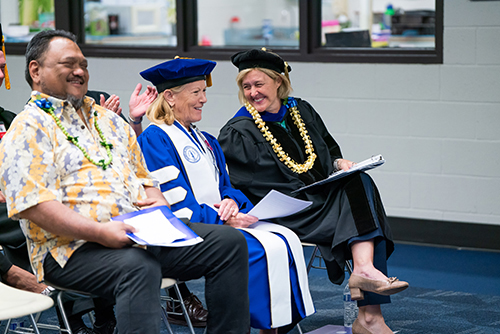
Drs. Janet Davidson and Lynn Babington share a light-hearted moment. Seated next to them is Mark Patterson, Chair Hawaii Correctional Oversight Commission and Hawaii Youth Correctional Facility, Warden.

It was the best news that Dr. Janet Davidson could have ever received on a Friday morning. After receiving an email message from Gabrielle Schechter, Health Policy Advisor with the Office of U.S. Senator Brian Schatz, Chaminade’s Vice Provost for Academic Affairs and a leader in criminology couldn’t believe what she was reading.

“I had to ask Jacki (Sanqui) to come to my office and read the message to make sure that I was reading it correctly,” said Davidson, who has spearheaded Chaminade’s Higher Education in Prison program. “She told me this was really great news and I was reading it correctly. The note said, ‘Your Higher Education in Prison Program earmark request to Senator Schatz’s office for FY24 was funded at $1.5 million!’ I was shocked.”

With the successful graduation of the pilot class, the second cohort of students from Halawa Correctional Facility includes 11 inmates, three more than the inaugural graduating class. Studies have clearly shown that higher education in prisons offers a multitude of benefits, particularly concerning re-entry into society and reducing rates of recidivism. Research further indicates that individuals who participate in educational programs while incarcerated are significantly less likely to return to prison upon release. Specifically, those who attain an associate’s degree have notably improved odds of successfully re-integrating into society compared to their counterparts without such credentials.

Yet, in our legal system and legislative practices, mass incarceration remains deeply entrenched. Despite efforts over the past half-century, initiatives such as the war on drugs have failed, leading to a troubling escalation in sentencing, probation and pretrial incarceration. But there is hope. In March, the U.S. Senate passed the second half of a bipartisan government funding bill that includes $31.8 million in new congressionally directed spending, also known as earmarks, secured by U.S. Senator Brian Schatz (D-Hawai‘i), chair of the Senate Appropriations Subcommittee on Transportation, Housing and Urban Development. The new funding follows nearly $400 million in earmark funding for Hawaii secured by Schatz in the first half of the appropriations deal signed into law earlier this month. Chaminade University of Honolulu was awarded $1.5 million, which will be used to build capacity of the prison education program.

“At Chaminade, one of our primary Marianist values is to advocate for social justice for transformative change,” says Chaminade President Lynn Babington, Ph.D. “We support a rehabilitation-through-education narrative, which we know is essential to incarcerated individuals finding a pathway to a second chance and a better future.”
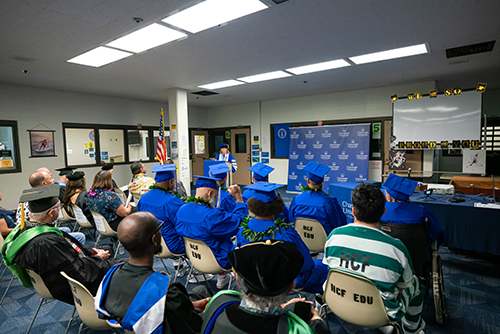
Last year's first graduating class attended a commencement ceremony at Halawa Correctional Facility.
Chaminade President Dr. Lynn Babington congratulated graduates during a commencement ceremony at Halawa Correctional Facility.

Hawaii’s correctional facilities epitomize the challenges the state face, grappling with chronic overcrowding and deteriorating conditions. In 1978, Hawaii’s incarceration rate stood at one per 1,000 people. Since then, national rates have skyrocketed, with Hawaii’s incarceration rate at 439 per 100,000 people (including prisons, jails, immigration detention and juvenile justice facilities), meaning that it locks up a higher percentage of its people than almost any democratic country on earth, according to the non-profit, non-partisan Prison Policy Initiative, whose research and advocacy is at the center of the national conversation about criminal justice reform and over-criminalization.

Following its re-designation, the Hawaii Department of Corrections and Rehabilitation underscored the importance of transitioning away from punitive justice, making rehabilitation a core aspect of its mission. With a staggering 95 percent of incarcerated individuals eventually returning to society, this shift is deemed crucial for achieving successful reintegration. As part of its restructuring, law enforcement functions previously under Department of Public Safety were transferred to a newly established Department of Law Enforcement. The move reflects a broader commitment to address the root causes of criminal behavior and promote long-term societal wellness. By prioritizing rehabilitation and reintegration programs, the Department of Corrections and Rehabilitation aims to create safer communities and support individuals in their journey toward positive change.

“The motto for our department is ‘He Au Hou,’ which means ‘a new era,’” said Tommy Johnson, Director of the new Department of Corrections and Rehabilitation, which re-establishes the Hawaii Department of Public Safety. “We’re able to focus our full attention, resources, and energy on rehabilitation and restoration to support those in our custody and care. We envisioned this over two years ago and it’s exciting to see this coming to fruition. We may not see changes occur overnight. We know there is always room for improvement, but I’m confident we’re headed in the right direction.”
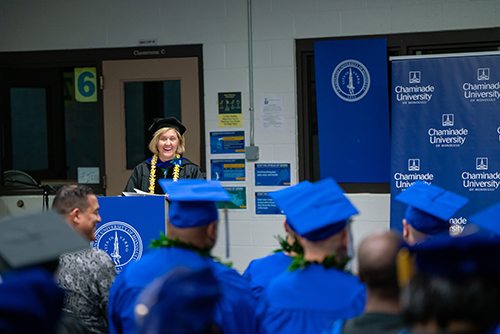
Chaminade Vice Provost for Academic Affairs, Dr. Janet Davidson, addressed graduates during last year's commencement ceremony at Halawa Correctional Facility.
Chaminade Vice Provost for Academic Affairs, Dr. Janet Davidson, addressed graduates during last year’s commencement ceremony at Halawa Correctional Facility.

Davidson shares Johnson’s optimism, and she hopes to expand Chaminade’s Higher Education in Prison program to include an interdisciplinary bachelor’s degree program and a new women’s program at Women’s Community Correctional Center. The commitment to these educational programs reflects a fundamental paradigm shift towards a justice system focused on rehabilitation rather than punitive measures. By providing access to education, prisons foster a culture that prioritizes personal growth and skill development, ultimately empowering individuals to become productive members of society upon release.

This non-punitive approach not only benefits the individuals directly involved but also contributes to broader societal outcomes, including reduced crime rates and enhanced community safety. Embracing higher education within the prison system signifies a commitment to justice that extends beyond punishment, striving instead for meaningful rehabilitation and long-term societal transformation.

“I don’t know how to do life out there,” one of the Halawa students told Matthews, referring to re-entering society after being released from prison, adding that they feel that she talks to them, and that she understands them. Empathy is indeed a powerful message for those incarcerated, who often say they don’t “feel treated as human beings.”

“I feel like a ‘wounded healer,’” says Matthews, quoting a term coined by Shadd Maruna, Ph.D., the dean of the School of Criminal Justice at Rutgers University Newark. “Many prisoners and former inmates express a desire to receive mentoring from formerly incarcerated persons who are ‘making it’ in conventional society.”

Prison reentry is a complex process that requires comprehensive strategies involving legislation, regulations, support programs, and community involvement. By prioritizing rehabilitation and reintegration, society can help individuals leaving incarceration rebuild their lives and become productive members of society. Through concerted efforts and collaboration, we can bridge the gap between prison and society, paving the way for successful reentry and reducing recidivism rates in the long run.
Posted by: University Communications & Marketing Filed Under: Diversity and Inclusion, Education, Featured Story, Innovation, Institutional Tagged With: Andrew W. Mellon Foundation Grant, Education in Prison, Marianist, Second Chance Pell

Andrew W. Mellon Foundation Grant  

October 6, 2023

New funding will help expand HEP Program

With support from a $750,000, three-year grant from the Andrew W. Mellon Foundation, Chaminade University of Honolulu will now be able to expand its Higher Education in Prison (HEP) program, which aims to be a pathway for participants to leave incarceration with new identities, perspectives and goals to help them thrive in society.  

“At Chaminade, one of our primary Marianist values is to advocate for social justice for transformative change,” said Chaminade President Lynn Babington, Ph.D. “We support a rehabilitation-through-education narrative, which we know is essential to incarcerated individuals finding a pathway to a second chance and a better future.”  

Chaminade’s current HEP program only serves males who are incarcerated at Halawa Correctional Facility. However, moving forward, the University plans to extend its cohort model HEP program to the Women’s Community Correctional Center (WCCC), as well as to those men serving time 3,000 miles from home at the Saguaro Prison in Arizona.  

The goal is to expand degree offerings, starting with the men in Halawa, to include an AA in Liberal Arts that can be extended to a BA in Interdisciplinary Studies. The coursework for the three degree programs will emphasize a humanities and liberal arts curriculum, and will be offered in a culturally responsive and trauma-informed way that will resonate with the overly-represented indigenous prison population.  

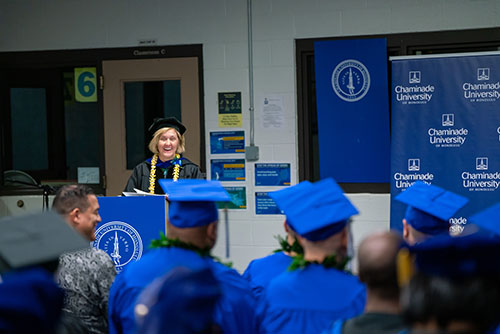
Dr. Janet Davidson addresses the new graduates during a Commencement Ceremony at Halawa Correctional Facility.

“If we want safer communities, if we want healthier families, if we want people who are incarcerated to have a chance when they come out, these are the types of rehabilitative programs we should be offering,” said Dr. Janet Davidson, Chaminade’s Vice Provost for Academic Affairs and a leader in criminology. “The idea is to shift the mindset. It will cost society less in the end.”  

Citing racial equity as a primary condition that makes HEP programs urgently necessary, the grant underscores the over-representation of Native Hawaiians in the criminal justice system. According to data collected by the Office of Hawaiian Affairs, Hawaii’s incarceration rate increased by 403 percent from 1978 to 2016, with Native Hawaiians affected disproportionately. Though accounting for only 18 percent of the state’s adult population, Native Hawaiians represent 37 percent of those incarcerated. This statistic includes Native Hawaiian women who make up 44 percent of the incarcerated women in Hawaii.  

While imprisoned women already have access to some college courses, they don’t have degree options. This Mellon grant will change this. “Since women are more likely than men to be the primary caretakers of dependent children prior to incarceration,” Davidson said, “their success after leaving prison will have a positive impact on their children and families, multiplying the effects of a single college degree.”  

Providing education in prison has indeed proven to reduce recidivism rates, and is associated with higher employment rates, which will improve public safety and allow individuals to return home to their communities and contribute to society. Moreover, a 2018 study from the RAND Corporation, funded by the Department of Justice, found that incarcerated individuals who participated in correctional education were 48 percent less likely to return to prison within three years than incarcerated individuals who did not participate in any correctional education programs. RAND also estimated that for every dollar invested in correctional education programs, four to five dollars are saved on three-year, re-incarceration costs.  

“The success of this pilot program—between Chaminade University of Honolulu and the Hawaii Department of Public Safety—demonstrates that partnerships can lead to transformative change,” Davidson said. “With the support and guidance of Chaminade’s distinguished faculty and support staff, and the cooperation and backing of Halawa Correctional Facility, these individuals have embraced the opportunity to redefine their futures. This program is part of Chaminade’s mission to educate for service, justice and peace. We hope that with their newly gained education, these students will have the skills needed to rebuild their lives upon reintegration into society.”        

Posted by: University Communications & Marketing Filed Under: Catholic, Diversity and Inclusion, Homepage, Innovation, Institutional Tagged With: Andrew W. Mellon Foundation Grant, Education in Prison, Transformation

Footer

Chaminade University Logo

3140 Waialae Avenue
Honolulu, Hawaii 96816

Contact Us
Phone: (808) 735-4711
Toll-free: (800) 735-3733

facebook twitter instagram youtube linkedin

Visit

  • Plan Your Visit
  • Campus Map (PDF)
  • Events

Resources

  • Campus Security
  • Student Consumer Information
  • Concerns, Feedback, and Reporting
  • Institutional Review Board
  • Title IX / Nondiscrimination Policy
  • Compliance
  • Emergency Information
  • Careers
  • Institutional Statement

People

  • Students
  • Parents
  • Alumni
  • Faculty & Staff

Policy

  • Privacy Policy
  • Terms and Conditions of Use


© Chaminade University of Honolulu