• Skip to primary navigation
  • Skip to main content
  • Skip to footer
Chaminade University of Honolulu

Chaminade University of Honolulu

  • VISIT
  • APPLY
  • GIVE
  • STUDENTS
  • PARENTS
  • ALUMNI
  • FACULTY/STAFF
  • Admissions
    • Admissions Home
    • Undergraduate Students
      • First-Year Students
      • Transfer Students
      • Admitted Students
    • Graduate Students
    • Flex Online Undergraduate Program
    • Military Students
    • Non-Degree/Visiting Students
    • Experiential Honors Program
    • Early College Program
    • New Student Orientation
  • Tuition & Aid
    • Financial Aid Home
    • Tuition & Expenses
    • Federal Updates & Changes
    • Scholarships
    • $5,000 Graduate Scholarship
    • VA Education Benefits
    • Net Price Calculator
  • Academics
    • Academics Home
    • Academic Programs
    • Office of Student Success
      • Academic Advising
      • Records and Registrar
    • Kōkua ʻIke (Support Services)
      • ADA Accommodations
      • Career Services
      • Proctoring Services
      • Tutoring Services
    • Sullivan Family Library
    • Undergraduate Research & Pre-Professional Programs
    • Commencement
  • Campus Life
    • About Campus Life
    • Student Engagement
    • Student Government Association
    • Residence Life and Housing
      • Summer Conference Housing
    • Health Services
    • Marianist Leadership Center
    • Counseling Center
    • Campus Ministry
    • Campus Security
    • Dining Services
    • Bookstore
  • Athletics
  • About
    • Chaminade University News
    • Our Story
    • Leadership
    • Chaminade University Strategic Plan 2024-2030
    • Mission & Rector
    • Association of Marianist Universities
    • Facts & Rankings
    • CIFAL Honolulu
    • Accreditation & Memberships
    • Montessori Laboratory School
Search
×

Search this web site

Innovation

Back to School

September 15, 2023

First cohort of Mu’o Scholarship recipients begin their journey to a teaching career

Efforts to address Hawaii’s teacher shortage have come in all different forms, from monetary incentives to scholarships. Recognizing the critical need for early education teachers in Hawaiʻi, Chaminade University and Kamehameha Schools have established the Mu‘o Scholarship, an innovative and community-focused teacher prep partnership that will provide tuition funding to educate, train and prepare aspiring teachers to lead Hawaii’s classrooms.  

“By providing these scholarships, we’re removing barriers that too often hinder many working adults in the state from obtaining a bachelor’s degree while still maintaining family and work commitments,” says Chaminade University President Lynn Babington, Ph.D. “Mu’o means to bud, and we believe our Mu’o Program will allow us to grow teachers, to bud teachers who will positively impact our communities through their teaching careers for generations to come.”  

This month, the first cohort of 49 Mu‘o Scholarship recipients began their path toward earning their teaching degrees. Of the 49 new students, 32 of them identified as Native Hawaiian, which matters because, like elsewhere around the country, the public education teacher workforce in Hawaii does not mirror the diversity of the student population. New York Times writer Claire Cain Miller cites research that says “students tend to benefit from having teachers who look like them, especially nonwhite students.”  

To address Hawaii's teacher shortage, Chaminade University and Kamehameha Schools have introduced their own new carrot: an innovative and community-focused teacher prep partnership that will provide 150 Muʻo Scholarships to educate, train and prepare aspiring teachers to lead Hawaiʻi’s classrooms.
Vice Provost Janet Davidson welcomes Muo scholars.

The same research shows that students perform better when they have teachers who reflect their race and gender, particularly in disadvantaged, high minority areas. However, this leads to another question: Do teachers who have a better cultural understanding of their students tend to stay longer in their roles? In Hawaii, the short answer is yes.  

“From Hanapepe to Hilo, we want to provide pathways to a college degree, and we believe that our Mu‘o Program will allow us to do that,” says Janet Davidson, Ph.D., Vice Provost of Academic Affairs. “By increasing opportunities for culturally relevant professional development, we significantly increase students’ success, and we see our students succeed to degree completion.”  

The Mu‘o Scholarship recipients also come from four of the major islands, with 14 from the Hawaii Island, 28 from Honolulu, eight from Kauai and five from Maui. Students’ majors also vary, with one concentrating on secondary education and another in elementary education, and the rest are majoring in either Early Childhood Education or Early Childhood Education with Montessori Credential.  

“We did some surveys and early childhood educators indicated their life situations didn’t allow them to take in-person courses,” says Dr. Elizabeth Park, Associate Professor and Director of Early Childhood Education with Montessori Credential. “So what we did was spend the energy and the time to design robust online courses to meet the needs of our educators.”      

Chaminade’s online bachelor’s degree program is designed for working adults in Hawai‘i who may already be serving as a teacher’s aide or, currently, in a similar position. The online delivery format will allow students to continue working while pursuing their bachelor’s degree. Program information is available and applications for the scholarships are being accepted. This transformative program is 100 percent online, with a requirement to complete a student-teaching track. Students will be paired with an academic advisor to guide them on the road to graduation.  

“Chaminade and Kamehameha Schools deeply value education, and we know a teacher-prep program, like our Mu‘o Program, will help address the teacher shortage here in Hawaii,” Davidson says. “And we know that education, especially from early childhood, has such a positive impact on our kids, their families and the community.”

Posted by: University Communications & Marketing Filed Under: Diversity and Inclusion, Education, Featured Story, Innovation, Institutional Tagged With: Elementary Education, Montessori, Online Undergraduate Program, Secondary Education

Enterprising Minds

September 8, 2023

Teams to compete in Silversword Business Competition

Game on! In a Shark Tank-like competition, teams of students will compete in an entrepreneurial 18-week contest, vying for the grand prize of $2,000. The catch: the product or the service must have some element of sustainability.  

“Your idea has to address any of the CIFAL Center’s 17 Sustainable Development Goals (SDG),” explained Asoke Datta, EdD, School of Business and Communication’s Assistant Dean, outlining the competition’s rules. “It has to be profitable, not just in terms of revenue, but for the greater good of society.”  

Without revealing too much about her strategy, Carol Nacario ’23, a senior in the School of Business and Communication, is concerned with all the “waste” that she sees around her. The environment, like many in her generation—led by Greta Thunberg and the Sunrise Movement, a youth-led political organization urging increased attention to climate change—is an issue that needs to be kept in the forefront of people’s minds.  

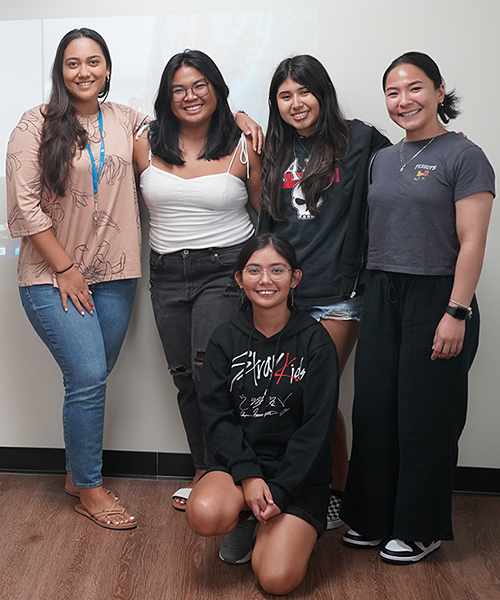
Students participating in the Silversword Business Competition include, from left, Peyton Haleamau, Michalla Burtado, Alyssa Torres (kneeling), Emma Rosales and Carol Nacario.

“Deciding on a final project will be the most difficult challenge,” shared Nacario with other students who attended Day 1 of the competition. “My target audience will be the campus.”  

Academic competitions play an essential part in learning for students. Participation offers a hands-on opportunity for students to apply the knowledge and principles they have gained in the classroom and apply it to real-work situations. These competitions foster such skills as leadership, teamwork and communication. They can also be a great way to make new connections and friends.  

School of Business and Communication interim dean, Dr. Annette Santos, issued her first challenge to the students: recruit others to join their teams. “It can be a team of two to five students,” said Santos via a live video feed from Guam. “However, at least one of the team members has to be from the School of Business and Communication.”  

A business major, Peyton Haleamau ’25, convinced second year forensics science majors, Emma Rosales ’25 and Michalla “Meeks” Butardo ’25, to be on her team. Having never taken a business course, Rosales and Butardo consider their lack of entrepreneurial savvy as their major challenge.  

“We’ll be here as advisors and mentors,” marketing lecturer Wera Panow-Loui, MBA, told the students. “Last year, I opened my house up to a team of students who were producing jewelry out of microplastics reclaimed from the beach and in the ocean. And I also fed them.”  

Datta suggested to find team members who are in different disciplines, from art and interior design to nursing and data analytics. “You want a wider perspective than just business,” he said. “That’s what entrepreneurs do—they get creative. And, if they fail, what they learn from that failure determines how they succeed the next time.”

Each team will be given $250 seed money to use at its discretion. The School of Business and Communication’s Advisory Board members, who are providing the funding for the seed money, will also be available as mentors.  

When the competition was launched in 2021, the plan was to have students open and manage a pop-up concession on campus. Because COVID-19 was still a factor, another approach was decided: the School invited students to participate in a business competition that would allow them to show off their creativity, their ability to work with others and their aptitude in everything from marketing to accounting and customer service.  

“Think of this competition as an incubator of ideas,” said Dr. Eduard Merc, who is Chaminade’s MBA director. “You’ll have the chance to work alongside your professors and the opportunity for experiential learning that goes beyond theory.”  

Students’ final presentation will take place on Nov. 16. Each team will be assessed by sales/revenue, social media likes and shares, and their profit-and-lost statement.  

“And your business must align with the sustainable approach,” Santos emphasized. “In developing your business plan, take into account these considerations: 1) Identify future needs; 2) Identify technology to serve that need; and 3) How will you deliver the need, through what channels of distribution?”  

Their time starts now!    

Posted by: University Communications & Marketing Filed Under: Business & Communication, Campus and Community, CIFAL Honolulu, Diversity and Inclusion, Featured Story, Innovation, Students Tagged With: Business Administration, Hogan Entrepreneurs Program, School of Business and Communication

One Year MBA: Smart Track to a Degree

September 1, 2023

Mia Vallero, MBA ’23, visited Nara, Japan four years ago. She remembers seeing the deer at Nara Park, and how playful and eager they were to be fed crackers by visitors. This past August, she returned to the same prefecture but this time the trip was part of the Chaminade University One Year MBA degree program, and she noticed the deer were not as lively as she remembered.

“It forced me to reflect on the tourism industry in Japan and in Hawaii,” Vallero ruminates. “I’m glad I had the opportunity to think twice about the use of wildlife for tourism and entertainment.”

Thinking deeply about business practices, culture, and economic impact and sustainability are all part of Chaminade’s One Year MBA program of which Vallero entered in the fall of 2022. The recent trip to Japan was one of the final segments of the program, as she traveled with eight fellow MBA candidates, her professor Dr. Caryn Callahan, and the Interim Dean of the School of Business and Communication Dr. Annette Santos. 

Considered the messengers of the gods, Nara's over 1000 deer have become a symbol of the city and have even been designated as a natural treasure.
Considered the messengers of the gods, Nara’s over 1000 deer have become a symbol of the city and have even been designated as a natural treasure.

A customer service manager at Aloha Freight Forwarders, Vallero enrolled in the One Year MBA program for the experience and skills she would gain to expand opportunities for her future. 

Likewise for fellow MBA candidate Joshua McDonough who earned his bachelor’s degree from Boston University. Both Vallero and McDonough belong to the second cohort of the One Year MBA program, which they will complete this September 2023. The first cohort of students entered in the fall of 2021 and earned their MBAs in September 2022. A third cohort will begin this September 2023 and will conclude in September 2024. All graduates have the option to participate in Chaminade’s commencement ceremony the following May of their program completion.

As an executive program designed for people who have work experience, the One Year MBA program provides valuable resources, credentials, and professional and practical classroom and real world exposure to its graduate students. In-person classes held every other Saturday on campus are supplemented by online course work and travel abroad, which is largely sponsored by Chaminade. The first cohort traveled to New Zealand and the international destination for the third cohort is yet to be determined. 

“Through this MBA program, I look to broaden my business perspective, grow my professional network and enhance my leadership, communication and critical thinking skills,” McDonough says.

On the recent trip to Japan, MBA candidates visited such businesses and organizations as  the Luxottica eyeglass frame factory, the Masunaga Optical Company, Daiko Advertising and Asahi Beer Suita Brewery. They also attended a baseball game at Koshien Stadium and enjoyed a private meeting with Kazuhiro Tanabe, a director of the stadium. 

Visiting the eyeglass and optical companies was particularly relevant since students were tasked to study the industry in preparation for their trip to Japan. They compared the operations of two different manufacturers, with one based in Milan, Italy—but has a presence in Japan— and the other based in Japan. They researched how a progressive, modern approach differs from a more traditional business model, and how they market, manufacture and distribute their products. 

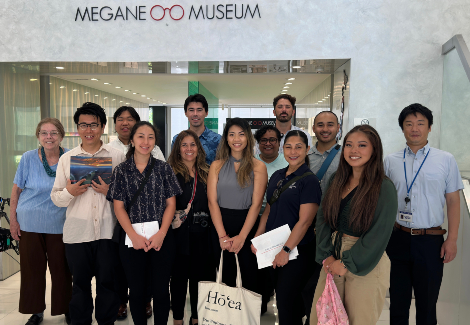
MBA candidates got to visit the Megane Museum, where visitors learn  about the history of glasses, and the more than 200 steps involved in making a pair.
MBA candidates got to visit the Megane Museum, where visitors learn about the history of glasses, and the more than 200 steps involved in making a pair.

“There’s nothing like getting students out into the field,” says Dr. Caryn Callahan, who has been teaching the One Year MBA program since its inception. “You can read textbooks and study in the classroom, but by traveling abroad we were able to meet with the presidents of companies, and were greeted warmly by high-level management. The students had researched the companies, and they were well prepared before going into these meetings”

Dr. Annette Santos agrees and recognizes the valuable experience students received by seeing Japanese business cultures through a western lens, learning about the diversification of industries, and understanding the differences and similarities between eastern and western ways of conducting business.” 

“Each curated tour, visits to manufacturing companies, meetings with heads of organizations was a professional and personal growth opportunity for our students,” Santos says. “Students  asked very good questions, such as, ‘What is it like to be a leader?’ as well as  about production and supply chain. It was really nice to see the students’ critical-thinking capacity, as reflected by the questions they asked the leaders.”

On September 16, the School of Business and Communication will hold a banquet for the graduating One Year MBA class, as well as for the new cohort of students entering the program to begin their 12 month journey, which will also conclude with international travel.

“Our international study trips transform students’ understanding of business and provide a wonderful opportunity of exposure to other cultures and local business practices,” says Dr. Eduard Merc, who is Chaminade’s MBA director. “Additionally, the academic trip gives participants a comprehensive overview of trends in business and an in-depth view into companies currently operating in the Asia Pacific region. 

“At the School of Business and Communication, we believe in the importance of our students seeing firsthand the strategies that international businesses have pursued to take part in the explosive growth of Asia, and how these companies effectively adapt to the ever-changing business, social, and political landscapes in which they operate,” Merc adds. “This supplements their MBA classroom learning in significant ways by learning directly from business leaders.”

The banquet will be bittersweet for the outgoing students whose lives for the past year were filled with the collegiality of their close-knit class. Now as alumni, they belong to Chaminade’s global network. And like many of his fellow MBA ’23 graduates, Ethan Dayton had a vision for what he hoped to accomplish a year ago when he started the curriculum. 

“My goal at the end of this program is to have amassed new knowledge,” wrote Dayton, a year ago, “and skills that expand my career path options.” 

Indeed, by all accounts, his and the entire cohort’s goals were beyond achieved. 

Posted by: University Communications & Marketing Filed Under: Business & Communication, Diversity and Inclusion, Featured Story, Hogan Entrepreneurial Program, Innovation Tagged With: Hogan Entrepreneurs Program, MBA, One Year MBA, School of Business and Communication, Travel Abroad

The Future of AI

July 27, 2023

LnRiLWJ1dHRvbntjb2xvcjojZjFmMWYxfS50Yi1idXR0b24tLWxlZnR7dGV4dC1hbGlnbjpsZWZ0fS50Yi1idXR0b24tLWNlbnRlcnt0ZXh0LWFsaWduOmNlbnRlcn0udGItYnV0dG9uLS1yaWdodHt0ZXh0LWFsaWduOnJpZ2h0fS50Yi1idXR0b25fX2xpbmt7Y29sb3I6aW5oZXJpdDtjdXJzb3I6cG9pbnRlcjtkaXNwbGF5OmlubGluZS1ibG9jaztsaW5lLWhlaWdodDoxMDAlO3RleHQtZGVjb3JhdGlvbjpub25lICFpbXBvcnRhbnQ7dGV4dC1hbGlnbjpjZW50ZXI7dHJhbnNpdGlvbjphbGwgMC4zcyBlYXNlfS50Yi1idXR0b25fX2xpbms6aG92ZXIsLnRiLWJ1dHRvbl9fbGluazpmb2N1cywudGItYnV0dG9uX19saW5rOnZpc2l0ZWR7Y29sb3I6aW5oZXJpdH0udGItYnV0dG9uX19saW5rOmhvdmVyIC50Yi1idXR0b25fX2NvbnRlbnQsLnRiLWJ1dHRvbl9fbGluazpmb2N1cyAudGItYnV0dG9uX19jb250ZW50LC50Yi1idXR0b25fX2xpbms6dmlzaXRlZCAudGItYnV0dG9uX19jb250ZW50e2ZvbnQtZmFtaWx5OmluaGVyaXQ7Zm9udC1zdHlsZTppbmhlcml0O2ZvbnQtd2VpZ2h0OmluaGVyaXQ7bGV0dGVyLXNwYWNpbmc6aW5oZXJpdDt0ZXh0LWRlY29yYXRpb246aW5oZXJpdDt0ZXh0LXNoYWRvdzppbmhlcml0O3RleHQtdHJhbnNmb3JtOmluaGVyaXR9LnRiLWJ1dHRvbl9fY29udGVudHt2ZXJ0aWNhbC1hbGlnbjptaWRkbGU7dHJhbnNpdGlvbjphbGwgMC4zcyBlYXNlfS50Yi1idXR0b25fX2ljb257dHJhbnNpdGlvbjphbGwgMC4zcyBlYXNlO2Rpc3BsYXk6aW5saW5lLWJsb2NrO3ZlcnRpY2FsLWFsaWduOm1pZGRsZTtmb250LXN0eWxlOm5vcm1hbCAhaW1wb3J0YW50fS50Yi1idXR0b25fX2ljb246OmJlZm9yZXtjb250ZW50OmF0dHIoZGF0YS1mb250LWNvZGUpO2ZvbnQtd2VpZ2h0Om5vcm1hbCAhaW1wb3J0YW50fS50Yi1idXR0b25fX2xpbmt7YmFja2dyb3VuZC1jb2xvcjojNDQ0O2JvcmRlci1yYWRpdXM6MC4zZW07Zm9udC1zaXplOjEuM2VtO21hcmdpbi1ib3R0b206MC43NmVtO3BhZGRpbmc6MC41NWVtIDEuNWVtIDAuNTVlbX0gLnRiLWJ1dHRvbltkYXRhLXRvb2xzZXQtYmxvY2tzLWJ1dHRvbj0iN2YxZDIyNzVmOWFiZGNlZWY4NmM1ZDFiOGZhMjdkM2IiXSB7IHRleHQtYWxpZ246IGluaXRpYWw7IH0gLnRiLWJ1dHRvbltkYXRhLXRvb2xzZXQtYmxvY2tzLWJ1dHRvbj0iN2YxZDIyNzVmOWFiZGNlZWY4NmM1ZDFiOGZhMjdkM2IiXSAudGItYnV0dG9uX19saW5rIHsgYmFja2dyb3VuZC1jb2xvcjogcmdiYSggMTQsIDMyLCAxNjQsIDEgKTtmb250LXdlaWdodDogcmVndWxhcjsgfSAudGItYnV0dG9uW2RhdGEtdG9vbHNldC1ibG9ja3MtYnV0dG9uPSI3ZjFkMjI3NWY5YWJkY2VlZjg2YzVkMWI4ZmEyN2QzYiJdIC50Yi1idXR0b25fX2ljb24geyBmb250LWZhbWlseTogZGFzaGljb25zOyB9IC50Yi1idXR0b25bZGF0YS10b29sc2V0LWJsb2Nrcy1idXR0b249IjdmMWQyMjc1ZjlhYmRjZWVmODZjNWQxYjhmYTI3ZDNiIl0gLnRiLWJ1dHRvbl9faWNvbjo6YmVmb3JlIHsgY29udGVudDogJ1xmNTIyJzsgfSBAbWVkaWEgb25seSBzY3JlZW4gYW5kIChtYXgtd2lkdGg6IDc4MXB4KSB7IC50Yi1idXR0b257Y29sb3I6I2YxZjFmMX0udGItYnV0dG9uLS1sZWZ0e3RleHQtYWxpZ246bGVmdH0udGItYnV0dG9uLS1jZW50ZXJ7dGV4dC1hbGlnbjpjZW50ZXJ9LnRiLWJ1dHRvbi0tcmlnaHR7dGV4dC1hbGlnbjpyaWdodH0udGItYnV0dG9uX19saW5re2NvbG9yOmluaGVyaXQ7Y3Vyc29yOnBvaW50ZXI7ZGlzcGxheTppbmxpbmUtYmxvY2s7bGluZS1oZWlnaHQ6MTAwJTt0ZXh0LWRlY29yYXRpb246bm9uZSAhaW1wb3J0YW50O3RleHQtYWxpZ246Y2VudGVyO3RyYW5zaXRpb246YWxsIDAuM3MgZWFzZX0udGItYnV0dG9uX19saW5rOmhvdmVyLC50Yi1idXR0b25fX2xpbms6Zm9jdXMsLnRiLWJ1dHRvbl9fbGluazp2aXNpdGVke2NvbG9yOmluaGVyaXR9LnRiLWJ1dHRvbl9fbGluazpob3ZlciAudGItYnV0dG9uX19jb250ZW50LC50Yi1idXR0b25fX2xpbms6Zm9jdXMgLnRiLWJ1dHRvbl9fY29udGVudCwudGItYnV0dG9uX19saW5rOnZpc2l0ZWQgLnRiLWJ1dHRvbl9fY29udGVudHtmb250LWZhbWlseTppbmhlcml0O2ZvbnQtc3R5bGU6aW5oZXJpdDtmb250LXdlaWdodDppbmhlcml0O2xldHRlci1zcGFjaW5nOmluaGVyaXQ7dGV4dC1kZWNvcmF0aW9uOmluaGVyaXQ7dGV4dC1zaGFkb3c6aW5oZXJpdDt0ZXh0LXRyYW5zZm9ybTppbmhlcml0fS50Yi1idXR0b25fX2NvbnRlbnR7dmVydGljYWwtYWxpZ246bWlkZGxlO3RyYW5zaXRpb246YWxsIDAuM3MgZWFzZX0udGItYnV0dG9uX19pY29ue3RyYW5zaXRpb246YWxsIDAuM3MgZWFzZTtkaXNwbGF5OmlubGluZS1ibG9jazt2ZXJ0aWNhbC1hbGlnbjptaWRkbGU7Zm9udC1zdHlsZTpub3JtYWwgIWltcG9ydGFudH0udGItYnV0dG9uX19pY29uOjpiZWZvcmV7Y29udGVudDphdHRyKGRhdGEtZm9udC1jb2RlKTtmb250LXdlaWdodDpub3JtYWwgIWltcG9ydGFudH0udGItYnV0dG9uX19saW5re2JhY2tncm91bmQtY29sb3I6IzQ0NDtib3JkZXItcmFkaXVzOjAuM2VtO2ZvbnQtc2l6ZToxLjNlbTttYXJnaW4tYm90dG9tOjAuNzZlbTtwYWRkaW5nOjAuNTVlbSAxLjVlbSAwLjU1ZW19IH0gQG1lZGlhIG9ubHkgc2NyZWVuIGFuZCAobWF4LXdpZHRoOiA1OTlweCkgeyAudGItYnV0dG9ue2NvbG9yOiNmMWYxZjF9LnRiLWJ1dHRvbi0tbGVmdHt0ZXh0LWFsaWduOmxlZnR9LnRiLWJ1dHRvbi0tY2VudGVye3RleHQtYWxpZ246Y2VudGVyfS50Yi1idXR0b24tLXJpZ2h0e3RleHQtYWxpZ246cmlnaHR9LnRiLWJ1dHRvbl9fbGlua3tjb2xvcjppbmhlcml0O2N1cnNvcjpwb2ludGVyO2Rpc3BsYXk6aW5saW5lLWJsb2NrO2xpbmUtaGVpZ2h0OjEwMCU7dGV4dC1kZWNvcmF0aW9uOm5vbmUgIWltcG9ydGFudDt0ZXh0LWFsaWduOmNlbnRlcjt0cmFuc2l0aW9uOmFsbCAwLjNzIGVhc2V9LnRiLWJ1dHRvbl9fbGluazpob3ZlciwudGItYnV0dG9uX19saW5rOmZvY3VzLC50Yi1idXR0b25fX2xpbms6dmlzaXRlZHtjb2xvcjppbmhlcml0fS50Yi1idXR0b25fX2xpbms6aG92ZXIgLnRiLWJ1dHRvbl9fY29udGVudCwudGItYnV0dG9uX19saW5rOmZvY3VzIC50Yi1idXR0b25fX2NvbnRlbnQsLnRiLWJ1dHRvbl9fbGluazp2aXNpdGVkIC50Yi1idXR0b25fX2NvbnRlbnR7Zm9udC1mYW1pbHk6aW5oZXJpdDtmb250LXN0eWxlOmluaGVyaXQ7Zm9udC13ZWlnaHQ6aW5oZXJpdDtsZXR0ZXItc3BhY2luZzppbmhlcml0O3RleHQtZGVjb3JhdGlvbjppbmhlcml0O3RleHQtc2hhZG93OmluaGVyaXQ7dGV4dC10cmFuc2Zvcm06aW5oZXJpdH0udGItYnV0dG9uX19jb250ZW50e3ZlcnRpY2FsLWFsaWduOm1pZGRsZTt0cmFuc2l0aW9uOmFsbCAwLjNzIGVhc2V9LnRiLWJ1dHRvbl9faWNvbnt0cmFuc2l0aW9uOmFsbCAwLjNzIGVhc2U7ZGlzcGxheTppbmxpbmUtYmxvY2s7dmVydGljYWwtYWxpZ246bWlkZGxlO2ZvbnQtc3R5bGU6bm9ybWFsICFpbXBvcnRhbnR9LnRiLWJ1dHRvbl9faWNvbjo6YmVmb3Jle2NvbnRlbnQ6YXR0cihkYXRhLWZvbnQtY29kZSk7Zm9udC13ZWlnaHQ6bm9ybWFsICFpbXBvcnRhbnR9LnRiLWJ1dHRvbl9fbGlua3tiYWNrZ3JvdW5kLWNvbG9yOiM0NDQ7Ym9yZGVyLXJhZGl1czowLjNlbTtmb250LXNpemU6MS4zZW07bWFyZ2luLWJvdHRvbTowLjc2ZW07cGFkZGluZzowLjU1ZW0gMS41ZW0gMC41NWVtfSB9IA==
Lance Askildson

Provost Lance Askildson joins KHPR’s Bytemarks Cafe to discuss AI and ChatGPT

Listen

References:

Lance Askildson: Here is why ChatGPT can never replace writers, educators or humans in general

How Is ChatGPT’s Behavior Changing over Time?

Over just a few months, ChatGPT went from correctly answering a simple math problem 98% of the time to just 2%, study finds

Posted by: University Communications & Marketing Filed Under: Innovation

People, Planet and Prosperity

June 21, 2023

Three-day conference sharply focused on issues of sustainability

We can no longer use the NIMBY (not in my backyard) argument when it comes to advancing future projects. We’ve arrived at a hinge moment when solving our biggest problems—from environmental to social—means we need to start saying YIMBY, yes to some things: from solar panels and wind turbines to battery production and lithium extraction to universal basic income and food security. These are challenges for sure, but left unaddressed, the consequences could spell disaster, as discussed during a three-day conference sponsored by Chaminade University’s CIFAL Center of Honolulu.

On the final day of the People, Planet and Prosperity for a Sustainable Future symposium, Dr. Gail Grabowsky addressed the United Nations Institute for Training and Research’s  (UNITAR) Agenda 2030 for Sustainable Development and its corresponding 17 Sustainable Development Goals (SDG), which cover a vast range of subjects that impact all of us.

“I’ve been steeped in environmental studies for more than 25 years,” said Grabowsky, Chaminade’s Dean of the School of Natural Sciences & Mathematics and Executive Director of CIFAL Honolulu during her keynote address to attendees. “And a year and a half into establishing CIFAL Honolulu, we’ve brought sustainability into people’s consciousness. And we’ve sponsored more than 50 events.”

The CIFAL Global Network is composed of 32 International Training Centers for Authorities and Leaders, all coordinated by UNITAR’s Social Development Program. The strategic locations of the 32 centers, which can be found across Asia, Oceania, Africa, Europe, the Americas and the Caribbean, ensure a global outreach. Each CIFAL—a French acronym for Centre International de Formation des Autorités/Acteurs Locaux (International Training Centers for Local Authorities and Local Actors)—outpost provides innovative training and serves as a hub for the exchange of knowledge among government officials, the private sector and civil society. 

Chaminade President Dr. Lynn Babington with Hawaii Gov. Joshua Greene during the People, Planet and Prosperity Conference.
Chaminade President Dr. Lynn Babington with Hawaii Gov. Josh Green during the People, Planet and Prosperity Conference.

In his keynote address, Hawaii Gov. Josh Green pledged to generate billions of dollars from philanthropy and outside investment to make Hawaii the first state to become fully reliant on clean energy. It’s a familiar stance that Green has taken since he introduced a slew of major climate policy initiatives earlier this year, including a recommitment to the U.S. Climate Alliance and the establishment of a Climate Advisory Panel.

“We have so many people in this room, find a project that will help Hawaii, help us with health care, help us with the environment,” Green told attendees. “I will bring in investors from across the globe because they are interested in Hawaii, but we will still need to do the job.  Be ready. It should be a dynamic few years.”

The presentations indeed reflected this dynamicism, featuring such diverse topics as “Teaching the Importance of the Ocean to Fight Climate Change,” “The First Statewide Initiative to Connect All Public Universities to Advance PK-12 Climate Literacy, Justice and Action,” “Innovation and Sustainability: The Negative Impact of the Protectionist Leadership Style” and “Food Insecurity.”

“Being part of the UN, we bring awareness to sustainable issues, and train people to get involved and to act on sustainability,” Grabowsky said. “We support economic sustainability in the context of still maintaining an aesthetic environment.”

As the only CIFAL Center in the Pacific, the Chaminade campus is part of a region that includes China, Korea, the Philippines and Australia. The CIFAL Network focuses on topics within four thematic axes: Urban Governance and Planning, Economic Development, Social Inclusion and Environmental Sustainability. Each center is locally managed by a host institution, with UNITAR providing academic content, technical support and quality assurance measures for their training activities. This allows each CIFAL to prioritize action in specific thematic axes, depending on local needs and priorities.

“The basic lesson of the Sustainable Development Goals is that human hopes, human aspirations, human fears are all interconnected,” said United Nations Assistant Secretary-General and executive director for UNITAR, Nikhil Seth, during last November’s “XIX Steering Committee Meeting of The CIFAL Global Network at Chaminade.  “You can’t separate them and follow them in discreet ways. The SDGs are like an umbrella of issues and almost everything you can possibly think of are probably covered in the 17 SDGs.”

And that includes Grabowsky’s pet project, “Pono Popoki Project: Malama Management of Free-Roaming Felines.” “Cats can be good for people’s mental health, which is Goal 3 of the SDGs,” said Grabowsky, pointing to a colorful chart that depicts all the SDGs. “And it also teaches our students biology and wildlife conservation.”

Posted by: University Communications & Marketing Filed Under: Campus and Community, CIFAL Honolulu, Diversity and Inclusion, Featured Story, Homepage, Innovation, Institutional Tagged With: Campus Event, CIFAL, Guest Speakers

Land-based Pedagogical Approach

June 13, 2023

Associate Professor of Arts and Design Junghwa Suh, D.Arch, is throwing caution to the wind and subverting the dominant paradigm. Ever since she took an ʻāina-based education workshop conducted by Cultural Engagement Specialist, Kahoalii Keahi-Wood, the Arts Program Coordinator has questioned her pedagogical style, drawing into particular focus her epistemology of interior design and the entire academic process.

“I was inspired by his teaching,” said Suh of Keahi-Wood. “His workshops were free-flowing and discussions came naturally, especially about respect of place and the ʻāina.”

In collaboration with then-visiting University of Maryland architecture professor, Ming Hu, Suh helped develop a new course themed, “ʻĀina-based Design Solution for Indigenous Communities in Hawaii.” The goal of the new course is to propose, test and validate an integrated ʻāina-based design approach that is intended to serve indigenous communities in Hawai‘i.

“The traditional pedagogical approach is process- and goal-oriented, meaning the structure of a course is linear—going from Point A to Point B,” Suh explained. “And because design education is very structured in the process, we sometimes lose the sight of meaning. Yes, content needs to be delivered, but it needs to be delivered meaningfully and beyond a set of skills.”

Associate Professor of Arts and Design Junghwa Suh, D.Arch presented her new course, "Āina-based Design Solution for Indigenous Communities in Hawaii," at the Association of Collegiate Schools of Architecture (ACSA) and the European Association for Architectural Education (EAAE) Conference in Reykjavik, Iceland.
Associate Professor of Arts and Design Junghwa Suh, D.Arch presented her new course, “Āina-based Design Solution for Indigenous Communities in Hawaii,” at the Association of Collegiate Schools of Architecture (ACSA) and the European Association for Architectural Education (EAAE) Conference in Reykjavik, Iceland.

While teaching the Studio Commercial course for seniors’ capstone Environmental + Interior Design project, Hu tasked the students to come up with a design to restore the Maunalua Fishpond Heritage Center in East Oahu, keeping true to the natural elements of the environs. Students had to understand the importance of the Center’s Kānewai Spring, which is “where the mountain gives birth to the ocean.” They also had to take into account the many cultural sites surrounding the spring, including the mākāhā (fishpond sluice gate) and kū‘ula (fishing stone shrine) with an upright Kū stone balanced by a low Hina stone where the fishermen of old would have given offerings asking for a plentiful catch.

“In the client briefing, we learned that the Center is dedicated towards passing down the Hawaiian culture to the next generation through education sessions and volunteer opportunities,” said newly-minted graduate, Maria Bernaldez ’23, who presented her design concept to leaders at the Center. “With that in mind, I implemented traditional Hawaiian hale aspects, keeping open entrances with no doors in places for public accessibility and wood slat ceiling and beams to imitate exposed wooden rafters and roofing made of coconut thatching.”

For her Materiality Interior Design Studio course, Suh assigned sophomores the project of re-conceptualizing the space at The Institute for Human Services’ Women’s & Family Shelter, giving the dormitory areas a more welcoming, inviting design, while mindful of the context and the community.

“They got to know the space, especially the sleeping areas,” Suh said. “I appreciated their research into understanding people, and learning how textural and tactile elements interact with the environment in this particular setting.”

The project spawned a discussion among Suh, Hu and E + ID program coordinator Matthew Higgins, and eventually evolved into an innovative research project that will be presented at the Association of Collegiate Schools of Architecture (ACSA) and the European Association for Architectural Education (EAAE) Conference on June 22-24, in Reykjavik, Iceland.

Titled, ‘Āina-based Design of Emergency and Homeless Shelters for Indigenous Communities, the project’s premise is to address the need for a novel design approach and socially-rich data on native Hawai‘i housing to guide future projects, and to avoid mistakes of the past. According to the abstract, the project tests two design principles that have been overlooked in the development of emergency housing initiatives: the integration of Hawaiian values with respect to the land (ʻāina) and people; and community engagement to generate solutions that are informed by local need.

“The beauty of being in an education environment is that it allows you to explore the meaning of an ʻāina-based design,” Suh said. “You get to know the actual place and not just the physical structure on the property. It’s placing the land in a historical and cultural context, and learning its significance; the overall approach to the design is dictated by the ʻāina and not the place.”

Posted by: University Communications & Marketing Filed Under: CIFAL Honolulu, Diversity and Inclusion, Featured Story, Humanities, Arts & Design, Innovation, Institutional Tagged With: Center for Innovation and Strategy, Environmental + Interior Design, Research

  • « Go to Previous Page
  • Page 1
  • Interim pages omitted …
  • Page 5
  • Page 6
  • Page 7
  • Page 8
  • Page 9
  • Interim pages omitted …
  • Page 12
  • Go to Next Page »

Footer

Chaminade University Logo

3140 Waialae Avenue
Honolulu, Hawaii 96816

Contact Us
Phone: (808) 735-4711
Toll-free: (800) 735-3733

facebook twitter instagram youtube linkedin

Visit

  • Plan Your Visit
  • Campus Map (PDF)
  • Events

Resources

  • Campus Security
  • Student Consumer Information
  • Concerns, Feedback, and Reporting
  • Institutional Review Board
  • Title IX / Nondiscrimination Policy
  • Compliance
  • Emergency Information
  • Careers
  • Institutional Statement

People

  • Students
  • Parents
  • Alumni
  • Faculty & Staff

Policy

  • Privacy Policy
  • Terms and Conditions of Use


© Chaminade University of Honolulu