• Skip to primary navigation
  • Skip to main content
  • Skip to footer
Chaminade University of Honolulu

Chaminade University of Honolulu

  • VISIT
  • APPLY
  • GIVE
  • STUDENTS
  • PARENTS
  • ALUMNI
  • FACULTY/STAFF
  • Admissions
    • Admissions Home
    • Undergraduate Students
      • First-Year Students
      • Transfer Students
      • Admitted Students
    • Graduate Students
    • Flex Online Undergraduate Program
    • Military Students
    • Non-Degree/Visiting Students
    • Experiential Honors Program
    • Early College Program
    • New Student Orientation
  • Tuition & Aid
    • Financial Aid Home
    • Tuition & Expenses
    • Federal Updates & Changes
    • Scholarships
    • $5,000 Graduate Scholarship
    • VA Education Benefits
    • Net Price Calculator
  • Academics
    • Academics Home
    • Academic Programs
    • Office of Student Success
      • Academic Advising
      • Records and Registrar
    • Kōkua ʻIke (Support Services)
      • ADA Accommodations
      • Career Services
      • Proctoring Services
      • Tutoring Services
    • Sullivan Family Library
    • Undergraduate Research & Pre-Professional Programs
    • Commencement
  • Campus Life
    • About Campus Life
    • Student Engagement
    • Student Government Association
    • Residence Life and Housing
      • Summer Conference Housing
    • Health Services
    • Marianist Leadership Center
    • Counseling Center
    • Campus Ministry
    • Campus Security
    • Dining Services
    • Bookstore
  • Athletics
  • About
    • Chaminade University News
    • Our Story
    • Leadership
    • Chaminade University Strategic Plan 2024-2030
    • Mission & Rector
    • Association of Marianist Universities
    • Facts & Rankings
    • CIFAL Honolulu
    • Accreditation & Memberships
    • Montessori Laboratory School
Search
×

Search this web site

Innovation

The Future of AI

July 27, 2023

LnRiLWJ1dHRvbntjb2xvcjojZjFmMWYxfS50Yi1idXR0b24tLWxlZnR7dGV4dC1hbGlnbjpsZWZ0fS50Yi1idXR0b24tLWNlbnRlcnt0ZXh0LWFsaWduOmNlbnRlcn0udGItYnV0dG9uLS1yaWdodHt0ZXh0LWFsaWduOnJpZ2h0fS50Yi1idXR0b25fX2xpbmt7Y29sb3I6aW5oZXJpdDtjdXJzb3I6cG9pbnRlcjtkaXNwbGF5OmlubGluZS1ibG9jaztsaW5lLWhlaWdodDoxMDAlO3RleHQtZGVjb3JhdGlvbjpub25lICFpbXBvcnRhbnQ7dGV4dC1hbGlnbjpjZW50ZXI7dHJhbnNpdGlvbjphbGwgMC4zcyBlYXNlfS50Yi1idXR0b25fX2xpbms6aG92ZXIsLnRiLWJ1dHRvbl9fbGluazpmb2N1cywudGItYnV0dG9uX19saW5rOnZpc2l0ZWR7Y29sb3I6aW5oZXJpdH0udGItYnV0dG9uX19saW5rOmhvdmVyIC50Yi1idXR0b25fX2NvbnRlbnQsLnRiLWJ1dHRvbl9fbGluazpmb2N1cyAudGItYnV0dG9uX19jb250ZW50LC50Yi1idXR0b25fX2xpbms6dmlzaXRlZCAudGItYnV0dG9uX19jb250ZW50e2ZvbnQtZmFtaWx5OmluaGVyaXQ7Zm9udC1zdHlsZTppbmhlcml0O2ZvbnQtd2VpZ2h0OmluaGVyaXQ7bGV0dGVyLXNwYWNpbmc6aW5oZXJpdDt0ZXh0LWRlY29yYXRpb246aW5oZXJpdDt0ZXh0LXNoYWRvdzppbmhlcml0O3RleHQtdHJhbnNmb3JtOmluaGVyaXR9LnRiLWJ1dHRvbl9fY29udGVudHt2ZXJ0aWNhbC1hbGlnbjptaWRkbGU7dHJhbnNpdGlvbjphbGwgMC4zcyBlYXNlfS50Yi1idXR0b25fX2ljb257dHJhbnNpdGlvbjphbGwgMC4zcyBlYXNlO2Rpc3BsYXk6aW5saW5lLWJsb2NrO3ZlcnRpY2FsLWFsaWduOm1pZGRsZTtmb250LXN0eWxlOm5vcm1hbCAhaW1wb3J0YW50fS50Yi1idXR0b25fX2ljb246OmJlZm9yZXtjb250ZW50OmF0dHIoZGF0YS1mb250LWNvZGUpO2ZvbnQtd2VpZ2h0Om5vcm1hbCAhaW1wb3J0YW50fS50Yi1idXR0b25fX2xpbmt7YmFja2dyb3VuZC1jb2xvcjojNDQ0O2JvcmRlci1yYWRpdXM6MC4zZW07Zm9udC1zaXplOjEuM2VtO21hcmdpbi1ib3R0b206MC43NmVtO3BhZGRpbmc6MC41NWVtIDEuNWVtIDAuNTVlbX0gLnRiLWJ1dHRvbltkYXRhLXRvb2xzZXQtYmxvY2tzLWJ1dHRvbj0iN2YxZDIyNzVmOWFiZGNlZWY4NmM1ZDFiOGZhMjdkM2IiXSB7IHRleHQtYWxpZ246IGluaXRpYWw7IH0gLnRiLWJ1dHRvbltkYXRhLXRvb2xzZXQtYmxvY2tzLWJ1dHRvbj0iN2YxZDIyNzVmOWFiZGNlZWY4NmM1ZDFiOGZhMjdkM2IiXSAudGItYnV0dG9uX19saW5rIHsgYmFja2dyb3VuZC1jb2xvcjogcmdiYSggMTQsIDMyLCAxNjQsIDEgKTtmb250LXdlaWdodDogcmVndWxhcjsgfSAudGItYnV0dG9uW2RhdGEtdG9vbHNldC1ibG9ja3MtYnV0dG9uPSI3ZjFkMjI3NWY5YWJkY2VlZjg2YzVkMWI4ZmEyN2QzYiJdIC50Yi1idXR0b25fX2ljb24geyBmb250LWZhbWlseTogZGFzaGljb25zOyB9IC50Yi1idXR0b25bZGF0YS10b29sc2V0LWJsb2Nrcy1idXR0b249IjdmMWQyMjc1ZjlhYmRjZWVmODZjNWQxYjhmYTI3ZDNiIl0gLnRiLWJ1dHRvbl9faWNvbjo6YmVmb3JlIHsgY29udGVudDogJ1xmNTIyJzsgfSBAbWVkaWEgb25seSBzY3JlZW4gYW5kIChtYXgtd2lkdGg6IDc4MXB4KSB7IC50Yi1idXR0b257Y29sb3I6I2YxZjFmMX0udGItYnV0dG9uLS1sZWZ0e3RleHQtYWxpZ246bGVmdH0udGItYnV0dG9uLS1jZW50ZXJ7dGV4dC1hbGlnbjpjZW50ZXJ9LnRiLWJ1dHRvbi0tcmlnaHR7dGV4dC1hbGlnbjpyaWdodH0udGItYnV0dG9uX19saW5re2NvbG9yOmluaGVyaXQ7Y3Vyc29yOnBvaW50ZXI7ZGlzcGxheTppbmxpbmUtYmxvY2s7bGluZS1oZWlnaHQ6MTAwJTt0ZXh0LWRlY29yYXRpb246bm9uZSAhaW1wb3J0YW50O3RleHQtYWxpZ246Y2VudGVyO3RyYW5zaXRpb246YWxsIDAuM3MgZWFzZX0udGItYnV0dG9uX19saW5rOmhvdmVyLC50Yi1idXR0b25fX2xpbms6Zm9jdXMsLnRiLWJ1dHRvbl9fbGluazp2aXNpdGVke2NvbG9yOmluaGVyaXR9LnRiLWJ1dHRvbl9fbGluazpob3ZlciAudGItYnV0dG9uX19jb250ZW50LC50Yi1idXR0b25fX2xpbms6Zm9jdXMgLnRiLWJ1dHRvbl9fY29udGVudCwudGItYnV0dG9uX19saW5rOnZpc2l0ZWQgLnRiLWJ1dHRvbl9fY29udGVudHtmb250LWZhbWlseTppbmhlcml0O2ZvbnQtc3R5bGU6aW5oZXJpdDtmb250LXdlaWdodDppbmhlcml0O2xldHRlci1zcGFjaW5nOmluaGVyaXQ7dGV4dC1kZWNvcmF0aW9uOmluaGVyaXQ7dGV4dC1zaGFkb3c6aW5oZXJpdDt0ZXh0LXRyYW5zZm9ybTppbmhlcml0fS50Yi1idXR0b25fX2NvbnRlbnR7dmVydGljYWwtYWxpZ246bWlkZGxlO3RyYW5zaXRpb246YWxsIDAuM3MgZWFzZX0udGItYnV0dG9uX19pY29ue3RyYW5zaXRpb246YWxsIDAuM3MgZWFzZTtkaXNwbGF5OmlubGluZS1ibG9jazt2ZXJ0aWNhbC1hbGlnbjptaWRkbGU7Zm9udC1zdHlsZTpub3JtYWwgIWltcG9ydGFudH0udGItYnV0dG9uX19pY29uOjpiZWZvcmV7Y29udGVudDphdHRyKGRhdGEtZm9udC1jb2RlKTtmb250LXdlaWdodDpub3JtYWwgIWltcG9ydGFudH0udGItYnV0dG9uX19saW5re2JhY2tncm91bmQtY29sb3I6IzQ0NDtib3JkZXItcmFkaXVzOjAuM2VtO2ZvbnQtc2l6ZToxLjNlbTttYXJnaW4tYm90dG9tOjAuNzZlbTtwYWRkaW5nOjAuNTVlbSAxLjVlbSAwLjU1ZW19IH0gQG1lZGlhIG9ubHkgc2NyZWVuIGFuZCAobWF4LXdpZHRoOiA1OTlweCkgeyAudGItYnV0dG9ue2NvbG9yOiNmMWYxZjF9LnRiLWJ1dHRvbi0tbGVmdHt0ZXh0LWFsaWduOmxlZnR9LnRiLWJ1dHRvbi0tY2VudGVye3RleHQtYWxpZ246Y2VudGVyfS50Yi1idXR0b24tLXJpZ2h0e3RleHQtYWxpZ246cmlnaHR9LnRiLWJ1dHRvbl9fbGlua3tjb2xvcjppbmhlcml0O2N1cnNvcjpwb2ludGVyO2Rpc3BsYXk6aW5saW5lLWJsb2NrO2xpbmUtaGVpZ2h0OjEwMCU7dGV4dC1kZWNvcmF0aW9uOm5vbmUgIWltcG9ydGFudDt0ZXh0LWFsaWduOmNlbnRlcjt0cmFuc2l0aW9uOmFsbCAwLjNzIGVhc2V9LnRiLWJ1dHRvbl9fbGluazpob3ZlciwudGItYnV0dG9uX19saW5rOmZvY3VzLC50Yi1idXR0b25fX2xpbms6dmlzaXRlZHtjb2xvcjppbmhlcml0fS50Yi1idXR0b25fX2xpbms6aG92ZXIgLnRiLWJ1dHRvbl9fY29udGVudCwudGItYnV0dG9uX19saW5rOmZvY3VzIC50Yi1idXR0b25fX2NvbnRlbnQsLnRiLWJ1dHRvbl9fbGluazp2aXNpdGVkIC50Yi1idXR0b25fX2NvbnRlbnR7Zm9udC1mYW1pbHk6aW5oZXJpdDtmb250LXN0eWxlOmluaGVyaXQ7Zm9udC13ZWlnaHQ6aW5oZXJpdDtsZXR0ZXItc3BhY2luZzppbmhlcml0O3RleHQtZGVjb3JhdGlvbjppbmhlcml0O3RleHQtc2hhZG93OmluaGVyaXQ7dGV4dC10cmFuc2Zvcm06aW5oZXJpdH0udGItYnV0dG9uX19jb250ZW50e3ZlcnRpY2FsLWFsaWduOm1pZGRsZTt0cmFuc2l0aW9uOmFsbCAwLjNzIGVhc2V9LnRiLWJ1dHRvbl9faWNvbnt0cmFuc2l0aW9uOmFsbCAwLjNzIGVhc2U7ZGlzcGxheTppbmxpbmUtYmxvY2s7dmVydGljYWwtYWxpZ246bWlkZGxlO2ZvbnQtc3R5bGU6bm9ybWFsICFpbXBvcnRhbnR9LnRiLWJ1dHRvbl9faWNvbjo6YmVmb3Jle2NvbnRlbnQ6YXR0cihkYXRhLWZvbnQtY29kZSk7Zm9udC13ZWlnaHQ6bm9ybWFsICFpbXBvcnRhbnR9LnRiLWJ1dHRvbl9fbGlua3tiYWNrZ3JvdW5kLWNvbG9yOiM0NDQ7Ym9yZGVyLXJhZGl1czowLjNlbTtmb250LXNpemU6MS4zZW07bWFyZ2luLWJvdHRvbTowLjc2ZW07cGFkZGluZzowLjU1ZW0gMS41ZW0gMC41NWVtfSB9IA==
Lance Askildson

Provost Lance Askildson joins KHPR’s Bytemarks Cafe to discuss AI and ChatGPT

Listen

References:

Lance Askildson: Here is why ChatGPT can never replace writers, educators or humans in general
How Is ChatGPT’s Behavior Changing over Time?

Over just a few months, ChatGPT went from correctly answering a simple math problem 98% of the time to just 2%, study finds

Posted by: University Communications & Marketing Filed Under: Innovation

People, Planet and Prosperity

June 21, 2023

Three-day conference sharply focused on issues of sustainability

We can no longer use the NIMBY (not in my backyard) argument when it comes to advancing future projects. We’ve arrived at a hinge moment when solving our biggest problems—from environmental to social—means we need to start saying YIMBY, yes to some things: from solar panels and wind turbines to battery production and lithium extraction to universal basic income and food security. These are challenges for sure, but left unaddressed, the consequences could spell disaster, as discussed during a three-day conference sponsored by Chaminade University’s CIFAL Center of Honolulu.

On the final day of the People, Planet and Prosperity for a Sustainable Future symposium, Dr. Gail Grabowsky addressed the United Nations Institute for Training and Research’s  (UNITAR) Agenda 2030 for Sustainable Development and its corresponding 17 Sustainable Development Goals (SDG), which cover a vast range of subjects that impact all of us.

“I’ve been steeped in environmental studies for more than 25 years,” said Grabowsky, Chaminade’s Dean of the School of Natural Sciences & Mathematics and Executive Director of CIFAL Honolulu during her keynote address to attendees. “And a year and a half into establishing CIFAL Honolulu, we’ve brought sustainability into people’s consciousness. And we’ve sponsored more than 50 events.”

The CIFAL Global Network is composed of 32 International Training Centers for Authorities and Leaders, all coordinated by UNITAR’s Social Development Program. The strategic locations of the 32 centers, which can be found across Asia, Oceania, Africa, Europe, the Americas and the Caribbean, ensure a global outreach. Each CIFAL—a French acronym for Centre International de Formation des Autorités/Acteurs Locaux (International Training Centers for Local Authorities and Local Actors)—outpost provides innovative training and serves as a hub for the exchange of knowledge among government officials, the private sector and civil society. 

Chaminade President Dr. Lynn Babington with Hawaii Gov. Joshua Greene during the People, Planet and Prosperity Conference.
Chaminade President Dr. Lynn Babington with Hawaii Gov. Josh Green during the People, Planet and Prosperity Conference.

In his keynote address, Hawaii Gov. Josh Green pledged to generate billions of dollars from philanthropy and outside investment to make Hawaii the first state to become fully reliant on clean energy. It’s a familiar stance that Green has taken since he introduced a slew of major climate policy initiatives earlier this year, including a recommitment to the U.S. Climate Alliance and the establishment of a Climate Advisory Panel.

“We have so many people in this room, find a project that will help Hawaii, help us with health care, help us with the environment,” Green told attendees. “I will bring in investors from across the globe because they are interested in Hawaii, but we will still need to do the job.  Be ready. It should be a dynamic few years.”

The presentations indeed reflected this dynamicism, featuring such diverse topics as “Teaching the Importance of the Ocean to Fight Climate Change,” “The First Statewide Initiative to Connect All Public Universities to Advance PK-12 Climate Literacy, Justice and Action,” “Innovation and Sustainability: The Negative Impact of the Protectionist Leadership Style” and “Food Insecurity.”

“Being part of the UN, we bring awareness to sustainable issues, and train people to get involved and to act on sustainability,” Grabowsky said. “We support economic sustainability in the context of still maintaining an aesthetic environment.”

As the only CIFAL Center in the Pacific, the Chaminade campus is part of a region that includes China, Korea, the Philippines and Australia. The CIFAL Network focuses on topics within four thematic axes: Urban Governance and Planning, Economic Development, Social Inclusion and Environmental Sustainability. Each center is locally managed by a host institution, with UNITAR providing academic content, technical support and quality assurance measures for their training activities. This allows each CIFAL to prioritize action in specific thematic axes, depending on local needs and priorities.

“The basic lesson of the Sustainable Development Goals is that human hopes, human aspirations, human fears are all interconnected,” said United Nations Assistant Secretary-General and executive director for UNITAR, Nikhil Seth, during last November’s “XIX Steering Committee Meeting of The CIFAL Global Network at Chaminade.  “You can’t separate them and follow them in discreet ways. The SDGs are like an umbrella of issues and almost everything you can possibly think of are probably covered in the 17 SDGs.”

And that includes Grabowsky’s pet project, “Pono Popoki Project: Malama Management of Free-Roaming Felines.” “Cats can be good for people’s mental health, which is Goal 3 of the SDGs,” said Grabowsky, pointing to a colorful chart that depicts all the SDGs. “And it also teaches our students biology and wildlife conservation.”

Posted by: University Communications & Marketing Filed Under: Campus and Community, CIFAL Honolulu, Diversity and Inclusion, Featured Story, Homepage, Innovation, Institutional Tagged With: Campus Event, CIFAL, Guest Speakers

Land-based Pedagogical Approach

June 13, 2023

Associate Professor of Arts and Design Junghwa Suh, D.Arch, is throwing caution to the wind and subverting the dominant paradigm. Ever since she took an ʻāina-based education workshop conducted by Cultural Engagement Specialist, Kahoalii Keahi-Wood, the Arts Program Coordinator has questioned her pedagogical style, drawing into particular focus her epistemology of interior design and the entire academic process.

“I was inspired by his teaching,” said Suh of Keahi-Wood. “His workshops were free-flowing and discussions came naturally, especially about respect of place and the ʻāina.”

In collaboration with then-visiting University of Maryland architecture professor, Ming Hu, Suh helped develop a new course themed, “ʻĀina-based Design Solution for Indigenous Communities in Hawaii.” The goal of the new course is to propose, test and validate an integrated ʻāina-based design approach that is intended to serve indigenous communities in Hawai‘i.

“The traditional pedagogical approach is process- and goal-oriented, meaning the structure of a course is linear—going from Point A to Point B,” Suh explained. “And because design education is very structured in the process, we sometimes lose the sight of meaning. Yes, content needs to be delivered, but it needs to be delivered meaningfully and beyond a set of skills.”

Associate Professor of Arts and Design Junghwa Suh, D.Arch presented her new course, "Āina-based Design Solution for Indigenous Communities in Hawaii," at the Association of Collegiate Schools of Architecture (ACSA) and the European Association for Architectural Education (EAAE) Conference in Reykjavik, Iceland.
Associate Professor of Arts and Design Junghwa Suh, D.Arch presented her new course, “Āina-based Design Solution for Indigenous Communities in Hawaii,” at the Association of Collegiate Schools of Architecture (ACSA) and the European Association for Architectural Education (EAAE) Conference in Reykjavik, Iceland.

While teaching the Studio Commercial course for seniors’ capstone Environmental + Interior Design project, Hu tasked the students to come up with a design to restore the Maunalua Fishpond Heritage Center in East Oahu, keeping true to the natural elements of the environs. Students had to understand the importance of the Center’s Kānewai Spring, which is “where the mountain gives birth to the ocean.” They also had to take into account the many cultural sites surrounding the spring, including the mākāhā (fishpond sluice gate) and kū‘ula (fishing stone shrine) with an upright Kū stone balanced by a low Hina stone where the fishermen of old would have given offerings asking for a plentiful catch.

“In the client briefing, we learned that the Center is dedicated towards passing down the Hawaiian culture to the next generation through education sessions and volunteer opportunities,” said newly-minted graduate, Maria Bernaldez ’23, who presented her design concept to leaders at the Center. “With that in mind, I implemented traditional Hawaiian hale aspects, keeping open entrances with no doors in places for public accessibility and wood slat ceiling and beams to imitate exposed wooden rafters and roofing made of coconut thatching.”

For her Materiality Interior Design Studio course, Suh assigned sophomores the project of re-conceptualizing the space at The Institute for Human Services’ Women’s & Family Shelter, giving the dormitory areas a more welcoming, inviting design, while mindful of the context and the community.

“They got to know the space, especially the sleeping areas,” Suh said. “I appreciated their research into understanding people, and learning how textural and tactile elements interact with the environment in this particular setting.”

The project spawned a discussion among Suh, Hu and E + ID program coordinator Matthew Higgins, and eventually evolved into an innovative research project that will be presented at the Association of Collegiate Schools of Architecture (ACSA) and the European Association for Architectural Education (EAAE) Conference on June 22-24, in Reykjavik, Iceland.

Titled, ‘Āina-based Design of Emergency and Homeless Shelters for Indigenous Communities, the project’s premise is to address the need for a novel design approach and socially-rich data on native Hawai‘i housing to guide future projects, and to avoid mistakes of the past. According to the abstract, the project tests two design principles that have been overlooked in the development of emergency housing initiatives: the integration of Hawaiian values with respect to the land (ʻāina) and people; and community engagement to generate solutions that are informed by local need.

“The beauty of being in an education environment is that it allows you to explore the meaning of an ʻāina-based design,” Suh said. “You get to know the actual place and not just the physical structure on the property. It’s placing the land in a historical and cultural context, and learning its significance; the overall approach to the design is dictated by the ʻāina and not the place.”

Posted by: University Communications & Marketing Filed Under: CIFAL Honolulu, Diversity and Inclusion, Featured Story, Humanities, Arts & Design, Innovation, Institutional Tagged With: Center for Innovation and Strategy, Environmental + Interior Design, Research

Designing Women

May 5, 2023

E+ID students present their works at the Senior Showcase Exhibit

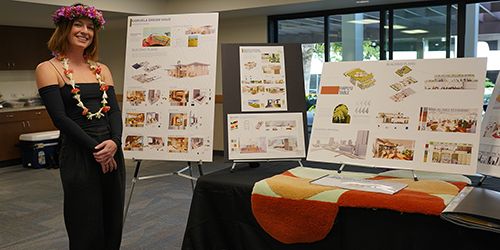
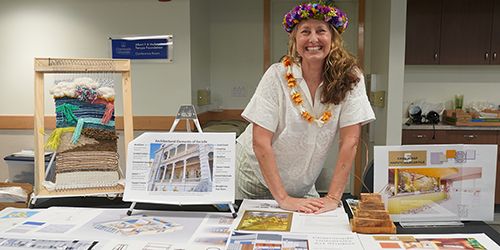
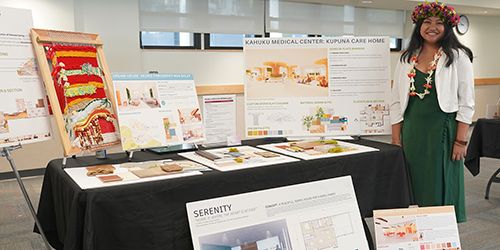
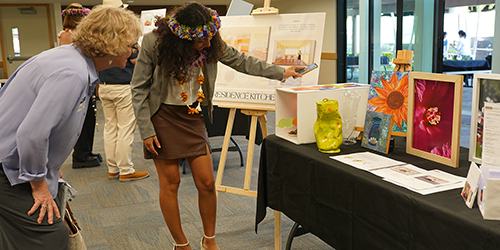
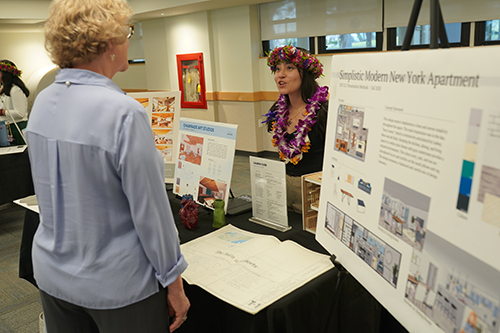
After all the late nights, tears and sweat, 2023 graduating seniors, Montserrat Lanfranco, Laura Flor, Maria Bernaldez, Angela Huber and Sarah Robertson had one last hurdle before Commencement: the Environmental + Interior Design’s Senior Showcase Exhibit. Presenting their projects to industry designers, family and friends on a Thursday night, the five seniors were eager to share a compilation of their works over the course of their undergraduate studies.

“There will be no more crying in the studio and calling security late at night to open the doors,” Flor laughed. “It’s exciting to be done, but it feels surreal because we’re all still busy.”

During her freshman year, Lanfranco built a “light box,” as required in her EID 205 Color for Interiors class, which focused extensively on the use and application of color in interior environments, including color notations, the Psychology of color and human response and application of color.

Angela Huber
Sarah Robertson
Maria Bernaldez
E+ID graduating students shared their projects during the Senior Showcase Exhibit.
Montserrat Lanfranco
E+ID graduating students presented their projects during Senior Showcase Exhibit.
Laura Flor
Senior graduating students shared their projects during Senior Showcase Exhibit at Hale Hoaloha.

Using a flashlight utility on an iPhone, Lanfranco pointed a beam inside the box—which had several round cutouts, each covered with a different patch of color cellophane—and explained the effects that color has on people’s moods.

“Imagine this is a building and the sun is moving through it, casting different colors and lighting,” said Lanfranco, shining a beam across her light box. “Color and lighting can certainly impact a person’s behavior and mental state.”

For her senior Capstone project, Bernaldez presented a re-design proposal to members of the Kahuku Medical Center Kupuna Caregivers. She also participated in a pitch to Maunalua Fishpond Heritage Center in East Oahu.

“I also had an internship with RMA Architects,” Bernaldez said. “And I just received an email about a full-time junior interior designer job offer from my supervisor at RMA, so I’m absolutely thrilled.”

The mission of Chaminade University’s Environmental + Interior Design Program is to educate, engage and empower students to optimize design of the built environment as it relates to our global, multi-cultural, multi-generational living and working communities. Graduates, like Bernaldez, are prepared to make the transition to entry-level professional practice, and to collaborate with architects and related industry professionals.

“The scope of design has expanded and much broader now,” explained E + ID program coordinator Matthew Higgins. “Here at Chaminade, the program added ‘Environmental’ to the curriculum in attempt to breakdown barriers, and to think beyond windows and doors.”

This was precisely the approach that Fuentes took when she worked on her Art Museum project. “I wanted to see how someone diagnosed with autism—which includes such a broad spectrum—would experience an art exhibit,” Fuentes said. “So, I set out to create more of an interactive exhibit.”

Posted by: University Communications & Marketing Filed Under: Campus and Community, Homepage, Humanities, Arts & Design, Innovation, Students Tagged With: Campus Event, Environmental + Interior Design

Scholarship to Support Teacher Shortage

May 3, 2023

New Partnership to Address Teacher Shortage

Every state across the country is coming up with solutions to combat the teacher shortage, which many education officials describe as a severe crisis. For its part, Hawaiʻi introduced multiple incentives and retention efforts—from higher pay to student loan forgiveness—to attract new teachers, but more educators will still be needed in the near future.

To address the community’s needs, Chaminade University and Kamehameha Schools have introduced their own new carrot: an innovative and community-focused teacher prep partnership that will provide 150 Muʻo Scholarships to educate, train and prepare aspiring teachers to lead Hawaiʻi’s classrooms.

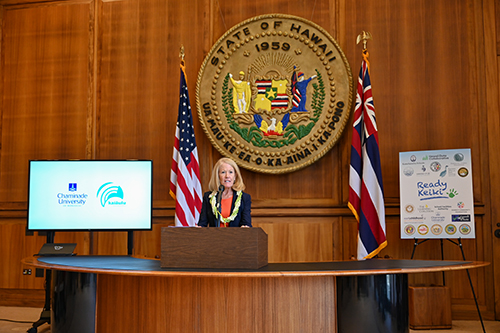
Chaminade President Lynn Babington addresses new partnership with Kamehameha Schools.

“We are excited to announce this partnership with Kamehameha Schools, which directly addresses one of our most pressing community issues: a teacher shortage,” said Chaminade University President Dr. Lynn Babington, during a press conference in the ceremonial chambers of the Office of the Lieutenant Governor Sylvia Luke. “By providing these scholarships, we’re removing barriers that too often hinder many working adults in the state from  obtaining a bachelor’s degree while still maintaining family and work commitments.”

The new partnership will provide full-tuition scholarships, and aligns with Lt. Gov. Sylvia Luke’s “Ready Keiki” program, which aims to create universal preschool access for all of Hawaiʻi’s 3- and 4-year-olds by 2032.

“Ready Keiki is a commitment by the State of Hawaii to provide access to early education,” Lt. Gov. Luke said. “In order to do that, it wasn’t just the state of Hawaii leading the charge. We needed partnership from many of the departments, all the counties and many of our private philanthropic partners, including Kamehameha Schools and Chaminade University.”

Beginning Fall 2023, Chaminade University and Kamehameha Schools will offer 50 students full-tuition Muʻo Scholarships to Chaminade’s online bachelor’s program to become teachers here in Hawaiʻi, prioritizing early learning. This enrollment will continue for two additional years for a total of 150 funded scholarships as a partnership through KS Kaiāulu, a new way for Kamehameha Schools to impact keiki and ʻohana in the kaiāulu (community) alongside community partners.

Dr. Wai’ale’ale Sarsona believes every keiki should have access to early learning.

“Every keiki should have access to early learning, which provides a strong foundation for a lifetime of learning,” said Dr. Waiʻaleʻale Sarsona, vice president of Hiʻialo at Kamehameha Schools. “We are committed to help make this vision a reality, and this latest partnership with Chaminade University will bring Hawaiʻi closer to achieving this goal.”

Chaminade University’s online bachelor’s degree program is designed for working adults in Hawai‘i who may already be serving as a teacher’s aide or, currently, in a similar position. The online delivery format will allow students to continue working while pursuing their bachelor’s degree. Program information is available and applications for the scholarships are being accepted. This transformative program is 100 percent online, with a requirement to complete a student-teaching track. Students will be paired with an academic advisor to guide them on the road to graduation.

Applications are open to all Hawaiʻi residents with additional consideration extended to those of Native Hawaiian ancestry. Recruitment and admittance priority will also be given to early childhood education applicants.

Chaminade University and Kamehameha Schools are institutions that value education and understand how teachers—at the early stages of childhood—have a positive impact on kids, their families and the community-at-large. This partnership is a testament to their commitment.

“This is a great day when we’re announcing this partnership, thanks to Chaminade University, thanks to the efforts of Kamehameha Schools,” said Lt. Gov. Luke. “We have found a way to fill that (teacher) void; and found the pathway to filling these classrooms with qualified teachers, qualified teaching assistants.”

Watch the KITV news coverage.

Watch KHON2’s news coverage.

Posted by: University Communications & Marketing Filed Under: Center for Teaching and Learning, Education, Homepage, Innovation Tagged With: Elementary Education, Scholarship

Na Liko Naʻauao

April 28, 2023

Students present their thought-provoking research findings

She suspected that she couldn’t be the only one feeling isolated and alone. With COVID cases spiking during her freshman year, Iris Hirata sheltered in place in her dorm room with her family support 5,000 miles away.

“I usually like being alone, but that was too much—even for me,” Hirata recalls. “It was depressing and I felt I had no one to talk to.”

As pandemic numbers started to decrease, and a semblance of normalcy emerged, Hirata never forgot those earlier times. “Biologically, I knew about COVID’s impact on the lungs,” Hirata says. “But I told Dr. Darren Iwamoto, we didn’t know the impact that COVID had on the mental health of individuals.”

It turned out to be a lot.

In an earlier research project she worked on with psychology professor Tracy Trevorrow, Ph.D., Hirata studied the effects of COVID on sleep quality. They learned that during the nascent stages of the pandemic, people tended to be more on their phones, which would disturb their sleep patterns and quality of sleep.

Iris Hirata stands in front of her presentation about COVID-19 and mental health.

“I was really big on healthcare at the time, which is what led me to do a research project on the impact of COVID on mental health,” says the biology major, who presented her findings during the 21st annual Na Liko Na’auao Symposium on April 14.

Pointing to a chart with spikes of blue and red lines, Hirata explains that the graph indicates the “bounce back” or the resiliency rate of the 200 students surveyed during her research.

“The epidemic has had a significant impact on university students’ mental health, including things like stress, anxiety, depression, and a lack of behavioral and emotional control,” Hirata concludes in her findings. “The findings support the literature that resilience is a key factor in influencing mental health and overall wellness.”

According to Amber Noguchi, Ph.D., Undergraduate Research and Pre-Professional Programs director, undergraduate and graduate research experience can look like a number of things. It can range from formal and clinical studies to data analysis, and creative works and beyond. On the occasion of this year’s Na Liko Na’auao Symposium, 25 student presenters covered a broad spectrum of issues and questions, from Hirata’s “How does COVID-19 Impact the Mental Health of Individuals?” to “Eat Healthy, Live Strong: Understanding Eating Behaviors of NHPI on Oahu” and “Sports Analytics: What Factors Determine a Winning Team?” and “Decolonizing Hawaii’s Diet.”

“All of these presentations stem from research projects that have been collaborations between the student researchers and their faculty mentors,” Noguchi explains. “This undergraduate conference celebrates student scholars from across all academic disciplines.”

In her research project with Dr. Guanlin Gao, “Eat Healthy, Live Strong: Understanding Eating Behaviors of NHPI on Oahu,” Autumn Fairall, ’23, examined the barriers to eating a healthy diet. “I started working with Dr. Gao as a research assistant in the Spring of 2022,” says Fairall, who will earn her Bachelor of Science in Nursing in May. “Initially, the project we worked on focused on the landscape of economic and personal finance in Hawaii. However, after talking with Dr. Gao and discussing personal interests in wellness and past, informal research connected to diet, the research focus altered.”

Chaminade President Dr. Lynn Babington presents Dr. Rylan Chong and Kawailani Luat with their respective awards.

During the conclusion of the Symposium, President Dr. Lynn Babington, defined a scholar as “A person with a desire to pursue and learn new things; a person on a quest for knowledge and a dedication to learning.” By not focusing on one academic discipline, Na Liko Na’auao gives all student scholars an opportunity to present their work in a formal setting, and receive feedback from both faculty and other scholars within their field.

Every year, after all the student scholars have presented their work, the Symposium concludes with a presentation of two special awards. Given annually, The President Sue Wesselkamper Award acknowledges a student who has demonstrated extensive community and university service. In order to qualify for the prize, a student must have a minimum 3.5 GPA, show scholarship beyond classroom requirements by undertaking their own independent research or study, and must have presented their work both on and off campus.

Kawailani Luat is this year’s recipient of the President Sue Wesselkamper Award. A senior, majoring in Data Science, Analytics and Visualization and minoring in Forensic Science, Luat consistently excels in her coursework and has taken on leadership roles through her extracurricular and volunteer services.

“To be recognized with this award validates all the hard work I’ve done to get here,” Luat said. “I finish my senior year with this last achievement, so I am beyond ecstatic.”

“Kawailani is very active within our Chaminade community, including the Animal Advocacy Club, I am a Scientist, and has helped at every Preview and Admitted Students Day,” Babington says. “She also served as a student panelist for the Women in Data Science Hawaiʻi program and volunteers at Palama Settlement, a non-profit community-based social service agency working in the Kalihi and Palama neighborhoods.”

Honoring the close student-faculty relationships formed at Chaminade, the President Mackey Award is presented to an outstanding faculty mentor, nominated by a student participating at the conference. This year’s recipient is Dr. Rylan Chong, nominated by LaVelle White.

“He personally helps students step outside themselves to try things that were not thought possible,” wrote White in his nomination letter. “He encourages and pushes students to go for internships and research programs like SPICE. He stays after class to help students answer questions, and he has a way of speaking that demystifies the whole process, giving students the confidence to essentially go for the gold.”

Posted by: University Communications & Marketing Filed Under: Behavioral Sciences, Campus and Community, Diversity and Inclusion, Humanities, Arts & Design, Innovation, Institutional, Natural Sciences & Mathematics, Students Tagged With: Campus Event, Honors and Awards

  • « Go to Previous Page
  • Page 1
  • Interim pages omitted …
  • Page 6
  • Page 7
  • Page 8
  • Page 9
  • Page 10
  • Interim pages omitted …
  • Page 13
  • Go to Next Page »

Footer

Chaminade University Logo

3140 Waialae Avenue
Honolulu, Hawaii 96816

Contact Us
Phone: (808) 735-4711
Toll-free: (800) 735-3733

facebook twitter instagram youtube linkedin

Visit

  • Plan Your Visit
  • Campus Map (PDF)
  • Events

Resources

  • Campus Security
  • Student Consumer Information
  • Concerns, Feedback, and Reporting
  • Institutional Review Board
  • Title IX / Nondiscrimination Policy
  • Compliance
  • Emergency Information
  • Careers
  • Institutional Statement

People

  • Students
  • Parents
  • Alumni
  • Faculty & Staff

Policy

  • Privacy Policy
  • Terms and Conditions of Use


© Chaminade University of Honolulu