• Skip to primary navigation
  • Skip to main content
  • Skip to footer
Chaminade University of Honolulu

Chaminade University of Honolulu

  • VISIT
  • APPLY
  • GIVE
  • STUDENTS
  • PARENTS
  • ALUMNI
  • FACULTY/STAFF
  • Admissions
    • Admissions Home
    • Undergraduate Students
      • First-Year Students
      • Transfer Students
      • Admitted Students
    • Graduate Students
    • Flex Online Undergraduate Program
    • Military Students
    • Non-Degree/Visiting Students
    • Experiential Honors Program
    • Early College Program
    • New Student Orientation
  • Tuition & Aid
    • Financial Aid Home
    • Tuition & Expenses
    • Federal Updates & Changes
    • Scholarships
    • $5,000 Graduate Scholarship
    • VA Education Benefits
    • Net Price Calculator
  • Academics
    • Academics Home
    • Academic Programs
    • Office of Student Success
      • Academic Advising
      • Records and Registrar
    • Kōkua ʻIke (Support Services)
      • ADA Accommodations
      • Career Services
      • Proctoring Services
      • Tutoring Services
    • Sullivan Family Library
    • Undergraduate Research & Pre-Professional Programs
    • Commencement
  • Campus Life
    • About Campus Life
    • Student Engagement
    • Student Government Association
    • Residence Life and Housing
      • Summer Conference Housing
    • Health Services
    • Marianist Leadership Center
    • Counseling Center
    • Campus Ministry
    • Campus Security
    • Dining Services
    • Bookstore
  • Athletics
  • About
    • Chaminade University News
    • Our Story
    • Leadership
    • Chaminade University Strategic Plan 2024-2030
    • Mission & Rector
    • Association of Marianist Universities
    • Facts & Rankings
    • CIFAL Honolulu
    • Accreditation & Memberships
    • Montessori Laboratory School
Search
×

Search this web site

Innovation

Chaminade, Blockchain Firm Partner for ‘Datapreneurship’ Internship

December 17, 2024

Chaminade University is proud to partner with cutting-edge software company Constellation Network to expand a “datapreneurship” internship program aimed at empowering students to innovate in the emerging digital economy.

Constellation Network, a leading blockchain solutions business, provides guidance and technical assistance to two federally-funded grant programs at Chaminade, including the $10 million NSF-INCLUDES ALL-SPICE Alliance aimed at building data science capacity across the Pacific and the ’Inana Innovators Program to nurture sustainability entrepreneurs.

Now, Chaminade and Constellation Network are working together to scale up a unique “datapreneurship” internship, first piloted in Summer 2024, with a full cohort of five new students to begin in Spring 2025.

Participants will work to build their skills as data scientists and entrepreneurs, leveraging Constellation Network’s blockchain technologies to tackle real-world challenges.


Never miss a post! Follow Chaminade University on Facebook and Instagram.


Dr. Helen Turner, principal investigator of the NSF-INCLUDES ALL-SPICE and ’Inana Innovators programs, said industry partnerships are “critically important to STEM higher education, especially in computational disciplines that have dramatic workforce shortfalls.”

“Our students are inspired by the transformational leaders and world-class technical experts they meet and they form game-changing networks to enhance their career prospects,” she said.

Turner added a short-course certification program is also being developed as part of the partnership. “Economic growth and diversification is a decades-long conversation in the islands, and I think our students feel the energy around the digital economy and Web3.0 as a truly viable path for increasing prosperity and accessing technical jobs in Hawaii and beyond,” Turner said.

Benjamin Diggles, co-founder of Constellation Network, said the business is “incredibly excited to be at the forefront of sovereign data attribution and incentive design by aligning with forward-thinking entities such as the ALL-SPICE program at Chaminade.”

“Both communication and financial exchange capabilities have significantly up-leveled because of Web3.0 technologies,” Diggles added. “In conjunction with joining this key alliance, Constellation is working with other universities on furthering Web 3.0 education.”

For more on the ALL-SPICE Alliance, click here.

Posted by: University Communications & Marketing Filed Under: Campus and Community, Featured Story, Homepage, Innovation Tagged With: Data Science, Innovation

Chaminade Partners on Cutting-edge AI Research

November 19, 2024

Project seeks to leverage AI to advance health equity

Chaminade University is a proud collaborator with the John A. Burns School of Medicine (JABSOM) at the University of Hawai’i on cutting-edge work designed to leverage artificial intelligence (AI) to advance health equity and research diversity in Hawai’i and the Pacific.

Chaminade will contribute to a JABSOM-led project that recently received a $500,000 Phase II award from the National Institutes of Health’s AIM-AHEAD (Artificial Intelligence/Machine Learning Consortium to Advance Health Equity and Researcher Diversity) program.

The work is aimed at using AI to enhance public health and reduce disparities, and the Hawai’i researchers plan to do that by deploying student researchers for new opportunities and “skilling up” AI experts so they can then serve as “navigators” for key stakeholders.

Dr. Alex Stokes is the principal investigator of the project at JABSOM and will collaborate closely with Dr. Helen Turner, research director at Chaminade’s CIFAL Honolulu Center, and her team.


Never miss a post! Follow Chaminade University on Facebook and Instagram.


Turner said Chaminade is a key partner with the University of Hawai’i and the national AIM-AHEAD consortium on the ARCH project, which stands for AI Resource Concierge for Healthcare.

“The ‘resource concierge’ is a web gateway for researchers, community, healthcare providers and policymakers to access AI/ML tools, datasets and the training and technical assistance needed to use them in support of their missions in health equity,” Turner said.

Dr. Helen Turner
Dr. Helen Turner

Turner added the JABSOM and Chaminade teams implemented a Phase I ARCH pilot in 2023-24 that offered AI resources to healthcare stakeholders, conducted a landscape needs assessment survey, and trained a new class of “AI navigators” to assist healthcare users in understanding the potential of AI to reduce health equity.

The team also started proof-of-concept research projects applying AI to health equity challenges, such as diabetes and PTSD, with collaborators from Hawai’i, American Samoa and Aotearoa.

“The successful ARCH-Hawaii pilot was selected for a competitive ‘Phase II’ to take it national, which is a wonderful development ” said Turner, adding the Chaminade team—which in addition to Turner, as principal investigator of an NSF Alliances grant, also includes Dr. Catherine Brockway and Connor Flynn—will contribute to the next phase of the AIM AHEAD project by implementing a national training curriculum (deploying the CIFAL Center’s UN short course model) to “skill up” AI navigators.

Those navigators will then help stakeholders to apply AI to their health equity projects.

Additionally, the grant will help support new opportunities for student researchers, including internships, a “health equity hackathon,” and other health equity projects during the school year.


Interested in learning more about the grants mentioned in this article?

  • The NIH AIM-AHEAD award number is OT2OD032581-01 and Stokes ([email protected]) is the principal investigator.
  • The NSF INCLUDES ALL-SPICE Alliance award number is: NSF HRD-2217242 and Turner ([email protected]) is the principal investigator.

Posted by: University Communications & Marketing Filed Under: Featured Story, Homepage, Innovation Tagged With: Grants, Office of Sponsored Programs, Research

Entrepreneur Kicks Off Speaker Series

September 5, 2024

The co-founder of Kō Hana Distillers detailed how he overcame ‘roadblocks’ to go to market

Kō Hana Distillers co-founder Robert Dawson kicked off the fall Hogan Entrepreneurial Leadership Program Guest Speaker Series, detailing his journey from a business idea to a successful company.

Speaking to attendees, Dawson said he “didn’t know anything about sugarcane” and “didn’t even like rum” when he moved to Hawaii with his wife and son in 2008. He said his deep appreciation of history led him to Hawaii’s agriculture past and ultimately, “Native Hawaiian sugarcane,” called kō.

He teamed up with a scholar to learn more about Hawaii sugarcane, which was brought by ancient Polynesian seafarers to Hawaii more than 1,000 years ago.

Having spent a time in Brazil, Dawson told attendees at his talk Wednesday he had always been a fan of cachaça, the Brazilian rum made from sugarcane juice. This would be the direction he would take with his new venture, he said, growing and harvesting Hawaiian varietal sugarcane to distill rhum agricole.

Incorporating Kō Hana Hawaiian Agricole Rum in 2011, Dawson and business partner Jason Brand introduced their first agricole-style rum made entirely from Hawaii-grown sugarcane in 2014.

“It took time and getting over a lot of roadblocks,” Dawson said.

“But now we’re expanding to grow sugarcane across 1,600 acres on the North Shore, and our goal is to become an international boutique rum distiller.”


Never miss a post! Follow Chaminade University on Facebook and Instagram.


The Hogan Guest Speaker Series is aimed at enriching the educational experience, connecting entrepreneurial-minded students with successful professionals from various industries and bridging the gap between theoretical knowledge and practical application.

Dr. Roy Panzarella, Hogan Entrepreneurial Leadership Program director, said guest speakers are selected based on the program’s objectives for the year. There are seven speakers on the schedule for the fall, including Better Sour and Shaka Tea co-founder Isabella Hughes, set to speak on Oct. 16.

“For many students, these are delightful opportunities to be exposed to and learn the power and value of networking,” Panzarella said, adding that speakers gives students invaluable real-world insights.

“Our wish is that all Hogan students, including those pursuing an MBA, will walk away from each lecture even more inspired to listen actively, read critically and speak effectively,” Panzarella said.

He also hopes the students leave the lectures, as well as the Hogan Entrepreneurial Leadership Program, more confident and excited about using their own talent and skills to start something new.

“Sometimes the Wednesday presentations have a long-lasting impact on our Hogan students, but I have found it is the lecturers themselves that have the most influence on them,” Panzarella said.

“Oftentimes, the personal narratives of the lecturers are so powerful they serve to inspire many students who doubt themselves and their capacity to achieve success.”


COMING UP:

An entrepreneurship teacher at Seabury Hall on Maui, Melissa Crounse Kaufman will be the next Hogan guest speaker on Sept. 18. Kaufman is the founding executive director of the Garage at Northwestern University and co-author of “Founded: The No B.S. Guide for Student Entrepreneurs.”

For the complete fall schedule, click here.

Posted by: University Communications & Marketing Filed Under: Business & Communication, Featured Story, Innovation Tagged With: Campus Event, Hogan Entrepreneurs Program

Student Research on Display

July 29, 2024

The Summer Research Institute Symposium was an opportunity for undergraduate scientists-in-training to get feedback on their work.

In his final presentation during the Summer Research Institute Symposium, Zach McClellan ’25 decided to pursue the correlation between the effects of occupational stressors on the quality of life among firefighters.
Zach McClellan ’25 presented his findings during the Summer Research Institute Symposium.

Zach McClellan ’25 comes from a long line of firefighters—and has seen first-hand the trauma these first responders can experience.

So as a participant in this year’s Summer Research Institute at Chaminade, the Psychology major decided to study how occupational stressors correlate to quality of life indicators for firefighters.

He presented his findings July 23 at the Summer Research Institute Symposium on campus, an annual showcase of cutting-edge undergraduate research at Chaminade conducted under the mentorship of professors.

“I sent out my first survey that comprised of demographics, the Firefighter Assessment of Stress Test (FAST), and the Quality of Life Enjoyment and Satisfaction Questionnaire Short Form (Q-LES-Q-SF) back in March,” said McClellan, pointing out the number of respondents shown on his poster board.

“This was my capstone project with Dr. (Darren) Iwamoto, and I want to take it as far as I can take it. The end goal is to get the study published.”

Organizers say the symposium reflects Chaminade’s strong commitment to advancing academic excellence while fostering close collaborations between faculty and student researchers.

A two-time participant in the Summer Research Institute Symposium, Grace Helmke ’25 built on last year’s “Climate Monstrosities” with this year’s “Climate Tricksters in an Indigenous Future.”

Mentored by Assistant Professor of English Dr. Justin Wyble, Helmke said she chose the subject for a couple of reasons. “The no. 1 reason was that I believe Indigenous peoples to have an incredibly important perspective on society—one that’s largely dismissed and unseen by the masses,” the English major said.

“Their viewpoints surrounding the ways in which to combat colonialism, preserve culture and fight for a greater future, are all concepts that each of the texts I focused on examined. I believe that discussing these concepts, principles and cultural beliefs, from an Indigenous perspective, has the potential to lead society into a future that rejects the colonial systems, and instead seeks equity and healing of the people.”

Amber Noguchi, program director for Chaminade’s Undergraduate Research and Pre-Professional Programs Office, said the symposium allows Summer Research Institute participants to not only showcase their work—but get feedback and questions from attendees to expand their research inquiries.

The institute is funded by a joint federal Title III grant with Kapiolani Community College.

A two-time participant in the Summer Research Institute Symposium, Grace Helmke ’25 built on last year’s “Climate Monstrosities” with this year’s “Climate Tricksters in an Indigenous Future.”
Grace Helmke ’25 explained her theories to a group of attendees.

“We just completed our fourth SRI,” Noguchi said, adding that participants also present at Kapiolani Community College’s Student Undergraduate Research Fair each semester.

Participant Georgeanna Flook is a rising senior and double majoring in Historical and Political Studies, and Criminology and Criminal Justice. Her research looked at the influence that education has on crime. Titled “Support Instead of Control: Education as a Unique Approach to Crime,” Flook’s study explored the possibility of reducing crime outside of traditional policing methods.

She credited her professors, Drs. Abby Halston and Kelly Treece, and lecturer Collin Lau, J.D., for their guidance as she conducted her research. Flook said she found that education, “acting as a means of formal social control and providing social support, can effectively reduce crime—regardless of the academic ability of the individual.”

“Future studies should focus on further articulating what effective social support means in the context of criminology and use working examples of social support to compare against crime trends,” concluded Flook, who aspires to go into criminal justice policy analysis.

Other Summer Research Institute participants at Chaminade this year included Ku‘ulei Koko ’26, who presented “Feeding Hawaii’s Future: Evaluating the Effectiveness of Culturally Tailored Programs for Native Hawaiians,” and LaVelle White ’26, who looked at “Student Food and Nutrition Security.”

For details on undergraduate research opportunities at Chaminade, click here.

Posted by: University Communications & Marketing Filed Under: Diversity and Inclusion, Featured Story, Innovation, Students, Undergraduate Research & Pre-Professional Programs Tagged With: Campus Event, Grants, Undergraduate Research & Pre-Professional Program

Training the Teacher: Financial Literacy

July 24, 2024

For a third year, this summer workshop at Chaminade sought to help teachers incorporate financial literacy principles into their classroom lessons.

For one week this July, 26 educators from across the island headed back to class at Chaminade.

They weren’t on campus to teach but to learn—as participants in Chaminade’s annual Economic Education Center for Excellence’s Summer Workshop, which ran from July 22 to 26.

Now in its third year, the workshop offers elementary to high school teachers innovative pedagogical instruction for incorporating key economic and finance principles into hands-on class lessons.

Attendee Daniel Quiamas heard about the summer workshop from a friend, Thomas Yeung, a teacher with Farrington High School’s Business Academy who attended last year’s series of workshops. Quiamas—a math teacher at Waipahu High—said after just two days that he had already learned new ways to incorporate economics and finance into his classroom instruction for ninth to 12th graders.

Chaminade President Dr. Lynn Babington, far right, and Greg Young President & CEO of HawaiiUSA Federal Credit Union, far left, pose with participants who held up the EECE Summer Workshop 2024 sign after completing the weeklong program.

“I was never really taught about financial literacy so this workshop is very informative,” said Quiamas, after listening to Joanne Ching, a financial wellness partner with HawaiiUSA Federal Credit Union, which was one of the sponsors of this annual Summer Workshop and a strong proponent of financial literacy.

The ECCE’s summer workshop is taught with a combination of lectures, in-class games and group activities, hands-on projects and field classes. Organizers say the curriculum places an emphasis on real-life examples and situations, and includes economics and personal finance concepts based on the Hawaii Department of Education Social Studies Common Core standards.

Some of the key topics covered include market operations and government interventions, environmental economics, personal finance education and financial wellness.

Guanlin Gao, director of the Economic Education Center for Excellence and an associate professor of economics at Chaminade, said the ECCE’s mission is to advance economic justice in Hawaii and across the Pacific. In addition to offering educational programs for teachers, students and the community, the center tackles research projects that dovetail with its mission—and can help inform policy-making.

Gao said the program has so far trained 62 teachers who work in schools statewide. Its economic literacy curriculum and programs have positively benefited more than 7,400 Hawaii students.

“The importance of financial literacy and basic economic principles can’t be overstated,” Gao said.

“It impacts people’s everyday lives.”

The ECCE’s growing outreach efforts come amid a greater push nationally to underscore financial literacy in schools nationwide. According to the Council for Economic Education’s latest biennial Survey of the States, more than two-thirds of all states now require personal finance classes for high school graduation—a sharp increase from 2022 when fewer than half the states had such mandates.

On the last day of the five-day ECCE workshop, participants were asked to give a presentation on how they plan to incorporate what they’ve learned into their own classrooms. Some said they would use it as a “bell ringer,” devoting the first few minutes of class to financial literacy and personal finances. Others planned to take a more comprehensive approach, developing specific age-appropriate lesson plans.

Social studies teacher John Silang, a 10-year veteran with Kapolei High School’s Business Academy, attended the workshop aspiring to learn how to stop systemic poverty.

“I call it Adulting 101,” Silang said. “I wanted to learn how college educators teach economics and how they apply the theories in the classroom.”

For Gao, the moral imperative of teaching financial literacy is clear.

“We recognize that there is still much to be done to improve financial literacy in Hawaii. However, we take pride in our efforts to make a difference and establish ourselves as a center for economic education,” Gao said. “Financial literacy doesn’t have to be daunting or out of reach. It should be accessible to everyone. In reality, we all have innate economic instincts; you might just not be aware of them—yet.”


  • Workshop participants received their certificates after the weeklong series of workshops.
    Workshop participants received their certificates after the weeklong series of workshops.
  • HawaiiUSA Federal Credit Union Financial Wellness Manager, Bryan Yucoco, was one of the guest speakers during the EECE Summer Workshop.
    HawaiiUSA Federal Credit Union Financial Wellness Manager, Bryan Yucoco, was one of the guest speakers during the EECE Summer Workshop.
  • Economics Professor, Dr. Guanlin Gao, discussed the basic fundamentals of economics and its functions in society.
    Economics Professor, Dr. Guanlin Gao, discussed the basic fundamentals of economics and its functions in society.
  • For five days, 26 educators from across the island went back to the classroom, not to teach but to learn more about financial literacy.
    For five days, 26 educators from across the island went back to the classroom, not to teach but to learn more about financial literacy.

Posted by: University Communications & Marketing Filed Under: Campus and Community, Featured Story, Innovation Tagged With: Economic Education Center for Excellence, School of Business and Communication

Harnessing the Power of Supercomputers

July 16, 2024

In an innovative summer research institute, Chaminade students used data science to tackle big research questions.

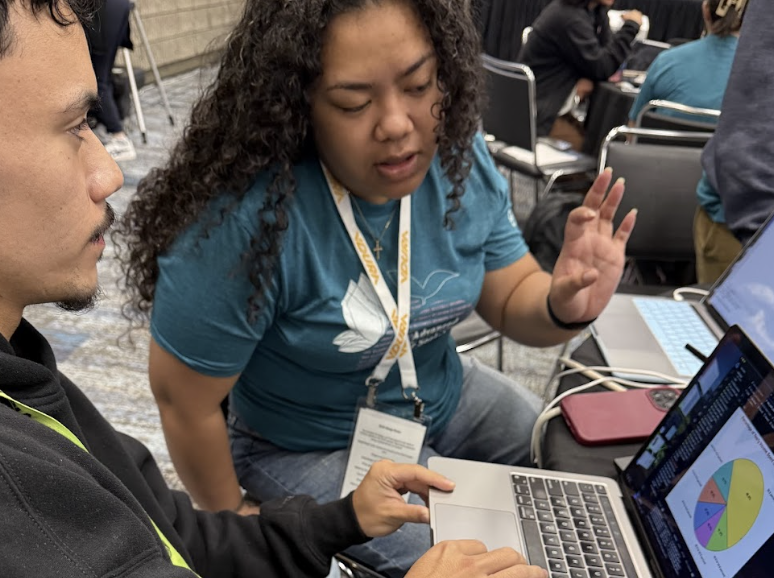
For four intensive weeks this summer, 25 Chaminade students used supercomputers at the Texas Advanced Computing Center to analyze complex data sets. They were looking to test hypotheses to complex research questions. And along the way, they got valuable hands-on experience in data science, one of the nation’s fastest-growing fields in a long list of sectors, from climate science to healthcare.

The Alliance Supporting Pacific Impact through Computational Excellence (ALL-SPICE) Data Science Summer Institute allows students to take a deep dive into their research interests, giving them access to tools and supercomputers that can help synthesize complex data sets into understandable, manageable variables.

“This is not theoretical learning,” says Connor Flynn ’21, a data scientist with Chaminade’s School of Natural Sciences and Mathematics. Flynn participated in ALL-SPICE as a student and now serves as a group leader. “This is literally experiential since some of the students’ research projects require that they go to actual sites to verify what they’ve captured in their data is accurate.”

ALL-SPICE, now in its sixth year, is the product of an innovative Chaminade partnership with the University of Texas at Austin’s Texas Advanced Computing Center. ALL-SPICE is one of just four new National Science Foundation INCLUDES Alliances, and organizers say the ALL-SPICE program helps level the playing field for Native Hawaiian and Pacific Islander (NHPI) students, who are woefully underrepresented in science, technology, engineering and math (STEM) fields.

“The program is transformative for students from Hawaii and the US-affiliated Pacific, from Chaminade and many other colleges,” said Dr. Helen Turner, biology professor and principal investigator for Chaminade’s NSF ALL-SPICE program.

“Students come in with curiosity and a passion to solve their islands’ challenges. They leave as card-carrying data scientists with a high-demand skill set that they can use to change the future.”

Wilneris Carrion-Colon ’25 and Johnny Bae ’26 were among the students who participated in this year’s ALL-SPICE summer intensive program. They are both excited about pursuing careers in STEM.

In the summer program, the two Data and Computer Science majors used imaging technology to detect marine debris found off Windward Oahu. Carrion-Colon said satellite technology has become a valuable tool for detecting and classifying environmental phenomena on both land and aquatic environments.

  • The data science classroom was the main hub for the ALL-SPICE Summer Institute.
  • Thirty-two students were divided into three groups then into sub-groups as they pursued their research interests.
  • For four weeks, students researched their interests in environmental management and health disparities.
  • Students share their research with Kumu Kahoa Keahi-Wood.
  • Kumu Kahoa Keahi-Wood serves as the Environmental Project Lead and has been with SPICE's first cohort since 2019.

“By analyzing reflectance and absorption of light, spectral bands enable machines to differentiate material classes,” said Carrion-Colon, during her final presentation.

“Notably, the Windward side was chosen because it is particularly susceptible to marine debris accumulation due to prevailing ocean currents.”

Carrion-Colon noted there are limitations to her analysis, but added that’s reason to do more research.

In his research, Bae mapped out ocean plastics using machine learning in waters northeast of Oahu.

Also using multispectral satellite imagery and statistical learning algorithms to detect floating marine debris, Bae sought to underscore the critical role of technology in environmental management.

“Ultimately, this work contributes to protecting marine ecosystems, supporting economic stability and safeguarding public health,” said Bae, in presenting his findings.

“Future research and initiatives—stemming from detecting and mitigating plastic marine debris in Hawaii’s ocean using machine learning and AI—can significantly contribute to the United Nations’ Sustainable Development Goals, specifically SDG 12, which focuses on responsible consumption and production; and SDG 13, which involves evaluating the carbon footprint of plastic debris.”

Open to all majors, from nursing and business to biology and interior design, the ALL-SPICE Data Science Summer Institute also teaches students how to code and use other cutting-edge tech.

Organizers say ALL-SPICE participants represent the region’s diversity, and include significant numbers of women and veterans. Students work in thematic areas that are of central importance to the Hawaii-Pacific region, including climate analytics, health inequity and the impacts of misinformation.

The summer institute also has a strong cultural component and culminates in a ho‘ike—a showcase of student projects). SPICE mentors include faculty, analysts and peers. To learn more, click here.

The SPICE program was funded by NSF INCLUDES ALL-SPICE Alliance #HRD-1744526. Student places were sponsored by ALL-SPICE and the following additional grants (Primary Investigator Dr. Helen Turner): NSF EPSCoR Hawaii (#OIA-2149133), the Pacific Intelligence Innovation Initiative, the Sullivan Family Foundation and NIH grant 3U54GM138062-03S1 (Primary Investigator Dr. Youping Deng, University of Hawaii).

Posted by: University Communications & Marketing Filed Under: Diversity and Inclusion, Featured Story, Innovation Tagged With: Alumni, Environmental Sciences, Environmental Studies, Office of Sponsored Programs

  • « Go to Previous Page
  • Page 1
  • Page 2
  • Page 3
  • Page 4
  • Interim pages omitted …
  • Page 12
  • Go to Next Page »

Footer

Chaminade University Logo

3140 Waialae Avenue
Honolulu, Hawaii 96816

Contact Us
Phone: (808) 735-4711
Toll-free: (800) 735-3733

facebook twitter instagram youtube linkedin

Visit

  • Plan Your Visit
  • Campus Map (PDF)
  • Events

Resources

  • Campus Security
  • Student Consumer Information
  • Concerns, Feedback, and Reporting
  • Institutional Review Board
  • Title IX / Nondiscrimination Policy
  • Compliance
  • Emergency Information
  • Careers
  • Institutional Statement

People

  • Students
  • Parents
  • Alumni
  • Faculty & Staff

Policy

  • Privacy Policy
  • Terms and Conditions of Use


© Chaminade University of Honolulu