• Skip to primary navigation
  • Skip to main content
  • Skip to footer
Chaminade University of Honolulu

Chaminade University of Honolulu

  • VISIT
  • APPLY
  • GIVE
  • STUDENTS
  • PARENTS
  • ALUMNI
  • FACULTY/STAFF
  • Admissions
    • Admissions Home
    • Undergraduate Students
      • First-Year Students
      • Transfer Students
      • Admitted Students
    • Graduate Students
    • Flex Online Undergraduate Program
    • Military Students
    • Non-Degree/Visiting Students
    • Experiential Honors Program
    • Early College Program
    • New Student Orientation
  • Tuition & Aid
    • Financial Aid Home
    • Tuition & Expenses
    • Federal Updates & Changes
    • Scholarships
    • $5,000 Graduate Scholarship
    • VA Education Benefits
    • Net Price Calculator
  • Academics
    • Academics Home
    • Academic Programs
    • Office of Student Success
      • Academic Advising
      • Records and Registrar
    • Kōkua ʻIke (Support Services)
      • ADA Accommodations
      • Career Services
      • Proctoring Services
      • Tutoring Services
    • Sullivan Family Library
    • Undergraduate Research & Pre-Professional Programs
    • Commencement
  • Campus Life
    • About Campus Life
    • Student Engagement
    • Student Government Association
    • Residence Life and Housing
      • Summer Conference Housing
    • Health Services
    • Marianist Leadership Center
    • Counseling Center
    • Campus Ministry
    • Campus Security
    • Dining Services
    • Bookstore
  • Athletics
  • About
    • Chaminade University News
    • Our Story
    • Leadership
    • Chaminade University Strategic Plan 2024-2030
    • Mission & Rector
    • Association of Marianist Universities
    • Facts & Rankings
    • CIFAL Honolulu
    • Accreditation & Memberships
    • Montessori Laboratory School
Search
×

Search this web site

Student Life

Iceland Beer Spa

December 11, 2023

E+ID students enter International Architecture/Design Contest

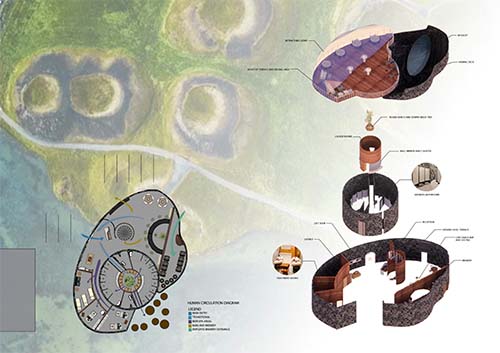
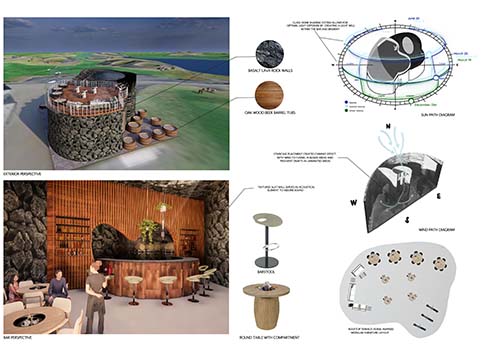
E+ID students' presentation board for the Iceland Beer Spa International Architecture/Design Competition.
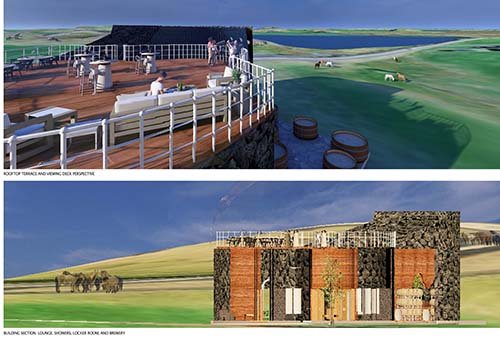
E+ID students’ presentation board for the Iceland Beer Spa International Architecture/Design Competition.
E+ID students' presentation board for the Iceland Beer Spa International Architecture/Design Competition.
E+ID students’ presentation board for the Iceland Beer Spa International Architecture/Design Competition.
E+ID students' presentation board for the Iceland Beer Spa International Architecture/Design Competition.
E+ID students’ presentation board for the Iceland Beer Spa International Architecture/Design Competition.
E+ID students' presentation board for the Iceland Beer Spa International Architecture/Design Competition.
E+ID students’ presentation board for the Iceland Beer Spa International Architecture/Design Competition.

After electronically submitting their final design concept to the Iceland Beer Spa International Architecture Competition, Katherine Liu ’26, Farrah Dinh ’25, Jazlynne Williamson ’25 and Soraya Ortiz ’25 were finally able to breathe a sigh of relief. For the past several weeks, the Chaminade Environmental + Interior Design majors were busy conceptualizing an eco-friendly space that would include a brewery, café snack bar, souvenir shop and full-service day spa facility.

“I asked them if they wanted to enter the competition, and they jumped at the chance,” says associate professor of Arts and Design Junghwa Suh, D.Arch, of the four students in her EID 384 class that focuses on sustainability in design. “It’s really impressive what they’ve been able to come up with in such a short amount of time.”

The overall competition was to replace an existing building on the property of the Sel Hotel, a family-run establishment, which is situated right in the Lake Myvatn area next to the legendary Skutustaoagigar craters, offering a prime location for a groundbreaking multi-purpose facility.  The competition sought to create a landmark destination that reflects the spirit of the region and provides an unforgettable experience for both tourists and locals alike.

Katherine Liu ’26, Farrah Dinh ’25, Jazlynne Williamson ’25, Soraya Ortiz ’25 and Dr. Junghwa Suh take a selfie before submitting their final design concept to the Iceland Beer Spa International Architecture Competition.

“Dr. Suh informed us that during her trip to Iceland, a tour guide explained how horses huddle and have formations to maintain warmth,” explains Liu, who initially wanted to pursue a degree in industrial engineering. “We wanted to integrate this idea into our design somehow since Icelandic culture values horses a great deal, and our project was strongly based off of organic forms and the idea of ‘life emulating nature.’

“The showers and bathrooms, for example, represent a cell or ecosystem within the organic crater shape of the building,” Liu adds. “Since we needed a modular element in our design, we decided to have our terrace furniture mimic the horse formations, showing the different groupings, which could be easily rearranged.” 

According to organizers, the competition was a rare opportunity to contribute to the evolution of hospitality and wellness in one of Iceland’s most enchanting regions. Designs had to be innovative and environmentally sensitive with the potential of making a lasting impact on the Myvatn Lake area and the world of architecture and design.

“This was the first time that Chaminade design students entered an international competition of this magnitude,” Suh says. “They’ve worked really hard and I’m proud of the final presentation.”

Praising Dinh, Williamson and Ortiz for their contributions, Liu says there was a lot of trust among them. “Jaz even let me take her laptop home because mine didn’t have some of the functions I needed to edit the design,” adds Liu, a student representative with the American Society of Interior Designers and a former intern with G70, a Honolulu architecture firm. “I even had her remotely take over my computer so we could finish this project on time.”

The finished design, “Da Crater Spa’t” creates a cohesive, functional and inviting space that caters to the various needs of guests. More importantly, the final product harmoniously incorporates the environs of Lake Myvatn, featuring basalt lava rock, natural ventilation, and eco-friendly finishes and materials that balance the serene beauty of the environment with the functional requirements of the project.

“They were super motivated and ambitious,” Suh says. “For three juniors and one sophomore, the level of their work is beyond impressive, and I hope they win.”

However, Liu, Dinh, Williamson and Ortiz acknowledge it’s going to be a difficult path. The competition, after all, is open to international licensed architects and designers who have years of experience in their respective fields. Still, the four Siverswords remain optimistic.

“If we win, we get to go to Iceland,” says Liu who plans on participating in a study abroad program in Florence, Italy next year. “After completing this project, my biggest takeaway was understanding the balance of adhering to a competition project timeline while continuously evolving design concepts through rigorous collaborative efforts.”

Posted by: University Communications & Marketing Filed Under: CIFAL Honolulu, Homepage, Humanities, Arts & Design, Institutional, Student Life Tagged With: Environmental + Interior Design, Honors and Awards

Economic Lesson

November 28, 2023

Chaminade students teach Jarrett Middle School students about economics

Standing in front of 13 William P. Jarrett Middle School students, Chopper Correia ’27, Brayden Braga ’27 and Roselyn Macias ’26 started their lesson by asking the students what they knew—if anything at their age—about economics. Some boisterously screamed out “money,” while others yelled “business.”

“In preparation, we’ve outlined a lesson plan,” said Macias, studying her notes before the class began. “This is my first visit here so I’m not sure what to expect.”

It was the second for Correia and Braga, both freshmen Silversword baseball players and Business Administration majors. “We’ll cover such topics as price control and budgeting,” Correia and Braga echoed. “And we’ll play a little game with them because they can easily associate with playing games.”

Turning to the class, Braga posed a second question: Who has ever heard the terms micro and macro economics? One student asked aloud, “Does it have something to do with money and budget? ” Another fired back with “small and big.” Right, Braga responded to “small and big,” then simplified the terms by explaining that microeconomics and macroeconomics are related, but separate approaches to studying the economy.

Macias took Braga’s explanation even further by expanding the subject to cover the definition of price control, price ceiling and price floor. “Price control comes in two forms,” the sophomore Business Marketing major said. “A price ceiling keeps a price from rising above a certain level—the ceiling. And a price floor keeps a price from falling below a certain level—the floor.”

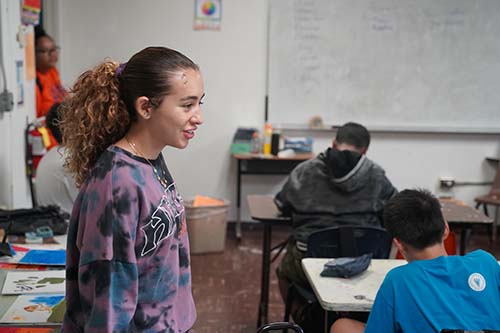
Roselyn Macias looks on as Jarrett Middle School students complete the task of creating their personal budgets.

Braga, Correia and Macias are all participating in Chaminade’s Office of Service Learning and Community Engagement program, which aims to empower students to define and deepen their classroom learning experience through impactful need-based community engagement rooted in Marianist and Native Hawaiian values.

“Our vision is to foster a collective sense of place through investment in community partnerships, service learning process and pedagogy, and a commitment to serving others,” said Mitch Steffey, Chaminade’s Associate Director of Service Learning and Community Engagement Service. “We envision a campus culture that embraces service and service learning as a valuable community-focused vehicle toward personal growth.”

The benefits of service learning extend to both the students and the communities they serve. For students, service learning allows them to apply classroom theories and concepts to tangible, real-world situations. This hands-on experience enhances their understanding of academic material and fosters critical thinking skills. Students also often acquire a diverse set of skills, including communication, teamwork, problem-solving and leadership. These skills are transferable to various professional and personal contexts, contributing to their overall development.

Meanwhile, the benefits to the community are many. First and foremost, service learning projects are designed to address specific community needs. Whether it’s tutoring, environmental initiatives or healthcare support, students contribute directly to ameliorating the well-being of the community. Secondly, universities and communities can build long-term, mutually beneficial partnerships through service learning programs. These collaborations promote ongoing support for community initiatives and foster a sense of shared responsibility.

“We also have a similar program with Palolo Elementary School,” said Jacob Escuza ’25, a student worker who acts as the Chaminade University liaison between Jarrett Middle School and Palolo Elementary School. “The Palolo program, though, is more of a one-on-one tutorial session with the kids.”

Steffey distinguishes the difference between community service and learning service. Citing an example of the latter, he uses a biology student who could go out in the lo‘i kalo (taro patch) to test the waters to see why one part of the patch produces more kalo than another.

“He/she can test if there’s too much acid in the water,” Steffey explained. “So, we’re going to the community to fulfill a need with the expertise that we already have through our professors, courses and classrooms.

“You don’t have that at beach cleanup,” Steffey continued. “The cleanup is good for the community, but there isn’t much learning being done.”

Jarrett Middle School students certainly learned about budgeting when Correia asked them to take a piece a paper out and pencil, and then pointed to a list on a whiteboard that included such budget line items as rent, food, water, video games, savings, candy, toys, furniture, toiletry and bike. Each was assigned a value from one to three points.

“You have 10 points or consider it the amount of money you make,” Correia instructed. “Now, choose the items you want until you reach 10 points and no more. And that will be your budget.”

The majority of the students prioritized rent and food, followed by video games, candy and bike. “I’m going to need a bike to get to work,” one student rationalized for adding the necessary transportation to the top of his priority list. “And I’m going have to eat, but I’m going to need a place to eat.”

Posted by: University Communications & Marketing Filed Under: Business & Communication, Campus and Community, Featured Story, Hogan Entrepreneurial Program, Service Learning, Student Life Tagged With: Hogan Entrepreneurs Program, Servant Leadership, Service Learning

Student Athlete

November 28, 2023

Haley Hayakawa ’24 has all the bases covered

Haley Hayakawa gets sworn in at the Kapolei field office of the Federal Bureau of Investigation.
Accepted into the FBI’s “Honors Internship Program,”Haley Hayakawa gets sworn in at the Kapolei field office.

Her fellow classmates think she’s playing Candy Crush on her laptop. But in actuality, Haley Hayakawa ’24 is eyeing her Google calendar, which is scattered with different colors, each representing a lab, class or work hours that she has committed to during the week.

When the California native is not in a class or lab, she’s out in left field, shagging flies as a member of the Women’s Softball team. And during the summer, Hayakawa was working 40 hours a week at the Federal Bureau of Investigation’s field office in Kapolei, where she participated in the “Honors Internship Program,” which only accepts a sliver two percent of all its applications.

“It was my first full-time job,” said the 22-year-old Forensic Science major. “It has been the best experience I’ve ever had; everybody there wants to be there, and they all want to help you.”

An avid softball player since the eighth grade, Hayakawa committed to Chaminade University when she was a junior in high school, the earliest a student athlete can officially commit to a Division I or Division II college. 

“I was recruited by Division I and Division II schools, but some wouldn’t allow their recruits to participate in sports if they plan to major in a hard science because of all the required labs,” Hayakawa said. “Chaminade does, and it’s one of the reasons I chose to come here.”

She was also familiar with Chaminade’s Forensics Science program, which requires its students to complete a rigorous, 135-hour internship with such offices as the Honolulu Department of the Medical Examiner, police departments in Hawaii and Guam or the Joint POW/MIA Accounting Command’s Central Identification Laboratory. 

“During my junior year, I interned with the Medical Examiner Department, which gets involved with deaths as a result of violence, substance abuse, trauma, accidents or suicide, among other suspicious causes of death,” Hayakawa explained. “After reading some of the suicide notes, I was thankful to be stressed out because those notes helped put things in perspective for me.”

An ambitious go-getter from an early age, Hayakawa is the only child and holds high expectations from herself—and not her parents, Greg and Myra Hayakawa. In fact, her father often tells her “to be open to changes, and not everything happens as planned.”

“In my freshman year, all I could eye was being awarded summa cum laude, which requires a 3.96 GPA,” Hayakawa notes. “I’ve only had one B and that was in Organic Biochemistry, which lowered my 4.0 GPA to 3.96.”

Ironically, one of her two American Chemical Society awards was being recognized as the Most Outstanding Student in Organic Biochemistry—despite her B—and Most Outstanding Student in Forensic Chemistry, nominated by David Carter, Ph.D., Forensic Sciences director and professor.

Haley Hayakawa gets ready to take off from second base.

“She also has minors in Biochemistry and Chemistry,” Carter says. “She is a stellar athlete on the softball team and she also works as one of our Forensic Sciences Laboratory Assistants.”

Hayakawa’s collegiate experience has certainly had its challenges. Her freshman year was during the height of COVID, which meant Hale Lokelani Residence Hall was in lockdown mode, limiting her interaction with fellow students except for her roommate Naomi Noguchi from Kauai. It was also her first time living away from home, and she couldn’t leave campus for three weeks. Meanwhile, the softball team couldn’t take to the gym and was forced to conduct its workouts via Zoom videos.

“My classes were from 8 a.m. to 5:30 p.m. on Mondays, Wednesday and Fridays, which was crazy,” Hayakawa recalls. “I was so overwhelmed, and when I went home for the winter break, my parents asked if I was OK because I had lost 30 pounds.”

When she returned to campus in the spring, Hayakawa now had to juggle between her softball season and her studies, maintaining a batting average of .377—earning her the team’s batting champion— and a perfect 4.0 GPA. 

“It’s easy to manage time, when your time is managed for you,” Hayakawa quips. “I’m all in … all the time.”

As she completes her final year as a Silversword, Hayakawa fondly reflects back on her time on Kalaepohaku campus, on the softball field, in the labs and with her friends. She already has future plans to attend graduate school, after having turned down a job offer with the FBI field office in Kapolei. 

“I’ve always wanted to help the community through criminal justice,” says Hayakawa, who will graduate as summa cum laude, thus achieving her ultimate freshman goal. “I made the right decision to come to Chaminade, not only because of its small class sizes, but because I got to form relationships with my professors and formed new friendships.”

Posted by: University Communications & Marketing Filed Under: Athletics, Featured Story, Natural Sciences & Mathematics, Student Life Tagged With: Forensic Sciences, Honors and Awards, Scholarship

Student Research Project

November 17, 2023

Pam Oda presents her research findings in Texas

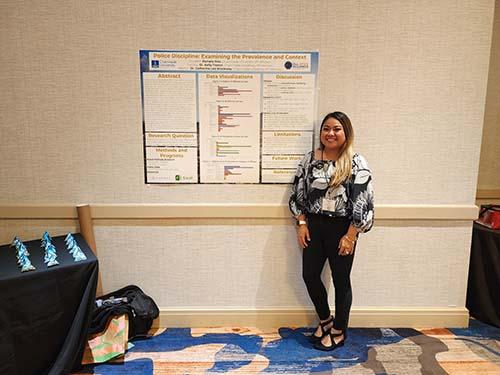
It’s just the beginning stages of her research, but Pam Oda ’24 has already presented her preliminary findings at the Society for Police and Criminal Psychology (SPCP) in Arlington, Texas, thanks to monies from the Alliance Supporting Pacific Impact through Computational Excellence (ALL-SPICE) grant. Standing in front of her presentation board, Oda explained the importance of education in the law enforcement field, which has long been debated. While many agencies have historically required little to no college coursework for entry-level positions, research suggests a positive correlation between education and job performance at all levels of law enforcement.

With the mentorship and encouragement of Dr. Kelly Treece, Criminology and Criminal Justice director and associate professor, Oda’s study evaluated disciplinary actions taken against Honolulu Police Department officers. With access to open records, Oda was able to obtain the types of allegations of police misconduct, which are divided into four sections: administrative investigation, criminal investigation, quality assurance and accreditation.

“Most of the violations were for administrative reasons,” said Treece, a former sergeant and trainer with the Pewaukee Police Department in Wisconsin. “Pam did a really good job with her presentation, and she handled herself very well in front of a lot of professionals.”

Pam Oda stands next to her poster board in Arlington, Texas.

The recent calls for police reform—combined with mounting evidence that an educated police force can have positive effects—have sparked a nationwide conversation about raising education requirements for police officers.

“Currently, the minimum qualification to become an HPD officer only requires having a high school diploma or your GED,” Oda said. “I think we need to raise that standard in Hawaii.”

In her presentation, Oda noted that 51.25 percent of officers received a High School Diploma or GED, 27.5 percent held a bachelor’s degree and 15 percent have received their associate’s degree or completed 60 semester credits or more. The numbers are consistent with national statistics, which show that only one percent of local police departments across the U.S. require their officers to hold four-year degrees and only eight percent call for officers to have attended any college at all.

Oda further noted that early research indicates that there is a broad performance difference between officers who have a college education and those who do not.

Citing a paper written by S.M. Smith and M.G. Aamodt (1997) in the Journal of Police and Criminal Psychology, the co-authors found that police officers who possess college degrees are better performers than those with only high school degrees, including overall performance, communication skills and decision-making ability. 

According to Oda, this type of research has been ongoing yet most departments are not implementing these findings into policy and practice. In addition, in a study conducted by the Police Executive Research Forum (2019), officers with a four-year college degree had significantly fewer civilian complaints than those with only a high school diploma. 

Oda also pointed out that research shows higher education has significant benefits for law enforcement officers, including the ability to navigate the complexities of modern-day policing, which consists of critical analysis, enhanced communication abilities and a comprehensive understanding of the criminal justice system (S. Christopher, 2015, in Policing: A Journal of Police and Practice). 

Now in her fifth year at Chaminade, Oda will complete a double major in Criminology and Criminal Justice and Data Science, Analytics and Visualization with minors in Computer Information Systems and Psychology in December. The Hilo native hopes to continue her research with Treece at Chaminade while pursuing her graduate degree in Criminal Justice.

“That’s the plan right now,” said Oda, who serves as the president for the Chaminade Student Government Association, as well as the president of the Restauranteers Club. “Since starting in fall 2019, I have taken advantage of the countless opportunities that Chaminade has to offer, from student clubs and organizations to research and internship opportunities to student employment and the ‘ohana spirit.”

Treece, too, plans to expand the research to include the Sheriff Division of the Hawaii Department of Public Safety, which will then include statewide statistics and a broader representation. By doing so, she and Oda will be able to capture a more robust picture of the correlation between education and law enforcement.

“The next step is to write a paper, which I’ve asked Pam to help me co-author,” Treece said. “She’s a little hesitant and nervous about it, just like she was when I first approached her about presenting in Texas. I think she’ll do great.”

Posted by: University Communications & Marketing Filed Under: Behavioral Sciences, Diversity and Inclusion, Featured Story, Innovation, Student Life Tagged With: Criminology and Criminal Justice, Master of Science in Criminal Justice Administration

Yin and Yang

October 23, 2023

Thirty years later, two middle school besties will graduate in ’24

The last time they graduated was in 1994 from Mililani High School. And when May 2024 comes around, Rita Aponte ’24 and KerryLynn Vea ’24 will again don their caps and gowns, as they prepare to cross the stage of the Waikiki Shell to receive their bachelor’s degrees.  

BFFs since high school, Aponte and Vea were able to pursue their university degrees, thanks to Bank of Hawaii’s College Assistance Program (CAP), which allows its employees to get back on the path to obtaining their first four-year undergraduate degree with tuition reimbursement.  

Draped with lei, Rita Aponte, left, and KerryLynn Vea posed for their graduation photo from Mililani High School in 1994.

“The Bank started this program in 2016, and I started the following year,” says Aponte, Manager of Loan Operations with Bank of Hawaii. “And my bestie, KerryLynn, is also on this journey with me since we both always wanted to get our degrees.”  

Both Aponte and Vea chose to start their families at a young age, hindering them from attending college. The two friends since middle school always had plans to return to university, but family obligations and full-time jobs prevented them from entering the college system.

“I get emotional when I talk about CAP,” says Vea, who was in the credit union industry for 20 years before joining Bank of Hawaii in 2016 and is now its Assistant Vice President-Mortgage Compliance Analyst. “Before CAP, I was resigned not to get my college degree, rationalizing to myself, ‘Oh well, I don’t need a degree since I already have a career.’”  

The American Council of Education estimates that approximately 20 percent of graduate students and six percent of the much larger number of undergraduates receive some financial assistance from their employers to attend school. As many as a third of undergraduates in fields like business and engineering also receive tuition aid, which, on average, covers about one-third of the annual cost paid by post-secondary students.  

Initially, when Aponte and Vea enrolled in Bank of Hawaii’s CAP initiative, they were limited to four specific start times a year (January, April, July and October). Today, new applicants have the flexibility to enroll for courses on a monthly basis throughout the year, which is consistent with Chaminade’s online Flex program.  

“I’ve worked at credit unions where tuition assistance was always included in the employee manual book, but I never once saw it used,” Vea says. “Bank of Hawaii, on the other hand, vigorously promotes CAP and they champion it, putting funding behind it with no strings attached. The program is a 100 percent benefit to all employees.”  

Bank of Hawaii’s executives said they needed a partner that understood the Bank’s vision of what they wanted to achieve with its CAP program. However, they also wanted to make sure that the online learning experience was customized to the specific needs of the Bank’s employees since they wanted CAP to be “a real pillar and cornerstone of what Bank of Hawaii is all about.”

“We thought it was not only important to train our employees in specific banking-related issues, but also to help them expand their overall educational base,” says Peter Ho, Bank of Hawaii’s Chairman, President and Chief Executive Officer, in a video release. “From an education standpoint, the important thing is to really help shape the individual’s mind and spirit—and that’s what education is all about; that’s what college is all about.”  

Although, Aponte and Vea didn’t experience the traditional campus setting, they were able to take their classes online, via Chaminade’s Flex program model, allowing students to take one or two courses at a time—or more if they choose—as they work toward their degree. And the pace of coursework rests with them. They can complete online courses in as few as six weeks. Or, they can take their time, wrapping up a course in six months. Flex students are also able to complete courses wherever they are, even on the go.  

“It was a real struggle during the holiday season,” Aponte recalls. “Even when we went on vacation to Disney World, algebra came along with me.”  

KerryLynn Vea takes a break from her studies with her new son.
KerryLynn Vea takes a break from her studies with her six-week old granddaughter Ellie in 2018.

The Flex Online Undergraduate program is WSCUC-accredited (WASC Senior College and University Commission) and has a broad range of study disciplines, including business administration, criminology and criminal justice, historical and political studies, education and psychology. It is designed with working adults in mind, distancing itself from rigid term schedules and due dates to give students the flexibility they need to achieve a work-life-school balance and make progress toward reaching their goals.  

“I started at Leeward Community College for a semester and a half, but scheduling was really difficult,” Vea says. “I just couldn’t do it all with a full-time job, a family and attending classes; it was a lot.”  

Nor could Aponte.

“I didn’t think a college degree was in the books for me,” Aponte asserts. “It was always nagging at me to get my bachelor’s, but I used time and cost as excuses not to pursue it. And now I’m motivated to finish this and I can’t wait.”  

Thirty years will have elapsed by the time Aponte and Vea attain their bachelor’s degree, and through the three decades, they’ve raised families, enjoyed successful careers and supported each other through both good times and bad.  

“Getting the bachelor’s degree with Rita couldn’t get any better,” Vea says. “I always say I’m the Yin because I’m more subdued and quieter, and she’s the Yang because she’s more outgoing and vocal. We might be opposites, but through this college process, we’ve depended on each other and have been each other’s greatest cheerleader.”      

Posted by: University Communications & Marketing Filed Under: Business & Communication, Diversity and Inclusion, Featured Story, Innovation, Institutional, Student Life Tagged With: Business Administration, Financial Aid, Scholarship

New Student Orientation

August 21, 2023

Incoming class of freshmen familiarize themselves with campus resources

Across the nation, thousands of freshmen will mark a rite of passage this month, standing in that liminal space between what lies behind and what awaits ahead—between the familiar past and the unpredictable future. As Davis and Rian Wakefield helped their daughter, Shalei Parong, check in to the Hale Pohaku dormitory during New Student Orientation, they felt a mix of emotions: sadness, worry and excitement.

“At least she’s close to home,” said Davis Wakefield, a firefighter with the Hawaii Fire Department based in Kona. “This is her choice to come here, and we support her decision; it’s a new chapter of her life.”

Writing their own stories was a key theme in Chaminade President Dr. Lynn Babington’s welcoming message to incoming students during the Academic Convocation at the Mamiya Theater. Another one of her keynotes involved the principles of a holistic, Marianist education, focused on service, justice, peace, adaptation and change.

“You’ve chosen to attend a warm and welcoming liberal arts University,” Babington told students. “You will form bonds here, and you’ll delve new ways of thinking and discerning who you are and who you want to be.”

Students write their names on tags.
Incoming freshmen received a lanyard for their student ID cards.
Checking in for New Student Orientation.
Signing in for New Student Orientation.
Waiting for the app Canva to open.
Faculty members stood outside of Mamiya Theater.
Chaminade President Dr. Lynn Babington to address students.
It was a full house at Mamiya Theater.
Trying to navigate the Kalaepohaku campus.
Faculty members gather for the Academic Convocation.
Fr. Chris Wittmann led the group in prayer.
Chaminade President Dr. Lynn Babington and faculty members welcomed new students during the Academic Convocation.
Chaminade Provost Lance Askildson explained that higher education is an intellectual exercise in application and reflection. 
Students applaud the words of Dr. Lance Askildson.
Chaminade Student Government Association President, Pamela Oda, advised new students not to fear change.
Students walk out of Mamiya Theater after Convocation.
A group of freshmen explored the Kalaepohaku campus.
Learning about campus resources.
Orientation leaders flash their shaka of approval.

Mandatory for all freshmen and transfers, the New Student Orientation (NSO) is designed to acquaint new students with the campus and the many available campus resources that enhance both academic success and personal development. Orientation activities focus on several important areas, including the curriculum, academic advising, college success, scholarships and financial aid, campus activities, student services, student organizations, Silversword Spirit and campus facilities.

“As I look into the audience, I see the many incoming college students who are unsure about what the future holds, already starting to feel homesick, thinking whether you made the right decision or not,” said Chaminade Student Government Association President Pamela Oda in her address to fellow students at the Academic Convocation. “College is a chapter in your life that involves the word that many people dread—change. Be open to the change and new experiences, don’t fight it!”

Freshman Jordan Ponsar ’27 said he was “stoked” when he was offered a soccer scholarship to attend Chaminade. The Long Island, N.Y., native was quick to make friends on move-in day, helping resident assistants, Kelsey Sablan ’23 and Micah Sanders ’24 at the check-in desk in the lobby of Hale Pohaku co-ed dorm.

“I’m going to make the most of my four years here,” said Ponsar, flashing the shaka sign. “This is all new so I look forward to all the future opportunities and experiences.”

In his opening comments, Senate Faculty President Dr. David Carter rhetorically asked, “Do you know what you’ve gotten yourselves into?” His question elicited some nervous laughter from the audience, but his answer was simple. “You’ve enrolled in a university where we want to get to know you,” said the Director and Professor of Forensic Sciences. “Being in the classroom with students is my happiest time of the week. I hope you learn from me as much as I learn from you.”

Navigating a successful collegial life is not always easy, especially during freshman year when everything seems foreign and unfamiliar. Yet Chaminade’s ‘ohana spirit provides a comfortable and safe environment that makes it easier for students to explore. Students are encouraged to step out of their comfort zones, to be curious, to embrace adaptation and to try something new. 

“You are here because we see in you the potential for transformation through higher education and the opportunity to live an examined life in service to yourself and your community,” said Dr. Lance Askildson, Chaminade Provost and Chief Academic Officer. “This is, in truth, an exhilarating yet also quite challenging inflection-point in your life.  You will struggle and even fail at times to achieve your goals—and that is OK. We are all here, as a community of faculty, staff and administrators, to support you and your journey.”

In her concluding remarks, Oda offered some sage advice. “As you start this new chapter in life, be open to experiencing new things and opportunities because you never know what could happen,” she advised. “As you meet new people, keep in mind that everyone comes from different walks of life and may not have experienced the same things you have. Each of you has your own unique story, embrace it. Once again, welcome to the Silversword ‘Ohana and SWORDS UP!”   

Posted by: University Communications & Marketing Filed Under: Campus and Community, Diversity and Inclusion, Featured Story, Homepage, Institutional, Student Life, Students Tagged With: Baseball, Campus Event

  • « Go to Previous Page
  • Page 1
  • Interim pages omitted …
  • Page 3
  • Page 4
  • Page 5
  • Page 6
  • Page 7
  • Interim pages omitted …
  • Page 9
  • Go to Next Page »

Footer

Chaminade University Logo

3140 Waialae Avenue
Honolulu, Hawaii 96816

Contact Us
Phone: (808) 735-4711
Toll-free: (800) 735-3733

facebook twitter instagram youtube linkedin

Visit

  • Plan Your Visit
  • Campus Map (PDF)
  • Events

Resources

  • Campus Security
  • Student Consumer Information
  • Concerns, Feedback, and Reporting
  • Institutional Review Board
  • Title IX / Nondiscrimination Policy
  • Compliance
  • Emergency Information
  • Careers
  • Institutional Statement

People

  • Students
  • Parents
  • Alumni
  • Faculty & Staff

Policy

  • Privacy Policy
  • Terms and Conditions of Use


© Chaminade University of Honolulu