
• Skip to primary navigation
  • Skip to main content
  • Skip to footer
Chaminade University of Honolulu

Chaminade University of Honolulu

  • VISIT
  • APPLY
  • GIVE
  • STUDENTS
  • PARENTS
  • ALUMNI
  • FACULTY/STAFF
  • Admissions
    • Admissions Home
    • Undergraduate Students
      • First-Year Students
      • Transfer Students
      • Admitted Students
    • Graduate Students
    • Flex Online Undergraduate Program
    • Military Students
    • Non-Degree/Visiting Students
    • Experiential Honors Program
    • Early College Program
    • New Student Orientation
  • Tuition & Aid
    • Financial Aid Home
    • Tuition & Expenses
    • Federal Updates & Changes
    • Scholarships
    • $5,000 Graduate Scholarship
    • VA Education Benefits
    • Net Price Calculator
  • Academics
    • Academics Home
    • Academic Programs
    • Office of Student Success
      • Academic Advising
      • Records and Registrar
    • Kōkua ʻIke (Support Services)
      • ADA Accommodations
      • Career Services
      • Proctoring Services
      • Tutoring Services
    • Sullivan Family Library
    • Undergraduate Research & Pre-Professional Programs
    • Commencement
  • Campus Life
    • About Campus Life
    • Student Engagement
    • Student Government Association
    • Residence Life and Housing
    • Health Services
    • Marianist Leadership Center
    • Counseling Center
    • Campus Ministry
    • Campus Security
    • Dining Services
    • Bookstore
  • Athletics
  • About
    • Chaminade University News
    • Our Story
    • Leadership
    • Chaminade University Strategic Plan 2024-2030
    • Mission & Rector
    • Association of Marianist Universities
    • Facts & Rankings
    • CIFAL Honolulu
    • Accreditation & Memberships
    • Montessori Laboratory School
Search
×

Search this web site

Servant Leadership

Economic Lesson

November 28, 2023

Chaminade students teach Jarrett Middle School students about economics

Standing in front of 13 William P. Jarrett Middle School students, Chopper Correia ’27, Brayden Braga ’27 and Roselyn Macias ’26 started their lesson by asking the students what they knew—if anything at their age—about economics. Some boisterously screamed out “money,” while others yelled “business.”

“In preparation, we’ve outlined a lesson plan,” said Macias, studying her notes before the class began. “This is my first visit here so I’m not sure what to expect.”

It was the second for Correia and Braga, both freshmen Silversword baseball players and Business Administration majors. “We’ll cover such topics as price control and budgeting,” Correia and Braga echoed. “And we’ll play a little game with them because they can easily associate with playing games.”

Turning to the class, Braga posed a second question: Who has ever heard the terms micro and macro economics? One student asked aloud, “Does it have something to do with money and budget? ” Another fired back with “small and big.” Right, Braga responded to “small and big,” then simplified the terms by explaining that microeconomics and macroeconomics are related, but separate approaches to studying the economy.

Macias took Braga’s explanation even further by expanding the subject to cover the definition of price control, price ceiling and price floor. “Price control comes in two forms,” the sophomore Business Marketing major said. “A price ceiling keeps a price from rising above a certain level—the ceiling. And a price floor keeps a price from falling below a certain level—the floor.”
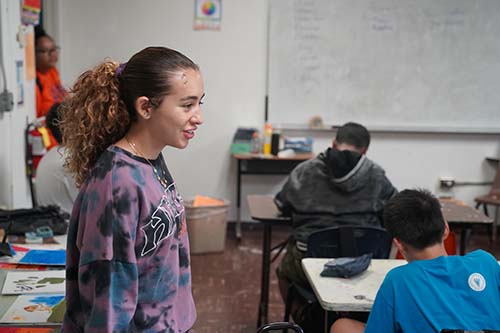
Roselyn Macias looks on as Jarrett Middle School students complete the task of creating their personal budgets.

Braga, Correia and Macias are all participating in Chaminade’s Office of Service Learning and Community Engagement program, which aims to empower students to define and deepen their classroom learning experience through impactful need-based community engagement rooted in Marianist and Native Hawaiian values.

“Our vision is to foster a collective sense of place through investment in community partnerships, service learning process and pedagogy, and a commitment to serving others,” said Mitch Steffey, Chaminade’s Associate Director of Service Learning and Community Engagement Service. “We envision a campus culture that embraces service and service learning as a valuable community-focused vehicle toward personal growth.”

The benefits of service learning extend to both the students and the communities they serve. For students, service learning allows them to apply classroom theories and concepts to tangible, real-world situations. This hands-on experience enhances their understanding of academic material and fosters critical thinking skills. Students also often acquire a diverse set of skills, including communication, teamwork, problem-solving and leadership. These skills are transferable to various professional and personal contexts, contributing to their overall development.

Meanwhile, the benefits to the community are many. First and foremost, service learning projects are designed to address specific community needs. Whether it’s tutoring, environmental initiatives or healthcare support, students contribute directly to ameliorating the well-being of the community. Secondly, universities and communities can build long-term, mutually beneficial partnerships through service learning programs. These collaborations promote ongoing support for community initiatives and foster a sense of shared responsibility.

“We also have a similar program with Palolo Elementary School,” said Jacob Escuza ’25, a student worker who acts as the Chaminade University liaison between Jarrett Middle School and Palolo Elementary School. “The Palolo program, though, is more of a one-on-one tutorial session with the kids.”

Steffey distinguishes the difference between community service and learning service. Citing an example of the latter, he uses a biology student who could go out in the lo‘i kalo (taro patch) to test the waters to see why one part of the patch produces more kalo than another.

“He/she can test if there’s too much acid in the water,” Steffey explained. “So, we’re going to the community to fulfill a need with the expertise that we already have through our professors, courses and classrooms.

“You don’t have that at beach cleanup,” Steffey continued. “The cleanup is good for the community, but there isn’t much learning being done.”

Jarrett Middle School students certainly learned about budgeting when Correia asked them to take a piece a paper out and pencil, and then pointed to a list on a whiteboard that included such budget line items as rent, food, water, video games, savings, candy, toys, furniture, toiletry and bike. Each was assigned a value from one to three points.

“You have 10 points or consider it the amount of money you make,” Correia instructed. “Now, choose the items you want until you reach 10 points and no more. And that will be your budget.”

The majority of the students prioritized rent and food, followed by video games, candy and bike. “I’m going to need a bike to get to work,” one student rationalized for adding the necessary transportation to the top of his priority list. “And I’m going have to eat, but I’m going to need a place to eat.”
Posted by: University Communications & Marketing Filed Under: Business & Communication, Campus and Community, Featured Story, Hogan Entrepreneurial Program, Service Learning, Student Life Tagged With: Hogan Entrepreneurs Program, Servant Leadership, Service Learning

Class Act

January 31, 2023

Students, staff volunteer to help The Institute for Human Services

Not to be confused with Service Learning Day, Servant Leadership Day only happens once a year in January to coincide with Founders’ Week. In the half century since its introduction, Robert Greenleaf’s “Servant Leadership” theory has become increasingly popular among American corporations. Companies such as Nordstrom, Starbucks, The Container Store and FedEx have all adopted the theory that a leader must be a servant first and a leader second. This was indeed the case when Chaminade University’s Mitch Steffey joined students and fellow staff members in an effort to help The Institute for Human Services (IHS).

“We’re learning just as much from the community as we are giving to it,” says Steffey, Associate Director

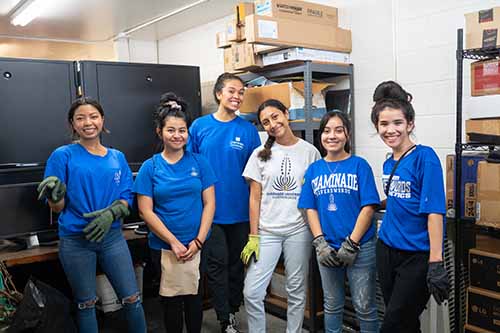
Students volunteered to participate in Servant Leadership Day at IHS.

of Service Learning and Community Engagement. “The idea is you’re leading for the people to accomplish their goals and not ours. It’s also talking about the difference between sympathy and empathy.”

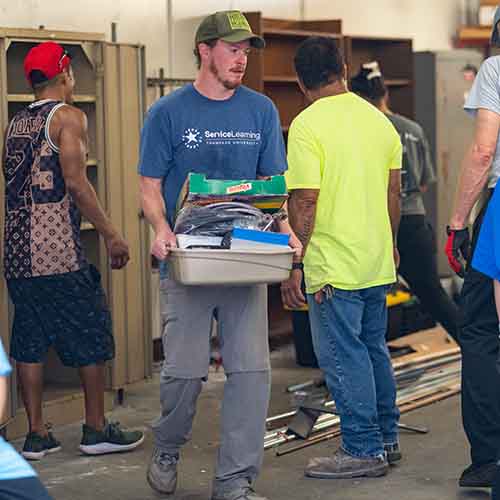
Silversword senior, Montserrat Lanfranco ’23, was among the volunteers who helped haul away old furniture, appliances and miscellaneous equipment in a Herculean effort to organize a large storage area at IHS. To Steffey’s point about empathy, Lanfranco muses that “everyone has a different situation as to why they’re homeless.”

During an on-camera interview with KGMB’s Hawaii News Now, Montserrat says by helping IHS—and thus, in essence, its clients—they’re digging into the roots of houselessness and helping a marginalized population of society plant new roots to promote a healthier type of system.

“At least that’s how I see it,” Montserrat concludes. “I feel like if we can get down to it (the root of the cause) then we can really solve the problem.”

Across the nation, homelessness has become a major flash point, attracting the attention and the ire of local, state and national lawmakers. On Dec. 19, 2022, the Biden-Harris administration released a federal plan for ending homelessness in America that starts with the ambitious goal of reducing homelessness by 25 percent by 2025. All In: The Federal Strategic Plan to Prevent and End Homelessness builds on the success of previous plans and will do more than any previous federal effort to systemically prevent homelessness, and combat the systemic racism that has created racial and ethnic disparities in homelessness.

Mitch Steffey organized Servant Leadership Day with IHS.

Modeled after the United States Interagency Council on Homelessness, The Hawai‘i Interagency Council on Homelessness (HICH) is an advisory body that serves as a statewide homelessness planning and policy development entity with broad representation from State and County government and the community. The council has adopted its own 10-year plan that utilizes an active implementation framework with the work divided into four general stages for implementation: exploration, installation, initial implementation and full implementation.

According to the released Ten-Year Strategic Plan and Framework, the proposal advances the vision of ending homelessness in Hawai‘i by implementing and sustaining a housing-focused system that draws upon the efforts of multiple partners and creates a clear pathway to stable housing for individuals and families experiencing homelessness. The plan and vision acknowledge that the work to combat homelessness cannot be addressed by any single government entity or provider alone, and requires a shared community effort and “all-hands-on-deck” approach. 

Steffey shares the same approach when he organizes these types of service events, which he hopes will become more frequent. “What we did at the IHS shelter is the community engagement part of my job,” says the Pennsylvania native, emphasizing the second half of his official staff title. “I’m trying to get students out of their residence halls, out of their homes and into the community.”

Steffey distinguishes the difference between community service and learning service. Citing an example of the latter, he uses a biology student who could go out in the lo’i kalo (taro patch) to test the waters to see why one part of the patch produces more kalo than another.

“He/she can test if there’s too much acid in the water,” Steffey explains. “So we’re going to the community to fulfill a need with the expertise that we already have through our professors, courses and classrooms.

“You don’t have that at beach cleanup,” Steffey continues. “The cleanup is good for the community, but there isn’t much learning being done.”

Posted by: University Communications & Marketing Filed Under: Campus and Community, Service Learning, Student Life, Students Tagged With: Community and Public Health, Servant Leadership, Service Learning

Footer

Chaminade University Logo

3140 Waialae Avenue
Honolulu, Hawaii 96816

Contact Us
Phone: (808) 735-4711
Toll-free: (800) 735-3733

facebook twitter instagram youtube linkedin

Visit

  • Plan Your Visit
  • Campus Map (PDF)
  • Events

Resources

  • Campus Security
  • Student Consumer Information
  • Concerns, Feedback, and Reporting
  • Institutional Review Board
  • Title IX / Nondiscrimination Policy
  • Compliance
  • Emergency Information
  • Careers
  • Institutional Statement

People

  • Students
  • Parents
  • Alumni
  • Faculty & Staff

Policy

  • Privacy Policy
  • Terms and Conditions of Use


© Chaminade University of Honolulu