
• Skip to primary navigation
  • Skip to main content
  • Skip to footer
Chaminade University of Honolulu

Chaminade University of Honolulu

  • VISIT
  • APPLY
  • GIVE
  • STUDENTS
  • PARENTS
  • ALUMNI
  • FACULTY/STAFF
  • Admissions
    • Admissions Home
    • First-Year Students
    • Transfer Students
    • Graduate Students
    • Flex Online Undergraduate Program
    • Military Students
    • Non-Degree/Visiting Students
    • Experiential Honors Program
    • Early College Program
    • New Student Orientation
  • Tuition & Aid
    • Financial Aid Home
    • Tuition & Expenses
    • Federal Updates & Changes
    • Scholarships
    • $5,000 Graduate Scholarship
    • VA Education Benefits
    • Net Price Calculator
  • Academics
    • Academics Home
    • Academic Programs
    • Office of Student Success
      • Academic Advising
      • Records and Registrar
    • Kōkua ʻIke (Support Services)
      • ADA Accommodations
      • Career Services
      • Proctoring Services
      • Tutoring Services
    • Sullivan Family Library
    • Undergraduate Research & Pre-Professional Programs
  • Campus Life
    • About Campus Life
    • Student Engagement
    • Student Government Association
    • Residence Life and Housing
    • Health Services
    • Marianist Leadership Center
    • Counseling Center
    • Campus Ministry
    • Campus Security
    • Dining Services
    • Bookstore
  • Athletics
  • About
    • Chaminade University News
    • Our Story
    • Leadership
    • Chaminade University Strategic Plan 2024-2030
    • Mission & Rector
    • Association of Marianist Universities
    • Facts & Rankings
    • CIFAL Honolulu
    • Commencement
    • Accreditation & Memberships
    • Montessori Laboratory School
Search
×

Search this web site

Natural Sciences & Mathematics

Students Showcase Work at Annual Na Liko Na‘auao

April 19, 2021

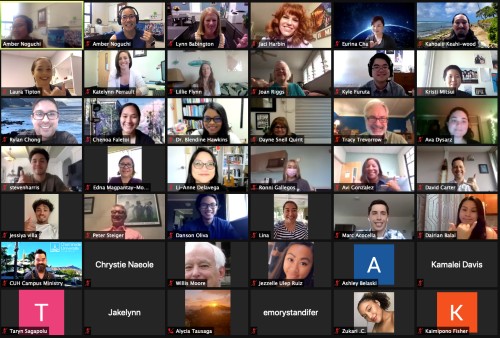
Na Liko Naauao virtual event 2021 screenshot

Chaminade undergraduates across all disciplines gathered virtually in early April to present their ongoing research across a broad array of exciting areas, from Native Hawaiian traditional medicine to data science database development to the microbiome, coral bleaching and cancer cell research.

The undergraduate conference, Na Liko Na‘auao, is an annual event at Chaminade to showcase exceptional original work by students seeking bachelor’s degrees and underscores the breadth and depth of academic scholarship at the University. Fields represented at this year’s conference, which included 23 presentations in all, ranged from Biology to Data Science to the Forensic Sciences.

The Na Liko Na‘auao symposium was first held at Chaminade in 2002.

Among the impressive topics students tackled this year:

  • “Modeling The Microbiome Of Aa In Vitro Taro Digestion Model,” from Ava Dysarz
  • “Seasonal Difference In Carcass Decomposition On Oahu,” presented by Marietta Lee
  • And “Keawawa Water Analysis And Restoration,” from Dorie Sanborn and Trinity Young

Organizers say Na Liko Na‘auao not only gives undergraduates an opportunity to offer the broader University community a glimpse into what they’re working on. It also gives them a chance to hone their presentation and speaking skills, synthesizing their research for a general audience.

The public forum also gives students an opportunity to take questions, giving them insight into their research strengths along with potential areas for improvement, further exploration and collaboration.

Also at Na Liko Na‘auao, the recipients of two prestigious Chaminade awards were announced.

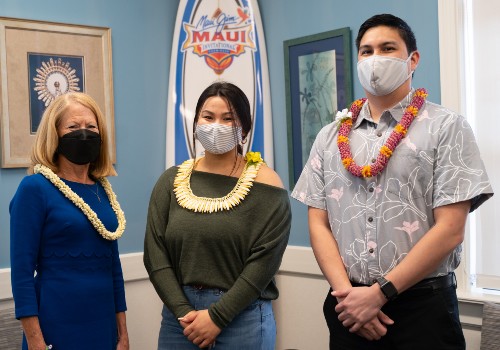
Dr. Lynn Babington, Darian Balai and Dr. Rylan Chon

The President Sue Wesselkamper Prize, which recognizes a student who has displayed academic scholarship beyond the classroom and has a record of service learning volunteerism and leadership, was awarded to Data Science student Dairain Balai, who is also minoring in Biology and Criminal Justice.

In nominating her for the award, Data Science program Director Dr. Rylan Chong said Dairain has participated in a host of leadership and research growth opportunities—and excelled in each of them.

And her work is already getting noticed. To continue her research on Native Hawaiian women’s health, Dairain was selected for a competitive spot as a paid research assistant at the University of Texas in Austin Texas Advanced Computing Center, where she is also serves as a mentor to other students.

Chong said Dairian, who graduated from Waianae High and is a Ho’oulu Scholar, “represents what Chaminade is all about locally, in her community, and on the mainland by going beyond the expectations of her service to community and education, development of her moral character, personal competencies, and commitment to build a more just and peaceful society.”

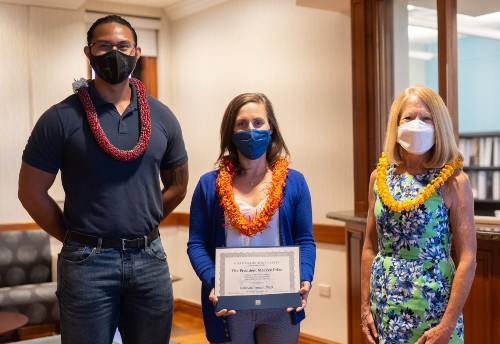
Danson Oliva, Dr. Kate Perrault and Dr. Lynn Babington

Also announced at the event: the recipient of the President Mackey Prize, which recognizes a faculty member at Chaminade with a record of student mentoring and a strong, ongoing commitment to providing students with research or creative experiences that go beyond the classroom.

This year’s awardee: Dr. Kate Perrault, an assistant professor of Forensic Sciences and Chemistry.

Undergraduate researcher Danson Oliva nominated Perrault for the honor, saying the professor is “extraordinarily passionate about the course material and wants every student to succeed.” Oliva added that working in a lab under Perrault has been a wonderful growth experience, allowing her to flex her scholarship muscles while also getting helpful and instructive feedback and mentoring.

“As a research mentor, she guides us but also helps us troubleshoot problems when they arise,” Oliva wrote. “With the help of Dr. Perrault, I have gone on to give two conference presentations on my project. It wouldn’t have happened if Dr. Perrault didn’t truly believe in our ability to succeed.”

Posted by: University Communications & Marketing Filed Under: Behavioral Sciences, Business & Communication, Campus and Community, Education, Faculty, Featured Story, Humanities, Arts & Design, Institutional, Natural Sciences & Mathematics, Nursing & Health Professions, Students

Under the Sea: Into Challenger Deep

April 12, 2021

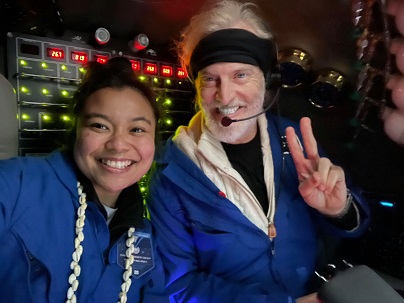
Nicole Yamase '14 and Victor Vescovo during Challenger Deep expidition
Nicole Yamase and Victor Vescovo

Have you ever wondered what secrets can be found at the ocean’s deepest depths? 

So has Nicole Yamase ’14. And then she got to travel there.

In March, Yamase was invited to jump into a special submersible and journey 35,856 feet below the waves (or as she likes to say, about 700 coconut trees stacked on top of one another) into the Challenger Deep—the deepest known spot in the ocean, located in the Mariana Trench.

Yamase, who is Micronesian, is the first Pacific Islander ever to make the trip.

She describes the place as nothing less than “unbelievable”—like an alien world.

“Once we slowly got to the bottom, I couldn’t believe my eyes,” she said, adding that the expedition down with ocean explorer Victor Vescovo—who organized the special dive—started about 10 AM. Four hours later, they were there, staring into the murky, dark and deepest known depths of the ocean.

“It looks like a desert down there,” Yamase said.

Reinforcing passion for environmental studies

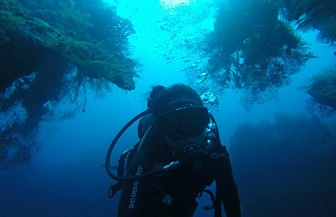
Yamase, who graduated from Chaminade with a B.S. in Environmental Studies and a B.S. in Biology and is now seeking a doctoral degree in Marine Biology from the University of Hawai‘i, was chosen for the journey because of her deep passion and previous work in helping to advocate for the oceans.

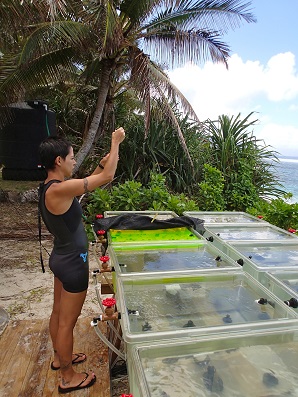
Nicole Yamase '14 (BS Environmental Studies, BS Biology) doing field work

Vescovo, she said, “thought it was time” that someone from the Federated States of Micronesia was invited down to the Challenger Deep, which can be found in their country’s waters. And not just “someone” was chosen, but a young leader who is studying diverse marine ecosystems.

She got additional support for the journey from the Waitt Institute and Micronesia Conversation Trust. 

Yamase said the experience of traveling to Challenger Deep was life-changing. It confirmed the incredible love she has for her research—she’s focused on studying the impacts of climate change on indigenous macroalgae important to Pacific reefs. And it underscored her other major academic focus: raising awareness about how climate change and rising sea levels are already impacting the Pacific.

“Humanity needs to improve its relationship with the world’s oceans,” Yamase said.

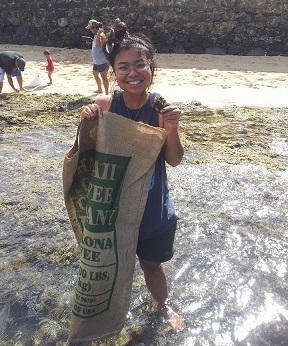
Because even the Challenger Deep wasn’t free of humanity’s fingerprint. When she was down there, nearly 7 miles below the surface, she saw boating tethers—human trash. “The fact that trash has made it all the way down to the deep is very alarming,” Yamase said. “It’s just a really pressing problem.”

Yamase knows that better than most.

Nicole Yamase '14 being a part of a beach clean up
Climate change is a problem now

When she returns to her hometown of Pohnpei in the Federated States of Micronesia, she sees the rising sea levels lapping up higher than they ever have before. Friends and loved ones post photographs on social media of ocean water going into homes and of cemeteries being washed away.

Climate change isn’t a future problem for her country, she says, it’s a problem now.

And it will take everyone, including her generation and future ones, to fix it.

Opening doors for Pacific Islanders

“Through this expedition, I really just want to promote STEM—because Pacific Islanders, we need us,” Yamase said. “We’re the ones who are going to be in the field. We need local mentors, local role models because that’s what we lack. It really has a huge impact to see your own succeed in the field.”

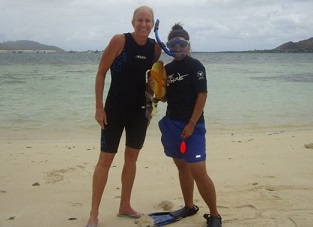
Nicole Yamase '14 and Dr. Grail Grabowsky
Dr. Gail Grabowsky and Nicole Yamase

As she continues to make her mark, Yamase is grateful to her own mentors, including those at Chaminade. She said it was Environmental Science and Studies Dr. Gail Grabowsky, dean of the School of Natural Sciences and Mathematics, who encouraged her as a freshman to apply for a summer internship at UH-Mānoa focused on marine biology. “From that first experience, I was like, ‘oh my goodness, this is for me,’” she said. She continued to be selected for internships and other opportunities, including a chance to study macroalgae in Miami’s Biscayne Bay.

That research formed the basis of the dissertation she’s now working on.

She said Biology Professor Dr. Jolene Cogbill, her adviser in the department, was also hugely instrumental in getting her linked up with opportunities that honed her skills—and bolstered her confidence. “They both really pushed me out of my comfort zone,” she said. “My first year, I never raised my hand. I couldn’t do it. After these summer internships of really participating in these opportunities with other Pacific Islanders, I thought, ‘I’m not alone in this.’”

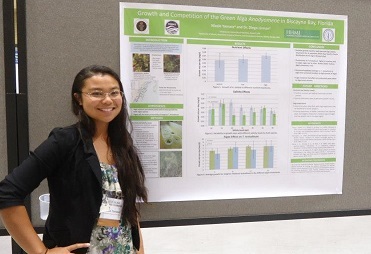
Nicole Yamase '14 showcasing her research at Chaminade's event in 2012

Yamase said she also got the chance to present her work at conferences and symposia.

She said she hopes to be that same inspiration to other young Pacific Islanders, especially those in environmental science, marine conservation and biology. She said her expedition into the Challenger Deep “was such a great opportunity to show young Pacific Islanders that we can do it.”

“There’s not that many of us in the science fields. Hopefully, this opens up doors.”

Posted by: University Communications & Marketing Filed Under: Alumni, Featured Story, Natural Sciences & Mathematics Tagged With: Biology, Environmental Studies

Finding Solutions Through Data Science

March 20, 2021

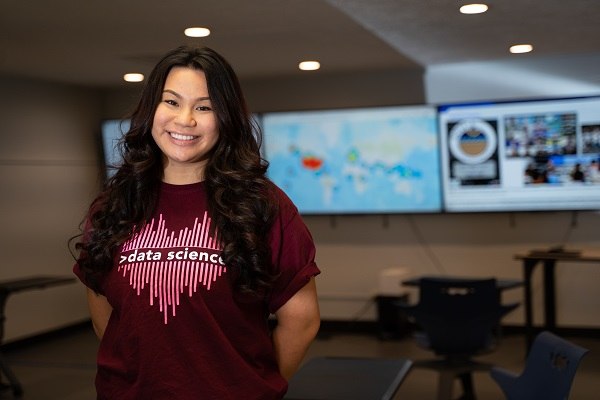
Dairian Balai '22, Data Science major

Dairian Balai ’22 peers into data to find solutions. That’s where she found her passion, too.

The Data Science major likes to say that all those numbers—on everything from community health disparities to poverty to race and education—represent people, with hopes and dreams, just like her. She’s on a mission to tell their story (and hers) by spotlighting the data that speaks to real experiences.

“I want to shine a light on the problems we’re facing,” she said.

And even though she hasn’t yet graduated, Balai is already making her mark. Thanks to a series of programs at Chaminade, Balai scored a paid remote internship with a University of Texas lab to research maternal and infant mortality and co-morbidities in Native Hawaiian communities.

She hopes to use data science to spotlight what factors can help protect moms and babies.

Balai grew up in Waiʻanae and graduated from Waiʻanae High. During her junior and senior year, she applied to a long list of potential universities in Hawaii and on the mainland. And she was pretty set on going out-of-state for her undergraduate education. But then her high school counselor told her about the Hoʻoulu STEM Scholarship, which covers 100% of Chaminade tuition and offers support services.

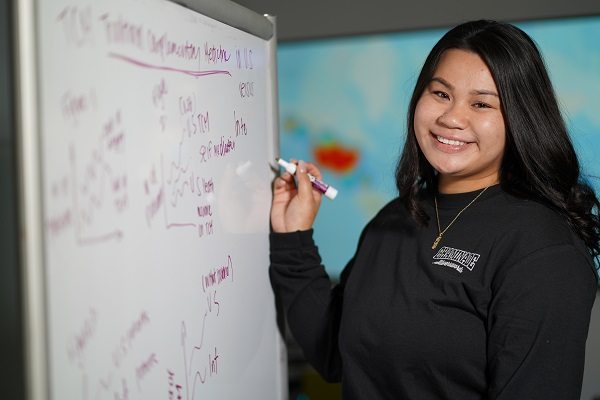
Dairian Balai '22, Data Science major

The scholarship convinced Balai to take a tour of Chaminade—and she’s glad she did.

“Off the bat, I liked how it was a small community. The campus was small,” she said, adding that she later spoke to her high school adviser and realized that the financial support offered through the Hoʻoulu STEM Scholarship far outweighed other aid universities on the mainland were offering her.

“I decided to stay. If I went back in time, I would make that decision again,” she said.

Balai said the thing she appreciates most about Chaminade is the one-on-one support she gets from professors and advisers, who have connected her with key opportunities. “They really make it a point to help you plan out your future,” she said. “They say ‘Chaminade is a family.’ I really believe that.”

Balai originally majored in Biology because she planned to go into healthcare.

But the course of her studies changed after she was participated in Chaminade’s Supporting Pacific Indigenous Computing Excellence (SPICE) program. The intensive, immersion experience, in partnership with the Texas Advanced Computing Center at the University of Texas at Austin, is designed to help train students to lead in data science and visualization efforts that support social justice projects in Hawaiʻi.

Balai said she learned coding in the SPICE program and worked with other students to create visualizations that helped illustrate her research area—how socio-economic status impacts healthcare.

From the SPICE program, Balai participated in a Computing4Change event in Chicago. The national competition challenges students to use computing for positive social change. Balai said through SPICE and the Computing4Change conference, she learned that data science wasn’t just about highlighting problems “but helping to solve them.” That, she realized, was the career she wanted to pursue.

Dairian Balai '22, Data Science major

So Balai switched majors to Data Science, taking the plunge even though it meant a little more time completing her undergraduate degree. She also started considering how she could eventually bring Data Science home—back to Waianae and the community she loves and eventually wants to serve.

She said Data Science helped her understand that having vulnerable populations doesn’t define Waiʻanae (and other communities with larger concentrations of low- and moderate-income families), but that socio-economic and other factors have a significant impact on the lives of Waianae residents.

She is especially interested in uncovering the factors that contribute to health disparities in her hometown. Data Science solutions to those gaps, she said, will help build a healthier community. And ultimately, that will help build a healthier state and nation, Balai added.

In 2019, Balai was offered a paid internship studying maternal health in Native Hawaiians. She said as a Native Hawaiian, the research feels personal—and all the more important given the healthcare challenges the community faces. She’s continuing that work and hopes to build on it.

In fact, Balai is now planning to go to graduate school.

She’s working with her adviser weekly to consider programs, and on crafting her long-term dream: returning to Waiʻanae to “build a better, a more aware community”—with Data Science.

Posted by: University Communications & Marketing Filed Under: Featured Story, Natural Sciences & Mathematics, Students Tagged With: Data Science

Returning Home to Chaminade

March 19, 2021

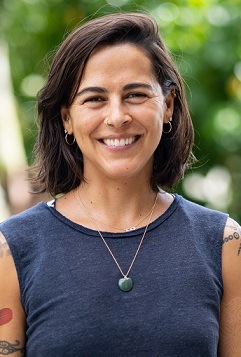
Lupita Ruiz-Jones

Dr. Lupita Ruiz-Jones, Assistant Professor of Environmental Science at Chaminade University, wants students to plan their careers with intention, so they end up doing work they love.

The key, she says, is pursuing and doing the things you are interested in, even when you don’t know where they will lead. After all, that’s what worked for her.

She was in high school in Santa Fe, New Mexico, when she learned about Chaminade University at a college fair. “I don’t think I ever would have heard of Chaminade except for that booth.”

She wanted to study human impacts on the environment, and she wanted to move away from the desert. Chaminade offered a major in environmental studies, and she was sold.

Seeking out opportunities and going after them has been a life-long pattern for Ruiz-Jones. It’s especially impressive when you learn she was raised by parents who didn’t complete college in a family without the trappings of success.

Her mother was always supportive but struggled with bipolar disorder. Ruiz-Jones’ father went to prison when she was 12, which she says had a significant impact on her. “I really appreciated the ability to choose where I put my attention,” she says.

Luptia Ruiz-Jones and Gail Grabowsky

In one of her first classes, Dr. Gail Grabowsky, now dean of the School of Natural Sciences and Mathematics, told the students it was great they were there. “She told us, ‘You’re going to love what you do, you’ll make an impact, but you’re not going to become rich.’”

“That was fine with me,” says Ruiz-Jones. “I felt like as long as I loved what I did and made an impact, that was what was important to me.”

During her freshman year, she applied and was selected for a five-week summer program in India. “The goal of that trip was to see what small non-profits were doing in India,” she says. “It was really about human well-being and the different ways people were contributing by doing service to the really poor. It was an incredible experience.”

But the summer after her sophomore year at Chaminade, she started doing undergraduate research at Kewalo Marine Lab. That’s where she first got excited about biology and organisms in coral reefs.

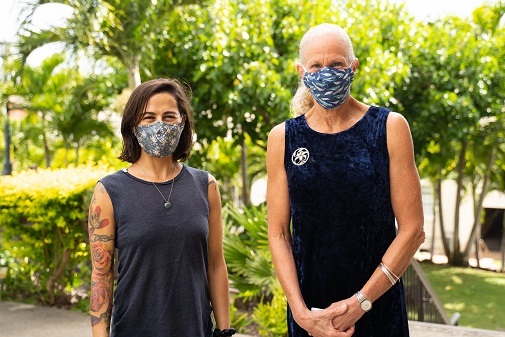
Dr. Lupita Ruiz-Jones, professor and alumna

At the end of her summer research at Kewalo Marine Lab, her advisor Dr. Mike Hadfield invited her to continue there in an internship. He also encouraged her to take all the science courses she could, which pushed her into a fifth year of college.

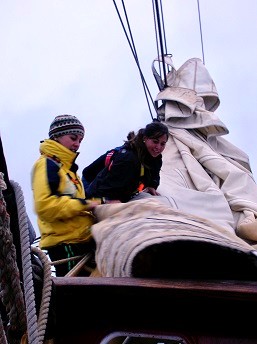
She didn’t mind, though, because she wanted to participate in a Sea Education Association summer-at-sea sailing program that focused on environmental studies. She spent four weeks sailing from Hawai‘i to San Francisco on a tall ship sailboat.

“Wow, that was a really powerful experience,” she says. “We did biological oceanography research. I focused my project on invertebrates that live on the surface out in the middle of the ocean.”

Dr. Lupita Ruiz-Jones, professor and alumna

After graduating from Stanford University with her PhD, she received the Thinking Matters Teaching Fellowship and spent four years team-teaching there. That, she says, is where she developed her identity as a teacher and her love for teaching.

During the summers, she started collaborating with scientists at the Hawai‘i Institute of Marine Biology.

That’s how she ended up back at Chaminade, as an assistant professor this time, in Fall 2020.

Right now, she says, her goals are to find ways to integrate her passion for research, coral reef ecology, and restoration into her teaching. And she’d love to take students on field trips to neighbor islands or other Pacific islands. “If we could do something like that where we took students to more remote Pacific Islands for environmental education, that’d be very cool.”

Posted by: University Communications & Marketing Filed Under: Alumni, Faculty, Featured Story, Natural Sciences & Mathematics Tagged With: Environmental Sciences, Environmental Studies

Service in Action, A Peace Corps Volunteer’s Story

March 12, 2021

“When I’m older, I want to join the Peace Corps.”

Her uncle’s stories of the Peace Corps, living in a faraway place called Togo (West Africa) among people very different from him yet who became lifelong friends, had captured the imagination of Alice Potter ’18, a precocious 4-year-old. It was in her blood. 

Potter and her family grew up in California while her father worked as a software engineer, and they also spent years living abroad, in Italy, Germany and France. Returning to the United States for college was never part of Potter’s plan; however, her mother did an internet search for colleges in the U.S. “with a good record of acceptance and graduation rates,” and Chaminade University of Honolulu popped up. The positive reviews about Chaminade’s student-to-faculty ratio, affordable tuition, overall quality, coupled with its location and Hawai‘i’s mild weather, all sounded very appealing. Her mother told her that if she got in, she would be going to the Marianist university. And to Potter’s surprise, the acceptance letter came. She was anxious to be going back to the U.S. and of all places the most remote 50th state.

There’s no place like Hawai‘i

Intimidated at first, she soon made new friends and began thriving in Chaminade’s customized learning experience. She also shared its values of serving the community by volunteering at the  Waikīkī Aquarium. Aside from her studies, Potter also fell in love with Hawai‘i’s marine life and flora and enjoyed learning about the islands’ rich history. “Never before had I encountered a place so profoundly connected to its people like in Hawai‘i,” she says.

Living her dream of joining the Peace Corps
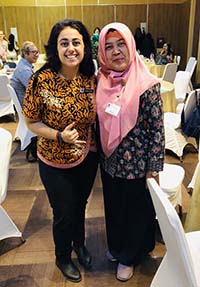
Alice Potter '18 with her counterpart in the Peace Corps
Alice with her counterpart Mrs. Irma

Potter graduated with a bachelor’s in communication degree with an environmental studies minor in 2018. At age 23, ready for a new adventure, she jumped at the opportunity to live her dream and join the Peace Corps. Because she spoke conversational French, Potter had hoped to be assigned to Africa specifically in Senegal; however, there was an opening to teach English in Southeast Asia. She had lived in a variety of places, yet she remembers experiencing culture shock when arriving in Indonesia, the world’s fourth most populous country with more than 267 million people with a Muslim majority. She was immediately struck by the language barrier and the lack of personal space in this bustling yet conservative, spiritual society.

The Peace Corps helps new volunteers acclimate to their new country through an intensive two to three months Pre-Service Training (PST) program. Potter explains this included language lessons, cultural classes, as well as learning about Peace Corps procedures and the country’s rules and local customs, providing the skills and knowledge you need to thrive on your own. During this time, she lived with the first of three host families. 

“My host family during PST was especially kind, patient, helpful and accepting, and I became very close to them,” Potter says. Her host family warmly welcomed her into their home, introducing Potter to many delicious Indonesian dishes, such as sate (marinated meat skewers), cap cai (stir-fried vegetables sometimes mixed with meat), nasi goring (fried rice) and rawon (beef soup), which became her favorite. Potter was relieved that one of her host twin sisters, Dhea, spoke English, helping her with the transition and translating for her twin, Adhe, and their parents. 

Once her assignment began, Potter lived with two other host families: a single mother with grown children, a driven career woman who worked as a caterer for weddings and funerals, as well as a seamstress and a make-up artist; and a young couple who introduced her to carp rearing, bird catching and coffee time. A neighboring family acted as her “mom and dad” when Potter needed adult assistance and they took her on day trips.

Teaching is learning

Potter was assigned to a vocational training high school near East Java, where she taught English to 15 to 18-year-old students, 85 percent of them male and the rest female. School was held seven days a week from 7 a.m. to 4:30 p.m. with extracurricular activities held on Saturdays. Potter says she taught two or three classes each day; class periods were two hours long for sophomores and juniors and one hour for seniors. The school offered career paths for students in fields such as auto mechanics, electrical work, computer work and broadcasting.

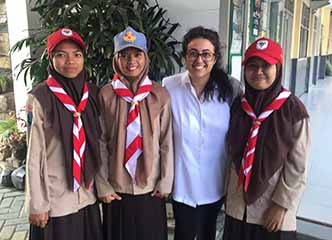
Alice Potter '18 with her students while in the Peace Corps

“Most of the time my students called me ‘Mister,’ or ‘mbak’ or ‘kak,’ which is equivalent to saying young miss or older sibling,” explains Potter. “I was the youngest teacher at the school,” she adds.

Halfway through her service, Potter was riding her bicycle back to school after a lunch break when she was hit by a motorcycle from behind. “Even though I was wearing a helmet, I had a pretty serious concussion. A piece of asphalt got inside one of the helmet vents and cut my scalp,” she says. “I also had cuts on my upper lip, under my eye and the edge of my forehead and some gashes along the right side of my face, arms and legs. Fortunately, I only needed stitches,” she adds.

The Peace Corps kept her in the capital for a few weeks for regular check-ups at the hospital. When she returned to school, she smiles as she remembers how the entire community—her host family, students and teachers—all offered to drive her home so she wouldn’t have to walk. “Student after student kept begging me to ride home with them,” she says with a laugh. The community was close-knit, reminding her of her ‘ohana at Chaminade. 

“The insight I gained from the students was invaluable,” she readily admits. As a teacher’s assistant, Potter adds she learned so much more from her students than she could have ever imagined. “My students taught me patience and acceptance. They also taught me to acknowledge the cultural differences of education in Indonesia versus in the U.S. and that young adults, no matter where you are in the world, want to be heard. It was amazing to watch them blossom,” Potter says. Their hospitality and intelligence impressed her day in and day out.

Potter learned to speak English, French, Italian and German while growing up and could now count Bahasa Indonesian as her fifth language. 

A lasting impact
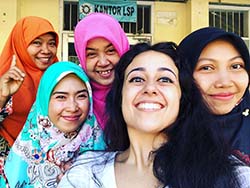
Alice Potter '18 with her fellow faculty members while in the Peace Corps

The Peace Corps profoundly changed Potter’s life. She learned the importance of keeping an open mind and welcoming others from different backgrounds with appreciation and understanding. While the Peace Corps may not be for everyone, Potter believes everyone could benefit from broadening their perspective by experiencing other cultures. “Immersing yourself in a different country with a foreign language and culture will humble you, and you’ll learn so much about yourself,” she confesses. “The Peace Corps was a beautiful, eye-opening experience that made a lasting impact,” she adds.

Potter keeps in touch with her first host family and hopes to go back to Indonesia as soon as it’s safe to do so. Saya meninggalkan sesuatu istimewa. “I left behind something special,” she translates.

What’s next?

After her 27-month stint in the Peace Corps, Potter moved back to California. Today, she continues to serve youth by teaching part-time in an after-school program. What’s next for Potter? She hopes to put her communication degree to use and strive toward her next goal of becoming a producer or film director.

Posted by: University Communications & Marketing Filed Under: Alumni, Business & Communication, Featured Story, Natural Sciences & Mathematics Tagged With: Communication, Environmental Studies Minor

Excellence in Scholarship and Teaching

March 1, 2021

Two Chaminade professors have been recognized for excellence in teaching and academic scholarship.

Jolene Cogbill

Dr. Jolene Cogbill, assistant professor of Biology, was named the inaugural recipient of the 2020 Chaminade University Excellence in Teaching Award. The honor celebrates teaching that has lasting and positive impacts on students and exemplifies innovative or transformative teaching practice.

Chaminade Provost Dr. Lance Askildson helped establish the Excellence in Teaching Award to underscore Chaminade’s commitment as a teaching institution. Award recipients receive $1,500 and public acknowledgment with a permanent display at Sullivan Family Library.

“Teaching excellence can make all the difference in a student’s academic career and should be recognized for its incredible importance to our University and broader community,” Askildson said.

“Great teaching can inspire students, challenge them and ignite their academic passions.”

Cogbill specializes in in Cellular and Molecular Biology, Developmental Biology and the teaching and design of biological lab techniques. She is also a Ho’oulu STEM academic navigator and coordinator of academic enrichment and outreach programs at the School of Natural Sciences and Mathematics.

Her accomplishments in the classroom include:

  • Developing a central theme to connect the semester and various lab units;
  • Focusing each lab around the scientific method with an emphasis on hands-on learning;
  • And creating a place-based curriculum that intentionally—and authentically—incorporates Native Hawaiian culture and ways of knowing, allowing for points of connection for all students.
Guanlin Gao

Dr. Guanlin Gao, assistant professor of economics, was also honored for her work.

Gao was named the 2020 recipient of the Fr. John F. Bolin Excellence in Scholarship Award, which recognizes Chaminade faculty members who have contributed substantial scholarship to their field of study. Awardees also receive a $1,500 prize and acknowledgment in a permanent display.

Gao is an applied microeconomist who conducts policy-driven research in behavioral, public and experimental economics and the economics of education. She seeks to deploy research-based evidence to help policymakers make decisions that benefit society, and in the last 12 months has published four papers in peer-reviewed journals and presented at five academic conferences.

Gao said she has also a strong commitment to innovative pedagogical approaches.

“I encourage the development of my students’ moral character and personal competencies,” she said, adding that she seeks to educate her students for adaptation and change but also challenges them to be the change. “I deeply believe that everyone can do their share to make the world a better place.”

Askildson congratulated both Cogbill and Gao for their achievements. “These two professors exemplify excellence in teaching and scholarship,” he said. “These awards recognizing their outstanding efforts are well-deserved and I look forward to all they will bring to our academic community—and to our students—in the years ahead.”

Posted by: University Communications & Marketing Filed Under: Business & Communication, Faculty, Featured Story, Natural Sciences & Mathematics Tagged With: Honors and Awards

  • « Go to Previous Page
  • Page 1
  • Interim pages omitted …
  • Page 8
  • Page 9
  • Page 10
  • Page 11
  • Page 12
  • Interim pages omitted …
  • Page 20
  • Go to Next Page »

Footer

Chaminade University Logo

3140 Waialae Avenue
Honolulu, Hawaii 96816

Contact Us
Phone: (808) 735-4711
Toll-free: (800) 735-3733

facebook twitter instagram youtube linkedin

Visit

  • Plan Your Visit
  • Campus Map (PDF)
  • Events

Resources

  • Campus Security
  • Student Consumer Information
  • Concerns, Feedback, and Reporting
  • Institutional Review Board
  • Title IX / Nondiscrimination Policy
  • Compliance
  • Emergency Information
  • Careers
  • Institutional Statement

People

  • Students
  • Parents
  • Alumni
  • Faculty & Staff

Policy

  • Privacy Policy
  • Terms and Conditions of Use


© Chaminade University of Honolulu