• Skip to primary navigation
  • Skip to main content
  • Skip to footer
Chaminade University of Honolulu

Chaminade University of Honolulu

  • VISIT
  • APPLY
  • GIVE
  • STUDENTS
  • PARENTS
  • ALUMNI
  • FACULTY/STAFF
  • Admissions
    • Admissions Home
    • Undergraduate Students
      • First-Year Students
      • Transfer Students
      • Admitted Students
    • Graduate Students
    • Flex Online Undergraduate Program
    • Military Students
    • Non-Degree/Visiting Students
    • Experiential Honors Program
    • Early College Program
    • New Student Orientation
  • Tuition & Aid
    • Financial Aid Home
    • Tuition & Expenses
    • Federal Updates & Changes
    • Scholarships
    • $5,000 Graduate Scholarship
    • VA Education Benefits
    • Net Price Calculator
  • Academics
    • Academics Home
    • Academic Programs
    • Office of Student Success
      • Academic Advising
      • Records and Registrar
    • Kōkua ʻIke (Support Services)
      • ADA Accommodations
      • Career Services
      • Proctoring Services
      • Tutoring Services
    • Sullivan Family Library
    • Undergraduate Research & Pre-Professional Programs
    • Commencement
  • Campus Life
    • About Campus Life
    • Student Engagement
    • Student Government Association
    • Residence Life and Housing
      • Summer Conference Housing
    • Health Services
    • Marianist Leadership Center
    • Counseling Center
    • Campus Ministry
    • Campus Security
    • Dining Services
    • Bookstore
  • Athletics
  • About
    • Chaminade University News
    • Our Story
    • Leadership
    • Chaminade University Strategic Plan 2024-2030
    • Mission & Rector
    • Association of Marianist Universities
    • Facts & Rankings
    • CIFAL Honolulu
    • Accreditation & Memberships
    • Montessori Laboratory School
Search
×

Search this web site

Natural Sciences & Mathematics

Islands of Opportunity: First-Ever Virtual DataCamp

January 16, 2021

In November 2020, the Islands of Opportunity-Louis Stokes Alliances for Minority Participation (IOA-LSAMP) and Chaminade University Honolulu partnered to launch an online data analytics proficiency course for university STEM students from Hawai‘i and the Pacific. The DataCamp was run by Chaminade faculty and staff under the supervision of a molecular immunologist and biologist. The program offered a unique opportunity for Native Hawaiian and Pacific Islander students to learn about the data analytics field through hands-on learning modules.

The University of Hawai‘i Hilo was also a participant in the DataCamp. Check out this article to learn more about the professors and students involved. We see bright futures ahead for Hawai‘i’s next generation of data scientists and can’t wait to see them use their newfound skills in our community! IOA-LSAMP includes 10 institutions across the Pacific region: Chaminade University of Honolulu, American Samoa Community College, College of the Marshall Islands, College of Micronesia—FSM, Guam Community College, Hawaiʻi Pacific University, Northern Marianas College, Palau Community College, University of Guam and University of Hawaiʻi at Mānoa.

Posted by: University Communications & Marketing Filed Under: Campus and Community, Diversity and Inclusion, Featured Story, Natural Sciences & Mathematics Tagged With: Data Science

Data and Design: A Powerful Storyteller

December 16, 2020

Majoring in data science means you spend a lot of your time combing through data, learning to use coding software, digitally mapping data and analyzing results. But at Chaminade University, it also means learning how to tell a story, understanding color theory, learning how to use design software and understanding the principles of visual communication.

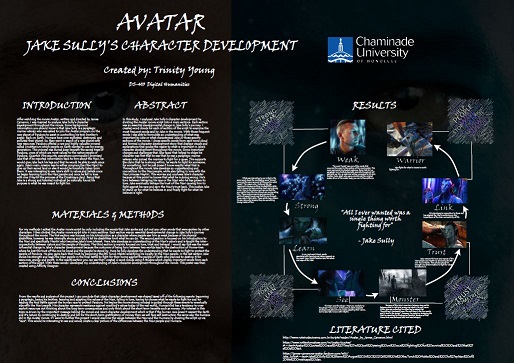
Digital Humanities Avatar presentation

Data Science 403: Digital Humanities is a new interdisciplinary course taught by Dr. Junghwa Suh, associate professor of environmental + interior design and Dr. Laura Tipton, assistant professor of data science, that all data science majors at Chaminade are required to take. The course merges the fields of humanities and data science, and teaches students how to turn data into meaningful, visual stories and relate it back to various dimensions of human living.

“We wanted to challenge the more analytic students in the course to think more creatively, both in their presentations and in their topics of study,” says Dr. Suh. “We wanted to show that not every data science analysis is based on a scientific study, sometimes we use data science to analyse classic literature or song lyrics.”

For many of the students, this was their first foray into the humanities and they weren’t quite sure what to expect.

“At the beginning of the semester, I interpreted digital humanities solely as studying the history of data science and technology,” says Trinity Young, a fourth-year student. “But now, after taking this course, I better understand that digital humanities is the study of applying data and technology to analyze and better understand human society and culture.”

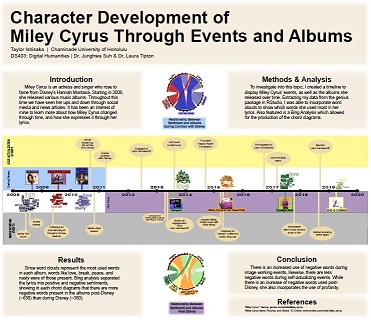
Digital Humanities Miley Cyrus presentation

In the first iteration of the course this past fall semester, each student was tasked with choosing a topic for a semester-long project that either brings them happiness or sparks their interest and passion. They then spent the first-half of the semester collecting and analyzing data, and the second half of the semester learning to develop a visually appealing story out of the data and present their findings. 

“[This course] really gave me another perspective in this area and allowed me to see the story behind everything,” says Taylor Ishisaka, a third-year student who used the project to explore how Miley Cyrus’s character has developed throughout various events and albums. “As of now, I truly think that it is necessary to have previous knowledge in humanities in order to understand the digital world better.”

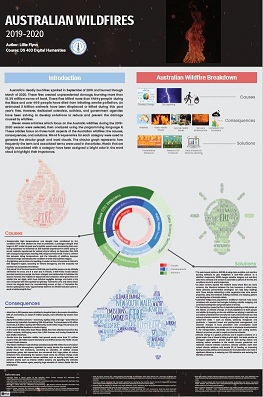
Digital Humanities Australian Wildfires

Lilianna Flynn, a senior who is majoring in business administration and minoring in data science, did her project on the recent Australian wildfires. She used data visualizations and word clouds to determine the causes and consequences of the wildfires and to identify solutions. 

“I believe my word clouds were my best visual aid,” says Flynn. “They displayed the most important words and gave the readers a basic understanding of the news articles.”

But her favorite part was seeing how creative her fellow classmates were in choosing their topics.

“My favorite part of the semester was listening to everyone’s presentations,” says Flynn. “Everyone had different ways of analyzing their data and unique presentation designs. Now, I believe design is even more important to communicate data visualizations effectively.” 

While the course was fun and meaningful for the students, the professors also had a good time with it. 

“I was really excited when I saw this course listed as part of the data science curriculum because it gave me a chance to highlight some of my “passion project” research areas, including dance history and mythology,” says Dr. Tipton. “And it gave me a chance to see what non-science interests the students have.”

On the other side, Dr. Suh was excited to take a dive into the sciences. “I have always wanted to teach a course where science meets art and design, and vice versa,” she says. “I usually don’t have a chance to meet students from other disciplines, so it was great interacting with the data science students.”

The pair is now brainstorming ways to expand the course in the future.

“Now I’m excited to see where this collaboration goes and how we can include students from other majors, like design and other humanities, next year,” says Dr. Tipton.

Posted by: University Communications & Marketing Filed Under: Featured Story, Humanities, Arts & Design, Natural Sciences & Mathematics Tagged With: Data Science, Environmental + Interior Design

New Data Science Scholarships

September 3, 2020

Chaminade University recently received a $1M grant from the National Science Foundation (NSF) to provide 20 scholarships for new first-year and transfer students who are majoring in data science.

Data science is one of the most in-demand and fastest growing careers in the Pacific region. As industries collect more data, they need more people who can analyze and interpret those data. This new program is part of a larger initiative to build a cohort of data science professionals in the Pacific to help support decision-making across Hawaii’s economic sectors.

“This program is all about access to high-paying in-demand jobs,” says Dr. Alexander Stokes, assistant professor at Chaminade University. “Every business sector in Hawaii, from healthcare to finance to energy and nonprofits, needs professionals in data analytics to provide decision support.”

Data science students at Chaminade participate in hands-on, project-based courses and internships that use real data provided by local businesses, agencies and community organizations. In addition to learning the necessary technical skills like coding and data visualization, students also learn about decision-making, data ethics and how to communicate complex datasets in a clear and concise way, ensuring they are well-versed in all aspects of the career.

“This project will empower students from across the region to find data-driven solutions to challenges in Hawaii and the Pacific region,” says Dr. Helen Turner, vice president for Strategy and Innovation at Chaminade University. “The Pacific faces unique challenges, and we need local students who can use local data to help us understand and address those challenges.”

The grant is part of NSF’s Scholarships in STEM (S-STEM) program, which seeks to increase the number of low-income academically talented students with demonstrated financial need who earn degrees in STEM fields. The scholarships will be available for new students who are majoring in data science, and preference will be given to students from Hawaii and the Pacific region who meet academic and financial requirements.

The new project aims to accomplish three things: 1) Mitigate the financial and academic barriers for low-income students from the Pacific; 2) acknowledge and address the cultural and non-academic barriers these students face when pursuing an education in STEM; and 3) develop new ways of teaching and supporting student needs, strengths and cultural expectations.

“There is a national need for well-educated STEM professionals from diverse backgrounds and experiences,” says Dr. Lynn Babington, president of Chaminade University. “The support from NSF will help strengthen the career pathway for low-income students and will ensure these future STEM workers receive a high-quality, values-driven education.”

Applications will be reviewed by a panel of Chaminade faculty members and students who are selected to participate in the program will receive a $10,000 per year scholarship. Program participants will also have access to academic navigators, cultural programming, life coaching, professional tutoring, paid internships, retreats and careers preparation.

/Honolulu Star-Advertiser article (9/28/20) >>

Posted by: University Communications & Marketing Filed Under: Diversity and Inclusion, Featured Story, Institutional, Natural Sciences & Mathematics Tagged With: Data Science, Scholarship

Serving Through Science

May 21, 2020

Sometimes, plans change. Sometimes, you enter college knowing exactly what you want to be when you grow up—and then you leave on a completely different track.

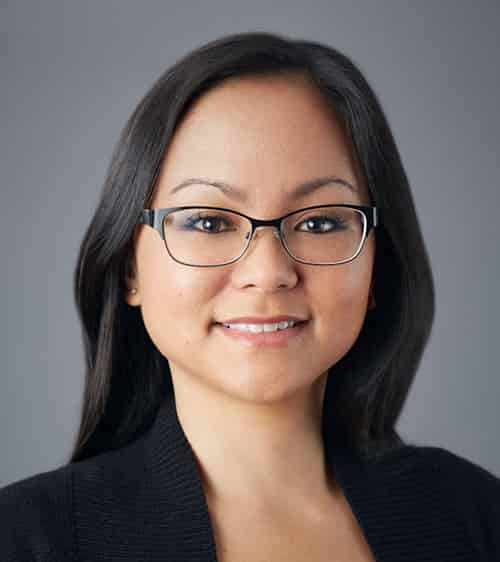
Jerlisa Arizala '04

At least that’s what happened to Jerlisa Arizala ‘04.

The Saipan native had always had her eyes on becoming a pediatrician.

Her first step was to get into a good university. But Saipan is fairly isolated, and her parents didn’t want her to travel too far.

Chaminade offered the perfect balance—a high-quality education that was relatively close to home, and an island lifestyle similar to the one she was used to. When she visited, she fell in love with the atmosphere. She felt the academic presence, but knew it would be a place where the community would support her and offer help if she needed it. She also really liked the diversity she saw on campus.

And her experience did not disappoint.

“My college experience was one of the best experiences of my life,” says Arizala. “I think Chaminade was the perfect place to feel comfortable being yourself because it was such a big melting pot. Everyone was so different and had an interesting background. It felt like everyone was accepted.”

One of the things that struck her right away was the diversity. For the first time, she realized just how many ways there were to be an American.

“It stood out so much to me that there were a lot of students from other U.S. Territories who were also American,” she remembers. “It was really nice to see all of the different definitions of American in one place. It wasn’t what a typical mainland experience would have been like.“

She started Chaminade as a biology major on the pre-med track. That’s how she met biology professor Ron Iwamoto. Not only was he her advisor, but he also taught a few of her classes. He noticed right away that she had a talent for writing.

“As my professor, he was able to look at my strengths and communicate what those were to me,” recalls Arizala. “He told me I was a good writer, and I should pursue some sort of writing career. And he told me I could do that within academia.”

It was through his guidance that she was inspired to pursue research instead of medical school. She also decided to add on an English minor. It provided a nice balance to the heavy biology classes, and it helped her develop her writing skills.

When she graduated in 2004, she went on to earn an M.S. in Biological Science from California State University Los Angeles, and a Ph.D. in molecular biology and virology from the City of Hope.

Sometimes she still thinks about becoming a pediatrician, but she never follows through because she really likes where her path has led her. She’s found that her ultimate goal was always to help people, and she can do that through research.

“I’ve learned so much about how to help people,” she says. “I have no regrets about the track I took. I know there are groups that need help, and I can help them through science.”

Arizala is a cell biologist at Kite Pharma, a subsidiary company of Gilead Sciences, Inc., and couldn’t be happier. The research coming out of Gilead represents everything she stands for—she loves how they want to give to the community and make sure everyone has access to drugs they need. Gilead Sciences is known for its antiviral drugs used to treat HIV. They have also made the news lately for their promising COVID-19 treatment that is currently undergoing clinical trials, Remdesivir.

Arizala’s expertise lies in reengineering T cells, a type of lymphocyte, or white blood cell, to attack and kill cancer cells. It’s a developing treatment for certain types of lymphomas and leukemias, and her company was responsible for the first T cell lymphoma treatment product to be approved and released on the market.

Her work is something she holds very dear to her heart. It’s a source of pride, and she finds it very rewarding. “Working for Kite Pharma is a great way to make a direct impact on a cancer patient’s life,” she says. “I help them have a better quality of life by allowing them to live longer and eradicate their cancer.”

Arizala credits both Iwamoto and Chaminade for the impact she’s had on others. If it weren’t for Iwamoto’s guidance, her educational path would have been very different.

In fact, their relationship came full circle right around 2012 or 2013. She was finishing up her Ph.D. at City of Hope, a world-class cancer hospital in Los Angeles. He was there as a lymphoma patient, receiving a transplant.

“We had dinner together and he met my husband,” she recalls. “It was the last time I saw him in person.”

Though they are in different states now, she still keeps in touch with her professor—he sends her updates of his grandchildren, and she sends him updates about her children. He’s also served as a reference, and helped her get into graduate school and get her first job.

Her time at Chaminade not only fostered her passion for science, but it also taught her to recognize her strengths and embrace who she is.

“Going to a school that was very warm and friendly taught me to be that way with others,” says Arizala. “It taught me to be genuine and to keep my morals.”

As a female and as a minority in the sciences, that has come in handy. She recognizes the responsibility she has in paving the way for others and has been able to stay true to herself and always represent where she is from.

“Chaminade prepared me to be a role model,” says Arizala. “Not only in building my passion in science, but also by building my character.”

Posted by: University Communications & Marketing Filed Under: Alumni, Diversity and Inclusion, Featured Story, Humanities, Arts & Design, Natural Sciences & Mathematics Tagged With: Biology, English

Working on the Frontlines

May 18, 2020

It’s Monday, and Ann-Janin Bacani arrives at work around 8:15 a.m. She covers herself head to toe in personal protective equipment (PPE), and heads into the lab.

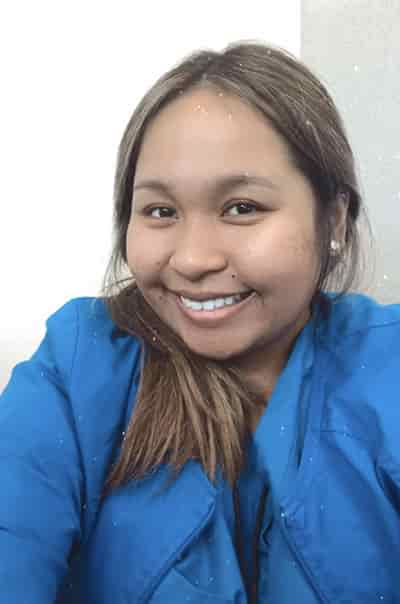
Ann-Janin Bacani '18

The Chaminade alumna checks each coronavirus testing swab that arrives—it’s essential to enter them into their database before proceeding. She ensures they each have proper approval from the state epidemiologist, and then she gets to work.

Each coronavirus test swab is analyzed for the virus through a lengthy process. First, the RNA is extracted from the virus. Then, it is converted to DNA. Finally, using a real-time, reverse transcriptase Polymerase Chain Reaction (RT-PCR) machine, the DNA is copied and amplified to identify the presence of 2019-nCoV genes. If the genes are present, the test is considered positive.

Bacani is a microbiologist in the Biological Response Section of the Hawaii State Department of Health’s Laboratory and Preparedness Response Branch.

Initially, she worked with the Food and Drug Administration to test food samples for salmonella and listeria. But when COVID-19 hit in January, Bacani’s lab was the first in the state of Hawaii to be approved to analyze test results.

At first, it was nerve wracking. There was a lot of initial uncertainty and risks. So much about the disease was unknown. But the department was quick to react.

“I was fully trained by highly trained microbiologists in my section and we were provided with the proper PPE to work the virus,” says Bacani. “That put my mind at ease while working in the laboratory.”

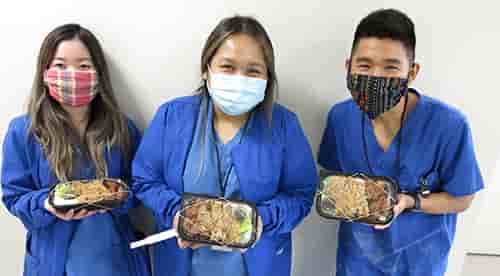
Ann-Janin Bacani '18 and her co-workers showing their lunch their received from donors
(L-R) Ayana Garnet, Ann-Janin Bacani ’18 and Drew Kuwazaki receiving their free ‘thank you’ bentos from the Hawaii Government Employee Association

As part of the Biological Response Section, the Waipahu High School graduate is part of a team of epidemiologists, physicians, microbiologists and officials from the Center for Disease Control and Prevention and Food and Drug Administration tasked with providing rapid response to bioterrorism, infectious disease outbreaks or any other public health emergency.

Their COVID testing lab serves all of Hawai‘i and many of the outer Pacific Islands as well. Bacani sees it as a chance to serve her community.

“It has always been my vision and goal to be able to give back to my community,” says Bacani. “From my early years at Chaminade University, I have wanted to provide and bring quality care to underserved populations.”

Bacani graduated from Chaminade University in 2018 as a biochemistry major with a minor in psychology.

She attributes a lot of what she does now to her time at Chaminade. It was through a Chaminade classmate that she initially found the position at the Department of Health—Alexis Young, another Chaminade alumna, is also a microbiologist at the department.

A graduate of Waipahu High School, Bacani was introduced to Chaminade University at a college fair field trip. Her dream was to become a pharmacist, so she chose Chaminade for the highly regarded STEM program. 

Her next four years were filled with leadership roles, clubs, research opportunities, premedical summer programs, travel to conferences and more. And while she didn’t always recognize it at the time, everything she learned was preparing her for her role today.

“Turns out, a lot of the things we all thought we wouldn’t need to know were things we later found to be very helpful,” she admits.

Perhaps her biggest lesson was understanding just how important it is to follow precise laboratory techniques and best practices—for a patient relying on a diagnosis, it can be life-changing.

“The human aspect of a clinical sample is more than just the volume in a tube,” says Bacani. “It’s the impact that the sample has that is important, which makes all of what I do as a microbiologist worthwhile.”

And the impact of what she does every day is not lost on her.

“Our job is so meaningful right now, as it is an essential task that allows people to know whether or not they have contracted the coronavirus,” explains Bacani. “It is so important to understand the precise laboratory techniques, tests and best medicinal approaches that allow for a patient’s life-changing diagnosis.”

While she has been honored to serve her community on the frontlines of this pandemic, Bacani’s ultimate goal is still to become a Doctor of Pharmacy. She’s humbled by the power drug interactions can have on a patient’s life, and wants to become a clinical or hospital pharmacist. She plans to start at the Daniel K. Inouye College of Pharmacy at University of Hawaii at Hilo in the fall.

Posted by: University Communications & Marketing Filed Under: Alumni, Behavioral Sciences, Featured Story, Natural Sciences & Mathematics Tagged With: Biochemistry, Psychology

Dr. Frederique Kandel Selected for Fellowship

May 12, 2020

Chaminade University Assistant Professor Frederique Kandel, PhD, has been selected for the 2020 Ronald M. Iwamoto Teaching Fellowship in Biology. Kandel is the first faculty member named to the program since its $50,000 endowment was established at the University in 2019.

Frederique Kandel

Kandel will hold the title of Iwamoto Fellow for two years. The endowment was established to honor Faculty Emeritus Ronald Iwamoto, biology faculty member at Chaminade University for 47 years. The Iwamoto Fellowship was aided by over 70 donors, many former students of Iwamoto. The funds from the Iwamoto Fellowship support professional development, including attendance at conferences, workshops, innovative curriculum development, or leadership in education training.

“Professor Emeritus Ron Iwamoto’s reputation as an inspiring and enthusiastic teacher remains much alive in our school,” said Kandel. “I am truly grateful and honored to receive this fellowship and look forward to starting the professional development program by attending the American Society of Microbiology conference for undergraduate educators. Mahalo nui loa to all involved.”

Applicants for the Iwamoto Fellowship must submit a strategic program of professional development with a defined set of goals for the two-year period. Many fellowships at universities across the United States are available for research activities, but it is rare to have a fellowship focused on the development of teaching and pedagogy.

Iwamoto Fellow candidates are nominated by the Dean of Natural Sciences at Chaminade University, and formally selected by a committee comprised of Chaminade University alumni, many of whom are healthcare professionals.

“Dr. Kandel is an extremely talented and dedicated biology professor who strives for excellence in her biology pedagogy and is very popular with our students,” said Gail Grabowsky PhD, Interim Dean of Natural Sciences at Chaminade University. “She strikes the perfect balance between empathy and compassion, and she teaches her students how to become accomplished and disciplined scientists. She was trained as a marine scientist but has such a broad breadth of scientific knowledge and experience that she is also currently the President-Elect of the Hawaii Branch of the American Society of Microbiology. Because of this fellowship Dr. Kandel will be able to do more and new wonderful things for our Chaminade biology students.”

Kandel has committed over 20 years to teaching biology, math, and science at the university and high school levels in diverse cultural and socioeconomic contexts. She teaches a range of topics at Chaminade University, from freshman biotechnology to human anatomy for nurses to a senior microbiology course and laboratory for biology students.

Her strategic program of professional development as an Iwamoto Fellow will be to attend the 2020 ASM Conference for Undergraduate Educators (ASMCUE) in Bellevue, Washington and the 2021 ASM Teaching Undergraduate Biology webinar series. Both events aim to enhance the quality of microbiology education. Upon completion of the webinar, attendees are also invited to participate in sessions at the 2021 ASMCUE and to submit a poster or demonstration. This opportunity will give Kandel the chance to share the innovative teaching techniques and experiences generated during the previous year.

The Iwamoto Fellowship is the first-ever fellowship of any kind at Chaminade University.

# # #

Chaminade University of Honolulu provides a collaborative and innovative learning environment that prepares graduate and undergraduate students for life, service and successful careers. Established in 1955, the university is guided by its Catholic, Marianist and liberal arts educational traditions, which include a commitment to serving the Native Hawaiian population. Chaminade offers an inclusive setting where students, faculty and staff collectively pursue a more just and peaceful society. For more information, visit chaminade.edu.

Posted by: University Communications & Marketing Filed Under: Faculty, Featured Story, Natural Sciences & Mathematics, Press Release Tagged With: Biology

  • « Go to Previous Page
  • Page 1
  • Interim pages omitted …
  • Page 9
  • Page 10
  • Page 11
  • Page 12
  • Page 13
  • Interim pages omitted …
  • Page 20
  • Go to Next Page »

Footer

Chaminade University Logo

3140 Waialae Avenue
Honolulu, Hawaii 96816

Contact Us
Phone: (808) 735-4711
Toll-free: (800) 735-3733

facebook twitter instagram youtube linkedin

Visit

  • Plan Your Visit
  • Campus Map (PDF)
  • Events

Resources

  • Campus Security
  • Student Consumer Information
  • Concerns, Feedback, and Reporting
  • Institutional Review Board
  • Title IX / Nondiscrimination Policy
  • Compliance
  • Emergency Information
  • Careers
  • Institutional Statement

People

  • Students
  • Parents
  • Alumni
  • Faculty & Staff

Policy

  • Privacy Policy
  • Terms and Conditions of Use


© Chaminade University of Honolulu