• Skip to primary navigation
  • Skip to main content
  • Skip to footer
Chaminade University of Honolulu

Chaminade University of Honolulu

  • VISIT
  • APPLY
  • GIVE
  • STUDENTS
  • PARENTS
  • ALUMNI
  • FACULTY/STAFF
  • Admissions
    • Admissions Home
    • Undergraduate Students
      • First-Year Students
      • Transfer Students
      • Admitted Students
    • Graduate Students
    • Flex Online Undergraduate Program
    • Military Students
    • Non-Degree/Visiting Students
    • Experiential Honors Program
    • Early College Program
    • New Student Orientation
  • Tuition & Aid
    • Financial Aid Home
    • Tuition & Expenses
    • Federal Updates & Changes
    • Scholarships
    • $5,000 Graduate Scholarship
    • VA Education Benefits
    • Net Price Calculator
  • Academics
    • Academics Home
    • Academic Programs
    • Office of Student Success
      • Academic Advising
      • Records and Registrar
    • Kōkua ʻIke (Support Services)
      • ADA Accommodations
      • Career Services
      • Proctoring Services
      • Tutoring Services
    • Sullivan Family Library
    • Undergraduate Research & Pre-Professional Programs
    • Commencement
  • Campus Life
    • About Campus Life
    • Student Engagement
    • Student Government Association
    • Residence Life and Housing
    • Health Services
    • Marianist Leadership Center
    • Counseling Center
    • Campus Ministry
    • Campus Security
    • Dining Services
    • Bookstore
  • Athletics
  • About
    • Chaminade University News
    • Our Story
    • Leadership
    • Chaminade University Strategic Plan 2024-2030
    • Mission & Rector
    • Association of Marianist Universities
    • Facts & Rankings
    • CIFAL Honolulu
    • Accreditation & Memberships
    • Montessori Laboratory School
Search
×

Search this web site

Diversity and Inclusion

Business Olympics

April 26, 2024

Annual Games Challenge High School Students

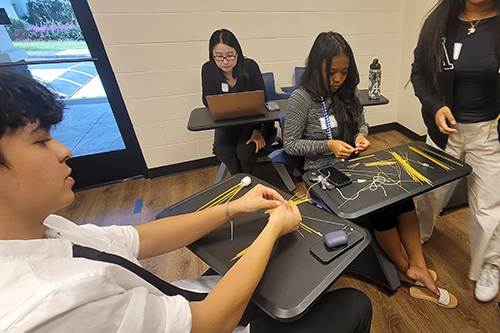
Let the mental gymnastics begin. In 20 minutes, teams had to build the tallest free-standing structure, using only spaghetti, one yard of tape, one yard of string and one marshmallow, which needed to sit on top. During this “Marshmallow Challenge,” sitting on one side of the room, the Spartan, Trojan and Athenian teams from Maryknoll School and Nanakuli High & Intermediate School talked about teamwork, listening, communication and trust. On the other side, Silverswords spoke of flexibility, creativity and open-mindedness.

“The Marshmallow Challenge is used a lot in business schools,” said assistant professor Eddie Merc, Ph.D., Chaminade’s MBA Director and Program Advisor. “The participants learn about team building and how to adapt if your design isn’t working.”

The contest was just one of many during the Third Annual Business Olympics, which is organized by the School of Business and Communications. As part of his operations management class, MvFaden Iriarte ’25 was among the Silversword participants in the Marshmallow Challenge.

“There was only one rule: your finished structure had to sit on the slippery surface of a desk,” explained Iriarte, as he pointed to their design, which won the challenge for being the tallest. “I was really impressed with what the high-school kids came up, and how they worked together and listened to each other.”

  • Ethan Hendricks and Vaneah Dela Cruz develop their structure as Maryknoll School's academic dean of science and English reviews the day's schedule.
    Ethan Hendricks and Vaneah Dela Cruz develop their structure as Maryknoll School’s academic dean of science and English reviews the day’s schedule.
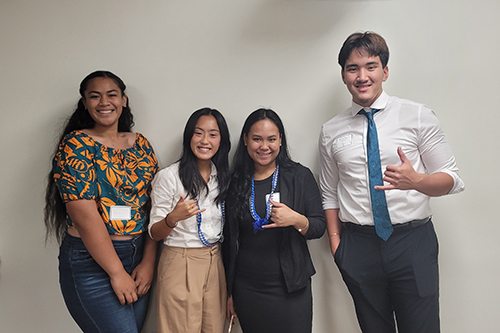
  • Nanakuli sophmore Saeota Fanuaea, far left, poses with Maryknoll School students, including senior Kainalu Szewczyk.
    Nanakuli sophmore Saeota Fanuaea, far left, poses with Maryknoll School students, including senior Kainalu Szewczyk.
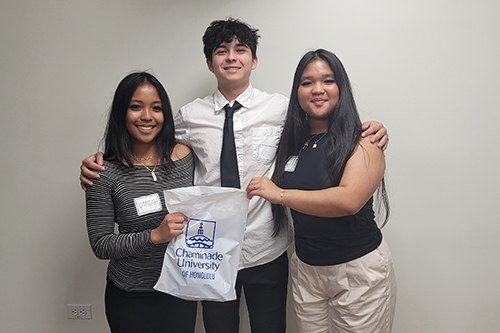
  • Ethan Hendricks poses with Vaneah Dela Cruz, left, and Megan Collado.
    Ethan Hendricks poses with Vaneah Dela Cruz, left, and Megan Collado.
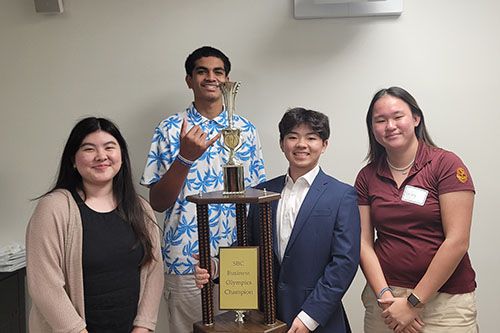
  • Nanakuli junior, Vai Fanuaea, flashing shaka, and Maryknoll School students pose with their trophy.
    Nanakuli junior, Vai Fanuaea, flashing shaka, and Maryknoll School students pose with their trophy.
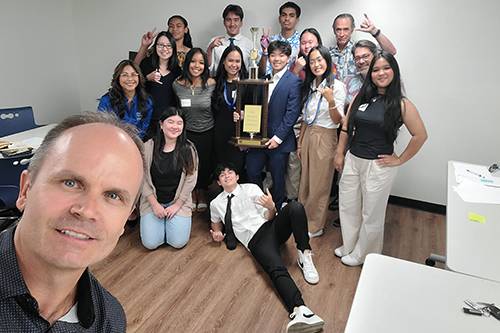
  • Dr. Eddie Merc with Drs. Annette Santos and Roy Panzarella pose with the Maryknoll Students after their Mini Shark competition.
    Dr. Eddie Merc with Drs. Annette Santos and Roy Panzarella pose with the Maryknoll Students after their Mini Shark competition.
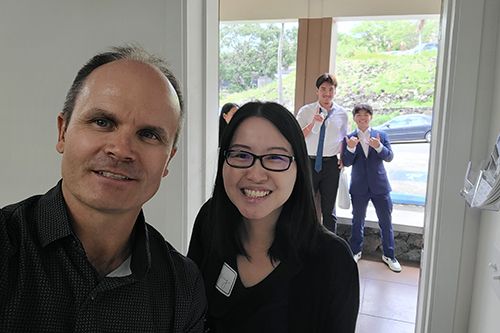
  • Dr. Eddie Merc takes a selfie with Maryknoll School's Kit-U Wong, who escorted the Trojans to Chaminade.
    Dr. Eddie Merc takes a selfie with Maryknoll School’s Kit-U Wong, who escorted the Trojans to Chaminade.
  • Now in its third year, the Business Olympics combines Merc’s efforts to reach out to high schools and his athletic background as a former collegiate tennis player. The event features five different stations or “challenges” that cover various subjects, including business fundamentals, management and teamwork, accounting and finance, marketing and a “Mini Shark” presentation.

    “The event provided them insights of what topics they would study in business school,” said Kit-U Wong, Maryknoll’s Social Science and English Dean of Academics. “They especially appreciated being able to ask questions to Chaminade University professors and getting great advice. I would love for future students to get the chance to participate.”

    Interim Dean Annette Santos was one of the four Mini Shark panel members, who listened and judged the five-minute business pitches. One team’s entrepreneurial idea was to develop a new eczema cream; another was to sell a protein ice cream after working out; and the third was to build a soundproof dog house.

    “It’s quite impressive what students can come up within five minutes—really impressive,” Santos said. “It was a successful Business Olympics event and a wonderful opportunity to bring students to campus, engage with our faculty, and create memorable experiences that we hope will bring them back.”

    Nanakuli High High School junior Vai and his freshman sister Saeota Fanuaea were encouraged by their mom, Rosa Fanuaea who attended Chaminade her freshman year, to join the Business Olympics event, telling them that this would be a good opportunity to visit the beautiful campus. Walking from the Sullivan Family Library to Hale Hoaloha, the siblings took in all the scenery, admiring the buildings and views.

    “So far we’ve learned about team building,” said Saeota Fanuaea, after competing in the Marshmallow Challenge. “Our next class is accounting and finance, which I am looking forward to learning about.”

    While the Trojans may have taken gold in the Mini Shark presentation, the Spartans and Athenians were also winners in their own sense. Maryknoll senior Ethan Hendricks felt he had already won after learning about SWOT (strengths, weaknesses, opportunities, and threats) analysis.

    “My mom has her own business, Alinea Jewelry, and I want to help her with her marketing, which is so old school right now,” said Hendricks, with a boyish grin. “I already learned about some business concepts today, which I never knew about. I can now use that knowledge when I run my mom’s marketing.”

    “I’m happy Ethan is exploring different avenues to educate himself about business and marketing,” said mom Andromeda Hendricks. “I support his endeavors and I think he is in good hands there at Chaminade.”

    Posted by: University Communications & Marketing Filed Under: Business & Communication, Campus and Community, Diversity and Inclusion, Faculty, Featured Story, Institutional Tagged With: Campus Event, Early College Experience, School of Business and Communication

    Commencement Ceremony 2024

    April 23, 2024

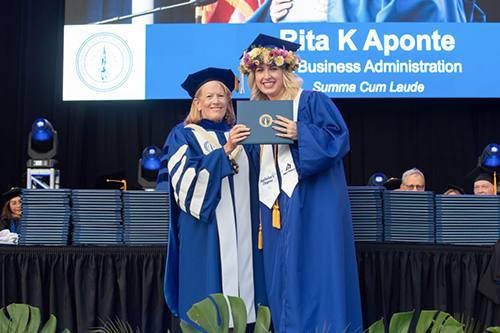
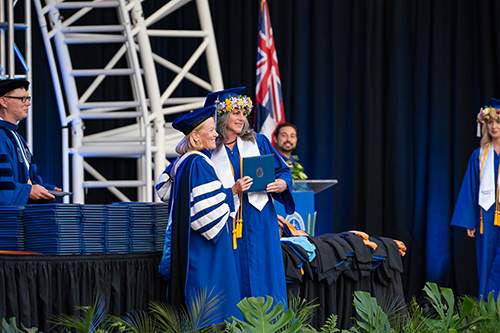
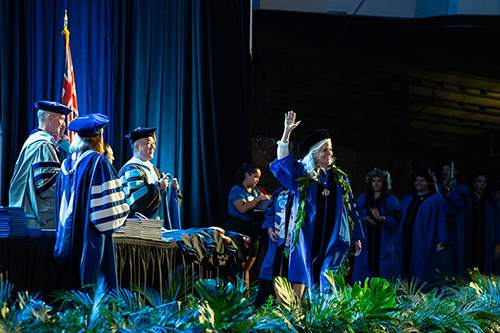
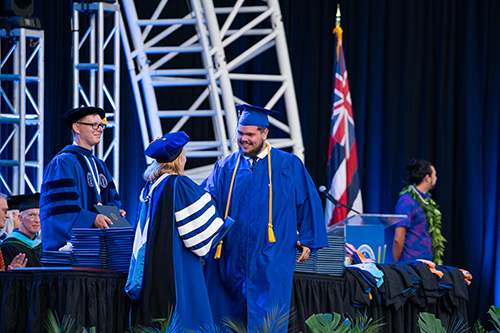
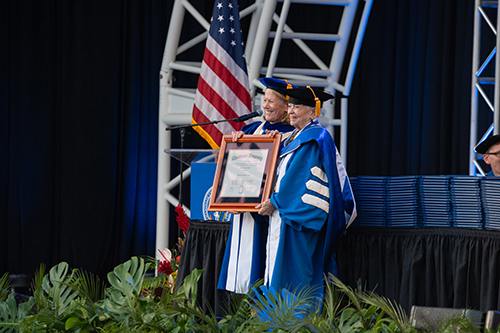
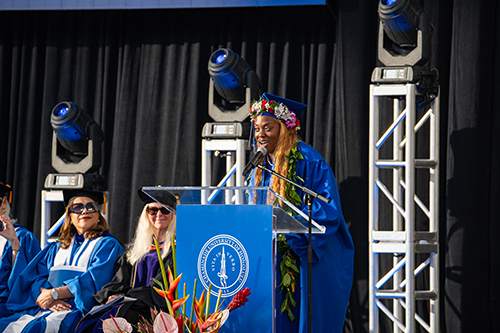
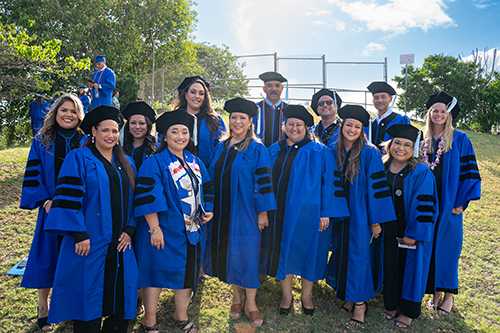
    Chaminade University will host its Spring 2024 Commencement on Saturday, May 4 at the Waikīkī Shell. The 5:30 p.m. ceremony will honor approximately 600 graduates receiving degrees from the University’s School of Business and Communication; School of Natural Sciences and Mathematics; School of Education and Behavioral Sciences; School of Humanities, Arts and Design; and the School of Nursing and Health Professions. 

    “Chaminadeʻs Commencement Ceremony is a beautiful and meaningful occasion for our graduates and their families,” said Chaminade University President Lynn Babington, PhD. “We celebrate this milestone and all of our graduates for their accomplishments, dedication and perseverance in pursuing their degrees. Congratulations to all of our graduates!”

    This year’s graduating class includes associates, bachelors and 36 doctoral students including the first Doctor of Education in Organizational Leadership for Adaptation and Change degree. Other highlights of the Commencement Ceremony: 

    • Executive Counselor for the Asian Pacific Islander Health Forum Dr. Kamanaʻopono M. Crabbe will serve as the Commencement Speaker. 
    • An honorary Doctor of Humane Letters degree will be bestowed to community leader Jean Estelle Rolles. 
    • Undergraduate Student Brittany K. Johnson and Graduate Student Donna Kay Fisher will speak as representatives of the student body.

    Posted by: University Communications & Marketing Filed Under: Alumni, Diversity and Inclusion, Featured Story, Institutional, Press Release Tagged With: Alumni, Campus Event, Commencement, Honors and Awards

    International Education Week

    April 18, 2024

    Student clubs share ethnic cuisines and dances

    With Chaminade’s diverse population, it’s only fitting that the University would celebrate International Education Week (April 8-12). Inspired by the United Nations Educational, Scientific and Cultural Organization’s World Day for Cultural Diversity for Dialogue and Development, the series of campus events featured a melting pot of flavors, starting with the Spring 2024 Taste of Culture.

    The Filipino Club served one of the national dishes of the Philippines—lechon, crispy roast pork.
    The Filipino Club served one of the national dishes of the Philippines—lechon, crispy roast pork.

    “Our University is a mosaic of talents, backgrounds and experiences, and it is this diversity that makes our community truly exceptional,” says Chaminade President Lynn Babington, Ph.D. “International Education Week allows us to celebrate not only the richness of the world’s cultures, but also the essential role of intercultural dialogue for achieving peace and sustainable development.”

    Participating clubs at this year’s Sixth Annual Taste of Culture included the TaoTao Marianas Club, World of Dance, Accounting Club, Office of Student Engagement, Chaminade Student Government Association, Micronesian Club, Lumana‘i O Samoa, Student Organization of Latinx, The Filipino Club, Office of the President, Chemistry Club and Restauranteers Club.

    Observing cultural week not only offers the Kalaepohaku community a chance to experience the diverse cultures of our student body, but it also facilitates the dismantling of stereotypes while fostering mutual comprehension and acceptance. Through the International Extravaganza, students and local residents can listen to the musical rhythms, watch the graceful dances, and enjoy the traditional attire and unique customs of various cultures, cultivating a profound admiration for our campus diversity and fostering cross-cultural empathy.

    “As advisors for The Filipino Club, Bro. Allen (Pacquing) and I ensure that the students are constantly receiving the support they need, ensuring that our activities run smoothly,” says Maritel Suniga, payroll specialist in the Business Office. “They put 100 percent of their time and energy into practicing the traditional tinikling dance, often rehearsing late into the night to perfect their moves.”

    Wearing a traditional barong tagalog, Christian Raquepo’s first-time experience at Taste of Culture and International Extravaganza was memorable. “These events are a testament to Chaminade’s value of education in the ‘ohana spirit and inclusivity,” said the Silversword freshman. “As a proud first generation Filipino-American, representing my culture in food and dance with our University community makes me proud of my cultural heritage.”

    In addition to The Filipino Club, other participants included Ka Ipu Kukui Me Ka ‘ie ‘ie (Hawaiian Club), Lumana‘’i O Samoa and the Taotao Marianas Club.

    “Cultural events allow me to be proud of who I am as a descendant of Filipino immigrants,” Raquepo said. “Dressing up in our cultural attire was my favorite moment.”

    Posted by: University Communications & Marketing Filed Under: Campus and Community, Diversity and Inclusion, Homepage, Institutional Tagged With: Alumni, Campus Event, Marianist

    Scholarly Research

    April 9, 2024

    Students present their thought-provoking research findings

    Psychology major juniors Leila-Jayne Casison and Clara Slate-Liu are on their way to the National Conference of Undergraduate Research (NCUR) in California. But before presenting their findings on a national stage, the two Silversword athletes presented their research at the annual Na Liko Na‘auao Symposium, allowing them to fine tune their presentation and to anticipate any questions they may have to field.

    “I think today was a good trial run for us in terms of getting used to discussing our study with others, especially those who we’ve never met before,” Casison said. “I also think we’re getting better with having meaningful conversations with those who find interest in our study on our athletes.”

    Titled “The Sleep of University Student-Athletes,” Casison’s and Liu’s study looked at sleep patterns of fellow Swords, and they concluded that soccer players have the worst sleeping habits of all the athletes.

    “Their practices start at 6 in the morning and they go to bed late,” Casison and Slate-Liu said. “So, of course, they’re going to experience daytime fatigue. It should be an issue that our coaches and athletic director are made aware of.”

    A Silversword tennis player, Sydney Danielson was tireless in her pursuit of learning about avian malaria and avian pox effects on Hawaiian birds, such as the ‘amakihi, apapane and ‘i‘wi. A passionate naturalist, the Minnesota native looked at the two diseases and their impact on native birds’ population.

    “Symptoms include swollen, tumor-like lesions on unfeathered parts of a bird’s body, such as the feet, legs, eyes and base of the bill,” Danielson explained of avian pox. “Both diseases are very difficult to manage, and the continued viability of our native forest birds depends on the preservation of their habitat.”

    Sarah Carroll explains her research to Fr. Martin Solma during the Na Liko Na'auao Symposium.
    Sarah Carroll explains her research to Fr. Martin Solma during the Na Liko Na’auao Symposium.
    Professor Tracy Trevorrow, Ph.D., discusses the research findings of Clara Slate-Liu, left, and Leila-Jayne Casison.
    Professor Tracy Trevorrow, Ph.D., discusses the research findings of Clara Slate-Liu, left, and Leila-Jayne Casison.
    Brittany Johnson commented on Brandon Koskie's research project on Kalauhaihai Fishpond and Kanewai Spring.
    Brittany Johnson commented on Brandon Koskie’s research project on Kalauhaihai Fishpond and Kanewai Spring.
    Lindsey Dimaya, left, a junior at Sacred Hearts Academy and a participant in Chaminade’s early college program, presented her findings to Joleigh Ballesteros-Magdaro.
    Lindsey Dimaya, left, a junior at Sacred Hearts Academy and a participant in Chaminade’s early college program, presented her findings to Joleigh Ballesteros-Magdaro.
    Brandon Koskie, right, discusses his research findings on two fishponds with Anson Ekau, who developed a dashboard for the Maunalua Fishpond Heritage Center.
    Brandon Koskie, right, discusses his research findings on two fishponds with Anson Ekau, who developed a dashboard for the Maunalua Fishpond Heritage Center.
    Katelyn Salcedo's hypotheses posed the question: Is Literacy Affected by the Home Environment.
    Katelyn Salcedo’s hypotheses posed the question: Is Literacy Affected by the Home Environment.
    Sydney Danielson explains the effects of avian malaria and avian pox to attendees at the Na Liko Na'auao Symposium.
    Sydney Danielson explains the effects of avian malaria and avian pox to attendees at the Na Liko Na’auao Symposium.
    Dr. Lynn Babington listened to what Kole Nagai had to say about his research findings during the 22nd Annual Na Liko Na'auao Symposium.
    Dr. Lynn Babington listened to what Kole Nagai had to say about his research findings during the 22nd Annual Na Liko Na’auao Symposium.
    Leila-Jayne Casison, left, and Clara Slate-Liu, studied the sleeping patterns of Silversword athletes.
    Leila-Jayne Casison, left, and Clara Slate-Liu, studied the sleeping patterns of Silversword athletes.

    For the past 22 years, student scholars have presented their yearlong work during this annual Symposium, allowing them to explain their research and answer questions from faculty, peers and at-large community members. In the past, students’ presentations have focused on mental health—especially the impact of COVID—physical health problems, substance abuse and even “climate monstrosities.”

    According to Amber Noguchi, Ph.D., Undergraduate Research and Pre-Professional Programs director, undergraduate and graduate research experience can look like a number of things. It can range from formal and clinical studies to data analysis, and creative works and beyond.

    “All of these presentations stem from research projects that have been collaborations between the student researchers and their faculty mentors,” Noguchi explains. “This undergraduate conference celebrates student scholars from across all academic disciplines.”

    For the past several months, Lindsey Dimaya has locked herself in her room, unwilling to share with her parents the project that she was working on for the Na Liko Na‘auao Symposium. An avid reader, the 17-year-old teenager chose to do research on adult literacy and its impact on mental health.

    Pointing to her presentation, dad Don Dimaya quipped that Lindsey finally explained why she isolated herself in her bedroom for all those hours. “Now it makes sense,” he said with a laugh. “Instead of getting her driver’s license last summer, she was busy with this.”

    “I looked at the correlation between adult literacy and mental health,” said Dimaya, a junior at Sacred Hearts Academy and a participant in Chaminade’s early college program. “One of the reasons I was interested in this research was because of a story I had heard about a mother who wanted to bake her daughter a birthday cake, but she couldn’t because she didn’t know how to read.”

    Dimaya’s research yielded some interesting findings, including a connection between improved reading skills and better mental health, and regaining childhood memories that emerged as a result of enhanced literacy.

    “The breadth and depths of these projects have blown me away,” said President Lynn Babington, Ph.D., in her closing remarks at the Symposium. “I have been truly impressed walking around the room, and listening to your presentations and your interests.”

    In his oral presentation, Anson Ekau ’25 demonstrated a beta dashboard that he developed for the Maunalua Fishpond Heritage Center, helping the nonprofit to monitor the health of the pond and its inhabitants.

    “This fishpond once stretched all the way to Mauanlua Bay,” Ekau said. “Now you can walk around it in two minutes. However, fishponds are crucial to the survival of native species, and they also allow us to promote and preserve Native Hawaiian culture.”

    The Symposium concluded with a presentation of the President Sue Wesselkamper Award, which acknowledges a student who has demonstrated extensive community and university service. In order to qualify for the prize, a student must have a minimum 3.5 GPA, show scholarship beyond classroom requirements by undertaking their own independent research or study, and must have presented their work both on and off campus. This year’s award went to Victoria Francois ’25, who gave a presentation on chronic pain among young adults and the effects of mindfulness.

    “I would do this again in a heartbeat,” said Francois of her research. “In doing research, I found that the world is your oyster, and that everything is open to you.”

    Posted by: University Communications & Marketing Filed Under: Behavioral Sciences, Campus and Community, Diversity and Inclusion, Faculty, Featured Story, Institutional Tagged With: Campus Event, Honors and Awards, Scholarship

    Sustainable Entrepreneurship

    April 2, 2024

    New ENV 490 Sustainability Innovation class stimulates paradigm shift

    Aside from being tongue twisters when said in succession, the terms sustainability and entrepreneurship are indeed big words, as pointed out by ’Inana Sustainability Entrepreneurship Program’s coordinator, Mariane Uehara. Tasked with creating a curriculum for the inaugural ENV 490 Sustainability Innovation course, Uehara admitted that she “jumped into the unknown” when she joined the United Nations’s CIFAL Center at Chaminade University.

    At the core of the ENV 490 is a student-driven project that’s in partnership with a local company. The goal was to balance the triple bottom line—people, planet and profit—while addressing the long-term impact of business activities on the environment and society. Sustainable entrepreneurship recognizes the interdependence of economic development, social well-being and environmental health, and seeks to create value in a way that is responsible and ethical.

    Lyla Gonsalves, left, and Jasmine Mondelo discussed possible solutions for Ten Tomorrow to become more sustainable.
    Lyla Gonsalves, left, and Jasmine Mondelo discussed possible solutions for Ten Tomorrow to become more sustainable.
    Sarah Carroll '25 identified potential partners that could help Re-use Hawaii and its sustainable efforts.
    Sarah Carroll identified potential partners that could help Re-use Hawaii gain greater community support.
    Ten Tomorrow designer Summer Shiigi, center, liked the ideas presented by Chaminade students, from left, Ka‘I‘inipu‘uwai “Mini” Keli‘iho‘omalu-Holz ’24, Lyla Gonsalves ’25, Jasmine Mondelo ’25 and LaVelle White ’26.
    Ten Tomorrow designer Summer Shiigi, center, liked the ideas presented by Chaminade students, from left, Ka‘I‘inipu‘uwai “Mini” Keli‘iho‘omalu-Holz ’24, Lyla Gonsalves ’25, Jasmine Mondelo ’25 and LaVelle White ’26.
    Re-use Hawaii's Workforce Development Coordinator Nathaniel Pak saw value in Chaminade student's sustainable efforts for the nonprofit. Team members included, from left, Sarah Carroll '25, Katherine “Kat” Liu ’26, Kaila Frank ’24 and Sano Tanna ’24.
    Re-use Hawaii’s Workforce Development Coordinator Nathaniel Pak saw value in Chaminade students’ sustainable efforts for the nonprofit. Team members included, from left, Sarah Carroll ’25, Katherine “Kat” Liu ’26, Kaila Frank ’24 and Sano Tanna ’24.

    “All the students’ projects had to align with at least one of the United Nations’s 17 Sustainable Development Goals (SDGs),” Uehara explained. “Although the vision was blurry at first, we figured out the puzzle together, and we had fun while doing so.”

    According to Uehara, the three goals of the ’Inana Program are: 1) To develop and implement programs for the education and training of undergraduate students in subjects directly relating to successful entrepreneurship; 2) To support minority business enterprises (MBEs), including building a diverse entrepreneurial pipeline to grow the number of MBEs; and 3) to create a UN Certificate program in sustainability entrepreneurship.

    Divided into three teams, 14 students presented their final entrepreneurial projects, working alongside with Ten Tomorrow, Re-use Hawaii and Plantoem. Under the mentorship of Uehara, and Cort Isernhagen and Jamie Lui of Diamond Head Research—a company that helps small companies track and assess their activities to identify trends and innovative business models that best support Corporate Social Responsibility, Environmental, Social and Corporate Governance, and philanthropic initiatives—the aspiring entrepreneurs demonstrated their ability to think outside the box.

    “First of all, who are you guys,” rhetorically asked Lui after listening to the students’ presentations. “You’re a completely different group from when we started this class a few months ago.”

    Exuding confidence, Sarah Carroll ’25 proposed a “Hanau Hana Aloha Event,” which would advertise Re-use Hawai’i as a community-based nonprofit worthy of long-term patronage and donation. Additionally, it would also pose these solutions: Engage an eco-conscious audience; showcase Re-use Hawaii’s mission beyond social media; and connect with long-term donors through a captivating experience.

    “Hosting an upcycle consignment event for Re-use Hawaii would present an innovative solution to address several pressing challenges,” the Data Science and Visualization major said. “It would help Re-Use connect with the community and give it more visibility, as well as broaden its donor pool.”

    Other Re-use Hawaii members included Katherine “Kat” Liu ’26, Sano Tanna ’24, Lihau Keoneula ’24 and Kaila Frank ’24.

    Pairing with Ten Tomorrow designer Summer Shiigi, Jasmine Mondelo ’25, Ka‘I‘inipu‘uwai “Mini” Keli‘iho‘omalu-Holz ’24, Lyla Gonsalves ’25 and LaVelle White ’26 aligned their entrepreneurial proposals with the local clothing company’s line of modern resort wear. An Environmental Studies major, Keli‘iho‘omalu-Holz identified the problem of having to bring in fabric, which contributes to carbon emissions, microplastics and landfills.

    Keli‘iho‘omalu-Holz’s solution was to source fabric that would be less harmful to the environment. She cited such alternatives as hemp, organic cotton, bamboo, recycled material and Tencel fabrics, which are produced with environmentally responsible processes from sustainably sourced natural raw wood fibers. Tencel textiles are also certified biodegradable.

    “I have a really keen interest in fashion, which is why I chose Ten Tomorrow ,” Keli‘iho‘omalu-Holz noted. “I wanted to find cost-effective solutions and sustainable fabrics that didn’t have a negative impact on our environment.”

    Alexandra Zingarelli ’24, Sydney Danielson ’25, Pūnohu Keahi ’25, Aleeyah Lemons ’24 and Conor McMahon ’24 partnered with Zoe Zhang of Plantoem, a portmanteau of plant and poem, and suggested a “Plantoem’s Appreciation March 2024.” Each week would tackle a different aspect, from the significance of native plants and “Aloha ʻĀina: Environmental Health Talk Story Event” to carbon offset, plant therapy and sustainable living workshops.

    “They really listened to what I had to say,” said Zhang, who founded Plantoem because of her love for plants and poetry. “Their proposal to me is highly viable. Since we came up with the awareness month idea during their second visit, I have already been in touch with some of the speakers who are interested in participating. The basic structure of the event month has already been sketched out. And the students are coming back to help work on the events in March.”

    In his closing remarks, Isernhagen commented on the diversity of ideas and the prototypes the students developed. “I liked the fact that you met the businesses where they were,” he concluded. “Your lenses were all sharply focused around sustainability. And I liked the fact that you collectively approached one problem but each of you came up with your own individual solution.”

    Posted by: University Communications & Marketing Filed Under: Business & Communication, CIFAL Honolulu, Diversity and Inclusion, Featured Story, Hogan Entrepreneurial Program, Innovation, Institutional Tagged With: CIFAL, CIFAL Center, Hogan Entrepreneurs Program, School of Business and Communication

    Nurturing Nurses

    April 2, 2024

    Answering the call for Hawaii’s need for more healthcare providers

    Some graduates work at The Queen’s Medical Center while others are employed by Hawaii Pacific Health and Kaiser Permanente. A few work in telemedicine with Pali Momi and Straub Medical Center. Since the Hawai‘i State Board of Nursing officially gave Chaminade University the green light to launch a nursing program in Fall 2010, the School of Nursing and Health Professions (SNHP) has graduated more than 600 nurses who have contributed to our community’s healthcare needs in various settings, including hospitals, doctors’ offices, clinics and other environments.

    “Our nursing program has a highly distinctive approach to nursing,” says Chaminade Provost and Senior Vice President Lance Askildson. “Our graduates are well rounded and play an essential role in their communities to advocate for health promotion.”

    Nursing stands as the cornerstone of the healthcare workforce, yet the demand for nurses is poised to escalate in the coming decade. Shifting population dynamics, advancements in technology and evolving healthcare models are set to catalyze an expansion in nursing roles, necessitating a highly educated nursing workforce. Compounded by the aging of the current nursing workforce and the impending wave of retirements, the United States is on track to face a significant nursing shortage by 2025, with Hawai‘i projected to experience a deficit of 3,311 professional nurses, according to an article published in Hawai‘i’s Journal of Medicine & Public Health.

    This year's White Coat Ceremony included 119 nursing students who are now officially in their clinical stages of their education.
    This year’s White Coat Ceremony included 119 nursing students who are now officially in their clinical stages of their education.

    In their research titled, Hawaii’s Nursing Workforce: Keeping Pace with Healthcare, the co-authors Sandra A LeVasseur, Ph.D., RN and Kristine Qureshi, Ph.D., RN, FAAN conclude that as healthcare needs change, academic, healthcare and community partners must be prepared to respond by developing innovative educational delivery models, new specialty programs and diverse clinical placement opportunities to ensure a pipeline of competent nurses across the state.  

    “The school just went through an external review” Askildson says. “The purpose of the review was to examine the current curriculum, capacities and profile of the School in order to identify opportunities for strategic investment and change that will strengthen academic excellence and student success in keeping with our University mission and ethos, and the enduring values of our School of Nursing and Health Professions.”

    In compiling their report on the SONHP, external reviewers Meredith Kazer, Ph.D., APRN, FAAN, (Team Lead), Beth P. Beckman, DNS, RN, FNP, NEA- BC, FAAN, Carrie M. Oliveira, Ph.D. and Marcia B. Proto, M.Ed, CAS met with faculty, staff, students and administrators, engaging stakeholders indiscussions that explored curricular issues, faculty and staff workload, the University’s commitment to ensuring a developmental approach to nursing and public health education, and exploring opportunities to further integrate SNHP programs in the service of Hawaii and its multicultural peoples.

    Furthermore, the reviewers note that the supportive culture that has been created and maintained throughout SNHP and the University is a tremendous strength of the School, and provides a strong foundation upon which to build. Throughout all their meetings, reviewers wrote they found a “strong sense of teamwork and collaboration, and there is a strong mission-focus throughout Chaminade and the SNHP team that embodies the mission in their work.”

    Presently, Hawai‘i boasts nine nursing programs dispersed across public and private universities and colleges. These programs have united in their efforts to align with the Institute of Medicine’s recommendations for the future of nursing. Through strategic partnerships and collaboration, the nursing landscape in Hawai‘i is undergoing a transformation. Practice boundaries are expanding, diverse pathways to advanced nursing education are being established, and nurses are forging alliances with other stakeholders to revolutionize healthcare delivery.

    To guide strategic planning efforts, the Hawai‘i State Center for Nursing diligently collects and analyzes data on the nursing workforce. This ongoing assessment allows for informed decision-making tailored to the unique needs of the state’s population and healthcare landscape. Identified gaps in nursing specialty education, particularly in areas such as school health and mental health, are being addressed through targeted initiatives aimed at bolstering education and training opportunities in these critical areas.

    “We want to continue to invest in our nursing program, which is one of the recommendations of the external reviewers,” Askildson says. “We want to continue to produce nurses without being transactional. Our nursing graduates are prized because they care deeply about their patients since they have a holistic approach to healthcare.”

    Posted by: University Communications & Marketing Filed Under: Alumni, Diversity and Inclusion, Homepage, Institutional, Nursing & Health Professions Tagged With: Alumni, Doctor of Nursing Practice, Doctorate of Nursing Practice, Nursing

    • « Go to Previous Page
    • Page 1
    • Page 2
    • Page 3
    • Page 4
    • Page 5
    • Page 6
    • Interim pages omitted …
    • Page 22
    • Go to Next Page »

    Footer

    Chaminade University Logo

    3140 Waialae Avenue
    Honolulu, Hawaii 96816

    Contact Us
    Phone: (808) 735-4711
    Toll-free: (800) 735-3733

    facebook twitter instagram youtube linkedin

    Visit

    • Plan Your Visit
    • Campus Map (PDF)
    • Events

    Resources

    • Campus Security
    • Student Consumer Information
    • Concerns, Feedback, and Reporting
    • Institutional Review Board
    • Title IX / Nondiscrimination Policy
    • Compliance
    • Emergency Information
    • Careers
    • Institutional Statement

    People

    • Students
    • Parents
    • Alumni
    • Faculty & Staff

    Policy

    • Privacy Policy
    • Terms and Conditions of Use


    © Chaminade University of Honolulu