• Skip to primary navigation
  • Skip to main content
  • Skip to footer
Chaminade University of Honolulu

Chaminade University of Honolulu

  • VISIT
  • APPLY
  • GIVE
  • STUDENTS
  • PARENTS
  • ALUMNI
  • FACULTY/STAFF
  • Admissions
    • Admissions Home
    • Undergraduate Students
      • First-Year Students
      • Transfer Students
      • Admitted Students
    • Graduate Students
    • Flex Online Undergraduate Program
    • Military Students
    • Non-Degree/Visiting Students
    • Experiential Honors Program
    • Early College Program
    • New Student Orientation
  • Tuition & Aid
    • Financial Aid Home
    • Tuition & Expenses
    • Federal Updates & Changes
    • Scholarships
    • $5,000 Graduate Scholarship
    • VA Education Benefits
    • Net Price Calculator
  • Academics
    • Academics Home
    • Academic Programs
    • Office of Student Success
      • Academic Advising
      • Records and Registrar
    • Kōkua ʻIke (Support Services)
      • ADA Accommodations
      • Career Services
      • Proctoring Services
      • Tutoring Services
    • Sullivan Family Library
    • Undergraduate Research & Pre-Professional Programs
    • Commencement
  • Campus Life
    • About Campus Life
    • Student Engagement
    • Student Government Association
    • Residence Life and Housing
      • Summer Conference Housing
    • Health Services
    • Marianist Leadership Center
    • Counseling Center
    • Campus Ministry
    • Campus Security
    • Dining Services
    • Bookstore
  • Athletics
  • About
    • Chaminade University News
    • Our Story
    • Leadership
    • Chaminade University Strategic Plan 2024-2030
    • Mission & Rector
    • Association of Marianist Universities
    • Facts & Rankings
    • CIFAL Honolulu
    • Accreditation & Memberships
    • Montessori Laboratory School
Search
×

Search this web site

Business & Communication

Enterprising Minds

September 8, 2023

Teams to compete in Silversword Business Competition

Game on! In a Shark Tank-like competition, teams of students will compete in an entrepreneurial 18-week contest, vying for the grand prize of $2,000. The catch: the product or the service must have some element of sustainability.  

“Your idea has to address any of the CIFAL Center’s 17 Sustainable Development Goals (SDG),” explained Asoke Datta, EdD, School of Business and Communication’s Assistant Dean, outlining the competition’s rules. “It has to be profitable, not just in terms of revenue, but for the greater good of society.”  

Without revealing too much about her strategy, Carol Nacario ’23, a senior in the School of Business and Communication, is concerned with all the “waste” that she sees around her. The environment, like many in her generation—led by Greta Thunberg and the Sunrise Movement, a youth-led political organization urging increased attention to climate change—is an issue that needs to be kept in the forefront of people’s minds.  

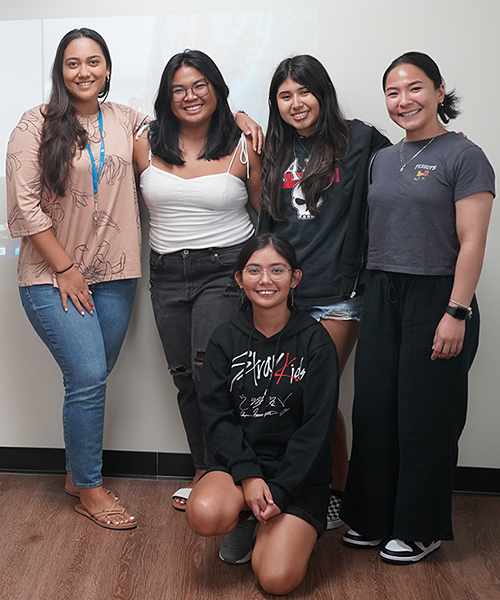
Students participating in the Silversword Business Competition include, from left, Peyton Haleamau, Michalla Burtado, Alyssa Torres (kneeling), Emma Rosales and Carol Nacario.

“Deciding on a final project will be the most difficult challenge,” shared Nacario with other students who attended Day 1 of the competition. “My target audience will be the campus.”  

Academic competitions play an essential part in learning for students. Participation offers a hands-on opportunity for students to apply the knowledge and principles they have gained in the classroom and apply it to real-work situations. These competitions foster such skills as leadership, teamwork and communication. They can also be a great way to make new connections and friends.  

School of Business and Communication interim dean, Dr. Annette Santos, issued her first challenge to the students: recruit others to join their teams. “It can be a team of two to five students,” said Santos via a live video feed from Guam. “However, at least one of the team members has to be from the School of Business and Communication.”  

A business major, Peyton Haleamau ’25, convinced second year forensics science majors, Emma Rosales ’25 and Michalla “Meeks” Butardo ’25, to be on her team. Having never taken a business course, Rosales and Butardo consider their lack of entrepreneurial savvy as their major challenge.  

“We’ll be here as advisors and mentors,” marketing lecturer Wera Panow-Loui, MBA, told the students. “Last year, I opened my house up to a team of students who were producing jewelry out of microplastics reclaimed from the beach and in the ocean. And I also fed them.”  

Datta suggested to find team members who are in different disciplines, from art and interior design to nursing and data analytics. “You want a wider perspective than just business,” he said. “That’s what entrepreneurs do—they get creative. And, if they fail, what they learn from that failure determines how they succeed the next time.”

Each team will be given $250 seed money to use at its discretion. The School of Business and Communication’s Advisory Board members, who are providing the funding for the seed money, will also be available as mentors.  

When the competition was launched in 2021, the plan was to have students open and manage a pop-up concession on campus. Because COVID-19 was still a factor, another approach was decided: the School invited students to participate in a business competition that would allow them to show off their creativity, their ability to work with others and their aptitude in everything from marketing to accounting and customer service.  

“Think of this competition as an incubator of ideas,” said Dr. Eduard Merc, who is Chaminade’s MBA director. “You’ll have the chance to work alongside your professors and the opportunity for experiential learning that goes beyond theory.”  

Students’ final presentation will take place on Nov. 16. Each team will be assessed by sales/revenue, social media likes and shares, and their profit-and-lost statement.  

“And your business must align with the sustainable approach,” Santos emphasized. “In developing your business plan, take into account these considerations: 1) Identify future needs; 2) Identify technology to serve that need; and 3) How will you deliver the need, through what channels of distribution?”  

Their time starts now!    

Posted by: University Communications & Marketing Filed Under: Business & Communication, Campus and Community, CIFAL Honolulu, Diversity and Inclusion, Featured Story, Innovation, Students Tagged With: Business Administration, Hogan Entrepreneurs Program, School of Business and Communication

One Year MBA: Smart Track to a Degree

September 1, 2023

Mia Vallero, MBA ’23, visited Nara, Japan four years ago. She remembers seeing the deer at Nara Park, and how playful and eager they were to be fed crackers by visitors. This past August, she returned to the same prefecture but this time the trip was part of the Chaminade University One Year MBA degree program, and she noticed the deer were not as lively as she remembered.

“It forced me to reflect on the tourism industry in Japan and in Hawaii,” Vallero ruminates. “I’m glad I had the opportunity to think twice about the use of wildlife for tourism and entertainment.”

Thinking deeply about business practices, culture, and economic impact and sustainability are all part of Chaminade’s One Year MBA program of which Vallero entered in the fall of 2022. The recent trip to Japan was one of the final segments of the program, as she traveled with eight fellow MBA candidates, her professor Dr. Caryn Callahan, and the Interim Dean of the School of Business and Communication Dr. Annette Santos. 

Considered the messengers of the gods, Nara's over 1000 deer have become a symbol of the city and have even been designated as a natural treasure.
Considered the messengers of the gods, Nara’s over 1000 deer have become a symbol of the city and have even been designated as a natural treasure.

A customer service manager at Aloha Freight Forwarders, Vallero enrolled in the One Year MBA program for the experience and skills she would gain to expand opportunities for her future. 

Likewise for fellow MBA candidate Joshua McDonough who earned his bachelor’s degree from Boston University. Both Vallero and McDonough belong to the second cohort of the One Year MBA program, which they will complete this September 2023. The first cohort of students entered in the fall of 2021 and earned their MBAs in September 2022. A third cohort will begin this September 2023 and will conclude in September 2024. All graduates have the option to participate in Chaminade’s commencement ceremony the following May of their program completion.

As an executive program designed for people who have work experience, the One Year MBA program provides valuable resources, credentials, and professional and practical classroom and real world exposure to its graduate students. In-person classes held every other Saturday on campus are supplemented by online course work and travel abroad, which is largely sponsored by Chaminade. The first cohort traveled to New Zealand and the international destination for the third cohort is yet to be determined. 

“Through this MBA program, I look to broaden my business perspective, grow my professional network and enhance my leadership, communication and critical thinking skills,” McDonough says.

On the recent trip to Japan, MBA candidates visited such businesses and organizations as  the Luxottica eyeglass frame factory, the Masunaga Optical Company, Daiko Advertising and Asahi Beer Suita Brewery. They also attended a baseball game at Koshien Stadium and enjoyed a private meeting with Kazuhiro Tanabe, a director of the stadium. 

Visiting the eyeglass and optical companies was particularly relevant since students were tasked to study the industry in preparation for their trip to Japan. They compared the operations of two different manufacturers, with one based in Milan, Italy—but has a presence in Japan— and the other based in Japan. They researched how a progressive, modern approach differs from a more traditional business model, and how they market, manufacture and distribute their products. 

MBA candidates got to visit the Megane Museum, where visitors learn  about the history of glasses, and the more than 200 steps involved in making a pair.
MBA candidates got to visit the Megane Museum, where visitors learn about the history of glasses, and the more than 200 steps involved in making a pair.

“There’s nothing like getting students out into the field,” says Dr. Caryn Callahan, who has been teaching the One Year MBA program since its inception. “You can read textbooks and study in the classroom, but by traveling abroad we were able to meet with the presidents of companies, and were greeted warmly by high-level management. The students had researched the companies, and they were well prepared before going into these meetings”

Dr. Annette Santos agrees and recognizes the valuable experience students received by seeing Japanese business cultures through a western lens, learning about the diversification of industries, and understanding the differences and similarities between eastern and western ways of conducting business.” 

“Each curated tour, visits to manufacturing companies, meetings with heads of organizations was a professional and personal growth opportunity for our students,” Santos says. “Students  asked very good questions, such as, ‘What is it like to be a leader?’ as well as  about production and supply chain. It was really nice to see the students’ critical-thinking capacity, as reflected by the questions they asked the leaders.”

On September 16, the School of Business and Communication will hold a banquet for the graduating One Year MBA class, as well as for the new cohort of students entering the program to begin their 12 month journey, which will also conclude with international travel.

“Our international study trips transform students’ understanding of business and provide a wonderful opportunity of exposure to other cultures and local business practices,” says Dr. Eduard Merc, who is Chaminade’s MBA director. “Additionally, the academic trip gives participants a comprehensive overview of trends in business and an in-depth view into companies currently operating in the Asia Pacific region. 

“At the School of Business and Communication, we believe in the importance of our students seeing firsthand the strategies that international businesses have pursued to take part in the explosive growth of Asia, and how these companies effectively adapt to the ever-changing business, social, and political landscapes in which they operate,” Merc adds. “This supplements their MBA classroom learning in significant ways by learning directly from business leaders.”

The banquet will be bittersweet for the outgoing students whose lives for the past year were filled with the collegiality of their close-knit class. Now as alumni, they belong to Chaminade’s global network. And like many of his fellow MBA ’23 graduates, Ethan Dayton had a vision for what he hoped to accomplish a year ago when he started the curriculum. 

“My goal at the end of this program is to have amassed new knowledge,” wrote Dayton, a year ago, “and skills that expand my career path options.” 

Indeed, by all accounts, his and the entire cohort’s goals were beyond achieved. 

Posted by: University Communications & Marketing Filed Under: Business & Communication, Diversity and Inclusion, Featured Story, Hogan Entrepreneurial Program, Innovation Tagged With: Hogan Entrepreneurs Program, MBA, One Year MBA, School of Business and Communication, Travel Abroad

Nonprofit Financial Seminar

August 30, 2023

After welcoming members from more than 50 charitable organizations, Associate Professor of Accounting with the School of Business and Communication, Richard Kido, noted that this year marked a milestone 20th anniversary of this Non-Profit Financial Seminar, which aims to provide guidance and information on financial and operational issues related to leading and managing nonprofit organizations that serve our communities.  

“Don’t forget to register or you won’t get your CPE credit,” Kido reminded attendees. Continuing professional education, or CPE, credit is a term referring to the points professionals receive for participating in specialized training. CPE credits are based on hours of study and count toward certification programs that enable professionals to maintain or update their credentials.  

“The last time I was up here, it was just me and a camera,” quipped Trever Asam, a partner at the Cades Schutte law firm, which specializes in tax and nonprofit organizations. “Today, I will provide an update on the new IRS federal tax rates, which have an impact on gift and estate taxes. I’ll also discuss gift bunching and the Secure Act 2.0.”  

Effective finance management is essential for the success of any non-profit organization. By understanding the importance of financial administration and the challenges that nonprofits face, organizations can take steps to improve their accounting practices and better serve their communities.  

Other speakers at the event included Be-Jay Kodama, a two-time Chaminade University graduate ’86 BA and ’17 MBA, and Vice President of Philanthropy at Catholic Charities Hawaii (CCH), who was a member of a panel that discussed fundraising and grant writing in the world of nonprofits.  

Panelists, from left, Angie Golis-Yamamoto, Be-Jay Kodama, Madalyn Kenney and Candace Asam-Lopez discussed fundraising challenges in the world of nonprofits.

“The work we do is important, and you have to be able to think outside of the box,” Kodama told attendees. “Don’t be afraid to ask … and ask again and again.”  

Also among the four-member panel was Angie Golis-Yamamoto, a 35-year veteran of the nonprofit sector, who shared her fundraising successes and failures. “The challenge is how to bring awareness and money to your special events,” said Golis-Yamamoto, Director of Development at Sacred Hearts Academy. “And there are a lot of logistics in running an event. For example, if you have an auction, do you have it online or do you it by paper?”  

Fellow panelists, Candace Asam-Lopez, Director of Development, Ronald McDonald House Charities Hawaii and Madalyn Kenney, Chief Development Officer, Make-A-Wish Hawaii shared their own approaches to fundraising, which include looking at events through a more critical lens, sponsor partnerships and post-event engagement.

“It requires a lot of committment,” Asam-Lopez said. “Events are expensive and labor intensive. And ever since COVID, the question still remains do you hold an in-person event or do you go virtual? But how would a virtual golf tournament look like?”

Organized annually by Chaminade’s School of Business and Communication, the daylong seminar featured an impressive slate of experts who made presentations that covered such topics as “COVID-19 Related 2023 Non-Profit Recovery Grant Program” by Shane Akagi, Administrator of the Office of Grants Management, City and County of Honolulu; “Recruitment and Retention of Employees” by Sarah Guay, Hawaii Employers Council’s President & Chief Executive Officer; and Strategic Alliances and Partnerships by Lindsay Kido, Beer is for Everyone Founder and Executive.  

Other scheduled speakers included Hugh R. Jones, Counsel, Ashford & Wriston LLP; Bernice Parsons, President & Co-Founder, Vertaccount; and Aedward Los Banos, Deputy Director, Department Of Community Services with the Department of Community Services, City and County of Honolulu.  

The day concluded with three breakout sessions, with the first focused on the Unrelated Business Income Tax (UBIT) led by Adjunct Professor Wayne M. Tanna, JD, LL.M; and Recruitment and Retention of Employees with Guay. The second session looked at Grant Accounting with Professor Aaron Williamson; and Strategic Alliances and Partnerships with Lindsay Kido. The day’s final session involved Understanding the Audit Process Review with Catha Lee Combs, CPA and Managing Partner with Wikoff Combs & Co., LLC; and Sources of Nonprofit Financial Information with Professor Kido.  

“This was the first year since COVID that the seminar was held fully in-person,” said Asoke Datta, EdD, School of Business and Communication’s Assistant Dean and the seminar’s Moderator for Financial Track Sessions. “You could really feel an uptick in energy and excitement. What this seminar achieves is to bring nonprofits together, which doesn’t often happen. So, the seminar allows these nonprofit leaders to meet each other and form new collaborations.”      

Posted by: University Communications & Marketing Filed Under: Business & Communication, Campus and Community, Diversity and Inclusion, Featured Story, Institutional Tagged With: Campus Event, Guest Speakers

Adult Education

August 11, 2023

Carlos Escuza ’23 describes Flex as an ‘awakening experience’

Call it a 40-year college plan. And when Carlos Escuza graduates in December with a B.A. in Business Administration, he will finally finish what he started decades ago when he was an undergraduate student at University of Phoenix in Riverside, Calif.

Like then, Escuza doesn’t represent the typical college student. He was in his 30s when he started, and he is now in his 60s as he completes his degree. As the nation’s baby boomers age, their influence continues to reshape the economy, the labor force, infrastructure and institutions. Some have called the demographic shift a “silver tsunami.” And that shift is apparent in higher education as a new wave of older students—like Escuza—return to college in pursuit of new opportunities.

“I stopped going to the University of Phoenix in 1992 because I got promoted as National Account Manager with the United States Postal Service,” Escuza says. “And I also had U.S. Army obligations.”

Since walking in a U.S. Army recruiting office in Chicago in 1979, Escuza has been all that he can be, a riff on an old Army slogan that prompted the then-20-year-old military veteran to enlist in the first place.

“The military gave me structure in my life,” says the native Peruvian. “Just like Chaminade University has taught me discipline in my pursuit of my bachelor’s since I started in January 2021.”

Jacob Escuza attended his dad Carlos Escuza’s retirement ceremony aboard the Mighty Mo in October 2019.

A new report by Lightcast, a leading company that provides labor market data, found that going back to college is an especially sound investment for adult learners. An analysis of more than 125 million online career profiles found that this group was 22 percent more likely to achieve upward mobility and earned annual salaries 140 percent greater than peers who didn’t return to college.

“When I retired from the Army on the deck of the Mighty Mo back in October 2019, I wasn’t sure of what I was going to do,” Escuza admits. “That’s when I turned to Cassandra Kam, a former educational counselor with the Veterans Affair. She was the one who told me about Chaminade University.”

Born in Chicago but raised in Lima, Peru, after his parents decided to move back to their native homeland when he was a 1-year-old baby, Escuza immediately returned to Chicago after graduating from high school. His formative years spent in the South American nation meant growing up with an extended family of cousins, aunts and uncles, and embracing a Hispanic culture.

“When I first moved back to Chicago, I was living at the Y, which is all I could afford,” Escuza recalls. “I received a grant and wanted to go to school, but I later decided to enlist in the U.S. Army.”

Escuza has no regrets enlisting in the Army and making it a career. He has been deployed to Europe, Afghanistan and Iraq, joining the ranks of thousands who were part of Operation Iraqi Freedom (OIF). In Iraq, he was part of the Multi-National Security Transition Command’s convoy security team known as the Rough Riders. Contrary to the sound of its name, the Rough Riders participated in goodwill missions to provide school supplies, gifts, candy and toys to Iraqi children in Baghdad.

“I was already in my 40s, but I was told I was needed because of my maturity and experience,” Escuza says. “Being involved in a war changed me profoundly in so many ways.”

When he returned from Iraq in 2008, Escuza manifested his Post-Traumatic Stress Disorder (PTSD).  “When I went through Kuwait, on a post-deployment, I saw outside the Morale, Welfare and Recreation (MWR) compound, this long wall with the names of soldiers who had died in the line of duty,” Escuza recounts. “They were listed in alphabetical order, and when I saw my friend’s name on it, I broke down and cried uncontrollably.”

Today, Escuza enjoys the support of his wife, Pam, his son Jacob and daughter Jaclyn Mills. He also appreciates the encouragement and understanding of Chaminade staff and faculty, whom he describes as inspirational. After he graduates, he says he plans to enroll in the M.S. in Counseling Psychology (MSCP) at Chaminade.

“This has been an awakening experience,” Escuza says. “If I were to put down in words all the positive feelings that I have collected and digested during my time at Chaminade, I would be writing an essay. The Flex program has truly met my spiritual and intellectual goals, and I’m grateful for this experience.”

Posted by: University Communications & Marketing Filed Under: Business & Communication, Diversity and Inclusion, Featured Story Tagged With: Business Administration, FLEX Program

Making Dollars & Cents

August 4, 2023

Demystifying Financial Literacy

Chaminade president Dr. Lynn Babington is flanked by, from left, Andrew Rosen, president and CEO of Hawaii State FCU, Greg Young, president and CEO of HawaiiUSA, Dr. Annette Santos, interim dean, School of Business and Communication, and Dr. Guanlin Gao, director of Chamiande’s Economic Education Center for Excellence and associate professor.

For a couple of hours on a Tuesday morning, Hale Hoaloha’s R301 became a trading floor, with buyers and sellers brokering deals during a stock market simulation game. Waving a card in the air—like a trader would do on a Stock Exchange—Waipahu High School Career and Technical Education (CTE) teacher Russell Park walked around the room, booming, “Who’s selling? I’m buying!” The exercise was all part of the Economics and Personal Finance Literacy Summer Institute, led by Dr. Guanlin Gao, Director of Chamiande’s Economic Education Center for Excellence and an Associate Professor of Economics with the School of Business and Communication.

“No takers,” said Park, after the first round. “What I’ve learned so far I wish I had known years ago. I have also realized the importance of sharing this information with kids—to prepare them for the real world.”

According to Gao, this summer institute offers students essential knowledge and skills on how to allocate limited resources they have in life, such as time and money, in the most efficient way to satisfy their wants and needs. It also prepares them to better understand and respond to the events that shape their economic environment and financial well-being.

“We’re all natural-born economists,” said Gao, while looking around the classroom. “You might not just realize it … for now.”

Initially intimidated by graphs and charts, DJ Woodard of Waianae High School, grew comfortable with the classes after the first day. On the trading floor, she used her savvy and some recently-learned buzz terms to clinch a deal and made a profit.   

Dr. Gao's Economics and Personal Finance Literacy Summer Institute curriculum included such topics as market operations and government interventions, environmental economics, personal finance education and financial wellness.
Dr. Gao’s Economics and Personal Finance Literacy Summer Institute curriculum included such topics as market operations and government interventions, environmental economics, personal finance education and financial wellness.

“This shows us how to give our students a financial foundation,” says Woodard, a transition coordinator. “It gives them exposure to financial literacy, such as budgeting and saving.”

According to Gao, this institute is taught in a combination of lectures (with an emphasis on real-life examples and situations), in-class games and group activities, hands-on projects and field classes. The curriculum includes the economics and personal finance concepts based on the Hawaii Department of Education (HDOE) Social Studies Common Core standards, including such topics as market operations and government interventions, environmental economics, personal finance education and financial wellness. 

“I wish this was available when I was young,” Woodard lamented. “I would have had a better financial foundation. But I guess at 60 years old, it’s never too late.”

Through the training, participating teachers received access to teaching resources, including ready-to-adopt lesson plans—which Woodard said she plans to use—and one-on-one assistance in adopting and adapting lesson plans for specific grade levels.

A 10th grade health teacher at Farrington High School, Jan Halpenny was part of the first cohort from last year’s institute. So, too, was Kalelani Ogata, a special needs teacher at Abraham Lincoln Elementary School.

“Students are so ill-prepared financially,” said Halpenny, who attended this year’s luncheon finale. “They don’t even understand the most basic of finances, such as supply and demand.”

Hale Hoaloha’s R301 became a trading floor, with buyers and sellers brokering deals during a stock market simulation game.

For her part, Ogata set up a class store, where the only accepted currency is good behavior. “These are special need 3- to 5-year-old kids,” she said. “They learn to count, and they quickly learn that needs and wants aren’t the same thing. The kids go home excited to talk about what they learned.”

The Nation’s Report Card on Financial Literary gave Hawaii a D grade, but cited some significant accomplishments, including the establishment and maintenance of a financial literacy website by the HDOE. Available is the HDOE Standards with Opportunities to Integrate Financial Literacy Concepts with financial literacy concepts matched to multiple English Language Arts, Mathematics, CTE, Social Studies and Science standards for K-12. The website also provides robust financial literacy resources and programs for teachers to help implement financial literacy instruction in their classrooms. In 2021, Hawaii’s legislature passed a resolution “urging the Department of Education to coordinate with the Department of Commerce and Consumer Affairs to implement a graduation requirement of at least a half credit in financial literacy during the junior or senior year.”

However, according to the report, although Hawaii has made efforts toward increasing its financial literacy instruction, mainly through establishing the Hawaii Public Schools Financial Literacy Task Force, it still receives a “D,” as it does not provide any substantial financial literacy instruction.

“We know we have work to do when it comes to financial literacy in Hawaii, but we are proud to be making a difference and serving as a hub for economics education,” Gao said. “Financial literacy doesn’t have to be hard and unreachable. In fact, financial literacy should be accessible to everyone.”

Posted by: University Communications & Marketing Filed Under: Business & Communication, Campus and Community, Homepage, Institutional Tagged With: Campus Event, Grants, Guest Speakers

Campus Romance Endures

July 21, 2023

Emily Palmer and Jason Perez enjoy life together after Chaminade

Her mom, Erinn Palmer ’81, graduated from Chaminade University. So, too, did her dad, Ron Palmer ’81. So a visit to the Kalaepohaku campus in 2010 easily convinced Emily Palmer ’17 that Chaminade University was the right fit. Meanwhile, Jason Perez’s ’18 reason to become a Silversword was so he could join his sister, Christela Perez ’19, on her journey to Hawaii.

“We met through my sister,” says Perez of his initial encounter with Palmer. “They were already close friends and because I’m close with my sister, I was always hanging around them.”

The young couple would eventually begin dating, and seeing each other every day. They would frequent the Sullivan Family Library’s lanai to study, preferring it over other outdoor areas because of its serenity and proximity to research literature.

Emily Palmer and Jason Perez constantly walked along Waialae Avenue.

Yet, what makes Palmer’s and Perez’s students-to-husband-and-spouse fairytale story is its rarity. Pew Research Center data reveals that when it comes to marriage after graduation, 28 percent of married graduates attended the same university as their spouse. But that percentage precipitously plummets to two percent when it comes to marriages between college sweethearts, according to researchers with CreditDonkey, a personal finance website.

This statistic highlights the fact that, while many college students may find themselves in romances, the chances of those relationships lasting into marriage are slim. It also serves as a reminder that college affairs can often be fleeting, and that it is important to be mindful of the potential for heartbreak.

However, because Chaminade has a nurturing environment and is rooted in community—which is the resounding sentiment echoed across the campus—students can be reassured that they will receive the necessary support. It’s not uncommon for this phrase—the prided, capital-c Community—to be interchanged with an even stronger word: ’Ohana.

Aside from the broader, communal ‘ohana that Chaminade fosters, it also often provides the backdrop to the infinite beginnings of new families, flesh and blood. Families like that of Palmer and Perez, and their 3-year-old son, Raiden.

“Maybe he’ll be the next generation to attend Chaminade,” jokes Palmer, who received her BS in Biochemistry, and is presently pursuing a pharmacology degree from Touro University California. “It was such a good choice for me to move away from California to attend university in Hawaii.”

Emily Palmer and Jason Perez are parents to 3-year-old Raiden.

Graduating with a bachelor’s degree in Communications Mass Media, Perez’s greatest takeaway while at Chaminade was the university’s diverse student population and its ability to bring people together.

“I still communicate with a lot of my classmates,” said Perez, who, along with Palmer, attended a Chaminade alumna event at Pitch Sports Bar at SALT at Our Kakaako earlier this year. “I really liked the different clubs, which were welcoming and inclusive.”

When Palmer’s education began at Chaminade, she was a shy, reserved teenager, and barely spoke out. But the four years she spent on campus transformed her from a meek 18-year-old teen to a confident young woman.

“I can speak out for myself now,” Palmer asserts. “I have my own voice and independence; I am a woman hear me roar!”

During her sophomore year, Palmer became an Admissions Department Telecounselor, entering prospective students’ data into the university computer system, maintaining contact with them to update their student status, and conducting campus tours of the university for incoming students and their families.

“Choosing Chaminade allowed me to be out on my own,” Palmer says. “It was a safe place where faculty, staff and peers would come to my aid if I ever needed it. It felt truly like ‘ohana.”

Perez says he became more worldly, especially as a staff writer with the Chaminade Silversword student newspaper, where he covered hot-button, controversial issues like the U.S. presidency, immigration and reform. “I liked the fact that the students all came from different walks of life and many from interracial families,” adds Perez, who is now the lead brewer for Heretic Brewing Company in Fairfield, Calif. “It felt so comfortable; it felt like being at home.”

Posted by: University Communications & Marketing Filed Under: Alumni, Business & Communication, Campus and Community, Featured Story, Natural Sciences & Mathematics Tagged With: Alumni

  • « Go to Previous Page
  • Page 1
  • Interim pages omitted …
  • Page 6
  • Page 7
  • Page 8
  • Page 9
  • Page 10
  • Interim pages omitted …
  • Page 25
  • Go to Next Page »

Footer

Chaminade University Logo

3140 Waialae Avenue
Honolulu, Hawaii 96816

Contact Us
Phone: (808) 735-4711
Toll-free: (800) 735-3733

facebook twitter instagram youtube linkedin

Visit

  • Plan Your Visit
  • Campus Map (PDF)
  • Events

Resources

  • Campus Security
  • Student Consumer Information
  • Concerns, Feedback, and Reporting
  • Institutional Review Board
  • Title IX / Nondiscrimination Policy
  • Compliance
  • Emergency Information
  • Careers
  • Institutional Statement

People

  • Students
  • Parents
  • Alumni
  • Faculty & Staff

Policy

  • Privacy Policy
  • Terms and Conditions of Use


© Chaminade University of Honolulu