• Skip to primary navigation
  • Skip to main content
  • Skip to footer
Chaminade University of Honolulu

Chaminade University of Honolulu

  • VISIT
  • APPLY
  • GIVE
  • STUDENTS
  • PARENTS
  • ALUMNI
  • FACULTY/STAFF
  • Admissions
    • Admissions Home
    • Undergraduate Students
      • First-Year Students
      • Transfer Students
      • Admitted Students
    • Graduate Students
    • Flex Online Undergraduate Program
    • Military Students
    • Non-Degree/Visiting Students
    • Experiential Honors Program
    • Early College Program
    • New Student Orientation
  • Tuition & Aid
    • Financial Aid Home
    • Tuition & Expenses
    • Federal Updates & Changes
    • Scholarships
    • $5,000 Graduate Scholarship
    • VA Education Benefits
    • Net Price Calculator
  • Academics
    • Academics Home
    • Academic Programs
    • Office of Student Success
      • Academic Advising
      • Records and Registrar
    • Kōkua ʻIke (Support Services)
      • ADA Accommodations
      • Career Services
      • Proctoring Services
      • Tutoring Services
    • Sullivan Family Library
    • Undergraduate Research & Pre-Professional Programs
    • Commencement
  • Campus Life
    • About Campus Life
    • Student Engagement
    • Student Government Association
    • Residence Life and Housing
      • Summer Conference Housing
    • Health Services
    • Marianist Leadership Center
    • Counseling Center
    • Campus Ministry
    • Campus Security
    • Dining Services
    • Bookstore
  • Athletics
  • About
    • Chaminade University News
    • Our Story
    • Leadership
    • Chaminade University Strategic Plan 2024-2030
    • Mission & Rector
    • Association of Marianist Universities
    • Facts & Rankings
    • CIFAL Honolulu
    • Accreditation & Memberships
    • Montessori Laboratory School
Search
×

Search this web site

Business & Communication

Dreams Come True

June 13, 2023

Faith Chang ’23 fulfills her lifetime dream

When she walks across the stage during the 65th Commencement, Faith Chang will have achieved one of her lifelong dreams: to earn a bachelor’s degree in Business Administration. For the newly minted alumna, the four-year Chaminade experience has only strengthened and bolstered her beliefs in community service and religious faith.

“I’ve always believed in helping the community ever since I was a kid,” says Chang, the 2023 recipient of the Hogan Entrepreneurial Leadership Program’s Aloha Spirit Award. “During my freshman year, I participated in a Service Learning opportunity at Kaimuki High School, where I helped high-school students with any of their class projects.”

Having the opportunity to intern while still studying affords college students a chance to build a professional network with industry leaders, and to hone their skills before entering the workforce. Internships also allow the intern to figure out one’s true passion.

For Chang, this meant following a path to seek a position with a nonprofit group, which could utilize what she learned at Chaminade and what she experienced as an intern with Make-A-Wish Hawai‘i.

Chaminade President Dr. Lynn Babington, left, and Christine and Glenn Hogan congratulate Faith Chang for her 2023 Hogan Entrepreneurial Program’s Aloha Spirt Award.
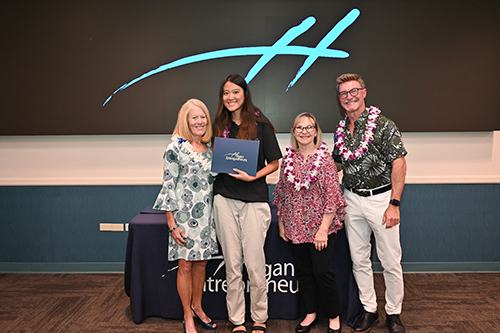
Chaminade President Dr. Lynn Babington, left, and Christine and Glenn Hogan congratulate Faith Chang for her 2023 Hogan Entrepreneurial Program’s Aloha Spirit Award.

“Faith was also an intern with Chaminade University’s Economics Education Center for Excellence (EECE) from 2021-2022,” says EECE director and associate professor, Dr. Guanlin Gao. “During her time there, she identified and adapted over 50 lesson plans in economics, personal finance and Hawaiian history for K-12 teachers. In addition, she presented her lesson plans and shared the resource pool she built with over 30 local public school teachers at the EECE 2022 Summer Workshop, which benefited the teachers and ultimately the next generation.”

During her stint with Make-A-Wish Hawai‘i, Chang interned with the Finance and Operations department, where her financial responsibilities included processing donations and payments, paying vendors, ensuring the monthly financial statements are accurate, and preparing for the annual budget, financial audit and Form 990.

“We rely a lot on our interns,” says Shari Young, Make-A-Wish Hawai‘i’s Director of Finance, who supervised Chang during her internship. “Faith had all the qualifications that we require of our interns, including being an active community member, a willingness to grow and learn, and she possessed the heart for our mission.”

A survey by the National Association of Colleges and Employers indicates that the starting salary for college graduates who completed an internship and were employed in a private, for-profit company was $53,521, while those who didn’t complete an internship started with an average of only $38,572. The same study found that 72.2 percent of college graduates with internship experience got a job offer, in contrast to 36.5 percent for those who didn’t complete one. These numbers indicate that pursuing an internship during your college years can add a competitive edge on the side students, increasing their opportunity to get a well-paying job after graduation.

The same held true across industry sectors—nonprofit ($41,876 vs. $31,443), state/local government ($42,693 vs. $32,969), and federal government sectors ($48,750 vs. $42,501).

“I sought the internship to enhance my resume, and gain a better understanding of nonprofit finance operations and expenses,” says Chang who won this year’s Hogan Entrepreneurial Program’s Aloha Spirit Award, which is given to a student who best embodies the spirit of the program. “Another takeaway from this internship was the reward of working with a nonprofit organization, like Make-A-Wish Hawai‘i, which is dedicated to the community, granting wishes and providing little girls and boys a lifetime of joy during a trying stage in their lives.

“I remember this one girl’s wish was to have a playground built in her backyard,” Chang recounts. “And when it was time for the reveal, her reaction and joy made me cry. And I immediately sent the video to my parents. It was just so heartwarming.”

With her expanded skill set, Gao predicts that Chang will continue her journey of making a real-world difference. “She is involved in so many community projects, including Chaminade’s Compassionate Cat Counting project, ‘Inana sustainability program, Earth Day thrift sale, as well as her church service at the Inspire Church conference,” Gao adds. “She has raised funds to sponsor children in Guatemala, as her passion is to make a real-world difference and give back to the community.”

Posted by: University Communications & Marketing Filed Under: Business & Communication, Campus and Community, Catholic, Hogan Entrepreneurial Program, Homepage, Institutional Tagged With: Business Administration, Hogan Entrepreneurs Program, Honors and Awards

Hawaiian Leadership Values

May 31, 2023

’19 MBA graduates co-author book for future leaders

Dressed in a tank top, shorts and slippahs, Nolene Gega ’19 scouted the streets of Kalihi, shopping around for a commercial printer. She finally found one that agreed to print a book, which she and nine other then-MBA Chaminade students co-wrote for their Island Business Po‘okela capstone project. “Hawaiian Values for Future Leaders: Definitions & Stories” was born from the idea that no reference book exists that highlights the importance of Hawaiian leadership values.

“The intent was to make a book that could be shared and approachable,” says Gega, a military veteran who was deployed to Kuwait from 2011-2012 and embedded as a civilian in Afghanistan from 2012-2014. “Every single book on Hawaiian values is so dense, and we wanted ours to be a sort of quick guide.”

Spearheaded by Gega, the 50-page book covers a series of key Hawaiian values, including Aloha, Cooperativeness (Kūpono), Humility (Haʻahaʻa), Helpfulness (Kōkua), Generosity (Lokomaikaʻi), Patience (Hoʻomanawanui), Hospitality (Hoʻokipa), Unity (Lōkahi), Courage (Koa), Responsibility (Kuleana) and Dignity (Hanohano). According to Gega, these 10 values were chosen based on the commonality of Lili‘uokalani Trust Trustee Thomas K. Kaulukukui’s journal Hūlili Vol. 10 and George S. Kanahele’s book Kū Kanaka–Stand Tall: A Search for Hawaiian Values.  

Shawn Uehira, left, and Nolene Gega co-wrote a book about Hawaiian leadership values.
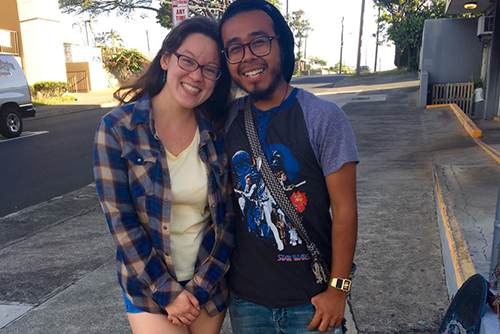
Shawn Uehira ’19, left, and Nolene Gega ’19 co-wrote a book about the importance of Hawaiian leadership values among local businesses.

“It’s a tool for storytelling,” said Gega’s fellow MBA graduate and co-author Shawn Uehira ’19, who tapped retired Hawaiian Electric executive and current President of the Collaborative Leaders Network, Robbie Alm, for his mo’olelo about Aloha, Lōkahi and Pu’u (sharing with future leaders). “We didn’t want our book to turn into a MLA-style manual. We even included blank pages in between the chapters so people could write down their own stories to share for future generations.”

In addition to Gega and Uehira, other contributing MBA cohort members included Tiana Brede ’19, Auli‘I Mafi ’19, Jeffrey Pi‘imauna ’19, Cliffton Pires ’19, Dan Scroggins ’19, Faisha Solomon ’19, Kim Spring ’19 and Xiao Yi ’19. Each was responsible for choosing one of the values and finding a storyteller who would be willing to share his/her perspectives regarding that particular value. Among the storytellers and community leaders are Cindy Asada, Director of Guest Relations at Four Seasons Hualalai;  Esben Borsting, Chaminade’s Director of Native Hawaiian Partnerships; Ed Demello, owner of Emerald Isle Plumbing; Kristiana Kahakauwila, “This is Paradise: Stories” author; Hinaleimoana Wong-Kalu, O‘ahu Island Burial Council; Anne Matute, Cromwell owner; Elizabet Sahtouris, Chaminade professor; Lilette Subedi, Director of Resource Development for the Whitmore Economic Development Group; Ramsay Taum, owner of Life Enhancement Institute of the Pacific; and Michael Toyama, Senior Principal with Bowers & Kubota.

“I contacted Lilette, a Native Hawaiian practitioner and Indologist, whom I met while she was a Navy contractor,” Gega said. “We met in ‘Aiea under a tree, and we just talked for hours about what it meant to be a Native Hawaiian. It was truly inspiring.”

When asked about the meaning of Haʻahaʻa, Subedi offered an anecdote, relating to a past event during which she was asked to speak about her role as the Sex Equity Coordinator for the state of Hawai‘i.

“I thought, ‘Oh my God! I need to sound smart,” Subedi recalled. “I prayed on it and went up and spoke. It didn’t matter the number of people because you start don’t look at that, you speak from the heart and just be who you are. It was well received.”

After giving this talk, Subedi learned not to be shy. “I fought and changed my path,” she added. “I learned to be assertive, not aggressive. I learned to stand and be who I am, as who I always was. Not in the mindset of being Hawaiian, just being me!”

A common question posed among all the interviewees was: Is there anything you feel is important to share today with future leaders? While the answers varied, from individual kuleana to community lōkahi, all believed in sharing aloha.

“Aloha means so many different things for each person,” Gega noted. “There’s no one true definition. I believe Aloha is that thing when all of the right things happen at the right time, and the right place for our good and the good of others, which means it comes from within you. It is something you have to bring to the situation as much as you receive in the situation.”

Posted by: University Communications & Marketing Filed Under: Alumni, Business & Communication, Hogan Entrepreneurial Program, Institutional Tagged With: Alumni, Hogan Entrepreneurs Program

First-Place Winners

May 4, 2023

Chaminade Edges out Nine Other Teams to Capture IACBE Award

As guest speaker during the Hogan Entrepreneurial Leadership Graduation/Induction, Michael Rose ’23 spoke highly of his fellow graduates, commending them for recently winning the Best Practices Award at the International Assembly for Collegiate Business Education (IACBE) Competition in Orlando, Florida.

“There were a lot of late nights, and a lot of data to absorb and synthesize,” said Rose during the Graduation/Induction ceremony. “We worked hard as a team to bring home this award.”

Rose, along with classmates Epifania Petelo, Ashley Yoshikawa, Michael Rose and Tino Colleo presented to a billion-dollar boat manufacturer, Correct Craft, which chose their findings and recommendations on optimizing the company’s supply chain to mitigate risk and maximize efficiency.

The Chaminade Team included professors Richard Kido, Eddie Merc, Dean of the School of Business and Communications Bill Rhey, Wera Panow-Loui and Guanlin Gao, and students Michael Rose, Ashley Yoshikawa, Epifania Petelo and Tino Colleo.

“It was a great way to apply my learning in the classroom to a real-life issue,” Petelo told Talanei News. “It also gave me networking opportunities and an avenue to expand beyond the island community.”

Mentored by professors Guanlin Gao, Richard Kido and Wera Panow-Loui, the students’ presentation, according to the team’s coach and MBA Director and Program Advisor, Eddie Merc, was “a result of countless nights, collaboration and a lot of pizzas.”

“They nailed it,” praised Merc of the Chaminade Team’s presentation, “They worked as a team and accomplished their objectives, and walked away with a first-place win. It was a well-earned victory.”

According to IACBE.org, it is the leading outcomes-based professional accrediting organization for business programs in student-centered colleges and universities throughout the world. The IACBE exists to promote, develop, and recognize excellence in business education.

IACBE judges noted “the winning presentation demonstrated excellence, as it pertains to an institution’s or program’s assurance of learning activities or quality enhancement initiatives.”

To win the award, the Chaminade Team submitted a well-written, carefully edited, and organized description of the poster presentation, including a brief abstract, a detailed description of the methods used for measuring outcomes and conclusion(s) drawn from the assessment results. The submission also provided recommendations based on the conclusion(s) and next steps for further supporting the assurance of learning activities or quality enhancement initiatives. 

“It was an incredible experience for our students,” said Dr. Guanlin Gao. “They worked really hard to put together their presentation, and we couldn’t be any prouder.”

Merc and Dr. Pam Estell (who was unable to attend the conference) took a victory lap when they were awarded first place for their research presentation in the Best Practices Poster Session competition. “We donated the winnings of $500 to Aloha United Way,” Merc said. “This conference brings together higher education leaders for informative presentations on all aspects of business education and best practices. We look forward to returning next year.”

Posted by: University Communications & Marketing Filed Under: Business & Communication, Faculty, Hogan Entrepreneurial Program Tagged With: Hogan Entrepreneurs Program, Honors and Awards

Hogan’s Heroes

April 28, 2023

Hogan Program Graduates and Inductees Share the Stage

Addressing attendees during the Hogan Entrepreneurial Leadership Program Induction/Graduation Ceremony, Glenn Hogan said it is an honor to continue the legacy that his late parents, Ed and Lynn, began 21 years ago when they invested their time and knowledge, and shared their experiences with aspiring entrepreneurs at Chaminade.

“My parents always believed in giving generously,” Hogan said. “At an early age, our parents taught us our ABCs. As entrepreneurs, they defined it as A for Attitude, B for Behavior.  And being parents married for 65 years, they didn’t always see eye-to-eye, but they always came together. And so the C, my mom believed that behavior resulted in Consequences, and my dad believed in behavior and Character.”

Hogan students have also learned another “Hoganism” known as the five Ds: Desire, Dedication, Devotion, Discipline and Determination. “Entrepreneurship is not just about starting a business, though it’s that, too,” explains Hogan Program Director, Dr. Roy Panzarella. “Entrepreneurship is about acquiring the skills of success, and we try to teach those skills in the context of entrepreneurship.”

Drs. Roy Panzarella and Chaminade President Lynn Babington, and Christine and Glenn Hogan flank this year's Hogan Entrepreneurial Leadership Program Awardees.
Drs. Roy Panzarella and Chaminade President Lynn Babington, and Christine and Glenn Hogan flank this year’s Hogan Entrepreneurial Leadership Program Awardees.

Funded by the Hogan Family Foundation, the eponymous Entrepreneurial Program, aims to educate Chaminade students how to be successful in business through a series of lectures with experienced Hawaii leaders, study abroad missions, community service projects, academic coursework and mentorship. Each year, a new cohort of students from all majors, including undergraduate juniors and seniors and graduate students, are accepted into the one- or two-year certificate program.

“This annual celebration is always a wonderful time to reflect on our students’ contributions to the common good,” says Chaminade President, Dr. Lynn Babington. “They represent our future leaders who will help transform society and make a huge difference in our communities.”

Poised to expand in the future, the Hogan Entrepreneurial Leadership Program, now in concert with the Suzie Martin & Vaughn Vasconcellos Leadership Institute, will train and mentor tomorrow’s leaders and entrepreneurs. The education that students will receive will prepare them to lead with empathy, morality, compassion, and a drive to identify problems and create scalable solutions that can benefit individuals, communities and the globe. 

Christine and Glenn Hogan attended the Graduation/Induction Ceremony.

“My dad always liked to say, ‘Doing business things that make social sense, doing social things that make business sense,’” Hogan says.  “He believed in entrepreneurial practices that benefit the community.”

At the ceremony, the graduating Hogan students were honored for completing the program and the incoming Hogan students were inducted in front of their Chaminade community, friends and family. Four awards were presented, including the Outstanding Hogan Entrepreneur of the Year Award, the Outstanding First Year Student Award, the In the Arena Award and the Aloha Spirit Award.

“When I entered the Hogan program in the Fall of 2020, I wanted to learn more about social enterprises,” says Berkshire Hathaway HomeServices Realtor, Ciena Alagao, a Hogan graduate who won the Outstanding Entrepreneur of the Year Award. “I wanted to start a business that would make a positive impact in the community.”

Nankuli native Waioli Misajon won the Outstanding First Year Award, while Jacob Fernandez and Faith Chang were recognized with In the Arena and Aloha Spirit awards, respectively. Twelve students were inducted into the program, and a total of 17 students graduated, three of whom received their two-year certificates and the rest earning their one-year certificates.

“We would like to take this opportunity to give a special mahalo to the entire Hogan Family,” Panzarella concludes. “Significant contributions of time, counsel and financial support to Chaminade University for over two decades have allowed us to measurably impact the lives of more than 400 Hogan students as they embarked upon careers, ‘determined to become contributing members of society,’ as Ed Hogan would say.”

Posted by: University Communications & Marketing Filed Under: Alumni, Business & Communication, Hogan Entrepreneurial Program, Institutional Tagged With: Hogan Entrepreneurs Program, Honors and Awards

Economic Education

March 9, 2023

Including indigenous cultures and values into education is not about making the Indigenous populations stronger. They are already strong. It’s about changing the way the world perceives that strength.”

Guanlin Gao, Ph.D., adapted from G.D. Anderson’s famous quote about feminism

Economics professor promotes financial literacy

Guanlin Gao, Ph.D., likes to play games. And during the recent National Association of Economic Education (NAEE) Conference at the Federal Reserve Bank of St. Louis, the Chaminade Economics associate professor and Director of Economic Education Center for Excellence devoted part of her presentation playing the Public Goods Game (PGG), in which players are given tokens—in this case Kona coffee beans—and given the opportunity to anonymously allocate them in either private or public funds.

“The purpose of the game is to let participants experience the indigenous culture through a hands-on game,” Gao explains. “The game is also related to the shared natural resources and land management of ahupua‘a, where people have shared responsibility and contribute to the common good with their expertise.”

This fundamental economic game has become a classic laboratory environment for studying collective group decisions in which participants decide how much to contribute to a common pool. The countervailing effect, however, is that there is an incentive for group members to “free-ride” on individuals who contribute positive amounts to the common pool. 

Guanlin Gao presents at the National Association of Economic Education Spring Conference at the Federal Reserve Bank of St. Louis

Those who invested in the private fund could keep the funds, and divide the shares among its members. However, for those who invested in the public fund, they could either share the return among all the groups or simply keep the yield within their own group.

“On the East Coast, players would largely invest in private funds,” Gao says. “But in Hawaii, most players contribute to public funds, which evenly distributes the return among all members. We have a more inclusive culture in Hawaii, as opposed to individualism.”

The NAEE’s three-day Spring Professional Development Conference was attended by economic educators at the state and federal level, as well as educational institutions that house the equivalent to Chaminade’s Economic Education for Excellence. One of NAEE’s primary missions is to provide professional development programs and training for educators to promote economics, personal finance and entrepreneurial education in the classroom.

“Right now, the country is having a movement about economic literacy, and it starts at an early age,” Gao says. “We want the younger generation to have a foundational understanding of personal finance and economics. We want to provide them the tools they need to make informed financial decisions, and create a better life for themselves and for those around them.”

The overall goal of the three-day conference was to promote economic and personal financial education from K-12 through college. Various departments of education around the country already stipulate that students take an economics or personal financial class in order to graduate. Gao is working on this with Hawaii Department of Education but, in the meantime, she’s sharing her knowledge with other teachers.

“I wanted the participants to walk away knowing more about the unique, yet diverse cultures, in this country, and promote economics and personal finance education in a way that relates and speaks to the populations we serve,” Gao notes. “I also talked about the traditions of sharing, not owning in Hawaii (for example, abundance means we have a lot to share, not how much we own), and why the conventional economic assumptions of ‘everyone is self-interested’ and ‘the only goal for a firm is to maximize profit’ do not resonate with our students’ identities and beliefs.”

Consider the Facts*

Many young people lack the basic financial knowledge and skills to prosper in life. Like many educators, the Council for Economic Education cares about equipping students with the knowledge they need to improve their futures.

40% of Americans have less than $300 in savings
24%
of Millennials demonstrate basic financial literacy
50%
of America’s youth will earn less than their parents

2 Million+
Students reached by CEE programs and teachers
Over 50,000
Teachers reached worldwide
1,000+
Lessons, guides & activities for teachers

*Council for Economic Education

Posted by: University Communications & Marketing Filed Under: Business & Communication, Diversity and Inclusion, Education, Faculty, Homepage Tagged With: Business Administration, Economic Education Center for Excellence

Building Blocks

February 1, 2023

Ayko Group owner Chris Lee ’17 hammers home his commitment to Habitat for Humanity

It wasn’t all bad. In fact, some good did emerge from COVID-19. Vaccine production ramped up. Economic stimulus programs helped families weather financial hardships. And businesses—small and large—received Coronavirus Aid, Relief, and Economic Security (CARES) Act funding to keep their workforce employed during the pandemic. For Chris Lee ’17, the Paycheck Protection Program (PPP) allowed him to build a relationship with Honolulu Habitat for Humanity.

“During the coronavirus scare, some of our planned/negotiated projects were suspended due to government restrictions,” says Lee, a Chaminade MBA graduate and owner of the construction company, Ayko Group. “Luckily, we received the PPP loans and we were able to keep the employees paid during the shut downs.”

 A community-service-oriented business owner, Lee talked to a friend—the president of a local HVAC company—about business slowdowns, and because of this stagnation, he learned his friend’s company started taking on philanthropic endeavors with their employees. This prompted Lee to call Habitat for Humanity Honolulu and Habitat for Humanity West O‘ahu to see if Ayko could lend a hand in their home builds.

“My thought process being we are carpenters, and knowing that we could assist others at the same time as keeping our skills honed, would be a win-win,” Lee notes.  “Habitat for Humanity Honolulu replied and was interested in this partnership, and we helped them on a few new builds along with some critical repairs.” 

Ayko staff helped build a home for Habitat for Humanity. ©Howard Wolff

In pre-pandemic times, Ayko Group strictly focused on commercial and military projects, given Lee’s background as a former U.S. Navy Civil Engineer Corps officer, who has worked as a civilian manager for both Navy Facilities Engineering Command (NAVFAC) and the Department of Veterans Affairs. Not keen on pursuing residential builds—because he’s uncomfortable about taking people’s money—his own admission—the 43-year-old entrepreneur decided to make an exception.

“The timing could not have been any better,” says Honolulu Habitat for Humanity CEO TJ Joseph, who is also a beneficiary of a Habitat for Humanity home. “Because of COVID, we had to stop all volunteer efforts, which we largely rely on to start and finish all our projects. So Chris’ call was a true godsend, and if it wasn’t for him coming out, we would not have finished the homes.”

The jobs started small, with some carpentry, drywalling, fire blocks, flooring issues, and leveling and patching a driveway for a new homestead home. Then came the Sniffen home in Waimānalo, which had only reached the demolition stage before the pandemic hit.

“It was just a slab,” Lee says. “So we brought in seven guys to work on-site and we finished the build in probably two, three weeks. I only like to do residential projects with organizations like Habitat.”

Workers framed a home for the Piohia Ohana construction project. ©Howard Wolff

In comparison, Joseph says the timeline for Habitat for Humanity to complete a single project could take months since the workforce consists of volunteers, who may or may not have any construction experience.

“Habitat for Humanity’s business model is based on a community building together,” Joseph explains. “With this old model, we were only able to finish one or two homes a year since we were only building on Saturdays. But now we’re using sub-contractors to lay the foundation, and install the roof, drywall, electric and plumbing.”

The concept that became Habitat for Humanity first grew from the fertile soil of Koinonia Farm, a community farm outside of Americus, Georgia, founded by farmer and biblical scholar Clarence Jordan.

On the farm, Jordan and Habitat’s eventual founders, Millard and Linda Fuller, developed the idea of “partnership housing,” which centered on those in need of adequate shelter working side-by-side with volunteers to build quality, affordable residences. The homes would be built at no profit. New homeowners’ housing payments would be combined with no-interest loans provided by supporters and money earned by fundraising to create “The Fund for Humanity,” which would then be used to build more houses.

Chris and Tara Lee named their company Ayko after their two kids—Ayla and Niko.

Thanks in no small part to the personal involvement of former U.S. President Jimmy Carter and his wife Rosalynn, and the awareness they have raised, Habitat now works in all 50 states in the U.S. and more than 70 countries. Habitat’s advocacy efforts focus on policy reform to remove systemic barriers preventing low-income and historically underserved families from accessing adequate, affordable shelter.

“Right now, we have 16 families on our waiting list,” Joseph says. “And of the 16, 14 or 15 of them already have funding.”

Lee plans to continue to help Habitat for Humanity, whenever he is able to do so. Quoting former Hogan Entrepreneur Program director, John Webster, Lee says he is abiding his creed: “Doing business things that make social sense and doing social things that make business sense.” 

“John always stated that before the Wednesday speaker sessions,” Lee says.

“It has always rang true to me, and when given the opportunity to help, I will, especially during a time like Covid. I’m fulfilling my service mission, which lines up with the values of a Chaminade education, and it also matches what my mom instilled in me when I was a kid.”

Posted by: University Communications & Marketing Filed Under: Alumni, Business & Communication, Homepage Tagged With: Alumni, Hogan Entrepreneurs Program

  • « Go to Previous Page
  • Page 1
  • Interim pages omitted …
  • Page 7
  • Page 8
  • Page 9
  • Page 10
  • Page 11
  • Interim pages omitted …
  • Page 25
  • Go to Next Page »

Footer

Chaminade University Logo

3140 Waialae Avenue
Honolulu, Hawaii 96816

Contact Us
Phone: (808) 735-4711
Toll-free: (800) 735-3733

facebook twitter instagram youtube linkedin

Visit

  • Plan Your Visit
  • Campus Map (PDF)
  • Events

Resources

  • Campus Security
  • Student Consumer Information
  • Concerns, Feedback, and Reporting
  • Institutional Review Board
  • Title IX / Nondiscrimination Policy
  • Compliance
  • Emergency Information
  • Careers
  • Institutional Statement

People

  • Students
  • Parents
  • Alumni
  • Faculty & Staff

Policy

  • Privacy Policy
  • Terms and Conditions of Use


© Chaminade University of Honolulu