• Skip to primary navigation
  • Skip to main content
  • Skip to footer
Chaminade University of Honolulu

Chaminade University of Honolulu

  • VISIT
  • APPLY
  • GIVE
  • STUDENTS
  • PARENTS
  • ALUMNI
  • FACULTY/STAFF
  • Admissions
    • Admissions Home
    • Undergraduate Students
      • First-Year Students
      • Transfer Students
      • Admitted Students
    • Graduate Students
    • Flex Online Undergraduate Program
    • Military Students
    • Non-Degree/Visiting Students
    • Experiential Honors Program
    • Early College Program
    • New Student Orientation
  • Tuition & Aid
    • Financial Aid Home
    • Tuition & Expenses
    • Federal Updates & Changes
    • Scholarships
    • $5,000 Graduate Scholarship
    • VA Education Benefits
    • Net Price Calculator
  • Academics
    • Academics Home
    • Academic Programs
    • Office of Student Success
      • Academic Advising
      • Records and Registrar
    • Kōkua ʻIke (Support Services)
      • ADA Accommodations
      • Career Services
      • Proctoring Services
      • Tutoring Services
    • Sullivan Family Library
    • Undergraduate Research & Pre-Professional Programs
    • Commencement
  • Campus Life
    • About Campus Life
    • Student Engagement
    • Student Government Association
    • Residence Life and Housing
      • Summer Conference Housing
    • Health Services
    • Marianist Leadership Center
    • Counseling Center
    • Campus Ministry
    • Campus Security
    • Dining Services
    • Bookstore
  • Athletics
  • About
    • Chaminade University News
    • Our Story
    • Leadership
    • Chaminade University Strategic Plan 2024-2030
    • Mission & Rector
    • Association of Marianist Universities
    • Facts & Rankings
    • CIFAL Honolulu
    • Accreditation & Memberships
    • Montessori Laboratory School
Search
×

Search this web site

Business & Communication

Business Olympics

April 26, 2024

Annual Games Challenge High School Students

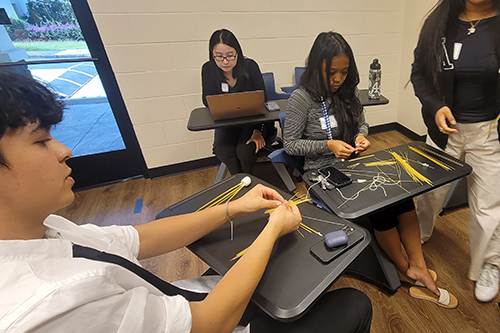
Let the mental gymnastics begin. In 20 minutes, teams had to build the tallest free-standing structure, using only spaghetti, one yard of tape, one yard of string and one marshmallow, which needed to sit on top. During this “Marshmallow Challenge,” sitting on one side of the room, the Spartan, Trojan and Athenian teams from Maryknoll School and Nanakuli High & Intermediate School talked about teamwork, listening, communication and trust. On the other side, Silverswords spoke of flexibility, creativity and open-mindedness.

“The Marshmallow Challenge is used a lot in business schools,” said assistant professor Eddie Merc, Ph.D., Chaminade’s MBA Director and Program Advisor. “The participants learn about team building and how to adapt if your design isn’t working.”

The contest was just one of many during the Third Annual Business Olympics, which is organized by the School of Business and Communications. As part of his operations management class, MvFaden Iriarte ’25 was among the Silversword participants in the Marshmallow Challenge.

“There was only one rule: your finished structure had to sit on the slippery surface of a desk,” explained Iriarte, as he pointed to their design, which won the challenge for being the tallest. “I was really impressed with what the high-school kids came up, and how they worked together and listened to each other.”
  • Ethan Hendricks and Vaneah Dela Cruz develop their structure as Maryknoll School's academic dean of science and English reviews the day's schedule.
    Ethan Hendricks and Vaneah Dela Cruz develop their structure as Maryknoll School’s academic dean of science and English reviews the day’s schedule.
  • Nanakuli sophmore Saeota Fanuaea, far left, poses with Maryknoll School students, including senior Kainalu Szewczyk.
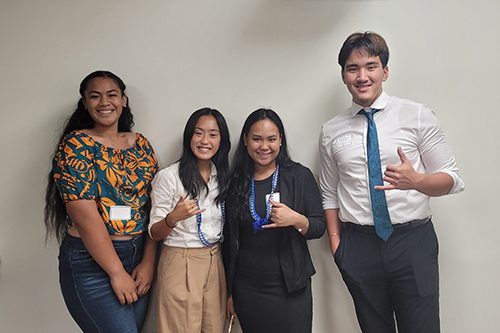
    Nanakuli sophmore Saeota Fanuaea, far left, poses with Maryknoll School students, including senior Kainalu Szewczyk.
  • Ethan Hendricks poses with Vaneah Dela Cruz, left, and Megan Collado.
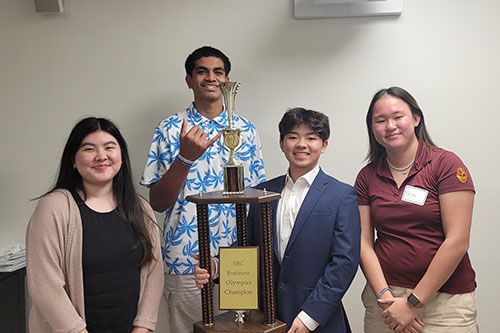
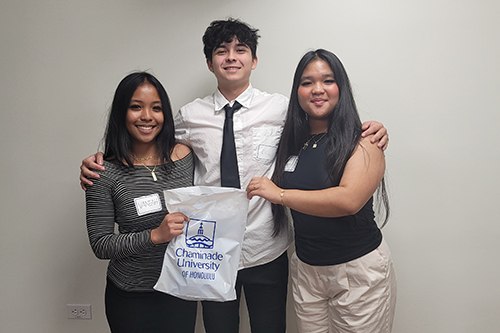
    Ethan Hendricks poses with Vaneah Dela Cruz, left, and Megan Collado.
  • Nanakuli junior, Vai Fanuaea, flashing shaka, and Maryknoll School students pose with their trophy.
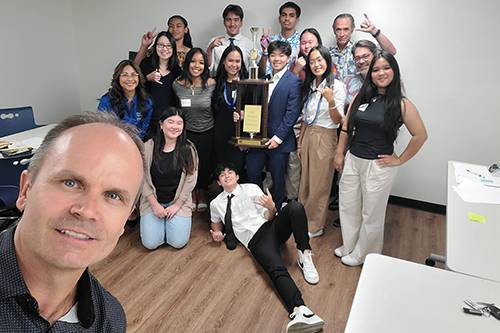
    Nanakuli junior, Vai Fanuaea, flashing shaka, and Maryknoll School students pose with their trophy.
  • Dr. Eddie Merc with Drs. Annette Santos and Roy Panzarella pose with the Maryknoll Students after their Mini Shark competition.
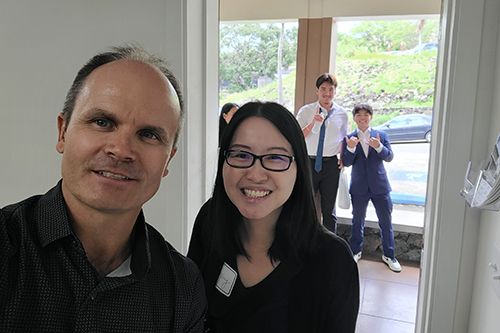
    Dr. Eddie Merc with Drs. Annette Santos and Roy Panzarella pose with the Maryknoll Students after their Mini Shark competition.
  • Dr. Eddie Merc takes a selfie with Maryknoll School's Kit-U Wong, who escorted the Trojans to Chaminade.
    Dr. Eddie Merc takes a selfie with Maryknoll School’s Kit-U Wong, who escorted the Trojans to Chaminade.

Now in its third year, the Business Olympics combines Merc’s efforts to reach out to high schools and his athletic background as a former collegiate tennis player. The event features five different stations or “challenges” that cover various subjects, including business fundamentals, management and teamwork, accounting and finance, marketing and a “Mini Shark” presentation.

“The event provided them insights of what topics they would study in business school,” said Kit-U Wong, Maryknoll’s Social Science and English Dean of Academics. “They especially appreciated being able to ask questions to Chaminade University professors and getting great advice. I would love for future students to get the chance to participate.”

Interim Dean Annette Santos was one of the four Mini Shark panel members, who listened and judged the five-minute business pitches. One team’s entrepreneurial idea was to develop a new eczema cream; another was to sell a protein ice cream after working out; and the third was to build a soundproof dog house.

“It’s quite impressive what students can come up within five minutes—really impressive,” Santos said. “It was a successful Business Olympics event and a wonderful opportunity to bring students to campus, engage with our faculty, and create memorable experiences that we hope will bring them back.”

Nanakuli High High School junior Vai and his freshman sister Saeota Fanuaea were encouraged by their mom, Rosa Fanuaea who attended Chaminade her freshman year, to join the Business Olympics event, telling them that this would be a good opportunity to visit the beautiful campus. Walking from the Sullivan Family Library to Hale Hoaloha, the siblings took in all the scenery, admiring the buildings and views.

“So far we’ve learned about team building,” said Saeota Fanuaea, after competing in the Marshmallow Challenge. “Our next class is accounting and finance, which I am looking forward to learning about.”

While the Trojans may have taken gold in the Mini Shark presentation, the Spartans and Athenians were also winners in their own sense. Maryknoll senior Ethan Hendricks felt he had already won after learning about SWOT (strengths, weaknesses, opportunities, and threats) analysis.

“My mom has her own business, Alinea Jewelry, and I want to help her with her marketing, which is so old school right now,” said Hendricks, with a boyish grin. “I already learned about some business concepts today, which I never knew about. I can now use that knowledge when I run my mom’s marketing.”

“I’m happy Ethan is exploring different avenues to educate himself about business and marketing,” said mom Andromeda Hendricks. “I support his endeavors and I think he is in good hands there at Chaminade.”
Posted by: University Communications & Marketing Filed Under: Business & Communication, Campus and Community, Diversity and Inclusion, Faculty, Featured Story, Institutional Tagged With: Campus Event, Early College Experience, School of Business and Communication

2024 Hogan Entrepreneurial Program and American Savings Bank Nonprofit Business Plan Competition

April 18, 2024

The biennial event attracts various not-for-profits

From recycling and technology to mental health and publishing, the services delivered by the winners of the 11th annual Hogan Entrepreneurial Program and American Savings Bank Nonprofit Business Plan Competition are as diverse as the clients they serve.

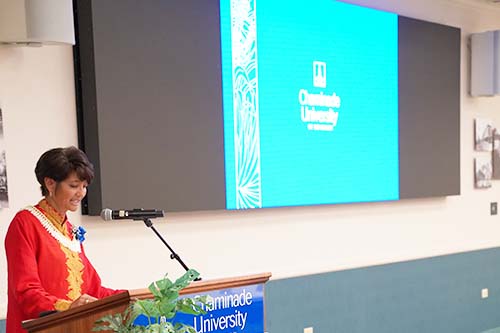
“We narrowed it down to eight finalists from the 23 entries that were submitted,” said Chaminade President Lynn Babington, Ph.D., in her opening remarks. “It was not easy, but the objective of this competition is to encourage excellence and innovation. The work that nonprofits do is absolutely vital to our communities.”

Chaminade’s Hogan Entrepreneurial Program and American Savings Bank’s Nonprofit Business Plan Competition is held every other year and is open to Hawaii nonprofit organizations seeking to start new ventures that will benefit society. The competition aims to stimulate public interest and support in nonprofit organizations—and encourage excellence and innovation in socially-motivated entrepreneurs.

“This biennial competition aligns well with our Marianist mission,” said Dr. Roy Panzarella, director of the Hogan Entrepreneurial Program. “These nonprofits are doing a lot of good for their communities.”

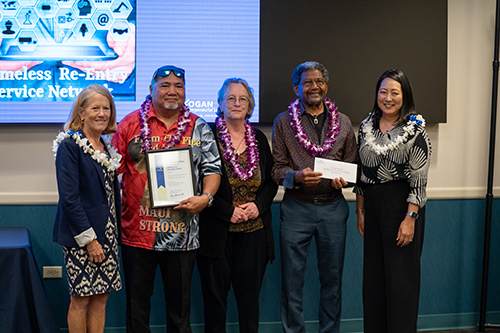
WorkNet members, from left, Mo Kalaikai, Stephanie Ann and Chas Williams were congratulated by Chaminade President Lynn Babington, Ph.D., far left, and American Savings Bank’s President and CEO Ann Teranishi.

In all, the Hogan Entrepreneurial Program and American Savings Bank awarded $41,000 to nine Hawaii nonprofit organizations who participated in the competition this year. The first-place winner, Worknet Inc., walked away with the $15,000 prize.

“I’m overwhelmed and seldom am I at a loss for words,” said WorkNet Founder, Executive Director and President Chas Williams, upon receiving his award. “We rarely have a chance to revel in the work we do, so I am proud to be here. For once, we’re recognized for the work we do.”

WorkNet is an innovative nonprofit that prepares prison inmates for a successful re-entry into community living to reduce recidivism. The organization specializes in offender re-entry services, which include helping parolees find jobs, secure housing, obtain a driver’s license and restore identity documents so they can have a higher success rate with their reintegration into our communities.

“To be in this company (among other nonprofits), I feel rewarded beyond belief,” says Williams, pssionatley shaking his fist. “This institution (Chaminade) is the training ground, and I offer myself to share my knowledge and ideas with people who are in this field.”

The second-place winner was Mothers Against Drunk Driving, which received $11,000 toward its Teen Influencer Summer Institute, a five-week program that aims to educate today’s youth about the dangers and tragedies of drinking and driving.

Third place went to Pasefika Presence, a nonprofit magazine with a mission to provide a space for voices of the Pacific to share their stories through the publication of their writing and art.

“It’s not easy juggling school and running a nonprofit magazine at the same time,” said Epifania “Epi” Petelo ’23. “We aim to help preserve our stories through this publication and provide Pasefika people, especially youth, with a magazine that they can actually see themselves in.”

Fourth place went to Mood USA. All dressed in the same Mood USA logo T-shirts, Waioli Misajon and her family members—including her 2-year-old daughter—said she was inspired by the competition two years ago, adding that her nonprofit was then just a dream. “This award comes with much appreciation for all the supporters and consultants who have helped develop the nonprofit Mood USA,” said the Nanakuli native of Mood USA, which supports mental health for children in the Leeward area.

The remaining five finalists included Hear 4 Hope, Downtown Art Center’s Metal Lab, PAWsitive Adventures, ThriveHI and Two Times Recycling. Each received a $1,000.

“American Savings Bank is proud to be a sponsor of this competition for many years now,” said American Savings Bank’s President and CEO Ann Teranishi. “The work that you’re doing is not easy, but please continue the work of nonprofits. Our communities need you.”

Posted by: University Communications & Marketing Filed Under: Alumni, Business & Communication, Featured Story, Hogan Entrepreneurial Program, Institutional Tagged With: Alumni, Campus Event, Hogan Entrepreneurs Program, Honors and Awards

Sustainable Entrepreneurship

April 2, 2024

New ENV 490 Sustainability Innovation class stimulates paradigm shift

Aside from being tongue twisters when said in succession, the terms sustainability and entrepreneurship are indeed big words, as pointed out by ’Inana Sustainability Entrepreneurship Program’s coordinator, Mariane Uehara. Tasked with creating a curriculum for the inaugural ENV 490 Sustainability Innovation course, Uehara admitted that she “jumped into the unknown” when she joined the United Nations’s CIFAL Center at Chaminade University.

At the core of the ENV 490 is a student-driven project that’s in partnership with a local company. The goal was to balance the triple bottom line—people, planet and profit—while addressing the long-term impact of business activities on the environment and society. Sustainable entrepreneurship recognizes the interdependence of economic development, social well-being and environmental health, and seeks to create value in a way that is responsible and ethical.

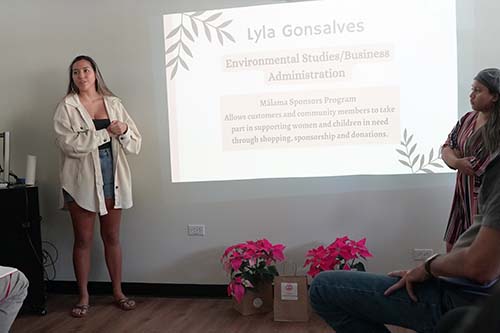
Lyla Gonsalves, left, and Jasmine Mondelo discussed possible solutions for Ten Tomorrow to become more sustainable.
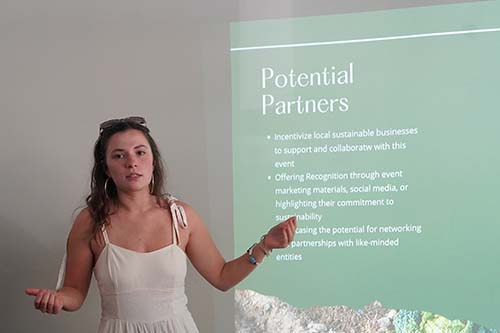
Sarah Carroll '25 identified potential partners that could help Re-use Hawaii and its sustainable efforts.
Sarah Carroll identified potential partners that could help Re-use Hawaii gain greater community support.
Ten Tomorrow designer Summer Shiigi, center, liked the ideas presented by Chaminade students, from left, Ka‘I‘inipu‘uwai “Mini” Keli‘iho‘omalu-Holz ’24, Lyla Gonsalves ’25, Jasmine Mondelo ’25 and LaVelle White ’26.
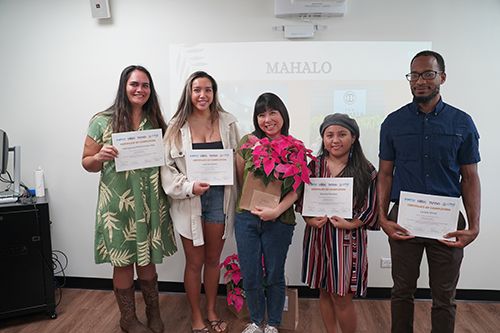
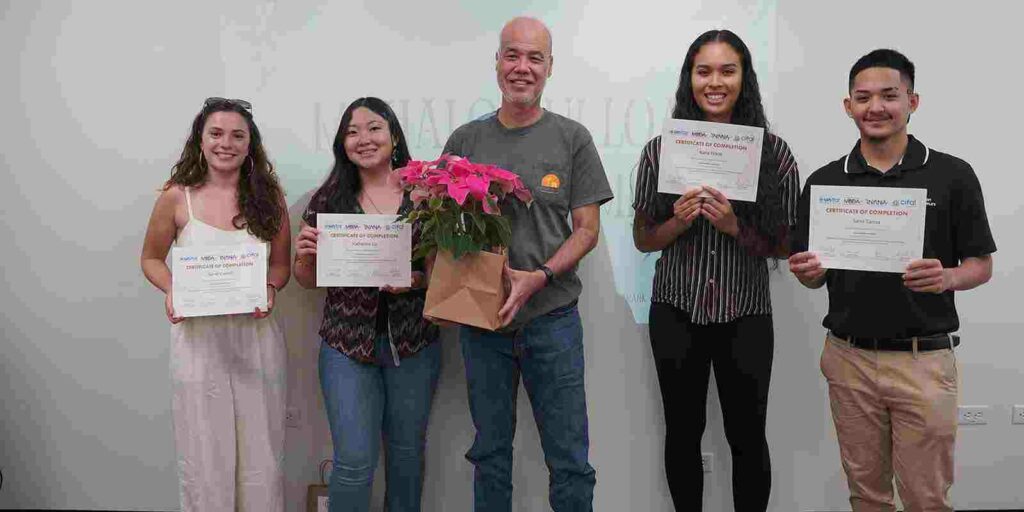
Re-use Hawaii's Workforce Development Coordinator Nathaniel Pak saw value in Chaminade student's sustainable efforts for the nonprofit. Team members included, from left, Sarah Carroll '25, Katherine “Kat” Liu ’26, Kaila Frank ’24 and Sano Tanna ’24.
Re-use Hawaii’s Workforce Development Coordinator Nathaniel Pak saw value in Chaminade students’ sustainable efforts for the nonprofit. Team members included, from left, Sarah Carroll ’25, Katherine “Kat” Liu ’26, Kaila Frank ’24 and Sano Tanna ’24.

“All the students’ projects had to align with at least one of the United Nations’s 17 Sustainable Development Goals (SDGs),” Uehara explained. “Although the vision was blurry at first, we figured out the puzzle together, and we had fun while doing so.”

According to Uehara, the three goals of the ’Inana Program are: 1) To develop and implement programs for the education and training of undergraduate students in subjects directly relating to successful entrepreneurship; 2) To support minority business enterprises (MBEs), including building a diverse entrepreneurial pipeline to grow the number of MBEs; and 3) to create a UN Certificate program in sustainability entrepreneurship.

Divided into three teams, 14 students presented their final entrepreneurial projects, working alongside with Ten Tomorrow, Re-use Hawaii and Plantoem. Under the mentorship of Uehara, and Cort Isernhagen and Jamie Lui of Diamond Head Research—a company that helps small companies track and assess their activities to identify trends and innovative business models that best support Corporate Social Responsibility, Environmental, Social and Corporate Governance, and philanthropic initiatives—the aspiring entrepreneurs demonstrated their ability to think outside the box.

“First of all, who are you guys,” rhetorically asked Lui after listening to the students’ presentations. “You’re a completely different group from when we started this class a few months ago.”

Exuding confidence, Sarah Carroll ’25 proposed a “Hanau Hana Aloha Event,” which would advertise Re-use Hawai’i as a community-based nonprofit worthy of long-term patronage and donation. Additionally, it would also pose these solutions: Engage an eco-conscious audience; showcase Re-use Hawaii’s mission beyond social media; and connect with long-term donors through a captivating experience.

“Hosting an upcycle consignment event for Re-use Hawaii would present an innovative solution to address several pressing challenges,” the Data Science and Visualization major said. “It would help Re-Use connect with the community and give it more visibility, as well as broaden its donor pool.”

Other Re-use Hawaii members included Katherine “Kat” Liu ’26, Sano Tanna ’24, Lihau Keoneula ’24 and Kaila Frank ’24.

Pairing with Ten Tomorrow designer Summer Shiigi, Jasmine Mondelo ’25, Ka‘I‘inipu‘uwai “Mini” Keli‘iho‘omalu-Holz ’24, Lyla Gonsalves ’25 and LaVelle White ’26 aligned their entrepreneurial proposals with the local clothing company’s line of modern resort wear. An Environmental Studies major, Keli‘iho‘omalu-Holz identified the problem of having to bring in fabric, which contributes to carbon emissions, microplastics and landfills.

Keli‘iho‘omalu-Holz’s solution was to source fabric that would be less harmful to the environment. She cited such alternatives as hemp, organic cotton, bamboo, recycled material and Tencel fabrics, which are produced with environmentally responsible processes from sustainably sourced natural raw wood fibers. Tencel textiles are also certified biodegradable.

“I have a really keen interest in fashion, which is why I chose Ten Tomorrow ,” Keli‘iho‘omalu-Holz noted. “I wanted to find cost-effective solutions and sustainable fabrics that didn’t have a negative impact on our environment.”

Alexandra Zingarelli ’24, Sydney Danielson ’25, Pūnohu Keahi ’25, Aleeyah Lemons ’24 and Conor McMahon ’24 partnered with Zoe Zhang of Plantoem, a portmanteau of plant and poem, and suggested a “Plantoem’s Appreciation March 2024.” Each week would tackle a different aspect, from the significance of native plants and “Aloha ʻĀina: Environmental Health Talk Story Event” to carbon offset, plant therapy and sustainable living workshops.

“They really listened to what I had to say,” said Zhang, who founded Plantoem because of her love for plants and poetry. “Their proposal to me is highly viable. Since we came up with the awareness month idea during their second visit, I have already been in touch with some of the speakers who are interested in participating. The basic structure of the event month has already been sketched out. And the students are coming back to help work on the events in March.”

In his closing remarks, Isernhagen commented on the diversity of ideas and the prototypes the students developed. “I liked the fact that you met the businesses where they were,” he concluded. “Your lenses were all sharply focused around sustainability. And I liked the fact that you collectively approached one problem but each of you came up with your own individual solution.”

Posted by: University Communications & Marketing Filed Under: Business & Communication, CIFAL Honolulu, Diversity and Inclusion, Featured Story, Hogan Entrepreneurial Program, Innovation, Institutional Tagged With: CIFAL, CIFAL Center, Hogan Entrepreneurs Program, School of Business and Communication

Dean’s Speaker Series

February 26, 2024

Dr. Crissy Gayagas discusses sustainability for good

Citing the words of the late American comedian, actor, author, television host and artist, Jonathan Winters, Col. Christine “Crissy” Gayagas (Ret.), Ed.D., told attendees that, “If your ship doesn’t come in, swim out to meet it!” In other words, don’t become apathetic. Take action.

As Regional Program Lead (RPL) for the Indo-Pacific, which is part of the Advising and Consulting (A&C) Division at the Institute for Security Governance (ISG), the self-described Army brat plays an important role in engaging partners in the vital Indo-Pacific Region.

“Eighty percent of goods are transited by water and 60 percent of that goes through the Indo-Pacific Region,” said Gayagas, Chaminade Board of Governors chair. “If conflict broke out in that region, it would create instability, and you probably wouldn’t receive that Amazon order you placed.”

As part of the School of Business & Communication Dean’s Speaker Series, Gayagas’s discussion focused on Sustainable Business for Good and the U.S.’s strategy for and paradigm shift in the Indo-Pacific region. In recent years, the Biden-Harris Administration has made historic strides to restore American leadership in the Indo-Pacific and adapt its role for the 21st century. A few years ago, the United States modernized its longstanding alliances, strengthened emerging partnerships, and forged innovative links among them to meet urgent challenges, from competition with China to climate change to the pandemic.

As part of the School of Business & Communication Dean's Speaker Series, Dr. Crissy Gayagas’s discussion focused on Sustainable Business for Good and the U.S.’s strategy for and paradigm shift in the Indo-Pacific region.
As part of the School of Business & Communication Dean’s Speaker Series, Dr. Crissy Gayagas’s discussion focused on Sustainable Business for Good and the U.S.’s strategy for and paradigm shift in the Indo-Pacific region.

Stretching from the Pacific coastline to the Indian Ocean, the area is home to more than half of the world’s people, nearly two-thirds of the world’s economy and seven of the world’s largest militaries. And in the years ahead, as the region drives as much as two-thirds of global economic growth, its influence will only grow—as will its importance to the United States.

“In a 2021 address during the East Asia Summit, President Biden said he envisions an Indo-Pacific that is open, connected, prosperous, resilient and secure,” Gayagas quoted to attendees. “We want to build our collective capacity with partner nations throughout the region. The more people who are empowered, the better we are for it.”

With a military career that spans across 24 years and three deployments, Gayagas became the only battalion commander who was a mother when she saw action in Iraq. She considers her service in the Army as the first phase of her life. The second phase was exploratory, and the third and current phase are convergent, allowing her two initial stages to come together to form a new whole.

“Within these three phases, I was always guided by five elements: passion, people, persistence, priority and pivot,” Gayagas explained. “Identify your passion and keep chipping away until you’re ready to take a deep dive. In the Army, we have a saying: Mission First, People Always. Seek out a support system. Persist and do what works for you. Assess your position and ask if it’s moving your North Star. Be ready to recognize diminishing returns and be open to pivot.”

After multiple Army command and staff positions around the United States (101st Airborne Division and 25th Infantry Division) and in Germany (8th Infantry Division), and operational and strategic experience in the Army’s Human Resources Command and with the 13th Sustainment Command (Expeditionary) in Texas and in Iraq, Gayagas retired in 2008 and started her own consulting firm MMGT Consulting, LLC.

“I wanted to create space for my daughter,” said Gayagas, citing the reason for her retirement from the Army. “In this third phase of my life, I am going to pivot and enjoy full-time retirement or a quarter retirement so I can create more lunch space with my parents (gesturing to her dad Ed and mom Norma Gayagas who were seated in the front row), and pursue more hobbies.”

Opening the floor to questions, John Barayuga ’25 asked Gayagas if her passions evolved over time or did it remain the same. “I really appreciated her answer about how her passion stayed relatively the same but with a few tweaks over time,” said Barayuga, an Accounting major with minors in Hawaiian Studies and Business Administration. “It reassured me of how our paths are a constant adventure of self-discovery.

“My biggest take-away was the five P’s [principles] that Dr. Gayagas shared,” Barayuga added. “I feel the lecture exceeded what I was expecting from it. And I am looking forward to future events!”

Posted by: University Communications & Marketing Filed Under: Business & Communication, Diversity and Inclusion, Featured Story, Institutional Tagged With: Campus Event, Guest Speakers

Entrepreneurial Endeavor

February 15, 2024

Recent graduate looks to open future businesses

Peterson Boyer’s decision to flee his home country of Haiti wasn’t based on a singular event but a confluence of factors: Political instability and civil unrest. Cratering economy and infrastructure recovery from a devastating earthquake that struck in 2010. Arriving on the shores of southern Florida, the then-25-year-old new emigree enlisted in the Army, eventually rising to the ranks as a logistics specialist and team leader.

“My military experience instilled in me a deep sense of discipline, resilience and commitment to excellence,” says Boyer ’23, during an interview from his Colorado residence. “I used the very same traits to achieve my bachelor’s degree with honors finishing with a 3.71 GPA.”

Ambitious and a fearless leader, Boyer established Enterprise Collision & Auto-body Repair LLC during his senior year at Chaminade and it continues to thrive. Crediting his parents for his business instincts, the 32-year-old entrepreneur also holds a marketing interest in the Rocky Mountain Region, though he was coy to reveal any details.

“When I was a student, I did this incredible marketing internship with Makana (Craig, Director of Chaminade University Online),” Boyer says. “I learned so much. I helped boost brand awareness by developing creative marketing strategies and campaigns. And I helped military personnel understand Chaminade’s online Flex program.”

Boyer’s interest in business stems from his parents’ own experience as retail shop owners in Port-au-Prince, where his mom and dad still maintain their business interest amid the turmoil and gang violence. After seeing his parents struggle with accounting principles and marketing strategies, Boyer decided that in order for him to succeed in establishing his own business, he needed to get his business degree.

After hearing praises about Chaminade from his Sergeant, Boyer decided to look into the University, unsure about the flexibility of the hybrid online classes necessary to obtain a degree in business administration.

“My professors challenged me and I think they prepared me well for the business world,” Boyer says. “(Richard) Kido had a great way of teaching accounting that helped students understand the concepts.”

By developing and improving his skills and having a better grasp of the market, Boyer says he has become a better, more effective leader. “Chaminade is a very good school compared to some of the other programs I looked into,” he adds. “The courses were super intense, but we got some good supporting materials that really helped in my understanding of what it’s like to run your own business.”

Like most non-traditional undergraduate students, Boyer juggled between his responsibility to the Army and his full-time job with an electrical engineer company, Prime Power, in Schofield.  And, of course, he needed to dedicate time to attend his online classes, which required at times for him to come to campus for in-person learning. Despite these challenges, Boyer brought his valuable life experiences, maturity and motivation to his studies.

“Everyone here is so supportive,” Boyer says. “I owe Chaminade because the University empowered me with the spirt of leadership and service. And the way I want to pay Chaminade back is with my success.”

While the odds of succeeding as an entrepreneur can be daunting, many successful entrepreneurs have faced setbacks and failures before achieving success. Learning from mistakes, seeking mentorship and guidance, and being willing to adapt and innovate are essential for increasing the chances of success in the entrepreneurial journey.

“I absolutely think that Chaminade is one of the best schools I could have ever attended,” Boyer says. “I am a better person for it and I am super grateful to be part of the Chaminade family.”

Posted by: University Communications & Marketing Filed Under: Alumni, Business & Communication, Diversity and Inclusion, Featured Story Tagged With: Business Administration, Honors and Awards, Internship, School of Business and Communication

Budget Analyst

December 19, 2023

Carol An Nacario ’23 to start new position with the Legislature

He had her at pizza. While walking past a classroom at Kieffer Hall, Carol An Nacario was swayed by School of Business and Communication assistant dean, Asoke Datta, Ed.D., to come in for some lunch. Not one to turn down free food — what college student does — Nacario willingly ambled through the door. Only then did she realize that she had just been recruited to enter the Silversword Business Competition.

“I only came in for the pizza,” laughs Nacario ’23, a business administration major. “I knew about the competition, but I had no intention of entering.”

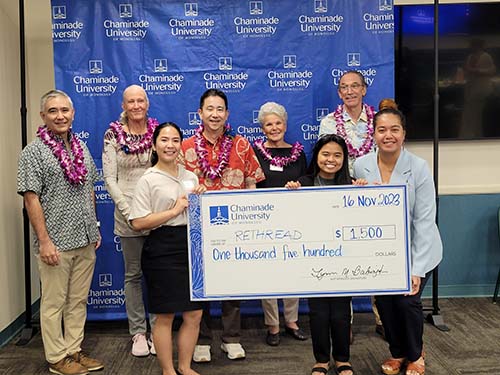
Not only did she enter the competition, but on Nov. 16, she and her team members, Kelsey Sablan ’23, Epifania “Epi” Petelo ’23 and Elizabeth “Liz” Devine ’23, walked away with the grand prize of $1,500 for their “Re-Thread” entrepreneurial concept, which “sews new life into unused fabrics and transforms them into stylish and sustainable pouches.”

“Carol has been a highly driven student who values self-learning and entrepreneurial opportunities for growth in the world of business,” says Assistant Professor and MBA Director Eddie Merc. “This business plan competition event was an ideal opportunity to showcase her passion for teamwork and giving back to the community through service and sustainability efforts. I’m very proud of Carol and her team to represent School of Business and Communication so well at this important entrepreneurial venue.”

Re-Thread members (Elizabeth “Liz” Devine ’23 is missing) from left, Carol An Nacario, Kelsey Sablan and Epifania ‘Epi’ Petelo, won the $1,500 grand prize. The competition’s judges included, from left, David Oyadomari, Dr. Gail Grabowsky, Eric Fujimoto, Sharon Weiner and Hogan program director Dr. Roy Panzarella.

This was just the first victory for Nacario, who will end her collegiate experience on a winning streak. The second has even greater consequences. After seeing a flyer advertising that “The Hawaii State Senate is HIRING,” the Guam native decided to apply for one of the openings.

“I got a call asking me to choose an interview date,” Nacario says. “I chose Nov. 2 and a couple of weeks later, I found out I was hired, and I received an offer letter signed by Hawaii State Senator Donovan Dela Cruz, the Chair of the Senate Committee on Ways and Means.”

Starting in January, Nacario will be a budget analyst with the powerful Senate Committee on Ways and Means (WAM), which oversees programs relating to overall state financing policies, including revenue enhancement, taxation, other revenues, and cash and debt management; statewide implementation of planning, programming, budgeting and evaluation; and government structure and finance.

“The day before the interview, I approached Dr. Merc for some advice about what to expect,” Nacario recounts. “He told me to relax, and to be prepared to be asked about my strengths and weaknesses.”

Nacario also summoned the STAR method—a lesson that she had learned from visiting assistant professor, Pamela Estell, Ph.D.—which is an interview technique that gives interviewees a straightforward format they can use to tell a story by laying out the Situation, Task, Action and Result.

“I was very nervous at first,” Nacario says. “They asked me a lot of questions about budgets and if I had ever worked on government budgeting. I had mentioned VLOOKUP, which is an Excel function that I learned from Shari Young (Director of Finance & Operations for Make-A-Wish Hawaii) during my internship, and they were impressed.”

For the 21-year-old Chamorro, the opportunities afforded to her by Chaminade almost never happened. She was initially enrolled to attend the University of Guam until a close friend convinced her to apply to Chaminade. Two weeks before the start of classes in Guam, Nacario finally received an acceptance letter from Chaminade University.

“For some reason, the letter was delayed and it was never delivered when it should have been,” Nacario recalls. “It was the year of COVID and I had to quickly make a decision.”

She made the right one. As she finishes her final exams and celebrates her 22nd birthday on Dec. 16, Nacario reflects back on her four years at Chaminade with a wide smile on her face.

“When I came to Hawaii, I had never been to any other mainland state,” Nacario says. “I don’t think I would have grown in Guam, like I have here. I was an introvert and intimidated with titles, but now I am able to work in a professional environment, like the State Legislature.”

Posted by: University Communications & Marketing Filed Under: Business & Communication, Hogan Entrepreneurial Program, Homepage, Institutional Tagged With: Business Administration, Hogan Entrepreneurs Program, School of Business and Communication

  • « Go to Previous Page
  • Page 1
  • Interim pages omitted …
  • Page 5
  • Page 6
  • Page 7
  • Page 8
  • Page 9
  • Interim pages omitted …
  • Page 26
  • Go to Next Page »

Footer

Chaminade University Logo

3140 Waialae Avenue
Honolulu, Hawaii 96816

Contact Us
Phone: (808) 735-4711
Toll-free: (800) 735-3733

facebook twitter instagram youtube linkedin

Visit

  • Plan Your Visit
  • Campus Map (PDF)
  • Events

Resources

  • Campus Security
  • Student Consumer Information
  • Concerns, Feedback, and Reporting
  • Institutional Review Board
  • Title IX / Nondiscrimination Policy
  • Compliance
  • Emergency Information
  • Careers
  • Institutional Statement

People

  • Students
  • Parents
  • Alumni
  • Faculty & Staff

Policy

  • Privacy Policy
  • Terms and Conditions of Use


© Chaminade University of Honolulu