• Skip to primary navigation
  • Skip to main content
  • Skip to footer
Chaminade University of Honolulu

Chaminade University of Honolulu

  • VISIT
  • APPLY
  • GIVE
  • STUDENTS
  • PARENTS
  • ALUMNI
  • FACULTY/STAFF
  • Admissions
    • Admissions Home
    • Undergraduate Students
      • First-Year Students
      • Transfer Students
      • Admitted Students
    • Graduate Students
    • Flex Online Undergraduate Program
    • Military Students
    • Non-Degree/Visiting Students
    • Experiential Honors Program
    • Early College Program
    • New Student Orientation
  • Tuition & Aid
    • Financial Aid Home
    • Tuition & Expenses
    • Federal Updates & Changes
    • Scholarships
    • $5,000 Graduate Scholarship
    • VA Education Benefits
    • Net Price Calculator
  • Academics
    • Academics Home
    • Academic Programs
    • Office of Student Success
      • Academic Advising
      • Records and Registrar
    • Kōkua ʻIke (Support Services)
      • ADA Accommodations
      • Career Services
      • Proctoring Services
      • Tutoring Services
    • Sullivan Family Library
    • Undergraduate Research & Pre-Professional Programs
    • Commencement
  • Campus Life
    • About Campus Life
    • Student Engagement
    • Student Government Association
    • Residence Life and Housing
      • Summer Conference Housing
    • Health Services
    • Marianist Leadership Center
    • Counseling Center
    • Campus Ministry
    • Campus Security
    • Dining Services
    • Bookstore
  • Athletics
  • About
    • Chaminade University News
    • Our Story
    • Leadership
    • Chaminade University Strategic Plan 2024-2030
    • Mission & Rector
    • Association of Marianist Universities
    • Facts & Rankings
    • CIFAL Honolulu
    • Accreditation & Memberships
    • Montessori Laboratory School
Search
×

Search this web site

Behavioral Sciences

Chaminade University Receives Maximum 10-Year Accreditation from APA for its Doctor of Psychology Program

May 12, 2021

Following a rigorous, months-long review, the Doctor of Psychology (PsyD) in Clinical Psychology degree program at the Hawaii School of Professional Psychology at Chaminade University of Honolulu has received full accreditation from the American Psychological Association (APA) for ten years.

APA accreditation signifies Chaminade’s PsyD program meets the highest standards in psychology education, preparing students to successfully and ethically deliver psychological services to the community.

“APA’s 10-year accreditation is an affirmation of the quality, rigor, and academic support that we provide our students through Chaminade’s PsyD program, giving them the tools and resources that they will need to serve the mental and behavioral health needs of our communities,” said Chaminade President Lynn Babington.

“Chaminade University is proud to offer the only APA-accredited PsyD program in the state, and is committed to partnering with our graduates as they expand access to evidence-based, culturally attuned psychological care. Like our community partners, we know that mental health is critical to overall health.”

Babington added that the COVID-19 pandemic has underscored the critical need for quality psychological services in Hawaii, especially in rural and under-resourced populations. “The PsyD program is built on Chaminade’s Marianist tradition of public service, and is part of a suite of academic offerings in mental health at Chaminade geared toward helping communities thrive,” Babington said.

As part of APA accreditation, Chaminade’s PsyD program faculty members and administrators underwent an extensive self-study process, highlighting areas of excellence and opportunities for further growth and innovation. An accreditation team of professionals from across the US also conducted a thorough program review to ensure the University’s PsyD program meets rigorous standards.

There are currently less than 70 PsyD programs in the US with full APA accreditation.

Chaminade’s PsyD stresses experiential learning and cutting-edge, community-focused practical application. Students complete a five-year course of study in preparation for licensed clinical practice, with a curriculum that integrates hands-on application with theory and research. Students are also mentored to serve as practitioner-scholars and leaders who seek to drive positive change.

Before graduation, students also complete at least 1500 hours of clinical practicum and  2,000 hours of  clinical internship held  in a variety of settings, including community mental health centers, nonprofits, hospitals, and psychiatric facilities.

In addition to APA accreditation, the PsyD program is accredited by the WASC Senior College and University Commission. Additional information on the program is available at chaminade.edu/psyd.

# # #

Chaminade University of Honolulu provides a collaborative and innovative learning environment that prepares graduate and undergraduate students for life, service and successful careers. Established in 1955, the university is guided by its Catholic, Marianist and liberal arts educational traditions, which include a commitment to serving the Native Hawaiian population. Chaminade offers an inclusive setting where students, faculty and staff collectively pursue a more just and peaceful society.

Posted by: University Communications & Marketing Filed Under: Behavioral Sciences, Featured Story, Institutional, Press Release Tagged With: Doctor of Psychology in Clinical Psychology

Students Showcase Work at Annual Na Liko Na‘auao

April 19, 2021

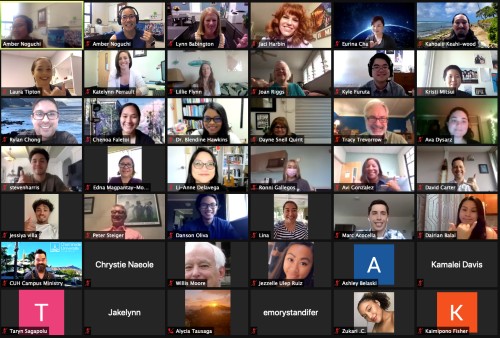
Na Liko Naauao virtual event 2021 screenshot

Chaminade undergraduates across all disciplines gathered virtually in early April to present their ongoing research across a broad array of exciting areas, from Native Hawaiian traditional medicine to data science database development to the microbiome, coral bleaching and cancer cell research.

The undergraduate conference, Na Liko Na‘auao, is an annual event at Chaminade to showcase exceptional original work by students seeking bachelor’s degrees and underscores the breadth and depth of academic scholarship at the University. Fields represented at this year’s conference, which included 23 presentations in all, ranged from Biology to Data Science to the Forensic Sciences.

The Na Liko Na‘auao symposium was first held at Chaminade in 2002.

Among the impressive topics students tackled this year:

  • “Modeling The Microbiome Of Aa In Vitro Taro Digestion Model,” from Ava Dysarz
  • “Seasonal Difference In Carcass Decomposition On Oahu,” presented by Marietta Lee
  • And “Keawawa Water Analysis And Restoration,” from Dorie Sanborn and Trinity Young

Organizers say Na Liko Na‘auao not only gives undergraduates an opportunity to offer the broader University community a glimpse into what they’re working on. It also gives them a chance to hone their presentation and speaking skills, synthesizing their research for a general audience.

The public forum also gives students an opportunity to take questions, giving them insight into their research strengths along with potential areas for improvement, further exploration and collaboration.

Also at Na Liko Na‘auao, the recipients of two prestigious Chaminade awards were announced.

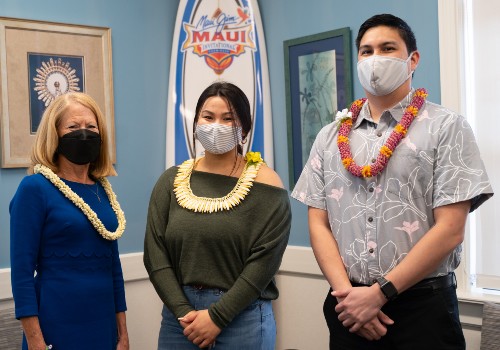
Dr. Lynn Babington, Darian Balai and Dr. Rylan Chon

The President Sue Wesselkamper Prize, which recognizes a student who has displayed academic scholarship beyond the classroom and has a record of service learning volunteerism and leadership, was awarded to Data Science student Dairain Balai, who is also minoring in Biology and Criminal Justice.

In nominating her for the award, Data Science program Director Dr. Rylan Chong said Dairain has participated in a host of leadership and research growth opportunities—and excelled in each of them.

And her work is already getting noticed. To continue her research on Native Hawaiian women’s health, Dairain was selected for a competitive spot as a paid research assistant at the University of Texas in Austin Texas Advanced Computing Center, where she is also serves as a mentor to other students.

Chong said Dairian, who graduated from Waianae High and is a Ho’oulu Scholar, “represents what Chaminade is all about locally, in her community, and on the mainland by going beyond the expectations of her service to community and education, development of her moral character, personal competencies, and commitment to build a more just and peaceful society.”

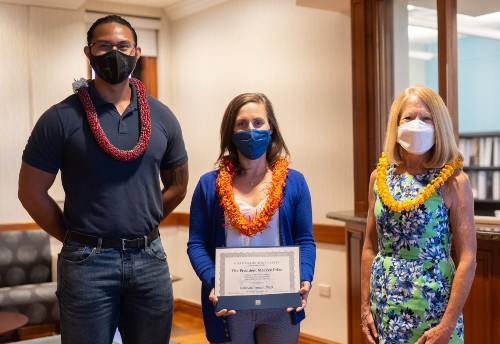
Danson Oliva, Dr. Kate Perrault and Dr. Lynn Babington

Also announced at the event: the recipient of the President Mackey Prize, which recognizes a faculty member at Chaminade with a record of student mentoring and a strong, ongoing commitment to providing students with research or creative experiences that go beyond the classroom.

This year’s awardee: Dr. Kate Perrault, an assistant professor of Forensic Sciences and Chemistry.

Undergraduate researcher Danson Oliva nominated Perrault for the honor, saying the professor is “extraordinarily passionate about the course material and wants every student to succeed.” Oliva added that working in a lab under Perrault has been a wonderful growth experience, allowing her to flex her scholarship muscles while also getting helpful and instructive feedback and mentoring.

“As a research mentor, she guides us but also helps us troubleshoot problems when they arise,” Oliva wrote. “With the help of Dr. Perrault, I have gone on to give two conference presentations on my project. It wouldn’t have happened if Dr. Perrault didn’t truly believe in our ability to succeed.”

Posted by: University Communications & Marketing Filed Under: Behavioral Sciences, Business & Communication, Campus and Community, Education, Faculty, Featured Story, Humanities, Arts & Design, Institutional, Natural Sciences & Mathematics, Nursing & Health Professions, Students

New Online School Counseling Program for Neighbor Islanders

March 5, 2021

Say you’ve just graduated on one of the neighbor islands with a bachelor’s degree in psychology. You want to get a master’s degree next, so you can become a school counselor and make a positive difference to your community’s students and their families—but there’s no appropriate master’s program on your island. Chaminade University is the only Hawai‘i university that offers a Master of Science in Counseling Psychology (MSCP) program with a concentration in School Counseling. You’d have to quit your job and relocate to O‘ahu for two-and-a-half years.

Or rather, that would have been your only choice last year.

Starting this spring semester, exclusively for neighbor island students, Chaminade will offer an online version of its Master of Science degree in Counseling Psychology (MSCP) with the School Counseling concentration. It solves two problems—not only that of neighbor island student demand but also the state’s need for more trained school counselors throughout Hawai‘i.

Dr. Darren Iwamoto, clinical director of School Counseling in Chaminade’s School of Education and Behavioral Sciences, says neighbor island students have always been interested in the MSCP program, and it’s always been hard for the school to meet that need because administrators assumed they needed to teach it in person. Pre-COVID-19, they had started working on a plan to send instructors to Maui and Hawai‘i Island to offer the MSCP program there.

But then came the pandemic, and with it, of course, remote learning. Iwamoto says the university discovered something surprising.

“Our faculty found they can be just as effective at teaching using Zoom and other kinds of video conferencing,” he says. He said they found online education still provided personalized learning and allowed students to connect with one another. “Our instructors found that even when they couldn’t teach in person, they were successfully getting that human interaction over video. It was working.”

The department conducted a needs assessment to see if there was current demand for the MSCP program among neighbor island students, and it came back positive. So they decided to start an online program specifically for neighbor island students.

While the School Counseling focus starts this spring, Chaminade will begin offering online versions of the other two Counseling Psychology concentrations, Mental Health and Marriage and Family, in the fall. Once all three concentrations are offered this fall, they will be available to students located anywhere.

“At that point, we’ll be running a complete MSCP online program alongside the in-person program,” says Iwamoto. “So students won’t have to fly to O‘ahu. Although they can participate in the in-person commencement.”

The online, 60-credit-hour, cohorted School Counseling program is taught in four 10-week terms per year. The year-round program, geared toward working professionals, can be completed in 30 months.

Upon completing the program, students not only receive a master’s in counseling psychology but are also eligible for a provisional K-12 counseling license and to be hired as a school counselor. “Because they’re trained in school counseling in general, they will also have the skillset and knowledge to work as a counselor in our private and charter schools,” says Iwamoto.

He says that while school counselors have always been crucial, that need has been even more significant since the COVID-19 pandemic began a year ago. He says stress, anxiety, and mood challenges, which were already high, have increased with COVID.

“What we’re finding is that the lack of social connection has probably played the biggest role in altering people’s moods,” he says. “That’s where counselors can really help, especially in regards to social-emotional learning and helping students, especially the younger ones, learn how to regulate their emotions better.”

As the school developed its MS in Counseling Psychology program, it carefully considered the university’s Marianist values, including the importance of providing an integral quality education. The program was specifically designed with an “integral quality education” in mind by ensuring it educates the whole person. It does this by not only focusing on academics. “We also educate them in terms of their personal and social development, and spiritually, in terms of getting them in tune with who they are and their value systems, ethics, and morals,” says Iwamoto.

“When students go on to become school counselors, they pass those same values on to the community,” he says. “They support students and their families and make a positive difference in their lives.”

The program also meets the Chaminade value of educating for adaptation and change. “That’s really what all this is about,” says Iwamoto. “Educating students to improve on their social-emotional skills is actually educating them for adaptation and change, for that ability to adapt and be flexible. That’s really been a theme with COVID, and so that’s what we’re promoting.”

The Master of Science in Counseling Psychology program is part of Chaminade’s School of Education and Behavioral Sciences. Dr. Dale Fryxell, Dean of the School of Education and Behavioral Sciences, says there’s long been a need for more trained school counselors, who play such an essential role in helping students, on the neighbor islands. “This program will really help our neighbor island students get the training they need to help students in their own communities with mental health and other issues.”

“School counselors really do help mold the future by emphasizing the importance of education and promoting students’ success,” agrees Dr. Lynn Babington, Chaminade University president.

“We’re so glad to be able to take the MSCP school counseling program online,” she says. “There’s a need on the neighbor islands, and when more of our neighbor island students become licensed school counseling professionals, they will truly be able to make a powerful difference in students’ lives.”

Learn More About the MSCP Program
Apply to the MSCP Program

Press Release >>

HINow Segment about MSCP in School Counseling Online Program >>

Posted by: University Communications & Marketing Filed Under: Behavioral Sciences, Campus and Community, Diversity and Inclusion, Featured Story Tagged With: Master of Science in Counseling Psychology

A Family Affair

December 15, 2020

As a child, Tesia Chang, MSJCA ’15 was always intrigued by detective and cop shows. Her father used to read her Nate the Great books, a children’s detective series about a young boy who solves mysteries written by Marjorie Weinman Sharmat.

“I always knew I wanted to become an investigator,” says Chang. “I wanted to follow in my mother’s footsteps.”

Chang’s mother passed away when she was three-years-old. It was always her goal to carry on her mother’s legacy.

Her mother had started as a clerk, until one of her supervisors recognized that she had an ability to do even more and go on to bigger things. Her supervisor encouraged her to seek higher education, so she got her college degree and advanced to become an investigator with the State of Hawaii Department of Commerce and Consumer Affairs.

There was a time in Chang’s life, toward the end of her undergraduate career, when she considered becoming an attorney and going to law school. She studied hard, took the LSAT and applied for law school—but those doors didn’t open.

She didn’t know it at the time, but it was a blessing in disguise. She’s now an investigator with the State of Hawaii Department of Commerce and Consumer Affairs, just like her mother used to be.

After graduating from college and realizing she was not going to become an attorney, Chang felt lost. She got a job working at a law firm as a file clerk while she tried to figure out her next move and worked at McDonald’s on the side. She used the opportunity to gain life skills, and to try to change the way she had been thinking about things.

“The one major thing that the whole process taught me was to think about things differently,” says Chang. “It helped prepare me for my current line of work. We’re often confronted with a wide range of complaints—some are very simple and others are very complex. It regularly requires analyzing things from a different perspective.”

Then, one day her father let her know about Chaminade’s Master of Science in Criminal Justice Administration program. He had friends in the law enforcement community who highly recommended it.

Chang enrolled, and got accepted. She kept her job at the law firm, and through Chaminade’s program she found an internship at the Honolulu Police Department in the Crime Scene Unit.

“I was shadowing evidence specialists,” recalls Chang. “There’s a lot of thought about how the scene was when you found it, and you have to use a lot of science and deductive reasoning. That was a really great opportunity.”

The experience re-ignited her passion for becoming an investigator and set her back on the career path she had always thought she’d follow.

Today, Chang talks about how the program gave her direction and believes it can give other students direction also.

“If you go through Chaminade’s program, it will definitely give you better direction or at least confirm where you want to be,” she says. “This is definitely the program that’s going to help you realize what you want to do.”

Toward the end of her time at Chaminade, she became a student helper at the Department of Commerce and Consumer Affairs, and when she graduated, the folks at the department let her know about a temporary emergency hire—someone from the unit was being deployed and they were looking to fill the position in the interim. A few months later, she became a permanent employee and has been there ever since.

Chang spends her days investigating consumer complaints about unfair and deceptive acts.

“We investigate a broad spectrum of different scams,” describes Chang. “Mortgage rescue fraud scams, refund and exchange laws and more. If a store doesn’t post proper signage, then that could be considered an unfair or deceptive act or practice.”

Chaminade taught her how to process information and think critically about a subject. She learned how to pick a topic and research it, and how to go about gathering information to support or disprove a theory. She finds herself using that knowledge on a daily basis.

“It’s the same process when you receive a complaint,” she says. “You analyze it and process it into pieces, and that allows you to analyze the evidence effectively. Based on that, you can draw a pretty good conclusion.”

She particularly remembers her courses with Professor Collin Lau, a lecturer of criminology and criminal justice.

“His classes forced you to cut down on the flowery stuff and get straight to the point and to the meat of the issue,” says Chang. “The complaints we receive give all sorts of information and you need to be able to cut through to get the who, what, when, where and why. Professor Lau’s courses taught me to dissect through all the information.”

Chang truly believes the experience she had at Chaminade has helped make her a better investigator. “I honestly feel like I wouldn’t be as effective of an investigator if I hadn’t gone through Chaminade’s masters program, and I can see that as I continue to work here.”

She thrives on the thrill of her job. She loves that it keeps her on her toes, and she never knows what kind of complaint she’s going to get next. Her favorite complaints involve refunds and exchanges, because she often goes undercover on site inspections.

“Being incognito is part of the fun,” says Chang excitedly. “We can dress up and pose as customers. We’re able to have a different experience that’s pretty close to how a customer would experience it.”

Her job has definitely impacted the way she shops and it’s made her a much more wary consumer. She’s learned to ask a lot of questions, something she always encourages other consumers to do. She believes questions are one of the best defenses against scams.

“If there’s one thing this job teaches you, it’s to not take anything at face value,” says Chang. “This job definitely opens your eyes to a lot of things that you wouldn’t have been aware of if you were just a consumer. Knowledge is definitely power.”

Despite all of the excitement and thrill she finds on a daily basis at work, Chang’s reasons for loving her job are very personal. Knowing that she’s carrying on her mother’s legacy has been way more meaningful than she ever anticipated. She’s found a closeness to her mother that she hadn’t known before.

“Because I was so young when she passed away, the reality of not having her in my life didn’t really kick in until I started working here,” shares Chang. “Once I started working here, I could actually imagine working with her.”

Sometimes, she plays through different scenarios in her head about what it would have been like to work with her mother.

“Sometimes I think ‘wow, if we worked in the same office, we could have been taking lunch breaks together, come to work together, left work together,’” says Chang. “It definitely helps me in my mind create a stronger connection to her.”

When she gets sad, she tries to focus on the fact that she’s helping people, just like her mother did.

“Whether we’re helping someone get some sort of restitution, or helping them by filing a complaint, our office is able to take action and stop the respondent from hurting anyone else,” she says. “It feels great when we’re able to help a consumer.”

Posted by: University Communications & Marketing Filed Under: Alumni, Behavioral Sciences, Featured Story Tagged With: Master of Science in Criminal Justice Administration

Finding Her Home Away From Home

December 10, 2020

When Melanie Legdesog Veltri originally came to Chaminade University as an undergraduate from Micronesia, her plan was to get a degree and then go back home to help her community. She wasn’t expecting to find a Micronesian community in Hawai‘i that needed her just as much.

Melani Legdesog Veltri '06, MSCJA '08

Veltri had always wanted to attend university in Hawai‘i, and she was attracted to Chaminade’s small class sizes and intimate community. 

“My parents and I both thought it would be a good transition after coming from a small place,” explains Veltri. And they were right. Veltri found a home at Chaminade. “I had just moved here and I didn’t know anything about what living in the U.S. was like—I really learned from Chaminade. I took a lot in since I was so young and impressionable.”

It wasn’t long before Veltri became a very active member of the Chaminade ‘ohana and Campus Ministry.

She graduated in 2006 with a degree in criminology and criminal justice, and immediately got a job working in the Records office on campus. She also enrolled in the master’s in Criminal Justice Administration program and would go to classes in the evenings. 

She really liked the perspective she gained through the master’s program, and the fact that so many of her peers were already professionals in the criminal justice field.

“I was able to take classes with people who were professionals, a lot of military members who did various things and were able to contribute to whatever we were studying academically,” describes Veltri. “Hearing from their first-hand experience gave me a whole other level of learning.”

But her plan had always been to become an attorney—Micronesia needed lawyers and doctors and her plan at the time was to go back home to help her community. So after graduating in 2008 with her master’s degree, she left her job in the Records office and enrolled in law school. 

“I didn’t really see myself doing business law or working in an office, I wanted to do something that directly impacts people,” says Veltri. “Becoming a public defender is what I was interested in since the beginning.”

Upon becoming a J.D. in 2012, she spent some time working for the Hawai‘i State Legislature as a staff attorney for the House Judiciary Committee while she waited for a position as a public defender to open up. She wanted to get some work experience and utilize her networks in Hawaii before she headed back home. Luckily, she didn’t have to wait long, and by 2013 she had landed her dream job. 

Veltri was drawn to working with underserved and underrepresented communities. She spends her days advising people who normally wouldn’t have access to an attorney or be able to afford legal advice. She helps them navigate a very complex and often overwhelming legal system.

“If I didn’t give them advice, they’d be lost,” describes Veltri. “It’s overwhelming for them. But when I help, I can see their appreciation.”

Veltri sees firsthand that the biggest issues on O‘ahu are the prevalence of drugs and the high levels of homelessness.

“People just can’t pay for rent and can’t get stable,” says Veltri. “We have a drug problem here that keeps people cycling in and out of the jail system. Especially with the rising cost of housing, I don’t see this problem solving itself in the near future.” 

Veltri doesn’t know what the solution is on a policy level, but she knows that the work she’s doing is making a difference for the people who are struggling. 

“If it’s a drug issue, maybe I can help divert them to the right program,” says Veltri. “Or if it’s a mental health problem, I can direct them to case management. I guess I’m trying to do something about the problem in a way that I know how. For me, it’s how I know how to help and it’s how I can contribute to the solution.” 

Veltri says she draws on her Chaminade experiences and education all the time. She shares a lot of the values that Chaminade instills and she has taken those into all aspects of her professional life. She embodies the Marianist focus on community service and does what she can to serve her community wherever she is. 

But Chaminade has also shaped her personal life. She and her husband got married at Chaminade, and her son was baptised at the Mystical Rose Oratory. She also encouraged her siblings to follow in her footsteps and attend Chaminade.

“I keep getting drawn back to Chaminade and I want to maintain that connection,” says Veltri. “It has had such a profound influence on who I am today. A lot of the decisions I make, I just keep coming back to Chaminade.” 

So much of her network in Hawai‘i is because of Chaminade. 

“It is very much a family-oriented school,” says Veltri. “You just feel this connection with your peers and classmates. The classes were so small, I know of my classmates—a lot of them are in the criminal justice field—and I still see them in the community. I guess it’s just, we grew up together.” 

The tight-knit community is part of what has kept Veltri in Hawai‘i. But the fact that Veltri has found so much need in Hawai‘i has also kept her in the islands longer than she had planned. 

“When I initially came out here to go to school, my goal was always to go back home and to help my community,” says Veltri. “But ever since I started doing the work I’m doing I find it hard to leave.” 

Veltri has found that even though she’s miles away from home, she’s still helping her community. A 1986 agreement between the Federated State of Micronesia and the United States provides Micronesians with the ability to work, study and live freely in the U.S, and today, Micronesians are Hawai‘i’s fastest growing immigrant population. In 2018, it was estimated that there were 18,000 Micronesians living in Hawai‘i, and that number was growing rapidly. 

At work, Veltri is involved in a project to support the Micronesian community. Through the program she works with legal aid, immigration attorneys and legal clinics to help educate the community. 

“The most recent project had to do with all of these emergency order violations and violating quarantine,” says Veltri. “They were just ticketing everyone and a lot of people in the Micronesian community were getting these tickets and didn’t know what to do with them.” 

To help educate the Micronesian community about new laws and regulations, they have started partnering with community leaders and relying on them to help disperse information. Recently, they held a virtual Q&A session to answer questions about the new regulations. 

“It’s a project that I’m proud to be part of,” says Veltri. “We’re becoming more and more active and people are starting to reach out to us to ask for help.”

Veltri still does want to go home at some point, but not until she feels like her work here is done. “There’s still a lot to do, and there are still a lot of ways that I can help where I am,” she says. “I love that I get to help the Micronesian community—those are my people and that’s where I come from.”

Posted by: University Communications & Marketing Filed Under: Alumni, Behavioral Sciences, Diversity and Inclusion, Featured Story Tagged With: Criminology and Criminal Justice, Master of Science in Criminal Justice Administration

A Passion for Criminal Justice Reform

November 16, 2020

At the age of 16, Shekina Boling had her first experience with the criminal justice system. It was, as she describes it, unfavorable. She had been sexually assaulted, and the criminal justice process that followed her attack was lengthy and uncomfortable, to say the least. 

After a drawn out and emotional trial, Boling’s attacker was ultimately found guilty. She is one of the lucky few—according to the Rape, Abuse and Incest National Network (RAINN), only 3 out of 4 sexual assaults are ever reported. And for every 230 sexual assaults that are reported to the police, only 46 reports will lead to arrest and only 5 cases will lead to a federal conviction. 

“I’m very thankful my assailant was found guilty,” recalls Boling. “My attorney had kept prepping me that it’s not very often these types of individuals are convicted. It shed light on something that I hadn’t realized took place.”

Shekina Boling, Master of Science in Criminal Justice Administration

The experience was what first made Boling interested in a criminal justice career. And it’s what drove her to pursue her undergraduate degree in public administration and justice administration.

But as an undergraduate taking criminal justice classes, she discovered another side of the criminal justice system that she became even more passionate about—wrongful convictions.

“After learning these things, I found it was something I felt really strongly about,” describes Boling. “It was always something that saddened me, knowing that wrongful incarceration was a very common occurrence in the U.S. And there still haven’t been a lot of reform efforts to reduce these kinds of things.”

Upon graduating, she knew she wanted to get her master’s in criminal justice. The Waipahu native didn’t know what to expect enrolling in graduate school, particularly since she lands on the side of criminal justice reform.

She decided to enroll in Chaminade’s Master of Science in Criminal Justice Administration program partly because of Chaminade’s well-known and well-respected forensic science department. Ultimately, she’d like to work for the Innocence Project, helping to overturn wrongful convictions, and she believes having an understanding of forensic science plays a vital role in proving innocence.

“A lot of the time forensics is used as this infallible idea and it’s not questioned,” says Boling. “I believe the legal system has flaws and in order to propose effective solutions you need to understand the system to the fullest extent.”

Despite her initial nerves, she’s found a welcoming and friendly environment at Chaminade. She knows her calls for criminal justice reform are not always popular within the field, but that’s why she loves Chaminade’s program so much. The classes are small and intimate, and make for a really transparent environment to have lively and informed discussions.

“People are all very passionate and are willing to have discussions even if you have contradicting beliefs,” says Boling. “So far everyone has been very respectful, even if they have a different opinion.”

She likes the inclusivity that Chaminade promotes, and loves how her professors constantly present ethical dilemmas and questions that force her to reevaluate her position.

“Without a doubt, I would say it’s helping me solidify my beliefs on everything and helping me find my voice,” says Boling. “Every class provides a safe space for voicing your opinions and backing them up.”

Boling thinks it’s the perfect time to be pursuing a Master’s in criminal justice, with so much of the nation’s spotlight on criminal justice reform. And she’s really enjoying that her professors are not shying away from talking about current events.

“Not only is there such an abundance of information that keeps coming out every single day—we’re moving into such a divisive period of American history—but every day illustrates themes that we learn about in the program,” explains Boling. “It’s a way for students to really hone their beliefs and see where they really stand and what they’re for and what they’re against, and find the reasons why they believe what they do.”

This last year in the program has helped Boling solidify her own stance on things and have the substance to back up her own positions. She’s also really enjoyed having friends and classmates that she can text when she sees things in the news, and has enjoyed sharing her passions and interests with them. 

Boling will graduate in March, and then wants to get her Ph.D. in forensic analysis. She’s looking at programs across the mainland for next fall, while keeping a close eye on the COVID-19 situation. 

“Because of where we are right now with the pandemic, I’m a little hesitant to want to move,” admits Boling. Since Hawaii does not currently offer a Ph.D. in forensics, she’s also exploring local internship opportunities in case she chooses to stay local and wait out the pandemic. 

Long term, she would like to become a State Policy Advocate with the Innocence Project and contribute to policy reform in Hawaii. To become eligible and competitive for the position, she needs at least three years of experience working with the legislative system. For now, if a Ph.D. program doesn’t work out for the fall, that’s where she plans to start.

Posted by: University Communications & Marketing Filed Under: Behavioral Sciences, Featured Story, Students Tagged With: Master of Science in Criminal Justice Administration

  • « Go to Previous Page
  • Page 1
  • Interim pages omitted …
  • Page 5
  • Page 6
  • Page 7
  • Page 8
  • Page 9
  • Interim pages omitted …
  • Page 11
  • Go to Next Page »

Footer

Chaminade University Logo

3140 Waialae Avenue
Honolulu, Hawaii 96816

Contact Us
Phone: (808) 735-4711
Toll-free: (800) 735-3733

facebook twitter instagram youtube linkedin

Visit

  • Plan Your Visit
  • Campus Map (PDF)
  • Events

Resources

  • Campus Security
  • Student Consumer Information
  • Concerns, Feedback, and Reporting
  • Institutional Review Board
  • Title IX / Nondiscrimination Policy
  • Compliance
  • Emergency Information
  • Careers
  • Institutional Statement

People

  • Students
  • Parents
  • Alumni
  • Faculty & Staff

Policy

  • Privacy Policy
  • Terms and Conditions of Use


© Chaminade University of Honolulu