• Skip to primary navigation
  • Skip to main content
  • Skip to footer
Chaminade University of Honolulu

Chaminade University of Honolulu

  • VISIT
  • APPLY
  • GIVE
  • STUDENTS
  • PARENTS
  • ALUMNI
  • FACULTY/STAFF
  • Admissions
    • Admissions Home
    • Undergraduate Students
      • First-Year Students
      • Transfer Students
      • Admitted Students
    • Graduate Students
    • Flex Online Undergraduate Program
    • Military Students
    • Non-Degree/Visiting Students
    • Experiential Honors Program
    • Early College Program
    • New Student Orientation
  • Tuition & Aid
    • Financial Aid Home
    • Tuition & Expenses
    • Federal Updates & Changes
    • Scholarships
    • $5,000 Graduate Scholarship
    • VA Education Benefits
    • Net Price Calculator
  • Academics
    • Academics Home
    • Academic Programs
    • Office of Student Success
      • Academic Advising
      • Records and Registrar
    • Kōkua ʻIke (Support Services)
      • ADA Accommodations
      • Career Services
      • Proctoring Services
      • Tutoring Services
    • Sullivan Family Library
    • Undergraduate Research & Pre-Professional Programs
    • Commencement
  • Campus Life
    • About Campus Life
    • Student Engagement
    • Student Government Association
    • Residence Life and Housing
      • Summer Conference Housing
    • Health Services
    • Marianist Leadership Center
    • Counseling Center
    • Campus Ministry
    • Campus Security
    • Dining Services
    • Bookstore
  • Athletics
  • About
    • Chaminade University News
    • Our Story
    • Leadership
    • Chaminade University Strategic Plan 2024-2030
    • Mission & Rector
    • Association of Marianist Universities
    • Facts & Rankings
    • CIFAL Honolulu
    • Accreditation & Memberships
    • Montessori Laboratory School
Search
×

Search this web site

Behavioral Sciences

NCIS Special Agents in Hawaii

July 19, 2023

Chaminade Alumni Represent True NCIS Agents

They don’t go around pointing their guns at people. They don’t detonate bombs. And they certainly don’t solve major crimes in an hour. But, what five Chaminade alumni do help to accomplish is to keep Hawaii safe.

​​As special agents for the Hawaii Field Office of NCIS headquartered at Pearl Harbor Naval Base, Chris Meana ’12, Pia Teves ’85, Tamara Kenessey ’16, Olivia DeQuiroz ’12 and Kay Een ’02  are tasked with monitoring crime, conducting polygraph tests, supporting criminal investigations, and providing analytical support and technical surveillance countermeasures (TSCM).

They’re important jobs for sure. And for Meana, it has been a “life calling.”
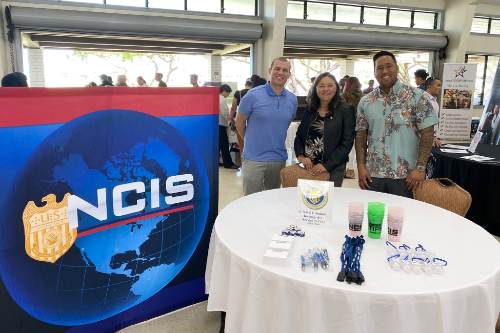
Chris Meana, right, and Kay Een promote NCIS at a recruitment affair.

“When I attended Chaminade, I was really into my religious classes, and I thought that was my calling,” says Meana, an Intelligence  Specialist with NCIS since 2015 who also acts as NCIS Honors Student Internship Coordinator, and is a member of Member of the Special Agent in Charge Advisory Group. “But then I served with the Hawaii National Guard and I refined my calling, wanting to make an impact in my hometown.”

For DeQuiroz, it was not so much a calling but a necessity that led her to the NCIS Hawaii Field Office. “I needed to pay for college so I applied for an administrative position,” says the Polygraph Examiner. “Then a job came up and I was encouraged to apply, and I passed a series of tests during the hiring process.”

Today, DeQuiroz provides counterintelligence, monitoring spies, terrorists and any matter that pertains to our national security across all branches of the military. She’s also involved with “Operation Keiki Shield,” which is part of the Hawaii Department of the Attorney General’s Internet Crimes Against Children Task Force that is comprised of a national network of 61 coordinated task forces, representing more than 5,400 federal, state and local law enforcement.

“Internet crimes are always challenging,” DeQuiroz says. “But we’ve managed to arrest more than 100 child predators in our Task Force in Hawaii.”
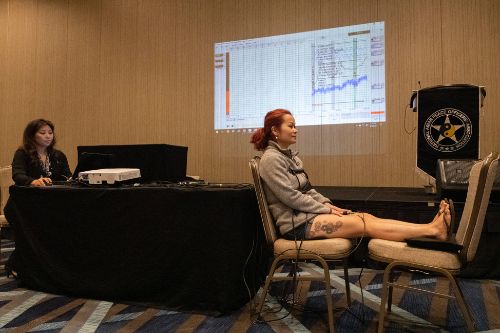
Olivia DeQuiroz administers a mock polygraph test.

With the nation’s strategic focus shifting towards the Indo-Pacific region, the NCIS Hawaii Field Office’s multi-faceted capabilities are even more in demand. Stretching from the Pacific coastline to the Indian Ocean, the area  is home to more than half of the world’s people, nearly two-thirds of the world’s economy and seven of the world’s largest militaries. And in the years ahead, as the region drives as much as two-thirds of global economic growth, its influence will only grow—as will its importance to the United States.

A former electrician with his family’s business, Teves started as a Technical Investigative Specialist (TIS) Agent in 1987 and became a Technical Enforcement Officer in 2014. He is now the sole provider of technical support for the Internet Crimes Against Children Task Force, as well as providing technical security for the entire Pacific Command.

“Before there was internet, I was looking at an actual bulletin board while I was on campus, and I came across this poster that read: Naval Investigative Service  (NIS), Office of Naval Intelligence (ONI), Special Agent position. Overseas travel, Worldwide locations,” recalls Teves, whose official NCIS title is currently Technical Surveillance Specialist. “I had no idea what it was, but it sounded sexy so I applied. About nine months later, I was hired as an Agent.”
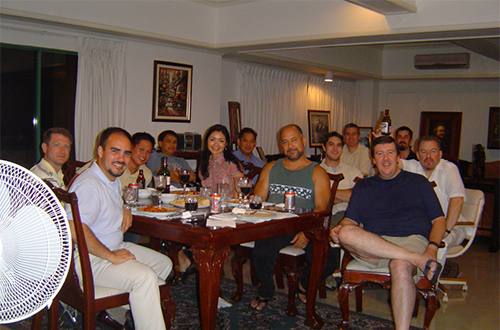
Pia Teves, wearing tank top, were on temporary duty travel to provide protective service for Adm. Samuel J. Locklear, Commander, U.S. Pacific Command during his official visit to Manila, Philippines in 2004.
Pia Teves, wearing tank top, and his colleagues were on temporary duty travel to provide protective service for Adm. Samuel J. Locklear, Commander, U.S. Pacific Command, during his official visit to Manila, Philippines in 2004.

Often misperceived as a branch of the military, NCIS is not. It is, however, the federal law enforcement arm of the Department of the Navy. Comprised primarily of civilian 1811 special agents and a small cadre of active duty Marine Corps active duty investigators, NCIS has more than 14 field offices and over 190 locations. Its special agents are stationed worldwide in support of military operations.

With historical roots tied to the Office of Naval Intelligence, the modern NCIS was formally established in 1966 as the Naval Investigative Service.  It was re-organized and assigned a civilian director in 1992, along with a name change to the now Naval Criminal Investigative Service. With this re-branding, NCIS also became a primarily civilian agency as an insulation against military command influence.

“We’re an agency of around only 2,500 members, which is relatively small compared to the major players, like the DEA, ATF and FBI,” Meana points out. “But our capabilities are well respected, and we are well known for our role in counterintelligence, protective service and force protection operations.”

Solving crimes and catching the bad guys, though, aren’t the only issues that the NCIS Hawai‘i Field Office faces. Integrating itself into the local community is vital, as well, which is why the team can be seen throughout the year at a variety of functions. Some outreach efforts focus on awareness and education, spanning across such topics as internet safety and sexual assault prevention to identity theft and cybercrime.
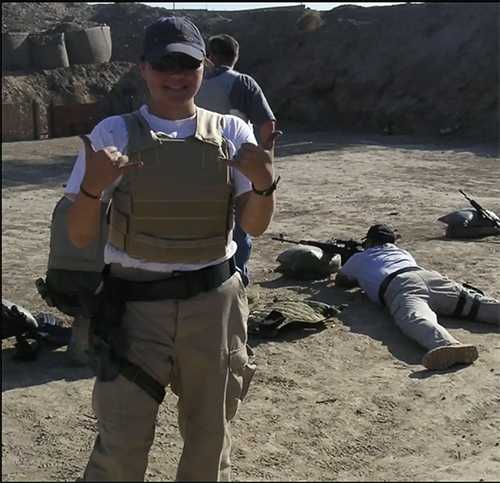
Kay Een flashes a shaka while in Baghdad, Iraq circa 2005.

A Special Agent since 2020, Kenessey deals with death investigations, child enticement, fraud, arson and all federal-level investigations that involve criminal and security matters with the Navy.

Upon learning that her mentor, Associate Professor Dr. Joe Allen, passed away in December 2021, Kenessey was saddened by the news. “Technically I wouldn’t be here if Dr. Allen hadn’t written a letter, and told me to check out NCIS,” Kenessey says. “I think Chaminade lost a valuable professor and mentor. As I said, he was an integral part of where I am today both academically and professionally.”

Kay Een, meanwhile, praises Chaminade for its welcoming atmosphere and for the experiential learning that helped her land a job with NCIS. As NCIS’ Chief Diversity and Inclusion Officer,  Een supports NCIS’ progression in the DEI arena by supporting enterprise initiatives to implement the best business practices, encouraging collaboration, and delivering proven solutions to nurture a ready and resilient, globally-engaged workforce. She was introduced to the NCIS Honors Internship Program while a Silversword.

“Much like my time at Chaminade, I believe there is great value being surrounded by people with different backgrounds, experiences and perspectives,” says Een, who is now in her 20th year with NCIS. “Being in a place that fosters diversity through inclusion is key to growing an innovative and agile workforce.”

As far as the authenticity of CBS’ popular NCIS franchise, Meana, Teves, DeQuiroz, Kenessey and Een agree that the drama doesn’t always get it right. “We have a close relationship with the show, and we’ve worked with them closely,” Meana says. “They try to stay close to reality, but they do add their own fictional twist.”

Posted by: University Communications & Marketing Filed Under: Alumni, Behavioral Sciences, Featured Story, Homepage, Institutional Tagged With: Alumni, Forensic Sciences, Psychology

PsyD Candidate Realizes Her Dream

June 13, 2023

Getting through a Transportation Security Agency (TSA) check point is no laughing matter. Nor should it be a crying one, unless you just learned that you’ve just been accepted to your dream university. After flying to Hawaii to visit Chaminade University, Jodie Gerson ’23 was en route home to Las Vegas when she was notified that she was accepted into the Doctor of Psychology Program in Clinical Psychology at Chaminade’s Hawai‘i School of Professional Psychology.

“I got up to the TSA agent and he asked if I was OK,” Gerson laughed. “I told him I was crying out of joy because I just received a call about my acceptance into Chaminade.”

Gerson, who had already held a master’s in Clinical Psychology and another master’s of science in Marriage, Family and Child Therapy, was already an accomplished professional, holding such management roles as Clinical Program Manager with the Nevada Youth Parole Bureau, Director at WestCare, Nevada, and Director of Performance Improvement and Risk Management with Spring Mountain Treatment Center and Spring Mountain Sahara Hospital.

“My wife, Chris, told me that I had met all my goals, except one, which was to apply to doctoral programs,” said Gerson, who is completing her internship with the Superior Court of the District of Columbia this July. “I had several offers across the board, but Chaminade really appealed to me so I flew out to visit.”

Chaminade President Dr. Lynn Babington and Dr. Sean Scanlan present Jodie Gerson with her PsyD degree.

Once on campus, Gerson said the setting was perfect, and she knew immediately that Chaminade was the right fit. Not only did it offer a doctoral program that she liked, but the university checked off another one of her boxes: cultural diversity.

“Oh my gosh, I thought to myself,” Gerson recalled. “This is THE one. After I did my interview, I took a tour of the campus, and it just felt right. I had to get in.”

Her interview was on a Tuesday and by Friday she received the call from the admissions team. Informed of her next steps in order to reserve her spot, Gerson immediately called Chris, and asked if she could send a deposit since she would be in the air.

“I didn’t even have a chance to tell Chris that I was accepted, and now I was asking her to send money to Chaminade,” Gerson smiled. “Even though they gave me a few extra days to complete the necessary steps, I didn’t want to take a chance of losing my spot. There was no way I was letting this opportunity slip by.”

A Certified Expert Trauma Professional who has worked in the field for more than 25 years, Gerson said she was still challenged by the doctoral program, which helped her gain a deeper analysis and understanding of clinical psychology. She also formed strong bonds with her fellow doctoral candidates.

“She has an incredible resume, and has been on multiple boards, including HPA (Hawai‘i Psychological Association) and APA (American Psychological Association),” said Dr. Sean Scanlan, Clinical Psychology Director with the School of Education and Behavioral Sciences. “Her work experience, with adults, adolescents and children, includes assistance and intervention with the homeless, individuals with mental illness, minors in foster care, forensics, youth parole and persons with HIV/AIDS.”

When Gerson returns from Washington, D.C. in July, she will begin a new job with the Department of Health Family Court Liaison Branch at the Hawai‘i Youth Correctional Facility and Detention Home, where she will advocate for teens, and assess risk, needs and protective factors in our youth populations.

She will also continue her studies, seeking to attain her Board certification by taking the Association of State and Provincial Psychology Boards’ Examination for Professional Practice in Psychology (EPPP), a rigorous process that could take as long as her PsyD program.

“Service to the community is one of the values that Chaminade upholds, and it’s one that I strongly believe in as well,” Gerson said “It has been a great experience, and I have no regrets.”

Posted by: University Communications & Marketing Filed Under: Alumni, Behavioral Sciences, Campus and Community, Diversity and Inclusion Tagged With: Doctor of Psychology in Clinical Psychology, Psychology

Na Liko Naʻauao

April 28, 2023

Students present their thought-provoking research findings

She suspected that she couldn’t be the only one feeling isolated and alone. With COVID cases spiking during her freshman year, Iris Hirata sheltered in place in her dorm room with her family support 5,000 miles away.

“I usually like being alone, but that was too much—even for me,” Hirata recalls. “It was depressing and I felt I had no one to talk to.”

As pandemic numbers started to decrease, and a semblance of normalcy emerged, Hirata never forgot those earlier times. “Biologically, I knew about COVID’s impact on the lungs,” Hirata says. “But I told Dr. Darren Iwamoto, we didn’t know the impact that COVID had on the mental health of individuals.”

It turned out to be a lot.

In an earlier research project she worked on with psychology professor Tracy Trevorrow, Ph.D., Hirata studied the effects of COVID on sleep quality. They learned that during the nascent stages of the pandemic, people tended to be more on their phones, which would disturb their sleep patterns and quality of sleep.

Iris Hirata stands in front of her presentation about COVID-19 and mental health.

“I was really big on healthcare at the time, which is what led me to do a research project on the impact of COVID on mental health,” says the biology major, who presented her findings during the 21st annual Na Liko Na’auao Symposium on April 14.

Pointing to a chart with spikes of blue and red lines, Hirata explains that the graph indicates the “bounce back” or the resiliency rate of the 200 students surveyed during her research.

“The epidemic has had a significant impact on university students’ mental health, including things like stress, anxiety, depression, and a lack of behavioral and emotional control,” Hirata concludes in her findings. “The findings support the literature that resilience is a key factor in influencing mental health and overall wellness.”

According to Amber Noguchi, Ph.D., Undergraduate Research and Pre-Professional Programs director, undergraduate and graduate research experience can look like a number of things. It can range from formal and clinical studies to data analysis, and creative works and beyond. On the occasion of this year’s Na Liko Na’auao Symposium, 25 student presenters covered a broad spectrum of issues and questions, from Hirata’s “How does COVID-19 Impact the Mental Health of Individuals?” to “Eat Healthy, Live Strong: Understanding Eating Behaviors of NHPI on Oahu” and “Sports Analytics: What Factors Determine a Winning Team?” and “Decolonizing Hawaii’s Diet.”

“All of these presentations stem from research projects that have been collaborations between the student researchers and their faculty mentors,” Noguchi explains. “This undergraduate conference celebrates student scholars from across all academic disciplines.”

In her research project with Dr. Guanlin Gao, “Eat Healthy, Live Strong: Understanding Eating Behaviors of NHPI on Oahu,” Autumn Fairall, ’23, examined the barriers to eating a healthy diet. “I started working with Dr. Gao as a research assistant in the Spring of 2022,” says Fairall, who will earn her Bachelor of Science in Nursing in May. “Initially, the project we worked on focused on the landscape of economic and personal finance in Hawaii. However, after talking with Dr. Gao and discussing personal interests in wellness and past, informal research connected to diet, the research focus altered.”

Chaminade President Dr. Lynn Babington presents Dr. Rylan Chong and Kawailani Luat with their respective awards.

During the conclusion of the Symposium, President Dr. Lynn Babington, defined a scholar as “A person with a desire to pursue and learn new things; a person on a quest for knowledge and a dedication to learning.” By not focusing on one academic discipline, Na Liko Na’auao gives all student scholars an opportunity to present their work in a formal setting, and receive feedback from both faculty and other scholars within their field.

Every year, after all the student scholars have presented their work, the Symposium concludes with a presentation of two special awards. Given annually, The President Sue Wesselkamper Award acknowledges a student who has demonstrated extensive community and university service. In order to qualify for the prize, a student must have a minimum 3.5 GPA, show scholarship beyond classroom requirements by undertaking their own independent research or study, and must have presented their work both on and off campus.

Kawailani Luat is this year’s recipient of the President Sue Wesselkamper Award. A senior, majoring in Data Science, Analytics and Visualization and minoring in Forensic Science, Luat consistently excels in her coursework and has taken on leadership roles through her extracurricular and volunteer services.

“To be recognized with this award validates all the hard work I’ve done to get here,” Luat said. “I finish my senior year with this last achievement, so I am beyond ecstatic.”

“Kawailani is very active within our Chaminade community, including the Animal Advocacy Club, I am a Scientist, and has helped at every Preview and Admitted Students Day,” Babington says. “She also served as a student panelist for the Women in Data Science Hawaiʻi program and volunteers at Palama Settlement, a non-profit community-based social service agency working in the Kalihi and Palama neighborhoods.”

Honoring the close student-faculty relationships formed at Chaminade, the President Mackey Award is presented to an outstanding faculty mentor, nominated by a student participating at the conference. This year’s recipient is Dr. Rylan Chong, nominated by LaVelle White.

“He personally helps students step outside themselves to try things that were not thought possible,” wrote White in his nomination letter. “He encourages and pushes students to go for internships and research programs like SPICE. He stays after class to help students answer questions, and he has a way of speaking that demystifies the whole process, giving students the confidence to essentially go for the gold.”

Posted by: University Communications & Marketing Filed Under: Behavioral Sciences, Campus and Community, Diversity and Inclusion, Humanities, Arts & Design, Innovation, Institutional, Natural Sciences & Mathematics, Students Tagged With: Campus Event, Honors and Awards

HPA Board Appointments

March 9, 2023

Psychology faculty members gain HPA board seats

The Hawai‘i Psychological Association (HPA) members have elected several Chaminade University faculty to its 2023-2024 Board. Sean Scanlan, Ph.D., becomes the society’s next president-elect. Also appointed to the HPA Board are Lianne Philhower as Secretary, Katie Chun as Clinical Division Representative and student representative Kendyl Oshiro.

Dr. Scanlan is currently an Associate Professor of Clinical Psychology and is the Director of the Hawai‘i School of Professional Psychology. He earned his Ph.D. in Clinical Psychology from the University of Hawai‘i at Manoa, and is licensed as a clinical psychologist in Hawai‘i. He has held several psychology-related administrative positions since 2000 and has served as the program’s director since 2014. His interests are in child and adolescent psychopathology, assessment and treatment. For more than 20 years, Scanlan has worked with hundreds of Hawai‘i’s children and adolescents as a therapist, behavioral consultant, parent trainer, treatment program director, teacher and coach. His specialty is in autism spectrum disorder and externalizing behavior disorders.

Dr. Philhower, Psy.D., M.P.H., is an Associate Professor and licensed clinical psychologist. Her diverse professional background includes working in public health environments, outpatient community mental health programs, private practice, school consultation and education. She utilizes a developmentally-informed, Cognitive Behavioral perspective that is highly compatible with Health Service Provider in Psychology’s (HSPP) aim to educate and train students employing a practitioner-scholar model. As a scholar, Philhower has provided community trainings, consultation and presentations, and has supported the research projects of countless students. She continues her own education and scholarship by pursuing a Ph.D. in Integrative Medicine.

Jeff Stern, Ph.D. has been appointed to the State Board of Psychology.

Dr. Chun is an Associate Professor who earned her Ph.D. in Clinical Psychology at the California School of Professional Psychology at Alliant International University, San Francisco Bay campus. Upon returning to Hawai‘i, she worked in child maltreatment and family trauma as a Hawai‘i-licensed clinical psychologist. After working at a nonprofit community mental health center, she went into private practice, providing assessment and therapy services to children, adolescents and adults in individual, Parent-Child Interaction Therapy and family therapy, as well as emotional and behavioral consultation. She also worked as the psychological evaluator at a K-12 independent school. Chun is a member of the American Psychological Association (APA), the APA Division 5, and HPA.

As the leading resource for psychological health, research and policy in the state, HPA’s mission is to enhance the quality of life for the people of Hawai’i by encouraging, integrating, applying and communicating the contributions of Psychology in all its branches. The organization also seeks to strengthen public relations, advocate for a psychologically healthy community, develop solutions for mental health care, be responsive to the multiple cultures in Hawai’ i, promote the highest standards of professional ethics, and to diffuse psychological knowledge through meetings, conventions and publications.

In other faculty news, Dr. Jeffrey Stern was recently appointed to the State Board of Psychology, which oversees licensing laws and professional conduct among other issues. Stern received his Ph.D. from the University of Hawaiʻi at Manoa and has been a licensed psychologist in Hawaii for more than 15 years. He is a past president of the Hawaiʻi Psychological Association and has been an HPA board member for more than a decade. Besides maintaining a clinical practice and teaching full time, Stern is the clinical director of the Hawaiʻi MCHLEND (Maternal Child Health – Leadership Education in Neurodevelopmental Disabilities) program, supported by a Federal training grant. He has served as an expert witness in due process hearings, frequently writes testimony as a member of the HPA Legislative Action Committe, and chaired the committee that drafted the continuing education statute for psychologists in the state. His research interests and current activities are focused on children with neurodevelopmental disabilities, and their families and workplace well-being.

Posted by: University Communications & Marketing Filed Under: Alumni, Behavioral Sciences, Education, Faculty Tagged With: Psychology

Mental Health Assistance Fund

February 8, 2023

Client Assistance Fund named after Chaminade Adjunct Faculty

Although Mental Health America ranks Hawaii as #2 in having a lower prevalence of mental illness and higher rates of access to care for adults, there still exists a mounting need for mental health services across the health-care sector. It’s a demand that the Samaritan Counseling Center Hawaii has been trying to fulfill since 1989. 

The Rev. Dr. Gary Augustin joined the fight 25 years ago, and he has been an integral part of the nonprofit mental health counseling center ever since. It was only fitting then that the Center would recently rename the Client Assistance Fund, which provides mental health subsidies to individuals with limited financial means, to The Rev. Dr. Gary Augustin Client Assistance Fund.

Client Assistance Fund renamed after The Rev. Dr. Gary Augustin.

Augustin joined the Center in 1997 as a Staff Counselor and Director of Education and Training, and over the years served as both Clinical Director and Executive Director. He is an adjunct faculty member at Chaminade University, a military family and life counselor, a licensed marriage and family therapist, and an ordained minister in Honolulu. He was also recognized with the Center’s prestigious Ho’omenemene Award in 2020. 

In a video tribute to acknowledge his award, Abby Halston, Chaminade Associate Professor of Psychology and Clinical Director, MSCP Marriage and Family, praised Augustin as being “a pioneer within our Hawaii marriage and family community with milestones including being the 30th in our state to first be licensed, and has been instructing, supervising and mentoring our Chaminade MSCP students for the past 20 years.”

“The Rev. Dr.  Augustin has tirelessly served his clients and the Center with humility, generosity and grace,” says The Rev. Dr. Bert Sumikawa, President of the Board of Directors of Samaritan Counseling Center Hawaii. “Renaming the Client Assistance Fund honors his contributions to the Center and his lasting legacy of hope, healing and compassion.”

The Client Assistance Fund has served Hawai’i since its 1989 inception, subsidizing mental health counseling for individuals, youth, couples and families who are uninsured, underinsured, elderly and low-income. It is a safety net for those with limited financial means, and helps to increase access to professional, affordable mental health care for the people of Hawaii.

In 2022, Samaritan Counseling Center Hawai’i served 609 clients and provided 5,179 counseling sessions. The Client Assistance Fund subsidized counseling for 260 clients and 36 percent of all counseling sessions.

“Dr. Augustin helped set me on a path of self-discovery and chart the road of inner growth,” says client Richard Morris. “He certainly helped me find a beneficial level of inner peace and outer understanding.”

Donations to The Rev. Dr. Gary Augustin Client Assistance Fund can be made online at www.samaritancounselingcenterhawaii.org/giving.

Posted by: University Communications & Marketing Filed Under: Behavioral Sciences, Campus and Community, Institutional Tagged With: Honors and Awards

Community Service

January 11, 2023

Making a difference through data science and service

Community service has always been a big part of Katherine Gonzalez’s life. 

Latinx Club

And her passion for making a difference followed her to Chaminade. It’s why she jumped at the opportunity to start a Latinx Club at the university to celebrate her culture with others, and why she was central to an effort to make care packages for the homeless during the pandemic. And it’s what ultimately landed her in data science, where she found an innovative way to serve others.

“Service is what being a good citizen means,” she said, in a recent interview. 

Gonzalez, who is slated to graduate in 2023, is originally from Los Angeles.  

She’s majoring in Criminology and Criminal Justice with a minor in Data Science but found Chaminade through her interest in Forensic Science. Gonzalez quips that she switched after a grueling semester of Chemistry, but she also found Criminology and Criminal Justice more in line with her interests in public policy and social justice.

During her freshman year at the university, Gonzalez kept her schedule busy. In addition to launching the Latinx Club, she was in student government and joined the Residence Hall Association. She said club activities helped her from getting homesick and gave her the chance to strike up new friendships.

It was in the summer before her sophomore year that she first learned the power of data science. 

One of her mentors, Data Science Program Director Dr. Rylan Chong, encouraged her to participate in Chaminade’s exciting hands-on collaboration with the Texas Advanced Computing Center. The program is called Supporting Pacific Indigenous Computing Excellence (SPICE) and challenges participants to use data science methodology to interpret, communicate and visualize big data sets in new ways.

Katherine Gonzalez '23 in Washington DC for SPICE
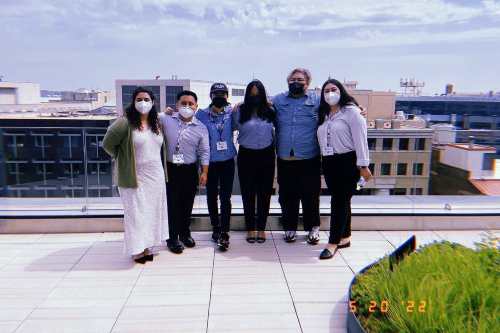
Katherine Gonzalez ’23 (left) with her colleagues in Washington DC for Advanced Computing for Social Change where she served as a mentor.

Students like Gonzalez walk away with a new appreciation of just how instrumental data can be in educating and informing communities—and helping to drive positive change. For SPICE, Gonzalez dove into data around missing children in Hawaii. She also tackled a project through the Chaminade Summer Research Institute that looked at health and wellness trends among foster children in the islands.

Almost immediately, she was hooked.

“People think coding is so hard, but it’s like everything. Once you learn it, it becomes more manageable,” she said, adding that she was honored in her sophomore year to continue her studies by participating in the Advanced Computing for Social Change Institute through Chaminade.

Like her other data science work, the program had a strong community service focus. And she said it prepared her for a new challenge in her junior year: to serve as a peer mentor for that initiative along with the Pacific Region Data Science Challenge, a competition with students from around the country. 

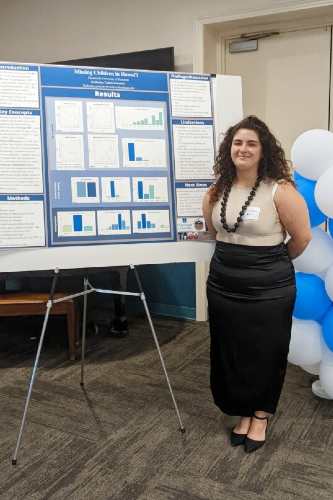
Katherine Gonzalez '23 with her poster

Gonzalez said helping other students built her confidence—and her passion for data science studies. “It’s just the best feeling to teach other people and help other people do things they never thought they could accomplish,” she said. “I realized that mentoring also helps you build your own skills.”

As a senior, Gonzalez is as busy as ever while looking forward to her next steps after graduation. In addition to participating in Campus Ministry, her Latinx Club and Chaminade’s Civic Engagement Club, Rodriguez is a peer mentor for a freshman orientation class and an assistant in the residence hall.

She also has an active internship with Dr. Janet Davidson, vice provost for Academic Affairs and Criminology and Criminal Justice professor, to provide data analysis on human trafficking. She said the work has given her a better understanding of what she wants to do after college.

First off, she said, she wants to attend graduate school to hone her coding skills.

And then she hopes to bring those skills to bear and drive positive change.

“I want to be able to help people,” Gonzalez said. “And this is a way that I can help in a big way.”

Posted by: University Communications & Marketing Filed Under: Behavioral Sciences, Homepage, Natural Sciences & Mathematics, Student Life, Students Tagged With: Criminology and Criminal Justice, Data Science

  • « Go to Previous Page
  • Page 1
  • Interim pages omitted …
  • Page 3
  • Page 4
  • Page 5
  • Page 6
  • Page 7
  • Interim pages omitted …
  • Page 12
  • Go to Next Page »

Footer

Chaminade University Logo

3140 Waialae Avenue
Honolulu, Hawaii 96816

Contact Us
Phone: (808) 735-4711
Toll-free: (800) 735-3733

facebook twitter instagram youtube linkedin

Visit

  • Plan Your Visit
  • Campus Map (PDF)
  • Events

Resources

  • Campus Security
  • Student Consumer Information
  • Concerns, Feedback, and Reporting
  • Institutional Review Board
  • Title IX / Nondiscrimination Policy
  • Compliance
  • Emergency Information
  • Careers
  • Institutional Statement

People

  • Students
  • Parents
  • Alumni
  • Faculty & Staff

Policy

  • Privacy Policy
  • Terms and Conditions of Use


© Chaminade University of Honolulu