• Skip to primary navigation
  • Skip to main content
  • Skip to footer
Chaminade University of Honolulu

Chaminade University of Honolulu

  • VISIT
  • APPLY
  • GIVE
  • STUDENTS
  • PARENTS
  • ALUMNI
  • FACULTY/STAFF
  • Admissions
    • Admissions Home
    • Undergraduate Students
      • First-Year Students
      • Transfer Students
      • Admitted Students
    • Graduate Students
    • Flex Online Undergraduate Program
    • Military Students
    • Non-Degree/Visiting Students
    • Experiential Honors Program
    • Early College Program
    • New Student Orientation
  • Tuition & Aid
    • Financial Aid Home
    • Tuition & Expenses
    • Federal Updates & Changes
    • Scholarships
    • $5,000 Graduate Scholarship
    • VA Education Benefits
    • Net Price Calculator
  • Academics
    • Academics Home
    • Academic Programs
    • Office of Student Success
      • Academic Advising
      • Records and Registrar
    • Kōkua ʻIke (Support Services)
      • ADA Accommodations
      • Career Services
      • Proctoring Services
      • Tutoring Services
    • Sullivan Family Library
    • Undergraduate Research & Pre-Professional Programs
    • Commencement
  • Campus Life
    • About Campus Life
    • Student Engagement
    • Student Government Association
    • Residence Life and Housing
      • Summer Conference Housing
    • Health Services
    • Marianist Leadership Center
    • Counseling Center
    • Campus Ministry
    • Campus Security
    • Dining Services
    • Bookstore
  • Athletics
  • About
    • Chaminade University News
    • Our Story
    • Leadership
    • Chaminade University Strategic Plan 2024-2030
    • Mission & Rector
    • Association of Marianist Universities
    • Facts & Rankings
    • CIFAL Honolulu
    • Accreditation & Memberships
    • Montessori Laboratory School
Search
×

Search this web site

Grants

Grant Expectations

October 5, 2023

Grant help via the Office of Sponsored Programs

Newly restructured and expanded, Chaminade’s Office of Sponsored Programs (OSP) will advance the university’s commitment through excellence in research administration, according to Claire Wright, Ph.D., who recently assumed the role of Senior Director with the Office of Sponsored Programs. It will also ensure that all grants are in compliance with federal, state and local regulations.  

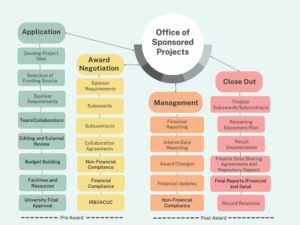
Office of Sponsored Projects timeline

The Office’s primary and most visible mission is to serve the University community in the successful pursuit of external funds to support research and campus programs. Wright will  collaborate with faculty through every step of the pre-award process to submit highly competitive proposals.  

“The office helps faculty members finance the research and projects that they want to do,” said Wright, who completed all of her undergraduate and graduate training in the U.K., and joined the Chaminade faculty in 2011. “This a change for me from teaching, but I want to help faculty members realize their dreams.”  

Although she’ll continue with her teaching duties with the School of Natural Sciences and Mathematics, Chrystie Naeole, Ph.D., now has the added responsibility of being the Director of  Office of Sponsored Projects.  

“As a federal grants specialist, I’ve undergone extensive federal training to be able to assist grantees with the development, interpretation of federal language, and submission of these grant applications,” Naeole said. “I will also help with the execution of grant subcontracts, sub-awards and the management of grant-maintained studentships.”  

Lynn Haff, Director of Proposal Development and Andrew Perez, Grants Financial Specialist; and Helen Turner, Ph.D., Senior Advisor on Sponsored Projects make up the remaining OSP team. A private funding specialist, Haff helps to identify and match grant seekers with potential funding sources of all kinds. She also helps to craft ideas for proposals, editing and drafting of proposal narratives, and the gathering of additional materials for submission, including bio sketches and letters of support. If the proposal submission is from a private source, Haff will also help with the submission process and the reporting requirements during the award period.  

Office of Sponsored Programs support

Perez is a staff member of the Business Office with an abundance of experience in grants financial management for both private and federal grants. He helps grantees generate grant budgets for application submission, and assists with the management of all financial reporting and compliance issues.  

“I was hired by Chaminade to fill this specific role more than nine years ago,” Perez says. “There are lot of moving parts to a grant, and our role is to make sure that nothing is overlooked and that all the details are complete.”

Recruited by Chaminade because of her past successes in winning grants with the National Institutes of Health (NICHD) and local foundations, and her progressive translational research, Wright takes on this new role as the university develops its 2024-2029 Strategic Plan.  

“Grants can help determine what the vision is for the school,” Wright said. “I’m here to help them write their grants, whatever that grant may be. And it’s not just for academic research; it could be for a study abroad program, student scholarships, community outreach or service learning. I’ll help them work through the process and their announcements, as well as with their reporting of outcomes.”  

Driven by an idea, a product, a concept or a cause, faculty members conducting research or off-campus activity are often dedicated to their project, but they might lack the experience or access to funding sources needed to effectively carry out that project. In most cases, faculty research projects require outside funding that often comes from federal and state agencies, foundation grants or fellowship programs.  

“And that’s where many universities’ Offices of Sponsored Programs play a critical role,” Wright said. “The office is the support system for faculty members who are trying to get a grant for their work in their respective disciplines.”    

Posted by: University Communications & Marketing Filed Under: Campus and Community, Faculty, Featured Story, Innovation, Institutional Tagged With: Grants, Honors and Awards

Making Dollars & Cents

August 4, 2023

Demystifying Financial Literacy

Chaminade president Dr. Lynn Babington is flanked by, from left, Andrew Rosen, president and CEO of Hawaii State FCU, Greg Young, president and CEO of HawaiiUSA, Dr. Annette Santos, interim dean, School of Business and Communication, and Dr. Guanlin Gao, director of Chamiande’s Economic Education Center for Excellence and associate professor.

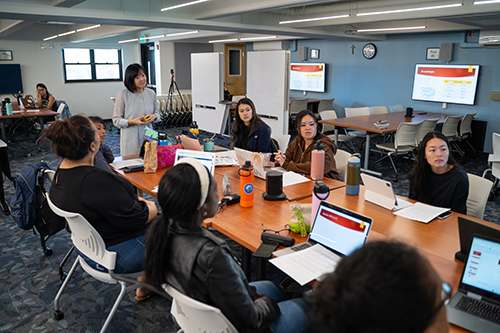
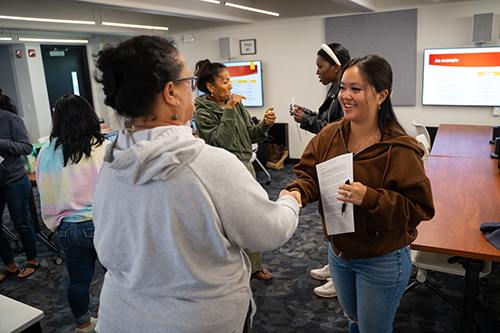
For a couple of hours on a Tuesday morning, Hale Hoaloha’s R301 became a trading floor, with buyers and sellers brokering deals during a stock market simulation game. Waving a card in the air—like a trader would do on a Stock Exchange—Waipahu High School Career and Technical Education (CTE) teacher Russell Park walked around the room, booming, “Who’s selling? I’m buying!” The exercise was all part of the Economics and Personal Finance Literacy Summer Institute, led by Dr. Guanlin Gao, Director of Chamiande’s Economic Education Center for Excellence and an Associate Professor of Economics with the School of Business and Communication.

“No takers,” said Park, after the first round. “What I’ve learned so far I wish I had known years ago. I have also realized the importance of sharing this information with kids—to prepare them for the real world.”

According to Gao, this summer institute offers students essential knowledge and skills on how to allocate limited resources they have in life, such as time and money, in the most efficient way to satisfy their wants and needs. It also prepares them to better understand and respond to the events that shape their economic environment and financial well-being.

“We’re all natural-born economists,” said Gao, while looking around the classroom. “You might not just realize it … for now.”

Initially intimidated by graphs and charts, DJ Woodard of Waianae High School, grew comfortable with the classes after the first day. On the trading floor, she used her savvy and some recently-learned buzz terms to clinch a deal and made a profit.   

Dr. Gao's Economics and Personal Finance Literacy Summer Institute curriculum included such topics as market operations and government interventions, environmental economics, personal finance education and financial wellness.
Dr. Gao’s Economics and Personal Finance Literacy Summer Institute curriculum included such topics as market operations and government interventions, environmental economics, personal finance education and financial wellness.

“This shows us how to give our students a financial foundation,” says Woodard, a transition coordinator. “It gives them exposure to financial literacy, such as budgeting and saving.”

According to Gao, this institute is taught in a combination of lectures (with an emphasis on real-life examples and situations), in-class games and group activities, hands-on projects and field classes. The curriculum includes the economics and personal finance concepts based on the Hawaii Department of Education (HDOE) Social Studies Common Core standards, including such topics as market operations and government interventions, environmental economics, personal finance education and financial wellness. 

“I wish this was available when I was young,” Woodard lamented. “I would have had a better financial foundation. But I guess at 60 years old, it’s never too late.”

Through the training, participating teachers received access to teaching resources, including ready-to-adopt lesson plans—which Woodard said she plans to use—and one-on-one assistance in adopting and adapting lesson plans for specific grade levels.

A 10th grade health teacher at Farrington High School, Jan Halpenny was part of the first cohort from last year’s institute. So, too, was Kalelani Ogata, a special needs teacher at Abraham Lincoln Elementary School.

“Students are so ill-prepared financially,” said Halpenny, who attended this year’s luncheon finale. “They don’t even understand the most basic of finances, such as supply and demand.”

Hale Hoaloha’s R301 became a trading floor, with buyers and sellers brokering deals during a stock market simulation game.

For her part, Ogata set up a class store, where the only accepted currency is good behavior. “These are special need 3- to 5-year-old kids,” she said. “They learn to count, and they quickly learn that needs and wants aren’t the same thing. The kids go home excited to talk about what they learned.”

The Nation’s Report Card on Financial Literary gave Hawaii a D grade, but cited some significant accomplishments, including the establishment and maintenance of a financial literacy website by the HDOE. Available is the HDOE Standards with Opportunities to Integrate Financial Literacy Concepts with financial literacy concepts matched to multiple English Language Arts, Mathematics, CTE, Social Studies and Science standards for K-12. The website also provides robust financial literacy resources and programs for teachers to help implement financial literacy instruction in their classrooms. In 2021, Hawaii’s legislature passed a resolution “urging the Department of Education to coordinate with the Department of Commerce and Consumer Affairs to implement a graduation requirement of at least a half credit in financial literacy during the junior or senior year.”

However, according to the report, although Hawaii has made efforts toward increasing its financial literacy instruction, mainly through establishing the Hawaii Public Schools Financial Literacy Task Force, it still receives a “D,” as it does not provide any substantial financial literacy instruction.

“We know we have work to do when it comes to financial literacy in Hawaii, but we are proud to be making a difference and serving as a hub for economics education,” Gao said. “Financial literacy doesn’t have to be hard and unreachable. In fact, financial literacy should be accessible to everyone.”

Posted by: University Communications & Marketing Filed Under: Business & Communication, Campus and Community, Homepage, Institutional Tagged With: Campus Event, Grants, Guest Speakers

NOAA B-WET Grant

July 25, 2023

Managing Hawaii’s Watersheds

The first field site to Paiko Lagoon provided a chicken-skin moment when a longtime resident of the area, Kai Hoshijo, a volunteer crew member with the Polynesian Voyaging Society and the Maunalua Fishpond Heritage Center, reminisced about the stories of her youthful days spent at the Wildlife Sanctuary in East Oahu, evoking a navigator mindset of observance and respect for the ‘aina (land).

“Kai grew up in Niu Valley and was telling a story in context of the sanctuary’s meaningful location,” recalls Katrina Roseler, Ph.D., shuddering while she remembered that exact moment. “It was the perfect start to our two-week workshop, demonstrating the reverence of place.”

Thanks to a grant from the National Oceanic and Atmospheric Administration (NOAA), Roseler and Environmental Sciences assistant professor, Lupita Ruiz-Jones, Ph.D., were able “to enhance the capacity of Hawaii’s secondary science teachers to engage their students in ahupua’a education and cultivate stewardship.” Ahupua’a is a Hawaiian term for a large traditional socioeconomic, geologic and climatic subdivision of land, which consists most frequently of a slice of an island that went from the top of the local mountain (volcano) to the shore, often following the boundary of a stream drainage.

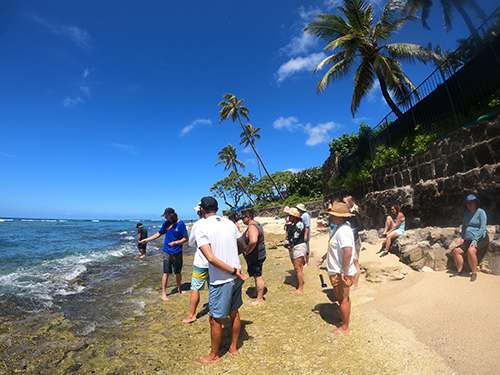
Cultural Engagement Specialist, Kahoalii Keahi-Wood points out limu near the shoreline of Diamond Head.

The summer workshops align with NOAA’s Bay Watershed Education (B-WET) initiative, an environmental education program that promotes place-based experiential learning for K–12 students and related professional development for teachers.

“We had our own play on acronyms with B-WET,” says Roseler, the grant’s Co-Principal Investigator. “We appropriately named our program M2M:WET, which stands for Mauka to Makai: Watershed Experience for Teachers.”

Much like B-WET, M2M:WET aims to foster the growth of new, innovative programs, and encourages capacity-building and environmental education partnerships.

During the field experience, teachers explored two primary questions: 1) How do we determine the health of our watersheds (ahupua‘a); and 2) How can educators engage students in thinking critically about the flow of water and cultivate a sense of stewardship for Hawaii’s watersheds?”

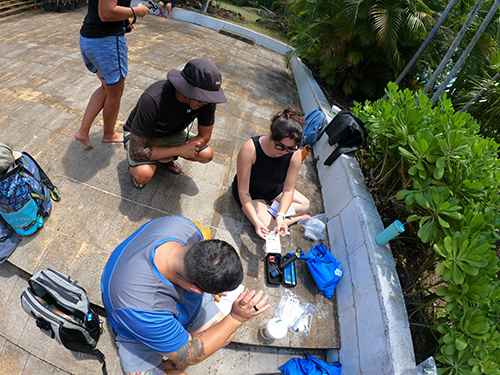
“My observation of the participating teachers was that they were super excited and nerdy in a positive science way,” says Ruiz-Jones, the grant’s other Co-Principal Investigator. “They were like kids on field trips, and eager to use some of the equipment we provided, like the GoPro, water test kits and water loggers, which is an instrument that automatically and continuously records fluctuations in water level.”

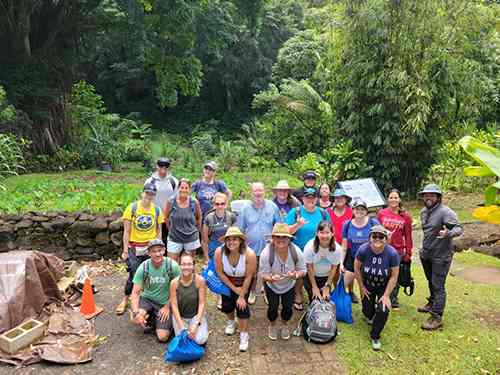
Participants visited Lyon Arboretum for one of their many workshops.
Participants visited Lyon Arboretum for one of their many field trips.

The outcome of the workshops helped inform teachers how to bring their field experiences into the classroom and their curriculum. They gained skills in environmental data collection, lab protocols, data analyses and data visualization. Water samples were gathered at the various sites and analyzed for nitrogen compounds, sulfate, phosphate and silica, using an automated spectrophotometry, as well as SEAL AQ400 chemistry and equipment. And they also collected water temperature data with the HOBO Tidbit temperature logger and learned how to use readily available water test kits.

Among the 16 K-12 teachers, Christina Chan of Highlands Intermediate School says she decided to participate in the program because she focuses on watersheds, which is one of her primary foci for her CTE (Career and Technical Education) class next year.

Chan adds that she learned about the use of five different field sites for studying the watershed; how to use a HOBO, GoPro and other devices for sampling water in the watershed; different pedagogy and Understanding by Design models; and making connections with other teachers and ideas on how to share watershed information.

Hanalani Schools’ Jessica Mountz opted in because she wanted to connect with other science teachers on Oahu and the Neighbor Islands, reasoning that in her 20 years of teaching, she found that collaboration with other teachers has been the most valuable tool in her professional growth.

Participants learned how to collect data during the M2M:Mauka to Makai workshops.
Participants learned how to collect data during the workshops.

“At the end of each day, I went home with so many lesson ideas my head was sometimes spinning,” says the high school science teacher. “From Wayfinding/ Navigation to Ahupuaʻa of Hawai’i, I plan on developing curriculum for my Biology and Advanced Placement Biology students that not only meets Science Standards (Next Generation Science Standards and College Board), but incorporates Hawaiian culture and empathy.  I look forward to continuing conversations and collaboration, not only with the other science teachers from the M2M:WET workshop, but with the faculty/staff at Chaminade University, Huli, and Maunalua Fishpond Heritage Center.”

Since its inception in 2002, 929 B-WET grants have been awarded for a total of $117 million.  The B-WET program currently serves seven regions of the country: California, Chesapeake Bay, Great Lakes, Gulf of Mexico, Hawaii, New England and the Pacific Northwest. Regional B-WET programs provide tailored grantee support and capacity building. This allows B-WET to include place-based STEM resources and expertise, and respond to local education and environmental priorities.

“The goal is to provide support for our K-12 science teachers so they can teach their students to become the future stewards of the land,” says Ruiz-Jones, with Roseler adding that they “hope to engage the students to appreciate the mauka to makai value of their ahupua‘a.”

Posted by: University Communications & Marketing Filed Under: Campus and Community, CIFAL Honolulu, Education, Homepage, Institutional, Natural Sciences & Mathematics Tagged With: CIFAL Center, Elementary Education, Environmental Studies, Grants

Scholars at Sea

June 5, 2023

Students immerse themselves in culture and history

Seven days. Seven ports. And a lot of history, foreign cultures and sites to absorb in between. These were the main takeaways that Chaminade students, Remo Merlo, Hannah Dyer, Nicole Vontsolos and Kevin Dean, gleaned from their short-term study abroad program this past spring.

Organized by Kelly Treece, Ph.D., Director and Associate Professor of Criminology and Criminal Justice, and Lynn Haff, Director of Grants Development, the scholar-at-sea-like program offered students a glimpse into European, Islamic, Muslim, Jewish, Middle Eastern and Western Asian cultures. The seven-day itinerary aboard the Norwegian Jade embarked from Athens, Greece, and circled the Aegean, Marmara and Mediterranean seas, with Ports of Call in Kusadasi, Turkey; Patmos, Greece; Jerusalem (Ashdod) and Tel-Aviv (Haifa), Israel; and Limassol, Cyprus.

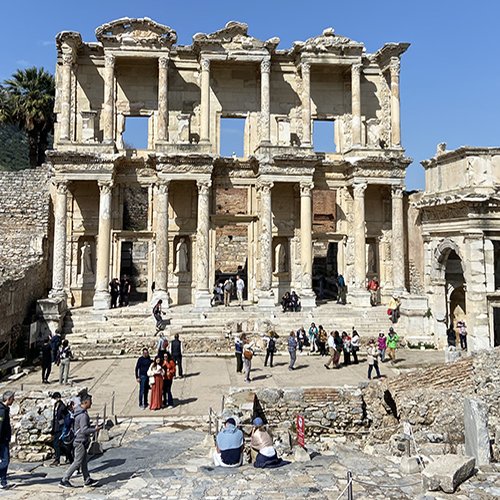
The ruins of Ephesus is 11 miles away from Kusadasi, Turkey, and it is one of the best preserved ancient cities of the world.

“We received a $13,000 Sidney Stern Memorial Trust grant, and we were all set to go in 2020 to Italy, Switzerland and Germany,” Treece says. “And then COVID happened.”

As travel restrictions began to relax in 2022, Treece charted a new course. This time would be different—in location and mode of travel. Also, rather than take a large cohort of students, who would have to pay their own way, Treece would use grant money to cover 90 percent of the program’s cost for four students: two females and two males.

“Coming out of COVID, we knew the students couldn’t afford to pay because they were still recovering from the economic impact of the pandemic,” Treece asserts. “We had limited funds, but we knew we could support four students.”

To qualify, each student was required to hold a current passport, to be in good academic standing and to write an essay explaining why he or she wanted to participate in this short-term study abroad, and how it would propel their future. The answers varied among the freshman, sophomore and two senior students. What was consistent, however, is that they all believed in the educational benefits of visiting different countries and gaining the exposure to foreign cultures.

“When Dr. Treece called and asked if I was still interested in going to Europe, I screamed, ‘Are you kidding me?’” recalls, Hannah Dyer, who was initially denied because she was a sophomore and preference was given to seniors. “It was my first time outside of the Americas so I was excited to see Europe and, technically, Western Asia because of Turkey.”

In preparation for the voyage, each student was assigned a country and tasked to create a travel brochure of sorts, providing details about the respective nation’s history, culture, socio-economic policies, political stability and religion.

“I learned more in the two weeks visiting each country than I would have learned in researching each one,” says freshman Remo Merlo. “They (Europeans) have such a different way of living, and we noticed this right away when we arrived in Athens.”

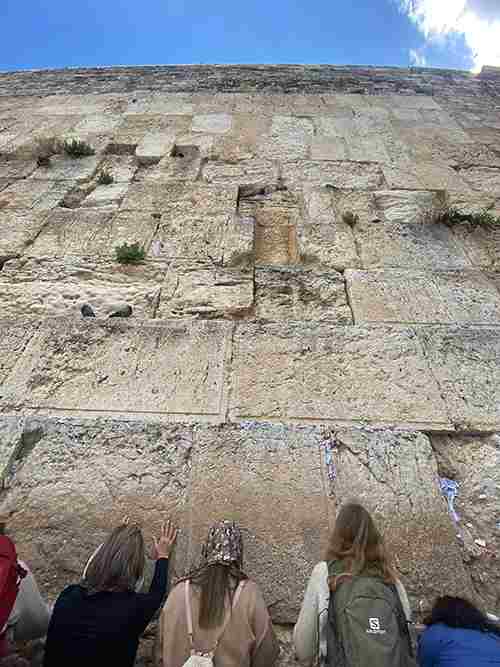
The Western Wall, also known as the “Wailing Wall” or the “Kotel,” is the most religious site in the world for the Jewish people.

Treece acknowledged her overall goal was cultural immersion for the students, allowing them to explore and develop their sense of curiosity and problem-solving skills. “I’ve chaperoned previous trips to London, England, when I was at another university, but those groups were much larger,” says the one-time police sergeant. “We brought together four complete strangers, and they formed a really tight-knit bond, each relying on the other for safety and awareness.”

And at no time was this more evident when they were in Israel. As peaceful protests choked the streets in Tel Aviv, Treece and Haff were stuck on a bus for several hours after returning from an excursion to Jerusalem. Meanwhile, Dyer and Vontsolos, who were on the same daytrip, had boarded an earlier bus, and only later learned of their chaperones’ predicament once they returned to the ship. 

“We were all texting them to see if they were OK,” Merlo says. “Dr. Treece reassured us they were fine, and everything was peaceful, which was another difference between what we saw in Tel Aviv and what we’ve seen in the U.S.”

Merlo and Dyer have already said they would definitely participate in a similar program should the opportunity again arise. “After college, I plan to move to Europe or Canada,” Merlo says. “And this trip even motivates me more to finish college early, and explore the next chapter of my life.”

Dyer returned to Hawaii on a traveling high, eager to take to the skies once again and return to Israel. “I wish I could have done more,” she says. “Visiting the different religious sights and learning about all the history was an immersive experience. 

“There were no emails and texts to respond to nor phones to answer,” Dyer adds. “We just all hung out and talked about what we were seeing and what we were experiencing. It was great just to hang out and unplug.”

Posted by: University Communications & Marketing Filed Under: Diversity and Inclusion, Institutional, Students Tagged With: Grants, Marianist, Study Abroad

Chaminade University Receives $50,000 Grant from the McInerny Foundation

September 27, 2022

Chaminade University of Honolulu recently received a $50,000 grant from the McInerny Foundation to support the school’s Economic Education Center for Excellence. The grant will fund financial literacy programs at the center for the 2022-2023 school year.

The Chaminade Economic Education Center for Excellence (EECE) promotes economic empowerment for families and communities in Hawaii and the US-affiliated Pacific through accessible and sustained economic and personal financial literacy training that is culturally responsive. The research projects improve understanding of barriers to economic empowerment which shed light on policies and practical interventions to overcome these barriers in Hawaii and beyond. 

The McInerny Foundation grant aims to serve approximately 30 public school teachers with professional development workshops in how to incorporate financial literacy into the K-12 classroom, and 20 high school students with age appropriate coursework in economics and personal finance. Chaminade students also benefit from the programs as EECE workshop teaching assistants.

# # #

Chaminade University of Honolulu believes in the power of education to drive positive change, broaden perspectives and deepen our understanding of one another. With an emphasis on transformative service-learning experiences, we prepare students to serve as tomorrow’s leaders, inspiring and challenging them to use their minds and their hearts to help build stronger and more just communities. We are proud to serve as Hawai‘i’s only Marianist university, and rely on these values to guide us in delivering a high-quality education with an individualized approach and a focus on excellence, innovation and change. Established in 1955, we offer more than 30 undergraduate and graduate programs, including doctoral degrees in education, psychology and nursing practice. Learn more at chaminade.edu.

Posted by: University Communications & Marketing Filed Under: Business & Communication, Featured Story, Press Release Tagged With: Economic Education Center for Excellence, Grants

Bringing Filipino Language and Culture Back to Hawaii

September 21, 2022

Cebuano Language and Culture Program

It was a trip of a lifetime for a group of Hawaii educators and teachers-in-training.

And Communication Professor Eva Washburn-Repollo, Ph.D. was overjoyed to be their guide.

Over the summer, Washburn-Repollo led participants of her Cebuano Language and Culture Program on a six-week adventure to the Philippines, offering them an immersive experience designed to broaden their perspectives and understanding of the country’s diverse languages and rich cultures.

The teachers visited indigenous herbal gardens, mangroves and coral reefs, attended language workshops, and participated in educational sessions at local universities and other institutions. But they weren’t just there to learn. Along the way, they developed cultural-based resource materials and curricula for their own classrooms—lessons aimed at weaving in their students’ perspectives.

Roughly a quarter of Hawaii public school students identify as Filipino.

“We all need to lift each other up,” said Washburn-Repollo, whose academic scholarship includes a focus on the positive impacts for students of cultural appreciation in classrooms. “When a student has a teacher who values their culture, they feel as if they can be anything they want to be.”

The trip was made possible thanks to a $100,000 grant from the Fulbright-Hays Group Projects Abroad (GPA) Program. Washburn-Repollo took the group of eight participants to the islands of Negros Oriental and Cebu in the central Visayas region of the Philippines. That’s where the Cebuano language is primarily spoken—Washburn-Repollo’s first language and one of more than 120 found in the Philippines.

Those on the trip included current educators with years of experience and those just starting out.

Brittni Friedlander began her third year of teaching this fall and jumped at the chance to make the journey to the Philippines. She said she’s passionate about weaving science and technology education into her classroom and recently wrote a children’s book called Puff Saves Paradise.

Cebuano Language and Culture Program

“About 70% percent of my classroom last year were students of Filipino descent and I’m also half-Filipino,” Friedlander said. “It was an amazing opportunity to not only truly connect with my students, but learn a bit about my cultural heritage as well and incorporate that into my classroom genuinely.”

She said the most memorable part of the trip was the closing ceremony, during which all the participants got the chance to share their final lesson plans. Friedlander also enjoyed learning about the customs of the region, from the delicious cuisine to the herbal remedies communities use.

“As a teacher, I think it’s so very important to connect with one’s students on a relational level,” Friedlander said. “From here, I would like to use the knowledge garnered during this journey and share it in my classroom with cultural units or ‘around the world’ day with my students.”

Participant Clarissa Torres just finished her Master of Arts in Teaching degree at Chaminade and was quickly hired to teach eighth-grade science at Mililani Middle School. She wanted to make the trek to the Philippines so she could make more (and stronger) connections with her students. “I also wanted to learn more about my own Filipino culture and wanted to gain new perspectives as an educator,” Torres said.

She added that the program wasn’t easy—by any stretch.

Torres struggled with getting out of her comfort zone and developing a lesson plan.

“I created an original Cebuano song about the collectivism of the community in Apo Island as well as how they conserve water,” Torres said. “This experience expanded my ideas on how to incorporate all of my students’ cultures in my classroom and music is one thing I would like to weave in.”

She said by learning just a few simple phrases in Cebuano, she was already making relationships with people she met. “They appreciated our efforts to learn the language,” Torres said. “My biggest takeaway was I have a greater understanding of the beauty of learning a new language.”

Cebuano Language and Culture Program

Washburn-Repollo agreed what moved her the most about the people that the group met on their adventure is just how excited they were to share their time—and wisdom. “Everyone we met wanted to share their language with us,” she said. “Every preserved language is a door to a new solution to diseases, it’s a door to alternatives to happiness and peace. We have so much to learn.”

This wasn’t the first group Washburn-Repollo has taken to the Philippines. It’s actually the fourth, though the previous treks weren’t funded by Fulbright. The professor has also accompanied nursing students for a clinical immersion and organized trips focused on community building and finance.

Her central focus is helping people realize that broadening their own perspective and learning from groups who have no voice on the world stage has the power to unearth rich gifts of knowledge. And in classrooms, she said, it can do a wonderful thing: to ensure students from all backgrounds feel welcome.

“The key is making all students feel valued,” she said.

Participant Kalika Ayin couldn’t agree more. She’s an English Learner teacher at Pearl City High School and applied to the Cebuano Language and Culture Program because she wanted to learn more about her own students. “Many of my students are from the Philippines … so I wanted to learn about Filipino culture so I could improve my teaching and my communication with their families,” Ayin said.

She added that she was particularly interested in the program’s language immersion component “because I knew it would help me understand what my students experience when they move to Hawaii. I also wanted to learn enough of their language to make them feel welcome and seen in my classroom.”

The most memorable part of the trip for Ayin was graciously being invited into her Filipino teacher partner’s home and meeting her family. “She bridged me into her culture and helped me practice the Cebuano language,” Ayin said, reflecting on the trip. “Her hospitality and patience deeply impacted me. Our partnership fostered an international teaching network—and an international friendship.”

She also said that the experience of learning a new language through immersion helped her see the world a little better through her students’ eyes. For example, when she was using the Cebuano language in conversation but couldn’t find the right word right away, her stress levels rose. “It helped me understand how my students likely feel immersed in U.S. classroom settings,” she said.

Cebuano Language and Culture Program

And Ayin is looking forward to one lesson, in particular, this coming school year.

She plans to show her students a video she co-wrote and produced with her Filipino teacher partner detailing how to make the Cebuano dessert binignit, a fruit stew made with coconut milk, sweet potato, bananas and other fruits and vegetables at hand. “The video includes a narrative about the rich symbolism between the ingredients in binignit and the Cebuano culture,” she said.

Ayin said she’ll use the video to launch into a unit of study exploring food staples across the Pacific.

And then her students will get to work in the kitchen (and classroom), producing a cookbook to share broadly with families in Pearl City that incorporates Pacific dishes. “My goal is to foster pride in multilingualism,” she said, “and help students own their languages with confidence.”

LeAndre Browne, a doctoral student in education at Chaminade who teaches first grade in Georgia, wishes every teacher could go on a trip like the one Washburn-Repollo organized. “I’m a lifelong learner and was extremely interested in learning another language and experiencing another culture,” she said.

“Despite being from different places, people can share similar interests bringing them closer, like a love of plants,” she said, adding that she is particularly grateful for all of the relationships she was able to forge with people the group learned from over the course of six weeks.

Jessica Watkins doesn’t have a classroom of her own yet but said she can’t wait to bring what she learned in the Philippines to her future lesson plans. Watkins is majoring in Elementary Education at Chaminade and said there were so many memorable moments on the trip, that it’s hard to pick a favorite.

Learning Cebuano songs and then singing them at their final presentation. Staying on Apo Island, which has no cars and limited hours of electricity service. Getting to enjoy the region’s stunning coastlines. “I now know enough of the language to have basic communication with someone,” Watkins added.

“And that could help my students feel more comfortable in my future classroom.”

Posted by: University Communications & Marketing Filed Under: Campus and Community, Diversity and Inclusion, Education, Faculty, Featured Story, Students Tagged With: Grants

  • « Go to Previous Page
  • Page 1
  • Page 2
  • Page 3
  • Page 4
  • Page 5
  • Go to Next Page »

Footer

Chaminade University Logo

3140 Waialae Avenue
Honolulu, Hawaii 96816

Contact Us
Phone: (808) 735-4711
Toll-free: (800) 735-3733

facebook twitter instagram youtube linkedin

Visit

  • Plan Your Visit
  • Campus Map (PDF)
  • Events

Resources

  • Campus Security
  • Student Consumer Information
  • Concerns, Feedback, and Reporting
  • Institutional Review Board
  • Title IX / Nondiscrimination Policy
  • Compliance
  • Emergency Information
  • Careers
  • Institutional Statement

People

  • Students
  • Parents
  • Alumni
  • Faculty & Staff

Policy

  • Privacy Policy
  • Terms and Conditions of Use


© Chaminade University of Honolulu