• Skip to primary navigation
  • Skip to main content
  • Skip to footer
Chaminade University of Honolulu

Chaminade University of Honolulu

  • VISIT
  • APPLY
  • GIVE
  • STUDENTS
  • PARENTS
  • ALUMNI
  • FACULTY/STAFF
  • Admissions
    • Admissions Home
    • Undergraduate Students
      • First-Year Students
      • Transfer Students
      • Admitted Students
    • Graduate Students
    • Flex Online Undergraduate Program
    • Military Students
    • Non-Degree/Visiting Students
    • Experiential Honors Program
    • Early College Program
    • New Student Orientation
  • Tuition & Aid
    • Financial Aid Home
    • Tuition & Expenses
    • Federal Updates & Changes
    • Scholarships
    • $5,000 Graduate Scholarship
    • VA Education Benefits
    • Net Price Calculator
  • Academics
    • Academics Home
    • Academic Programs
    • Office of Student Success
      • Academic Advising
      • Records and Registrar
    • Kōkua ʻIke (Support Services)
      • ADA Accommodations
      • Career Services
      • Proctoring Services
      • Tutoring Services
    • Sullivan Family Library
    • Undergraduate Research & Pre-Professional Programs
    • Commencement
  • Campus Life
    • About Campus Life
    • Student Engagement
    • Student Government Association
    • Residence Life and Housing
      • Summer Conference Housing
    • Health Services
    • Marianist Leadership Center
    • Counseling Center
    • Campus Ministry
    • Campus Security
    • Dining Services
    • Bookstore
  • Athletics
  • About
    • Chaminade University News
    • Our Story
    • Leadership
    • Chaminade University Strategic Plan 2024-2030
    • Mission & Rector
    • Association of Marianist Universities
    • Facts & Rankings
    • CIFAL Honolulu
    • Accreditation & Memberships
    • Montessori Laboratory School
Search
×

Search this web site

Students

Student Research on Display

July 29, 2024

The Summer Research Institute Symposium was an opportunity for undergraduate scientists-in-training to get feedback on their work.
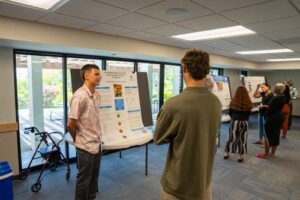
In his final presentation during the Summer Research Institute Symposium, Zach McClellan ’25 decided to pursue the correlation between the effects of occupational stressors on the quality of life among firefighters.
Zach McClellan ’25 presented his findings during the Summer Research Institute Symposium.

Zach McClellan ’25 comes from a long line of firefighters—and has seen first-hand the trauma these first responders can experience.

So as a participant in this year’s Summer Research Institute at Chaminade, the Psychology major decided to study how occupational stressors correlate to quality of life indicators for firefighters.

He presented his findings July 23 at the Summer Research Institute Symposium on campus, an annual showcase of cutting-edge undergraduate research at Chaminade conducted under the mentorship of professors.

“I sent out my first survey that comprised of demographics, the Firefighter Assessment of Stress Test (FAST), and the Quality of Life Enjoyment and Satisfaction Questionnaire Short Form (Q-LES-Q-SF) back in March,” said McClellan, pointing out the number of respondents shown on his poster board.

“This was my capstone project with Dr. (Darren) Iwamoto, and I want to take it as far as I can take it. The end goal is to get the study published.”

Organizers say the symposium reflects Chaminade’s strong commitment to advancing academic excellence while fostering close collaborations between faculty and student researchers.

A two-time participant in the Summer Research Institute Symposium, Grace Helmke ’25 built on last year’s “Climate Monstrosities” with this year’s “Climate Tricksters in an Indigenous Future.”

Mentored by Assistant Professor of English Dr. Justin Wyble, Helmke said she chose the subject for a couple of reasons. “The no. 1 reason was that I believe Indigenous peoples to have an incredibly important perspective on society—one that’s largely dismissed and unseen by the masses,” the English major said.

“Their viewpoints surrounding the ways in which to combat colonialism, preserve culture and fight for a greater future, are all concepts that each of the texts I focused on examined. I believe that discussing these concepts, principles and cultural beliefs, from an Indigenous perspective, has the potential to lead society into a future that rejects the colonial systems, and instead seeks equity and healing of the people.”

Amber Noguchi, program director for Chaminade’s Undergraduate Research and Pre-Professional Programs Office, said the symposium allows Summer Research Institute participants to not only showcase their work—but get feedback and questions from attendees to expand their research inquiries.

The institute is funded by a joint federal Title III grant with Kapiolani Community College.
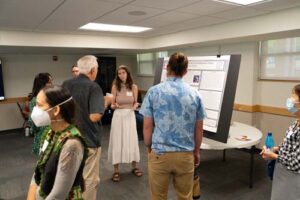
A two-time participant in the Summer Research Institute Symposium, Grace Helmke ’25 built on last year’s “Climate Monstrosities” with this year’s “Climate Tricksters in an Indigenous Future.”
Grace Helmke ’25 explained her theories to a group of attendees.

“We just completed our fourth SRI,” Noguchi said, adding that participants also present at Kapiolani Community College’s Student Undergraduate Research Fair each semester.

Participant Georgeanna Flook is a rising senior and double majoring in Historical and Political Studies, and Criminology and Criminal Justice. Her research looked at the influence that education has on crime. Titled “Support Instead of Control: Education as a Unique Approach to Crime,” Flook’s study explored the possibility of reducing crime outside of traditional policing methods.

She credited her professors, Drs. Abby Halston and Kelly Treece, and lecturer Collin Lau, J.D., for their guidance as she conducted her research. Flook said she found that education, “acting as a means of formal social control and providing social support, can effectively reduce crime—regardless of the academic ability of the individual.”

“Future studies should focus on further articulating what effective social support means in the context of criminology and use working examples of social support to compare against crime trends,” concluded Flook, who aspires to go into criminal justice policy analysis.

Other Summer Research Institute participants at Chaminade this year included Ku‘ulei Koko ’26, who presented “Feeding Hawaii’s Future: Evaluating the Effectiveness of Culturally Tailored Programs for Native Hawaiians,” and LaVelle White ’26, who looked at “Student Food and Nutrition Security.”

For details on undergraduate research opportunities at Chaminade, click here.
Posted by: University Communications & Marketing Filed Under: Diversity and Inclusion, Featured Story, Innovation, Students, Undergraduate Research & Pre-Professional Programs Tagged With: Campus Event, Grants, Undergraduate Research & Pre-Professional Program

Co-Curricular Awards 2024

April 29, 2024

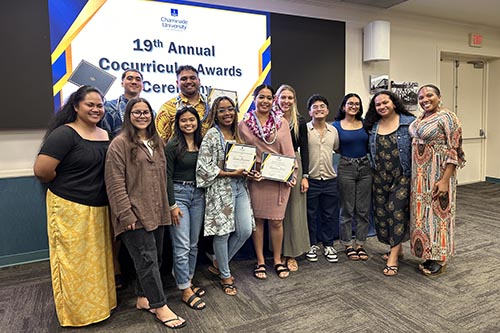
For the past 19 years, the Co-Curricular Awards have celebrated outstanding members of Chaminade University’s student body, clubs and organizations. These accolades honor individuals whose exceptional contributions exceed expectations, enriching both campus life and the wider community. Their dedication reflects the University’s commitment to public service and embodies its mission of making a positive impact on society.

“We had a total of 50 students who were nominated for the various awards,” says Allison Jerome, Vice President for Student Affairs and Dean of Students. “We also had our first graduate student award since we opened the awards this year to all students and not just undergraduates.”

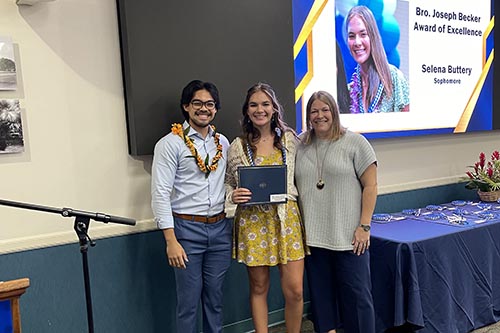
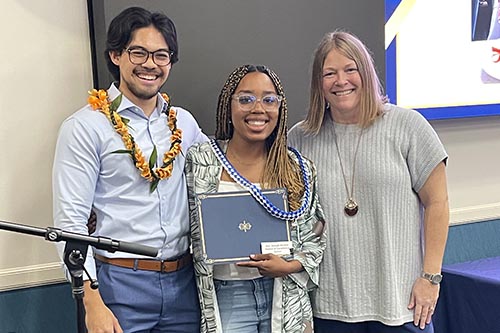
One member of each undergraduate class was selected to receive the Bro. Joseph Becker Award of Excellence, which recognizes those who display exceptional leadership skills through involvement in co-curricular activities. The awardees, with a diversity of scholarly ambitions, were: sophomore Selena Buttery ’26, junior Tyanna Hemmings ’25 and senior Pam Oda ’24.

Co-curricular activities, also known as out-of-class activities, are any events that you participate in outside of your regular academic coursework. They can be anything from sports and clubs to volunteering and part-time work.

“As an institution, it is our goal to educate students to be whole-rounded individuals who intentionally contribute to society through action-oriented critical thinking,” says Andrew Ancheta, Chaminade’s Student Engagement Coordinator. “To emphasize the importance of being involved in co-curricular activities on campus, the Co-curricular Awards are meant to celebrate the dedication our students have to contributing to our community. It’s important for us to show them our gratitude and appreciation for it.”

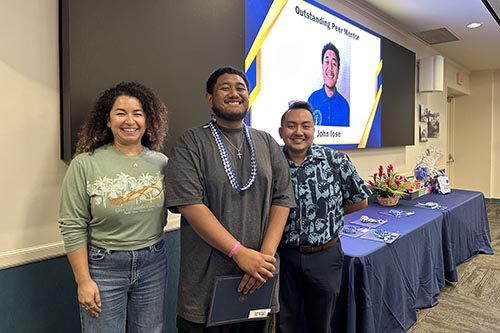
Student leader John Iose was honored with the Outstanding Peer Mentor Award, which recognizes upper-class students who work tirelessly as peer mentors to ensure that first-year students feel supported as new members of the Chaminade ‘ohana. Peer mentors commit significant hours of their time as co-teachers of CUH 100 First-Year Experience Seminar, and prepare for the position with training and class preparation.

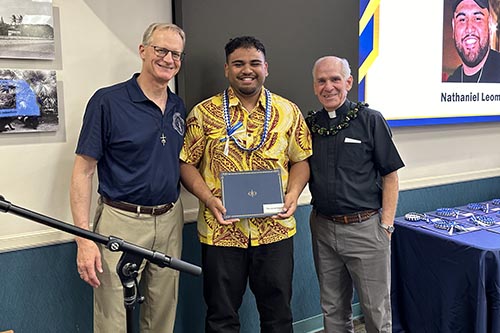
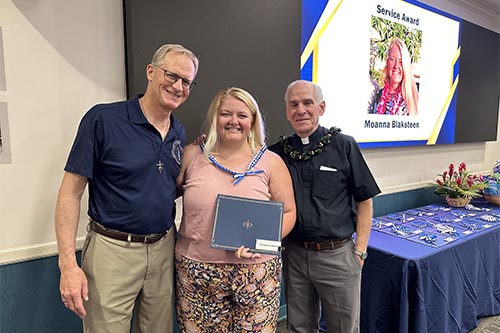
The Liturgy Award is given to an individual who has willingly volunteered his or her time and talent to contribute to the quality and spirituality of Campus Ministry’s weekend, and special liturgies and prayer experiences. This year’s honoree is Nathaniel Leomiti ’25. Meanwhile, Easton DelaCruz ’26 was awarded the Campus Ministry Award, and Isaiah Atalig ’24 was honored with two awards: the Frederik K.K. Kauhane Senior Aloha Spirit Award and Retreat Leader of the Year. Moanna Blaksteen ’24 took home The Service Award.

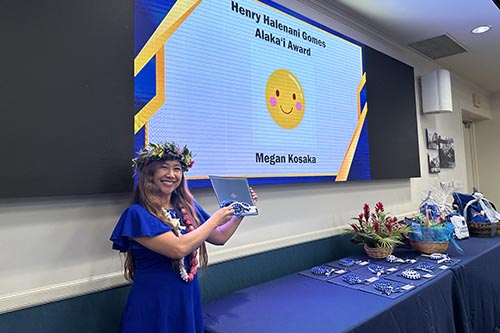
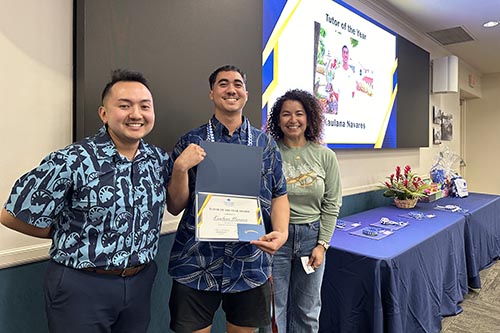
This year’s Tutor of the Year is Kaulana Navares, while two Silverswords were acknowledged as Outstanding Orientation Leaders—Caitlin Bocobo ’24 and Josh Dumas ’24. Epifania Petelo ’24 was recognized with the Resident Assistant Award of Excellence. Graduate student Megan Kosaka won the Henry Halenani Gomes Alaka‘i Award.

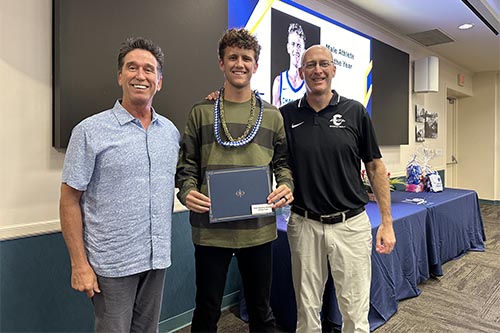
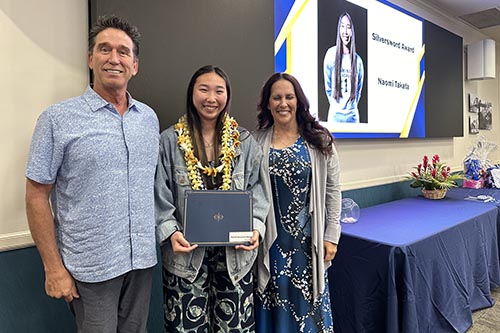
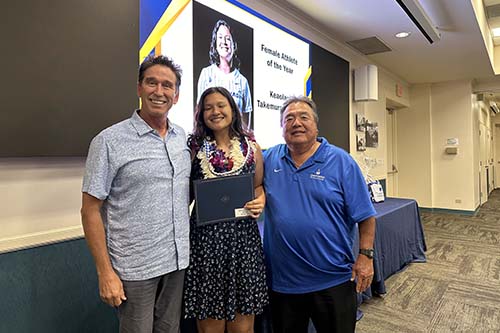
Male Student Athlete of Year Award went to Silversword basketball guard Ross Reeves ’26, while softball infielder/catcher Keaolani Takemura-Brehme ’24 was named the Female Student Athlete. And the recipient of the Silversword Award, which recognizes a student-athlete who represents the Marianist philosophy with sportsmanship, integrity and respect for others, was Chaminade Women’s Soccer goalkeeper Naomi Takata ’24.

“Being involved allows students the opportunity to build a support system, refine practical skills and broaden their experiential wisdom,” Ancheta says. “Co-curricular opportunities are the moments students can one day look back on and think, ‘Wow, I had a great time at Chaminade.'”

  • Andrew Anchetta and Allison Jerome with junior Tyanna Hemmings ’25 winner of the Bro. Joseph Becker Award of Excellence.
  • Andrew Anchetta and Allison Jerome with sophomore Selena Buttery ’26 winner of the Bro. Joseph Becker Award of Excellence.
  • Tyanna Hemmings ’25 and Epifania Petelo ’24 pose with their Co-Curricular Awards.
  • Athletic Director Tom Buning and Men's Basketball Coach Eric Bovaird congratulate guard Ross Reeves ’26.
  • Athletic Director Tom Buning and Women's Soccer Coach Michelle Richardson congratulate Ross Reeves ’26.
  • Frs. Chris Wittman and Martin Solma are proud of Nathaniel Leomiti ’25 for winning the Liturgy Award.
  • Graduate student Megan Kosaka is the first to be honored with the inaugural Henry Halenani Gomes Alaka‘i Award.
  • Frs. Chris Wittman and Martin Solma congratulate Moanna Blaksteen for her Service Award.
  • Athletic Director Tom Buning and Women's Softball Coach Kent Yamaguchi pose with Female Student Athlete infielder/catcher Keaolani Takemura-Brehme ’24.
  • Pono Riddle and Ariz Sánchez honored Tutor of the Year Kaulana Navares.
  • Pono Riddle and Ariz Sánchez pose with Outstanding Peer Mentor Award winner John Iose.

Posted by: University Communications & Marketing Filed Under: Campus and Community, Catholic, Diversity and Inclusion, Featured Story, Institutional, Students Tagged With: Campus Event, Honors and Awards

Matching Tuition

March 13, 2024

Chaminade’s Hawaii Guarantee Program matches UH Manoa’s resident tuition

Chaminade defies the age-old adage that nothing in life is guaranteed. Unless it concerns tuition. Last fall, the University assured that all incoming freshmen from Hawaii would pay the resident undergraduate rate of $11,304—the same amount students shell out at the University of Hawaii at Manoa—a steep discount on Chaminade’s typical tuition price of $29, 970. In subsequent years, Chaminade’s resident tuition will change if and only when UH Manoa’s does.

“After we launched the Hawaii Guarantee program, we saw a 30 percent increase in Hawaii applications/deposits,” says Jennifer Creech, Vice President for Enrollment Management and Student Success. “And we’ve also seen an increase of 27.36 percent from Fall 2022 to Fall 2023. Overall, we’re trending in the right direction.”

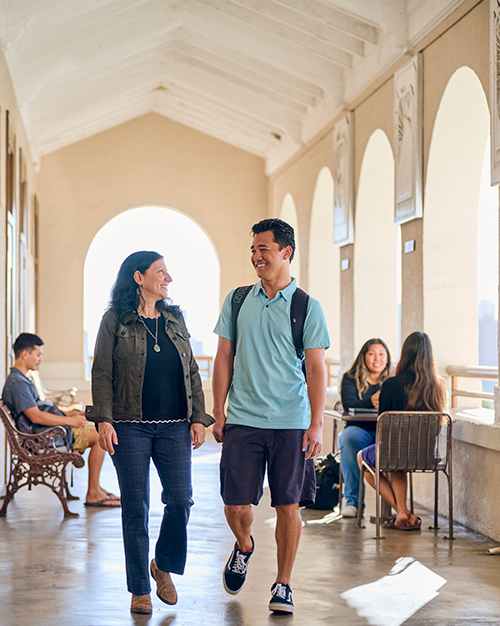
School of Humanities, Art and Design Dean Dr. Cheryl Edelson walks through Henry Hall with senior Sean Lorrenzo.
School of Humanities, Art and Design Dean Dr. Cheryl Edelson walks through Henry Hall with senior Sean-Zacharry Lorrenzo.

The cost of college has become a subject of significant concern and discussion in recent years. Rising tuition fees, along with additional incidental expenses such as textbooks, housing and meal plans, have made pursuing higher education financially daunting for many individuals and families.

This, of course, has led to concerns about accessibility and affordability, particularly for low-income and middle-class families. In response, policymakers, educators and advocacy groups have been exploring various strategies to address the issue, such as increasing need-based financial aid, expanding access to community colleges and trade schools, and implementing tuition-free or reduced-cost college programs at the state or national level.

“This effort is really a part of Chaminade’s service-oriented mission, which is to make higher education accessible to all Hawaii students,” says President Lynn Babington, Ph.D. “Across the country, less than half of students graduate on time. Our Hawaii Guarantee is designed to help students map out their academic journeys, and receive the course offerings and advising support needed to get them there. They will have a clear path to a four-year graduation.”

In addition to the predictable tuition rate, the Hawaii Guarantee amount of $11,304 can be reduced with various financial aid opportunities, including scholarships, grants and work-study programs, to further stem the financial burden on students, and to ensure that all students have access to the resources they need to succeed academically and professionally. However, to receive the Hawaii Guarantee rate, freshmen must be continuously enrolled at Chaminade for consecutive semesters and graduate in four years.

“We are committed to helping make the dream of higher education attainable,” Babington asserts. “Today’s students hold the power to change the world for the better—and we are proud to develop that next generation of leaders right here at home.”

When asked about the impetus for the new tuition schedule for local students, Creech said the University wanted to strengthen its commitment to the community. “Chaminade is a community-first University,” she added. “We wanted to remind our local residents that Chaminade is here and that the school is a good option to pursue their higher education.”

Enrollment at Chaminade has remained strong in recent years, and this Fall’s 484 incoming students represents the largest number in 20 years. The Hawaii Guarantee program is designed to offer students a transparent and predictable tuition structure, helping them plan for their educational expenses more effectively. Through this program, Chaminade pledges to keep tuition costs stable for students throughout their four years of undergraduate study, providing peace of mind and financial stability for both students and their families.

Furthermore, Chaminade is committed to providing a supportive learning environment that fosters student success. Through small class sizes, personalized attention from faculty and staff, and a strong sense of community, students can thrive academically and personally while pursuing their educational goals.

“Education is transformative,” Babington said. “Overall, the Hawaii Guarantee program exemplifies Chaminade’s dedication to making higher education affordable for all students in Hawaii. By removing financial barriers and providing comprehensive support services, Chaminade empowers students to achieve their full potential and make meaningful contributions to their communities and society at large.”

Posted by: University Communications & Marketing Filed Under: Campus and Community, Diversity and Inclusion, Featured Story, Institutional, Students Tagged With: Hawaii Guarantee, Tuition Savings

Honorary Luncheon

February 15, 2024

Students share the meaning of their scholarships with donors

Her voice quivering with emotion as she described the meaning of being awarded a scholarship during an annual honorary luncheon for donors, Audrey Pilar ’24 cited her mom and dad for instilling a belief in herself, sharing her parents’ story as a young couple struggling to make ends meet but never giving up and wanting more for her and her brother. Graduating in May with a major in Forensic Sciences, and minors in Chemistry and Data Science, Analytics and Visualization, the Mililani native admitted that, without her Dr. Feung Lee and Mrs. Mew Sin Lee Endowed Scholarship, she probably would have had to work three or more part-time jobs just to pay her tuition.

“When my mom wanted to come to America to have a better life for me and her, she did,” Pilar said. “When my dad was belittled for having a young family, he and my mom hustled, got an education, and successfully raised my brother and me. What I am trying to get across here is that someone gave them a chance in their lives. Someone gave my mom and dad a chance to succeed in life, and they took it. This is what receiving a donor scholarship means to me. Hope and a chance for a better future.”

In the pursuit of higher education, many students face formidable barriers, with financial constraints being among the most prevalent. For many individuals from low- to even middle-income backgrounds, the dream of attending college or university often seems like an unattainable aspiration. However, scholarships serve as beacons of hope, illuminating pathways to academic success and unlocking doors to opportunities that would otherwise remain shut.

“This year, between individual and Foundation scholarships, we supported 332 students with over $2 million, for an average scholarship award of $6,100, which is huge,” said Chaminade President, Lynn Babington, Ph.D. “Today, you’ll hear some of these students’ stories, and you’ll get a sense about their ambitions, their areas of academic interest and what they may have overcome to get here.”

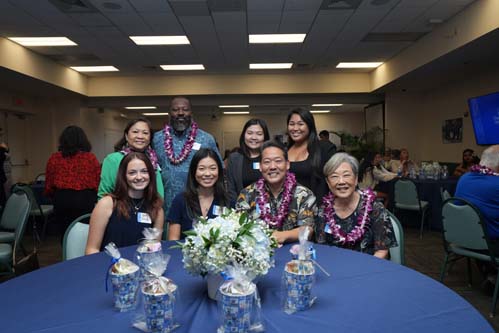
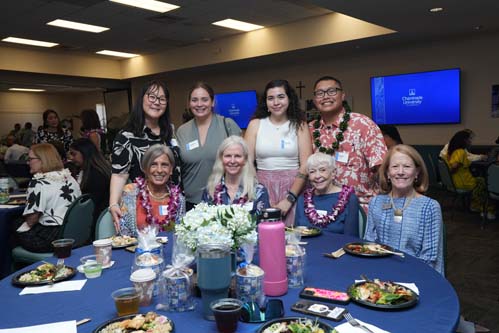
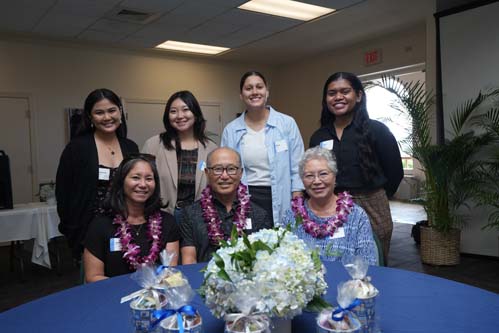
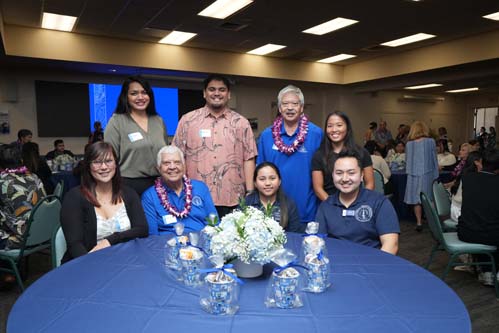
Scholarship Luncheon attendees include, standing from left, Edna Magpantay-Monroe, Michael Monroe, Tiannah Ohta and Genie Reutirez, and, seated from left, Bella Frasure, Alyssa Mori, and Keven and Diane Matsuura.
Scholarship Luncehon attendees include, standing from left, Edna Magpantay-Monroe, Michael Monroe, Tiannah Ohta and Genie Reutirez, and, seated from left, Bella Frasure, Alyssa Mori, and Keven and Diane Matsuura.
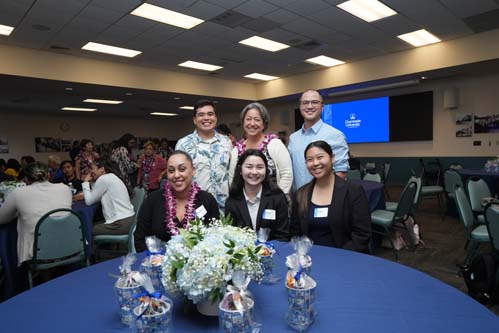
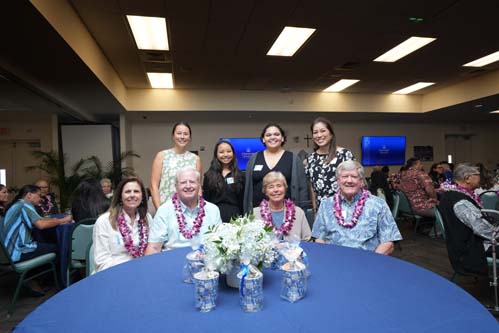
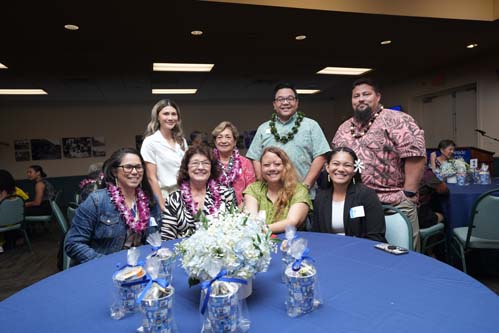
Scholarship Luncheon attendees include, standing from left, Jill Higashi, Kimberly Kameshige, Brianna Gutierrez Aceves and Easton DelaCruz, and, seated from left, Jeannine Wiercinski, Estelle Kelley, Jeannie Rolles and Chaminade President Dr. Lynn Babington.
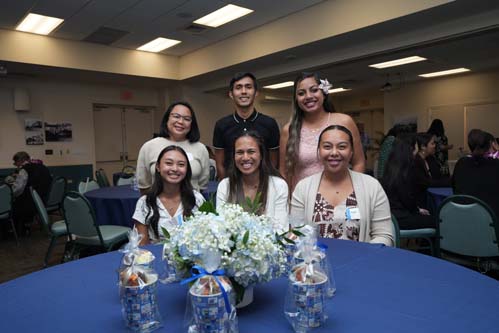
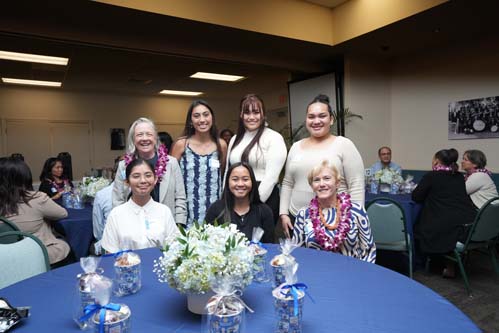
Scholarship Luncehon attendees include, standing from left, Janice Glade, Peter Jan Ramos and Anastasia Tangatailoa, and seated from left, Leila Casison, Caitlin Bocobo and Paige Garcia.
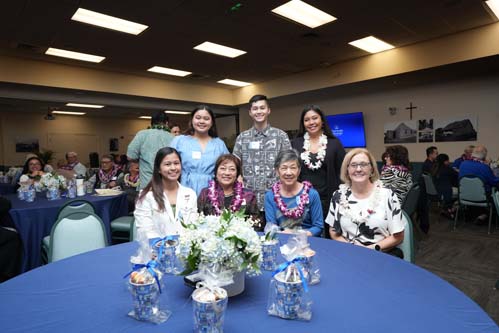
Scholarship Luncehon attendees include, standing from left, William Bernaldez, Amber Milsap and Greg Lagapa, and seated from left, Natasha Flores, Nicole Tanabe and Kelsey Nakagawa.
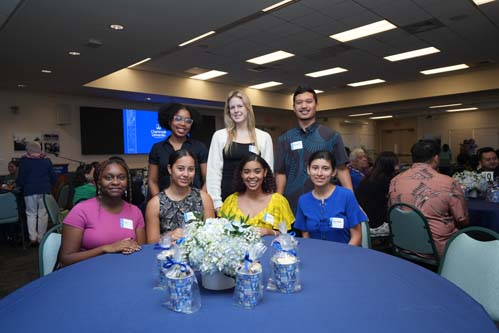
Scholarship Luncehon attendees include, standing from left, Tyanna Hemmings, Leah Carrington and Kaimipono Abella, and seated from left, Keila Anderson, Tessa Stanley, Aniyah Hazen and Ana Isabel Aranda.
Scholarship Luncehon attendees include, standing from left, Adrienne Aquino, Katherine Liu, Erica Tiwari and Alani Meltel, and seated from left, Jessica Schlais, and David and Christne Arita.
Scholarship Luncehon attendees include, standing from left, Kendra Sia, Nicole Kegine, Aleeyah Lemons and Heidi Bow, and seated from left, Sally and Michael Coovert, and Susie and John Field Jr.
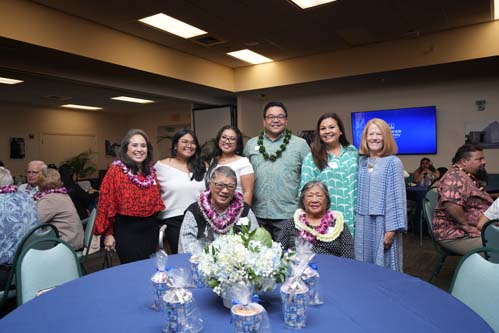
Scholarship Luncehon attendees include, standing from left, Debbie Ng Furuhashi, Michalla Burtado, Aloha Lei Garo, Bro. Alan Pacquing, Jodi-Anne Yoshida and Chaminade President Dr. Lynn Babington, and seated Bernard and Lolita Lum Hoy.
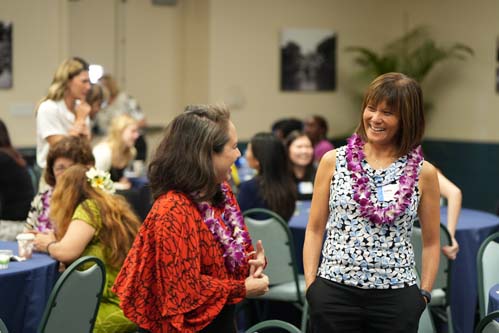
Debbie Ng Furuhashi and Cathy Ching share a laugh before the start of the Scholarship Luncheon.
Scholarship Luncehon attendees include, standing from left, Angelica Tangatailoa, Nathaniel Leomiti, Wayne Tanna, JD, and Jazzy Yasuda, and seated from left, Dorie Sanborn, Bro. Thomas Jalbert, Jasmine Mondelo and Pono Riddle.
Scholarship Luncehon attendees include, standing from left, Nagem Uiagalelei, Patricia Takamiya, Bro. Allen Pacquing and Richard Uiagalelei, and seated from left, Napua Rosehill, Carol Gouveia, Kawila and Kyla Castro.
Scholarship Luncehon attendees include, standing from left, Lauren Moriarty, Constance Keao, Huong Pham and Mame Hideyos, and seated from left, Alyssa Torres, Junelle Tangalin and Diane Peters-Nguyen.
Scholarship Luncehon attendees include, standing from left, Heather Kate Jarmillo, Marlon Francisco and Audrey Pilar and seated, from left, Kryzandreah Espanol, Tertia Freas, Elizabeth Hokada and Dr. Janet Davidson.

Seated with students, Adrienne Aquino ’26, Katherine Liu ’26, Erica Tiwari ’24 and Alani Meltel ’25, donors David and Christine Arita with daughter Jessica Schlais discussed each one’s goal, inspiring them to continue their education even long after they’ve graduated. The Aritas’ and Schlais’s American Floor and Home Foundation Scholarship is specifically earmarked for majors in the Environmental + Interior Design program.

An aspiring elementary education teacher, Aquino believes that early schooling provides a strong foundation for future learners. “Our graduation rates are getting lower and lower,” said the Kaneohe native. “We need more teachers if we want a better future for our keiki.”

Applauding Aquino for her dedication to becoming an elementary teacher, David Arita dispensed a bit of advice to her: “If you inspire them, they will always remember you,” he told her. “I still remember the teachers who made a major impact in my life, and I will never forget them.”

A sophomore Communication major, Easton DelaCruz ’26 has taken advantage of all the opportunities afforded to him since arriving on campus two years ago. He has been fortunate enough to engage in experiences that have enriched his education and broadened his perspective.

“Your commitment to financial assistance has allowed students like me to engage in transformative experiences, shaping us into well-rounded individuals prepared to contribute to society,” DelaCruz said in his address to donors. “With the wealth of past and current experiences, and the ones to come at Chaminade, I plan to return home and become a public servant to help my home become a better place for my parents’ generation, my generation and generations to come.”

In this landscape of financial uncertainty, scholarships emerge as powerful catalysts for change. These financial awards, often based on academic merit, financial need, or a combination of both, play a pivotal role in dismantling barriers to higher education. By providing financial assistance, scholarships enable deserving students to access resources, facilities and opportunities that would otherwise remain beyond their grasp.

Beyond financial assistance, scholarships also offer myriad opportunities for academic and personal growth. Many scholarship programs provide mentorship, networking opportunities and career development resources, empowering students to thrive both inside and outside the classroom. Furthermore, scholarships may fund internships, study abroad experiences and research projects, allowing students to broaden their horizons and cultivate valuable skills that enhance their employability and competitiveness in the job market.

“We know education transforms lives; our students set out to change the world, and they are making a difference,” said Babington. “Our reach is all over the world. And we are proud of our Chaminade students and alumni.”

Posted by: University Communications & Marketing Filed Under: Campus and Community, Diversity and Inclusion, Featured Story, Institutional, Students Tagged With: Honors and Awards, Marianist, Scholarship

Community Garden

November 28, 2023

Students tend to the māla as part of EN102

Pushing a wheelbarrow in the māla, Zachary “Pono” Narcisco was learning how to garden—not exactly what he had in mind when he enrolled in his English class. The “cultivating” effort is all part of Dr. Koreen Nakahodo’s mandatory service-learning component of her EN102 Composition and Rhetoric course.

“We have to do at least six hours of service learning,” said Narcisco, a freshman and an aspiring nurse. “Dr. Nakahodo asked us to write about our experience at the māla, and what value we can bring out from gardening.”

Many universities offer some form of service-learning, which is an educational approach that combines community service with academic learning to provide students with a holistic and hands-on learning experience. This experiential learning approach also helps students deepen their understanding of course material and how it applies to the everyday world.

“Unlike community service—which might include something like a one-day beach clean-up and then you go home—service learning directly connects service-to-course content,” said Mitch Steffey, Chaminade’s Associate Director of Service Learning and Community Engagement Service. “Learners try to apply aspects of the course while simultaneously working to satisfy the needs of the community.”

Nakahodo’s pedagogical approach to teaching is based on three principles: place, space and transactional writing. For this Fall’s EN102, she initially themed it “Food Insecurity,” which would have involved Christina Klimo, University of Dayton’s Write Place Coordinator with the Office of Learning Resource.

“Two years ago, we met while participating in the Marianist Educational Associates formation program, and we shared similar ideas,” said Nakahodo, who has taught at Chaminade since 1998. “Then we started having weekly Zoom meetings and it just progressed from there.”

After numerous Zoom conference calls, Nakahodo and Klimo had coordinated to collaborate on a course this term that would be based on the two universities’ community gardens, hence the theme. The first session was hosted by Silverswords who held up their laptops to capture the views of Diamond Head and the ocean to show the UD students.

“It was a get-to-know-each-other meeting,” Nakahodo said. “The second session was going to be hosted by UD and the third session would have been a collaborative effort. But unfortunately, Christina got sick and we had to postpone the session.”

Shoveling mulch into the wheelbarrow, sophomore Maka‘ala Ng said it’s difficult to grow plants and vegetables in this garden because of the quality of the soil, but they’ll persist, as long as students keep helping to tend the garden.

“When vegetables do start growing, we’re going to give them away,” said Ng, an Environmental Science and Environmental Studies double major. “Right now, we’re planting corn, peas, cucumbers and indigenous plants. We also apply three different methods to compost waste: tumbler, which looks like a cement mixer; vermicomposting or worm farm composting; and in-ground composting.”

 Steffey has spearheaded the garden endeavor for the past couple of years with the help of students like Narcisco and Ng, and professors like Nakahodo who want to address the disconnection between island residents living in today’s fast-paced, consumer-oriented society and their lack of awareness of food origins and production.

“Eighty-five to 90 percent of our food is imported,” Steffey said. “We need policies and actions to increase the amount of locally grown food consumed by Hawaii’s residents. And we’re trying to do our own little part for our community.”

Posted by: University Communications & Marketing Filed Under: Campus and Community, Featured Story, Institutional, Service Learning, Students Tagged With: Campus Event, Service Learning

Hogan Speaker Series

November 16, 2023

Panelists share their insights into entrepreneurship

What guides you? How do you find mentors? How do you overcome failure? What advice would you give your younger self?

These questions and many more were posed to three diverse and accomplished community leaders who served as panelists during the Hogan Entrepreneurial Leadership Program speaker series on Nov. 15 in a packed Keifer Hall Room 9. Panelists Haelee Tallett ’18, Shane Hanson ’16 and Julie Morikawa navigated the questions with ease and decorum, freely sharing their personal and professional experiences with students, alumni and faculty, all eager to soak in knowledge and insight. 

Tallett is the founder, owner and lead designer of Ocean Creations, which she started as an online business and now has several brick-and mortar-locations. Alumnus Shane Hanson is founder and owner of Freedom Fiduciaries. Morikawa, a hospitality industry executive, is the president of non-profit ClimbHi, which creates bridges between high school and college students from education to career paths, and is dedicated to workforce development in Hawaii.

Hogan program director Roy Panzarella opened the discussion by asking the panel, “What is your ‘Why?’” or “Why do what you do?” 

Hanson shared that being an entrepreneur is something innate, that he would rather work 80 hours for himself than 40 hours for another corporation. He also shared that he came to Chaminade to play basketball and eventually participated in a competiton in which student groups created their own products and marketing plans. The fulfilling and exciting experience has remained with him and sparked his entrepreneurial spirit. 

Being an entrepreneur is more important than being a jewelry designer to Hallett. While her company’s product is jewelry, what really motivates her is bringing a sense of confidence and beautiful design to customers who wear or give jewelry as gifts. Jewelry is the means to achieving that goal of the entrepreneurial journey of ideation to product to customer satisfaction. 

When asked how to create sustainable products that are not as profitable, Morikawa replied, “Why do they have to be separate, sustainability and profitablity?” She described a federal grant that ClimbHi recently received that involves partnering with local environmental and sustainability-focused organizations to maintain and improve an important ahupuaʻa (land division) on Oʻahu.

The 90-minute panel discussion served its purpose. The community leaders on the panel thoughtfully answered questions. Students respectfully asked questions. And all left the room with an understanding and insight into how following one’s dream is what it takes to be fulfilled and to have a meaningful impact.

The next Hogan Program speaker will be Gary Hogan on Wednesday, Nov. 29 from 6 to 7:30 p.m. in Kiefer Hall Room 9. Hogan is the CEO of Hogan Hospitality Group and Hawaiian Hotels & Resorts, as well as CEO and Board Chair of Pleasant Travel Service. 

Posted by: University Communications & Marketing Filed Under: Alumni, Business & Communication, Featured Story, Hogan Entrepreneurial Program, Institutional, Students Tagged With: Guest Speakers, Hogan Entrepreneurs Program, Master of Business Administration, School of Business and Communication

  • « Go to Previous Page
  • Page 1
  • Interim pages omitted …
  • Page 4
  • Page 5
  • Page 6
  • Page 7
  • Page 8
  • Interim pages omitted …
  • Page 37
  • Go to Next Page »

Footer

Chaminade University Logo

3140 Waialae Avenue
Honolulu, Hawaii 96816

Contact Us
Phone: (808) 735-4711
Toll-free: (800) 735-3733

facebook twitter instagram youtube linkedin

Visit

  • Plan Your Visit
  • Campus Map (PDF)
  • Events

Resources

  • Campus Security
  • Student Consumer Information
  • Concerns, Feedback, and Reporting
  • Institutional Review Board
  • Title IX / Nondiscrimination Policy
  • Compliance
  • Emergency Information
  • Careers
  • Institutional Statement

People

  • Students
  • Parents
  • Alumni
  • Faculty & Staff

Policy

  • Privacy Policy
  • Terms and Conditions of Use


© Chaminade University of Honolulu