• Skip to primary navigation
  • Skip to main content
  • Skip to footer
Chaminade University of Honolulu

Chaminade University of Honolulu

  • VISIT
  • APPLY
  • GIVE
  • STUDENTS
  • PARENTS
  • ALUMNI
  • FACULTY/STAFF
  • Admissions
    • Admissions Home
    • Undergraduate Students
      • First-Year Students
      • Transfer Students
      • Admitted Students
    • Graduate Students
    • Flex Online Undergraduate Program
    • Military Students
    • Non-Degree/Visiting Students
    • Experiential Honors Program
    • Early College Program
    • New Student Orientation
  • Tuition & Aid
    • Financial Aid Home
    • Tuition & Expenses
    • Federal Updates & Changes
    • Scholarships
    • $5,000 Graduate Scholarship
    • VA Education Benefits
    • Net Price Calculator
  • Academics
    • Academics Home
    • Academic Programs
    • Office of Student Success
      • Academic Advising
      • Records and Registrar
    • Kōkua ʻIke (Support Services)
      • ADA Accommodations
      • Career Services
      • Proctoring Services
      • Tutoring Services
    • Sullivan Family Library
    • Undergraduate Research & Pre-Professional Programs
    • Commencement
  • Campus Life
    • About Campus Life
    • Student Engagement
    • Student Government Association
    • Residence Life and Housing
      • Summer Conference Housing
    • Health Services
    • Marianist Leadership Center
    • Counseling Center
    • Campus Ministry
    • Campus Security
    • Dining Services
    • Bookstore
  • Athletics
  • About
    • Chaminade University News
    • Our Story
    • Leadership
    • Chaminade University Strategic Plan 2024-2030
    • Mission & Rector
    • Association of Marianist Universities
    • Facts & Rankings
    • CIFAL Honolulu
    • Accreditation & Memberships
    • Montessori Laboratory School
Search
×

Search this web site

Students

Environmental Leaders

September 13, 2023

Changemakers discuss their path to policymaking

One is nicknamed by her husband as the “Irresistible Force.” The other is known as “The Enforcer.” And the third has a spouse who wholeheartedly stands behind him—even if it means wielding a tire iron. Together, Althine Clark, Celeste Connors and William Aila, Jr., respectively, represent a “super power” to contend with when it involves environmental policy and activism in the islands.  

“The goal of this session is to have our guest speakers talk about how they got where they are today,” said Clark, a Chaminade adjunct professor who recently retired as the National Oceanic and Atmospheric Administration’s (NOAA) superintendent of Papahānaumokuākea Marine National Monument. “You’ll hear real-life examples of what it’s like to live a life in environmental policy.”  

In his opening story, Aila recalled a time when he was young with a fervent commitment to do whatever it took to preserve the aina–even if it meant physical confrontation. “I saw these three guys one day and I confronted them because they were mistreating a cultural site,” Aila shared with the students. “I asked them to stop and I started to move towards them. When you’re about to get into a fight, you look at the person’s eyes and then watch their shoulder. But these guys kept looking behind me so I thought I was going to be ambushed. And when I had a second to look back, I saw my wife standing there with a tire iron in her hands.”  

Today’s environmentalists are faced with many forms of violence—and even death at times. The non-governmental organization Standing Firm has published an annual report on the killings of land and environmental defenders around the world every year since 2012, after the murder of Chut Wutty, a Cambodian environmentalist who worked with the Global Witness CEO Mike Davis investigating illegal logging.  

While stationed in Greece as an economics officer with the U.S. Mission to the United Nations, Celeste Connors once remembered seeing a bullet lodged in her office window. “There was so much anti-American sentiment at the time,” said Connors, Executive Director of Hawaiʻi Green Growth, which is a United Nations Local 2030 hub that brings together diverse stakeholders committed to economic, social and environmental priorities. “But when I told them I was from Hawaii, everyone started reaching out because they can connect with Hawaii.”

Indeed, Hawaii holds a special place with Connors who decided to come home in 2015 after serving as a diplomat in Saudi Arabia, Greece, Germany and U.S. Mission to the UN. She later was named the Director for Environment and Climate Change at the National Security Council and National Economic Council in the White House (2008-2012), where she helped shape the Administration’s climate and energy policies, including the Sustainable Development Goals (SDGs). Connors also worked with the United Nations on the Paris climate agreement that was signed in 2016, which she sees as inspiration for Hawai‘i Green Growth’s goals.  

“The world is at a point where we desperately need solutions,” Connors asserted. “Since I left home, there has been a cultural renaissance, and other nations are now looking to indigenous models, such as Hawai’s ahupua‘a system, to become sustainable and independent. Think locally but act globally.”  

With a background in urban and regional planning, Clark understands the complexity of environmental law and policy, a class (ENV 300) that she is currently teaching to sophomores and juniors. Her introductory course outlines environmental policy and law—specifically its nature, development, flexibility, and growth, and to the ethical dimensions surrounding the creation of state, national and international environmental policy and law.  

“No is not an option nor an answer,” Clark said. “I’m now seeing lots of communities get engaged. One of the reasons I agreed to teach at Chaminade is because the University encourages students to get involved in projects that benefit society.”  

Asked by a student how to deal with climate change deniers, Aila said try to first reason with them. “And if that doesn’t work, go around him, go above him, go below him,” he advised. “Don’t let anyone tell you, you can’t. Instead, use those words as a motivator, and go out and make a difference.”                

Posted by: University Communications & Marketing Filed Under: Campus and Community, CIFAL Honolulu, Diversity and Inclusion, Homepage, Institutional, Students Tagged With: Campus Event, CIFAL Center, Environmental Sciences, Environmental Studies

Enterprising Minds

September 8, 2023

Teams to compete in Silversword Business Competition

Game on! In a Shark Tank-like competition, teams of students will compete in an entrepreneurial 18-week contest, vying for the grand prize of $2,000. The catch: the product or the service must have some element of sustainability.  

“Your idea has to address any of the CIFAL Center’s 17 Sustainable Development Goals (SDG),” explained Asoke Datta, EdD, School of Business and Communication’s Assistant Dean, outlining the competition’s rules. “It has to be profitable, not just in terms of revenue, but for the greater good of society.”  

Without revealing too much about her strategy, Carol Nacario ’23, a senior in the School of Business and Communication, is concerned with all the “waste” that she sees around her. The environment, like many in her generation—led by Greta Thunberg and the Sunrise Movement, a youth-led political organization urging increased attention to climate change—is an issue that needs to be kept in the forefront of people’s minds.  

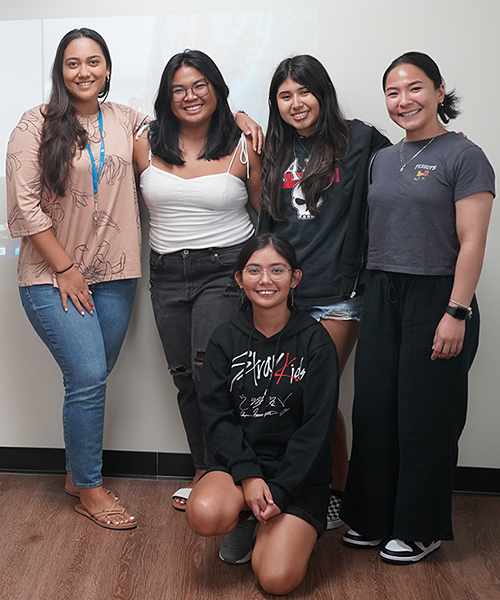
Students participating in the Silversword Business Competition include, from left, Peyton Haleamau, Michalla Burtado, Alyssa Torres (kneeling), Emma Rosales and Carol Nacario.

“Deciding on a final project will be the most difficult challenge,” shared Nacario with other students who attended Day 1 of the competition. “My target audience will be the campus.”  

Academic competitions play an essential part in learning for students. Participation offers a hands-on opportunity for students to apply the knowledge and principles they have gained in the classroom and apply it to real-work situations. These competitions foster such skills as leadership, teamwork and communication. They can also be a great way to make new connections and friends.  

School of Business and Communication interim dean, Dr. Annette Santos, issued her first challenge to the students: recruit others to join their teams. “It can be a team of two to five students,” said Santos via a live video feed from Guam. “However, at least one of the team members has to be from the School of Business and Communication.”  

A business major, Peyton Haleamau ’25, convinced second year forensics science majors, Emma Rosales ’25 and Michalla “Meeks” Butardo ’25, to be on her team. Having never taken a business course, Rosales and Butardo consider their lack of entrepreneurial savvy as their major challenge.  

“We’ll be here as advisors and mentors,” marketing lecturer Wera Panow-Loui, MBA, told the students. “Last year, I opened my house up to a team of students who were producing jewelry out of microplastics reclaimed from the beach and in the ocean. And I also fed them.”  

Datta suggested to find team members who are in different disciplines, from art and interior design to nursing and data analytics. “You want a wider perspective than just business,” he said. “That’s what entrepreneurs do—they get creative. And, if they fail, what they learn from that failure determines how they succeed the next time.”

Each team will be given $250 seed money to use at its discretion. The School of Business and Communication’s Advisory Board members, who are providing the funding for the seed money, will also be available as mentors.  

When the competition was launched in 2021, the plan was to have students open and manage a pop-up concession on campus. Because COVID-19 was still a factor, another approach was decided: the School invited students to participate in a business competition that would allow them to show off their creativity, their ability to work with others and their aptitude in everything from marketing to accounting and customer service.  

“Think of this competition as an incubator of ideas,” said Dr. Eduard Merc, who is Chaminade’s MBA director. “You’ll have the chance to work alongside your professors and the opportunity for experiential learning that goes beyond theory.”  

Students’ final presentation will take place on Nov. 16. Each team will be assessed by sales/revenue, social media likes and shares, and their profit-and-lost statement.  

“And your business must align with the sustainable approach,” Santos emphasized. “In developing your business plan, take into account these considerations: 1) Identify future needs; 2) Identify technology to serve that need; and 3) How will you deliver the need, through what channels of distribution?”  

Their time starts now!    

Posted by: University Communications & Marketing Filed Under: Business & Communication, Campus and Community, CIFAL Honolulu, Diversity and Inclusion, Featured Story, Innovation, Students Tagged With: Business Administration, Hogan Entrepreneurs Program, School of Business and Communication

Welcome to the Class of 2027

September 1, 2023

Freshman and Hawaii Island native Shalei Parong was among a throng of incoming students who moved into the Hale Pohaku co-ed dormitory on August 17. Meanwhile, after attending the freshman Apo Haumana Retreat, Gavin Ritcheson, Chase Murray and Kanden Yamada bonded and became instant friends.

“It was a fun retreat,” said Yamada of Apo Haumana. “We learned more about Chaminade’s mission, Hawaii’s culture, and we met with our new faculty mentors. We also sang a lot of karaoke., too”  

This year, Chaminade University welcomed one of its largest incoming classes in recent history. The projected number of new students amounts to 1,572 undergraduate students and 642 graduate students for a total of 2,214 student enrollment. (The official final count is due Oct. 1.) The incoming class of freshmen and transfer students added up to 481, many of whom attended the New Student Orientation.

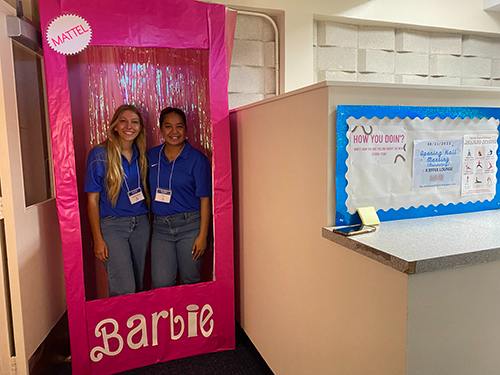
Madyson Jensen, left, and Epifania Petelo stand inside a Barbie box for incoming residents to have their photos taken.

This Fall, the University also noted a 34 percent increase in new students from Hawaii, thanks in large part to the Hawaiʻi Guarantee initiative, which makes tuition for local Hawaiʻi freshmen on par with tuition at UH Manoa.  

“It’s gratifying to see so many local high school graduates and others selecting Chaminade as the institute to pursue their higher education,” said Chaminade University President Dr. Lynn Babington. “We also have the highest graduation rate of Hawaii colleges, according to the National Center for Education Statistics, and that’s something of which we’re really proud.”  

Also of note, 285 students live in university residence halls, with nine resident assistants guiding their dormitory experience that includes activities, and all safety and security procedures.  

“We enforce the dorm rules,” said Kieffer Hall resident assistants Mady Jensen ’26 and Epifana Petelo ’23, as they waited to check in incoming students. “We make sure that everyone abides by the curfews and other regulations.”  

New this year is Chaminade’s Major and Minor in the Sport and Event Management (SEM) program within the School of Business and Communication. It is the first college program of its kind in Hawaii, according to SEM professor Wendy Lam, Ph.D. Students will take an interdisciplinary approach to build their foundation of knowledge with courses in sports business administration, sports psychology, sustainability, law, ethics and communications.  

“Sports programs generate tremendous value to both our communities and Hawaii’s economy,” said Lam, Associate Professor of Business. “The future of the school is mission-focused, practical and exciting.”  

New graduate programs include the Education Specialist in School Psychology (EdS); Doctor of Education in Organizational Leadership for Adaptation and Change (EdD–Sustainability Leadership concentration; Doctor of Nursing Practice (DNP)–BSN-DNP Pediatric Nurse Practitioner (PNP) certificate; and the Doctor of Nursing Practice (DNP)–Post-Doctor Pediatric Nurse Practitioner (PNP) Certificate.  

In addition to more than 60 majors and minors, the University’s Office of Student Engagement offers more than 30 active student clubs for students to join.  

“Looking ahead, we have an exciting year planned, and I am grateful in advance for all of the hard work and commitment of our faculty and staff members,” Babington said. “We are always here for our students.”    

Posted by: University Communications & Marketing Filed Under: Campus and Community, Diversity and Inclusion, Featured Story, Institutional, Students Tagged With: Athletics, Scholarship, Undergraduate Research & Pre-Professional Program

New Student Orientation

August 21, 2023

Incoming class of freshmen familiarize themselves with campus resources

Across the nation, thousands of freshmen will mark a rite of passage this month, standing in that liminal space between what lies behind and what awaits ahead—between the familiar past and the unpredictable future. As Davis and Rian Wakefield helped their daughter, Shalei Parong, check in to the Hale Pohaku dormitory during New Student Orientation, they felt a mix of emotions: sadness, worry and excitement.

“At least she’s close to home,” said Davis Wakefield, a firefighter with the Hawaii Fire Department based in Kona. “This is her choice to come here, and we support her decision; it’s a new chapter of her life.”

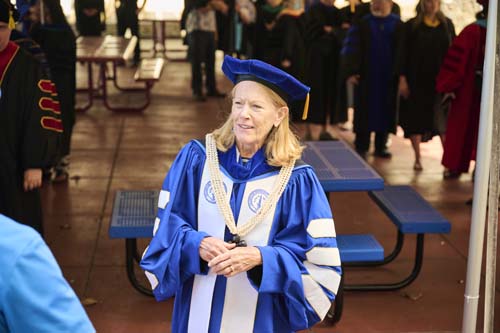
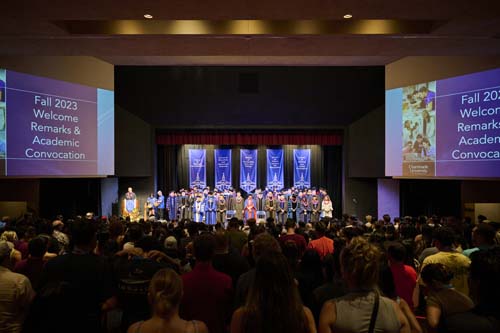
Writing their own stories was a key theme in Chaminade President Dr. Lynn Babington’s welcoming message to incoming students during the Academic Convocation at the Mamiya Theater. Another one of her keynotes involved the principles of a holistic, Marianist education, focused on service, justice, peace, adaptation and change.

“You’ve chosen to attend a warm and welcoming liberal arts University,” Babington told students. “You will form bonds here, and you’ll delve new ways of thinking and discerning who you are and who you want to be.”

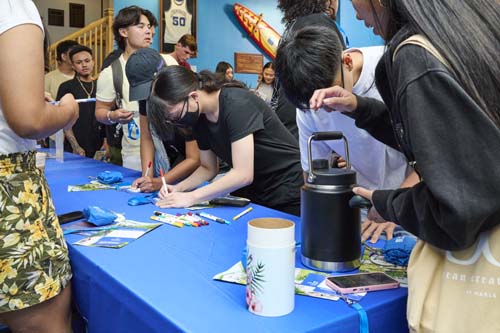
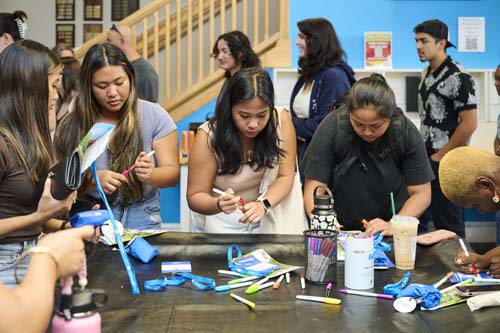
Students write their names on tags.
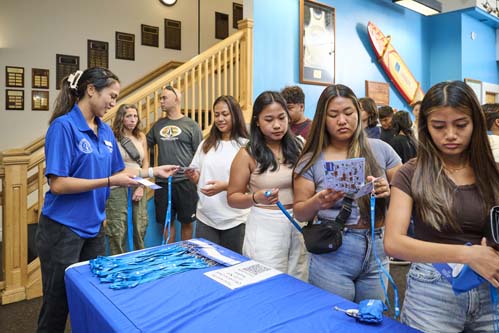
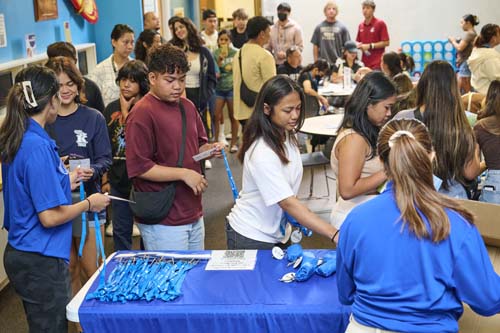
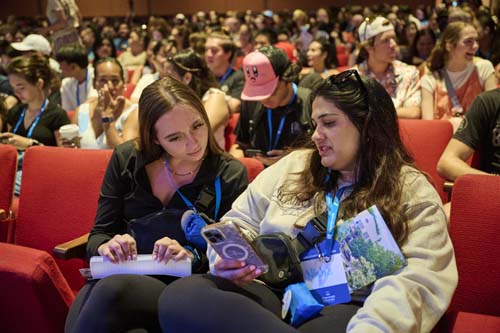
Incoming freshmen received a lanyard for their student ID cards.
Checking in for New Student Orientation.
Signing in for New Student Orientation.
Waiting for the app Canva to open.
Faculty members stood outside of Mamiya Theater.
Chaminade President Dr. Lynn Babington to address students.
It was a full house at Mamiya Theater.
Trying to navigate the Kalaepohaku campus.
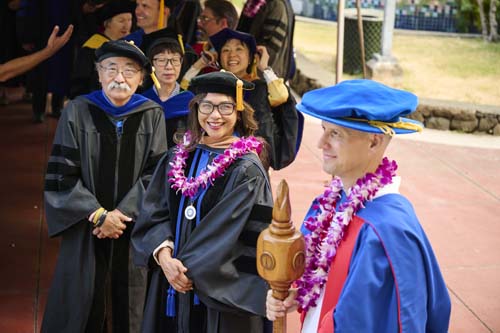
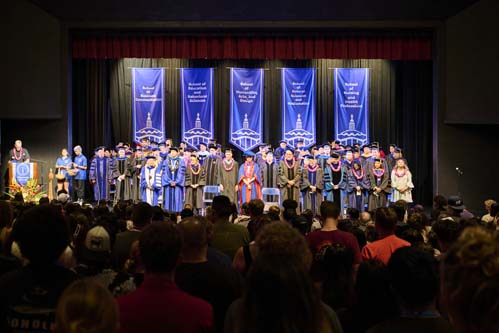
Faculty members gather for the Academic Convocation.
Fr. Chris Wittmann led the group in prayer.
Chaminade President Dr. Lynn Babington and faculty members welcomed new students during the Academic Convocation.
Chaminade Provost Lance Askildson explained that higher education is an intellectual exercise in application and reflection. 
Students applaud the words of Dr. Lance Askildson.
Chaminade Student Government Association President, Pamela Oda, advised new students not to fear change.
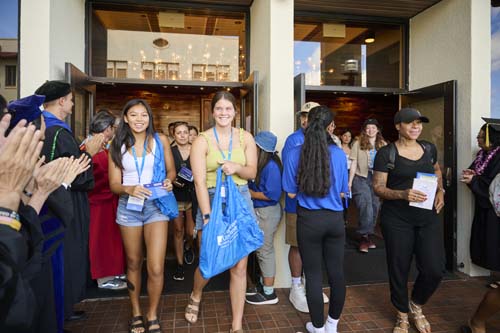
Students walk out of Mamiya Theater after Convocation.
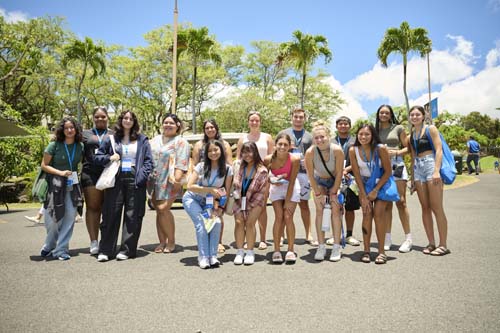
A group of freshmen explored the Kalaepohaku campus.
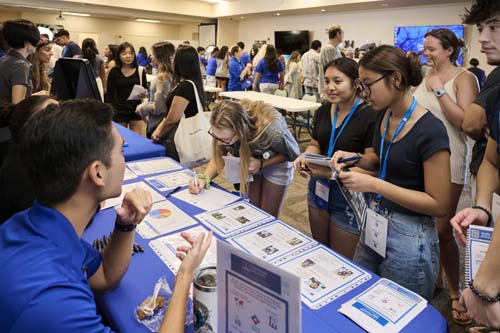
Learning about campus resources.
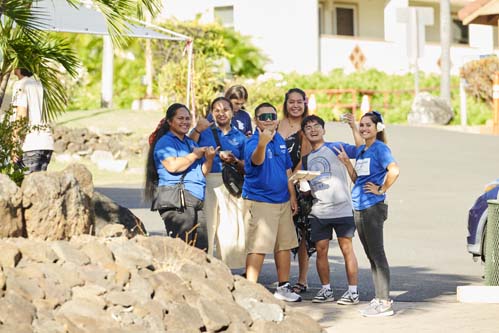
Orientation leaders flash their shaka of approval.

Mandatory for all freshmen and transfers, the New Student Orientation (NSO) is designed to acquaint new students with the campus and the many available campus resources that enhance both academic success and personal development. Orientation activities focus on several important areas, including the curriculum, academic advising, college success, scholarships and financial aid, campus activities, student services, student organizations, Silversword Spirit and campus facilities.

“As I look into the audience, I see the many incoming college students who are unsure about what the future holds, already starting to feel homesick, thinking whether you made the right decision or not,” said Chaminade Student Government Association President Pamela Oda in her address to fellow students at the Academic Convocation. “College is a chapter in your life that involves the word that many people dread—change. Be open to the change and new experiences, don’t fight it!”

Freshman Jordan Ponsar ’27 said he was “stoked” when he was offered a soccer scholarship to attend Chaminade. The Long Island, N.Y., native was quick to make friends on move-in day, helping resident assistants, Kelsey Sablan ’23 and Micah Sanders ’24 at the check-in desk in the lobby of Hale Pohaku co-ed dorm.

“I’m going to make the most of my four years here,” said Ponsar, flashing the shaka sign. “This is all new so I look forward to all the future opportunities and experiences.”

In his opening comments, Senate Faculty President Dr. David Carter rhetorically asked, “Do you know what you’ve gotten yourselves into?” His question elicited some nervous laughter from the audience, but his answer was simple. “You’ve enrolled in a university where we want to get to know you,” said the Director and Professor of Forensic Sciences. “Being in the classroom with students is my happiest time of the week. I hope you learn from me as much as I learn from you.”

Navigating a successful collegial life is not always easy, especially during freshman year when everything seems foreign and unfamiliar. Yet Chaminade’s ‘ohana spirit provides a comfortable and safe environment that makes it easier for students to explore. Students are encouraged to step out of their comfort zones, to be curious, to embrace adaptation and to try something new. 

“You are here because we see in you the potential for transformation through higher education and the opportunity to live an examined life in service to yourself and your community,” said Dr. Lance Askildson, Chaminade Provost and Chief Academic Officer. “This is, in truth, an exhilarating yet also quite challenging inflection-point in your life.  You will struggle and even fail at times to achieve your goals—and that is OK. We are all here, as a community of faculty, staff and administrators, to support you and your journey.”

In her concluding remarks, Oda offered some sage advice. “As you start this new chapter in life, be open to experiencing new things and opportunities because you never know what could happen,” she advised. “As you meet new people, keep in mind that everyone comes from different walks of life and may not have experienced the same things you have. Each of you has your own unique story, embrace it. Once again, welcome to the Silversword ‘Ohana and SWORDS UP!”   

Posted by: University Communications & Marketing Filed Under: Campus and Community, Diversity and Inclusion, Featured Story, Homepage, Institutional, Student Life, Students Tagged With: Baseball, Campus Event

Chaminade Scholar

June 13, 2023

Depending on the power grid in the countryside of Ukraine, Chaminade sophomore Victoria DelaCruz ’25 may or may not be able to teach American culture, environment and English to Kate (not her real name to protect her identity) through a volunteer role with ENGin, a nonprofit group that offers a unique opportunity to make a difference in a Ukrainian’s life. It’s a volunteer role that she pursued during her freshman year in 2021.

What she didn’t anticipate, though, was the Russian invasion of the second largest European country in February 2022. Still, the Saipan native persisted and persevered to maintain contact with Kate at least once a week to this very day.

“She wants to improve her English, and I’m trying to help her do that,” says DelaCruz, who opted to major in Data Science, Analytics and Visualization. “I am provided with class lessons, but I tailor them to fit with what I’m comfortable with.”

Growing up in the largest island in the Northern Mariana Islands, DelaCruz has always felt comfortable with helping her community, following her mom to work at KARIDAT, a not-for-profit, social service organization under the Catholic Charity Diocese of Chalan Kanoa. In 2018, when Super Typhoon Yutu, the strongest typhoon ever recorded to impact the Mariana Islands and the second-strongest to strike the United States or its territories, slammed into Saipan, DelaCruz was there.

Victoria DelaCruz helps out at the Kaimuki office of Aloha Harvest.

“She was doing basic intakes and helping out in the food pantry,” recalls mom Elaine DelaCruz, a Chaminade alumna who earned her bachelor’s degree in 1999 and her M.S. in Counseling Psychology (MSCP) in 2003. “She has always wanted to serve her community ever since she was a young girl.”

DelaCruz personifies the Chaminade Scholar, defined as a student who strives to discover his or her life vocation, to be a servant leader and to use God-given gifts and talents to pursue the common good. “Her reflection on service and the path she traveled to earn her internship with Aloha Harvest are inspiring,” says Bro. Ed Brink, a member of the Mission and Identity Committee that selects Chaminade Scholars. “She’s truly a remarkable young woman who exemplifies the Marianist education and values.”

While searching for a service project to fulfill one of the mandatory requirements of being a Chaminade Scholar, DelaCruz came upon the AmeriCorps Vista program and decided to become a member. The objective of Volunteers in Service to America (VISTA) is to provide needed resources to nonprofit organizations and public agencies to increase their capacity to lift communities out of poverty. It just so happened that Aloha Harvest was registering to participate in the VISTA program and looking for someone to work in its office.

“I started as a volunteer in late September 2022,” DelaCruz recalls. “At that point, Aloha Harvest was in the process of creating an AmeriCorps VISTA position (Program Data Evaluation Specialist), and found out I was a Data Science student. So, they asked me if I would be willing to fulfill that position, and that’s how I was recruited. My official first day as a full-time service member with Aloha Harvest was January 17, 2023, and I will be there until January 17, 2024.”

In addition to being a Chaminade Scholar, DelaCruz is also in the Experiential Honors Program, and she serves as vice president of the Chaminade Sustainability Council, the design manager for the Chaminade Student Programming Board and an Alliance Research Intern with the National Science Foundation.

DelaCruz credits her Chaminade Scholar status, not only for her monetary scholarship, but for helping her grow and commit to community service, which she plans to continue in Saipan after she graduates in 2024.

“When it comes to data science, there’s a great demand for it in Saipan, from the medical to the educational field,” DelaCruz asserts. “Saipan usually has to bring in people from the Mainland but it never lasts too long.”

And if you had told DelaCruz that she would be pursuing a degree in data science a year ago, she says she would have thought you were lying. “I never considered technology, and now I’m learning to code and use data,” she says. “I’m really glad I changed my major to DSAV because the skills that I have learned can be applied to so many fields. And I can use the knowledge that I gained and my passion for service to help my Chamorro community.”

Posted by: University Communications & Marketing Filed Under: Catholic, Humanities, Arts & Design, Service Learning, Students Tagged With: Honors and Awards, Scholarship

Scholars at Sea

June 5, 2023

Students immerse themselves in culture and history

Seven days. Seven ports. And a lot of history, foreign cultures and sites to absorb in between. These were the main takeaways that Chaminade students, Remo Merlo, Hannah Dyer, Nicole Vontsolos and Kevin Dean, gleaned from their short-term study abroad program this past spring.

Organized by Kelly Treece, Ph.D., Director and Associate Professor of Criminology and Criminal Justice, and Lynn Haff, Director of Grants Development, the scholar-at-sea-like program offered students a glimpse into European, Islamic, Muslim, Jewish, Middle Eastern and Western Asian cultures. The seven-day itinerary aboard the Norwegian Jade embarked from Athens, Greece, and circled the Aegean, Marmara and Mediterranean seas, with Ports of Call in Kusadasi, Turkey; Patmos, Greece; Jerusalem (Ashdod) and Tel-Aviv (Haifa), Israel; and Limassol, Cyprus.

The ruins of Ephesus is 11 miles away from Kusadasi, Turkey, and it is one of the best preserved ancient cities of the world.

“We received a $13,000 Sidney Stern Memorial Trust grant, and we were all set to go in 2020 to Italy, Switzerland and Germany,” Treece says. “And then COVID happened.”

As travel restrictions began to relax in 2022, Treece charted a new course. This time would be different—in location and mode of travel. Also, rather than take a large cohort of students, who would have to pay their own way, Treece would use grant money to cover 90 percent of the program’s cost for four students: two females and two males.

“Coming out of COVID, we knew the students couldn’t afford to pay because they were still recovering from the economic impact of the pandemic,” Treece asserts. “We had limited funds, but we knew we could support four students.”

To qualify, each student was required to hold a current passport, to be in good academic standing and to write an essay explaining why he or she wanted to participate in this short-term study abroad, and how it would propel their future. The answers varied among the freshman, sophomore and two senior students. What was consistent, however, is that they all believed in the educational benefits of visiting different countries and gaining the exposure to foreign cultures.

“When Dr. Treece called and asked if I was still interested in going to Europe, I screamed, ‘Are you kidding me?’” recalls, Hannah Dyer, who was initially denied because she was a sophomore and preference was given to seniors. “It was my first time outside of the Americas so I was excited to see Europe and, technically, Western Asia because of Turkey.”

In preparation for the voyage, each student was assigned a country and tasked to create a travel brochure of sorts, providing details about the respective nation’s history, culture, socio-economic policies, political stability and religion.

“I learned more in the two weeks visiting each country than I would have learned in researching each one,” says freshman Remo Merlo. “They (Europeans) have such a different way of living, and we noticed this right away when we arrived in Athens.”

The Western Wall, also known as the “Wailing Wall” or the “Kotel,” is the most religious site in the world for the Jewish people.

Treece acknowledged her overall goal was cultural immersion for the students, allowing them to explore and develop their sense of curiosity and problem-solving skills. “I’ve chaperoned previous trips to London, England, when I was at another university, but those groups were much larger,” says the one-time police sergeant. “We brought together four complete strangers, and they formed a really tight-knit bond, each relying on the other for safety and awareness.”

And at no time was this more evident when they were in Israel. As peaceful protests choked the streets in Tel Aviv, Treece and Haff were stuck on a bus for several hours after returning from an excursion to Jerusalem. Meanwhile, Dyer and Vontsolos, who were on the same daytrip, had boarded an earlier bus, and only later learned of their chaperones’ predicament once they returned to the ship. 

“We were all texting them to see if they were OK,” Merlo says. “Dr. Treece reassured us they were fine, and everything was peaceful, which was another difference between what we saw in Tel Aviv and what we’ve seen in the U.S.”

Merlo and Dyer have already said they would definitely participate in a similar program should the opportunity again arise. “After college, I plan to move to Europe or Canada,” Merlo says. “And this trip even motivates me more to finish college early, and explore the next chapter of my life.”

Dyer returned to Hawaii on a traveling high, eager to take to the skies once again and return to Israel. “I wish I could have done more,” she says. “Visiting the different religious sights and learning about all the history was an immersive experience. 

“There were no emails and texts to respond to nor phones to answer,” Dyer adds. “We just all hung out and talked about what we were seeing and what we were experiencing. It was great just to hang out and unplug.”

Posted by: University Communications & Marketing Filed Under: Diversity and Inclusion, Institutional, Students Tagged With: Grants, Marianist, Study Abroad

  • « Go to Previous Page
  • Page 1
  • Interim pages omitted …
  • Page 6
  • Page 7
  • Page 8
  • Page 9
  • Page 10
  • Interim pages omitted …
  • Page 36
  • Go to Next Page »

Footer

Chaminade University Logo

3140 Waialae Avenue
Honolulu, Hawaii 96816

Contact Us
Phone: (808) 735-4711
Toll-free: (800) 735-3733

facebook twitter instagram youtube linkedin

Visit

  • Plan Your Visit
  • Campus Map (PDF)
  • Events

Resources

  • Campus Security
  • Student Consumer Information
  • Concerns, Feedback, and Reporting
  • Institutional Review Board
  • Title IX / Nondiscrimination Policy
  • Compliance
  • Emergency Information
  • Careers
  • Institutional Statement

People

  • Students
  • Parents
  • Alumni
  • Faculty & Staff

Policy

  • Privacy Policy
  • Terms and Conditions of Use


© Chaminade University of Honolulu