• Skip to primary navigation
  • Skip to main content
  • Skip to footer
Chaminade University of Honolulu

Chaminade University of Honolulu

  • VISIT
  • APPLY
  • GIVE
  • STUDENTS
  • PARENTS
  • ALUMNI
  • FACULTY/STAFF
  • Admissions
    • Admissions Home
    • Undergraduate Students
      • First-Year Students
      • Transfer Students
      • Admitted Students
    • Graduate Students
    • Flex Online Undergraduate Program
    • Military Students
    • Non-Degree/Visiting Students
    • Experiential Honors Program
    • Early College Program
    • New Student Orientation
  • Tuition & Aid
    • Financial Aid Home
    • Tuition & Expenses
    • Federal Updates & Changes
    • Scholarships
    • $5,000 Graduate Scholarship
    • VA Education Benefits
    • Net Price Calculator
  • Academics
    • Academics Home
    • Academic Programs
    • Office of Student Success
      • Academic Advising
      • Records and Registrar
    • Kōkua ʻIke (Support Services)
      • ADA Accommodations
      • Career Services
      • Proctoring Services
      • Tutoring Services
    • Sullivan Family Library
    • Undergraduate Research & Pre-Professional Programs
    • Commencement
  • Campus Life
    • About Campus Life
    • Student Engagement
    • Student Government Association
    • Residence Life and Housing
      • Summer Conference Housing
    • Health Services
    • Marianist Leadership Center
    • Counseling Center
    • Campus Ministry
    • Campus Security
    • Dining Services
    • Bookstore
  • Athletics
  • About
    • Chaminade University News
    • Our Story
    • Leadership
    • Chaminade University Strategic Plan 2024-2030
    • Mission & Rector
    • Association of Marianist Universities
    • Facts & Rankings
    • CIFAL Honolulu
    • Accreditation & Memberships
    • Montessori Laboratory School
Search
×

Search this web site

Campus and Community

Na Liko Naʻauao

April 28, 2023

Students present their thought-provoking research findings

She suspected that she couldn’t be the only one feeling isolated and alone. With COVID cases spiking during her freshman year, Iris Hirata sheltered in place in her dorm room with her family support 5,000 miles away.

“I usually like being alone, but that was too much—even for me,” Hirata recalls. “It was depressing and I felt I had no one to talk to.”

As pandemic numbers started to decrease, and a semblance of normalcy emerged, Hirata never forgot those earlier times. “Biologically, I knew about COVID’s impact on the lungs,” Hirata says. “But I told Dr. Darren Iwamoto, we didn’t know the impact that COVID had on the mental health of individuals.”

It turned out to be a lot.

In an earlier research project she worked on with psychology professor Tracy Trevorrow, Ph.D., Hirata studied the effects of COVID on sleep quality. They learned that during the nascent stages of the pandemic, people tended to be more on their phones, which would disturb their sleep patterns and quality of sleep.

Iris Hirata stands in front of her presentation about COVID-19 and mental health.

“I was really big on healthcare at the time, which is what led me to do a research project on the impact of COVID on mental health,” says the biology major, who presented her findings during the 21st annual Na Liko Na’auao Symposium on April 14.

Pointing to a chart with spikes of blue and red lines, Hirata explains that the graph indicates the “bounce back” or the resiliency rate of the 200 students surveyed during her research.

“The epidemic has had a significant impact on university students’ mental health, including things like stress, anxiety, depression, and a lack of behavioral and emotional control,” Hirata concludes in her findings. “The findings support the literature that resilience is a key factor in influencing mental health and overall wellness.”

According to Amber Noguchi, Ph.D., Undergraduate Research and Pre-Professional Programs director, undergraduate and graduate research experience can look like a number of things. It can range from formal and clinical studies to data analysis, and creative works and beyond. On the occasion of this year’s Na Liko Na’auao Symposium, 25 student presenters covered a broad spectrum of issues and questions, from Hirata’s “How does COVID-19 Impact the Mental Health of Individuals?” to “Eat Healthy, Live Strong: Understanding Eating Behaviors of NHPI on Oahu” and “Sports Analytics: What Factors Determine a Winning Team?” and “Decolonizing Hawaii’s Diet.”

“All of these presentations stem from research projects that have been collaborations between the student researchers and their faculty mentors,” Noguchi explains. “This undergraduate conference celebrates student scholars from across all academic disciplines.”

In her research project with Dr. Guanlin Gao, “Eat Healthy, Live Strong: Understanding Eating Behaviors of NHPI on Oahu,” Autumn Fairall, ’23, examined the barriers to eating a healthy diet. “I started working with Dr. Gao as a research assistant in the Spring of 2022,” says Fairall, who will earn her Bachelor of Science in Nursing in May. “Initially, the project we worked on focused on the landscape of economic and personal finance in Hawaii. However, after talking with Dr. Gao and discussing personal interests in wellness and past, informal research connected to diet, the research focus altered.”

Chaminade President Dr. Lynn Babington presents Dr. Rylan Chong and Kawailani Luat with their respective awards.

During the conclusion of the Symposium, President Dr. Lynn Babington, defined a scholar as “A person with a desire to pursue and learn new things; a person on a quest for knowledge and a dedication to learning.” By not focusing on one academic discipline, Na Liko Na’auao gives all student scholars an opportunity to present their work in a formal setting, and receive feedback from both faculty and other scholars within their field.

Every year, after all the student scholars have presented their work, the Symposium concludes with a presentation of two special awards. Given annually, The President Sue Wesselkamper Award acknowledges a student who has demonstrated extensive community and university service. In order to qualify for the prize, a student must have a minimum 3.5 GPA, show scholarship beyond classroom requirements by undertaking their own independent research or study, and must have presented their work both on and off campus.

Kawailani Luat is this year’s recipient of the President Sue Wesselkamper Award. A senior, majoring in Data Science, Analytics and Visualization and minoring in Forensic Science, Luat consistently excels in her coursework and has taken on leadership roles through her extracurricular and volunteer services.

“To be recognized with this award validates all the hard work I’ve done to get here,” Luat said. “I finish my senior year with this last achievement, so I am beyond ecstatic.”

“Kawailani is very active within our Chaminade community, including the Animal Advocacy Club, I am a Scientist, and has helped at every Preview and Admitted Students Day,” Babington says. “She also served as a student panelist for the Women in Data Science Hawaiʻi program and volunteers at Palama Settlement, a non-profit community-based social service agency working in the Kalihi and Palama neighborhoods.”

Honoring the close student-faculty relationships formed at Chaminade, the President Mackey Award is presented to an outstanding faculty mentor, nominated by a student participating at the conference. This year’s recipient is Dr. Rylan Chong, nominated by LaVelle White.

“He personally helps students step outside themselves to try things that were not thought possible,” wrote White in his nomination letter. “He encourages and pushes students to go for internships and research programs like SPICE. He stays after class to help students answer questions, and he has a way of speaking that demystifies the whole process, giving students the confidence to essentially go for the gold.”

Posted by: University Communications & Marketing Filed Under: Behavioral Sciences, Campus and Community, Diversity and Inclusion, Humanities, Arts & Design, Innovation, Institutional, Natural Sciences & Mathematics, Students Tagged With: Campus Event, Honors and Awards

Upstream Battle

April 6, 2023

Freshmen students help in Palolo Stream cleanup

Empty bottles and cans. Cartons and styrofoam containers. A neon pink plastic ball. These were just some of the debris littered along the banks of Palolo Stream. Huddled below a large banyan tree above the flotsam and jetsam, John Watase and Hideki Kimukai said they’ve seen worse—even in just the past couple of days.

Pointing to a group of Dr. Lupita Ruiz-Jones’s ENV 100 students as they climbed down a slope to reach the banks of the stream, Kimukai said, “they have no choice,” referring to students’ responsibility of being good stewards of the aina.

“They represent the future,” said Kimukai, an Education Specialist + Japanese Education Program Lead with Sustainable Coastlines. “They’re the ones inheriting this earth. They’ll be the ones to fight for climate change, and they’ll be the ones affecting and writing policies.”

Dr. Lupita Ruiz-Jones and her ENV100 students help with the cleanup efforts along Palolo Stream.
Dr. Lupita Ruiz-Jones and her ENV 100 students help with the cleanup efforts along Palolo Stream.

An environmental teacher with Saint Louis School, Watase is urgently sounding the alarm bells, not only about the stream but the state of the environment. “I don’t know what people are thinking when they’re tossing their trash,” said Watase, who graduated from Saint Louis in 2006. “I’ve seen so much waste that’s simply inexcusable.”

Before setting off along a wooden path that Watase helped build, Ruiz-Jones instructed her students to grab some gloves and trash pickers, warning them of the challenges they might encounter during the hour-long cleanup, including large pieces of debris and the foul stench.

“In this short amount of time, you can make a difference,” said Ruiz-Jones, encouraging her students to participate in other cleanups around the island. “It’s not easy work; it’s hard, but you’re contributing to the solution, and helping to prevent rubbish from making its journey to the ocean.”

A 10-year service member and veteran of the Army, LaVelle White ’26 quickly filled his bag with plastic bottles, aluminum cans and other rubbish even before he reached the banks. “I’ve volunteered on a couple of cleanups around the island,” said White, a freshman who is using the GI Bill to earn a Chaminade degree. “And I’ve also participated in cleanups in Oklahoma and San Antonio. It’s my way of contributing to the community, wherever that may be at the time.”

In her ENV 100 class, Ruiz-Jones introduces students to rudimentary environmental issues, providing them theory in the classroom and practicum outside the campus with such experiential opportunities as the Palolo Stream Cleanup, a Beach Cleanup in Waimanalo and internships with nonprofit organizations.

“At the Maunalua Fishpond Heritage Center, for example, students are collecting data and using their findings to help restore the fishpond,” explained Ruiz-Jones, whose passion for the environment was sparked when she attended a Bioneers Conference in Northern California when she was in high school. “This is what service learning looks like. It connects student learning in the classroom with real-world experiences in the community.”

At Saint Louis, Watase teaches his students all about composting, from permaculture to vermicompost. It’s a matter that’s close to his heart since he runs his own farm in Waialua. The Palolo Stream is also spiritual for him, which is the reason he leads his students on regular cleanups along the banks.

“The ultimate goal is to restore the path and manage the debris in the stream,” Watase says. “We’re also trying to rid of the invasive fish to give ‘o‘opu (the Hawaiian word for fish in the goby family) a chance to thrive. The last fish cleanup we did in the stream, we caught 1,700 fish in a few hours. And of the 1,700, only four were ‘o‘opu and the rest were tilapia, small-mouth bass and lots of catfish—all invasive.”

As students scaled back to the top of the embankment, Kimukai commented that he wants to teach students “to re-learn what they’ve learned.” “I enjoy talking story with students of all ages, from K to K—keiki to kapuna,” he said. “We try to inspire the kids and be inspired by them. They can change the future, as long as they have the mindset.”

Posted by: University Communications & Marketing Filed Under: Alumni, Campus and Community, CIFAL Honolulu, Education, Featured Story, Homepage Tagged With: Environmental Studies, Environmental Studies Minor

Show Time

April 6, 2023

Powerful Play Examines Race in the U.S.

Written and directed by Chaminade English Professor Dr. Allison Francis, “The Autobiography of an Ex-Colored Man” is a three-act play adaptation that evokes the music, imagery and energy at the turn of the 20th century in America. 

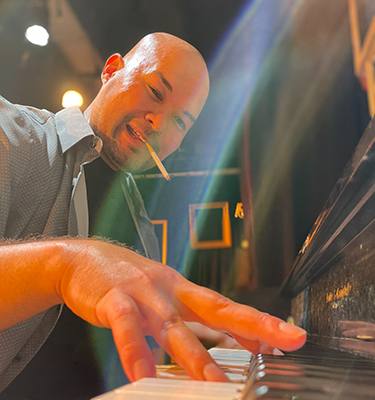
Jason Lee Hoy plays the play’s lead character.

“James Weldon Johnson wrote the novella in 1912, and it was only about 120 pages,” says Francis, who is the first writer ever to adapt the novel into a screenplay. “The play will feature ragtime music, racial identity and depictions of lynching with the main character traveling across U.S. and Europe.”

The first fictional memoir ever written by a black person who was also the first black executive secretary of the National Association for the Advancement of Colored People (NAACP), “The Autobiography of an Ex-Coloured Man” influenced a generation of writers during the Harlem Renaissance, and served as eloquent inspiration for Zora Neale Hurston, Ralph Ellison and Richard Wright. In the 1920s and since, it has continually compelled the reader to challenge assumptions about race. It has also given white readers a new perspective on their own culture, revealing the double standard of racial identity imposed on African Americans.

Narrated by a mulatto man whose light skin allows him to “pass” for white, the novella describes a pilgrimage through America’s color lines at the turn of the century—from a black college in Jacksonville, Florida to an elite New York City nightclub, from the rural South to the white suburbs of the Northeast.

This is a potent, painfully honest examination of race in America, a canticle to the anguish of forging an identity in a nation obsessed with color. And, as the late poet Arna Bontemps pointed out decades ago, “the problems of the artist [as presented here] seem as contemporary as if the book had been written this year.”

The three-day performances will run from April 21-23, with shows starting at 7:30 p.m. on April 21 and 22, and a matinee program at 2 p.m. on April 23. Seating is limited at the Vi and Paul Loo Theatre. Click here for tickets.

“It’s an ambitious undertaking to stage this play,” says Performing Arts assistant professor Christopher Patrinos in praise of Francis. “Allison deserves a lot of credit for writing and directing such a challenging theme.”

Posted by: University Communications & Marketing Filed Under: Campus and Community, Diversity and Inclusion, Faculty, Featured Story, Homepage, Student Life Tagged With: Campus Event

Celebration of the Arts

April 5, 2023

During the pandemic, most campus events went dark, including the Environmental + Interior Design Program’s annual art exhibition. However, as COVID restrictions lifted last year, Dr. Junghwa Suh decided to resurrect the program and named it Celebration of the Arts. This year, the associate professor of Arts and Design tacked on “Gala” at the end of the title to reflect what she hopes will be even bigger and better than last year’s celebration.

“This is to showcase the talent on campus,” Suh says. “Our art program is actually flourishing, and we’re seeing higher enrollment.”

Faculty and staff members, students and anyone with an artistic flair are invited to submit their pièces de résistance, from ceramics and drawings to paintings and poetry. The Chaminade Celebration of the Arts at the Sullivan Family Library held a soft opening on April 10 with a celebration gala held on April 19. The installation can be viewed until the end of the month.

The Celebration of Arts installation will be on display through the end of April.

Supported by The Marianist Sponsorship Ministries Foundation, the Chaminade Celebration of the Arts Gala will be a culmination of “The Marianists & the Arts” workshop series, which began in 2021. The year-long project was undertaken to engage Chaminade faculty, staff and undergraduate and graduate student leaders in the historical stories of the transformative educational approach—witty, quirky and visionary—of the first Marianists in Hawaii in the establishment of Chaminade.

“The first year of the granted project focused on building ‘A Sense of Spirit; A Sense of Place’ with the study of six of the early Marianists in Hawaii,” explains Sr. Malia Wong, D.Min, Program Director for Chaminade’s BDK-Fujitani Interfaith Program. “The second year of the project focused on using the Hawaiian translation (‘olelo Hawai’i) of the Characteristics of Marianist Education to inspire others to reflect on these guiding principles in their lives, in their language, and hopefully as wisdom values to nobly live by. This is one way of perpetuating the legacy of Chaminade against the unique and diverse cultural richness of the environment embraced in the graciousness of the spirit of Hawaii.”

Suh has already commissioned works from students and adjunct faculty, guaranteeing that there will be a good representation of the various art mediums. “There is so much creativity on campus,” says the Discipline Coordinator for Arts and Design. “The Gala Night will feature food, a talent show and live music. It will truly be a celebratory event.”

Suh and Wong are excited about the inclusion of more three-dimensional art, more commonly referred to as 3D art. The term refers to any art that is created in three dimensions, rather than two-dimensional, like a drawing. This type of three-dimensional art can be made in many different ways, including sculptures, paintings and even photographs. 3D art can be used to create beautiful and intricate pieces that are sure to amaze and impress viewers.   

“We also emphasize the therapeutic and healing aspects of art,” Suh says. “I believe there should be a balance between the humanities and the sciences, and art is the perfect medium to achieve that equilibrium.”

The Gala is open to the Kalaepohaku community and neighboring residents and will be on display through the month of April.

Posted by: University Communications & Marketing Filed Under: Campus and Community Tagged With: Campus Event, Environmental + Interior Design

Brink of Enlightenment

March 22, 2023

Formation never really ends for a Marianist; it is a life-long process of spiritual renewal, personal growth and committed service.

Bro. Ed Brink, S.M.

Bro. Ed Brink sheds light on Marianist values

Inspired by author Rachel Carson’s seminal novel about the environment, “Silent Spring,” a young dewy-eyed Bro. Ed Brink sought to pursue a degree in Environmental Engineering Technology with hopes of being part of the solution to climate change. The caveat: He had to attend a Catholic college.

After researching Catholic universities in and around his home state of New York, Brink decided to step out of his zip code and visited the University of Dayton. Hesitant at first about living in the Midwest, Brink arrived on the College Park campus not yet fully committed to enroll. However, after reviewing the various majors offered at the school, the then-18-year-old teenager found an environmental program that suited his passion.

“Like a lot of people in the ’70s, I was influenced by Rachel Carson’s writings about the dangers to our environment,” recalls Brink, who pledged his first vows to the Society of Mary (Marianists) on Aug. 11, 1985. “I wanted to use technology to do good for the climate.”

Bro. Ed Brink discusses Marianist values with students at the Sullivan Family Library Lawn.

Soon, though, Brink found himself more interested in the acts of service, which is one of the pillars of a Marianist education. He no longer saw himself as a renegade “environmentalist” with a mission to save the planet. Instead, with the encouragement of his professor, Fr. James Heft, Brink thought deeply about committing to the religious life of a Marianist.

“I went to my first meeting and I got scared away,” says Brink, with a smile. “Honestly, I wasn’t sure this was going to be for me.”

Although ambivalent, Brink was still very much interested in the acts-of-service component of his education, prompting him to live in a Marianist community during his junior and senior years. The experience compelled him to start the Marianist Formation, a relatively lengthy, five-step process to help future Marianists determine whether it is the right path for them. 

The first phase, “Contact,” requires regular interaction with a Marianist priest or brother and a local Marianist community, which would provide the opportunity for live-in experiences, discernment groups and retreats.

“And then you do two years of novitiate, most of which takes place at Mount Saint John in Beavercreek, Ohio,” explains Brink, whose pursuit to understand the meaning of religious life led him to the Bergamo Center for Lifelong Learning, a nearby retreat that welcomes people of all faiths to experience spiritual growth through its educational and ecumenical programs. 

“During the first year, the formation focuses on intellectual and spiritual growth,” Brink says, “and you take classes in the history and theology of religious life, and life as a Marianist in particular.”

During his second year as a novice, Brink participated in active ministry while also teaching classes. Once he completed his novitiate stage, Brink made his first vows and entered the “Temporary Professed” period, which can take three to six years.

“It’s a long and involved process to become a perpetually professed brother,” Brink says. “Formation never really ends for a Marianist; it is a life-long process of spiritual renewal, personal growth and committed service.”

Bro. Ed Brink returns to the classroom to teach CUH 100.

After completing his bachelor’s in Environmental Engineering Technology at the University of Dayton, where he also obtained his Ohio teaching certificate, he then attained his master’s in Private School Administration from the University of San Francisco. In 1985, he started full-time teaching at Chaminade Julienne Catholic High School in Dayton, until 1989, when he switched to part-time teaching and worked in campus ministry the rest of the time. Brink was subsequently named director of Faculty and Staff Development and then principal from 1994 to 1998. 

 “I’ve spent more than 25 years in Dayton, longer than any one place I’ve lived in my life,” Brink says. “And now I’m entering my seventh year here in Hawai’i.”

Prior to his appointment as Chaminade’s Rector in 2016 and now also its Vice-President of Mission, Brink served as a regent for the university from 2007 to 2015. At the same time, he worked for the Society of Mary as the Assistant for Education for the Marianist Province of the U.S., overseeing the relationships between the Province and three Marianist universities: Chaminade University of Honolulu, University of Dayton and St. Mary’s University in San Antonio. At the University of Dayton, he served as the director for the Center for Catholic Education and the school’s Lalanne Program director.

Brink was also a liaison between the Province and such sponsored schools as Saint Louis, planning and executing programs for teachers and administrators. In addition, he was a member of the Provincial Council and a board member for Saint Louis School.

The popular campus figure has now also returned to the classroom, teaching CUH 100, which provides an overview of the university. 

“I really like the interaction with students,” Brink says. “I received a call out of the blue the other day from a former UD student, whom I remember taking outside the chemistry lab and telling him he better button up and apply himself. He became a doctor and he wanted to tell me this, and that he has never forgotten the talk I gave him that day. Now seeing that kind of transformation is rewarding.” 

Posted by: University Communications & Marketing Filed Under: Campus and Community, Catholic Tagged With: Marianist

History in the Making

March 9, 2023

Students from middle to high schools show off their historical projects

Participants work on an origami project with the guidance of members from the Japanese Cultural Center of Hawaii.

With easing COVID restrictions, this year’s Honolulu District History Day Fair was not held virtually for the first time since the pandemic. The hybrid format allowed students to attend in-person at Chaminade University’s Hale Hoaloha. In total, 114 students—from middle to high schools—registered from eight schools, including some ʻōlelo Hawaiʻi students; 65 projects were submitted; and 10 teachers acted as mentors.

“The Chaminade School of Humanities has a longstanding relationship with Hawaii History Day,” says Cheryl Edelson, Chaminade’s Dean of School of Humanities, Arts and Design. “In fact, Chaminade Professor of History, Dr. Mitch Yamasaki, is one of the founding members of Hawaii History Day—a program that since 1990 has brought together K-12 teachers, students and community members to research and create projects on the importance of history.”

Hawaii History Day coincides with the National History Day® (NHD), an educational nonprofit organization that engages teachers and students in historical research. The mission of NHD is to improve the teaching and learning of history in middle and high school through an innovative framework of historical inquiry and research. Students learn history by selecting topics of interest, launching into year-long research projects, and presenting their findings through creative approaches and media.

“The scope of projects and the innovative approaches presented by students is always exciting and impressive,” Edelson says. “In 2021, Hawaii History Day participant Keilani Kajiyama Tinkham of Laie Elementary School earned first place honors in the National Junior Division in Performance for her project The Rhythm of Resilience: Communication through the Bon Dance.” 

Social Studies teacher Jaimy Valerio helps students with their project.

Students can choose from one of five different project formats: Exhibit, Performance, Documentary, Essay and Website. On Hawaii Island, students can also enter their projects in ʻŌlelo Hawaiʻi. This year’s narrative theme was “Frontiers in History: People, Places, Ideas.”

“Hawaiʻi History Day is about community, connection, and the exchange of knowledge through storytelling, connecting our histories to our everyday lives and sparking inspiration for the future,”  says Shannon Cristobal, Director of Hawaiʻi History Day. “These community connections and storytelling exchanges have been particularly crucial for our students as they endured constant schedule changes and profound isolation during online learning through the COVID pandemic, which has really hit our educational community hard.”

Winners will go on to compete at the state competition at a later date. Their projects capture the human experience, showcasing the complex historical contexts that have led to the ideas, which have become so ingrained in our everyday lives.

“When students participate in History Day, they become expert detectives, writers, artists and storytellers,” says Devin Makizuru, Hawaii History Day Assistant Coordinator. “They find bits and pieces of a story, and bring them together to create a different one. This story they tell has a part of them in it, so it is special in that way. We may hear the same stories over the years, but the voices telling them are different. And sometimes, something very special happens…and someone tells a story that no one has ever heard before.”

Posted by: University Communications & Marketing Filed Under: Campus and Community, Diversity and Inclusion, Education, Homepage Tagged With: Campus Event

  • « Go to Previous Page
  • Page 1
  • Interim pages omitted …
  • Page 20
  • Page 21
  • Page 22
  • Page 23
  • Page 24
  • Interim pages omitted …
  • Page 51
  • Go to Next Page »

Footer

Chaminade University Logo

3140 Waialae Avenue
Honolulu, Hawaii 96816

Contact Us
Phone: (808) 735-4711
Toll-free: (800) 735-3733

facebook twitter instagram youtube linkedin

Visit

  • Plan Your Visit
  • Campus Map (PDF)
  • Events

Resources

  • Campus Security
  • Student Consumer Information
  • Concerns, Feedback, and Reporting
  • Institutional Review Board
  • Title IX / Nondiscrimination Policy
  • Compliance
  • Emergency Information
  • Careers
  • Institutional Statement

People

  • Students
  • Parents
  • Alumni
  • Faculty & Staff

Policy

  • Privacy Policy
  • Terms and Conditions of Use


© Chaminade University of Honolulu