• Skip to primary navigation
  • Skip to main content
  • Skip to footer
Chaminade University of Honolulu

Chaminade University of Honolulu

  • VISIT
  • APPLY
  • GIVE
  • STUDENTS
  • PARENTS
  • ALUMNI
  • FACULTY/STAFF
  • Admissions
    • Admissions Home
    • Undergraduate Students
      • First-Year Students
      • Transfer Students
      • Admitted Students
    • Graduate Students
    • Flex Online Undergraduate Program
    • Military Students
    • Non-Degree/Visiting Students
    • Experiential Honors Program
    • Early College Program
    • New Student Orientation
  • Tuition & Aid
    • Financial Aid Home
    • Tuition & Expenses
    • Federal Updates & Changes
    • Scholarships
    • $5,000 Graduate Scholarship
    • VA Education Benefits
    • Net Price Calculator
  • Academics
    • Academics Home
    • Academic Programs
    • Office of Student Success
      • Academic Advising
      • Records and Registrar
    • Kōkua ʻIke (Support Services)
      • ADA Accommodations
      • Career Services
      • Proctoring Services
      • Tutoring Services
    • Sullivan Family Library
    • Undergraduate Research & Pre-Professional Programs
    • Commencement
  • Campus Life
    • About Campus Life
    • Student Engagement
    • Student Government Association
    • Residence Life and Housing
      • Summer Conference Housing
    • Health Services
    • Marianist Leadership Center
    • Counseling Center
    • Campus Ministry
    • Campus Security
    • Dining Services
    • Bookstore
  • Athletics
  • About
    • Chaminade University News
    • Our Story
    • Leadership
    • Chaminade University Strategic Plan 2024-2030
    • Mission & Rector
    • Association of Marianist Universities
    • Facts & Rankings
    • CIFAL Honolulu
    • Accreditation & Memberships
    • Montessori Laboratory School
Search
×

Search this web site

Campus and Community

Chaminade University and United Nations Host Pacific Regional Sustainability Conference

November 29, 2022

Chaminade University and the United Nations will host a ground-breaking regional sustainability conference this week at the university campus to discuss climate change and the potential impacts to the Pacific region.

The “XIX Steering Committee Meeting Of The CIFAL Global Network” runs from Wednesday, November 30 to Friday, December 2, with the three-day conference bringing together world and local community leaders on goals, education and solutions to the global warming crisis. It will include seminars and workshops by experts from the United Nations and others around the world on climate change, global warming and sustainability.

This regional conference hosted by Chaminade University follows the UN COP 27 Climate Change Summit held earlier this month in Egypt, in which 200 participating countries came together to help resolve the climate change issue.

Seminars and workshops will allow timely and important discussions on a variety of topics related to leadership, health and wellbeing, education, and sustainability in Hawai‘i as well as the United Nations’ Sustainable Development Goals. These goals include climate action, advocating for the oceans, reducing inequalities, and developing programs that pursue peace, justice and strong institutions.

Conference attendees will participate at this week’s Hawaii conference either in-person or virtually. The conference will kick off with an evening reception on Tuesday, November 29 at the university with opening remarks by event co-organizers United Nations Assistant Secretary-General and UNITAR executive director Nikhil Seth and Chaminade University provost Dr. Lance Askildson. Hawaii Governor-Elect Dr. Josh Green is also scheduled to speak during the opening reception.

Earlier this year, Chaminade and the United Nations launched a new Pacific region training and research center to provide leadership development opportunities to tackle these urgent global issues. The university’s Centre International de Formation des Autorités et Leaders (CIFAL) Honolulu is the first and only one of 24 international United Nations Institute for Training and Research (UNITAR) centers to represent the Pacific area.

The Pacific region training center will provide innovative leadership development opportunities and tackle issues such as climate change, poverty, clean water and energy and other urgent global issues. The university’s CIFAL Honolulu Center is the only international United Nations Institute for Training and Research (UNITAR) center located in the Pacific region.

“Our school is honored to partner with the United Nations in hosting this exciting, groundbreaking conference to deal with the critical and timely issue of climate change,” said Chaminade University president Dr. Lynn Babington. “Our state has been an amazing leader in studying climate change and in innovating solutions that include using indigenous knowledge and practices along with new technologies. Sharing these ideas with the rest of the world will only benefit all of us in dealing with this global crisis.”

Tuesday’s reception from 5 p.m. to 8 p.m. and Friday’s sessions from 11 a.m. to 1 p.m. are open to the public. To learn more about the new Chaminade United Nations learning center, go to: chaminade.edu/cifal-honolulu.

# # #

About Chaminade University
Chaminade University of Honolulu believes in the power of education to drive positive change, broaden perspectives and deepen our understanding of one another. With an emphasis on transformative service-learning experiences, we prepare students to serve as tomorrow’s leaders, inspiring and challenging them to use their minds and their hearts to help build stronger and more just communities. We are proud to serve as Hawai‘i’s only Marianist university, and rely on these values to guide us in delivering a high-quality education with an individualized approach and a focus on excellence, innovation and change. Established in 1955, we offer more than 30 undergraduate and graduate programs, including doctoral degrees in education, psychology and nursing practice. Learn more at chaminade.edu.

UNITAR CIFAL Honolulu Center at Chaminade University
CIFAL Honolulu Center is part of the United Nations Institute for Training and Research (UNITAR). It is the 21st international training and research center of the CIFAL Global Network and the only center located in the Pacific Region. CIFAL Honolulu aspires to empower Pacific peoples to create a sustainable future that reflects their values and the priorities of their communities.

Posted by: University Communications & Marketing Filed Under: Campus and Community, CIFAL Honolulu, Diversity and Inclusion, Featured Story, Innovation, Institutional, Press Release

Annual Ceremony Anoints the Hands of Healthcare Workers, Nursing Students

November 3, 2022

“There may come a time when recovery lies in the hands of physicians, for they too pray to the Lord that he grant them success in diagnosis and in healing for the sake of preserving life.”

Ecclesiasticus 38:1-4,6-10,12-14

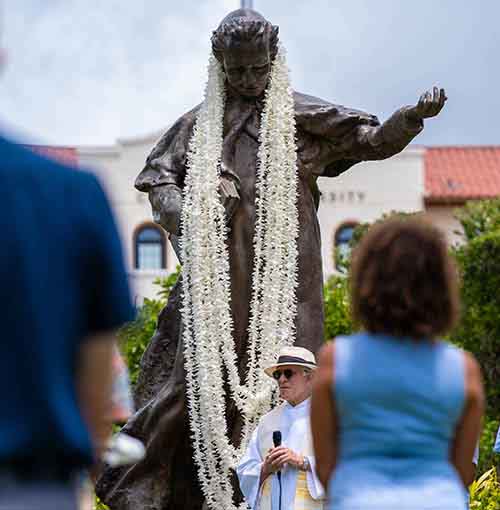
Blessing of hands at the Mystical Rose Oratory

In the book of Ecclesiasticus, it is said, “to honor physicians for their services, for the Lord created them.” The same could be said for students who seek a career in the medical field, and for all caregivers and those working in the medical profession. Sponsored by Campus Ministry, the annual St. Luke’s Blessing at the Mystical Rose Oratory honors these students by anointing their healing hands.

“Let us pray for all healthcare workers and those preparing for the healthcare profession,” said School of Nursing Professor Edna Magpantay-Monroe, in her closing prayer. “That their healing hands might bring comfort, hope, reassurance and joy to all those whom they serve.”

University chaplain Rev. Marty Solma, S.M., presided over the blessing, noting that this is a wonderful opportunity every year to honor those who embrace a life of service through healthcare nursing and to receive an anointment of their hands to recognize the importance that hands are in this critical profession. He then rhetorically asked, why is it that we bless the hands of medical professionals?

“It’s a tradition in in a number of churches in our Catholic tradition,” he replied. “It recognizes that of all the tools you have available to you, your hands will serve your patients directly and most personally. Medicine is important; surgery is often needed. But it’s your hands that will bring tenderness and care, and comfort and reassurance.

St. Luke was indeed blessed with the gift of healing. Deemed the first Christian physician on record and the Patron of the Medical Profession, Luke has influenced thousands of healthcare workers who have followed in his footsteps.

In his letter to the Colossians, St. Paul describes Luke as “the beloved physician,” (Colossians 4:14). In Lives of Illustrious Men, written circa A.D. 393, St. Jerome refers to him as “a physician of Antioch.”

Believed to be the author of the Gospel that bears his name, as well as of the Acts of the Apostles, Luke’s profession as a doctor is apparent in his writings. He includes more miracles of physical healing than any of the other Gospels, 13 compared to 12 in Matthew, 11 in Mark and only two in John. He uses more medical terms than any other New Testament writer. His description of the ailing reveals a knowledge of medicine that is absent in the other Gospels, using such precise medical terms as “dropsy” (Luke 14: 1-6), fever and dysentery.

“It’s my honor to participate in this very important ceremony to bless the hands of our nursing and healthcare professional students, and any of you who may be practicing nurses or other healthcare professionals,” said Chaminade University president, Dr. Lynn Babington. “The professionalism, care and compassion inherent in your profession are strengthened by this blessing. It also symbolizes commitment to your patients.”

Posted by: University Communications & Marketing Filed Under: Campus and Community, Catholic, Featured Story, Nursing & Health Professions

Leading Scholar of Religion Discusses Disaffiliation

October 28, 2022

One of the most urgent issues in social science research and among catholic institutions stems from the fact that people are leaving the church and disaffiliating from religion. It’s a serious concern that Fr. James Heft, S.M., discussed during a Marianist lecture at the Mystical Rose Oratory.

Fr. Jim Heft, SM

Themed, “Where Have All Young People Gone?,” Fr. Heft outlined complex solutions to a complicated question. Addressing the crowd, he shared his anecdotal stories, one of which occurred during a wedding rehearsal dinner.

“I asked a young woman named Monica about her religion, to which she answered, ‘Religion was forced down my throat,’” Fr. Heft recounts. “Whoa! I told her now that you can feed yourself, what do you think? It started five years of correspondence.”

Such candid conversations need to start happening across that nation if we want to find the reasons for disaffiliation. 

A 2018 study by the Institute for Advanced Catholic Studies (IACS) at the University of Southern California found that the Catholic population has been declining in the U.S., and Catholicism has experienced a greater net loss of people than any other religious tradition. The study also found that the majority of millennials raised Catholic typically now report that they are unaffiliated and there has been a significant drop in weekly Sunday attendance.

In a more recent Pew Research Study released in December 2021, those surveyed said they no longer go to church, but they still believe in God and pray. The report also revealed that those in the 18-29 age range represented the fastest decline in religious affiliation, with 36 percent rejecting any type of affiliation with a religious denomination. 

“Our interdisciplinary study, ‘Empty Chairs,’ published in 2021 by Oxford University Press, offers a more detailed—I think informative—and contextualized description of disaffiliation than the Pew study, which has its limitations,” Heft asserts. “The Pew provides a good overview of a specific demographic, mainly white, affluent and well educated.”

In contrast, Heft described the sample group for “Empty Chairs” as more inclusive and representative of a more diverse cohort among the unaffiliated. The study included immigrants whose approach to religion is different than white young adults. College non-graduates, high-school graduates, non-affiliated theists, the economically disenfranchised and an older generation—that had not affiliated with any religion for decades—also participated. 

Fr. Jim Heft, SM, speaking to students

“The study, however, provided some good news,” Heft said. “We document how religious parents provide warmth, appropriate religious structures and space for appropriate autonomy.”

The research also documents how fostering religious religious development in youth protects against delinquency, violence, depression and anxiety. In short, the healthy practice of religion cultivates psychological and physical well being, as well as civic involvement.

“Religious education and institutions continue to make a positive impact,” Heft asserted. “The question is: Is it secularization, the general movement in the culture, that has marginalized and privatized religion, and contributed profoundly to the situation we’re in?”

Heft admitted that disaffiliation is serious and alarming, but we shouldn’t become discouraged; there is hope. As the late religious scholar Huston Smith liked to say, “Religion gives traction to spirituality.”

“There are a lot of people suffering and hurting, and there’s nothing like an easy answer to make them more distant from faith,” Heft said. “We need to be careful in wanting to promote the faith in a deep way but not to promote it superficially. Afterall, Jesus said, ‘My God, my God, my God, why have you forsaken me?’”


Watch the full Marianist Lecture featuring Fr. Jim Heft, S.M, here.

Posted by: University Communications & Marketing Filed Under: Campus and Community, Catholic, Diversity and Inclusion, Featured Story Tagged With: Marianist Lecture

A New Frontier for Students

October 17, 2022

Students VR moon walking with NASA Educators

Students were over the moon when National Aeronautics and Space Administration (NASA) educators were on campus for a one-day Science, Technology, Engineering and Mathematics (STEM) event. Among them was Elementary Education major, Alaina Mercado, who described the experience as creative and inspiring.

“I got to ride a rocket to the International Space Station—virtually, of course,” Mercado quips. “It really made science fun and gave students a true hands-on, simulation experience; I even got to move about the cabin, as well as conduct a spacewalk.”

The outreach program is a national educator professional development and STEM engagement organization designed to partner with NASA in support of STEM educators and their students across the country. Its primary mission is to help a broader group of educators access the best of NASA’s professional learning resources, which are integrated with culturally relevant STEM pedagogies. The goal, overall, is to inspire and motivate diverse student audiences to pursue STEM fields of study, careers and opportunities with NASA.

NASA educators
NASA educators Sara Torres, Ph.D., and Monica Uribe

“NASA’s education and outreach programs are important to NASA’s mission, especially in STEM education for a few reasons,” explains NASA Ames Research Center Education Specialist, Sara Torres, Ph.D., one of the four NASA educators who led the event’s activities. “First, this is one of the ways that NASA not only informs the public of its programs and missions but engages the public through their educational competitions and hands-on activities that align with real-time work.”

Secondly, Torres adds, because NASA is aware of the demographic shift in the country, it has made a commitment to reach all students, including underserved and underrepresented population.

“NASA education specialists have the agency to connect NASA engineers and scientists to the public, allowing them to see the faces of NASA,” says NASA Armstrong Flight Research Center Education Specialist Monica Uribe, another event participant. “This opportunity not only creates spaces to learn about the important work NASA does but to connect with them in a way that students see themselves in the people who work at NASA and, most importantly, begin to see the possibilities that they, too, one day can work at a place like NASA.”

Associate Professor at the School of Education and Behavioral Sciences and Director of Teacher Education Programs, Dr. Katrina Roseler first established a Chaminade connection with NASA in 2016, but it wasn’t until a NASA summer workshop in 2018, when she met Dr. Torres, that opened the possibility of an on-campus visit.

“Since 2018, Chaminade students and I have participated in NASA Education activities, specifically online webinars, some of which have been facilitated by Dr. Torres and Dr. Monice Uribe (another event attendee and a NASA Armstrong Flight Research Center Education Specialist),” Roseler says. “In the spring of 2022, I reached out to Dr. Torres about an opportunity to collaborate virtually to support elementary education majors. Those conversations evolved into the face-to-face experience and subsequent activities that occurred during the three-day event in September.”

Students doing NASA projects

The day’s event at Chaminade featured various technology-based activities, an art project, as well as an engineering design challenge, which entailed using different materials to develop a Lunar Lander with a paper cup, note cards, channel sticks, rubber bands, adhesive tape and construction paper. Students were tasked to design and create a capsule that astronauts would be safe in when dropped from a height of 4 -5 feet.

“My Lander didn’t work so well,” Mercado laughs. “All the educators, though, were so very kind and encouraging.”

“We chose NASA activities that aligned well with the topics presented,” Torres says. “One was the moon. Students created their own rover out of recyclable materials. Their objective was to have the cardboard rover move using a rubber band, pencil, straw and Life Savers candy.”

NASA educators also covered the topic of Aeronautics. During the “Navigate Your Zone” module, students were able to use small ball robots, called Spheros, to simulate Unmanned Aerial Vehicles or UAVs. In another activity, students used templates of the experimental plane X-59 to fold paper airplanes then use their own breath as the thrust to make the paper airplane fly.

“The X-59 is NASA’s experimental plane, which is designed to lower the sonic boom,” Torres says. “Succeeding in this will allow for commercial travel to only take half the time it currently takes.”

Chaminade student teaching at Palolo Elementary School

A secondary component of the event included a visit to Palolo Elementary School, where Chaminade students took what they learned from NASA educators and shared it with the students in grades three to five.

“We transferred our knowledge to the kids,” Mercado says. “So it was kind of going full circle.”

Torres notes that their experience with the Chaminade education students was a joy, adding every student was motivated and ready to engage in the activity.

“More importantly, students were working—not only to learn the activities—but they understood they would be leading the activities with elementary students the following day and took their learning seriously,” Torres says. “Every student engaged positively, asked questions to better be prepared and did a phenomenal job facilitating the activities the following day.”

Roseler believes that such hands-on learning activities—which model what teachers should be doing in classrooms—are always beneficial.

“I imagine that these activities will resonate with Chaminade Education students for years to come,” Roseler says. “I plan on using them as examples throughout the remainder of the semester as examples of active learning with real-world applications.”

Posted by: University Communications & Marketing Filed Under: Campus and Community, Education, Featured Story, Students Tagged With: Experiential Learning

Using AI and Machine Learning in Healthcare

September 26, 2022

AIM-HEAD symposium slide

Algorithms are increasingly being used to make big decisions in healthcare, and there’s a common misconception that they’re unbiased. The truth is: they’re as biased as the humans that create them and a group of researchers—including several at Chaminade University—are trying to spotlight what that means.

In partnership with a federal consortium looking at the issue—dubbed AIM-AHEAD—Chaminade hosted a special virtual symposium in August aimed at better understanding the uses of artificial intelligence (AI) and machine learning in health and what changes are needed to improve health equity in the Pacific.

Dr. Claire Wright, an associate professor at Biology at Chaminade, said the symposium was about beginning a conversation—and ensuring Pacific voices are part of it. “We wanted to engage the community and understand some of the things that are really important to them,” she said.

“We think it’s kind of science fiction but there are many elements of health sciences that machine learning is already used, like diagnostics, surgery, prognosis, and driving health plans. But the data used to run those algorithms is not representative of our population in Hawaii.”

So is that a problem? And if so, how much of a problem?

That was the question tackled during the event—and the topics covered could help guide the development of best practices and ethical guidelines nationally. AIM-AHEAD, which organized the symposium with Chaminade, is funded by the National Institutes of Health and focused on increasing diversity among AI and machine learning researchers to ultimately improve the technologies in health applications, starting with electronic health records. The initiative’s acronym stands for the Artificial Intelligence/Machine Learning Consortium to Advance Health Equity and Researcher Diversity.

Chaminade Data Science Director Dr. Rylan Chong delivered the opening keynote at the symposium, urging attendees to consider how bias makes its way into algorithms and machine learning programs at various points in the process—from the bias that researchers bring to biases baked into “norm studies.”

Dr. Melissa McCradden, who is a bioethicist at the Hospital for Sick Children (affiliated with the University of Toronto), built on those themes in her keynote. She said the conversation happening around algorithmic bias, including in healthcare, is ultimately about “doing better science.”

“One of the major misperceptions is because AI uses so much data … that it’s ultimately leading us toward a place where we’re modeling objective truths about the world,” she said. “But we need to be really, really cautious about assuming that more data can get us closer to objectivity.”

Instead, she said, communities need to work together to make “values-based choices.”

And then, McCradden added, those choices need to be evaluated for their impacts.

Importantly, the symposium also included listening sessions so participants could weigh in on where inequities are now—and how technology might help to address them—rather than make them worse.

“These tools are already being used, but we don’t know the power of them for our communities,” Wright said. “Before we go too far down the line, we want to make sure that some of the folks who are underrepresented have the opportunity to be involved in the conversation.”

She added, “Let’s direct the quality of our own healthcare. Let’s tailor it to fit our needs.”  

Posted by: University Communications & Marketing Filed Under: Campus and Community, Diversity and Inclusion, Featured Story, Innovation, Natural Sciences & Mathematics

Bringing Filipino Language and Culture Back to Hawaii

September 21, 2022

Cebuano Language and Culture Program

It was a trip of a lifetime for a group of Hawaii educators and teachers-in-training.

And Communication Professor Eva Washburn-Repollo, Ph.D. was overjoyed to be their guide.

Over the summer, Washburn-Repollo led participants of her Cebuano Language and Culture Program on a six-week adventure to the Philippines, offering them an immersive experience designed to broaden their perspectives and understanding of the country’s diverse languages and rich cultures.

The teachers visited indigenous herbal gardens, mangroves and coral reefs, attended language workshops, and participated in educational sessions at local universities and other institutions. But they weren’t just there to learn. Along the way, they developed cultural-based resource materials and curricula for their own classrooms—lessons aimed at weaving in their students’ perspectives.

Roughly a quarter of Hawaii public school students identify as Filipino.

“We all need to lift each other up,” said Washburn-Repollo, whose academic scholarship includes a focus on the positive impacts for students of cultural appreciation in classrooms. “When a student has a teacher who values their culture, they feel as if they can be anything they want to be.”

The trip was made possible thanks to a $100,000 grant from the Fulbright-Hays Group Projects Abroad (GPA) Program. Washburn-Repollo took the group of eight participants to the islands of Negros Oriental and Cebu in the central Visayas region of the Philippines. That’s where the Cebuano language is primarily spoken—Washburn-Repollo’s first language and one of more than 120 found in the Philippines.

Those on the trip included current educators with years of experience and those just starting out.

Brittni Friedlander began her third year of teaching this fall and jumped at the chance to make the journey to the Philippines. She said she’s passionate about weaving science and technology education into her classroom and recently wrote a children’s book called Puff Saves Paradise.

Cebuano Language and Culture Program

“About 70% percent of my classroom last year were students of Filipino descent and I’m also half-Filipino,” Friedlander said. “It was an amazing opportunity to not only truly connect with my students, but learn a bit about my cultural heritage as well and incorporate that into my classroom genuinely.”

She said the most memorable part of the trip was the closing ceremony, during which all the participants got the chance to share their final lesson plans. Friedlander also enjoyed learning about the customs of the region, from the delicious cuisine to the herbal remedies communities use.

“As a teacher, I think it’s so very important to connect with one’s students on a relational level,” Friedlander said. “From here, I would like to use the knowledge garnered during this journey and share it in my classroom with cultural units or ‘around the world’ day with my students.”

Participant Clarissa Torres just finished her Master of Arts in Teaching degree at Chaminade and was quickly hired to teach eighth-grade science at Mililani Middle School. She wanted to make the trek to the Philippines so she could make more (and stronger) connections with her students. “I also wanted to learn more about my own Filipino culture and wanted to gain new perspectives as an educator,” Torres said.

She added that the program wasn’t easy—by any stretch.

Torres struggled with getting out of her comfort zone and developing a lesson plan.

“I created an original Cebuano song about the collectivism of the community in Apo Island as well as how they conserve water,” Torres said. “This experience expanded my ideas on how to incorporate all of my students’ cultures in my classroom and music is one thing I would like to weave in.”

She said by learning just a few simple phrases in Cebuano, she was already making relationships with people she met. “They appreciated our efforts to learn the language,” Torres said. “My biggest takeaway was I have a greater understanding of the beauty of learning a new language.”

Cebuano Language and Culture Program

Washburn-Repollo agreed what moved her the most about the people that the group met on their adventure is just how excited they were to share their time—and wisdom. “Everyone we met wanted to share their language with us,” she said. “Every preserved language is a door to a new solution to diseases, it’s a door to alternatives to happiness and peace. We have so much to learn.”

This wasn’t the first group Washburn-Repollo has taken to the Philippines. It’s actually the fourth, though the previous treks weren’t funded by Fulbright. The professor has also accompanied nursing students for a clinical immersion and organized trips focused on community building and finance.

Her central focus is helping people realize that broadening their own perspective and learning from groups who have no voice on the world stage has the power to unearth rich gifts of knowledge. And in classrooms, she said, it can do a wonderful thing: to ensure students from all backgrounds feel welcome.

“The key is making all students feel valued,” she said.

Participant Kalika Ayin couldn’t agree more. She’s an English Learner teacher at Pearl City High School and applied to the Cebuano Language and Culture Program because she wanted to learn more about her own students. “Many of my students are from the Philippines … so I wanted to learn about Filipino culture so I could improve my teaching and my communication with their families,” Ayin said.

She added that she was particularly interested in the program’s language immersion component “because I knew it would help me understand what my students experience when they move to Hawaii. I also wanted to learn enough of their language to make them feel welcome and seen in my classroom.”

The most memorable part of the trip for Ayin was graciously being invited into her Filipino teacher partner’s home and meeting her family. “She bridged me into her culture and helped me practice the Cebuano language,” Ayin said, reflecting on the trip. “Her hospitality and patience deeply impacted me. Our partnership fostered an international teaching network—and an international friendship.”

She also said that the experience of learning a new language through immersion helped her see the world a little better through her students’ eyes. For example, when she was using the Cebuano language in conversation but couldn’t find the right word right away, her stress levels rose. “It helped me understand how my students likely feel immersed in U.S. classroom settings,” she said.

Cebuano Language and Culture Program

And Ayin is looking forward to one lesson, in particular, this coming school year.

She plans to show her students a video she co-wrote and produced with her Filipino teacher partner detailing how to make the Cebuano dessert binignit, a fruit stew made with coconut milk, sweet potato, bananas and other fruits and vegetables at hand. “The video includes a narrative about the rich symbolism between the ingredients in binignit and the Cebuano culture,” she said.

Ayin said she’ll use the video to launch into a unit of study exploring food staples across the Pacific.

And then her students will get to work in the kitchen (and classroom), producing a cookbook to share broadly with families in Pearl City that incorporates Pacific dishes. “My goal is to foster pride in multilingualism,” she said, “and help students own their languages with confidence.”

LeAndre Browne, a doctoral student in education at Chaminade who teaches first grade in Georgia, wishes every teacher could go on a trip like the one Washburn-Repollo organized. “I’m a lifelong learner and was extremely interested in learning another language and experiencing another culture,” she said.

“Despite being from different places, people can share similar interests bringing them closer, like a love of plants,” she said, adding that she is particularly grateful for all of the relationships she was able to forge with people the group learned from over the course of six weeks.

Jessica Watkins doesn’t have a classroom of her own yet but said she can’t wait to bring what she learned in the Philippines to her future lesson plans. Watkins is majoring in Elementary Education at Chaminade and said there were so many memorable moments on the trip, that it’s hard to pick a favorite.

Learning Cebuano songs and then singing them at their final presentation. Staying on Apo Island, which has no cars and limited hours of electricity service. Getting to enjoy the region’s stunning coastlines. “I now know enough of the language to have basic communication with someone,” Watkins added.

“And that could help my students feel more comfortable in my future classroom.”

Posted by: University Communications & Marketing Filed Under: Campus and Community, Diversity and Inclusion, Education, Faculty, Featured Story, Students Tagged With: Grants

  • « Go to Previous Page
  • Page 1
  • Interim pages omitted …
  • Page 22
  • Page 23
  • Page 24
  • Page 25
  • Page 26
  • Interim pages omitted …
  • Page 50
  • Go to Next Page »

Footer

Chaminade University Logo

3140 Waialae Avenue
Honolulu, Hawaii 96816

Contact Us
Phone: (808) 735-4711
Toll-free: (800) 735-3733

facebook twitter instagram youtube linkedin

Visit

  • Plan Your Visit
  • Campus Map (PDF)
  • Events

Resources

  • Campus Security
  • Student Consumer Information
  • Concerns, Feedback, and Reporting
  • Institutional Review Board
  • Title IX / Nondiscrimination Policy
  • Compliance
  • Emergency Information
  • Careers
  • Institutional Statement

People

  • Students
  • Parents
  • Alumni
  • Faculty & Staff

Policy

  • Privacy Policy
  • Terms and Conditions of Use


© Chaminade University of Honolulu