• Skip to primary navigation
  • Skip to main content
  • Skip to footer
Chaminade University of Honolulu

Chaminade University of Honolulu

  • VISIT
  • APPLY
  • GIVE
  • STUDENTS
  • PARENTS
  • ALUMNI
  • FACULTY/STAFF
  • Admissions
    • Admissions Home
    • Undergraduate Students
      • First-Year Students
      • Transfer Students
      • Admitted Students
    • Graduate Students
    • Flex Online Undergraduate Program
    • Military Students
    • Non-Degree/Visiting Students
    • Experiential Honors Program
    • Early College Program
    • New Student Orientation
  • Tuition & Aid
    • Financial Aid Home
    • Tuition & Expenses
    • Federal Updates & Changes
    • Scholarships
    • $5,000 Graduate Scholarship
    • VA Education Benefits
    • Net Price Calculator
  • Academics
    • Academics Home
    • Academic Programs
    • Office of Student Success
      • Academic Advising
      • Records and Registrar
    • Kōkua ʻIke (Support Services)
      • ADA Accommodations
      • Career Services
      • Proctoring Services
      • Tutoring Services
    • Sullivan Family Library
    • Undergraduate Research & Pre-Professional Programs
    • Commencement
  • Campus Life
    • About Campus Life
    • Student Engagement
    • Student Government Association
    • Residence Life and Housing
      • Summer Conference Housing
    • Health Services
    • Marianist Leadership Center
    • Counseling Center
    • Campus Ministry
    • Campus Security
    • Dining Services
    • Bookstore
  • Athletics
  • About
    • Chaminade University News
    • Our Story
    • Leadership
    • Chaminade University Strategic Plan 2024-2030
    • Mission & Rector
    • Association of Marianist Universities
    • Facts & Rankings
    • CIFAL Honolulu
    • Accreditation & Memberships
    • Montessori Laboratory School
Search
×

Search this web site

Campus and Community

Bringing Filipino Language and Culture Back to Hawaii

September 21, 2022

Cebuano Language and Culture Program

It was a trip of a lifetime for a group of Hawaii educators and teachers-in-training.

And Communication Professor Eva Washburn-Repollo, Ph.D. was overjoyed to be their guide.

Over the summer, Washburn-Repollo led participants of her Cebuano Language and Culture Program on a six-week adventure to the Philippines, offering them an immersive experience designed to broaden their perspectives and understanding of the country’s diverse languages and rich cultures.

The teachers visited indigenous herbal gardens, mangroves and coral reefs, attended language workshops, and participated in educational sessions at local universities and other institutions. But they weren’t just there to learn. Along the way, they developed cultural-based resource materials and curricula for their own classrooms—lessons aimed at weaving in their students’ perspectives.

Roughly a quarter of Hawaii public school students identify as Filipino.

“We all need to lift each other up,” said Washburn-Repollo, whose academic scholarship includes a focus on the positive impacts for students of cultural appreciation in classrooms. “When a student has a teacher who values their culture, they feel as if they can be anything they want to be.”

The trip was made possible thanks to a $100,000 grant from the Fulbright-Hays Group Projects Abroad (GPA) Program. Washburn-Repollo took the group of eight participants to the islands of Negros Oriental and Cebu in the central Visayas region of the Philippines. That’s where the Cebuano language is primarily spoken—Washburn-Repollo’s first language and one of more than 120 found in the Philippines.

Those on the trip included current educators with years of experience and those just starting out.

Brittni Friedlander began her third year of teaching this fall and jumped at the chance to make the journey to the Philippines. She said she’s passionate about weaving science and technology education into her classroom and recently wrote a children’s book called Puff Saves Paradise.

Cebuano Language and Culture Program

“About 70% percent of my classroom last year were students of Filipino descent and I’m also half-Filipino,” Friedlander said. “It was an amazing opportunity to not only truly connect with my students, but learn a bit about my cultural heritage as well and incorporate that into my classroom genuinely.”

She said the most memorable part of the trip was the closing ceremony, during which all the participants got the chance to share their final lesson plans. Friedlander also enjoyed learning about the customs of the region, from the delicious cuisine to the herbal remedies communities use.

“As a teacher, I think it’s so very important to connect with one’s students on a relational level,” Friedlander said. “From here, I would like to use the knowledge garnered during this journey and share it in my classroom with cultural units or ‘around the world’ day with my students.”

Participant Clarissa Torres just finished her Master of Arts in Teaching degree at Chaminade and was quickly hired to teach eighth-grade science at Mililani Middle School. She wanted to make the trek to the Philippines so she could make more (and stronger) connections with her students. “I also wanted to learn more about my own Filipino culture and wanted to gain new perspectives as an educator,” Torres said.

She added that the program wasn’t easy—by any stretch.

Torres struggled with getting out of her comfort zone and developing a lesson plan.

“I created an original Cebuano song about the collectivism of the community in Apo Island as well as how they conserve water,” Torres said. “This experience expanded my ideas on how to incorporate all of my students’ cultures in my classroom and music is one thing I would like to weave in.”

She said by learning just a few simple phrases in Cebuano, she was already making relationships with people she met. “They appreciated our efforts to learn the language,” Torres said. “My biggest takeaway was I have a greater understanding of the beauty of learning a new language.”

Cebuano Language and Culture Program

Washburn-Repollo agreed what moved her the most about the people that the group met on their adventure is just how excited they were to share their time—and wisdom. “Everyone we met wanted to share their language with us,” she said. “Every preserved language is a door to a new solution to diseases, it’s a door to alternatives to happiness and peace. We have so much to learn.”

This wasn’t the first group Washburn-Repollo has taken to the Philippines. It’s actually the fourth, though the previous treks weren’t funded by Fulbright. The professor has also accompanied nursing students for a clinical immersion and organized trips focused on community building and finance.

Her central focus is helping people realize that broadening their own perspective and learning from groups who have no voice on the world stage has the power to unearth rich gifts of knowledge. And in classrooms, she said, it can do a wonderful thing: to ensure students from all backgrounds feel welcome.

“The key is making all students feel valued,” she said.

Participant Kalika Ayin couldn’t agree more. She’s an English Learner teacher at Pearl City High School and applied to the Cebuano Language and Culture Program because she wanted to learn more about her own students. “Many of my students are from the Philippines … so I wanted to learn about Filipino culture so I could improve my teaching and my communication with their families,” Ayin said.

She added that she was particularly interested in the program’s language immersion component “because I knew it would help me understand what my students experience when they move to Hawaii. I also wanted to learn enough of their language to make them feel welcome and seen in my classroom.”

The most memorable part of the trip for Ayin was graciously being invited into her Filipino teacher partner’s home and meeting her family. “She bridged me into her culture and helped me practice the Cebuano language,” Ayin said, reflecting on the trip. “Her hospitality and patience deeply impacted me. Our partnership fostered an international teaching network—and an international friendship.”

She also said that the experience of learning a new language through immersion helped her see the world a little better through her students’ eyes. For example, when she was using the Cebuano language in conversation but couldn’t find the right word right away, her stress levels rose. “It helped me understand how my students likely feel immersed in U.S. classroom settings,” she said.

Cebuano Language and Culture Program

And Ayin is looking forward to one lesson, in particular, this coming school year.

She plans to show her students a video she co-wrote and produced with her Filipino teacher partner detailing how to make the Cebuano dessert binignit, a fruit stew made with coconut milk, sweet potato, bananas and other fruits and vegetables at hand. “The video includes a narrative about the rich symbolism between the ingredients in binignit and the Cebuano culture,” she said.

Ayin said she’ll use the video to launch into a unit of study exploring food staples across the Pacific.

And then her students will get to work in the kitchen (and classroom), producing a cookbook to share broadly with families in Pearl City that incorporates Pacific dishes. “My goal is to foster pride in multilingualism,” she said, “and help students own their languages with confidence.”

LeAndre Browne, a doctoral student in education at Chaminade who teaches first grade in Georgia, wishes every teacher could go on a trip like the one Washburn-Repollo organized. “I’m a lifelong learner and was extremely interested in learning another language and experiencing another culture,” she said.

“Despite being from different places, people can share similar interests bringing them closer, like a love of plants,” she said, adding that she is particularly grateful for all of the relationships she was able to forge with people the group learned from over the course of six weeks.

Jessica Watkins doesn’t have a classroom of her own yet but said she can’t wait to bring what she learned in the Philippines to her future lesson plans. Watkins is majoring in Elementary Education at Chaminade and said there were so many memorable moments on the trip, that it’s hard to pick a favorite.

Learning Cebuano songs and then singing them at their final presentation. Staying on Apo Island, which has no cars and limited hours of electricity service. Getting to enjoy the region’s stunning coastlines. “I now know enough of the language to have basic communication with someone,” Watkins added.

“And that could help my students feel more comfortable in my future classroom.”

Posted by: University Communications & Marketing Filed Under: Campus and Community, Diversity and Inclusion, Education, Faculty, Featured Story, Students Tagged With: Grants

Harnessing the Data Revolution Through a $10 Million Grant

September 2, 2022

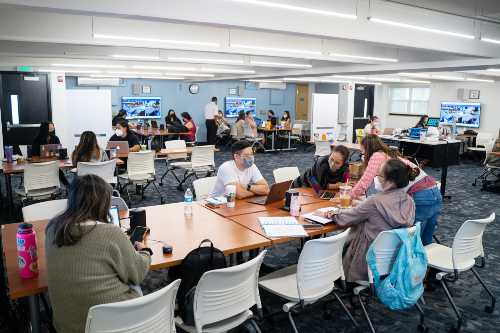
Data science class

Dr. Rylan Chong, director of Chaminade’s Data Science program, calls it nothing less than historic.

In early August, the National Science Foundation (NSF) INCLUDES Alliance selected Chaminade University to lead a groundbreaking $10 million grant project aimed at creating new opportunities in STEM and data science careers for historically underrepresented populations across Hawai‘i and the Pacific Region.

The grant announcement, Chong said, is one of those moments that educators will look back on in a decade or so and recognize as a turning point—the beginning of new initiatives that opened doors for students, the institutions that serve them, and nonprofit and business communities in the region.

“This is about leveling up, addressing capacity in the workforce and making sure our low-income and underrepresented students have an opportunity to bring their perspectives to data science,” Chong said, adding that welcoming diverse populations into data science will ensure their voices are heard.

“You can apply data science to every field—education, healthcare and mental health, environment science and climate change, and criminal justice,” he said. “It’s not just about crunching numbers but ensuring the numbers reflect different viewpoints and getting those numbers into the right hands.”

That’s why the Data Science program at Chaminade doesn’t just want to prepare students for competitive careers at the Googles and Amazons of the world. “We also want to find opportunities for students working in grassroots and community organizations, being able to contribute to projects they’re interested in while making a difference to the places where they live,” Chong said.

The competitive NSF grant is one of the largest Chaminade has ever received and reflects the strong data science work and foundational programs already in place at the University.

environmental sciences class at Makapuu

With the transformative funding, Chaminade’s United Nations-affiliated CIFAL Honolulu Center will spearhead the launch of the university’s new Alliance Supporting Pacific Impact through Computational Excellence (ALL-SPICE) with a consortium of partners, putting a strong emphasis on leadership for sustainable development and efforts aimed at tackling the growing impacts of climate change.

“Chaminade University is really quite honored to lead this important initiative charged with empowering STEM leaders for tomorrow from across Hawai‘i and the Pacific, equipping them with the cutting-edge tools they need to drive sustainable development projects,” said President Lynn Babington, PhD.

“This grant is part of a collective and exciting effort to meet a pivotal moment in our history by expanding opportunities to a new generation of change-makers. Our mission of service is foundational to everything we do at Chaminade and so we are proud to drive a culturally informed initiative ultimately designed to help build healthier, more resilient and socially just communities.”

The first ALL-SPICE programming and opportunities launched in the Fall.

Dr. Helen Turner, research director of the Chaminade United Nations CIFAL Honolulu Center and a professor of Biology, is principal investigator for ALL-SPICE along with Chong. She said the funding will focus on three central efforts: bolstering training and educating, conducting data science research on sustainable development projects, and building capacity (including infrastructure) for data analytics in Hawai‘i and the Pacific.

“This work takes a village,” Turner said, adding the grant was the result of years of collaboration between Chaminade and other institutions to step up programming and underscore the importance of data science to the community. The Chaminade-led consortium includes the University of Hawaii Data Science Institute, East-West Center and the Texas Advanced Computing Center (TACC).

“The National Science Foundation identified the power of data analytics for education, research and industry. They use this phrase ‘harnessing the data revolution’ because right now we are all swimming in an ocean of data,” Turner said. “We can either drown as individuals, communities and society or we can swim and surf that wave—take data and turn it into wisdom, knowledge and action-based plans.”

Data science student looking at data

Turner said that’s exactly what the Data Science program at Chaminade is focused on.

And the grant will exponentially increase that work, expanding opportunities to more students, community leaders and institutions so they can use data for the greater good. “Data and social justice go hand and hand. To me, it’s a very obvious and beautiful linkage,” Turner said.

For example, she says that health inequities are fundamentally a data problem—failing to get the right resources to the right people or not fully understanding the root causes for gaps in care. Environmental problems, economic development, educational gaps can be approached similarly.

“Because a big piece of this is meeting the needs of the community,” she added. “No university in the United States can keep up with the pace of demand for data scientists. We want our students to succeed, but we also don’t want our own organizations in Hawai‘i to be left behind.”

That’s why the grant will, in part, fund research or hands-on internships for students. Already, Chaminade students in data science are working on a plethora of important projects—looking at everything from maternal mortality in Pacific populations to recidivism in Hawai‘i.

“If you ask what is a data scientist, the answer is everything,” she said. “With data science, students undoubtedly can follow their personal passions and make a positive impact. This is ultimately a vehicle for students’ passions to change the world. It’s also about democratizing our relationship with data.”

CIFAL Honolulu Executive Director and Dean of the School of Natural Sciences and Mathematics Dr. Gail Grabowsky said data visualization and interpretation are a central focus of the grant’s programming. That’s because it’s not enough to analyze the data. Helping the community (especially non-data scientists) understand what the data says is just as important.

“We think data alone will change the world and it won’t,” said Grabowsky, who is also dean of the School of Natural Sciences and Mathematics at Chaminade. “What will change the world is many people working together on shared goals, using data along the way to inform policy and guide next steps.”

She added that CIFAL Honolulu envisions the Pacific Ocean as a “connector,” helping to spur conversations around both modern approaches and traditional knowledge and practices. Indigenous ways of knowing, Grabowsky added, could also bring about new perspectives and questions.

Dr. Lance Askildson, Chaminade provost, called the grant and its potential impact “incredibly significant.” He added, “This is really about creating a network of institutions across the Pacific, of which Chaminade is the lead, to provide education, training and research.”

He said a key part of the funding is working with community stakeholders to help them tell their own community stories with data. “Particularly here in the West, there is a tremendous amount of data being collected on us at all times of the day,” he said. “Being in control of your data is just like being in control of your Facebook profile—it’s a chance to tell a story with greater integrity that prioritizes your needs.”

data science class

ALL-SPICE co-Principal Investigator Dr. Kelly Gaither, the director of health analytics at TACC and a professor of Maternal Health at the Dell Medical School at the University of Texas at Austin, first started hearing about Chaminade’s work in data science in 2005 as part of a grant review committee.

What struck her the most, she said, is there was no tension between the pursuit of data science and traditional Hawaiian and Pacific knowledge and ways of knowing. “Chaminade was really trying to chop down any notion that Hawaiian science is not science,” she said. “This is the true definition of capacity building. Chaminade is really leading this, one community stakeholder and one student at a time.”

Gaither added she’s especially excited about the workforce opportunities the grant has to offer.

“We can dream big, peacefully coexist and all move forward,” she said. “That’s what is possible.”

Posted by: University Communications & Marketing Filed Under: Campus and Community, CIFAL Honolulu, Diversity and Inclusion, Featured Story, Innovation, Institutional, Natural Sciences & Mathematics Tagged With: Data Science, Grants

Pre-College Summer Institutes 2022

August 30, 2022

“Cooking with Chemistry”

“Think Like a Champion”

“Psychology of Happiness”

Those might sound like great reads—or fascinating TED Talks.

But they were actually some of the engaging and hands-on courses offered at Chaminade University over the summer to groups of Hawaii high schoolers. The students were participants in Chaminade’s Summer Institutes, made possible at the university thanks to a partnership with the federal GEARUP program.

The workshops are designed to give high school students a taste of college—and get them hooked.

Participants this year for the seven, two-week sessions included ninth to 12th graders from Farrington, Kaimukī, Ānuenue and McKinley high schools. And in addition to going on field trips and tackling fun projects, they got the chance to attend co-curricular sessions on college readiness. The topics covered everything you’d need to know as you prepare to graduate from high school and plan for college, including applying for financial aid, navigating admissions and student life.

Pure Imagination

Aaron Williamson, assistant professor of Accounting, taught a session called “The Successes of Pure Imagination: Business Development and Entrepreneurial Mentorship.” He said the course was designed as “an immersion into the world of entrepreneurship”—from business plan development, brainstorming sessions, strategic thinking skills-building and the application of “principles of success” in daily life.

“The entire process of teaching the course was memorable—from idea inception to business plan presentations,” he said. “Having a small part in assisting students to see how an idea can impact the world and developing theoretical businesses that will be on the streets of tomorrow is so enjoyable.”

Cooking with Chemistry
Chaminade University Summer Institute - Cooking with Chemistry

In Dr. Francis Sakai-Kawada’s “Cooking with Chemistry” course, students tie-dyed their lab coats to better understand the chemistry of dyes, made their own bars of soap as they explored the properties of saponification, and took chemistry into the kitchen to make butter, mayonnaise, boba and ice cream.

“The goal was develop activities that were hands-on and engaging,” he said. “We had the creative license and flexibility to tie underlying scientific and chemistry concepts to every activity. Our priority was to incorporate an element of fun. We wanted our students to see that so much of what we deal with in our daily life can be related to chemistry, from food to household cleaning products.”

Kawada added that students started the course a little shy, but slowly opened up.

And the highlight of the session: visiting the IL Gelato Factory to talk story with owner Dr. Dirk Koeppenkastrop (a fellow chemist), who discussed his path from a chemistry lab to studying the art and science of gelato in Italy and the “perfect ratio of ingredients” that goes into the sweet treat.

Psychology of Happiness
Chaminade University Summer Institute - Psychology of Happiness

Dr. Abby Halston, an assistant professor of psychology at Chaminade and clinical director of the university’s Marriage and Family Counseling program, taught the “Psychology of Happiness” course—which incorporated everything from guided meditation and breathing to personal journaling.

Students also put together personal stress management plans, worked to identify their hopes and dreams for college and beyond, and participated in mock career development interviews. The group also got to go on a field trip to Beyond Monet, an immersive experience into the artist’s works.

“I wanted to create a fun and life-changing institute where high school students could gain deep personal insight into their psychological wellbeing while learning personal management skills that could be utilized throughout their lifespan,” Halston said. “We focused on understanding the keys to happiness … and the power of our mindset to achieving our hopes and dreams.”

She added, “I cannot wait until next summer’s institute!”

For the Love of Math
Chaminade University Summer Institute - For the Love of Math

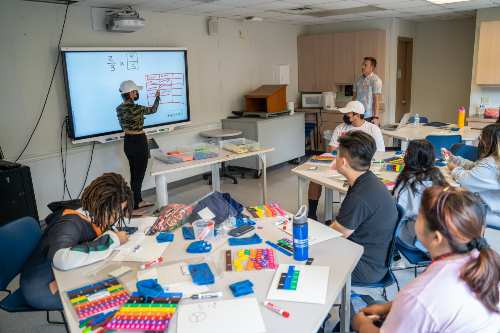
For the Summer Institutes course on “Creating Number Sense to Increase Love of Math,” Assistant Professor of Education Dr. Travis Mukina wasn’t just teaching math fundamentals, but un-teaching some bad math habits. “Most days consisted of mental math activities that forced students to view numbers in ways their elementary school teachers did not allow,” Mukina said. “We broke numbers apart, changed their values and accommodated for the change at the end of the problem.”

“Hands-on manipulatives were also used daily to allow students to visually see how the numbers were working with each other in multiple different strategies. Every activity ensured the students were learning from each other rather than from me. It was amazing to witness!” Mukina added.

He said one of the big takeaways for students was that math isn’t a set of rules and procedures to memorize, but about creativity and flexibility. Mukina also wanted participants to see how math can be used seamlessly in everyday life—and how even complicated things can be broken down.

“I feel so honored to be part of this summer institute,” he said.

Living Pono
Chaminade University Summer Institute - For the Love of Math

For the “Living Pono” institute, School of Nursing and Health Professions Professors Dr. Jennifer Nafarrete and Dr. Edna Magpantay-Monroe covered a wide range of health topics—from nutrition to human anatomy and physiology to reproductive health. Along the way, students tried their hand at cooking, engaged in some friendly competition, and put together presentations to tackle big topics.

Magpantay-Monroe said students really enjoyed the concepts of emotional intelligence and mindfulness, and especially loved their field trip to Ho‘omaluhia Botanical Garden—where they were challenged to strengthen their ability to “notice” and “be with nature.”

“I really enjoyed being a source of information to these students—helping them realize self-care is important but they also need to be self-aware of what is happening around them,” she said. “Being with nature helped increase their capacity to be mindful and reduce their stressors.”

Nafarrete added she was also happy to give students actionable, healthy solutions they can use everyday—like recipes. “My thought process was to find fun ways to engage students into making conscious choices about their health while considering how it affects the environment,” she said.

Think Like a Champion
Chaminade University Summer Institute - Think Like a Champion

Dr. Guanlin Gao, associate professor of Economics at Chaminade and director of the Economic Education Center for Excellence, focused on personal finance literacy in her course, “Think Like a Champion.” She wanted students to walk away with a better understanding of how to handle money.

“We spent one day visiting a local financial institution to learn more about how they operate and contribute to managing personal finances,” Gao said. “We spent another day on a fun team competition that involved budgeting, shopping and cooking. We even played a game that was all about inflation.”

Gao said the point of all the exercises was to help students see how better (and smarter) financial decisions ultimately lead to happier lives. “Interacting with the students was my favorite part,” she said. “For many of them, our trip to a bank was the first time they’d seen an actual vault. During our cooking competition, they all made nutritious meals. The best part: they were so proud of themselves.”

Posted by: University Communications & Marketing Filed Under: Behavioral Sciences, Business & Communication, Campus and Community, Diversity and Inclusion, Early College, Featured Story, Institutional, Natural Sciences & Mathematics, Nursing & Health Professions Tagged With: Summer Institutes

Economic Center for Excellence: Providing Financial Literacy Resources

August 22, 2022

What does cooking have to do with economics? Dr. Guanlin Gao is glad you asked.

High school students learning how to budget for a meal

Gao, a professor of economics and director of the Economic Education Center for Excellence at Chaminade, is on a mission to bolster financial literacy, education, and research in Hawaii. That’s why on a recent weekday she was cooking with a group of teens after giving them a budget to plan a menu.

The exercise was part of a hands-on financial literacy workshop for Hawaii high school students—and one of the economic center’s latest educational offerings. EECE also recently welcomed 28 Hawaii State Department of Education teachers to campus from 15 Oahu K-12 schools for an innovative educator training program. The aim: help them incorporate accessible and real-world financial literacy lessons into their curriculum.

“We’re here to help people understand just how important economics is to their everyday lives. Financial literacy education has the power to promote economic empowerment, ultimately strengthening our communities, our families, and the broader local economy,” Gao said.

With the support of community stakeholders and several organizations, Chaminade launched the Economic Education Center for Excellence in 2021 with an ambitious mission: “to advance prosperity and economic justice in Hawaii and the Pacific through integrated economic education, training and research.”

Gao notes that financial literacy in Hawaii is a significant area of need.

Nearly 7 in 10 Hawaii residents are considered “financially unhealthy.” Approximately 59% of Hawaii families report they’re struggling financially. And while 21 states require high school students to complete a personal finance or financial literacy course, Hawaii isn’t one of them.

Economic Education Center for Excellence educator workshop

“We use a train-the-trainer approach at the center,” Gao said. “In other words, our educational approaches, initiatives and projects have exponential power because everyone who comes through our center has the tools and the capacity to pass on what they’ve learned on to others.”

Chaminade President Lynn Babington, PhD, said the university was also the perfect place to house the Economic Education Center for Excellence because of its wealth of academic expertise, strong connections with the community, and institutional mission of public service.

“The center has not been operating for long, but it is already making a positive impact in the community,” Babington said. “Over the last year, we have also learned just how strong the demand for economics education and financial literacy is across the state. We look forward to continuing our expansion of the center’s programming to reach more Hawaii educators and students.”

Gao said the center is focused on:

  • providing accessible training programs to K-12 educators and students;
  • engaging with community networks to bolster financial literacy discussions;
  • undertaking research that explores barriers to economic empowerment;
  • and demonstrating measurable outcomes and impacts.

She added that another key focus is offering educational programming on the Neighbor Islands. “We want to reach people statewide with high-quality teacher training and financial literacy tools, and we’ve already started to make connections with Neighbor Island teachers and schools,” Gao said.

Since kicking off in April 2021, the center has already offered hands-on training opportunities for teachers and workshops for students—like the Summer Research Institute seminar where Gao found herself cooking with teens. She said the students got $15 to cook a nutritious meal for a family of four. Along the way, they learned key skills, from budgeting to product affordability and planning.

Also as part of the workshop, the students visited HawaiiUSA Federal Credit Union and walked into the vault. The idea was to explore the importance of personal banking and savings, and make financial institutions less mysterious.

Gao said the teacher training seminar is just as hands-on.

Economic Education Center for Excellence educator workshop

Educators round out the workshop by sharing their lesson plans with their colleagues and walking through the exercise together. “Teachers are passionate about sharing these important financial literacy skills with their students,” Gao said, adding reviews of the courses were overwhelmingly positive.

“They want to share what they’ve learned with their fellow teachers and they have strongly recommended the trainings,” Gao said. “The next step is reaching more educators and then building and building on what they’ve learned. The center’s focus is all about scaling up but also about repetition.”

Gao said the center is also interested in working with the Hawaii Department of Education to incorporate financial literacy lessons into the social studies curriculum, and already sees the workshops with educators as core to weaving grade-level appropriate economics education into classrooms.

Speaking of big goals, Gao has no shortage of them.

Within five years, she wants the center’s training opportunities to have reached hundreds of Hawaii teachers—and their thousands of students. She is also seeking new grant funding, pursuing research for publication in journals, and excited about the potential for welcoming affiliate faculty or advisors.

“We know we have work to do when it comes to financial literacy in Hawaii. But we are proud to be making a difference and serving as a hub for economics education,” Gao said. “Financial literacy doesn’t have to be hard and unreachable. In fact, financial literacy should be accessible to everyone.”

Posted by: University Communications & Marketing Filed Under: Business & Communication, Campus and Community, Featured Story, Innovation, Institutional Tagged With: Economic Education Center for Excellence

Chaminade University Receives $10 Million Grant for United Nations Sustainability Center

August 18, 2022

The National Science Foundation (NSF) selected Chaminade University to lead a groundbreaking $10 million, five-year grant project to create new leadership pathways into data science careers for students and working professionals across Hawaii and the Pacific region.

The grant is part of a comprehensive $39 million effort to establish four new NSF INCLUDES Alliances nationwide designed to bolster diversity and inclusion in scientific leadership, innovation and discovery.

With the help of the transformative funding, Chaminade University’s new United Nations sustainability center, CIFAL Honolulu, and Data Science program will spearhead the launch of the university’s new Alliance Supporting Pacific Impact through Computational Excellence (ALL-SPICE). Working with a consortium of partners, ALL-SPICE will focus on the application of data analytics to solve critical sustainability issues and promote sustainable development across the Pacific region. The program will also focus on workforce development, providing opportunities for skills building in data science to meet employer needs in this high-demand field.

The first Alliance programming will begin this September.

“Chaminade University is honored to lead this important initiative charged with empowering STEM leaders for tomorrow from across Hawaii and the Pacific, equipping them with the cutting-edge data analytics skills they need to drive sustainable development,” said Chaminade President Dr. Lynn Babington.

“This grant is part of a collective and exciting effort to meet a pivotal moment in our history by expanding opportunities to a new generation of change-makers. This program is founded in our mission of serving community needs and building d healthier, more resilient and socially just communities in Hawaii and the Pacific region.”

CIFAL Honolulu Executive Director Dr. Gail Grabowsky said ALL-SPICE will be “laser-focused” on data science as critical to helping Hawaii and Pacific region communities meet their sustainable development goals, including bolstering renewable energy, reducing inequality and forming sustainable communities.

“This project is about putting Pacific data in Pacific hands to effect regional change and develop the capacity for data-driven decision support,” Grabowsky said. “Our communities are facing big challenges and so this alliance is about helping tomorrow’s Hawaii and Pacific leaders to find big solutions.”

Dr. Helen Turner, research director of Chaminade’s CIFAL Honolulu Centre, is the principal investigator for ALL-SPICE along with Data Science Director Dr. Rylan Chong. She said the Data Science program at Chaminade has taken a community-focused approach from the start.

“Our data science faculty has a portfolio approach to data science education that meets students, working professionals and community members where they are to offer academic, training and informal learning programs,” she said. “NSF recognized the potential of applying this strategy across our Pacific region with a focus on using data analytics to promote sustainable development goals.”

The ALL-SPICE Alliance will have three central functions:

  • Offering training and education programs;
  • Conducting data science research on sustainable development;
  • And building capacity for data analytics, including with cyber infrastructure.

The Chaminade University-led consortium includes the University of Hawaii, East-West Center and the Texas Advanced Computing Center.

# # #

Chaminade University of Honolulu believes in the power of education to drive positive change, broaden perspectives, and deepen our understanding of one another. With an emphasis on transformative service-learning experiences, we prepare students to serve as tomorrow’s leaders, inspiring and challenging them to use their minds and their hearts to help build stronger and more just communities. We are proud to serve as Hawai‘i’s only Marianist university and rely on these values to guide us in delivering a high-quality education with an individualized approach and a focus on excellence, innovation, and change. Established in 1955, we offer more than 30 undergraduate and graduate programs, including doctoral degrees in education, psychology, and nursing practice. Learn more at chaminade.edu.

Posted by: University Communications & Marketing Filed Under: Campus and Community, CIFAL Honolulu, Diversity and Inclusion, Featured Story, Institutional, Natural Sciences & Mathematics, Press Release Tagged With: Data Science, Grants

Kosasa Foundation Awards $25,000 to Chaminade University for Emerging Scholars Program on Kaua’i

August 15, 2022

Kauai students visiting campus during emerging scholars program

Chaminade University recently received a $25,000 grant from the Kosasa Foundation in continued support of its Emerging Scholars Early College program. Now in its second year, the program is designed to promote pathways to college for rural Kaua‘i high school students. 

Open to qualified high school juniors and seniors, the Emerging Scholars program gives students a chance to discover and explore their passions and academic interests while earning dual-enrollment (high school and college) credits. For the 2022-2023 academic year, the program plans to enroll 40 Kapa‘a High school juniors and seniors.

Kauai students visiting campus during emerging scholars program

“We are extremely proud of our Emerging Scholars Early College program and grateful to the Kosasa Foundation for its ongoing support,” said Chaminade President Dr. Lynn Babington. “Programs like this allow Chaminade to provide access to college education for rural high school students, enhancing their enrichment opportunities and ability to grow as civic minded individuals.”

The Emerging Scholars Early College program is comprised of distance learning featuring Chaminade faculty and guest speakers. At the beginning of each semester, a team of Chaminade faculty and staff will visit Kapa‘a High School for an orientation with students, parents and teachers. At the completion of the academic year, students will participate in a culminating event on Chaminade’s campus, where they will stay in the residence hall and enjoy a sample college experience. 

In its first year, the Emerging Scholars program on Kaua‘i, which was also funded by the Kosasa Foundation, had a cohort of 24 juniors and seniors from Kapa‘a High School. 

# # #

Chaminade University of Honolulu believes in the power of education to drive positive change, broaden perspectives and deepen our understanding of one another. With an emphasis on transformative service-learning experiences, we prepare students to serve as tomorrow’s leaders, inspiring and challenging them to use their minds and their hearts to help build stronger and more just communities. We are proud to serve as Hawai‘i’s only Marianist university, and rely on these values to guide us in delivering a high-quality education with an individualized approach and a focus on excellence, innovation and change. Established in 1955, we offer more than 30 undergraduate and graduate programs, including doctoral degrees in education, psychology and nursing practice. Learn more at chaminade.edu.

Posted by: University Communications & Marketing Filed Under: Campus and Community, Diversity and Inclusion, Early College, Featured Story, Institutional, Press Release Tagged With: Grants

  • « Go to Previous Page
  • Page 1
  • Interim pages omitted …
  • Page 24
  • Page 25
  • Page 26
  • Page 27
  • Page 28
  • Interim pages omitted …
  • Page 51
  • Go to Next Page »

Footer

Chaminade University Logo

3140 Waialae Avenue
Honolulu, Hawaii 96816

Contact Us
Phone: (808) 735-4711
Toll-free: (800) 735-3733

facebook twitter instagram youtube linkedin

Visit

  • Plan Your Visit
  • Campus Map (PDF)
  • Events

Resources

  • Campus Security
  • Student Consumer Information
  • Concerns, Feedback, and Reporting
  • Institutional Review Board
  • Title IX / Nondiscrimination Policy
  • Compliance
  • Emergency Information
  • Careers
  • Institutional Statement

People

  • Students
  • Parents
  • Alumni
  • Faculty & Staff

Policy

  • Privacy Policy
  • Terms and Conditions of Use


© Chaminade University of Honolulu