• Skip to primary navigation
  • Skip to main content
  • Skip to footer
Chaminade University of Honolulu

Chaminade University of Honolulu

  • VISIT
  • APPLY
  • GIVE
  • STUDENTS
  • PARENTS
  • ALUMNI
  • FACULTY/STAFF
  • Admissions
    • Admissions Home
    • Undergraduate Students
      • First-Year Students
      • Transfer Students
      • Admitted Students
    • Graduate Students
    • Flex Online Undergraduate Program
    • Military Students
    • Non-Degree/Visiting Students
    • Experiential Honors Program
    • Early College Program
    • New Student Orientation
  • Tuition & Aid
    • Financial Aid Home
    • Tuition & Expenses
    • Federal Updates & Changes
    • Scholarships
    • $5,000 Graduate Scholarship
    • VA Education Benefits
    • Net Price Calculator
  • Academics
    • Academics Home
    • Academic Programs
    • Office of Student Success
      • Academic Advising
      • Records and Registrar
    • Kōkua ʻIke (Support Services)
      • ADA Accommodations
      • Career Services
      • Proctoring Services
      • Tutoring Services
    • Sullivan Family Library
    • Undergraduate Research & Pre-Professional Programs
    • Commencement
  • Campus Life
    • About Campus Life
    • Student Engagement
    • Student Government Association
    • Residence Life and Housing
      • Summer Conference Housing
    • Health Services
    • Marianist Leadership Center
    • Counseling Center
    • Campus Ministry
    • Campus Security
    • Dining Services
    • Bookstore
  • Athletics
  • About
    • Chaminade University News
    • Our Story
    • Leadership
    • Chaminade University Strategic Plan 2024-2030
    • Mission & Rector
    • Association of Marianist Universities
    • Facts & Rankings
    • CIFAL Honolulu
    • Accreditation & Memberships
    • Montessori Laboratory School
Search
×

Search this web site

Campus and Community

Education Behind Bars: A Better Future Awaits

August 12, 2022

Dr. Janet Davidson is a leader in criminology. She has spent decades researching in the field, mentored hundreds of students, published a long list of peer-reviewed papers in scholarly journals. Put simply, she’s seen it all—so she was surprised to be surprised when she started teaching behind bars.

Last year, she spearheaded Chaminade’s innovative effort to launch a Second Chance Pell Grant program at Halawa Correctional Facility. Inmates are given the opportunity to earn an associate’s degree in Business Administration after completing core and major-specific courses over two and a half years.

Second Chance Pell cohort

In addition to overseeing administration of the initiative, Davidson is one of the teachers for participants—nine in all after some natural attrition in the inaugural cohort. She expected classes with the inmates to be interesting, exciting and different. But she didn’t count on learning so much, too.

“It’s incredibly rewarding,” said Davidson, who is also vice provost for Academic Affairs at Chaminade. “They’re eager and they want to learn and they do their homework. I’m so proud Chaminade was able to launch this program. We educate for service, justice and peace and this program does that.”

Davidson said years of research have shown educational programs in prisons help bolster job opportunities for people once they get out of prison and decrease the chances they’ll re-offend.

And while there’s a stigma around inmates, Davidson said, the students in the cohort continue to impress her. “They’re just the best,” she said. “They’re not distracted by cell phones. They know this is a privilege so they’re engaged. It’s just a pleasure to have them in the classroom.”

Second Chance Pell student

Albert Batalona is one of those students. He said he applied to participate in the “second chance” program because he wants to be able to secure a better-paying job after he gets out of prison. He also hopes society sees his degree as proof that he can make a positive contribution to society.

“I’m really trying my best to learn all I can and take this seriously,” Batalona said, adding he’s enjoyed being able to connect with professors. “They have come to really teach us, not just go through the motions. They held no prejudice against me for my past mistake, something I’m not used to.”

Participant Anthony Chatman said it’s tough to always be judged by those past mistakes, but he’s hopeful Chaminade’s program could help change that. “Many in our community feel that we shouldn’t be given a second chance at freedom, let alone given the opportunity to educate ourselves,” he said.

Second Chance Pell student

That’s something John Granger has grappled with, too.

The 37-year-old said earning an associate’s degree through the prison program will give him an opportunity to start over. “I have for a while had some good ideas, but I lacked the resources to convert those ideas into dreams and those dreams into goals,” said Granger, a Maui resident. “I believe that not only if you know better you do better, but if you know deeper you will achieve greater.”

Kelson Akeo said he wanted to apply for the program for a simple reason: he wanted to be the first person in his family to get a college degree. “I wanted to prove to myself that I can be more than just a construction worker,” he said. “I can be a person who can utilize both mind and body.”

Second Chance Pell student

Akeo said while he is still serving his time, he’s beginning to see a new and brighter future for himself.

“Earning this degree will show me that I am worthy of having a brilliant future,” he said, adding his experience so far in the program has been a “rollercoaster” of emotions. Sometimes, he’s feeling proud about how far he’s made it. Other times, he feels overwhelmed and wants to give up.

“But then I hear that little voice saying to me, ‘you got this’ since enrolling into this program and working towards my degree changed me to be more appreciative to those who believe in giving second chances,” he said, adding he is so thankful to his professors and their belief in him.

“These instructors make me feel free again and that is a very rare feeling to have in prison.”

Davidson said it has been incredibly rewarding to see the program’s students build their confidence bit by bit as they tackle new assignments and grasp new concepts. Together, the cohort has completed a variety of courses since launching in Fall 2021, including business administration, accounting, English, communication, biology and math.

Davidson says it’s a joy teaching at the prison especially in her most recent course, Contemporary Issues in Criminal Justice. She says while the participants obviously bring personal experiences to the topic, they have focused on broadening their perspective with readings and class discussions.

“They wanted to understand the larger context and that’s powerful,” she said.

She called one of the students her “encyclopedia” because he’s so well-read and frequently brings newspaper clippings to class that connect with what’s being taught. Another student finished his GED in prison and can’t wait to finish the AA. “I’ve seen him coming into his own,” Davidson said.

Second Chance Pell student

Keola Rapoza chose to join the program because he wanted his years behind bars to count for something. He will also be the first person in his family to earn a college degree. “My experience so far has been awesome even though I’m doing a college program in prison and not in a college campus setting,” he said. “What I like most about this program is the professors are patient with us.”

Patient, he added, as in understanding inmates can’t always get access to the prison’s learning center and are sometimes further restricted by COVID lockdowns. And Rapoza said he’s proud to be paving the way for other inmates in the islands and setting a positive example. “Education is the most important thing in life,” he said. “I feel if everybody in this world was educated, there would be world peace.”

Second Chance Pell student

Nikkos Gordon has wanted to pursue a college degree since he was sentenced in 2012, and the Chaminade program has allowed him to think about what’s next in life. “I wanted to prove to others and myself that I can do this and I’ve always been able to do this,” Gordon said. “I wanted to show myself that I’ve changed and grew from the teenage boy who didn’t care much about pursuing a higher education. This program has shown me there are people who won’t treat me like an animal.”

Gordon added while he’s faced many obstacles on his academic journey, he’s determined to move forward. “I feel like knowledge is power and we can only change through education,” he said. “Society is so focused on retributivism it forgets that we’re still people even though we’ve made mistakes.”

Second Chance Pell student

Raphael Holley is so engaged in soaking up new knowledge he frequently writes down the books his professors mention so he can ask his family to order them and send them his way. “The experience has been a blessing for me,” he said. “It helps me to stay out trouble and it has given me another chance. Enrolling in this program and working towards my degree has changed my perspective.”

As part of the program, federal Pell Grant funding—through a pilot program—and private donations cover the costs of all tuition, books, and fees. Students had to apply and be selected for the first cohort. 

COVID presented an additional obstacle, including frequent pandemic-prompted lockdowns.

Davidson said the cohort will graduate in Spring 2023 and the next group will begin that Fall.

“If we want safer communities, if we want healthier families, if we want people who are incarcerated to have a chance when they come out, these are the types of rehabilitative programs we should be offering,” she said. “The idea is to shift the mindset. It will cost society less in the end.”

Second Chance Pell student

Ronald Page can attest to the power of the program.

He said the classes and discussions keep his mind sharp—and leave him wanting more.

“I know I’m doing something positive for myself,” he said.

Posted by: University Communications & Marketing Filed Under: Business & Communication, Campus and Community, Featured Story, Students Tagged With: Business Administration

Chaminade Launches EdD in Educational Psychology Program

July 5, 2022

teacher with a student

As part of an exciting partnership with the Hawaii State Department of Education (DOE), Chaminade University is gearing up to welcome its inaugural cohort for the new Doctor of Education in Educational Psychology program.

The EdD program, which is offered fully online, is designed for mental health professionals serving in educational settings and driven to build their skills as leaders, mental health counselors and scholar-practitioners. Dr. Darren Iwamoto, program coordinator, said the degree’s cutting-edge curriculum includes a wealth of hands-on experiences, including around psychological test administration.

He added the doctoral program was developed to help Hawaii meet a critical and growing need for advanced clinical professionals in educational settings. And while the Fall 2022 cohort will be restricted to Department of Education employees, Chaminade plans to open seats to the public within two years.

“We worked incredibly closely with the DOE and other key stakeholders in designing this program so it was a pure partnership from the very beginning,” Iwamoto said. “It’s about a meeting a need that’s currently a gap in the Department of Education system and the community more broadly.”

Iwamoto said the program was specifically tailored to meet the rigorous Hawaii Department of Commerce and Consumer Affairs academic requirements for mental health licensure. Participants also complete 600 internship hours and a dissertation that’s woven into coursework.

After finishing the 60-credit hour program, students will be fully qualified to serve as educational psychologists in Hawaii PK-12 schools or in related sectors, such as with nonprofits that deliver services to youth. Iwamoto added the doctoral degree puts a strong emphasis on cultural awareness and considering the whole student as part of a push to broaden key support systems.

“This program is all about helping students with the highest needs,” he said. 

Chaminade President Lynn Babington, PhD, said the program underscores the university’s tireless commitment to meeting community needs head-on—with quality, innovative and relevant programming designed to prepare students to serve others and drive positive change.

“The COVID pandemic and its fallout have not only highlighted the shortage of mental health professionals in Hawaii, but worsened it,” Babington said. “We know the new Doctor of Education in Educational Psychology is part of the solution and look forward to seeing graduates of this program taking on the challenges they see around them and helping build healthier, happier communities.”

Coursework in the program helps students to build a strong foundation for their direct service and leadership opportunities. It includes explorations of legal, professional and ethical issues, techniques for advanced counseling and group facilitation, and special education identification and assessment.

“This program—years in the making—was made possible thanks to the invaluable support, insight and expertise of our valued collaborators at the Hawaii Department of Education,” said Dr. Dale Fryxell, dean of the School of Education and Behavioral Sciences. “We are proud to be partnering with them on a multi-year effort to strengthen the psychological support framework in Hawaii’s public schools.”

In an added benefit, Iwamoto said the Department of Education was able to secure federal grant funding to cover tuition, fees and other expenses for members of the inaugural cohort. Chaminade hopes to have 20 members in the first class, and they will begin their coursework in October.

Posted by: University Communications & Marketing Filed Under: Behavioral Sciences, Campus and Community, Featured Story, Institutional Tagged With: Doctor of Education in Educational Psychology

Chaminade Hosts Virtual Forum with Medical Team Who Performed the First Pig-Heart Transplant

June 24, 2022

In January 2022, 57-year-old David Bennett, Sr., was suffering from terminal heart disease when he made history—and grabbed headlines—as the first person to receive a genetically modified pig’s heart. The groundbreaking operation inspired millions and heralded a new frontier in transplant science.

Bennett, Sr., lived for two months with his donor heart before his condition deteriorated and he was administered palliative care when it was clear he would not recover. David Bennett, Jr., said his father will be remembered for his humor, his kindness, and his ardent belief in the power of education.

It was that legacy that helped make a rare opportunity a reality for the Silversword community.

On the afternoon of May 31, about 100 Chaminade faculty members and students gathered for “Advances in Porcine Xenotransplantation,” a virtual forum with Bennett, Sr.’s, medical team and his son. The event was an opportunity for attendees to unpack the latest on the first-of-its-kind transplant, while also learning more about David Bennett, Sr., the “goofy” patient and beloved father and grandfather.

“It’s an honor and privilege to do this for my dad, who helped to advance science,” David Bennett, Jr., told participants. “He was always generous with his time and he always reminded me how proud he was of me. My dad was somebody who had lots of friends and who got along with people very well.”

Dr. Bartley Griffith

Dr. Bartley Griffith, the world-renowned cardiothoracic surgeon who performed the surgery at the University of Maryland Medical Center, said Bennett, Sr., was a “terrible candidate” for the operation “in the truest sense of the word.” His overall health was poor and his ability to fight infections low.

“He would be classified as almost untreatable by transplantation standards,” Griffith said.

He was also deemed ineligible for a traditional heart transplant.

“The only thing about Dave that made him a great candidate was his toughness,” Griffith told participants, adding genetically modified pig hearts had only ever before been transplanted into non-human primates. “We didn’t know if the pig heart would work for two minutes, two days, two months or two years. The testing of this was just done in animals and they have a different immune system.”

Dr. Genevieve Griffiths, Dr. Claire Wright and Dr. Sandra Bourgette-Henry, of Chaminade, moderated the conversation and presented questions gathered in advance from students and members of the faculty.

Wright, an associate professor of Biology, called the forum a great opportunity to learn about the scientific and human aspects of a massive medical innovation. “This was a human who meant so much to his family and friends and now leaves us with this wonderful legacy,” she said.

Griffith, the surgeon, agreed. “We are doing exactly what Dave Bennett, Jr., requested of us, which is to learn something and to spread that learning to those who are interested,” he said. Griffith added there is still much to discover about the transplant itself and about Bennett, Sr.’s, cause of death.

“We are still working with tissues to take a deep dive on what really happened,” Griffith said.

Dr. Kapil Saharia

Dr. Kapil Saharia, an assistant professor of Medicine at UMMC’s Institute of Human Virology and Bennett’s infectious disease specialist, said the transplant underscores just how far transplant science has come in the last decade alone. “I think this is setting the stage for really bigger steps,” he said.

Dr. Alison Grazioli, UMMC medical director and the head of the Cardiac Surgery Intensive Care Unit, added Bennett, Sr.’s, transplant was “in many regards a success. We learned so much from Mr. Bennett and will continue to do so. It is everybody’s great hope that xenotransplantation will continue to improve.”

Dr. Aison Grazioli

Grazioli spent long days—for months—caring for Bennett, Sr., and said she built strong relationships with him and his family along the way. “The greatest thing we got out of it was getting to know Dave Bennett, Jr., and his family,” she told attendees. “All of those unexpected things and all the hurdles that we had to overcome, it was made so much easier that we developed relationships with such great people.”

In response to a question about what’s next for animal organ transplants, Grazioli said more breakthroughs are around the corner. “There’s talk of clinical trials where we can, in a rigorous way … really get to define who should get these transplants and save the most lives,” she said.

“Mr. Bennett energized the science and I think you’re going to hear a lot more about it.”

Posted by: University Communications & Marketing Filed Under: Campus and Community, Featured Story, Natural Sciences & Mathematics, Nursing & Health Professions Tagged With: Guest Speakers

Chaminade Launches Doctor of Marriage and Family Therapy Program

May 26, 2022

couple holding hands during marriage therapy

To help meet a critical need for mental health services, leadership and program administration in Hawaii, Chaminade University has launched a new Doctor of Marriage and Family Therapy (DMFT) program and is already receiving applications for the inaugural cohort—whose members will begin instruction in Fall 2022.

The doctoral degree received WASC accreditation, in recognition of the high quality of academic preparation and rigor for participating students, said the program’s director Dr. Blendine Hawkins.

Hawkins, an assistant professor of Psychology at Chaminade and a licensed marriage and family therapist, said the graduate degree will welcome students with diverse educational and professional backgrounds, including in psychology, counseling, social work or marriage and family therapy. Applicants must have a master’s degree in Marriage and Family Therapy or completed coursework sufficient for MFT licensure. They also must be clinically active or be working to achieve licensure.

“We want to take their skills to the next level as they become expert clinicians, serving Hawaii in a culturally sensitive way,” she said, adding that the degree will prepare students for leadership, supervision and consultation, teaching in higher education, and for program administration.

“Hawaii has a dearth of experts in this field,” Hawkins said. “This program is about helping the next generation of marriage and family therapy clinicians build their skills. We think with the family in mind all the time and that’s really what sets us apart. Our prime purpose is to strengthen those connections, to honor families, to look at those areas of hurt and pain, and to help people build resilience.”

The Doctor of Marriage and Family Therapy will be delivered fully online, with both synchronous and asynchronous classes. With 10-week terms, students can complete their degree in as few as 36 months.

The degree, the only one of its kind in Hawaii, is also practice-focused and designed for working professionals. The cohort system allows participants to make progress toward their degree as a team, Hawkins said, supporting one another and building strong relationships along the way.

As part of the degree, participants will complete a dissertation and be encouraged to select an action research project focused on hands-on learning and maximizing their positive impact. “Students will be able to conduct their dissertation research in their workplace or as part of a clinic experience, understanding how to better help their clients and evaluating programs,” Hawkins said.

Chaminade President Lynn Babington, PhD, said the doctoral degree helps to meet a strong need for marriage and family therapy clinicians operating at the highest levels of the discipline. “The Doctor of Marriage and Family Therapy is all about leadership and preparing students to take the next step in their careers so they can better advocate for families and build healthier family units which in turn positively impacts our community,” she said.

“Service and social justice are at the foundation of this degree, aligning with our broader Marianist values at Chaminade that seek to educate the whole person and help students pursue positive change.”

Dr. Dale Fryxell, dean of the School of Education and Behavioral Sciences, added that the professors serving the program were hand-picked and are all experts in their field. “These faculty-mentors are not only well-versed in theory but in practice, bringing decades of experience to the program,” Fryxell said.

“They are perfectly suited to supporting our DMFT participants as they build on their professional identities in advanced levels of clinical intervention and also grow adept at systemic leadership, program building and consultation to practitioners, nonprofit organizations and healthcare entities.”

Hawkins said the program is designed to appeal to a wide range of students, including mid-career professionals and those who have just completed a master’s degree in Marriage and Family Therapy.

Participants, she added, will have access to a strong network of support from faculty members, program advisors and Chaminade support staff. Hawkins also said the coursework—like the dissertation—is designed to stress experiential learning, skills building and leadership development.

“They’ll have opportunities to hone their skills in real-world settings, weaving in unique challenges, complexities and nuances present in Hawaii,” Hawkins said. “And at every turn, we will employ a socially just, informed lens to working with clients while recognizing no two families are alike.”

Posted by: University Communications & Marketing Filed Under: Behavioral Sciences, Campus and Community, Featured Story, Institutional Tagged With: Doctor of Marriage and Family Therapy

Chaminade Hosts Pacific Region Data Science Challenge

May 17, 2022

Rewarding. Difficult. Inspiring. Those were some of the words student participants used to describe their experiences in the inaugural Advanced Computing for Social Change Challenge in the Pacific, hosted earlier this spring by Chaminade University’s Data Science, Analytics and Visualization program.

Dr. Rylan Chong, director of the program, said about 20 students from across the Pacific—including Saipan and Guam—participated in the remote, week-long event along with six undergraduate mentors.

The challenge in March was held in coordination with similar events scattered across the country, Chong said, and with support from Extreme Science and Engineering Discovery Environment (XSEDE) and Texas Advanced Computing Center, whose supercomputer was used by student participants.

Chong said the challenges are meant to test participants’ data analysis and interpretation skills, creativity, innovation, and ability to work under pressure. Participants also get invaluable training and mentorship—all as part of a broader effort to help them connect real-world data to actionable solutions.

Over the course of the week, students identified a research question, pored over the relevant data, arrived at results, created data visualizations, and then presented their work. Along the way, they also attended workshops on everything from statistics to text mining in order to hone their skills.

He said the projects students worked on included a study of COVID-19 in Hawaii and an exploration of native birds of Haleakala. “Each project provided data sets for participants to derive their project from,” he said. “The data sets included thousands of records and results were used to inform researchers.”

Sarah Caroll '24 poster for ASCS data science challenge

He added that the underlying theme of the challenge was about building capacity and learning communities in the Pacific to “harness the power of technology and data to address” challenges.

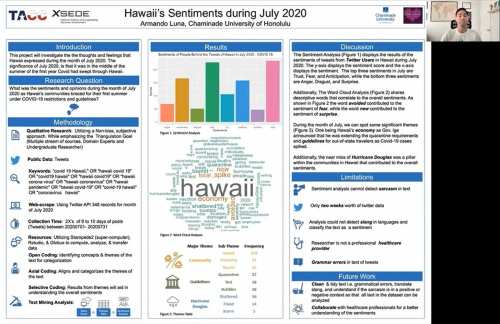
Chaminade Data Science student Sarah Carroll ’24 jumped at the chance to participate in the competition to build on her skills and apply them. She focused on COVID-19 in Hawaii, text-mining Twitter data to analyze community sentiment on the virus and the government response.

“It was very rewarding to see that I am capable of implementing what I learned,” Carroll said, adding that she was thrilled to be able to put together a project and get immediate feedback on her presentation. “This experience really boosted my confidence in working with data.”

Punohu Keahi '25 poster for ASCS data science challenge

Punohu Keahi is a first-year student at Chaminade, majoring in Environmental Studies, and participated in hopes of learning more about how to turn big data sets into results that communities can actually use to make decisions. “My biggest reason for joining this program was to step out of my comfort zone,” Keahi said. “Getting this experience is something I will never forget.”

Keahi opted to dive into data from the Haleakala National Bird survey.

“I love native birds and I’m interested in knowing more about the different factors that could have caused the fluctuations in the bird population,” she said. “My biggest challenge during this program was figuring out how to code and then create different scatter plot and bar graphs.”

One of the greatest thrills? Using a supercomputer for the first time.

Armando Luna's poster for ASCS data science challenge

Armando Luna, a Data Science student at Chaminade, said the competition was tough—but a worthwhile experience. “The biggest challenge was ensuring I would have a presentable and complete project in time,” Luna said. “However, we had fantastic mentors who helped us through the week.”

Mentors like Dairian Balai ’22, who said she wanted to volunteer because of her own positive experiences at Advanced Computing for Social Change Challenges on the mainland. She was in the 2019 ACSC cohort and said the mentors were key to ensuring the event was filled with both learning and fun.

She said many of the students participating in this year’s challenge didn’t have any experience with coding, programming or working with big data sets. That meant they needed some extra help to ensure they didn’t get overwhelmed. “The students persevered and created incredible posters,” she said.

She added that what she enjoyed most about being a mentor was watching students grow in the challenge. “You can tell how much confidence they gained,” Balai said. “I also like seeing those great ‘aha!’ moments when they’re running into issues and then they finally make a breakthrough.”

Posted by: University Communications & Marketing Filed Under: Campus and Community, Diversity and Inclusion, Featured Story, Natural Sciences & Mathematics, Students Tagged With: Campus Event, Data Science

Celebrating Our Graduates: Spring Commencement 2022

May 16, 2022

Value your ‘ohana, embrace your kuleana and remember that obstacles are meant to be overcome.

Suzanne Puanani Vares-Lum, president of the East-West Center, giving the commencement speech

That was the message East-West Center President Suzanne Puanani Vares-Lum had for Chaminade University’s Spring 2022 graduates at the university’s 64th annual Commencement exercises on May 7.

“When you walk out of here today, remember those who walked with you, remember all those who helped you get here, and remember what it means to be a servant leader—even when it’s tough,” said Vares-Lum, in her address graduates at the Waikiki Shell. “Be a light wherever you go, learn, listen, teach, encourage. … Embrace where you come from and don’t let others define who you are.”

Vares-Lum is the first woman and Native Hawaiian to be selected to lead the East-West Center. In speaking to graduates, she described her humble beginnings and her struggles at home and at school.

“Most people who knew me then would never have imagined that I would one day be standing before you—as your commencement speaker, a retired two-star general and now the head of one of our region’s most respected institutions of learning, the East-West Center,” Vares-Lum said.

“Fortunately, I spent many of my summers growing up with my grandparents on Maui. They knew everything about hard work and commitment. I watched and learned. We have so much to learn from our kupuna. It kindled a drive inside of me that said, ‘I refuse to be defined by life’s circumstances.’”

Spring 2022 Commencement at the Waikiki Shell

The message was well-received by graduates, who were faced with a host of new COVID-related challenges and were able to tackle them all to achieve their goals. The Commencement included about 540 students in all, including 140 undergraduates who qualified for Honors recognition.

Melanie Kushi was graduating with her Doctor of Psychology in Clinical Psychology (PsyD) degree, and said the graduation represented the end of a “long journey” and the beginning of a new adventure. She has been selected for a post-doctoral position at Waianae Coast Comprehensive Health Center.

“I couldn’t have done this without the love and support of my family,” she said. “It’s a lot of hard work.”

Fellow PsyD graduate Daniel Kinikini couldn’t agree more and added he’s thankful to his professors at Chaminade and his fellow cohort members for helping him get through the toughest days. “I’m looking forward to the future,” said Kinikini, adding that the pandemic has underscored the importance of a robust mental healthcare system in Hawaii. “Being able to work with, especially the underserved population, that’s something I’m really passionate about. Many doors are opened now.”

Educator Brandy Wilson was ecstatic after graduating with her Master of Arts in Teaching degree, and said she’s planning to bring her new skills to her current work. “I love preschool,” said Wilson, who teaches at Mokapu Elementary in Kailua. “Being at Chaminade has helped me so much to learn strategies for working with both general education and special education students. I will continue to do that.”

Dr. Lynn Babington speaking at Spring 2022 Commencement

The Commencement ceremony began with a special invocation from Bro. Edward Brink, vice president for Mission and Rector at Chaminade. President Dr. Lynn Babington then addressed graduates, congratulating them on all they have accomplished—including in the face of adversity.

“During the past two years, we have all lived with uncertainty. You had to pivot to online learning, missed seeing some of your friends, faculty and staff, and were never able to properly celebrate all of your accomplishments in the community,” Babington said, in her speech. “You have learned the power of sacrifice because you have made necessary ones to keep yourself and your families safe.”

She added that Class of 2022 has demonstrated not only resiliency, but tenacity and grace in responding to an ever-changing landscape of obstacles. “You give us all great hope for the future,” she said. “You are our future leaders and we are confident in your ability to succeed.”

In addition to graduates, two extraordinary members of the community were honored at the Commencement ceremony: Kitty Sullivan Wo and Vaughn Vasconcellos were this year’s recipients of Chaminade’s Doctor of Humane Letters honorary degree.

Kitty Sullivan Wo and Vaughn Vasconcellos receiving their Doctor of Humane Letters honorary degree

Sullivan Wo, director of the Sullivan Family of Companies, is a philanthropist and previously served on Chaminade’s Boards of Governors and as chair of the Board of Regents. In her support of Chaminade’s mission, Sullivan Wo was instrumental in a major fundraising campaign and dedicated the Sullivan Family Library. Vasconcellos, who founded Akimeka LLC, has worked throughout this career to bolster opportunities for young people. He also previously served as chair for Chaminade’s Board of Regents and currently serves on Chaminade’s Board of Governors and Hogan Entrepreneurial Program Advisory Board.

The undergraduate Commencement speaker was Albert Respicio, who majored in Communication. In celebrating his fellow graduates, he asked them to remember all those who made the day possible. “We didn’t do this alone,” he said. “Thank you to all our parents, friends, teachers and everyone else in between that believed in us when we didn’t. When we struggled to think that we could.”

undergraduate and graduate commencement speakers

Graduate speaker Kiana Dizon, who received her Master of Science in Counseling Psychology degree, encouraged her fellow Silverswords to make big dreams and then go for them—just like she did. “I never thought I could make my dreams a reality until I pursued a passion at an institution that empowered me to do so,” she said, adding degrees speak not only to a person’s intellect but to their character.

Nursing graduate Lara Domogma said she feels the same way.

She called the day “surreal” and said she was moved to be able to share it with her family.

“This is really happening,” she said, beaming. “I’m here. I can’t believe it.”

While the Commencement ceremony was the main event of the weekend, the celebrations for graduates actually started on May 6 with a special Baccalaureate Mass at the Mystical Rose Oratory. The gathering, an annual tradition, is an opportunity for the Chaminade community to reflect on the accomplishments of the term’s graduating class and give thanksgiving for all they have.

graduates standing at the Spring 2022 Commencement

Kaimaile Leopoldo, a Master’s in Teaching graduate, said she’s most grateful for the positive impact she’ll have on young people’s lives. Leopoldo said she went into preschool teaching because she loves working with very young children and serving as one of their very first teachers. “This degree means so much,” she said. “Having students take what I teach into their lives, that’s what I’m excited about.”

Joseph Durocher was at Commencement to celebrate the completion of his bachelor’s degree in Biochemistry. But he won’t be away from Chaminade for long: He’s hoping to apply to the university’s One Year MBA program and is interested in pursuing a future in biotechnology.

For now, though, he’s letting his newest title—college graduate—sink in.

“Being here right now,” he said, “it definitely feels amazing.”


Watch the Commencement recap here.

Watch the full Commencement here.

Posted by: University Communications & Marketing Filed Under: Campus and Community, Featured Story, Institutional, Students

  • « Go to Previous Page
  • Page 1
  • Interim pages omitted …
  • Page 25
  • Page 26
  • Page 27
  • Page 28
  • Page 29
  • Interim pages omitted …
  • Page 51
  • Go to Next Page »

Footer

Chaminade University Logo

3140 Waialae Avenue
Honolulu, Hawaii 96816

Contact Us
Phone: (808) 735-4711
Toll-free: (800) 735-3733

facebook twitter instagram youtube linkedin

Visit

  • Plan Your Visit
  • Campus Map (PDF)
  • Events

Resources

  • Campus Security
  • Student Consumer Information
  • Concerns, Feedback, and Reporting
  • Institutional Review Board
  • Title IX / Nondiscrimination Policy
  • Compliance
  • Emergency Information
  • Careers
  • Institutional Statement

People

  • Students
  • Parents
  • Alumni
  • Faculty & Staff

Policy

  • Privacy Policy
  • Terms and Conditions of Use


© Chaminade University of Honolulu