• Skip to primary navigation
  • Skip to main content
  • Skip to footer
Chaminade University of Honolulu

Chaminade University of Honolulu

  • VISIT
  • APPLY
  • GIVE
  • STUDENTS
  • PARENTS
  • ALUMNI
  • FACULTY/STAFF
  • Admissions
    • Admissions Home
    • Undergraduate Students
      • First-Year Students
      • Transfer Students
      • Admitted Students
    • Graduate Students
    • Flex Online Undergraduate Program
    • Military Students
    • Non-Degree/Visiting Students
    • Experiential Honors Program
    • Early College Program
    • New Student Orientation
  • Tuition & Aid
    • Financial Aid Home
    • Tuition & Expenses
    • Federal Updates & Changes
    • Scholarships
    • $5,000 Graduate Scholarship
    • VA Education Benefits
    • Net Price Calculator
  • Academics
    • Academics Home
    • Academic Programs
    • Office of Student Success
      • Academic Advising
      • Records and Registrar
    • Kōkua ʻIke (Support Services)
      • ADA Accommodations
      • Career Services
      • Proctoring Services
      • Tutoring Services
    • Sullivan Family Library
    • Undergraduate Research & Pre-Professional Programs
    • Commencement
  • Campus Life
    • About Campus Life
    • Student Engagement
    • Student Government Association
    • Residence Life and Housing
      • Summer Conference Housing
    • Health Services
    • Marianist Leadership Center
    • Counseling Center
    • Campus Ministry
    • Campus Security
    • Dining Services
    • Bookstore
  • Athletics
  • About
    • Chaminade University News
    • Our Story
    • Leadership
    • Chaminade University Strategic Plan 2024-2030
    • Mission & Rector
    • Association of Marianist Universities
    • Facts & Rankings
    • CIFAL Honolulu
    • Accreditation & Memberships
    • Montessori Laboratory School
Search
×

Search this web site

University Communications & Marketing

Big Dreams to Achieve Big Things

March 22, 2022

Meshelle Hirashima receiving her Chaminade diploma from Bro. Bernie Pleoger, SM

Meshelle Hirashima’s advice to young people is simple: you need big dreams to achieve big things.

She would know.

Hirashima, who graduated from Chaminade in 2017 with a degree in Historical and Political Studies and a Biochemistry minor, receives her Doctor of Medicine degree in May from Boston University School of Medicine. She is seeking to specialize in Obstetrics and Gynecology, and credits strong female role models—including the grandmother who raised her—for helping her believe in herself so she could reach her goals.

“I’ve had remarkable people in my life to be an example and help guide me to where I am today,” Hirashima said. “No one would think I would come this far knowing my history. I just feel so blessed.”

Hirashima was adopted as a toddler by her grandmother because her mother was struggling with substance abuse issues. Her mother has since turned her life around, Hirashima said, and the two share a special relationship. It’s because of her grandmother and her mother that she wants to be an OBGYN.

Hirashima is also the first person on her mother’s side to graduate from college.

And she’s the first person in her family to go to medical school.

In addition to her role models, she credits Chaminade with helping her get there. Hirashima was able to secure an early admission spot at Boston University’s School of Medicine thanks to Chaminade’s articulation agreement program with the institution—and the preparation she got along the way.

She also said immersive experiences at Chaminade helped her build her confidence.

Among them, in 2014, advisors at Chaminade encouraged Hirashima to apply for a six-week summer program at UCLA aimed at helping students from disadvantaged and diverse backgrounds get a taste for what it feels like to be a medical student and understand the steps to become a doctor. She said the program put a big emphasis on health disparities and helped her see how she could serve others. 

“It gave me a taste for what I could expect, and I was hooked,” she said.

An early dream to help others

Hirashima was born and raised in Hawaii and attended Moanalua High School.

From a young age, she said, she dreamed of becoming a doctor. She wanted to help others like the people who had helped her grandmother when she was diagnosed with breast cancer. And as she got older, she realized that being a doctor didn’t just mean providing medical care but helping people through everyday struggles and “being with them through momentous points in their lives.”

At Moanalua, many of Hirashima’s friends were eyeing larger universities.

But she wanted something different—a place where she could try out different things and pursue disciplines that intrigued her. That’s why she found herself initially majoring in Environmental + Interior Design at Chaminade before switching to Historical Political Studies with a Biochemistry minor.

How did that fit into her path to medical school?

Hirashima said she wanted to broaden her horizons and take the opportunity to dive into a course of study that would help her better understand the world. To her, the study of history and political studies was the opportunity to figure out why people decide what they decide and why they act as they do.

That foundation of knowledge, she said, helped her become a more empathetic, well-rounded person.

‘I knew what I wanted’
Meshelle Hirashima wearing her white coat at Boston University

Along the way, by minoring in Biochemistry, Hirashima was able to secure the science and math prerequisites she would need to apply to medical school. And she got a unique taste for what her life as a medical student would entail with those immersive experiences, like the one at UCLA.

Chaminade’s articulation agreement with Boston University’s School of Medicine was key to her admission. The program, in which Chaminade partners with a host of highly-esteemed universities on the mainland, allows students to set an early course to advanced studies in healthcare careers—establishing a strong academic record and completing prerequisites while at Chaminade.

After completing the requirements of her Chaminade degree, Hirashima also spent a year at Boston University preparing for medical school, taking graduate courses and studying for the entrance exam. “It was like drinking from a fire hose. And unconventionally, I put all my eggs in the Boston basket,” she recalled. “I’d never even been to the East Coast, have no family there, but I knew what I wanted.”

And she got it.

She said she was at the pool with a friend when she learned she’d been admitted.

“I just started screaming and jumping up and down,” she said.

From there, there would be more grueling work and long hours ahead. The COVID pandemic sharply curtailed the number of in-person learning hours she got. But in her third year, she moved on to rotations—a chance for medical students to work hands-on in different medical specialties.

Internal medicine. Psychiatry. Pediatrics. Hirashima loved them all.

But the OBGYN rotation was special. “It was about building connections with women. Just kind of through reflection, I thought, ‘Where am I going to make the biggest impact with my career?’ I had such strong female role models growing up and I knew I wanted to help women like them,” she said.

‘I used to be in those shoes’
Meshelle Hirashima '17 on Match Day—she is paired with University of Hawaii

While one chapter of Hirashima’s journey ends in May, when she earns her medical degree, another begins as she continues on her path to residency.

Her dream of returning to Hawaii to serve the people and communities that helped her remains alive. On Match Day, she was paired with the University of Hawaii’s Obstetrics and Gynecology program.

She is excited to come home, continue her training and cross off another goal from her list. Along the way, she hopes to inspire other young people to think big. “I had lots of humbling experiences growing up, but that didn’t stop me,” she said. “Overcoming obstacles will never be easy. But with help, it’s not impossible.”

Hirashima’s biggest piece of advice to others is simple: take advantage of opportunities presented to you. “It can sometimes be scary to get outside of your comfort zone,” she said. “I’m so lucky to have had people around me, including at Chaminade, who really believed in me and who helped guide me.”

She added that her “humbling experiences” growing up helped her build understanding for others. “When I talk to a patient who is struggling, I know a little bit about what that feels like. I used to be in those shoes,” she said. Her big dream now: serve as a role model just as many did for her.

“I want young people to know there’s so much out there, and they just have to go out and get it.”



Posted by: University Communications & Marketing Filed Under: Alumni, Featured Story, Humanities, Arts & Design, Natural Sciences & Mathematics Tagged With: Articulation Agreements, Biochemistry, Historical and Political Studies

Student’s Business Makes Paw-sitive Impact

March 16, 2022

Oliver Carson, Business Administration student, creator of Better Place Brands

By day, Oliver Carson is studying business. And by night, he’s running one.

The Chaminade University senior and Hogan Entrepreneurial Program student owns Better Place Brands, whose mission of giving back is baked right into the name. Carson started the business with his father in August 2020, launching a line of private-label coffee brands geared toward animal lovers.

“Customers not only want a great product, but they want the product to stand for something. That’s what this company is all about,” Carson said. “It also feels good to make those donations every quarter.”

Carson’s Better Place Brands has different “companies” named after pets.

There’s the Great Dane Coffee Company. The Golden Retriever Coffee Company. And most recently, Carson launched the Cat Rescue Coffee Company. In all, he has 13 private coffee labels. And each of them donates 20% of the proceeds to charities and rescue shelters located across the United States. Two are located right here in Hawaii—Cat People of Oahu and Lanai Cat Sanctuary.

In 2021, Carson’s companies gave $10,000 in cash and in-kind merchandise to organizations.

“We did better than expected,” he said, adding he hopes to donate even more this year.

‘A really perfect fit’
Oliver Carson with his two dogs

Carson grew up in a suburb outside of Cleveland and attended Villa Angela-St. Joseph High School, a Marianist school. As a child, he visited Hawaii several times with his family—and it became a dream to study in the islands. It turned out that dream was much more achievable than he realized.

A basketball coach who used to play at Chaminade chatted with him about the university.

He then learned about the Chaminade Scholars program, which offers up to 75% off tuition to students who are members of a Catholic parish or attend a Catholic or Marianist high school, demonstrate academic excellence, and participate in experiences of service and faith.

Of everything Chaminade had to offer, he was most excited about joining a vibrant community and learning more about Hawaii’s rich cultural traditions. “I grew up in a diverse environment and that has always been something that I’ve been attracted to,” Carson said. “It was a really perfect fit.”

At Chaminade, Carson also found the same values of family spirit, serving others and giving back that he’d embraced at his Marianist high school. “It really felt similar to that tradition I experienced,” he said.

In fact, Carson said he felt a special connection to Chaminade on his very first day in the residence halls. He attended Mass at the Mystical Rose Oratory and met Fr. Marty Solma, SM, who also grew up just outside of Cleveland and attended Villa Angela-St. Joseph High. “It was such a crazy moment,” Carson said.

From there, Carson jumped into life in the islands.

His roommates, who were from Hawaii, showed him the best beaches and taught him how to surf. He became the manager of the basketball team. And, he served as a peer mentor for CUH 100, a welcome course for incoming students.

At the beginning of his junior year, he joined the Hogan Entrepreneurial Program.

Carson said Hogan’s programs and networking opportunities continue to inspire him—and Hogan Program Director Dr. Roy Panzarella has given him the confidence to pursue his own business ventures. “We have been so lucky to hear from entrepreneurs from all over the world doing great things,” he said.

A business that gives back
Oliver Carson's Boxy Brown's Coffee Co pillow and boxer

Carson is busy enough as a student that it’s hard to imagine how he has time to run a business.

At Better Place Brands, he handles everything from customer service to social media. And he’s particularly proud of his business model: Selling a good product while supporting a good cause.

As a Business Administration student, he has been able to use his experience as a business owner for class projects, getting input—and no shortage of encouragement—from his professors and peers along the way. He has also thrived in the School of Business and Communication’s “business for good” approach and believes strongly that everyone has a role in making the world a better place.

After all, he does own a company called Better Place Brands.  

Carson is an animal lover himself and started his Great Dane Coffee Company first in honor of his family’s Great Dane. He then partnered with pet rescue organizations, which were able to promote what he was doing—and help him continue to grow and launch more companies along the way.

He said while he’s gearing up for graduate school—he plans to pursue an MBA degree—he’s also looking ahead to expand his business. “We want to continue to add more brands and to eventually grow beyond the dog rescue world,” Carson said. “Our ultimate goal is to do even more good out there—with the help of our customers and the causes they believe in.”

Posted by: University Communications & Marketing Filed Under: Business & Communication, Featured Story, Hogan Entrepreneurial Program, Students Tagged With: Business Administration, Chaminade Scholar

Welcome to MBA Alumnus and Kaiser Permanente COO’s World

March 11, 2022

Andrew Giles, MBA '17, COO of Kaiser Permanente Hawaii

To say that Andrew Giles, MBA ’17, has been busy over the last few years is putting things mildly.

It’s more like he’s been running a marathon—at a sprinter’s pace.

Giles was recently selected to serve as the chief operating officer of Kaiser Permanente Hawaii’s Moanalua Medical Center. Previously, he was the assistant administrator of hospital operations and support services. And in early 2020, he was also tapped as Kaiser’s COVID incident commander.

It’s a role that required him to “live and breathe” epidemiology and virology while also working to understand ever-changing facility needs, secure needed supplies and expand to meet new demand.

Testing centers, hospitalization surges, mass vaccine clinics. Welcome to Giles’ world.

“It’s been a whirlwind,” Giles said, huffing a laugh. “Educating, testing, and from a leadership perspective, keeping the staff motivated and ensuring they have the appropriate equipment.”

And that’s not all Giles has been up to.

In December, Giles wrapped up a one-year term as president of the Hawaii chapter for the American College of Healthcare Executives, an organization that provides scholarships, networking, and continuing education opportunities. He’s also active in American Hospital Association and other industry groups.

All that hard work hasn’t gone unnoticed.

In 2021, Giles was honored as one of Pacific Business News’ “40 under 40” Hawaii professionals.

“On a day-to-day basis, my priority typically lies at the hospital, ensuring we’re providing safe and quality care to patients,” said Giles. “I really like to engage with staff and serve as a conduit to make sure they have the tools they need to be successful, including looking at our operational metrics and targets.”

Giles moved to the islands about a decade ago, after wrapping up an undergraduate degree in Organizational Management at Wilmington University and working in operations and environmental services. He worked at other Hawaii hospitals before finding a spot at Kaiser Permanente as director of support services, overseeing everything from hospital communications to patient transport.

It was around that time that Giles started to look at MBA programs.

He considered several different universities but ultimately decided on Chaminade’s MBA program after taking a tour of the campus. Giles said he wanted to take classes in person and liked the university’s strong Marianist mission, individualized approach to the degree and emphasis on hands-on learning.

“The mission and involvement in the community, it certainly resonated with my faith,” he said.

Giles added that the small class sizes also helped students create stronger relationships and bring the content to life. “I had a really diverse group of people in my classes,” said Giles. “There were folks earlier in their careers. There were later careerists in the military. I made some really good connections.”

Looking back, he said several projects he undertook as an MBA student still resonates with him.

In one, he explored the delivery of healthcare to medically-underserved communities, including the Waianae Coast, Wahiawa and the North Shore. He said he also appreciated the Hawaiian Studies course he took that helped him better understand culturally appropriate ways to serve patients.

And while at Chaminade, Giles also participated in the signature Hogan Entrepreneurial Program and described it as a highlight. “The Hogan program was an extremely valuable learning experience, hearing the inspirational stories from entrepreneurs and connecting with community leaders,” he said.

Shortly after graduating with his MBA degree, Giles was promoted to the assistant administrator role at Kaiser.

And he said he’s just as excited today about his work as he was when he started.

“I’m really thankful for what I do,” he said. “I just genuinely enjoy helping people.”

Posted by: University Communications & Marketing Filed Under: Alumni, Business & Communication, Featured Story, Hogan Entrepreneurial Program Tagged With: Master of Business Administration

Bishop Robert McElroy Discusses a Synodal Church

March 10, 2022

In late 2021, Pope Francis called on the whole of the Catholic Church to embark on a two-year journey of reflection, profound renewal, and transformative reform that seeks to touch every element of ecclesiastical life and drive an ongoing process of reflection among Catholics worldwide.

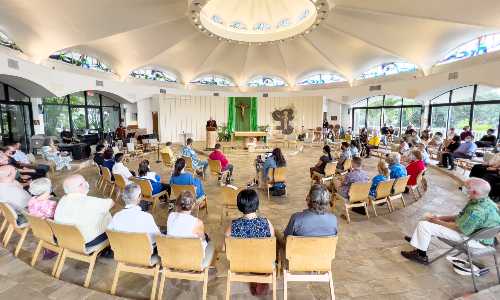
Bishop Robert McElroy speaking during the Chaminade Marianist Lecture

As Most Reverend Robert McElroy, Bishop of San Diego, explained in a recent Marianist Lecture at the Mystical Rose Oratory, this process of “synodality” is not about issuing new documents from Rome but embracing change together. It is, he added, “a continuing call to reform within the life of the Church.”

Bishop McElroy acknowledged that the term “synodality” is confusing and has been misunderstood.

And so, in unpacking it during his lecture on February 27, Bishop McElroy first noted that the concept of synod is not new but rather ancient and refers to a “coming together” or a religious assembly. “Pope Francis is calling for a moment of rediscovering, of going back and rediscovering part of our tradition,” he said.

In outlining the “architecture of synodality” at both the parish and personal level, Bishop McElroy said the process presents several key themes. Among them: that synodality “points to the reality that the whole people of God are engaged and journeying together in the life of the Church” and also demands a “constant state of discernment”—seeking answers as part of a community and in dialogue.

Bishop McElroy also underscored the importance of “authentic listening” and empowering diverse voices.

“A synodal church is a humble and honest church,” he said. “A synodal church seeks to discern its woundedness and embrace reform. Its holiness is exemplified by humility. A synodal church seeks a healthy decentralization in its structure and life. Practices that exclude groups must be rejected.”

Bishop McElroy continued, “Pope Francis has called us to transform the life of the Church and in turn the life of the world.” And that work—the process of reflection, listening and mission—“is not the work of a moment, but the work of a lifetime. At this moment, it is our work and is our mission.”

Bishop Robert McElroy speaking during the Chaminade Marianist Lecture

The global conversations on synodality in the Catholic Church will culminate with an international gathering in October 2023, during which church leaders will seek to explore key themes identified at dioceses. Bishop McElroy, however, cautioned against thinking of the dialogue as something that ends there. “This notion of synodality is a process of conversation. It doesn’t end at a particular time,” he said.  

Bishop McElroy delivered his address before an audience both online and in person, and then participated in a question-and-answer session to clarify key points or explore new ones. The talk was presented as part of the ongoing Marianist Lecture series, sponsored by the Marianist Center of Hawaii, Chaminade University and Saint Louis School, and designed to foster inclusive and robust dialogue.

Following his address, Bishop McElroy was presented with the Mackey Award for Catholic Thought.

Several attendees at the lecture thanked Bishop McElroy for helping them to understand the concept of synodality. They also wondered aloud about next steps, including what they could do to participate in the conversation and encourage their fellow parishioners to do the same.

“I think what stuck out most to me was the real inward focusing of it, about listening, changing our stance as a church to be more humble and just more understanding,” said Sebastian Conway-Phillips.

Another attendee, Our Lady of Good Counsel School Principal Chantelle Enos-Luarca, said the faculty and staff members at her campus participated in a robust dialogue as part of the process of synodality.

“We have some great ideas … but what’s next?” she asked.

Bishop McElroy responded, “I think the most important consequences are the conservations that occur at the local level. All of these parishes, there are certain things that come up that are good things to do.” He added that there’s no need to wait on implementing those good ideas. “Do them now,” he said.


Watch the entire Marianist Lecture below.

Posted by: University Communications & Marketing Filed Under: Campus and Community, Catholic, Featured Story Tagged With: Guest Speakers, Marianist

Student Wins SC21 Data Science Competition

March 7, 2022

Taylor Ishisaka loves to unlock the secrets hidden in data.

There’s nothing more satisfying or rewarding, she says, than translating big data sets into clear, actionable information that communities can use to understand themselves better or tackle existing problems anew. “The world of data science has so much to offer,” said the Chaminade senior.

That passion isn’t only infectious, it’s getting noticed.

Taylor Ishisaki reviewing data science information

Most recently, she was part of a team that took home top honors in the inaugural data science competition at SC21, one of the biggest international conferences on high-performance computing. The competition, held over two phases in October and November 2021, was designed to give students a chance to showcase their computing, problem-solving and data analysis skills in a team dynamic.

Ishisaka, who is a Ho’oulu Scholar and Data Science major at Chaminade, said the competition started with a meet-and-greet opportunity over Zoom followed by details on the expectations for participants. She was put into a team with students from around the nation, including Washington State University and Central Texas College.

The first phase of the competition required students to perform analysis on a data set using a high-performance computing cloud. Ishisaka said the task was designed to test participants’ time management skills, teamwork, and ability to work effectively in the cloud platform.

The data set was a compilation of agricultural and livestock data from the U.S. Department of Agriculture database. Ishisaka’s team looked at crop production and fertilization data over several years, and Ishisaka created a color-coded heat map showing changes over time. A teammate, meanwhile, crafted several graphs that showed crop and soy production over specific Census years.

Ishisaka and her teammates put together a report in order to move to Phase 2, during which participants were challenged to find their own datasets to highlight problems in specific regions. Ishisaka’s team focused on Missouri data, specifically looking at data on bison populations. They took a multi-state view, tying in figures on climate and other environmental factors in their analysis.

The challenges were tough enough, but Ishisaka’s team also lost members over the course of the competition. Two didn’t show up again after the initial Zoom session. A third team member dropped off the map in Phase 2. That left the original team of five with just two members.

“As there were only two of us left in the most critical phase, my team member and I met with our mentor for hours each day discussing our progress on the project and next steps,” Ishisaka said. “We had to retrace our steps and rediscover our project purpose in order to put together our presentation.”

It was no easy task—but Ishisaka wasn’t deterred.

“After hours of putting together our presentation and rearranging everything to make sure that our story flowed, we created a product that we were proud of,” she said, adding that she stayed up all night before presentation day so she could memorize her talking points and deliver a clear message.

She delivered the presentation via Zoom with the judges and other teams all there. When everything was done, she was proud to have completed what she set out to do—and wasn’t thinking all that much about whether she’d actually be recognized for her efforts. “I was honestly surprised when we won,” she said. “I attended presentations of the other competitors and their projects were phenomenal.”

Ishisaka said she’s very happy with what she and her teammate were able to accomplish.

“I decided to keep on going throughout the competition because for one, I was representing Chaminade. And secondly, I know that my progress in the competition was a reflection of the skills and values that I learned throughout my academic journey in data science,” she said.

Ishisaka added she’s not one to leave things unfinished.

“Once I commit to a project, I am in it for the long haul,” she said.

The same goes for her commitment to data science, a major she fell into after participating in the Supporting Pacific Indigenous Computing Excellence (SPICE) Summer Institute in Summer 2019. SPICE, a partnership between Chaminade and the Texas Advanced Computer Center, gives students from all different majors and backgrounds a chance to explore data science and its many applications.

Ishisaka said that she entered the SPICE program not knowing anything about data science, “or that it even existed.” She added, “The following semester, I went to academic advising and switched my major from biochemistry to data science, and honestly it was probably one of the best choices I ever made.”

Posted by: University Communications & Marketing Filed Under: Featured Story, Natural Sciences & Mathematics, Students Tagged With: Data Science, Honors and Awards

Inaugural President’s Innovation Award

March 3, 2022

Two faculty members who spearheaded out-of-the-box programs aimed at expanding educational opportunities to more members of the community and broadening the university’s positive impact were honored recently with the inaugural President’s Innovation Awards at Chaminade.

The recipients were:

  • Dr. Rylan Chong, assistant professor of Data Science, for his student-powered computing program that seeks to put data analytics in the hands of community members. Through a pilot program, his students worked with grassroots groups on the Waianae Coast to develop a community sentiment dashboard aimed at measuring well-being and health metrics.
  • Dr. Janet Davidson, vice provost and professor of Criminology and Criminal Justice, for overseeing the successful design and launch of a Chaminade associate’s degree program at a Hawaii prison—the only Second Chance Pell Program currently offered in the state.
Dr. Rylan Chong posing with Dr. Lynn Babington

Chaminade President Dr. Lynn Babington said all of those nominated for the awards, and especially those who won, underscore how innovation is woven into Chaminade’s DNA. “The pandemic has added no shortage of challenges to our work at Chaminade, but it has also shown the power of innovation in helping us to meet our social service mission and expand our important work,” Babington said.

“I am so honored to say our campus is full of innovators—members of our Silversword ‘ohana who understand that today’s new ideas and new approaches are tomorrow’s successes and best practices.”

The Center for Strategy and Innovation created the President’s Innovation Award program and announced a call for nominations in September 2021. Winners were announced at a Spring Kickoff event for faculty and staff members celebrating the beginning of the new term.

Dr. Helen Turner, vice president for strategy and innovation at Chaminade, described the selection process as rigorous and said a five-member committee reviewed nominations and chose the recipients.

Both awardees said they were honored and humbled by the recognition.

Dr. Janet Davidson with her certificate for the inaugural President's Innovation Award

“I am truly grateful,” Chong said. “Receiving this award acknowledges how data science can unite communities, break down silos and social stereotypes about STEM disciplines, and be a field to catalyze social good. I want to personally thank the Waianae Coast community for their support.”

Chong added that he was particularly proud of the hands-on experiences students got throughout the course of the project—from interviewing community members to presenting their findings and continuously adding to and revising the dashboard as a “living tool” for stakeholders.

“Students made connections on how and when to use the data science and project management skills and tools they learned in their classes toward a real and relevant project,” Chong said. “They also learned a lot of soft skills, networking and working with a diverse group of people with various backgrounds to get real-world experience. And our shared work on this project continues.”

Davidson said the innovation award is a “rewarding validation” of all the work that’s gone into the Second Chance Pell Program, whose first cohort has 14 students. “This award is a reminder of the team behind this. It reminds me of how thankful I am that there has been university support all around. So many people support the mission of this program and its alignment with Chaminade’s values.”

She noted the COVID pandemic meant that faculty members and staff delivering the program were required to quickly pivot so they could continue to meet student needs and program expectations. “This honor means a lot,” she said. “And I look forward to seeing who is honored next year.”

Posted by: University Communications & Marketing Filed Under: Campus and Community, Center for Strategy and Innovation, Faculty, Featured Story, Innovation, Institutional, President Tagged With: Honors and Awards

  • « Go to Previous Page
  • Page 1
  • Interim pages omitted …
  • Page 63
  • Page 64
  • Page 65
  • Page 66
  • Page 67
  • Interim pages omitted …
  • Page 148
  • Go to Next Page »

Footer

Chaminade University Logo

3140 Waialae Avenue
Honolulu, Hawaii 96816

Contact Us
Phone: (808) 735-4711
Toll-free: (800) 735-3733

facebook twitter instagram youtube linkedin

Visit

  • Plan Your Visit
  • Campus Map (PDF)
  • Events

Resources

  • Campus Security
  • Student Consumer Information
  • Concerns, Feedback, and Reporting
  • Institutional Review Board
  • Title IX / Nondiscrimination Policy
  • Compliance
  • Emergency Information
  • Careers
  • Institutional Statement

People

  • Students
  • Parents
  • Alumni
  • Faculty & Staff

Policy

  • Privacy Policy
  • Terms and Conditions of Use


© Chaminade University of Honolulu