• Skip to primary navigation
  • Skip to main content
  • Skip to footer
Chaminade University of Honolulu

Chaminade University of Honolulu

  • VISIT
  • APPLY
  • GIVE
  • STUDENTS
  • PARENTS
  • ALUMNI
  • FACULTY/STAFF
  • Admissions
    • Admissions Home
    • Undergraduate Students
      • First-Year Students
      • Transfer Students
      • Admitted Students
    • Graduate Students
    • Flex Online Undergraduate Program
    • Military Students
    • Non-Degree/Visiting Students
    • Experiential Honors Program
    • Early College Program
    • New Student Orientation
  • Tuition & Aid
    • Financial Aid Home
    • Tuition & Expenses
    • Federal Updates & Changes
    • Scholarships
    • $5,000 Graduate Scholarship
    • VA Education Benefits
    • Net Price Calculator
  • Academics
    • Academics Home
    • Academic Programs
    • Office of Student Success
      • Academic Advising
      • Records and Registrar
    • Kōkua ʻIke (Support Services)
      • ADA Accommodations
      • Career Services
      • Proctoring Services
      • Tutoring Services
    • Sullivan Family Library
    • Undergraduate Research & Pre-Professional Programs
    • Commencement
  • Campus Life
    • About Campus Life
    • Student Engagement
    • Student Government Association
    • Residence Life and Housing
      • Summer Conference Housing
    • Health Services
    • Marianist Leadership Center
    • Counseling Center
    • Campus Ministry
    • Campus Security
    • Dining Services
    • Bookstore
  • Athletics
  • About
    • Chaminade University News
    • Our Story
    • Leadership
    • Chaminade University Strategic Plan 2024-2030
    • Mission & Rector
    • Association of Marianist Universities
    • Facts & Rankings
    • CIFAL Honolulu
    • Accreditation & Memberships
    • Montessori Laboratory School
Search
×

Search this web site

Diversity and Inclusion

Honorary Luncheon

February 15, 2024

Students share the meaning of their scholarships with donors

Her voice quivering with emotion as she described the meaning of being awarded a scholarship during an annual honorary luncheon for donors, Audrey Pilar ’24 cited her mom and dad for instilling a belief in herself, sharing her parents’ story as a young couple struggling to make ends meet but never giving up and wanting more for her and her brother. Graduating in May with a major in Forensic Sciences, and minors in Chemistry and Data Science, Analytics and Visualization, the Mililani native admitted that, without her Dr. Feung Lee and Mrs. Mew Sin Lee Endowed Scholarship, she probably would have had to work three or more part-time jobs just to pay her tuition.

“When my mom wanted to come to America to have a better life for me and her, she did,” Pilar said. “When my dad was belittled for having a young family, he and my mom hustled, got an education, and successfully raised my brother and me. What I am trying to get across here is that someone gave them a chance in their lives. Someone gave my mom and dad a chance to succeed in life, and they took it. This is what receiving a donor scholarship means to me. Hope and a chance for a better future.”

In the pursuit of higher education, many students face formidable barriers, with financial constraints being among the most prevalent. For many individuals from low- to even middle-income backgrounds, the dream of attending college or university often seems like an unattainable aspiration. However, scholarships serve as beacons of hope, illuminating pathways to academic success and unlocking doors to opportunities that would otherwise remain shut.

“This year, between individual and Foundation scholarships, we supported 332 students with over $2 million, for an average scholarship award of $6,100, which is huge,” said Chaminade President, Lynn Babington, Ph.D. “Today, you’ll hear some of these students’ stories, and you’ll get a sense about their ambitions, their areas of academic interest and what they may have overcome to get here.”

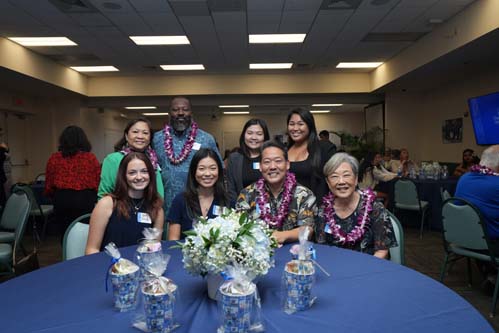
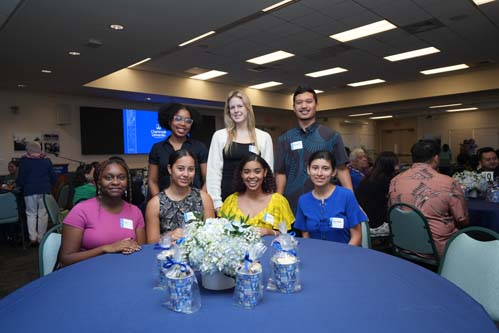
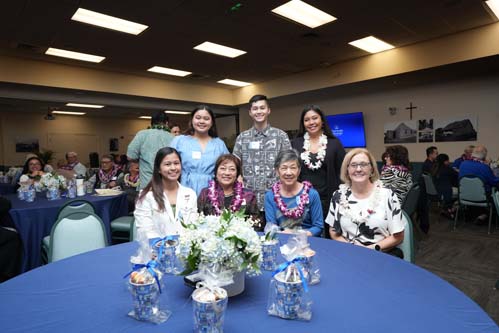
Scholarship Luncheon attendees include, standing from left, Edna Magpantay-Monroe, Michael Monroe, Tiannah Ohta and Genie Reutirez, and, seated from left, Bella Frasure, Alyssa Mori, and Keven and Diane Matsuura.
Scholarship Luncehon attendees include, standing from left, Edna Magpantay-Monroe, Michael Monroe, Tiannah Ohta and Genie Reutirez, and, seated from left, Bella Frasure, Alyssa Mori, and Keven and Diane Matsuura.
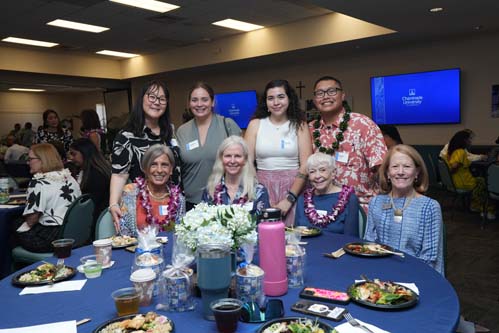
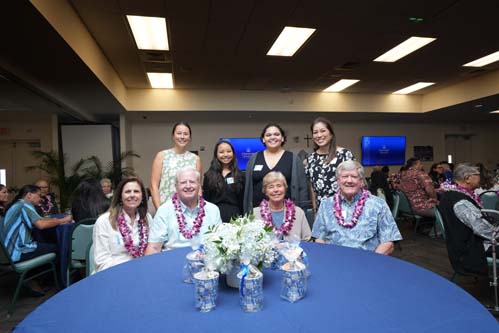
Scholarship Luncheon attendees include, standing from left, Jill Higashi, Kimberly Kameshige, Brianna Gutierrez Aceves and Easton DelaCruz, and, seated from left, Jeannine Wiercinski, Estelle Kelley, Jeannie Rolles and Chaminade President Dr. Lynn Babington.
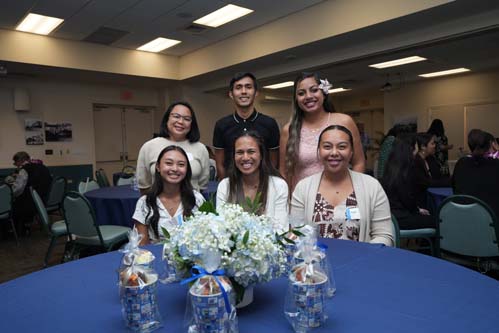
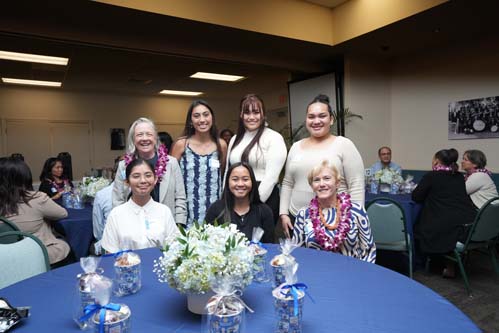
Scholarship Luncehon attendees include, standing from left, Janice Glade, Peter Jan Ramos and Anastasia Tangatailoa, and seated from left, Leila Casison, Caitlin Bocobo and Paige Garcia.
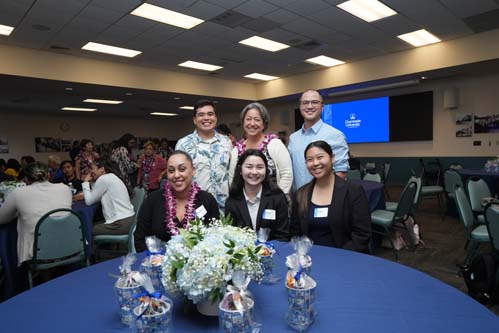
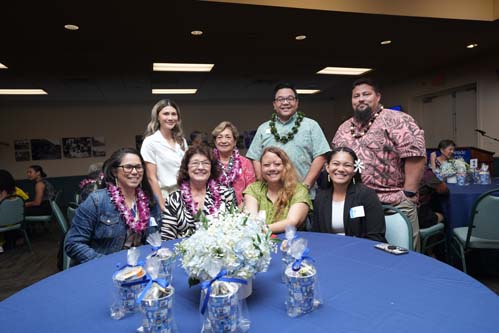
Scholarship Luncehon attendees include, standing from left, William Bernaldez, Amber Milsap and Greg Lagapa, and seated from left, Natasha Flores, Nicole Tanabe and Kelsey Nakagawa.
Scholarship Luncehon attendees include, standing from left, Tyanna Hemmings, Leah Carrington and Kaimipono Abella, and seated from left, Keila Anderson, Tessa Stanley, Aniyah Hazen and Ana Isabel Aranda.
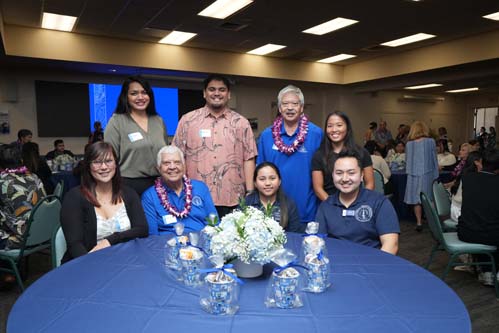
Scholarship Luncehon attendees include, standing from left, Adrienne Aquino, Katherine Liu, Erica Tiwari and Alani Meltel, and seated from left, Jessica Schlais, and David and Christne Arita.
Scholarship Luncehon attendees include, standing from left, Kendra Sia, Nicole Kegine, Aleeyah Lemons and Heidi Bow, and seated from left, Sally and Michael Coovert, and Susie and John Field Jr.
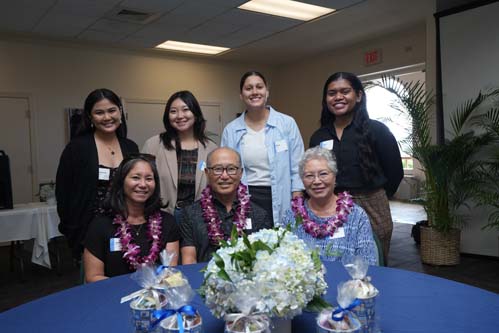
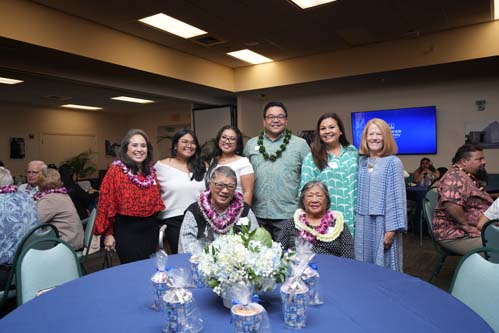
Scholarship Luncehon attendees include, standing from left, Debbie Ng Furuhashi, Michalla Burtado, Aloha Lei Garo, Bro. Alan Pacquing, Jodi-Anne Yoshida and Chaminade President Dr. Lynn Babington, and seated Bernard and Lolita Lum Hoy.
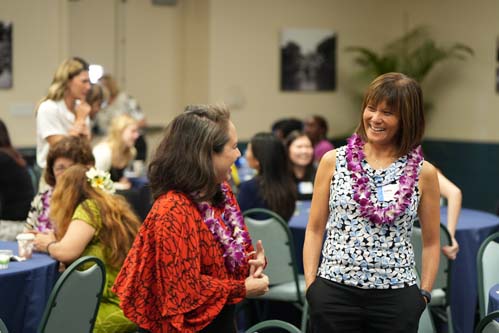
Debbie Ng Furuhashi and Cathy Ching share a laugh before the start of the Scholarship Luncheon.
Scholarship Luncehon attendees include, standing from left, Angelica Tangatailoa, Nathaniel Leomiti, Wayne Tanna, JD, and Jazzy Yasuda, and seated from left, Dorie Sanborn, Bro. Thomas Jalbert, Jasmine Mondelo and Pono Riddle.
Scholarship Luncehon attendees include, standing from left, Nagem Uiagalelei, Patricia Takamiya, Bro. Allen Pacquing and Richard Uiagalelei, and seated from left, Napua Rosehill, Carol Gouveia, Kawila and Kyla Castro.
Scholarship Luncehon attendees include, standing from left, Lauren Moriarty, Constance Keao, Huong Pham and Mame Hideyos, and seated from left, Alyssa Torres, Junelle Tangalin and Diane Peters-Nguyen.
Scholarship Luncehon attendees include, standing from left, Heather Kate Jarmillo, Marlon Francisco and Audrey Pilar and seated, from left, Kryzandreah Espanol, Tertia Freas, Elizabeth Hokada and Dr. Janet Davidson.

Seated with students, Adrienne Aquino ’26, Katherine Liu ’26, Erica Tiwari ’24 and Alani Meltel ’25, donors David and Christine Arita with daughter Jessica Schlais discussed each one’s goal, inspiring them to continue their education even long after they’ve graduated. The Aritas’ and Schlais’s American Floor and Home Foundation Scholarship is specifically earmarked for majors in the Environmental + Interior Design program.

An aspiring elementary education teacher, Aquino believes that early schooling provides a strong foundation for future learners. “Our graduation rates are getting lower and lower,” said the Kaneohe native. “We need more teachers if we want a better future for our keiki.”

Applauding Aquino for her dedication to becoming an elementary teacher, David Arita dispensed a bit of advice to her: “If you inspire them, they will always remember you,” he told her. “I still remember the teachers who made a major impact in my life, and I will never forget them.”

A sophomore Communication major, Easton DelaCruz ’26 has taken advantage of all the opportunities afforded to him since arriving on campus two years ago. He has been fortunate enough to engage in experiences that have enriched his education and broadened his perspective.

“Your commitment to financial assistance has allowed students like me to engage in transformative experiences, shaping us into well-rounded individuals prepared to contribute to society,” DelaCruz said in his address to donors. “With the wealth of past and current experiences, and the ones to come at Chaminade, I plan to return home and become a public servant to help my home become a better place for my parents’ generation, my generation and generations to come.”

In this landscape of financial uncertainty, scholarships emerge as powerful catalysts for change. These financial awards, often based on academic merit, financial need, or a combination of both, play a pivotal role in dismantling barriers to higher education. By providing financial assistance, scholarships enable deserving students to access resources, facilities and opportunities that would otherwise remain beyond their grasp.

Beyond financial assistance, scholarships also offer myriad opportunities for academic and personal growth. Many scholarship programs provide mentorship, networking opportunities and career development resources, empowering students to thrive both inside and outside the classroom. Furthermore, scholarships may fund internships, study abroad experiences and research projects, allowing students to broaden their horizons and cultivate valuable skills that enhance their employability and competitiveness in the job market.

“We know education transforms lives; our students set out to change the world, and they are making a difference,” said Babington. “Our reach is all over the world. And we are proud of our Chaminade students and alumni.”

Posted by: University Communications & Marketing Filed Under: Campus and Community, Diversity and Inclusion, Featured Story, Institutional, Students Tagged With: Honors and Awards, Marianist, Scholarship

Environmental Science

January 25, 2024

After earning her bachelor’s, Casidhe Mahuka joins CRAG in American Samoa

In recent years, scientists, world leaders, politicians and environmentalists have been warning us about a dire existential threat, noting that climate change poses a grave risk that needs to be urgently addressed and mitigated. As an invasive species coordinator (ISC) at the Coral Reef Advisory Group (CRAG) in American Samoa, Casidhe Mahuka ’22 is doing her part in monitoring and protecting the waters encircling the small U.S. territory.

Since graduating with a BS in Environmental Sciences, the American Samoa native has used her Chaminade education to make an impact in her community. As the ISC for CRAG, Mahuka collects ocean data and implements bi-monthly phytoplankton monitoring in association with the National Oceanic and Atmospheric Administration’s National Phytoplankton Monitoring Network (PMN), which is a community-based network of volunteers who monitor marine phytoplankton and harmful algal blooms (HABs).

Mahuka explains that she has three overarching goals: 1) Integrate community-based methods to restore village-level ecosystems using ridge-to-reef approach in Aua and Fagasa; 2) increase invasive species management policy and activity coordination in and among local and regional organizations; and 3) bolster invasive species management in other priority sites.

“Other priorities include monitoring ballast water, biofouling, reef flats, and testing the water’s salinity, turbidity and overall quality,” Mahuka further describes. “I also work with the US Coast Guard to stay informed on stony coral tissue loss disease, the Vessel Incidental Discharge Act (VIDA) and other regional biosecurity issues.”

Covering more than 70 percent of our planet, the world’s oceans play a crucial role in regulating climate and supporting diverse ecosystems. However, the alarming rise in ocean temperatures due to climate change is threatening marine life, particularly the delicate balance of coral reefs.

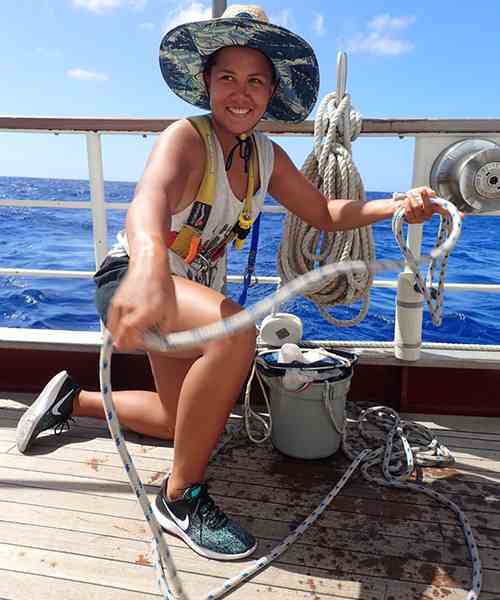
Casidhe Mahuka prepares to tie an Anchor Bend knot.
In the summer of 2018, Casidhe Mahuka participated in the SEA Semester, which is Boston University’s Study Abroad Program. The ship traveled from Tahiti to the Hawaii islands.

Primarily driven by human activities such as the burning of fossil fuels and deforestation, climate change has led to a significant increase in global temperatures. As a result, the world’s oceans are also experiencing warming trends, the consequences of which are far-reaching and affect marine ecosystems in various ways.

“Our ecosystems are fragile,” Mahuka says. “Although they cover only a small fraction of the ocean floor, coral reefs support about 25 percent of all marine species. The intricate structures of reefs provide habitats and food for a vast array of marine life, including fish, invertebrates and microorganisms.”

Furthermore, coral reefs act as natural barriers that protect coastlines from the impacts of storms, hurricanes and erosion. The complex structures of coral reefs also dissipate wave energy, reducing the intensity of waves that reach the shore.

Mahuka has had a passion for ocean science ever since she visited the National Marine Sanctuary of American Samoa in the 7th grade. It was the first time that she discovered that she could not only breathe underwater, but she could also breathe underwater for a living.

“That was it; I was totally hooked,” Mahuka says. “I was determined to be an ocean scientist because I have always loved being in the water. And to get paid for it, I was all in.”

As a member of the first cohort of students who majored in Environmental Science at Chaminade, Mahuka mirrors a growing trend among students who are pursuing their degrees in this field, marking a 24 percent increase in degrees awarded since 2016. Data from the U.S. Department of Education shows a steady uptick over five years. In the 2017–2018 academic year—the most recent year for which aggregate data is available—a total of 6,697 students earned bachelor’s degrees in environmental science. That means 1,155 more graduates earned such degrees than did five years earlier.

The trend is illustrated by Chaminade’s School of Natural Science and Mathematics’s introduction of an Environmental Science major four years ago. While a major in Environmental Studies has existed since 2000, the decision to focus on hard sciences was a natural progression for such programs.

While there is an overlap that exists between the two majors, Environmental Science is an interdisciplinary science-based major, which combines biological, ecological, chemical, geological and mathematical principles often used to solve environmental challenges or manage natural resources. Conversely, Environmental Studies is an interdisciplinary social science and humanities-based major. It focuses on the human relationship with the environment, and how environmental challenges intersect with politics, economics, society and culture. 

For 10 days in November, Mahuka was aboard the Exploration Vessel Nautilus surveying previously unmapped seafloor in U.S. waters south of the Hawaiian Islands. She was selected as a Seafloor Mapping Intern by Ocean Exploration Trust (OET), an organization that works to explore the ocean, seeking out new discoveries, while pushing the boundaries of STEAM education (Science, Technology, Engineering, the Arts, and Math) and technological innovation.

“It was a great experience after I found my sea legs,” Mahuka says. “I definitely chose the right career because marine science allows you to travel around the world, where you get to meet and learn from amazing and intellectual people who have the exact same passion as you do!”

Posted by: University Communications & Marketing Filed Under: Alumni, Diversity and Inclusion, Homepage, Innovation, Natural Sciences & Mathematics Tagged With: CIFAL, CIFAL Center, Environmental Studies

Early College Exposure

December 21, 2023

High school students earn college credit

For the past two years, Kapaa High School seniors, Tatum Harper and Taeani Largusa, have taken several synchronous online courses with Chaminade University professors, earning college credit while simultaneously fulfilling their high school requirements. The hours of studying and discipline paid off. Learning she just got into Columbia University, Harper was ecstatic.

“It’s my dream school,” said Harper, during Chaminade’s inaugural Early College Summit, which was attended by a mix of 70 students from Kapaa High School, Sacred Hearts Academy and Saint Louis. “Participating in this program has really prepared me for college.”

Largusa echoed the same sentiment, adding that she expects to hear from Syracuse University soon. “When I took the virtual campus tour I fell in love with it,” says the first generation, soon- to-be-college student. “This program has given me confidence in knowing that I can handle the demand of college courses.”

Early college programs can provide several benefits, including the opportunity for students to accelerate their education, which can lead to the completion of college degrees at an earlier age. There’s also the perk of cost savings, reducing tuition costs for future higher education.

Sacred Hearts Academy counselors Ashley Luke and Sharlene Chock both agreed that Chaminade’s early college program will help students become familiar with the expectations and rigor of college-level coursework, easing their transition to full-time college later on.

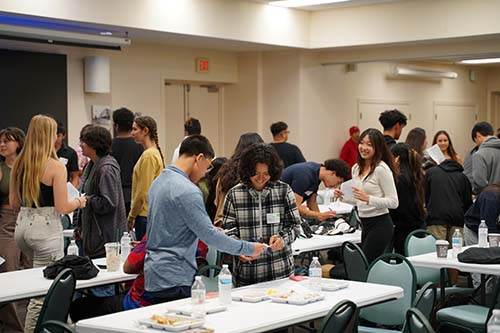
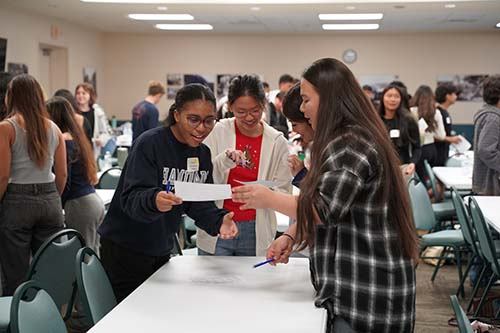
Students circled the room to fill out their bingo-like cards.
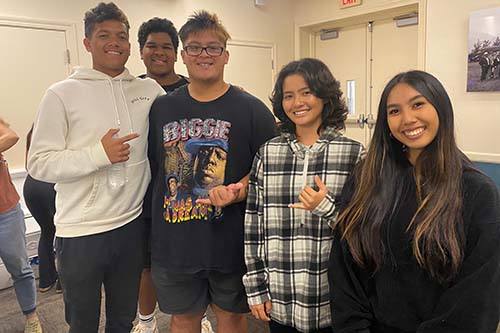
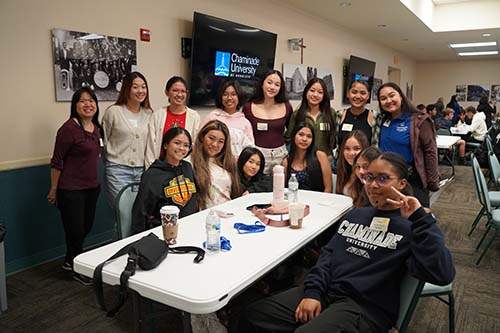
Saint Louis and Kapaa High School students mingled during the Early College Summit.
Sacred Hearts Academy students played a bingo-like game, with the first one to fill all 25 boxes with the right answers winning the grand prize.
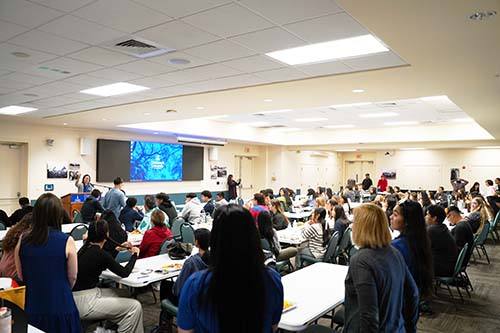
Chaminade’s Early College Director, Kim Baxter, addressed the students at the T.C. Ching Conference Center in Eiben Hall before they set off to visit other campus locations.
Sacred Hearts Academy juniors completed their first semester of college courses.

“Some struggled initially with the transition because of the extra studies involved in taking college-level courses,” said Luke, who counsels 10th and 11th graders. “Even our top students were stretched because they didn’t understand process versus perfection, which they’re used to achieving in high school.”

With this first cohort of 17 Lancers, Chock believes the college exposure will help them navigate the waters of post-secondary education. “They have already been individually challenged,” said the 12th grade counselor. “I think the experience shows them that college is attainable.”

Saint Louis School students Landon Dimaya, Cash Acorda and Kevin Simmons will begin their college courses next semester. The three Crusaders cited different reasons for participating in the program. Dimaya is a fraternal twin whose sister Lindsey is already a Sacred Hearts Academy participant. “I want to reduce the financial burden on my parents,” he said. “It would be really expensive to have to pay tuition for me and my sister at the same time.”

“I want to get ahead,” offered Acorda, who plans to apply to Stanford, with Simmons further noting that the experience would look good on his application.

Research demonstrates that early college programs show strong and lasting evidence of effectiveness for all students. It promotes both post-secondary access and success. The data is undeniable that students who participate in such programs will be ahead of their peers and graduate from a four-year university either debt-free or with very little federal student loan debt. The latest data further supports the claim that students who participate in these programs are better prepared to transfer to a four-year university than students who attend the university without prior college experience. 

Moreover, encouraging students to attend college improves individuals’ earnings over a career, increases the amount of taxes the government collects, and reduces government spending on federal assistance programs. 

“This program is such a great opportunity for these high school students to earn dual credits,” said Kim Baxter, Chaminade’s Early College Director. “And it gives them that real college experience.”

Posted by: University Communications & Marketing Filed Under: Campus and Community, Catholic, Diversity and Inclusion, Early College, Featured Story, Innovation, Institutional Tagged With: Campus Event, Early College Experience

Senate Confirmation

December 12, 2023

Shanlyn Park ’91 confirmed in a bipartisan vote

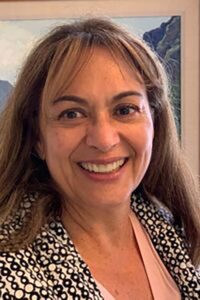
The District of Hawaii has its first Native Hawaiian woman to serve on the federal bench as a district court judge. Shanlyn Park ’91 is a current state court judge and former federal public defender. She was nominated for the judgeship on September 27, and sat for her hearing before the Senate Judiciary Committee on October 4. She was confirmed on November 30.

In a bipartisan U.S. Senate vote, Shanlyn Park ’91 was confirmed as the first Native Hawaiian woman to serve on the federal bench as a district court judge.

“Judge Park’s unique combination of experience, tenacity and genuine kindness will be a huge asset to the federal bench,” said Chief U.S. District Judge Derrick K. Watson in a released statement. “We are excited to have her join us as our colleague in 2024.”

Park was confirmed on a bipartisan vote of 53-45. The lifetime appointment is particularly significant in terms of representation as Native Hawaiians comprise 21.8 percent of the population in the district where she will preside.

Born and raised in Hawaii, Park has been a state circuit court judge since 2021. She previously worked in private practice and at the Office of the Federal Public Defender for the District of Hawaii. While a practicing attorney, she has also represented individuals on a pro bono basis, including cases of employee discrimination.

In a joint statement, U.S. Sen. Brian Schatz and U.S. Sen. Mazie Hirono applauded Park’s confirmation, saying she “led a distinguished career dedicated to public service.”

“She has exhibited a commitment to justice, fairness and impartiality throughout her career, and is highly qualified to serve on the U.S. District Court,” the senators said. “As the first Native Hawaiian woman to serve as a federal district court judge, Judge Park’s confirmation reflects the Biden-Harris Administration’s commitment to building a federal judiciary that reflects the diversity of our communities.”

Park was the second Hawaii judge to be confirmed in November. The Senate also voted to confirm Micah Smith, a federal prosecutor, to a district court judgeship. Appointed under Article III of the U.S. Constitution, federal district court judges are nominated by the president, confirmed by the U.S. Senate and serve lifetime appointments upon good behavior.

Both Park and Smith fit into President Joe Biden’s broader goal of diversifying the federal judiciary.

“They have the legal acumen as well as the character and temperament required to fulfill the duties of US District Court judges,” Sen. Schatz (D-HI) said at the September 27 hearing. “It’s for these reasons that I’m proud to support their nominations to the federal bench.”

Park is expected to fill the seat currently held by U.S. District Court Judge Leslie Kobayashi, who is expected to go on senior status in October 2024. “Judge Park’s credentials are impressive by any measure, Schatz said. “But the historic nature of her nomination should not be lost on anyone.”

Schatz added that Park has a commitment to equal justice and has spent two decades as a public defender “giving voice to those most in need.”

“She represented low-income defendants on a variety of complex cases, earning a reputation among colleagues and opposing counsel alike as a highly-skilled, compassionate and solutions-oriented attorney,” Schatz said. “And she has brought her integrity and sound judgment to the bench since becoming a state court judge in 2021.

Smith will fill the seat currently held by U.S. District Court Judge J. Michael Seabright, who will go on senior status in January.

Appointed under Article III of the U.S. Constitution, federal district court judges are nominated by the president, confirmed by the U.S. Senate and serve lifetime appointments upon good behavior.

Posted by: University Communications & Marketing Filed Under: Alumni, Diversity and Inclusion, Featured Story, Institutional, Press Release Tagged With: Alumni, Honors and Awards

Ocean Science

November 20, 2023

Professor Sean Chamberlin credits Chaminade for lifetime experience

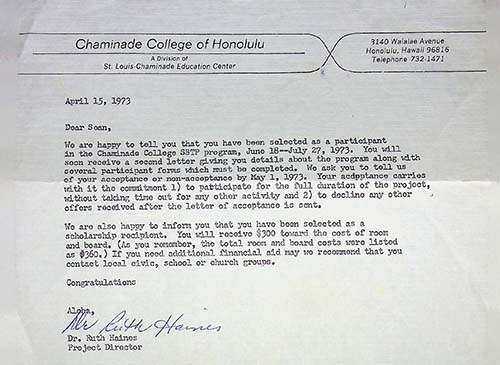
Dr. Sean Chamberlin has treasured his Chaminade acceptance letter to a science program that he received 50 years ago.

Akin to someone cherishing a handwritten love letter for a lifetime, Sean Chamberlin, Ph.D., covets a Chaminade acceptance letter he received more than 50 years ago. He even kept the envelope it came in. Five decades ago, the Florida native had applied to then-Chaminade College’s Science Training Program (STP) for high school students. The experience would forever change his life.

As an aspiring oceanographer, Chamberlin was among 36 students from across the nation who were invited to participate in the six-week program. To this day, he can vividly recall falling in “love with Chaminade University in May 1973,” the month he received his acceptance letter from Dr. Ruth Haines, Chaminade College’s then-STP project director. 

“I was 17 years old and I had never been away from home by myself,” exclaimed Chamberlin, during a phone interview. “Now I was going to Hawaii for six weeks—by myself! Chaminade made that happen. The school even paid for most of my room and board, which was about $60 per week in those days. Needless to say, I was super stoked.”

He has never forgotten the experience and the mentorship he received from Dr. Ron Iwamoto, biology professor emeritus with Chaminade. At the time, Chamberlin admitted he was carefree, staying up late at nights, coming to class barefooted, hanging with college students who were living on the top floor of the dorm and having his first pizza with pineapple at St. Louis Drive In.

“Despite my shenanigans, Dr. Iwamoto took me under his wing,” said Chamberlin, citing Iwamoto as one of the most influential people in his life. “Students in the program were required to carry out a research project as part of their studies. I didn’t realize it at the time, but Dr. Iwamoto devised a project for me that would require lots of energy, and would take me as far away as possible from the other students.”

Iwamoto’s strategy paid off.

The research project involved building an artificial reef in a bay where Iwamoto liked to fish. Like a MacGyver, Chamberlin creatively improvised by filling a few old tires with bricks and hauling them out to a channel between the reefs. Every day, he swam out to the spot and made frequent observations of the organisms that came to live there.

“I remember screaming through my snorkel when I saw the first fish inhabitants,” Chamberlin said. “The project didn’t amount to much scientifically, but it meant everything to me personally. I fell in love with field work, a passion that would propel my career as an ocean scientist for the next several decades.”

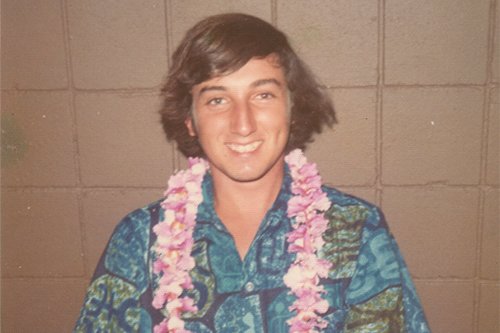
Dr. Sean Chamberlin received a lei upon his arrival on Oahu.

Chamberlin is careful in choosing his words to describe the courses he teaches in the Department of Earth Sciences at Fullerton College. He substitutes ocean science for the term oceanography, the scientific nomenclature more commonly used among scientists who study the properties (temperature, density, etc.) and movement (waves, currents, and tides) of seawater and the interaction between the ocean and the atmosphere. He also prefers to use the term weather and climate science to describe meteorology.

“Some students get intimidated about science because they may not have been exposed to it at a younger age,” Chamberlin explained. “Personally, I was always fascinated with science and living in Florida, I was exposed to the space program at an early age. I could see rockets go over my head in my own backyard. However, my parents weren’t too keen on me becoming an astronaut, but when I was 10 years old I learned about Scott Carpenter, an astronaut who became an aquanaut, and that was OK with them.”

After attending Chaminade’s STP, Chamberlin followed his passion and attended the University of Washington, a national leader in oceanographic research and education. Four of his peers in the Chaminade summer program also decided to enroll at UW.

At UW,  the aspiring scientist landed opportunities as a work-study student to carry out undergraduate research. By his junior year, he was regularly sailing aboard oceanographic vessels in the North Pacific. After graduating with bachelor’s degrees in oceanography and English, Chamberlin decided to attend graduate school at the University of Southern California.

He pursued his research aboard Jacques Cousteau’s Calypso in Tahiti, where he tested a new optical tool for measuring how fast ocean plants grow. He has also been to the Arctic where he sailed with Norwegian oceanographers in the Barents Sea. In 1988, Chamberlin spent five weeks aboard a polar research vessel in the Antarctic. He even got to walk on the sea ice in the Weddell Sea. His postdoctoral research with Lamont-Doherty Earth Observatory in Palisades, New York, led him to Iceland, the Azores and Portugal on research expeditions in the North Atlantic.

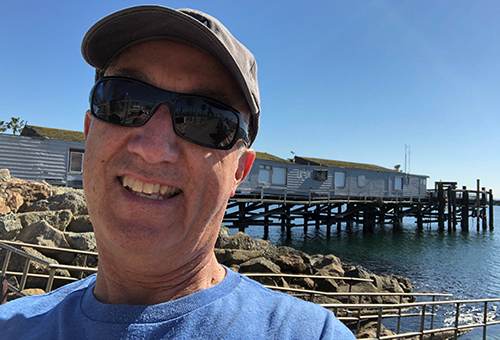
Dr. Sean Chamberlin still enjoys conducting field research.

“All of these paths originated from Chaminade,” Chamberlin said. “My experiences on a reef in a Hawaiian bay—thanks to Dr. Iwamoto—inspired me to pursue field science. “Perhaps because of that experience, my textbooks—“Exploring the World Ocean” (Chamberlin and Dickey 2008) and “Our World Ocean” (Chamberlin, Shaw, and Rich 2023)—draw from Hawaii’s countless examples of ocean features, processes and scientific achievements.”

But this story isn’t really about Chamberlin, it’s about the thousands of young people who have benefitted from his experiences at Chaminade. Although, he is not Hawaiian, he gained a profound respect for the  Hawaiian culture and its people, thanks to Chaminade. 

A few years ago, Chamberlin read a post on Chaminade’s Facebook page about the Ron Iwamoto Teaching Fellowship in Biology, which brought back fond memories for him—especially of Dr. Iwamoto and the once-in-a-lifetime opportunity afforded to him by Chaminade. 

“I smile when I think of how Dr. Iwamoto and Chaminade shaped my life as a young man,” Chamberlin said. “My choice of colleges, my pursuit of oceangoing research, my respect for diverse people and their cultures, and my love for Hawaii are rooted in my experiences under his mentorship. As an ocean educator, writer and scientist, I can only hope that my contributions are a fraction as impactful as Dr. Iwamoto’s were on me.  After all, it only takes a few bricks, a tire and a passion for life to make a beautiful reef.”

Posted by: University Communications & Marketing Filed Under: Campus and Community, Diversity and Inclusion, Faculty, Featured Story, Innovation, Natural Sciences & Mathematics, Undergraduate Research & Pre-Professional Programs

Student Research Project

November 17, 2023

Pam Oda presents her research findings in Texas

It’s just the beginning stages of her research, but Pam Oda ’24 has already presented her preliminary findings at the Society for Police and Criminal Psychology (SPCP) in Arlington, Texas, thanks to monies from the Alliance Supporting Pacific Impact through Computational Excellence (ALL-SPICE) grant. Standing in front of her presentation board, Oda explained the importance of education in the law enforcement field, which has long been debated. While many agencies have historically required little to no college coursework for entry-level positions, research suggests a positive correlation between education and job performance at all levels of law enforcement.

With the mentorship and encouragement of Dr. Kelly Treece, Criminology and Criminal Justice director and associate professor, Oda’s study evaluated disciplinary actions taken against Honolulu Police Department officers. With access to open records, Oda was able to obtain the types of allegations of police misconduct, which are divided into four sections: administrative investigation, criminal investigation, quality assurance and accreditation.

“Most of the violations were for administrative reasons,” said Treece, a former sergeant and trainer with the Pewaukee Police Department in Wisconsin. “Pam did a really good job with her presentation, and she handled herself very well in front of a lot of professionals.”

Pam Oda stands next to her poster board in Arlington, Texas.

The recent calls for police reform—combined with mounting evidence that an educated police force can have positive effects—have sparked a nationwide conversation about raising education requirements for police officers.

“Currently, the minimum qualification to become an HPD officer only requires having a high school diploma or your GED,” Oda said. “I think we need to raise that standard in Hawaii.”

In her presentation, Oda noted that 51.25 percent of officers received a High School Diploma or GED, 27.5 percent held a bachelor’s degree and 15 percent have received their associate’s degree or completed 60 semester credits or more. The numbers are consistent with national statistics, which show that only one percent of local police departments across the U.S. require their officers to hold four-year degrees and only eight percent call for officers to have attended any college at all.

Oda further noted that early research indicates that there is a broad performance difference between officers who have a college education and those who do not.

Citing a paper written by S.M. Smith and M.G. Aamodt (1997) in the Journal of Police and Criminal Psychology, the co-authors found that police officers who possess college degrees are better performers than those with only high school degrees, including overall performance, communication skills and decision-making ability. 

According to Oda, this type of research has been ongoing yet most departments are not implementing these findings into policy and practice. In addition, in a study conducted by the Police Executive Research Forum (2019), officers with a four-year college degree had significantly fewer civilian complaints than those with only a high school diploma. 

Oda also pointed out that research shows higher education has significant benefits for law enforcement officers, including the ability to navigate the complexities of modern-day policing, which consists of critical analysis, enhanced communication abilities and a comprehensive understanding of the criminal justice system (S. Christopher, 2015, in Policing: A Journal of Police and Practice). 

Now in her fifth year at Chaminade, Oda will complete a double major in Criminology and Criminal Justice and Data Science, Analytics and Visualization with minors in Computer Information Systems and Psychology in December. The Hilo native hopes to continue her research with Treece at Chaminade while pursuing her graduate degree in Criminal Justice.

“That’s the plan right now,” said Oda, who serves as the president for the Chaminade Student Government Association, as well as the president of the Restauranteers Club. “Since starting in fall 2019, I have taken advantage of the countless opportunities that Chaminade has to offer, from student clubs and organizations to research and internship opportunities to student employment and the ‘ohana spirit.”

Treece, too, plans to expand the research to include the Sheriff Division of the Hawaii Department of Public Safety, which will then include statewide statistics and a broader representation. By doing so, she and Oda will be able to capture a more robust picture of the correlation between education and law enforcement.

“The next step is to write a paper, which I’ve asked Pam to help me co-author,” Treece said. “She’s a little hesitant and nervous about it, just like she was when I first approached her about presenting in Texas. I think she’ll do great.”

Posted by: University Communications & Marketing Filed Under: Behavioral Sciences, Diversity and Inclusion, Featured Story, Innovation, Student Life Tagged With: Criminology and Criminal Justice, Master of Science in Criminal Justice Administration

  • « Go to Previous Page
  • Page 1
  • Interim pages omitted …
  • Page 5
  • Page 6
  • Page 7
  • Page 8
  • Page 9
  • Interim pages omitted …
  • Page 23
  • Go to Next Page »

Footer

Chaminade University Logo

3140 Waialae Avenue
Honolulu, Hawaii 96816

Contact Us
Phone: (808) 735-4711
Toll-free: (800) 735-3733

facebook twitter instagram youtube linkedin

Visit

  • Plan Your Visit
  • Campus Map (PDF)
  • Events

Resources

  • Campus Security
  • Student Consumer Information
  • Concerns, Feedback, and Reporting
  • Institutional Review Board
  • Title IX / Nondiscrimination Policy
  • Compliance
  • Emergency Information
  • Careers
  • Institutional Statement

People

  • Students
  • Parents
  • Alumni
  • Faculty & Staff

Policy

  • Privacy Policy
  • Terms and Conditions of Use


© Chaminade University of Honolulu