• Skip to primary navigation
  • Skip to main content
  • Skip to footer
Chaminade University of Honolulu

Chaminade University of Honolulu

  • VISIT
  • APPLY
  • GIVE
  • STUDENTS
  • PARENTS
  • ALUMNI
  • FACULTY/STAFF
  • Admissions
    • Admissions Home
    • Undergraduate Students
      • First-Year Students
      • Transfer Students
      • Admitted Students
    • Graduate Students
    • Flex Online Undergraduate Program
    • Military Students
    • Non-Degree/Visiting Students
    • Experiential Honors Program
    • Early College Program
    • New Student Orientation
  • Tuition & Aid
    • Financial Aid Home
    • Tuition & Expenses
    • Federal Updates & Changes
    • Scholarships
    • $5,000 Graduate Scholarship
    • VA Education Benefits
    • Net Price Calculator
  • Academics
    • Academics Home
    • Academic Programs
    • Office of Student Success
      • Academic Advising
      • Records and Registrar
    • Kōkua ʻIke (Support Services)
      • ADA Accommodations
      • Career Services
      • Proctoring Services
      • Tutoring Services
    • Sullivan Family Library
    • Undergraduate Research & Pre-Professional Programs
    • Commencement
  • Campus Life
    • About Campus Life
    • Student Engagement
    • Student Government Association
    • Residence Life and Housing
      • Summer Conference Housing
    • Health Services
    • Marianist Leadership Center
    • Counseling Center
    • Campus Ministry
    • Campus Security
    • Dining Services
    • Bookstore
  • Athletics
  • About
    • Chaminade University News
    • Our Story
    • Leadership
    • Chaminade University Strategic Plan 2024-2030
    • Mission & Rector
    • Association of Marianist Universities
    • Facts & Rankings
    • CIFAL Honolulu
    • Accreditation & Memberships
    • Montessori Laboratory School
Search
×

Search this web site

Diversity and Inclusion

Student Research Project

November 17, 2023

Pam Oda presents her research findings in Texas

It’s just the beginning stages of her research, but Pam Oda ’24 has already presented her preliminary findings at the Society for Police and Criminal Psychology (SPCP) in Arlington, Texas, thanks to monies from the Alliance Supporting Pacific Impact through Computational Excellence (ALL-SPICE) grant. Standing in front of her presentation board, Oda explained the importance of education in the law enforcement field, which has long been debated. While many agencies have historically required little to no college coursework for entry-level positions, research suggests a positive correlation between education and job performance at all levels of law enforcement.

With the mentorship and encouragement of Dr. Kelly Treece, Criminology and Criminal Justice director and associate professor, Oda’s study evaluated disciplinary actions taken against Honolulu Police Department officers. With access to open records, Oda was able to obtain the types of allegations of police misconduct, which are divided into four sections: administrative investigation, criminal investigation, quality assurance and accreditation.

“Most of the violations were for administrative reasons,” said Treece, a former sergeant and trainer with the Pewaukee Police Department in Wisconsin. “Pam did a really good job with her presentation, and she handled herself very well in front of a lot of professionals.”
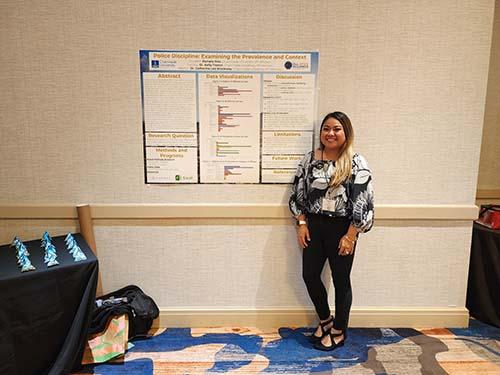
Pam Oda stands next to her poster board in Arlington, Texas.

The recent calls for police reform—combined with mounting evidence that an educated police force can have positive effects—have sparked a nationwide conversation about raising education requirements for police officers.

“Currently, the minimum qualification to become an HPD officer only requires having a high school diploma or your GED,” Oda said. “I think we need to raise that standard in Hawaii.”

In her presentation, Oda noted that 51.25 percent of officers received a High School Diploma or GED, 27.5 percent held a bachelor’s degree and 15 percent have received their associate’s degree or completed 60 semester credits or more. The numbers are consistent with national statistics, which show that only one percent of local police departments across the U.S. require their officers to hold four-year degrees and only eight percent call for officers to have attended any college at all.

Oda further noted that early research indicates that there is a broad performance difference between officers who have a college education and those who do not.

Citing a paper written by S.M. Smith and M.G. Aamodt (1997) in the Journal of Police and Criminal Psychology, the co-authors found that police officers who possess college degrees are better performers than those with only high school degrees, including overall performance, communication skills and decision-making ability. 

According to Oda, this type of research has been ongoing yet most departments are not implementing these findings into policy and practice. In addition, in a study conducted by the Police Executive Research Forum (2019), officers with a four-year college degree had significantly fewer civilian complaints than those with only a high school diploma. 

Oda also pointed out that research shows higher education has significant benefits for law enforcement officers, including the ability to navigate the complexities of modern-day policing, which consists of critical analysis, enhanced communication abilities and a comprehensive understanding of the criminal justice system (S. Christopher, 2015, in Policing: A Journal of Police and Practice). 

Now in her fifth year at Chaminade, Oda will complete a double major in Criminology and Criminal Justice and Data Science, Analytics and Visualization with minors in Computer Information Systems and Psychology in December. The Hilo native hopes to continue her research with Treece at Chaminade while pursuing her graduate degree in Criminal Justice.

“That’s the plan right now,” said Oda, who serves as the president for the Chaminade Student Government Association, as well as the president of the Restauranteers Club. “Since starting in fall 2019, I have taken advantage of the countless opportunities that Chaminade has to offer, from student clubs and organizations to research and internship opportunities to student employment and the ‘ohana spirit.”

Treece, too, plans to expand the research to include the Sheriff Division of the Hawaii Department of Public Safety, which will then include statewide statistics and a broader representation. By doing so, she and Oda will be able to capture a more robust picture of the correlation between education and law enforcement.

“The next step is to write a paper, which I’ve asked Pam to help me co-author,” Treece said. “She’s a little hesitant and nervous about it, just like she was when I first approached her about presenting in Texas. I think she’ll do great.”


Posted by: University Communications & Marketing Filed Under: Behavioral Sciences, Diversity and Inclusion, Featured Story, Innovation, Student Life Tagged With: Criminology and Criminal Justice, Master of Science in Criminal Justice Administration

Yin and Yang

October 23, 2023

Thirty years later, two middle school besties will graduate in ’24

The last time they graduated was in 1994 from Mililani High School. And when May 2024 comes around, Rita Aponte ’24 and KerryLynn Vea ’24 will again don their caps and gowns, as they prepare to cross the stage of the Waikiki Shell to receive their bachelor’s degrees.  

BFFs since high school, Aponte and Vea were able to pursue their university degrees, thanks to Bank of Hawaii’s College Assistance Program (CAP), which allows its employees to get back on the path to obtaining their first four-year undergraduate degree with tuition reimbursement.  

Draped with lei, Rita Aponte, left, and KerryLynn Vea posed for their graduation photo from Mililani High School in 1994.

“The Bank started this program in 2016, and I started the following year,” says Aponte, Manager of Loan Operations with Bank of Hawaii. “And my bestie, KerryLynn, is also on this journey with me since we both always wanted to get our degrees.”  

Both Aponte and Vea chose to start their families at a young age, hindering them from attending college. The two friends since middle school always had plans to return to university, but family obligations and full-time jobs prevented them from entering the college system.

“I get emotional when I talk about CAP,” says Vea, who was in the credit union industry for 20 years before joining Bank of Hawaii in 2016 and is now its Assistant Vice President-Mortgage Compliance Analyst. “Before CAP, I was resigned not to get my college degree, rationalizing to myself, ‘Oh well, I don’t need a degree since I already have a career.’”  

The American Council of Education estimates that approximately 20 percent of graduate students and six percent of the much larger number of undergraduates receive some financial assistance from their employers to attend school. As many as a third of undergraduates in fields like business and engineering also receive tuition aid, which, on average, covers about one-third of the annual cost paid by post-secondary students.  

Initially, when Aponte and Vea enrolled in Bank of Hawaii’s CAP initiative, they were limited to four specific start times a year (January, April, July and October). Today, new applicants have the flexibility to enroll for courses on a monthly basis throughout the year, which is consistent with Chaminade’s online Flex program.  

“I’ve worked at credit unions where tuition assistance was always included in the employee manual book, but I never once saw it used,” Vea says. “Bank of Hawaii, on the other hand, vigorously promotes CAP and they champion it, putting funding behind it with no strings attached. The program is a 100 percent benefit to all employees.”  

Bank of Hawaii’s executives said they needed a partner that understood the Bank’s vision of what they wanted to achieve with its CAP program. However, they also wanted to make sure that the online learning experience was customized to the specific needs of the Bank’s employees since they wanted CAP to be “a real pillar and cornerstone of what Bank of Hawaii is all about.”

“We thought it was not only important to train our employees in specific banking-related issues, but also to help them expand their overall educational base,” says Peter Ho, Bank of Hawaii’s Chairman, President and Chief Executive Officer, in a video release. “From an education standpoint, the important thing is to really help shape the individual’s mind and spirit—and that’s what education is all about; that’s what college is all about.”  

Although, Aponte and Vea didn’t experience the traditional campus setting, they were able to take their classes online, via Chaminade’s Flex program model, allowing students to take one or two courses at a time—or more if they choose—as they work toward their degree. And the pace of coursework rests with them. They can complete online courses in as few as six weeks. Or, they can take their time, wrapping up a course in six months. Flex students are also able to complete courses wherever they are, even on the go.  

“It was a real struggle during the holiday season,” Aponte recalls. “Even when we went on vacation to Disney World, algebra came along with me.”  

KerryLynn Vea takes a break from her studies with her new son.
KerryLynn Vea takes a break from her studies with her six-week old granddaughter Ellie in 2018.

The Flex Online Undergraduate program is WSCUC-accredited (WASC Senior College and University Commission) and has a broad range of study disciplines, including business administration, criminology and criminal justice, historical and political studies, education and psychology. It is designed with working adults in mind, distancing itself from rigid term schedules and due dates to give students the flexibility they need to achieve a work-life-school balance and make progress toward reaching their goals.  

“I started at Leeward Community College for a semester and a half, but scheduling was really difficult,” Vea says. “I just couldn’t do it all with a full-time job, a family and attending classes; it was a lot.”  

Nor could Aponte.

“I didn’t think a college degree was in the books for me,” Aponte asserts. “It was always nagging at me to get my bachelor’s, but I used time and cost as excuses not to pursue it. And now I’m motivated to finish this and I can’t wait.”  

Thirty years will have elapsed by the time Aponte and Vea attain their bachelor’s degree, and through the three decades, they’ve raised families, enjoyed successful careers and supported each other through both good times and bad.  

“Getting the bachelor’s degree with Rita couldn’t get any better,” Vea says. “I always say I’m the Yin because I’m more subdued and quieter, and she’s the Yang because she’s more outgoing and vocal. We might be opposites, but through this college process, we’ve depended on each other and have been each other’s greatest cheerleader.”      

Posted by: University Communications & Marketing Filed Under: Business & Communication, Diversity and Inclusion, Featured Story, Innovation, Institutional, Student Life Tagged With: Business Administration, Financial Aid, Scholarship

Silversword Alumni Reunion: A Time to Remember

October 20, 2023

Kalaepōhaku was the place to be this past week as generations of alumni returned for four different reunion events, each reconnecting and engaging Chaminade University graduates with their beloved alma mater. Satisfaction was achieved beyond expectations. Watch this recap video.

“As you gather with your fellow Silverswords, we hope you are rekindling friendships, sharing cherished memories, and creating new connections,” wrote President Lynn Babington and Director of Alumni Relations Jodi-Anne Yoshida, MBA ’23 in the program for the reunion dinner. “You can continue to be proud of your alma mater and how Chaminade has flourished.” 

Back to School!

The Silversword Reunion week kicked off on Thursday, October 12, with an early evening tailgate party at Henry Hall Courtyard. Yoshida welcomed the guests, whose graduating years ranged from the 1960s to 2023. Guests received Chaminade alumni t-shirts and blue pompoms while enjoying a delicious dinner of BBQ chicken, kiawe-smoked pork chops, greens and more. Following the tailgate, the party was moved inside to McCabe Gymnasium to cheer on the Chaminade women’s volleyball team. The Silverswords swept the HPU Sharks! 

Then, on Aloha Friday, October 13, alumni returned to campus for tours and an ono local-style bento lunch. Students Aleeyah Lemons ’24 and Noelani Tugaoen ’25 guided alumni on walking tours, strolling along Second Road, past Ching Hall and Eiben Hall, into the Sullivan Family Library and back to Henry Hall, where President Babington greeted them with her warmth and aloha. In the library, alumni perused past yearbooks and were amused to find their student photos. They recalled that the library was once housed in Henry Hall as they shared heartfelt stories from their college days. 

Special Reunion Dinner, Alumni Awards and Mass

The long-anticipated reunion dinner was a great success, as nearly 300 alumni and guests gathered in the Ching Conference Center on October 14. Emceed by former Miss Universe Brook Lee ’96, the program opened with a blessing from Bro. Ed Brink, followed by the presentation of Alumni Awards and presentation of videos: Kahala Kabalis Hoke ’05, MS ’07 received the Marianist Alumni Award; Dr. Thomas Shieh ’87 received the Distinguished Alumni Award; and Lei Uʻi Kaholokula ’23 was named the Young Alumni Award recipient. Read more about the alumni award winners here. Lee brought her charisma and sparkle to the program, which featured music by Nick Laʻa and DJ Sounds by Pipi. Guests received the exclusive Chaminade tote bag by Eden In Love, reunion favors, and each other’s engaging company. 

While alumni dined on Hawaiian dinner catered by Bill Quinlan, the memories and good feelings filled the room as people strolled down Memory Lane and reminisced about their Silversword days.

The following morning, a Sunday Mass was held as alumni gathered in the sacred Mystical Rose Oratory to celebrate faith, hope and love.

Posted by: University Communications & Marketing Filed Under: Alumni, Campus and Community, Diversity and Inclusion, Featured Story, Institutional Tagged With: Alumni

Andrew W. Mellon Foundation Grant  

October 6, 2023

New funding will help expand HEP Program

With support from a $750,000, three-year grant from the Andrew W. Mellon Foundation, Chaminade University of Honolulu will now be able to expand its Higher Education in Prison (HEP) program, which aims to be a pathway for participants to leave incarceration with new identities, perspectives and goals to help them thrive in society.  

“At Chaminade, one of our primary Marianist values is to advocate for social justice for transformative change,” said Chaminade President Lynn Babington, Ph.D. “We support a rehabilitation-through-education narrative, which we know is essential to incarcerated individuals finding a pathway to a second chance and a better future.”  

Chaminade’s current HEP program only serves males who are incarcerated at Halawa Correctional Facility. However, moving forward, the University plans to extend its cohort model HEP program to the Women’s Community Correctional Center (WCCC), as well as to those men serving time 3,000 miles from home at the Saguaro Prison in Arizona.  

The goal is to expand degree offerings, starting with the men in Halawa, to include an AA in Liberal Arts that can be extended to a BA in Interdisciplinary Studies. The coursework for the three degree programs will emphasize a humanities and liberal arts curriculum, and will be offered in a culturally responsive and trauma-informed way that will resonate with the overly-represented indigenous prison population.  

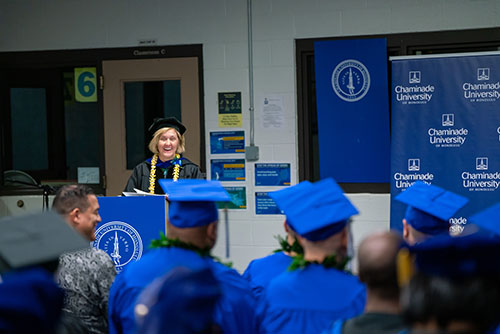
Dr. Janet Davidson addresses the new graduates during a Commencement Ceremony at Halawa Correctional Facility.

“If we want safer communities, if we want healthier families, if we want people who are incarcerated to have a chance when they come out, these are the types of rehabilitative programs we should be offering,” said Dr. Janet Davidson, Chaminade’s Vice Provost for Academic Affairs and a leader in criminology. “The idea is to shift the mindset. It will cost society less in the end.”  

Citing racial equity as a primary condition that makes HEP programs urgently necessary, the grant underscores the over-representation of Native Hawaiians in the criminal justice system. According to data collected by the Office of Hawaiian Affairs, Hawaii’s incarceration rate increased by 403 percent from 1978 to 2016, with Native Hawaiians affected disproportionately. Though accounting for only 18 percent of the state’s adult population, Native Hawaiians represent 37 percent of those incarcerated. This statistic includes Native Hawaiian women who make up 44 percent of the incarcerated women in Hawaii.  

While imprisoned women already have access to some college courses, they don’t have degree options. This Mellon grant will change this. “Since women are more likely than men to be the primary caretakers of dependent children prior to incarceration,” Davidson said, “their success after leaving prison will have a positive impact on their children and families, multiplying the effects of a single college degree.”  

Providing education in prison has indeed proven to reduce recidivism rates, and is associated with higher employment rates, which will improve public safety and allow individuals to return home to their communities and contribute to society. Moreover, a 2018 study from the RAND Corporation, funded by the Department of Justice, found that incarcerated individuals who participated in correctional education were 48 percent less likely to return to prison within three years than incarcerated individuals who did not participate in any correctional education programs. RAND also estimated that for every dollar invested in correctional education programs, four to five dollars are saved on three-year, re-incarceration costs.  

“The success of this pilot program—between Chaminade University of Honolulu and the Hawaii Department of Public Safety—demonstrates that partnerships can lead to transformative change,” Davidson said. “With the support and guidance of Chaminade’s distinguished faculty and support staff, and the cooperation and backing of Halawa Correctional Facility, these individuals have embraced the opportunity to redefine their futures. This program is part of Chaminade’s mission to educate for service, justice and peace. We hope that with their newly gained education, these students will have the skills needed to rebuild their lives upon reintegration into society.”        

Posted by: University Communications & Marketing Filed Under: Catholic, Diversity and Inclusion, Homepage, Innovation, Institutional Tagged With: Andrew W. Mellon Foundation Grant, Education in Prison, Transformation

Association of Marianist Universities

September 28, 2023

Advancing Marianist and Catholic values in higher education

In his seminal book, “A New Fulcrum: Marianist Horizons Today,” the late Fr. David Fleming posed: “What Makes University Education ‘Marianist’?” One of the potential answers perhaps lies in the synthesis of faith and reason, a hallmark of Catholic and Marianist education. It’s about fostering a community of learners who not only excel academically, but who also grow spiritually, morally and ethically. It’s about instilling in students a deep sense of social responsibility and a commitment to making the world a better place.

“In terms of the relationship between faith and reason, I adhere to Pope John Paul II’s 1998 Encyclical Letter ‘Fides Et Ratio,'” in which he describes Faith and Reason as two wings on which the human spirit rises to the contemplation of truth,” answered Chaminade President Dr. Lynn Babington, when asked about her understanding of the relationship between faith and reason in an interview with the Association of Catholic Colleges and Universities. “In other words, the Catholic intellectual tradition at the heart of a Catholic university presupposes the harmonious existence between faith and reason. It’s a relationship that is not static because both faith and reason are involved in a mutual search for and reception of meaning and truth.”

Bro. Tom Giardino addresses Flyer alumni during a University of Dayton award ceremony. ©Briana Snyder, Knack Video + Photo

For Association of Marianist Universities (AMU) Executive Director Bro. Thomas Giardino, Fleming’s question could serve as a catalyst for conversations that are needed today in order to develop and advance the mission and identity of Marianist and Catholic higher education.

“Since the Marianist educational tradition is a person-centered charism [gift] with a mission strategy, when this reality is felt by students, staff and faculty then that university education is alive with the Marianist sensibilities,” said Giardino in an email response. “This means that the university community experiences that they individually matter, that relationships matter, that the world matters, and that there is a relationship between their education and their encounter with our world. For this to happen, there needs to be a critical mass of persons who are in the community, not simply for transactional relationships, but for transformational relationships; that is, it touches the meaning and purpose of their identity, what they live for.”

In today’s society, where knowledge is abundant but wisdom is scarce, Catholic and Marianist universities face pressing issues. One such issue is the challenge of maintaining their distinct identity and values in a rapidly changing world. The secularization of higher education and the prevailing culture of individualism pose threats to the unique mission of these universities.

Another pressing issue is the need for inclusivity and diversity. As society becomes more pluralistic, Catholic and Marianist universities must ensure that their campuses are welcoming to people of all backgrounds and faiths. They should strive to create an environment where open dialogue and respectful exchange of ideas can flourish.

AMU plays a crucial role in addressing these challenges. It serves as a platform for collaboration and shared learning among Catholic and Marianist universities. It fosters a sense of solidarity and unity among these institutions, helping them preserve their core values while adapting to the demands of the modern world.

“The Association of Marianist Universities provides a structure for the three Marianist Universities to share ideas and programming to strengthen the Marianist identity of each of the universities,” said Bro. Ed Brink, Chaminade’s Vice President of Mission and Rector. “Through the work of AMU, there are regular meetings (usually via Zoom) of people from each of the universities that have similar jobs.”

In 2005, members from Chaminade University, University of Dayton and St. Mary’s University of San Antonio responded to the call from AMU Board to build a partnership among members of the Society of Mary, the sponsoring religious body. It would invite a cadre of lay collaborators, who would together sustain and renew the mission and identity that was Catholic, and that embodied the Marianist educational tradition.  

Since then, faculty, staff and administrators have been invited each year to deepen their understanding of and their commitment to the traditions and beliefs that make each respective university a Catholic and Marianist community.

Bro. Ed Brink teaches the fundamentals of Marianist values.

“In the summer of 2022, AMU held a symposium during which more than 100 people from the three universities gathered to reflect on the unique contributions that Marianist Universities make within American higher education, and to envision possibilities for the future,” Brink said. “Whenever AMU gathers people from the three universities together, we are reminded that we are part of a bigger mission.  While we all take pride in our own work, we are able to see that we are working on a project that goes well beyond our own institution and campus walls.”

In a world marked by division and polarization, the three Marianist/Catholic universities promote a message of unity and common purpose. They produce graduates who are not only academically competent but also compassionate, ethical and dedicated to making a positive impact on society.

In a world hungry for meaning and purpose, the Association of Marianist Universities serves as a guiding light. It reminds us that education is not just about acquiring knowledge; it’s about becoming better human beings. It underscores the enduring relevance of Catholic and Marianist principles in today’s society, where the search for truth, goodness and justice remains as vital as ever.

“Our faculty and staff already embrace and appreciate the values of providing a quality education, and an education for service, justice, peace, adaptation and change,” Babington said. “They may not necessarily have a religious affiliation, but they do believe in an equal and just society, which is what we impart to our students.”

Posted by: University Communications & Marketing Filed Under: Campus and Community, Catholic, Diversity and Inclusion, Homepage, Institutional Tagged With: Campus Event, Guest Speakers, Marianist

New College Rankings

September 19, 2023

Chaminade makes 2024 annual listing by US News & World Report

The US News & World Report released its 2024 annual ranking list of the nation’s “Best Colleges” on Monday, and Chaminade University once again fared strongly in several categories, ranking No. 10—bumping up a spot from 2023—for Best Value among regional universities in the west. The University was also recognized as No. 29 in Social Mobility for graduates and No. 30 as Best in the Western Region.

“Chaminade combines many of the advantages of a large university—such as innovative programs, dedicated faculty, research programs and real-world learning opportunities—with the personal attention and close-knit culture of a small, private institution,” said Chaminade President Lynn Babington, Ph.D. “We offer a unique blend of liberal and professional studies that provides our students with the skills, knowledge and experience they need to build successful lives and achieve their dreams.”  

This year, US News made several changes to the metrics it uses to rank colleges, such as introducing new criteria tied to first-generation students, and placing more weight on retention of and graduation rates for students who received need-based Pell grants. The system also adds greater emphasis on “social mobility,” which generally refers to an individual making gains in education, income and other markers of socioeconomic status.  

“The significant changes in this year’s methodology are part of the ongoing evolution to make sure our rankings capture what is most important for students as they compare colleges and select the school that is right for them,” U.S. News CEO Eric Gertler said in a statement to USA TODAY.  

The rankings were calculated using as many as 19 key measures of academic quality to evaluate nearly 1,500 U.S. four-year bachelor’s degree-granting institutions. These statistics reflect educational excellence and graduate outcomes, as well as considerations that vary person-to-person, like campus culture, strength in specific majors and financial aid offered.  

Chaminade was also recognized favorably from two other sources. Recently, Forbes ranked both Chaminade’s Master’s of Education online program and the Bachelor’s of Education online program in the top 10 across the country. Both programs accommodate working adults and others who need a flexible college experience.  

CounselingPsychology.org—a website devoted to providing educational resources for aspiring counselors and psychologists—also ranked Chaminade’s online bachelor’s degree in Psychology as #1. This recognition is a testament to Chaminade’s faculty, staff and students who contribute to making this program one of the best in the country.  

“Our comprehensive excellence is notable,” Babington said. “Many of our peer institutions are weighted heavily toward certain disciplines, but we are fortunate to have a balanced portfolio of strengths. Indeed, we have nationally recognized programs that range from nursing to forensics.”  

U.S. News and World Report Rankings*:  
Regional Universities West #30
Best Value – Regional Universities West #10
Social Mobility – Regional Universities West #29  
*These rankings are based on in-depth analyses of a wide variety of data points, as explained in the Best Colleges methodology article.  

Posted by: University Communications & Marketing Filed Under: Campus and Community, Diversity and Inclusion, Featured Story, Innovation, Institutional, Students Tagged With: Honors and Awards, Student Government

  • « Go to Previous Page
  • Page 1
  • Interim pages omitted …
  • Page 6
  • Page 7
  • Page 8
  • Page 9
  • Page 10
  • Interim pages omitted …
  • Page 23
  • Go to Next Page »

Footer

Chaminade University Logo

3140 Waialae Avenue
Honolulu, Hawaii 96816

Contact Us
Phone: (808) 735-4711
Toll-free: (800) 735-3733

facebook twitter instagram youtube linkedin

Visit

  • Plan Your Visit
  • Campus Map (PDF)
  • Events

Resources

  • Campus Security
  • Student Consumer Information
  • Concerns, Feedback, and Reporting
  • Institutional Review Board
  • Title IX / Nondiscrimination Policy
  • Compliance
  • Emergency Information
  • Careers
  • Institutional Statement

People

  • Students
  • Parents
  • Alumni
  • Faculty & Staff

Policy

  • Privacy Policy
  • Terms and Conditions of Use


© Chaminade University of Honolulu