• Skip to primary navigation
  • Skip to main content
  • Skip to footer
Chaminade University of Honolulu

Chaminade University of Honolulu

  • VISIT
  • APPLY
  • GIVE
  • STUDENTS
  • PARENTS
  • ALUMNI
  • FACULTY/STAFF
  • Admissions
    • Admissions Home
    • Undergraduate Students
      • First-Year Students
      • Transfer Students
      • Admitted Students
    • Graduate Students
    • Flex Online Undergraduate Program
    • Military Students
    • Non-Degree/Visiting Students
    • Experiential Honors Program
    • Early College Program
    • New Student Orientation
  • Tuition & Aid
    • Financial Aid Home
    • Tuition & Expenses
    • Federal Updates & Changes
    • Scholarships
    • $5,000 Graduate Scholarship
    • VA Education Benefits
    • Net Price Calculator
  • Academics
    • Academics Home
    • Academic Programs
    • Office of Student Success
      • Academic Advising
      • Records and Registrar
    • Kōkua ʻIke (Support Services)
      • ADA Accommodations
      • Career Services
      • Proctoring Services
      • Tutoring Services
    • Sullivan Family Library
    • Undergraduate Research & Pre-Professional Programs
    • Commencement
  • Campus Life
    • About Campus Life
    • Student Engagement
    • Student Government Association
    • Residence Life and Housing
      • Summer Conference Housing
    • Health Services
    • Marianist Leadership Center
    • Counseling Center
    • Campus Ministry
    • Campus Security
    • Dining Services
    • Bookstore
  • Athletics
  • About
    • Chaminade University News
    • Our Story
    • Leadership
    • Chaminade University Strategic Plan 2024-2030
    • Mission & Rector
    • Association of Marianist Universities
    • Facts & Rankings
    • CIFAL Honolulu
    • Accreditation & Memberships
    • Montessori Laboratory School
Search
×

Search this web site

Diversity and Inclusion

Hail to the King

August 31, 2023

It was literally one step forward, two steps back for Cedric King as he learned to walk again after having both of his legs severed by an improvised explosive device (IED) during his second tour in Afghanistan. But he got up … again and again, each time with even more steely determination to weather what he calls “the storm.”  

“I’m not going to tell you it wasn’t tough,” said King, who made an appearance on the Kalaepohaku campus to give his keynote address titled, “Relentless Spirit, Resilient Mind.” “The beginning was difficult. I had to relearn how to walk, how to write, how to type, how to drive. But I didn’t give up and play victim, and the woe-is-me card.”  

A retired Army 82nd Division Airborne Master Sergeant, King was only 34 years old when he lost his limbs and severely injured his right forearm, which took years to reconstruct and is now disfigured.
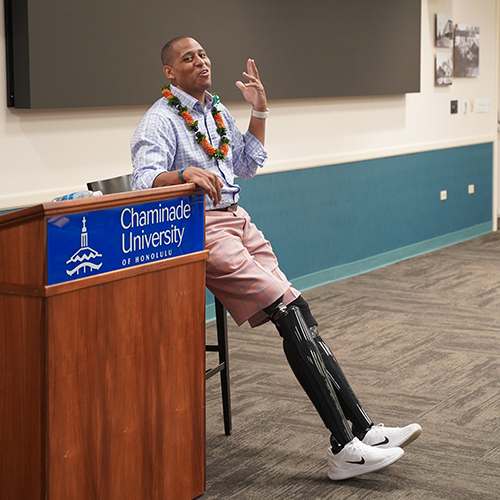
Retired Army Master Sergeant Cedric King gave a TEDx-like talk about resiliency and persistence.

Recalling the moment when his platoon was under machine gun fire while doing reconnaissance in an Afghanistan village, King described the explosion as “knocking him off his feet.” When he gained consciousness, he saw in his periphery that a medic was running towards him pulling out a tourniquet while en route.  

“I thought, I just got knocked down,” said King, who was unaware of his severe injuries until he looked down at his severed legs and could see his radial artery pulsating from his forearm. “The next thing I remember was waking up in the hospital, eight days later.”  

King would spend three years at the Walter Reed National Military Medical Center’s Military Advanced Training Center (MATC), which is a state-of-the-art facility where service members, retirees and family members use sophisticated prosthetics and cutting-edge athletic equipment to move from injury to independence.  

“When I woke up, I knew the life that I had was no longer the same,” King said. “I couldn’t make peace with this storm. But my wife and kids told me they needed me to be dad again.”  

With his family in attendance, King thanked his mom Sandra Williams, step-dad Valton Williams and his aunts, Coralis McCormick and Karen McClinic, for their years of support and love. “They probably had it harder because they were the ones who got the call,” King said. “You know it’s possible that something like this could happen, but you never think it would happen to you.”  

While recovering from his injuries, King made it a point to complete his bachelor’s degree and began to fine tune his speaking voice. “When I was in the hospital, my heart said ‘Hey man, you still have so much good to give,’” recounted the North Carolina native. “If you could only get out of this hospital bed, you could probably be inspiring to other people.”  

Since becoming a bilateral amputee below the knee, King has shared his story of perseverance and resilience with such audiences as the US Naval Academy and the United States Military Academy at West Point, and professional sports teams of the NFL, NBA and MLB. He has spoken about his experience with Fortune 500 companies from Home Depot to Facebook. And in February 2019, his story was published into print when he released his book called, “The Making Point.”  

Clutching her copy of “The Making Point” at the TEDx-like talk at the T.C. Ching Conference Center, nursing sophomore Grace Kang ’26 presented King with an orchid lei, telling him how inspiring it was to read about his life.  

In his book, King shares his mindsets, philosophies and stories that include how 21 months after losing both of his legs, he completed the 2014 Boston Marathon. And after 26 months and three days, he finished a 70.3 mile half Ironman Triathlon. He has been featured on such cable networks as CBS, NBC, ABC, HBO and the NFL Network. The 45-year-old Atlanta resident is also a two-time New York City Marathon Finisher, a five-time Boston Marathon finisher, numerous half marathons and a thrice 48.6 mile Disney Marathon series finisher.  

“Your process touched me and made me cry,” Kang told King. “I don’t know how you coped during your darkest moments. You kept getting up no matter the challenges.”  

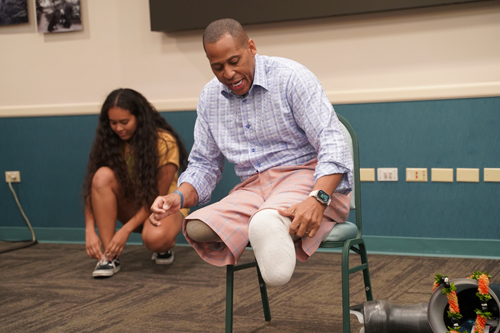
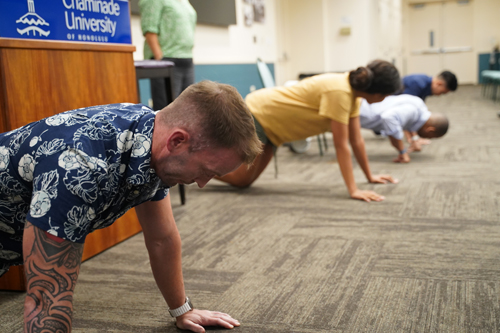
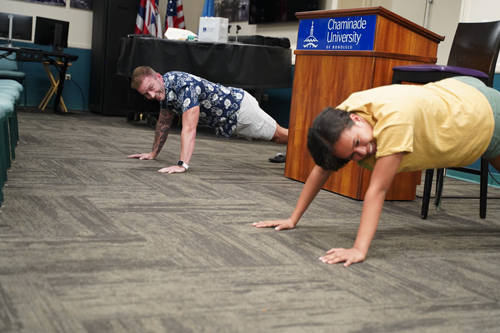
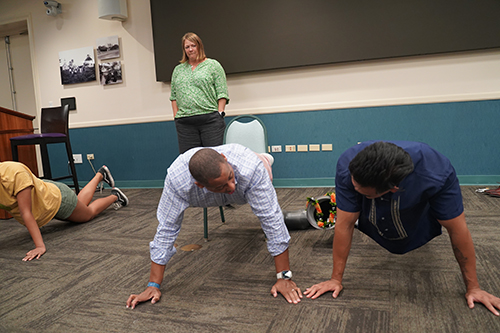
Toward the end of his talk, King issued his own challenge to Nick Creech, Kaila Frank ’24 and Andrew Ancheta ’21. Sitting on a chair, King removed his prosthetics and then maneuvered his his hip and thigh onto the chair and lowered his upper torso in a push-up position.  

“I’m the storm,” King told Creech, Frank and Ancheta. “And now you’re going to get down and match me in push-ups. I’m going to do everything to try to trick you to give up. So, can you outlast the storm?”  

After 12 reps, the challenge was over. Creech, Frank and Ancheta survived the storm.  

“You have to have reps, which represent hard times, and each time you do a rep, you’re getting stronger,” said King, using metaphorical terms. “Storms are there to train you; they’re your allies and not your enemy.  

“You have to relook how you see things,” King continued. “You could see yesterday as great, but you could make tomorrow even better.”  
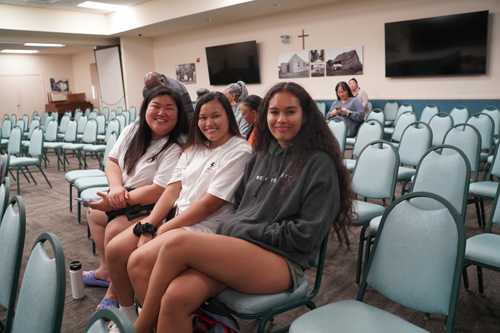
Students, from left, Grace Kang, Huong Pham and Kaila Frank.
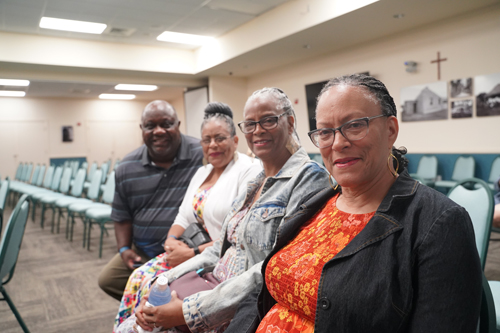
Cedric King’s family, from left, step-dad Valton Williams, mom Sandra Williams and his aunts, Coralis McCormick and Karen McClinic
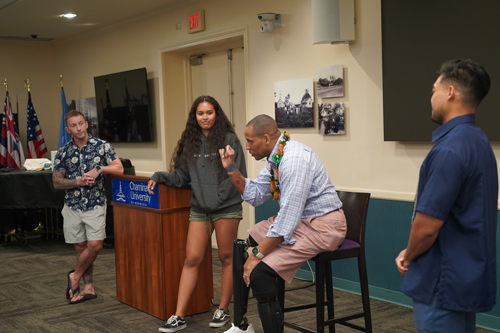
Cedric King issues a challenge to Nick Creech, Kaila Frank and Andrew Ancheta.
Cedric King removed his prosthetics before the challenge.
Nick Creech holds a push-up position.
Nick Creech and Kaila Frank look over at Cedric King.
Cedric King tries to convince Andrew Ancheta to quit while Vice President for Student Affairs & Dean of Students, Alison Jerome, plays “referee.”

Posted by: University Communications & Marketing Filed Under: Campus and Community, Diversity and Inclusion, Institutional Tagged With: Campus Event, Guest Speakers

Nonprofit Financial Seminar

August 30, 2023

After welcoming members from more than 50 charitable organizations, Associate Professor of Accounting with the School of Business and Communication, Richard Kido, noted that this year marked a milestone 20th anniversary of this Non-Profit Financial Seminar, which aims to provide guidance and information on financial and operational issues related to leading and managing nonprofit organizations that serve our communities.  

“Don’t forget to register or you won’t get your CPE credit,” Kido reminded attendees. Continuing professional education, or CPE, credit is a term referring to the points professionals receive for participating in specialized training. CPE credits are based on hours of study and count toward certification programs that enable professionals to maintain or update their credentials.  

“The last time I was up here, it was just me and a camera,” quipped Trever Asam, a partner at the Cades Schutte law firm, which specializes in tax and nonprofit organizations. “Today, I will provide an update on the new IRS federal tax rates, which have an impact on gift and estate taxes. I’ll also discuss gift bunching and the Secure Act 2.0.”  

Effective finance management is essential for the success of any non-profit organization. By understanding the importance of financial administration and the challenges that nonprofits face, organizations can take steps to improve their accounting practices and better serve their communities.  

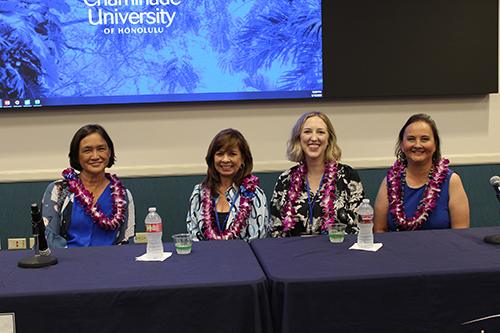
Other speakers at the event included Be-Jay Kodama, a two-time Chaminade University graduate ’86 BA and ’17 MBA, and Vice President of Philanthropy at Catholic Charities Hawaii (CCH), who was a member of a panel that discussed fundraising and grant writing in the world of nonprofits.  

Panelists, from left, Angie Golis-Yamamoto, Be-Jay Kodama, Madalyn Kenney and Candace Asam-Lopez discussed fundraising challenges in the world of nonprofits.

“The work we do is important, and you have to be able to think outside of the box,” Kodama told attendees. “Don’t be afraid to ask … and ask again and again.”  

Also among the four-member panel was Angie Golis-Yamamoto, a 35-year veteran of the nonprofit sector, who shared her fundraising successes and failures. “The challenge is how to bring awareness and money to your special events,” said Golis-Yamamoto, Director of Development at Sacred Hearts Academy. “And there are a lot of logistics in running an event. For example, if you have an auction, do you have it online or do you it by paper?”  

Fellow panelists, Candace Asam-Lopez, Director of Development, Ronald McDonald House Charities Hawaii and Madalyn Kenney, Chief Development Officer, Make-A-Wish Hawaii shared their own approaches to fundraising, which include looking at events through a more critical lens, sponsor partnerships and post-event engagement.

“It requires a lot of committment,” Asam-Lopez said. “Events are expensive and labor intensive. And ever since COVID, the question still remains do you hold an in-person event or do you go virtual? But how would a virtual golf tournament look like?”

Organized annually by Chaminade’s School of Business and Communication, the daylong seminar featured an impressive slate of experts who made presentations that covered such topics as “COVID-19 Related 2023 Non-Profit Recovery Grant Program” by Shane Akagi, Administrator of the Office of Grants Management, City and County of Honolulu; “Recruitment and Retention of Employees” by Sarah Guay, Hawaii Employers Council’s President & Chief Executive Officer; and Strategic Alliances and Partnerships by Lindsay Kido, Beer is for Everyone Founder and Executive.  

Other scheduled speakers included Hugh R. Jones, Counsel, Ashford & Wriston LLP; Bernice Parsons, President & Co-Founder, Vertaccount; and Aedward Los Banos, Deputy Director, Department Of Community Services with the Department of Community Services, City and County of Honolulu.  

The day concluded with three breakout sessions, with the first focused on the Unrelated Business Income Tax (UBIT) led by Adjunct Professor Wayne M. Tanna, JD, LL.M; and Recruitment and Retention of Employees with Guay. The second session looked at Grant Accounting with Professor Aaron Williamson; and Strategic Alliances and Partnerships with Lindsay Kido. The day’s final session involved Understanding the Audit Process Review with Catha Lee Combs, CPA and Managing Partner with Wikoff Combs & Co., LLC; and Sources of Nonprofit Financial Information with Professor Kido.  

“This was the first year since COVID that the seminar was held fully in-person,” said Asoke Datta, EdD, School of Business and Communication’s Assistant Dean and the seminar’s Moderator for Financial Track Sessions. “You could really feel an uptick in energy and excitement. What this seminar achieves is to bring nonprofits together, which doesn’t often happen. So, the seminar allows these nonprofit leaders to meet each other and form new collaborations.”      

Posted by: University Communications & Marketing Filed Under: Business & Communication, Campus and Community, Diversity and Inclusion, Featured Story, Institutional Tagged With: Campus Event, Guest Speakers

New Student Orientation

August 21, 2023

Incoming class of freshmen familiarize themselves with campus resources

Across the nation, thousands of freshmen will mark a rite of passage this month, standing in that liminal space between what lies behind and what awaits ahead—between the familiar past and the unpredictable future. As Davis and Rian Wakefield helped their daughter, Shalei Parong, check in to the Hale Pohaku dormitory during New Student Orientation, they felt a mix of emotions: sadness, worry and excitement.

“At least she’s close to home,” said Davis Wakefield, a firefighter with the Hawaii Fire Department based in Kona. “This is her choice to come here, and we support her decision; it’s a new chapter of her life.”

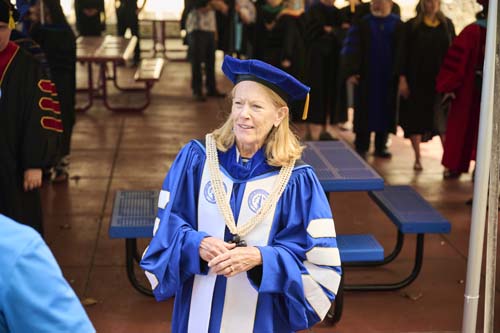
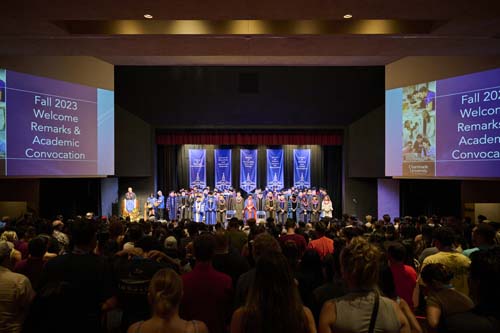
Writing their own stories was a key theme in Chaminade President Dr. Lynn Babington’s welcoming message to incoming students during the Academic Convocation at the Mamiya Theater. Another one of her keynotes involved the principles of a holistic, Marianist education, focused on service, justice, peace, adaptation and change.

“You’ve chosen to attend a warm and welcoming liberal arts University,” Babington told students. “You will form bonds here, and you’ll delve new ways of thinking and discerning who you are and who you want to be.”

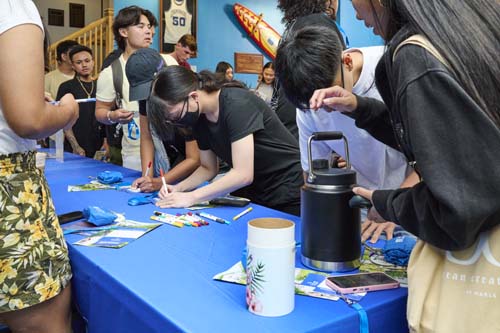
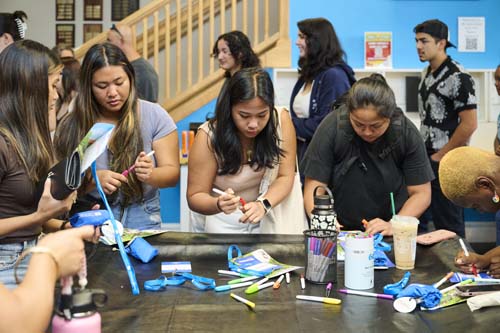
Students write their names on tags.
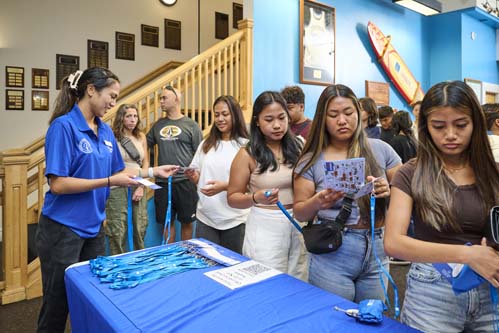
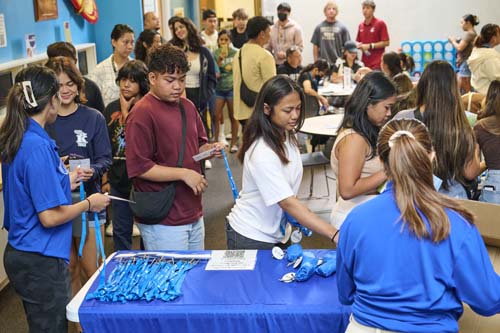
Incoming freshmen received a lanyard for their student ID cards.
Checking in for New Student Orientation.
Signing in for New Student Orientation.
Waiting for the app Canva to open.
Faculty members stood outside of Mamiya Theater.
Chaminade President Dr. Lynn Babington to address students.
It was a full house at Mamiya Theater.
Trying to navigate the Kalaepohaku campus.
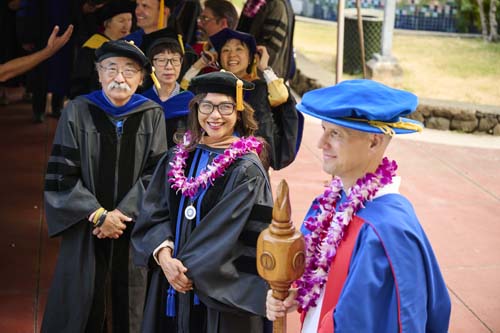
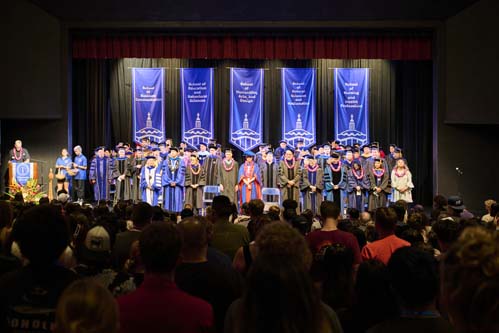
Faculty members gather for the Academic Convocation.
Fr. Chris Wittmann led the group in prayer.
Chaminade President Dr. Lynn Babington and faculty members welcomed new students during the Academic Convocation.
Chaminade Provost Lance Askildson explained that higher education is an intellectual exercise in application and reflection. 
Students applaud the words of Dr. Lance Askildson.
Chaminade Student Government Association President, Pamela Oda, advised new students not to fear change.
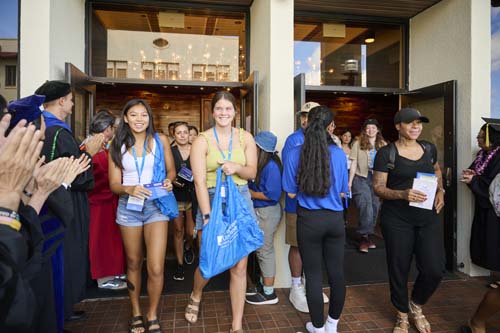
Students walk out of Mamiya Theater after Convocation.
A group of freshmen explored the Kalaepohaku campus.
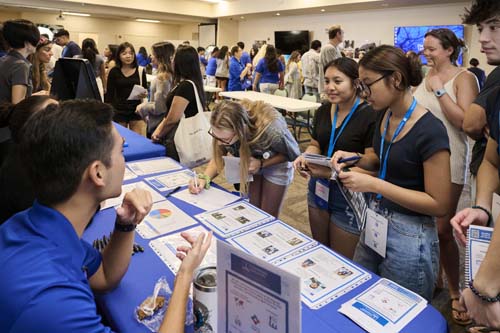
Learning about campus resources.
Orientation leaders flash their shaka of approval.

Mandatory for all freshmen and transfers, the New Student Orientation (NSO) is designed to acquaint new students with the campus and the many available campus resources that enhance both academic success and personal development. Orientation activities focus on several important areas, including the curriculum, academic advising, college success, scholarships and financial aid, campus activities, student services, student organizations, Silversword Spirit and campus facilities.

“As I look into the audience, I see the many incoming college students who are unsure about what the future holds, already starting to feel homesick, thinking whether you made the right decision or not,” said Chaminade Student Government Association President Pamela Oda in her address to fellow students at the Academic Convocation. “College is a chapter in your life that involves the word that many people dread—change. Be open to the change and new experiences, don’t fight it!”

Freshman Jordan Ponsar ’27 said he was “stoked” when he was offered a soccer scholarship to attend Chaminade. The Long Island, N.Y., native was quick to make friends on move-in day, helping resident assistants, Kelsey Sablan ’23 and Micah Sanders ’24 at the check-in desk in the lobby of Hale Pohaku co-ed dorm.

“I’m going to make the most of my four years here,” said Ponsar, flashing the shaka sign. “This is all new so I look forward to all the future opportunities and experiences.”

In his opening comments, Senate Faculty President Dr. David Carter rhetorically asked, “Do you know what you’ve gotten yourselves into?” His question elicited some nervous laughter from the audience, but his answer was simple. “You’ve enrolled in a university where we want to get to know you,” said the Director and Professor of Forensic Sciences. “Being in the classroom with students is my happiest time of the week. I hope you learn from me as much as I learn from you.”

Navigating a successful collegial life is not always easy, especially during freshman year when everything seems foreign and unfamiliar. Yet Chaminade’s ‘ohana spirit provides a comfortable and safe environment that makes it easier for students to explore. Students are encouraged to step out of their comfort zones, to be curious, to embrace adaptation and to try something new. 

“You are here because we see in you the potential for transformation through higher education and the opportunity to live an examined life in service to yourself and your community,” said Dr. Lance Askildson, Chaminade Provost and Chief Academic Officer. “This is, in truth, an exhilarating yet also quite challenging inflection-point in your life.  You will struggle and even fail at times to achieve your goals—and that is OK. We are all here, as a community of faculty, staff and administrators, to support you and your journey.”

In her concluding remarks, Oda offered some sage advice. “As you start this new chapter in life, be open to experiencing new things and opportunities because you never know what could happen,” she advised. “As you meet new people, keep in mind that everyone comes from different walks of life and may not have experienced the same things you have. Each of you has your own unique story, embrace it. Once again, welcome to the Silversword ‘Ohana and SWORDS UP!”   

Posted by: University Communications & Marketing Filed Under: Campus and Community, Diversity and Inclusion, Featured Story, Homepage, Institutional, Student Life, Students Tagged With: Baseball, Campus Event

Adult Education

August 11, 2023

Carlos Escuza ’23 describes Flex as an ‘awakening experience’

Call it a 40-year college plan. And when Carlos Escuza graduates in December with a B.A. in Business Administration, he will finally finish what he started decades ago when he was an undergraduate student at University of Phoenix in Riverside, Calif.

Like then, Escuza doesn’t represent the typical college student. He was in his 30s when he started, and he is now in his 60s as he completes his degree. As the nation’s baby boomers age, their influence continues to reshape the economy, the labor force, infrastructure and institutions. Some have called the demographic shift a “silver tsunami.” And that shift is apparent in higher education as a new wave of older students—like Escuza—return to college in pursuit of new opportunities.

“I stopped going to the University of Phoenix in 1992 because I got promoted as National Account Manager with the United States Postal Service,” Escuza says. “And I also had U.S. Army obligations.”

Since walking in a U.S. Army recruiting office in Chicago in 1979, Escuza has been all that he can be, a riff on an old Army slogan that prompted the then-20-year-old military veteran to enlist in the first place.

“The military gave me structure in my life,” says the native Peruvian. “Just like Chaminade University has taught me discipline in my pursuit of my bachelor’s since I started in January 2021.”

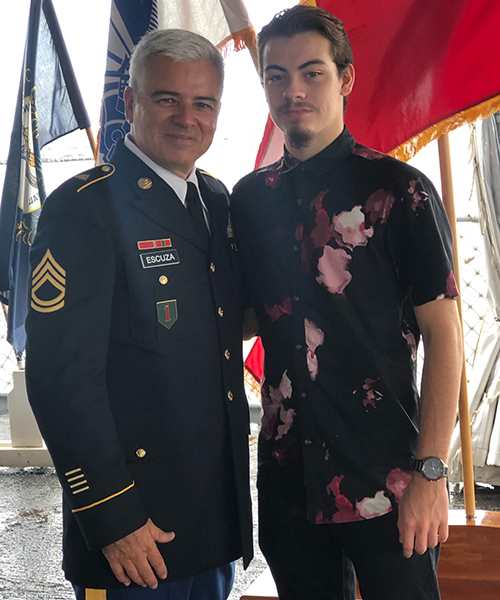
Jacob Escuza attended his dad Carlos Escuza’s retirement ceremony aboard the Mighty Mo in October 2019.

A new report by Lightcast, a leading company that provides labor market data, found that going back to college is an especially sound investment for adult learners. An analysis of more than 125 million online career profiles found that this group was 22 percent more likely to achieve upward mobility and earned annual salaries 140 percent greater than peers who didn’t return to college.

“When I retired from the Army on the deck of the Mighty Mo back in October 2019, I wasn’t sure of what I was going to do,” Escuza admits. “That’s when I turned to Cassandra Kam, a former educational counselor with the Veterans Affair. She was the one who told me about Chaminade University.”

Born in Chicago but raised in Lima, Peru, after his parents decided to move back to their native homeland when he was a 1-year-old baby, Escuza immediately returned to Chicago after graduating from high school. His formative years spent in the South American nation meant growing up with an extended family of cousins, aunts and uncles, and embracing a Hispanic culture.

“When I first moved back to Chicago, I was living at the Y, which is all I could afford,” Escuza recalls. “I received a grant and wanted to go to school, but I later decided to enlist in the U.S. Army.”

Escuza has no regrets enlisting in the Army and making it a career. He has been deployed to Europe, Afghanistan and Iraq, joining the ranks of thousands who were part of Operation Iraqi Freedom (OIF). In Iraq, he was part of the Multi-National Security Transition Command’s convoy security team known as the Rough Riders. Contrary to the sound of its name, the Rough Riders participated in goodwill missions to provide school supplies, gifts, candy and toys to Iraqi children in Baghdad.

“I was already in my 40s, but I was told I was needed because of my maturity and experience,” Escuza says. “Being involved in a war changed me profoundly in so many ways.”

When he returned from Iraq in 2008, Escuza manifested his Post-Traumatic Stress Disorder (PTSD).  “When I went through Kuwait, on a post-deployment, I saw outside the Morale, Welfare and Recreation (MWR) compound, this long wall with the names of soldiers who had died in the line of duty,” Escuza recounts. “They were listed in alphabetical order, and when I saw my friend’s name on it, I broke down and cried uncontrollably.”

Today, Escuza enjoys the support of his wife, Pam, his son Jacob and daughter Jaclyn Mills. He also appreciates the encouragement and understanding of Chaminade staff and faculty, whom he describes as inspirational. After he graduates, he says he plans to enroll in the M.S. in Counseling Psychology (MSCP) at Chaminade.

“This has been an awakening experience,” Escuza says. “If I were to put down in words all the positive feelings that I have collected and digested during my time at Chaminade, I would be writing an essay. The Flex program has truly met my spiritual and intellectual goals, and I’m grateful for this experience.”

Posted by: University Communications & Marketing Filed Under: Business & Communication, Diversity and Inclusion, Featured Story Tagged With: Business Administration, FLEX Program

Student-Athletes Score Awards

August 4, 2023

54 Silverswords honored with Academic Achievement Award

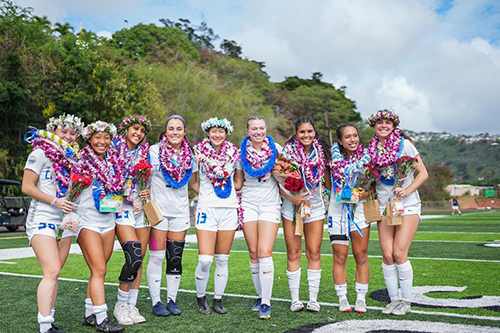
Nine seniors played their final game with the Silverswords Women's Soccer team.
Nine seniors played their final game with the Women’s Soccer team.

Now in its 16th year, the Division 2 Athletic Directors Association (D2 ADA) Academic Achievement Award is a program that recognizes the scholastic accomplishments of student-athletes at the Division II level. This year, a record 54 Silversword student-athletes were honored with the award, eclipsing last year’s number of 52.

“Intercollegiate athletics is an important component of the student experience at Chaminade,” says President Dr. Lynn Babington. “As a Marianist, Catholic institution, we value the development of the whole person, and athletics creates the opportunity for our students to not only excel in sports, but to learn teamwork and leadership and provide school spirit to the campus.”

To be honored with the D2 ADA Academic Achievement Award, the school’s athletic director must be a current dues-paying member of the D2 ADA. Also, a student-athlete must have a minimum cumulative grade-point average of 3.5 or higher on a 4.0 scale, have attended a minimum two years (four semesters) of college level work ,and have been an active member of an intercollegiate team during his/her academic year.

Eleven Silverswords posted 4.00 grade-point averages during their time at Chaminade with two senior student-athletes—Peyton Oshiro (men’s cross country) and Hoku Schatz (women’s soccer)—wrapping up their playing careers with perfect GPAs.

In all, a record-breaking 19,646 student-athletes from across 196 NCAA Division II institutions were recognized with the award.

Isaac Amaral-Artharee ranks 11th in the all-time scoring list with 1,326 points ... second in 3-pointers made (192) ... fourth in free throw percentage (83.5; 198-of-237) ... seventh in starts (69) ... sixth in minutes played (2,842).
Isaac Amaral-Artharee ranks 11th in the all-time scoring list with 1,326 points.

“I couldn’t be more proud of our student-athletes, who earned the prestigious honor of being a D2 ADA Academic Achievement Award winner,” said Chaminade Athletic Director Tom Buning. “Having a school record number of awardees is a testament to our Silverswords dedication to excellence in the classroom and competition. This accomplishment is even more noteworthy when considering that travel for the PacWest Conference competition requires extended absences from class.”

Of the more than 1,100 NCAA member universities and colleges, about 300 classify their athletics programs in Division II.
 
Division II is all about balance. Students participate in highly competitive athletics, have the best access ratio to NCAA championships of any division and can earn athletics scholarships, but their college experience includes so much more than sports participation. The balanced approach in athletics, academics and community engagement allows Division II student-athletes to focus on their academic pursuits, internships, studies abroad and all that interests them.
 
Among the most distinguishing features in Division II is its athletics scholarship model, which awards partial scholarships that students combine with academic or need-based grants to construct their financial aid package. Division II believes it is important to acknowledge and financially reward students’ athletics abilities. This partial scholarship model keeps athletics budgets more closely proportioned with the total institutional budget.

The following Silversword student-athletes were recipients of the D2 ADA Academic Achievement Award (listed by sport):

Men’s Basketball
Isaac Amaral-Artharee
Scott Ator
Dorian Harris
Kameron Ng
Braden Olsen
Patrick Renane
Kobe Young
 
Women’s basketball
Olivia Crigler
Mia Ming
Emma Morris
 
Men’s Cross Country
Elijah Bernardo-Flores
Peyton Oshiro
Peter Jan Ramos
Josiah Rodrigues
 
Women’s Cross Country
Leila-Jayne Casison
Montserrat Lanfranco
Eri Leong
Ashley Yoshikawa
 
Men’s Golf
Kal O’Brien
Schuyler Peterson
 
Men’s Soccer
Kekoa Kuloloia
Kaulana Navares
Daniel Villalva
Brandon Yasue
 
Women’s Soccer
Lece Aviles
Gracie Bowers
Ruby Burroughs
Caili Cain
Gracie Knowd
Jenna McLean
Kira Nishiki
Dayna Nishimura
Hoku Schatz
Clara Slate-Liu
Kyla Takazono
Nicole Vontsolos
 
Women’s Softball
Kobe Brown
Taryn Fujioka
Kailah Gates-Coyaso
Taylor Genera
Haley Hayakawa
Bailey Jacobsen
Kieren Lopez
Chasity McKean
Cheyne Obara
Keolani Takemura
 
Women’s Tennis
Sydney Danielson
Emily Ramirez Miranda
 
Women’s Volleyball
Alexia Byrnes
Sasha Colombo
Greta Corti
Brooklen Pe’a
Kaybrie Pe’a
Sophie Schilling
 

Posted by: University Communications & Marketing Filed Under: Athletics, Campus and Community, Diversity and Inclusion, Featured Story Tagged With: Athletics, Honors and Awards, Men's Basketball, Women's Volleyball

Staff, Faculty Attend MEA Formation

July 24, 2023

Attendees pledge to uphold Marianist-Catholic mission

After 19 years of working at Catholic higher education institutions, Jennifer Creech felt she was finally ready to commit. Her eyes lighting up as she spoke about her recent formation as a Marianist Educational Associate (MEA), the Vice President for Enrollment Management and Student Success was eager to share her experience.

MEA Formation participants included, from left, Frederique Kandel, Ph.D., Father Martin Solma, Jennifer Creech, and Drs. Janet Davidson, Darren Iwamoto, Dustyn Ragasa, and David Carter. Missing is Dr. Tom Buning.

“Selfishly, this was for me,” Creech said of the formation retreat. “I often attend conferences for professional reasons, but going through the formation was personal. I wanted to learn how to be a better person to my team and our students, and the meaning and value of our Marianist mission.”

In 2005, members from Chaminade University, University of Dayton and St. Mary’s University of San Antonio responded to a call from the Association of Marianist Universities (AMU) Board to build a partnership among members of the Society of Mary, the sponsoring religious body. It would invite a cadre of lay collaborators, who would together sustain and renew the mission and identity that was Catholic, and that embodied the Marianist educational tradition. 

Since then, faculty, staff and administrators have been invited each year to deepen their understanding of and their commitment to the traditions and beliefs that make each respective university a Catholic and Marianist community.

“I’ve always believed in our mission,” said Darren Iwamoto, who also attended the formation at the University of Dayton. “The formation experience helped me to focus in what I do and not work blindly.”

The seven-day formation program consisted of readings, reflections and sharing of insights. Each participant received a binder that was divided by presentations, which covered a variety of topics, from Vocational Stories and the Catholic Story to the Marianist Story and the Catholic Intellectual Tradition.

Opening her binder, Creech flipped through the colored tabs before stumbling upon a note card that contained some of her thoughts, writing down such key words as “living and working with intention, love, grace, transparency, access, persistence, empathy and understanding.”

“We are privileged in our roles, which are not self-serving,” Creech asserted. “Our mission is to empower others, to be part of a team and to advocate for our students.”

Following the initial retreat, the MEAs will then meet once a month from September to May to continue their formation by developing, strengthening and advancing the Catholic and Marianist philosophy of education.  At the end of the academic year during a special service, the MEAs will make a public commitment to sustain and enrich the University’s Catholic and Marianist character. 

Staff and faculty from Chaminade and University of Dayton gather for dinner at an outdoor patio.
Staff and faculty from Chaminade University, University of Dayton and St. Mary’s gather for an early-evening dinner at an outdoor patio.

“The Marianist Charism is a combination of faith, following Mary, community, mission and inclusivity,” Iwamoto explained. “The Charism informs how, as educators, we inspire our students and how we collaborate with our peers.”

Other Chaminade participants included Drs. Janet Davidson, David Carter, Frederique Kandel and Tom Buning.  

To ensure that Marianist universities sustain a strong Catholic and Marianist mission and identity, three vital tasks need to be accomplished, according to the Association of Marianists Universities (AMU).  First, there must be a significant number of people who are employed at the universities, and who are steeped in and appreciate the Catholic and Marianist traditions of education.  Second, these individuals must have the capacity and willingness to work together to incorporate these traditions into the culture of Marianist universities. Third, these persons would be committed to adapt and transform the traditions so that Marianist universities forge an engaging response to the challenges facing American higher education while contributing to the task of working toward global justice, so integral to the Marianist charism.

MEAs are lay persons who are, first of all, employees of the campus community who are hired to perform in a professional role in the work of Marianist higher education. Associates make an intentional choice to use that professional role to partner with the Marianist vowed religious on campus to strengthen the Catholic and Marianist mission and identity.  All MEAs are committed to using their sphere of influence to strengthen the Catholic and Marianist mission and identity in ways that are effective and appropriate. MEAs are committed to a journey of personal and professional growth in understanding and embracing the gift of the Marianist charism.

“The whole week I had what I call ‘God sightings,’” Creech said. “I don’t know how to describe it. It’s like love, you know it’s there, but it’s difficult to explain. The more you trust it, the more you hear it.”

Posted by: University Communications & Marketing Filed Under: Catholic, Diversity and Inclusion, Homepage, Institutional Tagged With: Catholic, Formation, Marianist

  • « Go to Previous Page
  • Page 1
  • Interim pages omitted …
  • Page 8
  • Page 9
  • Page 10
  • Page 11
  • Page 12
  • Interim pages omitted …
  • Page 23
  • Go to Next Page »

Footer

Chaminade University Logo

3140 Waialae Avenue
Honolulu, Hawaii 96816

Contact Us
Phone: (808) 735-4711
Toll-free: (800) 735-3733

facebook twitter instagram youtube linkedin

Visit

  • Plan Your Visit
  • Campus Map (PDF)
  • Events

Resources

  • Campus Security
  • Student Consumer Information
  • Concerns, Feedback, and Reporting
  • Institutional Review Board
  • Title IX / Nondiscrimination Policy
  • Compliance
  • Emergency Information
  • Careers
  • Institutional Statement

People

  • Students
  • Parents
  • Alumni
  • Faculty & Staff

Policy

  • Privacy Policy
  • Terms and Conditions of Use


© Chaminade University of Honolulu