• Skip to primary navigation
  • Skip to main content
  • Skip to footer
Chaminade University of Honolulu

Chaminade University of Honolulu

  • VISIT
  • APPLY
  • GIVE
  • STUDENTS
  • PARENTS
  • ALUMNI
  • FACULTY/STAFF
  • Admissions
    • Admissions Home
    • Undergraduate Students
      • First-Year Students
      • Transfer Students
      • Admitted Students
    • Graduate Students
    • Flex Online Undergraduate Program
    • Military Students
    • Non-Degree/Visiting Students
    • Experiential Honors Program
    • Early College Program
    • New Student Orientation
  • Tuition & Aid
    • Financial Aid Home
    • Tuition & Expenses
    • Federal Updates & Changes
    • Scholarships
    • $5,000 Graduate Scholarship
    • VA Education Benefits
    • Net Price Calculator
  • Academics
    • Academics Home
    • Academic Programs
    • Office of Student Success
      • Academic Advising
      • Records and Registrar
    • Kōkua ʻIke (Support Services)
      • ADA Accommodations
      • Career Services
      • Proctoring Services
      • Tutoring Services
    • Sullivan Family Library
    • Undergraduate Research & Pre-Professional Programs
    • Commencement
  • Campus Life
    • About Campus Life
    • Student Engagement
    • Student Government Association
    • Residence Life and Housing
      • Summer Conference Housing
    • Health Services
    • Marianist Leadership Center
    • Counseling Center
    • Campus Ministry
    • Campus Security
    • Dining Services
    • Bookstore
  • Athletics
  • About
    • Chaminade University News
    • Our Story
    • Leadership
    • Chaminade University Strategic Plan 2024-2030
    • Mission & Rector
    • Association of Marianist Universities
    • Facts & Rankings
    • CIFAL Honolulu
    • Accreditation & Memberships
    • Montessori Laboratory School
Search
×

Search this web site

Humanities, Arts & Design

Surf Studies

July 18, 2023

Culture, history and future intersect to create the perfect wave

Surf studies may just well be the new wave in some academia circles. As more scholars publish academic books about the sport of surfing, from “Waves of Resistance: Surfing and History in Twentieth-Century Hawaiʻi” to “Waves of Knowing: A Seascape Epistemology,” universities around the world have begun to embrace the discipline as worthy of research, education and scholarship.

A decade ago, a love for surfing prompted a group of Chaminade faculty members, including Drs. Jim Kraus, Pete Steiger, Michio Yamasaki and Hank Trapido-Rosenthal, to brainstorm the idea of teaching an undergraduate surf class. Yet, it wasn’t until a few years ago, during a casual faculty pau hana, that the notion of “Critical Surf Studies” re-emerged.

“I mentioned it to Lynn (President Babington) and she was interested,” recalls Kraus, an avid surfer since the ’60s and the former publisher of “Hawai‘i Surf & Sea;” from 1980-1984. “Then Lance (Provost) walked by, and I pitched the idea to him, too.”

Eventually, it was Cheryl Edelson, Ph.D., Dean of School of Humanities, Arts, and Design, who presented the topic to the full Chaminade Curriculum Council, which is the final recommending voice in curricular matters with the definitive stamps of approval resting with Drs. Babington and Askildson.

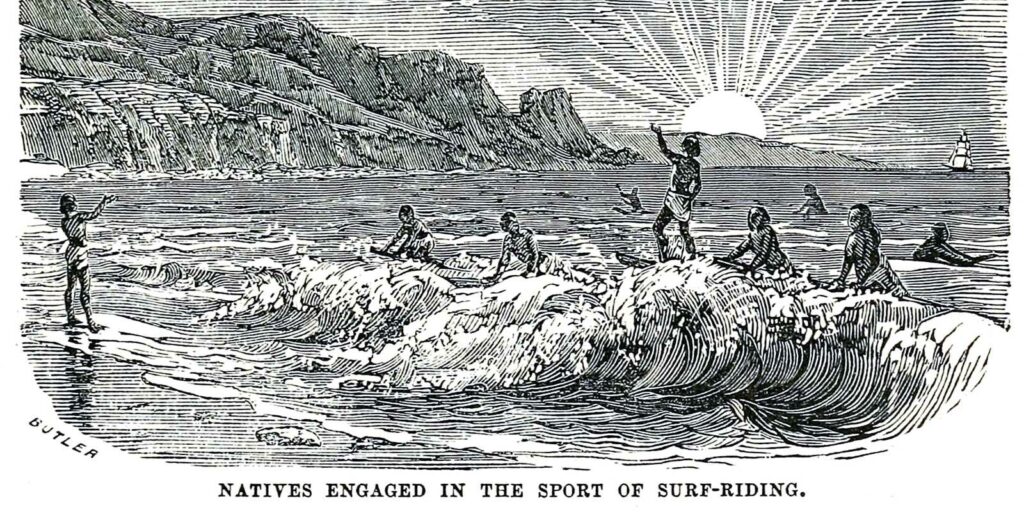
Magazine illustration of native Hawaiians surf-riding (surfing) from an article entitled “Our Neighbors of the Sandwich Islands” in Hutchings’ California Magazine, November 1858.

“Surfing is such an integral part of Hawaiian culture that it deserves to be part of our curriculum,” Babington says. “This program is the first of its kind in Hawai‘i, and it challenges students to explore surf culture’s indigenous origins, its growing popularity globally and its importance to Hawai‘i’s sense of place.”

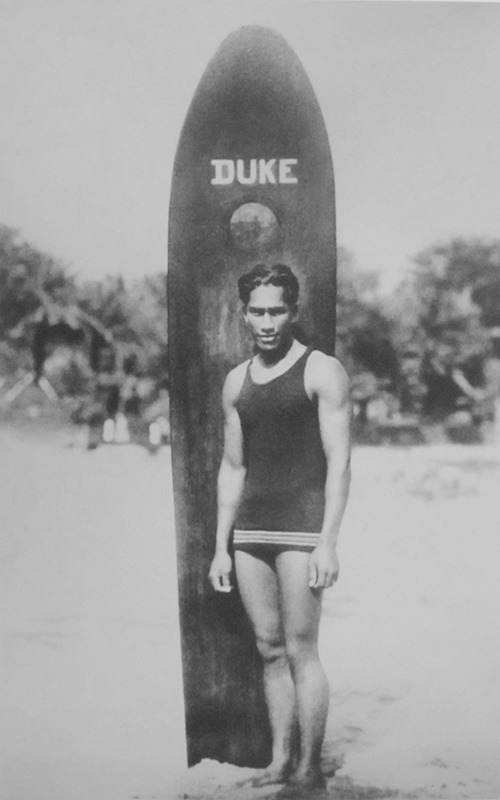
Duke Paoa Kahinu Mokoe Hulikohola Kahanamoku (August 24, 1890 – January 22, 1968) was a Hawaiian competition swimmer who popularized the sport of surfing.
Duke Paoa Kahinu Mokoe Hulikohola Kahanamoku (August 24, 1890 – January 22, 1968) was a Hawaiian Olympic swimmer who popularized the sport of surfing. 

Celebrating its second anniversary, the Surf Studies Minor examines the broad area of surfing communities and the complicated conflicts that define them, conflicts over access—to beaches, to parking and to the surf zone (po‘ina nalu) itself. Also of central concern is “ownership” of individual waves. It’s a question that Kraus posed in his first class of the semester.

“The idea behind wave ownership and the entitlement that accompanies the belief that one could own any wave signifies a pretty strong misunderstanding of the relationship between surfers and the wave,” Environmental Studies major, Kahana Yokoyama ’23, posted to the class’s online forum. “A good example is merging while driving. If two lanes combine, regardless of where, there is a relatively similar degree of respect when leaving room for others to merge. Taking turns is the most basic basis for this and the same is true for surfing.”

The SURF 480 class uses an asynchronous-learning model, which does not require consistent real-time interactions with an instructor. Students can access course materials—lectures, readings and assignments—on their own time. Although this is an online class, students are required to regularly participate by posting responses to questions posed on the forum. And they must also keep a journal in a conventional bound paper notebook, which they will have to submit regularly, and which Kraus says he reserves the right to read.

“We examine surfing in an academic sense and as part of pop culture,” Kraus explains. “We look at surfing from three perspectives: as a spectator watching surfers from the beach, in the movies and online; as a participant who enters the water and finds a way to the po’ina nalu; and as a literalist, someone who watches weather reports and predicts the surf, promotes surfing, or designs surf boards or clothing.”

According to Kraus, by the end of the term, students should be able to 1) define key terminology used in the interpretation and analysis of surf culture; 2) articulate the relationship between surfing communities and coastal ecosystems; and 3) report on what is of personal, ethical or religious significance in surfing and surf studies by applying Marianist values related to “Education in Family Spirit.”

“This class accentuates my environmental studies, and gives context to the Hawaiian culture and what we read about in texts,” says Yokoyama, who already has a job lined up as an environmental consultant with a Kailua firm. “It teaches you how to apply what you’re learning about surfing to reef health, and how coastal eco-systems interact with surfing as a sport and an industry.”

One of the most famous surf spots in the world, Oahu’s North Shore’s Banzai Pipeline, is the site of one of three of the competitions for the Vans Triple Crown of Surfing title.

While Chaminade students are able to minor in Surf Studies, other universities now offer fully-fledged bachelor’s degrees in surfing, while a few schools even enroll students in post-graduate programs that focus on surfing.

Dr. Gail Grabowsky, Dean of the School of Natural Sciences & Mathematics and Executive Director U.N. CIFAL Honolulu, believes that there’s a lot of activity related to getting on a board and riding the waves. “Many of the Environmental Studies students love the ocean, and are also very conscious of issues like marine debris and materialism,” says Grabowsky. “There are also some wonderful service opportunities with charitable organizations that really look after the ocean, such as the Surfrider Foundation, which has raised awareness and kept wonderful data.”

Askildson has developed a deep connection with surfing since he first learned the art of riding waves off the shores of Daytona Beach in Florida 25 years ago. His affinity towards the surf has grown even deeper since first moving to Australia and now to Hawai‘i.

“I found the Surf Studies program compelling because it is as much about the history of the Hawaiian culture as it is about the history of surfing,” Askildson asserts. “At Chaminade, we serve the people of Hawai‘i and celebrate the culture that makes our islands both unique and special; this program is a striking articulation of that mission and legacy.”

Posted by: University Communications & Marketing Filed Under: Diversity and Inclusion, Featured Story, Homepage, Humanities, Arts & Design, Institutional Tagged With: Curriculum, Surf Studies

Chaminade Scholar

June 13, 2023

Depending on the power grid in the countryside of Ukraine, Chaminade sophomore Victoria DelaCruz ’25 may or may not be able to teach American culture, environment and English to Kate (not her real name to protect her identity) through a volunteer role with ENGin, a nonprofit group that offers a unique opportunity to make a difference in a Ukrainian’s life. It’s a volunteer role that she pursued during her freshman year in 2021.

What she didn’t anticipate, though, was the Russian invasion of the second largest European country in February 2022. Still, the Saipan native persisted and persevered to maintain contact with Kate at least once a week to this very day.

“She wants to improve her English, and I’m trying to help her do that,” says DelaCruz, who opted to major in Data Science, Analytics and Visualization. “I am provided with class lessons, but I tailor them to fit with what I’m comfortable with.”

Growing up in the largest island in the Northern Mariana Islands, DelaCruz has always felt comfortable with helping her community, following her mom to work at KARIDAT, a not-for-profit, social service organization under the Catholic Charity Diocese of Chalan Kanoa. In 2018, when Super Typhoon Yutu, the strongest typhoon ever recorded to impact the Mariana Islands and the second-strongest to strike the United States or its territories, slammed into Saipan, DelaCruz was there.

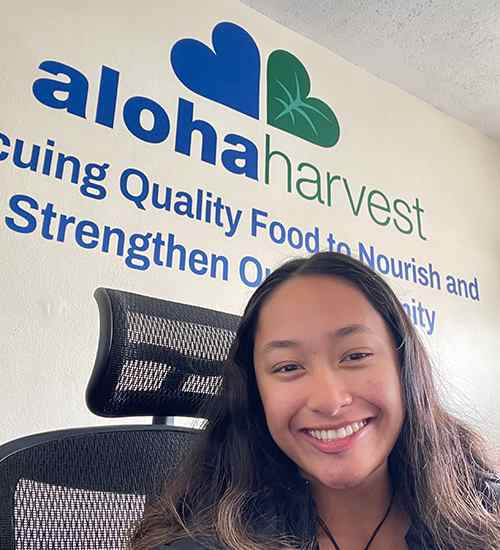
Victoria DelaCruz helps out at the Kaimuki office of Aloha Harvest.

“She was doing basic intakes and helping out in the food pantry,” recalls mom Elaine DelaCruz, a Chaminade alumna who earned her bachelor’s degree in 1999 and her M.S. in Counseling Psychology (MSCP) in 2003. “She has always wanted to serve her community ever since she was a young girl.”

DelaCruz personifies the Chaminade Scholar, defined as a student who strives to discover his or her life vocation, to be a servant leader and to use God-given gifts and talents to pursue the common good. “Her reflection on service and the path she traveled to earn her internship with Aloha Harvest are inspiring,” says Bro. Ed Brink, a member of the Mission and Identity Committee that selects Chaminade Scholars. “She’s truly a remarkable young woman who exemplifies the Marianist education and values.”

While searching for a service project to fulfill one of the mandatory requirements of being a Chaminade Scholar, DelaCruz came upon the AmeriCorps Vista program and decided to become a member. The objective of Volunteers in Service to America (VISTA) is to provide needed resources to nonprofit organizations and public agencies to increase their capacity to lift communities out of poverty. It just so happened that Aloha Harvest was registering to participate in the VISTA program and looking for someone to work in its office.

“I started as a volunteer in late September 2022,” DelaCruz recalls. “At that point, Aloha Harvest was in the process of creating an AmeriCorps VISTA position (Program Data Evaluation Specialist), and found out I was a Data Science student. So, they asked me if I would be willing to fulfill that position, and that’s how I was recruited. My official first day as a full-time service member with Aloha Harvest was January 17, 2023, and I will be there until January 17, 2024.”

In addition to being a Chaminade Scholar, DelaCruz is also in the Experiential Honors Program, and she serves as vice president of the Chaminade Sustainability Council, the design manager for the Chaminade Student Programming Board and an Alliance Research Intern with the National Science Foundation.

DelaCruz credits her Chaminade Scholar status, not only for her monetary scholarship, but for helping her grow and commit to community service, which she plans to continue in Saipan after she graduates in 2024.

“When it comes to data science, there’s a great demand for it in Saipan, from the medical to the educational field,” DelaCruz asserts. “Saipan usually has to bring in people from the Mainland but it never lasts too long.”

And if you had told DelaCruz that she would be pursuing a degree in data science a year ago, she says she would have thought you were lying. “I never considered technology, and now I’m learning to code and use data,” she says. “I’m really glad I changed my major to DSAV because the skills that I have learned can be applied to so many fields. And I can use the knowledge that I gained and my passion for service to help my Chamorro community.”

Posted by: University Communications & Marketing Filed Under: Catholic, Humanities, Arts & Design, Service Learning, Students Tagged With: Honors and Awards, Scholarship

Land-based Pedagogical Approach

June 13, 2023

Associate Professor of Arts and Design Junghwa Suh, D.Arch, is throwing caution to the wind and subverting the dominant paradigm. Ever since she took an ʻāina-based education workshop conducted by Cultural Engagement Specialist, Kahoalii Keahi-Wood, the Arts Program Coordinator has questioned her pedagogical style, drawing into particular focus her epistemology of interior design and the entire academic process.

“I was inspired by his teaching,” said Suh of Keahi-Wood. “His workshops were free-flowing and discussions came naturally, especially about respect of place and the ʻāina.”

In collaboration with then-visiting University of Maryland architecture professor, Ming Hu, Suh helped develop a new course themed, “ʻĀina-based Design Solution for Indigenous Communities in Hawaii.” The goal of the new course is to propose, test and validate an integrated ʻāina-based design approach that is intended to serve indigenous communities in Hawai‘i.

“The traditional pedagogical approach is process- and goal-oriented, meaning the structure of a course is linear—going from Point A to Point B,” Suh explained. “And because design education is very structured in the process, we sometimes lose the sight of meaning. Yes, content needs to be delivered, but it needs to be delivered meaningfully and beyond a set of skills.”

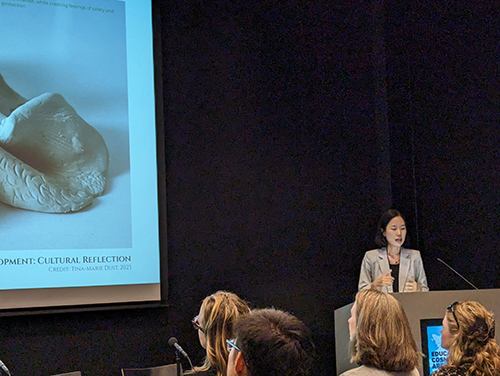
Associate Professor of Arts and Design Junghwa Suh, D.Arch presented her new course, "Āina-based Design Solution for Indigenous Communities in Hawaii," at the Association of Collegiate Schools of Architecture (ACSA) and the European Association for Architectural Education (EAAE) Conference in Reykjavik, Iceland.
Associate Professor of Arts and Design Junghwa Suh, D.Arch presented her new course, “Āina-based Design Solution for Indigenous Communities in Hawaii,” at the Association of Collegiate Schools of Architecture (ACSA) and the European Association for Architectural Education (EAAE) Conference in Reykjavik, Iceland.

While teaching the Studio Commercial course for seniors’ capstone Environmental + Interior Design project, Hu tasked the students to come up with a design to restore the Maunalua Fishpond Heritage Center in East Oahu, keeping true to the natural elements of the environs. Students had to understand the importance of the Center’s Kānewai Spring, which is “where the mountain gives birth to the ocean.” They also had to take into account the many cultural sites surrounding the spring, including the mākāhā (fishpond sluice gate) and kū‘ula (fishing stone shrine) with an upright Kū stone balanced by a low Hina stone where the fishermen of old would have given offerings asking for a plentiful catch.

“In the client briefing, we learned that the Center is dedicated towards passing down the Hawaiian culture to the next generation through education sessions and volunteer opportunities,” said newly-minted graduate, Maria Bernaldez ’23, who presented her design concept to leaders at the Center. “With that in mind, I implemented traditional Hawaiian hale aspects, keeping open entrances with no doors in places for public accessibility and wood slat ceiling and beams to imitate exposed wooden rafters and roofing made of coconut thatching.”

For her Materiality Interior Design Studio course, Suh assigned sophomores the project of re-conceptualizing the space at The Institute for Human Services’ Women’s & Family Shelter, giving the dormitory areas a more welcoming, inviting design, while mindful of the context and the community.

“They got to know the space, especially the sleeping areas,” Suh said. “I appreciated their research into understanding people, and learning how textural and tactile elements interact with the environment in this particular setting.”

The project spawned a discussion among Suh, Hu and E + ID program coordinator Matthew Higgins, and eventually evolved into an innovative research project that will be presented at the Association of Collegiate Schools of Architecture (ACSA) and the European Association for Architectural Education (EAAE) Conference on June 22-24, in Reykjavik, Iceland.

Titled, ‘Āina-based Design of Emergency and Homeless Shelters for Indigenous Communities, the project’s premise is to address the need for a novel design approach and socially-rich data on native Hawai‘i housing to guide future projects, and to avoid mistakes of the past. According to the abstract, the project tests two design principles that have been overlooked in the development of emergency housing initiatives: the integration of Hawaiian values with respect to the land (ʻāina) and people; and community engagement to generate solutions that are informed by local need.

“The beauty of being in an education environment is that it allows you to explore the meaning of an ʻāina-based design,” Suh said. “You get to know the actual place and not just the physical structure on the property. It’s placing the land in a historical and cultural context, and learning its significance; the overall approach to the design is dictated by the ʻāina and not the place.”

Posted by: University Communications & Marketing Filed Under: CIFAL Honolulu, Diversity and Inclusion, Featured Story, Humanities, Arts & Design, Innovation, Institutional Tagged With: Center for Innovation and Strategy, Environmental + Interior Design, Research

Designing Women

May 5, 2023

E+ID students present their works at the Senior Showcase Exhibit

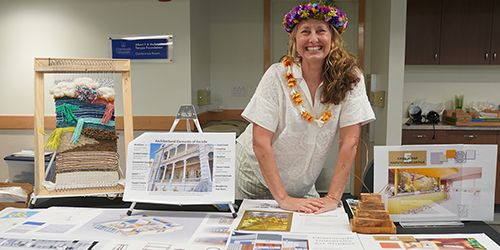
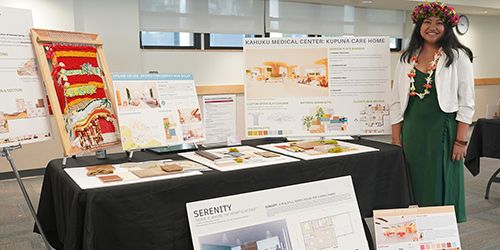
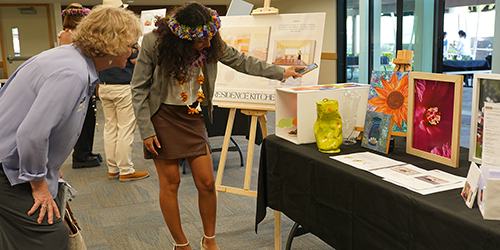
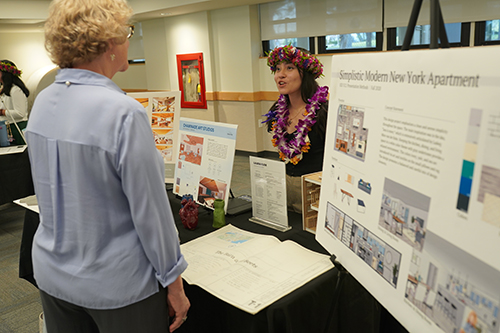
After all the late nights, tears and sweat, 2023 graduating seniors, Montserrat Lanfranco, Laura Flor, Maria Bernaldez, Angela Huber and Sarah Robertson had one last hurdle before Commencement: the Environmental + Interior Design’s Senior Showcase Exhibit. Presenting their projects to industry designers, family and friends on a Thursday night, the five seniors were eager to share a compilation of their works over the course of their undergraduate studies.

“There will be no more crying in the studio and calling security late at night to open the doors,” Flor laughed. “It’s exciting to be done, but it feels surreal because we’re all still busy.”

During her freshman year, Lanfranco built a “light box,” as required in her EID 205 Color for Interiors class, which focused extensively on the use and application of color in interior environments, including color notations, the Psychology of color and human response and application of color.

Angela Huber
Sarah Robertson
Maria Bernaldez
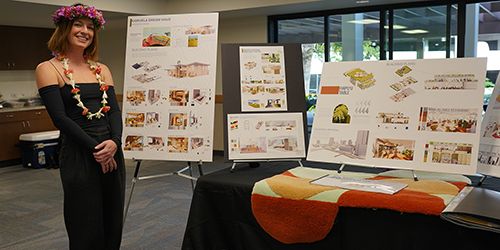
E+ID graduating students shared their projects during the Senior Showcase Exhibit.
Montserrat Lanfranco
E+ID graduating students presented their projects during Senior Showcase Exhibit.
Laura Flor
Senior graduating students shared their projects during Senior Showcase Exhibit at Hale Hoaloha.

Using a flashlight utility on an iPhone, Lanfranco pointed a beam inside the box—which had several round cutouts, each covered with a different patch of color cellophane—and explained the effects that color has on people’s moods.

“Imagine this is a building and the sun is moving through it, casting different colors and lighting,” said Lanfranco, shining a beam across her light box. “Color and lighting can certainly impact a person’s behavior and mental state.”

For her senior Capstone project, Bernaldez presented a re-design proposal to members of the Kahuku Medical Center Kupuna Caregivers. She also participated in a pitch to Maunalua Fishpond Heritage Center in East Oahu.

“I also had an internship with RMA Architects,” Bernaldez said. “And I just received an email about a full-time junior interior designer job offer from my supervisor at RMA, so I’m absolutely thrilled.”

The mission of Chaminade University’s Environmental + Interior Design Program is to educate, engage and empower students to optimize design of the built environment as it relates to our global, multi-cultural, multi-generational living and working communities. Graduates, like Bernaldez, are prepared to make the transition to entry-level professional practice, and to collaborate with architects and related industry professionals.

“The scope of design has expanded and much broader now,” explained E + ID program coordinator Matthew Higgins. “Here at Chaminade, the program added ‘Environmental’ to the curriculum in attempt to breakdown barriers, and to think beyond windows and doors.”

This was precisely the approach that Fuentes took when she worked on her Art Museum project. “I wanted to see how someone diagnosed with autism—which includes such a broad spectrum—would experience an art exhibit,” Fuentes said. “So, I set out to create more of an interactive exhibit.”

Posted by: University Communications & Marketing Filed Under: Campus and Community, Homepage, Humanities, Arts & Design, Innovation, Students Tagged With: Campus Event, Environmental + Interior Design

Na Liko Naʻauao

April 28, 2023

Students present their thought-provoking research findings

She suspected that she couldn’t be the only one feeling isolated and alone. With COVID cases spiking during her freshman year, Iris Hirata sheltered in place in her dorm room with her family support 5,000 miles away.

“I usually like being alone, but that was too much—even for me,” Hirata recalls. “It was depressing and I felt I had no one to talk to.”

As pandemic numbers started to decrease, and a semblance of normalcy emerged, Hirata never forgot those earlier times. “Biologically, I knew about COVID’s impact on the lungs,” Hirata says. “But I told Dr. Darren Iwamoto, we didn’t know the impact that COVID had on the mental health of individuals.”

It turned out to be a lot.

In an earlier research project she worked on with psychology professor Tracy Trevorrow, Ph.D., Hirata studied the effects of COVID on sleep quality. They learned that during the nascent stages of the pandemic, people tended to be more on their phones, which would disturb their sleep patterns and quality of sleep.

Iris Hirata stands in front of her presentation about COVID-19 and mental health.

“I was really big on healthcare at the time, which is what led me to do a research project on the impact of COVID on mental health,” says the biology major, who presented her findings during the 21st annual Na Liko Na’auao Symposium on April 14.

Pointing to a chart with spikes of blue and red lines, Hirata explains that the graph indicates the “bounce back” or the resiliency rate of the 200 students surveyed during her research.

“The epidemic has had a significant impact on university students’ mental health, including things like stress, anxiety, depression, and a lack of behavioral and emotional control,” Hirata concludes in her findings. “The findings support the literature that resilience is a key factor in influencing mental health and overall wellness.”

According to Amber Noguchi, Ph.D., Undergraduate Research and Pre-Professional Programs director, undergraduate and graduate research experience can look like a number of things. It can range from formal and clinical studies to data analysis, and creative works and beyond. On the occasion of this year’s Na Liko Na’auao Symposium, 25 student presenters covered a broad spectrum of issues and questions, from Hirata’s “How does COVID-19 Impact the Mental Health of Individuals?” to “Eat Healthy, Live Strong: Understanding Eating Behaviors of NHPI on Oahu” and “Sports Analytics: What Factors Determine a Winning Team?” and “Decolonizing Hawaii’s Diet.”

“All of these presentations stem from research projects that have been collaborations between the student researchers and their faculty mentors,” Noguchi explains. “This undergraduate conference celebrates student scholars from across all academic disciplines.”

In her research project with Dr. Guanlin Gao, “Eat Healthy, Live Strong: Understanding Eating Behaviors of NHPI on Oahu,” Autumn Fairall, ’23, examined the barriers to eating a healthy diet. “I started working with Dr. Gao as a research assistant in the Spring of 2022,” says Fairall, who will earn her Bachelor of Science in Nursing in May. “Initially, the project we worked on focused on the landscape of economic and personal finance in Hawaii. However, after talking with Dr. Gao and discussing personal interests in wellness and past, informal research connected to diet, the research focus altered.”

Chaminade President Dr. Lynn Babington presents Dr. Rylan Chong and Kawailani Luat with their respective awards.

During the conclusion of the Symposium, President Dr. Lynn Babington, defined a scholar as “A person with a desire to pursue and learn new things; a person on a quest for knowledge and a dedication to learning.” By not focusing on one academic discipline, Na Liko Na’auao gives all student scholars an opportunity to present their work in a formal setting, and receive feedback from both faculty and other scholars within their field.

Every year, after all the student scholars have presented their work, the Symposium concludes with a presentation of two special awards. Given annually, The President Sue Wesselkamper Award acknowledges a student who has demonstrated extensive community and university service. In order to qualify for the prize, a student must have a minimum 3.5 GPA, show scholarship beyond classroom requirements by undertaking their own independent research or study, and must have presented their work both on and off campus.

Kawailani Luat is this year’s recipient of the President Sue Wesselkamper Award. A senior, majoring in Data Science, Analytics and Visualization and minoring in Forensic Science, Luat consistently excels in her coursework and has taken on leadership roles through her extracurricular and volunteer services.

“To be recognized with this award validates all the hard work I’ve done to get here,” Luat said. “I finish my senior year with this last achievement, so I am beyond ecstatic.”

“Kawailani is very active within our Chaminade community, including the Animal Advocacy Club, I am a Scientist, and has helped at every Preview and Admitted Students Day,” Babington says. “She also served as a student panelist for the Women in Data Science Hawaiʻi program and volunteers at Palama Settlement, a non-profit community-based social service agency working in the Kalihi and Palama neighborhoods.”

Honoring the close student-faculty relationships formed at Chaminade, the President Mackey Award is presented to an outstanding faculty mentor, nominated by a student participating at the conference. This year’s recipient is Dr. Rylan Chong, nominated by LaVelle White.

“He personally helps students step outside themselves to try things that were not thought possible,” wrote White in his nomination letter. “He encourages and pushes students to go for internships and research programs like SPICE. He stays after class to help students answer questions, and he has a way of speaking that demystifies the whole process, giving students the confidence to essentially go for the gold.”

Posted by: University Communications & Marketing Filed Under: Behavioral Sciences, Campus and Community, Diversity and Inclusion, Humanities, Arts & Design, Innovation, Institutional, Natural Sciences & Mathematics, Students Tagged With: Campus Event, Honors and Awards

Honor Roll

January 18, 2023

Chaminade bestows Heritage Awards

To recognize their exceptional contributions in personifying the Marianist values, Dr. Darren Iwamoto, Maritel Suniga and Kobe Ngirailemesang ’23 have been honored with this year’s Heritage Awards. It’s a distinction that Brother Ed Brink says “shows the breadth and impact an individual may have on campus and in the community.”

Dr. Lynn Babington presents Dr. Darren Iwamoto with his Chaminade Award.

A testament to that mission is Dr. Darren Iwamoto, Associate Professor in Education and Behavioral Sciences, who received this year’s Chaminade Award, given to a faculty or staff member who has exhibited a continuous commitment to Marianist values in education.

“Yes, these awards are designed to honor individuals,” says Brink, Vice President of Mission and Rector, addressing the Founders’ Day Mass attendees. “But these awards are also meant to remind all of us the mission of the university and the importance of trying to live out that mission on a daily basis.”

“I truly try to live the Marianist Education Core Values and receiving this award is special because it tells me that I’m on the right path,” Iwamoto says. “This award motivates me to continue serving our students in Family Spirit and I’m blessed to be a part of an organization that truly lives its mission and values.”

Father Marty congratulates Kobe Ngirailemesang for his 2023 Founders’ Award.

Sharing the same sentiment is Kobe Ngirailemesang ’23, a graduating senior, who was presented with the Founders’ Award, which recognizes a student who has exhibited a commitment to Marianist values by outstanding generosity, respect for others and spirit of faith.

“Personally, this award is about being of service to others whenever it is possible,” Ngirailemesang says. “I never thought of helping others as an obligation. I really just enjoy the company of others, regardless of it being for work/class or not. I am truly honored to have received this award.”

Draped in a colorful ring of lei, Maritel Suniga received the Marianist Award.

Meanwhile, Payroll Specialist in the Business Office, Maritel Suniga was honored with the Marianist Award, conferred to a staff member who has exhibited a continuous and extraordinary commitment to the vision and mission of Chaminade University while drawing others into the collaborative community.

The three honorees were recognized at a special ceremony on Jan. 18, following the Founders’ Day Mass at Mystical Rose Oratory. The event was the culmination of a series of gatherings meant to celebrate not only the founders of the Marianist family—including the university’s namesake—but the characteristics of a Marianist education and the values and mission that are central to Chaminade’s identity.

“We gather today to be inspired,” says Brink, during the award ceremony portion of the Mass, “and to hopefully recommit ourselves to be the best member of this community that we can be.”

Posted by: University Communications & Marketing Filed Under: Campus and Community, Chaminade History Center, Diversity and Inclusion, Homepage, Service Learning, Students Tagged With: Honors and Awards, Marianist

  • « Go to Previous Page
  • Page 1
  • Page 2
  • Page 3
  • Page 4
  • Page 5
  • Interim pages omitted …
  • Page 15
  • Go to Next Page »

Footer

Chaminade University Logo

3140 Waialae Avenue
Honolulu, Hawaii 96816

Contact Us
Phone: (808) 735-4711
Toll-free: (800) 735-3733

facebook twitter instagram youtube linkedin

Visit

  • Plan Your Visit
  • Campus Map (PDF)
  • Events

Resources

  • Campus Security
  • Student Consumer Information
  • Concerns, Feedback, and Reporting
  • Institutional Review Board
  • Title IX / Nondiscrimination Policy
  • Compliance
  • Emergency Information
  • Careers
  • Institutional Statement

People

  • Students
  • Parents
  • Alumni
  • Faculty & Staff

Policy

  • Privacy Policy
  • Terms and Conditions of Use


© Chaminade University of Honolulu