• Skip to primary navigation
  • Skip to main content
  • Skip to footer
Chaminade University of Honolulu

Chaminade University of Honolulu

  • VISIT
  • APPLY
  • GIVE
  • STUDENTS
  • PARENTS
  • ALUMNI
  • FACULTY/STAFF
  • Admissions
    • Admissions Home
    • Undergraduate Students
      • First-Year Students
      • Transfer Students
      • Admitted Students
    • Graduate Students
    • Flex Online Undergraduate Program
    • Military Students
    • Non-Degree/Visiting Students
    • Experiential Honors Program
    • Early College Program
    • New Student Orientation
  • Tuition & Aid
    • Financial Aid Home
    • Tuition & Expenses
    • Federal Updates & Changes
    • Scholarships
    • $5,000 Graduate Scholarship
    • VA Education Benefits
    • Net Price Calculator
  • Academics
    • Academics Home
    • Academic Programs
    • Office of Student Success
      • Academic Advising
      • Records and Registrar
    • Kōkua ʻIke (Support Services)
      • ADA Accommodations
      • Career Services
      • Proctoring Services
      • Tutoring Services
    • Sullivan Family Library
    • Undergraduate Research & Pre-Professional Programs
    • Commencement
  • Campus Life
    • About Campus Life
    • Student Engagement
    • Student Government Association
    • Residence Life and Housing
    • Health Services
    • Marianist Leadership Center
    • Counseling Center
    • Campus Ministry
    • Campus Security
    • Dining Services
    • Bookstore
  • Athletics
  • About
    • Chaminade University News
    • Our Story
    • Leadership
    • Chaminade University Strategic Plan 2024-2030
    • Mission & Rector
    • Association of Marianist Universities
    • Facts & Rankings
    • CIFAL Honolulu
    • Accreditation & Memberships
    • Montessori Laboratory School
Search
×

Search this web site

Featured Story

Economics, Democracy and Entrepreneurship

October 15, 2020

Over decades of work as an educator and activist, Li Schoolland ’88 has appeared before young professionals in fledgling democracies around the globe to underscore the importance of cherishing—and fighting to preserve—freedom and to offer a path forward in crafting a free market future.

She counts among her former students the mayor of Vilnius, Lithuania, along with countless policymakers, advocates and leaders of non-governmental organizations across Eastern Europe, China, the Middle East and elsewhere. Last year, she was on the road for 200 days—traveling to 24 countries.

Schoolland, speaking from her Waipahu home on a recent day, says she’s driven by two passions in life.

“One is God,” she says. “One is liberty.”

And even amid the pandemic, with traveling out of the question, she’s continued her work. In September, she was preparing to speak to virtual classrooms in Africa, China and Europe via Zoom, a medium that she admits took some getting used to but that she’s proud to have since mastered.

Schoolland accomplishes her work thanks to loose affiliations with a number of international organizations and strong relationships with an army of economists worldwide. She says she doesn’t ask for speaking fees—and kindly requests that they all do the same.

In return, she says, she gets to see the positive impact of her work.

“Coming from a Communist country inspired me to help,” she said.

Schoolland grew up in China, the daughter of a surgeon and a professor, and says she saw the cruel injustices of authoritarian Communist rule firsthand. When she moved to the United States in the 1980s, she vowed to do whatever she could to promote liberal economics and do some good in the world.

After completing a Master’s degree in Japanese literature at the University of Minnesota, Schoolland made her way to the islands to enroll in Chaminade’s Master’s degree in Japanese Business Studies. She describes the program, which was offered through a corporate partnership, as “intense” and immersive.

“The experience was very valuable,” she said. “Six days of classes and a lot of homework.”

As part of the degree, she was able to complete a three-month internship in Japan. She was interested in retail so sought an internship at a department store. During her time there, she helped the merchandising department develop a new brand that launched in the store.

After graduation, Schoolland remained in retail, working with Duty Free and then starting her own business as an art dealer. She also worked with a Japanese development company into the early 1990s.

The crash of the Japanese economy in 1991, though, changed the course of her life.

The business she worked for had to liquidate and Schoolland found herself with a new purpose: as the caregiver to elderly relatives. She went back into the workplace seven years later, as a teacher. By then, she wasn’t interested in the hectic, round-the-clock world of development or retail. She wanted a position that would allow her to spend time, especially the holidays, with her family.

Schoolland found a teaching position at Punahou, where her daughter was attending school.

And during breaks, she and her daughter would try to squeeze in as much travel as they could.

At every destination, Schoolland would wear her teaching hat, sharing what she knew with others.

That wanderlust grew into a mission: Schoolland and her husband, also an economist, started coordinating educational camps and conferences for young professionals. Oftentimes, the events were in partnership with local universities. The topics: Free market economics and democracy.

Schoolland’s work has taken her across Eastern Europe, from Lithuania to Latvia to Estonia to Poland.

About 10 years ago, she was delighted to finally set up an event in China. She partnered with Northeastern University there and developed a summer school program with about 100 students. Last year, more than 200 students attended to hear well-known economists from around the world.

The speakers, she said, “sacrifice and they don’t get paid” to attend the events.

So far this year, Schoolland has had to cancel more than seven trips internationally. That hasn’t discouraged her. If anything, it has redoubled her resolve to promote market economics, democracy and entrepreneurship. She said she can’t wait to get back on the road (and in the air) when she’s able to.

Posted by: University Communications & Marketing Filed Under: Alumni, Business & Communication, Featured Story

Lifelong Learner

October 13, 2020

By the time Lysa Rutledge decided to go back to school, she already had an extensive career under her belt and was approaching retirement. But getting her master’s was the perfect gateway to her long-time dream: becoming a teacher.

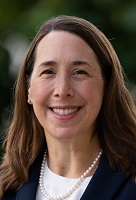
Lysa Rutledge, MSCJA '20

Rutledge first attended Chaminade as an undergraduate student over 20 years ago. She was in the Army at the time, stationed at Schofield Barracks, and enrolled for Chaminade’s on-base program. She graduated in 2000 with a degree in psychology and a minor in criminal justice.

At the time, Rutledge wanted to become a probation officer. She has family members that work in corrections in her home state of California, and she wanted a career that would make a difference. Her first job after graduating was as a case manager with the Federal Bureau of Prisons in California. And from there, her passion grew.

“My initial motivation was to get case management experience,” says Rutledge. “I wanted to be a probation officer and in federal probation they want you to have at least three years of case management experience. I ended up really enjoying working for the Bureau so I stayed with it. I’ve had a great career.”

As a case manager, Rutledge felt like she could really have an impact on the lives of the individuals she worked with. Her job was to work with inmates, review their progress and help them prepare for release and reentry into society. Essentially, she was a social worker in a prison setting. She’s always had an interest in social work and being a case manager was a way for her to tap into that passion.

“I was a case manager for ten years,” says Rutledge. “All of my inmates were females…they are eventually going to get out and go into our communities, and it was just a sense of responsibility to help these women come out and be better citizens in society. I would come across these women who have never had opportunities, and it’s really rewarding. It’s just very rewarding.”

Rutledge worked for the Federal Bureau of Prisons in California for 16 years. But in 2016, when an opportunity to return to Hawaii presented itself, Rutledge jumped at the chance.

“I came here on a promotion,” says Rutledge. “When I had the opportunity to come back, I kind of jumped at it. I love living here.”

Lysa Rutledge, MSCJA '20

Rutledge now works at the Federal Bureau of Prisons in Hawaii. She’s a case management coordinator and is part of the management team. She oversees the receiving and discharge department and supervises all of the case managers.

It’s a hard time to work in federal law enforcement with so much divisiveness in communities across the country. But being in Hawaii and working in corrections, Rutledge has felt fairly removed from a lot of that.

“It does affect us, what happens on the streets every day with the police officers, but what affects us more are the policy changes,” says Rutledge. “Fortunately, in Hawaii, we don’t see as much of what goes on in the mainland. I have heard different things about what goes on with different parts of the country, some people feel they can’t wear their uniform to and from work. I haven’t found that here in Hawaii.”

If anything, Rutledge has encountered a more welcoming and supportive community in Hawaii. There’s also more support for those with a criminal past.

“I feel like there’s so much community support and so many resources for ex-offenders here,” she says. “It’s just part of the Hawaiian culture of helping out. All of the resources we can get in the community definitely help these inmates with reentry and make my job a lot easier.”

She’s also noticed a difference in the inmates she works with—they’re less aggressive in Hawaii than what she encountered on the mainland.

She enrolled in the Chaminade’s Master of Science in Criminal Justice Administration program in 2017, and will graduate in December. Her motivation was mostly one of self-improvement—after an extensive career, she wasn’t looking for job growth. She was looking to learn and to expand her knowledge so that she could one day teach criminal justice.

“I feel like I have so much experience in corrections that I would like to teach undergraduates,” says Rutledge. “That’s what motivated me to get my master’s degree.”

But the program also helped give her a better understanding of her role at the Bureau and the policies they abide by.

“It has helped me with my writing skills and just kind of opening my eyes to what’s out there in the new age of corrections and law enforcement,” describes Rutledge. “With a lot of things that we do at the Bureau, I really see how they come out from laws that have passed or grievances that have gone to the supreme court. It’s neat to see where the policies and the laws have come from. For me, that’s been really interesting.” 

It hasn’t been easy to go back to school after 20 years in the workforce. She’s had to retrain herself to be a student and reestablish her study skills. But having a core group of supportive and knowledgeable professors has really helped. And even though most of her classmates are a lot younger and are just starting their careers, Rutledge has enjoyed hearing their perspectives.

“It was really nice to see and interact with that young perspective,” says Rutledge. “And I think they enjoyed picking my brain as well. There are actually two Chaminade students that just became corrections officers and joined the Bureau because I helped guide them. It’s nice to be able to recruit people in.”

Rutledge plans to retire from the Federal Bureau of Prisons in four years, and when she does, she’d love to come back to Chaminade—this time as a professor.

Posted by: University Communications & Marketing Filed Under: Behavioral Sciences, Featured Story, Students Tagged With: Master of Science in Criminal Justice Administration

NASPA Undergraduate Fellows Program

September 28, 2020

Two Chaminade students, Eri Leong ’23 and Andrew Ancheta ’21 were accepted into the 2020–2021 class of NASPA Undergraduate Fellows Program (NUFP). Hosted by the National Association of Student Personnel Administrators (NASPA) in Higher Education, the highly competitive fellowship gives students from traditionally underrepresented and historically disenfranchised communities a chance to learn more about careers in student affairs and higher education.

Eri Leong '23, 2020–2021 class of NASPA Undergraduate Fellows Program
Eri Leong ’23

Students apply together with a mentor from their home university, and spend one year participating in on-campus mentorship, professional development events and scholarship opportunities.

For her mentor, Leong chose Allison Jerome, Vice President for Student Affairs and Dean of Students at Chaminade. “She seems to be brilliant at everything she does, and if I were to become a student affairs professional, I would want to embody that brilliance of hers as much as possible” says Leong when asked about her decision. “I chose Dean Allison because I look up to her immensely and I know she has an incredible amount of information to guide me with.”

Ancheta had similar praise for the mentor he selected, Joseph Granado, Chaminade’s Director of Student Activities and Leadership. “It is easy to tell that Joseph genuinely wants to see all of his students succeed,” says Ancheta. “He knows how to connect with them, how to understand them, and most importantly, how to challenge them to reach for the stars that they desire. He is a great inspiration to many.”

Leong and Ancheta both felt connected to the organization’s mission: to increase the number of historically disenfranchised and underrepresented professionals in student affairs and/or higher education, including but not limited to those of racial and ethnic-minority background; those having a disability; and those identifying as LGBTQ. And they both see student affairs as a potential long-term career path.

“I’ve always loved helping people and student affairs is a profession that has the joy of getting to do that everyday,” says Leong. “I’m drawn to the possibility of having a profession that allows me to assist the next generation in flourishing into the best possible versions of themselves.”

Andrew Ancheta '21, 2020–2021 class of NASPA Undergraduate Fellows Program (NUFP)
Andrew Ancheta ’21

“My lifelong journey is one of self-improvement,” explains Ancheta. “I am really just hoping to gain the tools and skills that will help me be successful in improving lives. I want to walk with others on their journey toward self-discovery, internal reflection and professional development.”

Leong and Ancheta will have access to the entire Student Affairs division at Chaminade and gain a better understanding of what a profession in student affairs entails. They’ll also participate in the regional NASPA conference that will be held in November.

Although the conference will be virtual, they’re both excited about the networks they’ll create with students from other universities.

“I’m looking forward to meeting and connecting with other NUFP members,” says Leong. “People-oriented is a characteristic I heavily consider myself to have, so with every new experience I’m always looking forward to the people I get to meet and learn from.”

Similarly, Ancheta says: “As someone who was born and raised in the beautiful state of Hawaii, it is not too often that I hear fresh perspectives. Hearing new stories from new people is a great way to continue the development of my own personal outlook on life situations, social issues, etc.”

In the meantime, they’re just excited to continue learning from their mentors and gaining new insight into student affairs as a profession.

“As [Joseph’s] NUFP mentee, I am looking forward to learning more about all of the skills, techniques, and methods that he has picked up throughout his years as a student affairs professional,” says Ancheta. “I have absolute confidence that I will continue to learn from him.”

Posted by: University Communications & Marketing Filed Under: Diversity and Inclusion, Featured Story, Student Life, Students

US-China Relations: Duel or Duet

September 21, 2020

“The Chinese government, over the several years, has started to try and change its development model quite substantially, and COVID-19 has put these efforts on steroids,” stated Chaminade Professor Dr. Chris McNally during the opening of The Annual Dr. N.H. Paul Chung Memorial Lecture.

Dr. N.H. Paul Chung Memorial Lecture. Panelists, Dr. Chris McNally along with Professor Charles Booth from the William S. Richardson School of Law at UH Manoa, Senior Instructor Ji Chen from University of Colorado at Denver, and Emeritus Professor Stephen C. Thomas also from the University of Colorado at Denver

The lecture, presented by the Pacific Asian Management Institute and the University of Hawaii Center for Chinese Studies on September 11, consisted of a panel of experts that explored the U.S.’s relations with China. Panelists included McNally along with Professor Charles Booth from the William S. Richardson School of Law at UH Manoa, Senior Instructor Ji Chen from University of Colorado at Denver, and Emeritus Professor Stephen C. Thomas also from the University of Colorado at Denver.

The panel offered a fascinating glimpse into the intricacies and complexities that surround the U.S.’s relationship with China amidst an ongoing trade war and a tumultuous global pandemic. The hour-long discussion briefly touched on a plethora of topics, including the recent change in China’s relationship with Hong Kong, human rights, economic sustainability and development, technology infrastructure, COVID-19 and the upcoming U.S. election.

A large question loomed over whether China would surpass the U.S. as an economic leader in coming years, particularly when it comes to technology and the development of artificial intelligence. “Whether or not they will be ahead of us by 2030 is very difficult to judge,” says McNally. “How much China is able to leapfrog us, that is still really a question for the future.”

But he did concede that China’s economy had fared far better than the U.S.’s during the COVID-19 pandemic. “There is no doubt now that the Chinese have fared a lot better economically during this COVID-19 pandemic than most other large economies,” says McNally. “In terms of manufacturing, the economy has recovered very rapidly. But in terms of consumption the Chinese economy is still lagging.”

According to McNally, that is bad news for the U.S. “That basically portends some rather dire futures for us, because we look at the Chinese as having recovered much more rapidly than other economies, yet their consumption power is still lacking.” says McNally. “So for the U.S. and Europe, this means we will have real difficulties getting our consumption fully back up.”

McNally also warned of the potential long-term damage of the Trump administration’s approach to trade. “It’s not just the Chinese, it’s many other countries and industries that are looking at U.S. supplies and saying ‘Can we trust them in the future?’ and ‘Should we diversify?’” says McNally. “All you’re doing is basically incentivizing the rest of the world to try to become less dependent on the United States.”

For McNally, that could have devastating effects for the U.S. economy and threaten our position as a global economic leader. “The whole idea of decoupling is not so much the U.S. decoupling from China, it’s the rest of the world decoupling from the United States,” says McNally. “And that is not something you want to happen…you don’t even want to put that idea into people’s heads.”

As for the upcoming election, McNally says it’s anyone’s guess who the Chinese would prefer to win. “For the Chinese, another four years of Trump would mean another four years of chaos and another four years of delegitimizing the U.S., which would help China in the long term,” predicts McNally. He believes a Biden administration would mean more stability, and the Chinese value stability. “But a Biden administration is likely to rally allies and try to create a united front to face the Chinese. That would tell the Chinese they need to play by certain rules of the game.”

At the end, the panelists were each asked to give a short summary of what they wanted the biggest takeaway to be, as well as a word or phrase to end on. Most speakers sided with McNally’s political lean. Professor Booth took the opportunity to stress just how important this upcoming election was, while Ji Chen emphasized McNally’s point that decoupling is not the solution. “Historically, China is not the enemy,” says Ji Chen who is originally from China. “The only thing the Chinese want is a better way of life.” McNally took that one step further by declaring that “China is not Russia.”

“Yes, China is a massive challenge to the United States, no doubt,” concluded McNally. “But the Chinese have an enormous stake in keeping the international order intact, at least the parts they like…they’re not intent on destroying it as the Russians are, clearly. And we seem to have, quite deliberately in my opinion, confused that and made China the enemy…And that, as Ji Chen mentioned, is not the case.”


Posted by: University Communications & Marketing Filed Under: Faculty, Featured Story, Humanities, Arts & Design Tagged With: Thought Leadership

2020 Hawaii Catholic Schools Teacher of the Year

September 14, 2020

Growing up, the library was always a place where Laurel Oshiro felt safe. It was a place where she could just be herself and explore her own interests. So when her friend introduced her to a master’s in library science program, it felt like a natural fit. Oshiro was in her final semester of student teaching at the time, about to graduate with her bachelor’s, and fell in love with the idea of becoming a school librarian.

“I prayed and prayed for guidance before I graduated,” recalls Oshiro when asked about her decision to become a librarian. “One day, while I was praying, I went to the library and the librarian was super nice. I’ve always loved the library, and I decided to apply for a school librarian graduate program. As soon as I did, it felt like all these doors opened up. My interest in learning was reawakened.”

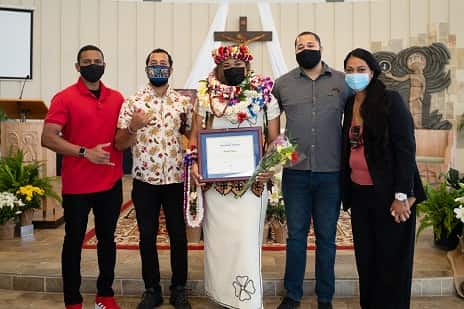
 Laurel Oshiro, the 2020 Hawaii Catholic Schools Teacher of the Year awardee

Fast forward to 2020, and Oshiro has obviously made the right career choice. She was recently named the 2020 Hawaii Catholic Schools Teacher of the Year, an annual award that’s presented by Chaminade University, Catholic Schools Hawaii and John C. and Mary Lou Brogan. The recipient receives a golden pine“apple” trophy and $1,000.

Oshiro’s passion and love for her job are evident the moment you start talking with her. She is the school librarian for grades JK-6 at Sacred Hearts Academy and she is known for her creative programming and knack for bringing new ideas and programs to the school.

“One of my administrators joked that I’m a Jill of all trades,” says Oshiro, laughing. “But that’s why I love Sacred Hearts so much…my principals give me so much freedom and so many resources to try to influence and create new programs.”

In 2010, Oshiro started a digital media club on campus for grades 4-6. They produce movies that are shared with the entire school community and host an annual red carpet event that is open to the public. Several students have gone on to careers in broadcast journalism. In 2013, she established the iTeach808: Empowering Hawaii’s Teachers in Technology conference, a free educational technology conference that reaches over 150 teachers from 40 schools across Hawaii each year.

More recently, Oshiro has been spearheading efforts to create a STREAM Innovation Center on campus and is piloting a new program that has already shown to increase student reading achievement and motivation. An avid sports fan and certified yoga instructor, she’s also been known to coach the school soccer and track and field teams and offer free yoga classes for colleagues. In the summer, she teaches yoga classes at the Sacred Hearts high school for students. She serves as the Vice President of Membership for the Hawaii Association of School Librarians in her spare time.

Oshiro became a mother this summer and is currently taking some time off to spend with her new baby. But she misses her Sacred Hearts community dearly and she’s treating this time away as a sabbatical, a chance to discover new books and catch up on new trends in the field of library science.

For Oshiro, there’s something very special about being in the Catholic school system that she’s excited to return to after maternity leave. She’s a devout Christian and finds fulfillment in being able to share her faith with her students.

“I look forward to mass every month and being able to talk to the children about God,” says Oshiro. “I love praying with them and helping them. It’s one thing to raise kids to be really smart and have high scores, but it’s another thing to develop their hearts.”

She has a profound respect for the teachers that surround her and attributes much of her success to the incredible work that they do every day. “I look at my neighbors, the teachers on my left and the teachers on my right, and I’m like ‘boy, they are working so hard,’” she describes. “I think managing a classroom of 25 kids is much harder than what I do. I have the one place on campus where students don’t get graded. That’s why I decided to become a librarian.”

As for the teacher-of-the-year award, Oshiro is truly honored. “It was so nice of Chaminade, it felt like the Heisman of teacher’s awards—that trophy was enormous!”

But she views the award as something her whole school earned. She believes it’s the result of the support network that she has found at Sacred Hearts Academy and it wouldn’t have been possible if it weren’t for the support of her fellow colleagues and administrators.

“It’s such an honor, I’m very humbled by it,” she says. “I hope to steward it well.”

Posted by: University Communications & Marketing Filed Under: Catholic, Education, Featured Story Tagged With: Honors and Awards

Pushing Boundaries: Sushi with Attitude

September 8, 2020

Remi Kohno '15

At Chaminade University, we talk a lot about adaptation and change—educating for adaptation and change is one of the five core tenets of a Marianist education. The concept is woven throughout our curricula, and our students learn about the importance of embracing change and adapting to meet it as they move through our programs.

Adapting to change is something that is very familiar to Remi Kohno ‘15. She came to Chaminade University from Pasadena, California to play basketball and major in elementary education. But after her first year, she realized neither of those were the right fit. She didn’t like the competition she found on the basketball court, and teaching wasn’t her passion. So she quit the basketball team and switched her major to communications with a focus in marketing.

Her junior year brought even more change when she joined the Hogan Entrepreneurial Program. It quickly started pushing her out of her comfort bubble, and it altered the way she reacted to pressure. 

“I saw all these great people join the Hogan program and I wanted to be just like them,” recalls Kohno. “Hogan definitely pushed my boundaries, which was nice. It really helped me grow as a person, both professionally and personally.”

Students who are accepted into the Hogan Entrepreneurial Program spend one or two years learning what it takes to become a successful entrepreneur. They mingle and network with some of Hawaii’s biggest business leaders, they travel, they participate in internships and they work with industry leaders to design their own business plans and fine tune their public speaking abilities.

The program helped Kohno break out of her shell and become more confident in her abilities to lead and engage.

One moment in particular stands out in her memory. Every Wednesday evening, Hogan participants gather to welcome and learn from a guest speaker from the Hawaii business industry. Guests range from Mattson Davis, the former president and CEO of Kona Brewing Co., to Chuck Cardinal, a former Colonel in the United States Army and the former Chief of Staff to a WWII Commander.

On this particular night, the speaker was Eddie Flores, Jr., the founder of L&L Hawaiian BBQ. Flores has an inspiring story—he’s the son of immigrant parents and the eldest of seven children. His family moved to Hawaii from China when he was a young child. His father worked as a janitor and his mother worked as a restaurant cashier and dishwasher. He himself struggled with a learning disability growing up that kept him behind in school. But as a young man, he worked hard, ultimately earning enough money to buy his mother a restaurant, in what would become the first L&L location. His restaurant chain now has over 200 locations and in 2019 it was ranked as the No. 1 Asian food franchise by Entrepreneur. 

Kohno had been designated as the evening’s notetaker, which meant it was her job to document Flores’ speech and at the end of the evening, stand up to present a recap to her classmates while Flores watched on.

She was just a little intimidated. “You’re listening and engaging, but you’re also taking notes so that you can structure it into a recap and presentation,” remembers Kohno. “After [Flores] was done, I had to go up in front of the whole class and do a quick overview of what was most important. It was nerve-wracking. But then I got to give him a lei, which was nice and helped alleviate any tension.”

Remi Kohno '15 at the American Advertising Federation’s Most Promising Multicultural Student program

Kohno’s senior year, right after returning from a semester studying abroad in France, one of her professors recommended her for the American Advertising Federation’s Most Promising Multicultural Student program. She was one of only a handful of students selected from across the nation to participate in the intensive immersion program, designed to connect diverse up-and-coming advertising talent with some of the largest advertisers in the nation. She once again found herself at the airport, ready to embrace the unknown, this time in New York City.

Luckily, she had learned how to network and interact with business leaders through the Hogan program. “We got to meet a ton of people and tour their facilities and headquarters,” says Kohno. “It was an opportunity to connect with businesses and send them your resume, and hopefully get a follow up interview to help jumpstart your career after college.”

Through all of the change and opportunity that came her way at Chaminade, Hogan taught Kohno to remain calm and collected, and cool under pressure. Through Hogan and her professors, she learned to see challenge as opportunity. It’s something that has served her well after college, particularly today.

Remi Kohno '15 with her family—Sushi With Attitude

Before COVID, her family ran a small restaurant stall called Sushi with Attitude at a night market in Los Angeles. While she has a full-time job at NBC during the day, she helps them on the side. When the pandemic shut down the market, they had to completely rethink their strategy and their focus. With Kohno’s help, they converted the business into a cloud kitchen model, meaning they are operating completely on delivery apps without a storefront, and launched a new product: the sushibi. It’s a combination of sushi and musubi.

“We wanted to offer musubi, but a lot of people in Los Angeles don’t know what they are,” says Kohno. “We also wanted to be able to show up in the sushi category on delivery apps—it is one of the most used keywords. So we rebranded our musubi to be sushibi to bridge the gap.”

The business has received a bit of media attention as a result, and Kohno’s Hogan training has come in useful.

Remi Kohno '15 and her family being interviewed for their family business, Sushi With Attitude

“Hogan helped me learn to speak and structure what I’m going to say, which has helped a lot with media interviews,” says Kohno. “I recently interviewed with KTLA news. I was really nervous because it was live, but it was nice to be able to do something that I wasn’t really comfortable with, and Hogan taught me how to do that.”

Kohno attributes much of her recent success to Hogan and the opportunities she had at Chaminade. “Definitely Hogan, all of the professors I had at Chaminade and being part of the American Advertising Federation, they have all helped me grow into this role that I have right now.”

She works full-time as a manager in paid social media at NBC. And only five years after graduating from college, she feels like she’s almost landed her dream job.

“I love what I do at NBC. They’re a really great company,” says Kohno. “I want to continue to grow and become a director, and continue to be knowledgeable about all the various platforms and their nuances and updates. That is my dream goal. I think I’m almost there.”

Posted by: University Communications & Marketing Filed Under: Alumni, Business & Communication, Featured Story, Hogan Entrepreneurial Program Tagged With: Communication

  • « Go to Previous Page
  • Page 1
  • Interim pages omitted …
  • Page 65
  • Page 66
  • Page 67
  • Page 68
  • Page 69
  • Interim pages omitted …
  • Page 85
  • Go to Next Page »

Footer

Chaminade University Logo

3140 Waialae Avenue
Honolulu, Hawaii 96816

Contact Us
Phone: (808) 735-4711
Toll-free: (800) 735-3733

facebook twitter instagram youtube linkedin

Visit

  • Plan Your Visit
  • Campus Map (PDF)
  • Events

Resources

  • Campus Security
  • Student Consumer Information
  • Concerns, Feedback, and Reporting
  • Institutional Review Board
  • Title IX / Nondiscrimination Policy
  • Compliance
  • Emergency Information
  • Careers
  • Institutional Statement

People

  • Students
  • Parents
  • Alumni
  • Faculty & Staff

Policy

  • Privacy Policy
  • Terms and Conditions of Use


© Chaminade University of Honolulu