• Skip to primary navigation
  • Skip to main content
  • Skip to footer
Chaminade University of Honolulu

Chaminade University of Honolulu

  • VISIT
  • APPLY
  • GIVE
  • STUDENTS
  • PARENTS
  • ALUMNI
  • FACULTY/STAFF
  • Admissions
    • Admissions Home
    • Undergraduate Students
      • First-Year Students
      • Transfer Students
      • Admitted Students
    • Graduate Students
    • Flex Online Undergraduate Program
    • Military Students
    • Non-Degree/Visiting Students
    • Experiential Honors Program
    • Early College Program
    • New Student Orientation
  • Tuition & Aid
    • Financial Aid Home
    • Tuition & Expenses
    • Federal Updates & Changes
    • Scholarships
    • $5,000 Graduate Scholarship
    • VA Education Benefits
    • Net Price Calculator
  • Academics
    • Academics Home
    • Academic Programs
    • Office of Student Success
      • Academic Advising
      • Records and Registrar
    • Kōkua ʻIke (Support Services)
      • ADA Accommodations
      • Career Services
      • Proctoring Services
      • Tutoring Services
    • Sullivan Family Library
    • Undergraduate Research & Pre-Professional Programs
    • Commencement
  • Campus Life
    • About Campus Life
    • Student Engagement
    • Student Government Association
    • Residence Life and Housing
      • Summer Conference Housing
    • Health Services
    • Marianist Leadership Center
    • Counseling Center
    • Campus Ministry
    • Campus Security
    • Dining Services
    • Bookstore
  • Athletics
  • About
    • Chaminade University News
    • Our Story
    • Leadership
    • Chaminade University Strategic Plan 2024-2030
    • Mission & Rector
    • Association of Marianist Universities
    • Facts & Rankings
    • CIFAL Honolulu
    • Accreditation & Memberships
    • Montessori Laboratory School
Search
×

Search this web site

Featured Story

Student Athlete

November 28, 2023

Haley Hayakawa ’24 has all the bases covered
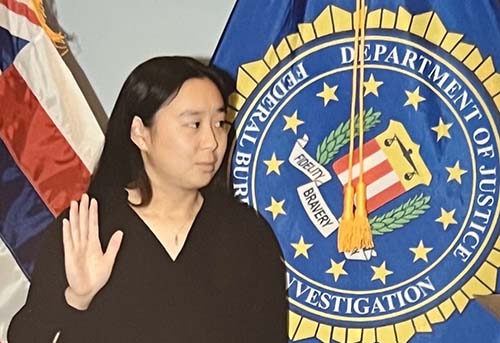
Haley Hayakawa gets sworn in at the Kapolei field office of the Federal Bureau of Investigation.
Accepted into the FBI’s “Honors Internship Program,”Haley Hayakawa gets sworn in at the Kapolei field office.

Her fellow classmates think she’s playing Candy Crush on her laptop. But in actuality, Haley Hayakawa ’24 is eyeing her Google calendar, which is scattered with different colors, each representing a lab, class or work hours that she has committed to during the week.

When the California native is not in a class or lab, she’s out in left field, shagging flies as a member of the Women’s Softball team. And during the summer, Hayakawa was working 40 hours a week at the Federal Bureau of Investigation’s field office in Kapolei, where she participated in the “Honors Internship Program,” which only accepts a sliver two percent of all its applications.

“It was my first full-time job,” said the 22-year-old Forensic Science major. “It has been the best experience I’ve ever had; everybody there wants to be there, and they all want to help you.”

An avid softball player since the eighth grade, Hayakawa committed to Chaminade University when she was a junior in high school, the earliest a student athlete can officially commit to a Division I or Division II college. 

“I was recruited by Division I and Division II schools, but some wouldn’t allow their recruits to participate in sports if they plan to major in a hard science because of all the required labs,” Hayakawa said. “Chaminade does, and it’s one of the reasons I chose to come here.”

She was also familiar with Chaminade’s Forensics Science program, which requires its students to complete a rigorous, 135-hour internship with such offices as the Honolulu Department of the Medical Examiner, police departments in Hawaii and Guam or the Joint POW/MIA Accounting Command’s Central Identification Laboratory. 

“During my junior year, I interned with the Medical Examiner Department, which gets involved with deaths as a result of violence, substance abuse, trauma, accidents or suicide, among other suspicious causes of death,” Hayakawa explained. “After reading some of the suicide notes, I was thankful to be stressed out because those notes helped put things in perspective for me.”

An ambitious go-getter from an early age, Hayakawa is the only child and holds high expectations from herself—and not her parents, Greg and Myra Hayakawa. In fact, her father often tells her “to be open to changes, and not everything happens as planned.”

“In my freshman year, all I could eye was being awarded summa cum laude, which requires a 3.96 GPA,” Hayakawa notes. “I’ve only had one B and that was in Organic Biochemistry, which lowered my 4.0 GPA to 3.96.”

Ironically, one of her two American Chemical Society awards was being recognized as the Most Outstanding Student in Organic Biochemistry—despite her B—and Most Outstanding Student in Forensic Chemistry, nominated by David Carter, Ph.D., Forensic Sciences director and professor.
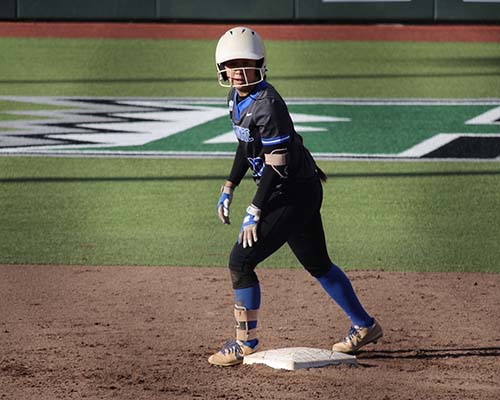
Haley Hayakawa gets ready to take off from second base.

“She also has minors in Biochemistry and Chemistry,” Carter says. “She is a stellar athlete on the softball team and she also works as one of our Forensic Sciences Laboratory Assistants.”

Hayakawa’s collegiate experience has certainly had its challenges. Her freshman year was during the height of COVID, which meant Hale Lokelani Residence Hall was in lockdown mode, limiting her interaction with fellow students except for her roommate Naomi Noguchi from Kauai. It was also her first time living away from home, and she couldn’t leave campus for three weeks. Meanwhile, the softball team couldn’t take to the gym and was forced to conduct its workouts via Zoom videos.

“My classes were from 8 a.m. to 5:30 p.m. on Mondays, Wednesday and Fridays, which was crazy,” Hayakawa recalls. “I was so overwhelmed, and when I went home for the winter break, my parents asked if I was OK because I had lost 30 pounds.”

When she returned to campus in the spring, Hayakawa now had to juggle between her softball season and her studies, maintaining a batting average of .377—earning her the team’s batting champion— and a perfect 4.0 GPA. 

“It’s easy to manage time, when your time is managed for you,” Hayakawa quips. “I’m all in … all the time.”

As she completes her final year as a Silversword, Hayakawa fondly reflects back on her time on Kalaepohaku campus, on the softball field, in the labs and with her friends. She already has future plans to attend graduate school, after having turned down a job offer with the FBI field office in Kapolei. 

“I’ve always wanted to help the community through criminal justice,” says Hayakawa, who will graduate as summa cum laude, thus achieving her ultimate freshman goal. “I made the right decision to come to Chaminade, not only because of its small class sizes, but because I got to form relationships with my professors and formed new friendships.”
Posted by: University Communications & Marketing Filed Under: Athletics, Featured Story, Natural Sciences & Mathematics, Student Life Tagged With: Forensic Sciences, Honors and Awards, Scholarship

Ocean Science

November 20, 2023

Professor Sean Chamberlin credits Chaminade for lifetime experience

Dr. Sean Chamberlin has treasured his Chaminade acceptance letter to a science program that he received 50 years ago.

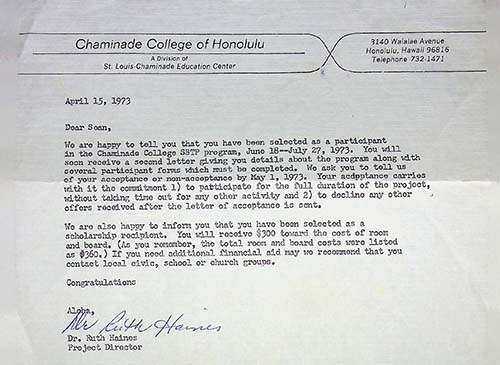
Akin to someone cherishing a handwritten love letter for a lifetime, Sean Chamberlin, Ph.D., covets a Chaminade acceptance letter he received more than 50 years ago. He even kept the envelope it came in. Five decades ago, the Florida native had applied to then-Chaminade College’s Science Training Program (STP) for high school students. The experience would forever change his life.

As an aspiring oceanographer, Chamberlin was among 36 students from across the nation who were invited to participate in the six-week program. To this day, he can vividly recall falling in “love with Chaminade University in May 1973,” the month he received his acceptance letter from Dr. Ruth Haines, Chaminade College’s then-STP project director. 

“I was 17 years old and I had never been away from home by myself,” exclaimed Chamberlin, during a phone interview. “Now I was going to Hawaii for six weeks—by myself! Chaminade made that happen. The school even paid for most of my room and board, which was about $60 per week in those days. Needless to say, I was super stoked.”

He has never forgotten the experience and the mentorship he received from Dr. Ron Iwamoto, biology professor emeritus with Chaminade. At the time, Chamberlin admitted he was carefree, staying up late at nights, coming to class barefooted, hanging with college students who were living on the top floor of the dorm and having his first pizza with pineapple at St. Louis Drive In.

“Despite my shenanigans, Dr. Iwamoto took me under his wing,” said Chamberlin, citing Iwamoto as one of the most influential people in his life. “Students in the program were required to carry out a research project as part of their studies. I didn’t realize it at the time, but Dr. Iwamoto devised a project for me that would require lots of energy, and would take me as far away as possible from the other students.”

Iwamoto’s strategy paid off.

The research project involved building an artificial reef in a bay where Iwamoto liked to fish. Like a MacGyver, Chamberlin creatively improvised by filling a few old tires with bricks and hauling them out to a channel between the reefs. Every day, he swam out to the spot and made frequent observations of the organisms that came to live there.

“I remember screaming through my snorkel when I saw the first fish inhabitants,” Chamberlin said. “The project didn’t amount to much scientifically, but it meant everything to me personally. I fell in love with field work, a passion that would propel my career as an ocean scientist for the next several decades.”

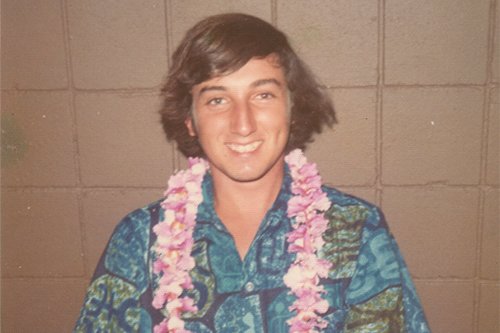
Dr. Sean Chamberlin received a lei upon his arrival on Oahu.

Chamberlin is careful in choosing his words to describe the courses he teaches in the Department of Earth Sciences at Fullerton College. He substitutes ocean science for the term oceanography, the scientific nomenclature more commonly used among scientists who study the properties (temperature, density, etc.) and movement (waves, currents, and tides) of seawater and the interaction between the ocean and the atmosphere. He also prefers to use the term weather and climate science to describe meteorology.

“Some students get intimidated about science because they may not have been exposed to it at a younger age,” Chamberlin explained. “Personally, I was always fascinated with science and living in Florida, I was exposed to the space program at an early age. I could see rockets go over my head in my own backyard. However, my parents weren’t too keen on me becoming an astronaut, but when I was 10 years old I learned about Scott Carpenter, an astronaut who became an aquanaut, and that was OK with them.”

After attending Chaminade’s STP, Chamberlin followed his passion and attended the University of Washington, a national leader in oceanographic research and education. Four of his peers in the Chaminade summer program also decided to enroll at UW.

At UW,  the aspiring scientist landed opportunities as a work-study student to carry out undergraduate research. By his junior year, he was regularly sailing aboard oceanographic vessels in the North Pacific. After graduating with bachelor’s degrees in oceanography and English, Chamberlin decided to attend graduate school at the University of Southern California.

He pursued his research aboard Jacques Cousteau’s Calypso in Tahiti, where he tested a new optical tool for measuring how fast ocean plants grow. He has also been to the Arctic where he sailed with Norwegian oceanographers in the Barents Sea. In 1988, Chamberlin spent five weeks aboard a polar research vessel in the Antarctic. He even got to walk on the sea ice in the Weddell Sea. His postdoctoral research with Lamont-Doherty Earth Observatory in Palisades, New York, led him to Iceland, the Azores and Portugal on research expeditions in the North Atlantic.

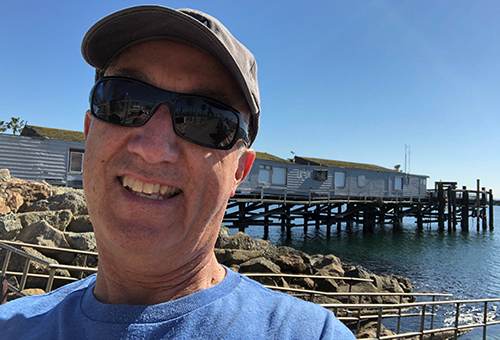
Dr. Sean Chamberlin still enjoys conducting field research.

“All of these paths originated from Chaminade,” Chamberlin said. “My experiences on a reef in a Hawaiian bay—thanks to Dr. Iwamoto—inspired me to pursue field science. “Perhaps because of that experience, my textbooks—“Exploring the World Ocean” (Chamberlin and Dickey 2008) and “Our World Ocean” (Chamberlin, Shaw, and Rich 2023)—draw from Hawaii’s countless examples of ocean features, processes and scientific achievements.”

But this story isn’t really about Chamberlin, it’s about the thousands of young people who have benefitted from his experiences at Chaminade. Although, he is not Hawaiian, he gained a profound respect for the  Hawaiian culture and its people, thanks to Chaminade. 

A few years ago, Chamberlin read a post on Chaminade’s Facebook page about the Ron Iwamoto Teaching Fellowship in Biology, which brought back fond memories for him—especially of Dr. Iwamoto and the once-in-a-lifetime opportunity afforded to him by Chaminade. 

“I smile when I think of how Dr. Iwamoto and Chaminade shaped my life as a young man,” Chamberlin said. “My choice of colleges, my pursuit of oceangoing research, my respect for diverse people and their cultures, and my love for Hawaii are rooted in my experiences under his mentorship. As an ocean educator, writer and scientist, I can only hope that my contributions are a fraction as impactful as Dr. Iwamoto’s were on me.  After all, it only takes a few bricks, a tire and a passion for life to make a beautiful reef.”

Posted by: University Communications & Marketing Filed Under: Campus and Community, Diversity and Inclusion, Faculty, Featured Story, Innovation, Natural Sciences & Mathematics, Undergraduate Research & Pre-Professional Programs

Student Research Project

November 17, 2023

Pam Oda presents her research findings in Texas

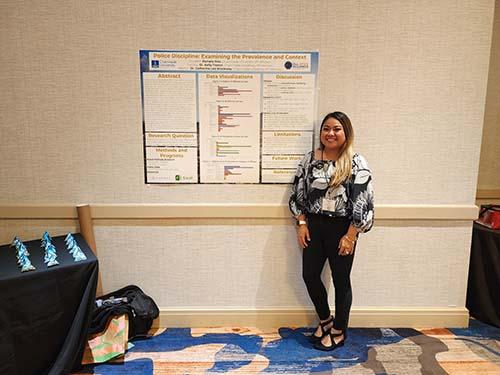
It’s just the beginning stages of her research, but Pam Oda ’24 has already presented her preliminary findings at the Society for Police and Criminal Psychology (SPCP) in Arlington, Texas, thanks to monies from the Alliance Supporting Pacific Impact through Computational Excellence (ALL-SPICE) grant. Standing in front of her presentation board, Oda explained the importance of education in the law enforcement field, which has long been debated. While many agencies have historically required little to no college coursework for entry-level positions, research suggests a positive correlation between education and job performance at all levels of law enforcement.

With the mentorship and encouragement of Dr. Kelly Treece, Criminology and Criminal Justice director and associate professor, Oda’s study evaluated disciplinary actions taken against Honolulu Police Department officers. With access to open records, Oda was able to obtain the types of allegations of police misconduct, which are divided into four sections: administrative investigation, criminal investigation, quality assurance and accreditation.

“Most of the violations were for administrative reasons,” said Treece, a former sergeant and trainer with the Pewaukee Police Department in Wisconsin. “Pam did a really good job with her presentation, and she handled herself very well in front of a lot of professionals.”

Pam Oda stands next to her poster board in Arlington, Texas.

The recent calls for police reform—combined with mounting evidence that an educated police force can have positive effects—have sparked a nationwide conversation about raising education requirements for police officers.

“Currently, the minimum qualification to become an HPD officer only requires having a high school diploma or your GED,” Oda said. “I think we need to raise that standard in Hawaii.”

In her presentation, Oda noted that 51.25 percent of officers received a High School Diploma or GED, 27.5 percent held a bachelor’s degree and 15 percent have received their associate’s degree or completed 60 semester credits or more. The numbers are consistent with national statistics, which show that only one percent of local police departments across the U.S. require their officers to hold four-year degrees and only eight percent call for officers to have attended any college at all.

Oda further noted that early research indicates that there is a broad performance difference between officers who have a college education and those who do not.

Citing a paper written by S.M. Smith and M.G. Aamodt (1997) in the Journal of Police and Criminal Psychology, the co-authors found that police officers who possess college degrees are better performers than those with only high school degrees, including overall performance, communication skills and decision-making ability. 

According to Oda, this type of research has been ongoing yet most departments are not implementing these findings into policy and practice. In addition, in a study conducted by the Police Executive Research Forum (2019), officers with a four-year college degree had significantly fewer civilian complaints than those with only a high school diploma. 

Oda also pointed out that research shows higher education has significant benefits for law enforcement officers, including the ability to navigate the complexities of modern-day policing, which consists of critical analysis, enhanced communication abilities and a comprehensive understanding of the criminal justice system (S. Christopher, 2015, in Policing: A Journal of Police and Practice). 

Now in her fifth year at Chaminade, Oda will complete a double major in Criminology and Criminal Justice and Data Science, Analytics and Visualization with minors in Computer Information Systems and Psychology in December. The Hilo native hopes to continue her research with Treece at Chaminade while pursuing her graduate degree in Criminal Justice.

“That’s the plan right now,” said Oda, who serves as the president for the Chaminade Student Government Association, as well as the president of the Restauranteers Club. “Since starting in fall 2019, I have taken advantage of the countless opportunities that Chaminade has to offer, from student clubs and organizations to research and internship opportunities to student employment and the ‘ohana spirit.”

Treece, too, plans to expand the research to include the Sheriff Division of the Hawaii Department of Public Safety, which will then include statewide statistics and a broader representation. By doing so, she and Oda will be able to capture a more robust picture of the correlation between education and law enforcement.

“The next step is to write a paper, which I’ve asked Pam to help me co-author,” Treece said. “She’s a little hesitant and nervous about it, just like she was when I first approached her about presenting in Texas. I think she’ll do great.”

Posted by: University Communications & Marketing Filed Under: Behavioral Sciences, Diversity and Inclusion, Featured Story, Innovation, Student Life Tagged With: Criminology and Criminal Justice, Master of Science in Criminal Justice Administration

Hogan Speaker Series

November 16, 2023

Panelists share their insights into entrepreneurship

What guides you? How do you find mentors? How do you overcome failure? What advice would you give your younger self?

These questions and many more were posed to three diverse and accomplished community leaders who served as panelists during the Hogan Entrepreneurial Leadership Program speaker series on Nov. 15 in a packed Keifer Hall Room 9. Panelists Haelee Tallett ’18, Shane Hanson ’16 and Julie Morikawa navigated the questions with ease and decorum, freely sharing their personal and professional experiences with students, alumni and faculty, all eager to soak in knowledge and insight. 

Tallett is the founder, owner and lead designer of Ocean Creations, which she started as an online business and now has several brick-and mortar-locations. Alumnus Shane Hanson is founder and owner of Freedom Fiduciaries. Morikawa, a hospitality industry executive, is the president of non-profit ClimbHi, which creates bridges between high school and college students from education to career paths, and is dedicated to workforce development in Hawaii.

Hogan program director Roy Panzarella opened the discussion by asking the panel, “What is your ‘Why?’” or “Why do what you do?” 

Hanson shared that being an entrepreneur is something innate, that he would rather work 80 hours for himself than 40 hours for another corporation. He also shared that he came to Chaminade to play basketball and eventually participated in a competiton in which student groups created their own products and marketing plans. The fulfilling and exciting experience has remained with him and sparked his entrepreneurial spirit. 

Being an entrepreneur is more important than being a jewelry designer to Hallett. While her company’s product is jewelry, what really motivates her is bringing a sense of confidence and beautiful design to customers who wear or give jewelry as gifts. Jewelry is the means to achieving that goal of the entrepreneurial journey of ideation to product to customer satisfaction. 

When asked how to create sustainable products that are not as profitable, Morikawa replied, “Why do they have to be separate, sustainability and profitablity?” She described a federal grant that ClimbHi recently received that involves partnering with local environmental and sustainability-focused organizations to maintain and improve an important ahupuaʻa (land division) on Oʻahu.

The 90-minute panel discussion served its purpose. The community leaders on the panel thoughtfully answered questions. Students respectfully asked questions. And all left the room with an understanding and insight into how following one’s dream is what it takes to be fulfilled and to have a meaningful impact.

The next Hogan Program speaker will be Gary Hogan on Wednesday, Nov. 29 from 6 to 7:30 p.m. in Kiefer Hall Room 9. Hogan is the CEO of Hogan Hospitality Group and Hawaiian Hotels & Resorts, as well as CEO and Board Chair of Pleasant Travel Service. 

Posted by: University Communications & Marketing Filed Under: Alumni, Business & Communication, Featured Story, Hogan Entrepreneurial Program, Institutional, Students Tagged With: Guest Speakers, Hogan Entrepreneurs Program, Master of Business Administration, School of Business and Communication

Triennial Aircraft Disaster Exercise

November 6, 2023

First responders put skills to the test during emergency response drill

Imagine an aircraft explosion on landing and the immediate aftermath. The moments after an airplane crash are undoubtedly critical, as nursing student Sigfried Halili ’23 learned firsthand during the Triennial Aircraft Disaster Exercise. This every-three-year, mandatory certification requirement by the Federal Aviation Administration tests airfield disaster preparedness and response by simulating a full-scale aircraft emergency disaster. The drill tests and evaluates the operational capacity of emergency response in a stress environment.

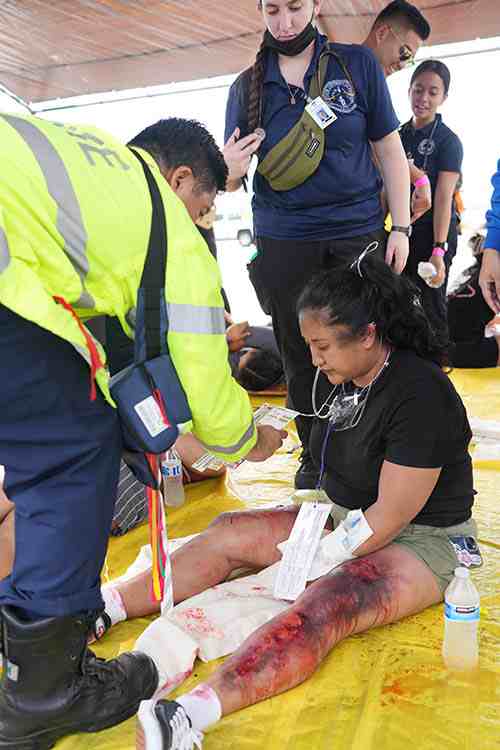
Mock patients in moulage (make-up) are treated by Chaminade nursing students during the Triennial Aircraft Disaster Exercise.

Divided among four groups colored Red, Green, Yellow and Black, Chaminade nursing students treated patients with varying injuries, with the Red group receiving the most seriously injured, the Green team tending to those with superficial abrasions and contusions, the Yellow team looking after patients in between Red and Green, and Black team announcing mortality.

“The firefighters and EMS would perform triage and assess where the injured passengers would be taken,” explained Halili, the senior representative of the Student Nursing Association. “Of the five patients I treated, one was mortally injured, another belonged to the Green category and the three others were in critical condition.”

This triennial, multi-agency exercise involved hundreds of volunteers—including 175 nursing students from Chaminade University—and airport personnel who acted as injured passengers. Participating agencies included Hawaii Department of Transportation (HDOT) Airports Division staff, HDOT Aircraft Rescue Fire Fighting (ARFF) units, Securitas, the Federal Aviation Administration, the Transportation Security Administration, City & County of Honolulu Fire and Police Departments, Emergency Medical Services, American Medical Response, Joint Base Pearl Harbor Hickam Federal Fire Department, U.S. Coast Guard, Hawaii Department of Public Safety and airline personnel.

Volunteers portrayed passengers who were injured, uninjured, unresponsive, fainting, deceased, family, friends, responders, medical personnel and other miscellaneous roles. Make-up (moulage) was applied to simulate varying injuries, from deep lacerations to serious tissue wounds. Participants were also asked to “role play,” pretending to cry, scream with injuries and yell confusedly. Others acted grief stricken, angry and demanding information. All these roles were to simulate a real-life event to help responders to be better prepared. This exercise is an opportunity to get an on-scene and behind-scene view of a real-life emergency simulation.

The main focus for the nursing students during the exercise was to practice use of the Incident Command System— a systemic tool used for the command control and coordination of emergency response—and perform disaster triage and treatment skills. The event was a great opportunity for nursing students from three local nursing schools—including Chaminade—to work cohesively in an intense and stressful environment, an experience most of them had never encountered.

“This was the first triennial exercise that I participated in,” said Halili, who will graduate in December and take the National Council Licensure Examination to become a fully licensed Certified Nurse. “It was amazing to see how many people get involved when an emergency happens on an airport tarmac.”

Posted by: University Communications & Marketing Filed Under: Featured Story, Institutional, Nursing & Health Professions, Students Tagged With: Nursing

Top Cop Scholarships

October 31, 2023

Three Silverswords recognized for their commitment to criminal justice

Now in its 38th year, the Annual TOP COP Award Ceremony honors law enforcement and security professionals from several sectors, including law enforcement, private security, military and non-profit agencies.

“We are excited to be together in the same space and time to celebrate the dedication of our law enforcement and security professionals in the State of Hawaii,” said Law Enforcement and Security Coalition of Hawaii president Jeremiah Pahukula, Jr., during his opening remarks. “Your presence here today demonstrates your commitment to the safety and security of our island home and we are grateful for your support.”

Equally grateful are this year’s Top Cop Scholarship recipients, including Chaminade senior Chasity McKean ’24, who will graduate with a major in Criminal Justice and minor in Psychology. Receiving the ASIS Region 1D Scholarship, the Kapolei native plans on pursuing a career with the Honolulu Police Department.

“My initial plans post-degree is to join HPD and once I get in, work my way up the ladder to become a canine officer,” wrote McKean in her essay outlining her interest in a Criminal Justice degree. “However, I’m still keeping my options open since having a Criminal Justice degree is very broad and there is much I can do with it. I’ve been doing research and applying for internships to get different work experiences within the criminal justice field.”

Earning the Bob Flatting Scholarship was fellow Silversword Benjamin Carlin, who is working towards his Master’s degree in Criminal Justice. The U.S. Army Police Officer aspires to advance from an enlisted soldier to a commissioned officer with the United States Army’s Military Police Corps, which provides expertise in policing, detainment and stability operations in order to enhance security and enable mobility.

Aligned with the goals of the U.S. Army’s Military Police Corps, the Law Enforcement and Security Coalition of Hawai‘i adopted the Hawaiian expression of “E Pupukahi,” which holds the symbolic meaning of “working together as one to make Hawai‘i a safe place to live and work.”

“Working with these talented individuals who value the accomplishments of those who protect our communities has been my pleasure,” said Pahukula, Jr. “I look forward to their continued support.”

Chaminade senior Alisha Gifford’s lifetime ambition is to serve and protect her community. As this year’s Top Cop Scholarship awardee, Gifford is currently in the selection process of being an intern with HPD. Her longterm goal, however, is to pursue a career with the United States Air Force.

Posted by: University Communications & Marketing Filed Under: Featured Story, Natural Sciences & Mathematics, Students Tagged With: Criminology and Criminal Justice, Master of Science in Criminal Justice Administration, Scholarship

  • « Go to Previous Page
  • Page 1
  • Interim pages omitted …
  • Page 37
  • Page 38
  • Page 39
  • Page 40
  • Page 41
  • Interim pages omitted …
  • Page 92
  • Go to Next Page »

Footer

Chaminade University Logo

3140 Waialae Avenue
Honolulu, Hawaii 96816

Contact Us
Phone: (808) 735-4711
Toll-free: (800) 735-3733

facebook twitter instagram youtube linkedin

Visit

  • Plan Your Visit
  • Campus Map (PDF)
  • Events

Resources

  • Campus Security
  • Student Consumer Information
  • Concerns, Feedback, and Reporting
  • Institutional Review Board
  • Title IX / Nondiscrimination Policy
  • Compliance
  • Emergency Information
  • Careers
  • Institutional Statement

People

  • Students
  • Parents
  • Alumni
  • Faculty & Staff

Policy

  • Privacy Policy
  • Terms and Conditions of Use


© Chaminade University of Honolulu