• Skip to primary navigation
  • Skip to main content
  • Skip to footer
Chaminade University of Honolulu

Chaminade University of Honolulu

  • VISIT
  • APPLY
  • GIVE
  • STUDENTS
  • PARENTS
  • ALUMNI
  • FACULTY/STAFF
  • Admissions
    • Admissions Home
    • Undergraduate Students
      • First-Year Students
      • Transfer Students
      • Admitted Students
    • Graduate Students
    • Flex Online Undergraduate Program
    • Military Students
    • Non-Degree/Visiting Students
    • Experiential Honors Program
    • Early College Program
    • New Student Orientation
  • Tuition & Aid
    • Financial Aid Home
    • Tuition & Expenses
    • Federal Updates & Changes
    • Scholarships
    • $5,000 Graduate Scholarship
    • VA Education Benefits
    • Net Price Calculator
  • Academics
    • Academics Home
    • Academic Programs
    • Office of Student Success
      • Academic Advising
      • Records and Registrar
    • Kōkua ʻIke (Support Services)
      • ADA Accommodations
      • Career Services
      • Proctoring Services
      • Tutoring Services
    • Sullivan Family Library
    • Undergraduate Research & Pre-Professional Programs
    • Commencement
  • Campus Life
    • About Campus Life
    • Student Engagement
    • Student Government Association
    • Residence Life and Housing
      • Summer Conference Housing
    • Health Services
    • Marianist Leadership Center
    • Counseling Center
    • Campus Ministry
    • Campus Security
    • Dining Services
    • Bookstore
  • Athletics
  • About
    • Chaminade University News
    • Our Story
    • Leadership
    • Chaminade University Strategic Plan 2024-2030
    • Mission & Rector
    • Association of Marianist Universities
    • Facts & Rankings
    • CIFAL Honolulu
    • Accreditation & Memberships
    • Montessori Laboratory School
Search
×

Search this web site

Featured Story

Early College Exposure

December 21, 2023

High school students earn college credit

For the past two years, Kapaa High School seniors, Tatum Harper and Taeani Largusa, have taken several synchronous online courses with Chaminade University professors, earning college credit while simultaneously fulfilling their high school requirements. The hours of studying and discipline paid off. Learning she just got into Columbia University, Harper was ecstatic.

“It’s my dream school,” said Harper, during Chaminade’s inaugural Early College Summit, which was attended by a mix of 70 students from Kapaa High School, Sacred Hearts Academy and Saint Louis. “Participating in this program has really prepared me for college.”

Largusa echoed the same sentiment, adding that she expects to hear from Syracuse University soon. “When I took the virtual campus tour I fell in love with it,” says the first generation, soon- to-be-college student. “This program has given me confidence in knowing that I can handle the demand of college courses.”

Early college programs can provide several benefits, including the opportunity for students to accelerate their education, which can lead to the completion of college degrees at an earlier age. There’s also the perk of cost savings, reducing tuition costs for future higher education.

Sacred Hearts Academy counselors Ashley Luke and Sharlene Chock both agreed that Chaminade’s early college program will help students become familiar with the expectations and rigor of college-level coursework, easing their transition to full-time college later on.
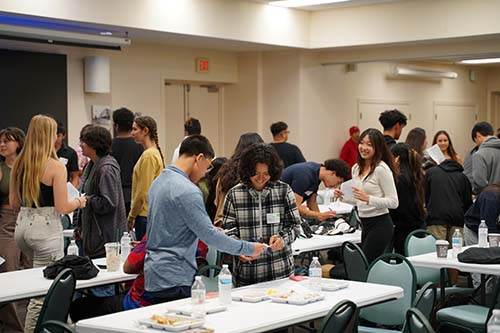
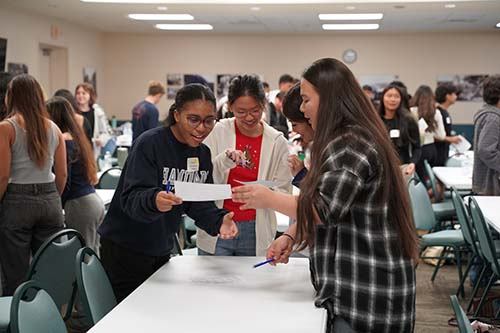
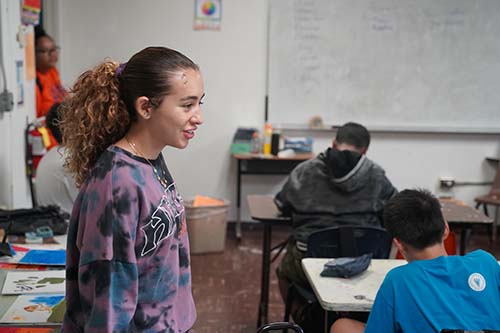
Students circled the room to fill out their bingo-like cards.
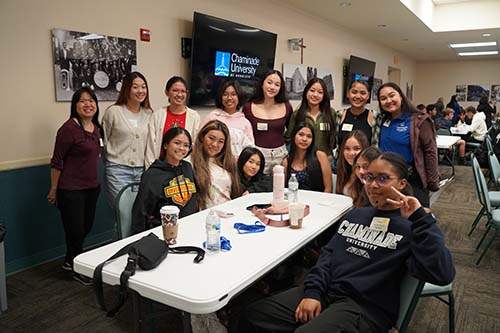
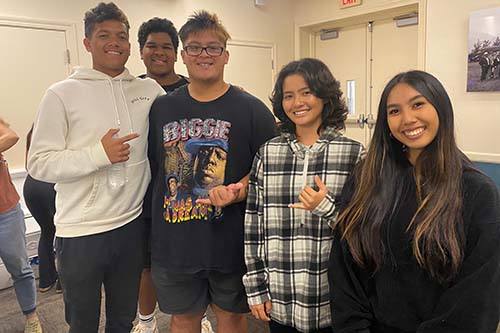
Saint Louis and Kapaa High School students mingled during the Early College Summit.
Sacred Hearts Academy students played a bingo-like game, with the first one to fill all 25 boxes with the right answers winning the grand prize.
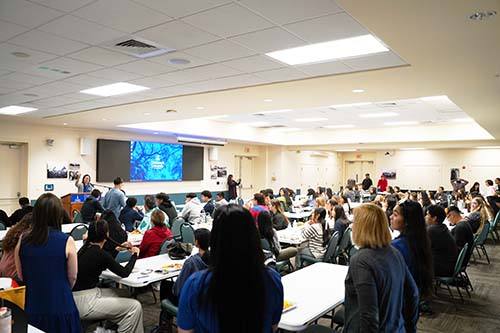
Chaminade’s Early College Director, Kim Baxter, addressed the students at the T.C. Ching Conference Center in Eiben Hall before they set off to visit other campus locations.
Sacred Hearts Academy juniors completed their first semester of college courses.

“Some struggled initially with the transition because of the extra studies involved in taking college-level courses,” said Luke, who counsels 10th and 11th graders. “Even our top students were stretched because they didn’t understand process versus perfection, which they’re used to achieving in high school.”

With this first cohort of 17 Lancers, Chock believes the college exposure will help them navigate the waters of post-secondary education. “They have already been individually challenged,” said the 12th grade counselor. “I think the experience shows them that college is attainable.”

Saint Louis School students Landon Dimaya, Cash Acorda and Kevin Simmons will begin their college courses next semester. The three Crusaders cited different reasons for participating in the program. Dimaya is a fraternal twin whose sister Lindsey is already a Sacred Hearts Academy participant. “I want to reduce the financial burden on my parents,” he said. “It would be really expensive to have to pay tuition for me and my sister at the same time.”

“I want to get ahead,” offered Acorda, who plans to apply to Stanford, with Simmons further noting that the experience would look good on his application.

Research demonstrates that early college programs show strong and lasting evidence of effectiveness for all students. It promotes both post-secondary access and success. The data is undeniable that students who participate in such programs will be ahead of their peers and graduate from a four-year university either debt-free or with very little federal student loan debt. The latest data further supports the claim that students who participate in these programs are better prepared to transfer to a four-year university than students who attend the university without prior college experience. 

Moreover, encouraging students to attend college improves individuals’ earnings over a career, increases the amount of taxes the government collects, and reduces government spending on federal assistance programs. 

“This program is such a great opportunity for these high school students to earn dual credits,” said Kim Baxter, Chaminade’s Early College Director. “And it gives them that real college experience.”
Posted by: University Communications & Marketing Filed Under: Campus and Community, Catholic, Diversity and Inclusion, Early College, Featured Story, Innovation, Institutional Tagged With: Campus Event, Early College Experience

True Calling

December 18, 2023

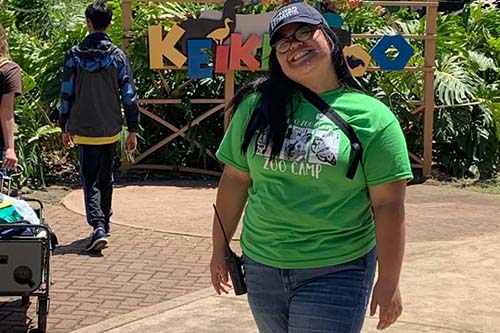
As a Zoo Camp instructor, Sara Aliza Sahagon finally found her true passion—to teach.

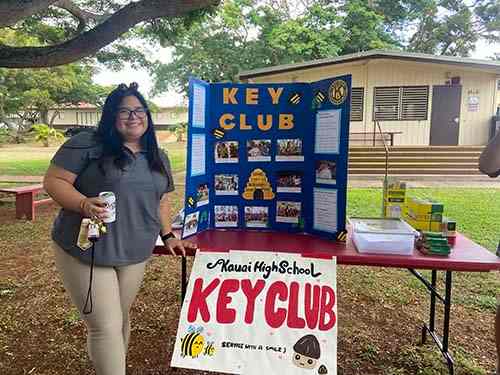
Sara Aliza Sahagon ’24 holds down two jobs: her regular day job as a long-term substitute teacher at Kauai High School and what she defines as her “heart job,” which is taking care of her community service programs, a passion she has maintained since she was a young Chamorro in Guam.

“I wanted to become a social worker when I was younger,” says Sahagon, who will walk in the May 2025 Commencement Ceremony. “I was volunteering with Youth for Youth LIVE! Guam, which is a non-profit community-based, youth-centered, youth-driven drug prevention program for teens between the ages of 11 and 17. This is what I thought I was going to do for the rest of my life.”

Sara Aliza Sahagon serves as the head advisor with Kauai High School's Key Club, which focuses on community service.
Sara Aliza Sahagon serves as the head advisor with Kauai High School’s Key Club, which focuses on community service.

Her mom, Stacey Coletta, had other plans for her daughter. Although accepted into Stanford, Coletta was restrained from attending the private research university due to tuition and board costs. Understandably, she wanted Sara and her older sister, Hanna, to move off island, and to explore and experience the world through another lens.

In her senior year at Notre Dame in Talo’fo’fo’, Sahagon applied to the University of Hawaii–Manoa and Hawaii Pacific University (HPU). Unfortunately, she admittedly missed the Chaminade University application deadline.

“I wanted to find an open world,” Sahagon says. “I wanted to meet new people who weren’t related to me. I wanted to experience new things, but I still wasn’t ready to leave the island lifestyle all behind, like my older sister did when she went to school in San Diego. So, Oahu was perfect for me.”

Accepted to HPU, Sahagon was excited to go to college … until she got there. The classrooms, she says, felt like they were closing in on her and doubts of her academic knowledge crept in, incapacitating her from thinking and constantly intimidated by her fellow classmates. It was a shock to Sahagon because she had always been at the top of her class back in Guam, earning As and merits for her work.

“I couldn’t deal with traditional college,” Sahagon says. “I felt dumber than everyone in the room, and it really brought me down. So, I dropped out after my first year.”

After bouncing from job to job, from Kate Spade to Bath & Body Works, Sahagon landed an instructor position with the Honolulu Zoo’s “Zoo Camp.” After years of searching, the 23 year old finally found her true calling. She flourished, and learned and absorbed everything she could about zoology—from the various species to their different habitats.

“I worked at the Zoo for three years until COVID hit,” Sahagon laments. “I loved teaching and I knew that’s what I wanted to do. I did find another position with After-School All-Stars Hawaii, which provides school-based, after-school and summer programs for underserved communities and students. I ran my own site.”

As fruitful and satisfying as the experience was at After-School All-Stars Hawaii, constantly nagging in the back of Sahagon’s mind was college. By now, her mom—a lifetime educator and the current vice principal (Academy of Human Services) at Kauai High School—had moved to the Garden Isle, and they would frequently speak of Sahagon returning to college. Sahagon, though, was trapped in that circuitous 9-5 cycle on Oahu. She would constantly tell herself that she was going to be a teacher and no one was going to stop her—except herself.

Sara Aliza Sahagon's experience as a Zoo Camp instructor led her to finally find her true calling.
Sara Aliza Sahagon’s experience as a Zoo Camp instructor led her to finally find her true calling—to teach.

Although Coletta initially discouraged her two daughters from becoming teachers—only because she knew how hard it is to be a teacher— having been one herself for years—she was now supporting Sara’s dream. It was now or never.

“My mom told me that if I wanted to become a teacher, now was the time because there’s a shortage of teachers every where,” Sahagon recalls. “She had one stipulation: I had to move to Kauai. She said to me, ‘You’re going to get it done and you’re going to do great things.'”

It was enough of a push to motivate Sahagon to move with her mom and stepdad. She began researching various programs and colleges, and looked into the online programs at University of Phoenix. In the end, Chaminade’s Flex option won her over.

“I chose Chaminade because it keeps spirituality at the forefront, which helps keep me grounded,” asserts Sahagon, now the head adviser of the high school’s Key Club, which focuses on community service. “I also hold the same Marianist-Catholic values. I know that everything I do has a purpose; every exam, every activity and every paper has meaning.”

Now in her second year of the Flex program, Sahagon’s Chaminade experience is the antipode of HPU. These days, it’s just her in the competition, and she feels she has “strong support” from the University’s faculty and staff. Sahagon says, with her Chaminade education, she will be well prepared to have her own classroom. She has already applied concepts that she has learned in her classes with her students. And she has learned different teaching strategies that are effective. 

“I wish I had applied to Chaminade earlier,” Sahagon says. “It’s been a very positive experience and I love being a Silversword. I feel truly blessed to be able to finish my college degree at Chaminade.”

Posted by: University Communications & Marketing Filed Under: Education, Featured Story, Institutional, Student Life Tagged With: FLEX Program, Secondary Education

Senate Confirmation

December 12, 2023

Shanlyn Park ’91 confirmed in a bipartisan vote

The District of Hawaii has its first Native Hawaiian woman to serve on the federal bench as a district court judge. Shanlyn Park ’91 is a current state court judge and former federal public defender. She was nominated for the judgeship on September 27, and sat for her hearing before the Senate Judiciary Committee on October 4. She was confirmed on November 30.

In a bipartisan U.S. Senate vote, Shanlyn Park ’91 was confirmed as the first Native Hawaiian woman to serve on the federal bench as a district court judge.

“Judge Park’s unique combination of experience, tenacity and genuine kindness will be a huge asset to the federal bench,” said Chief U.S. District Judge Derrick K. Watson in a released statement. “We are excited to have her join us as our colleague in 2024.”

Park was confirmed on a bipartisan vote of 53-45. The lifetime appointment is particularly significant in terms of representation as Native Hawaiians comprise 21.8 percent of the population in the district where she will preside.

Born and raised in Hawaii, Park has been a state circuit court judge since 2021. She previously worked in private practice and at the Office of the Federal Public Defender for the District of Hawaii. While a practicing attorney, she has also represented individuals on a pro bono basis, including cases of employee discrimination.

In a joint statement, U.S. Sen. Brian Schatz and U.S. Sen. Mazie Hirono applauded Park’s confirmation, saying she “led a distinguished career dedicated to public service.”

“She has exhibited a commitment to justice, fairness and impartiality throughout her career, and is highly qualified to serve on the U.S. District Court,” the senators said. “As the first Native Hawaiian woman to serve as a federal district court judge, Judge Park’s confirmation reflects the Biden-Harris Administration’s commitment to building a federal judiciary that reflects the diversity of our communities.”

Park was the second Hawaii judge to be confirmed in November. The Senate also voted to confirm Micah Smith, a federal prosecutor, to a district court judgeship. Appointed under Article III of the U.S. Constitution, federal district court judges are nominated by the president, confirmed by the U.S. Senate and serve lifetime appointments upon good behavior.

Both Park and Smith fit into President Joe Biden’s broader goal of diversifying the federal judiciary.

“They have the legal acumen as well as the character and temperament required to fulfill the duties of US District Court judges,” Sen. Schatz (D-HI) said at the September 27 hearing. “It’s for these reasons that I’m proud to support their nominations to the federal bench.”

Park is expected to fill the seat currently held by U.S. District Court Judge Leslie Kobayashi, who is expected to go on senior status in October 2024. “Judge Park’s credentials are impressive by any measure, Schatz said. “But the historic nature of her nomination should not be lost on anyone.”

Schatz added that Park has a commitment to equal justice and has spent two decades as a public defender “giving voice to those most in need.”

“She represented low-income defendants on a variety of complex cases, earning a reputation among colleagues and opposing counsel alike as a highly-skilled, compassionate and solutions-oriented attorney,” Schatz said. “And she has brought her integrity and sound judgment to the bench since becoming a state court judge in 2021.

Smith will fill the seat currently held by U.S. District Court Judge J. Michael Seabright, who will go on senior status in January.

Appointed under Article III of the U.S. Constitution, federal district court judges are nominated by the president, confirmed by the U.S. Senate and serve lifetime appointments upon good behavior.

Posted by: University Communications & Marketing Filed Under: Alumni, Diversity and Inclusion, Featured Story, Institutional, Press Release Tagged With: Alumni, Honors and Awards

Literary Honor

December 6, 2023

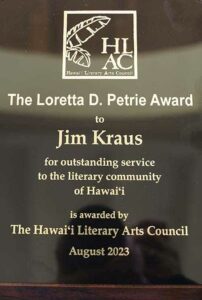
Professor Jim Kraus receives Loretta Petrie Award

It was poetic that Chaminade English professor James Kraus, Ph.D., was announced as the recipient of this year’s Loretta Petrie Award by the Hawaii Literary Arts Council (HLAC). After all, the award’s namesake was an early leader of HLAC, and a teacher and administrator at Chaminade University, where she took an active role in its literary magazine and sustained her own lifelong interest in writing. A legacy that Kraus helps perpetuate today on campus.

English professor Jim Kraus, Ph.D., was a recipient of this year’s Loretta Petrie Award by the Hawaii Literary Arts Council.

“This is meaningful because it is recognition for the work I have done on behalf of the literary community, trying to model what it is to be a good ‘literary citizen,’” says Kraus who, incidentally, was hired by Petrie as a full-time Chaminade faculty member in 1985. “I’ve been active in this regard for well over 40 years, since I was in graduate school at the University of Hawaii in the 1970s.”

An avid surfer who started teaching part-time at Chaminade in 1976, Kraus’ formative years were spent studying nuclear engineering with the Navy, with a dream of getting into the United States Coast Guard Academy. Then the Vietnam War happened, and he became a conscientious objector, legally claiming the right to refuse to perform military service on the grounds of freedom, and conscience and thought principles.  

“I never wanted anything to do with nuclear technology ever again when I returned from the Navy,” Kraus asserts. “There was a lot going on in those days, including the 1970 massive protests that led to the Kent State shooting.”

From 1980-1984, Kraus was the founder, editor and publisher of Hawai‘i Surf & Sea magazine, a publication dedicated to all aspects of the ocean. It was a passion for Kraus, as was poetry. Today, he is a popular English professor and a prolific author, whose poems have graced multiple magazines and literary journals, including Virginia Quarterly Review, Pequod, Unmuzzled Ox, Kentucky Poetry Review, Bamboo Ridge, Hawaii Review, Neologism Poetry Journal, Poetry Hawaii and elsewhere. His latest essay Poetry and Anti-Nuclearism was published in the volume Toxic Immanence: Decolonizing Nuclear Legacies and Futures (McGill-Queens University Press). He has also recently taught a poetry class at Halawa Correctional Facility as part of Chaminade’s Higher Education in Prison (HEP) program.

“The intent is to honor resident members of the Hawaii literary community whose contributions have benefited the work and advancement of others,” said HLAC officer John Simonds of the Loretta Petrie Award. “The awardees may (but need not) be active writers, professionals or volunteers in roles that may include (but are not limited to) editing, publishing, mentoring, event-organizing, promoting, or serving as creative allies or catalysts.”

Now in its seventh year, the awards were inspired by a bequest from Loretta D. Petrie (1928-2014), whose generosity has enabled the HLAC to honor her legacy of unselfish service, particularly to other writers. The awards have resulted from her unrestricted bequest to the Council, a gift made known after her death in 2014 at age 85. Members of her family living on the mainland agreed with HLAC that such an award would be appropriate to her memory.

A professor of English, Kraus teaches creative writing, American literature and surf studies. Currently, he is the editor of the Chaminade Literary Review (CLR). He is also a past president of the HLAC.

“My experience in the literary community has included participating in the Poets-in-the-schools Program, helping organize and incorporate the Hawaii Literary Arts Council back in the ’70s, sitting on its board in the ’80s, then serving as its president,” says Kraus, who will be on sabbatical in the spring at New York University. “I continue to be active in publishing Chaminade Literary Review—which was initiated by Petrie in 1986—as well as organizing poetry readings and other events.”

Posted by: University Communications & Marketing Filed Under: Faculty, Featured Story, Humanities, Arts & Design, Institutional Tagged With: English, Honors and Awards

Economic Lesson

November 28, 2023

Chaminade students teach Jarrett Middle School students about economics

Standing in front of 13 William P. Jarrett Middle School students, Chopper Correia ’27, Brayden Braga ’27 and Roselyn Macias ’26 started their lesson by asking the students what they knew—if anything at their age—about economics. Some boisterously screamed out “money,” while others yelled “business.”

“In preparation, we’ve outlined a lesson plan,” said Macias, studying her notes before the class began. “This is my first visit here so I’m not sure what to expect.”

It was the second for Correia and Braga, both freshmen Silversword baseball players and Business Administration majors. “We’ll cover such topics as price control and budgeting,” Correia and Braga echoed. “And we’ll play a little game with them because they can easily associate with playing games.”

Turning to the class, Braga posed a second question: Who has ever heard the terms micro and macro economics? One student asked aloud, “Does it have something to do with money and budget? ” Another fired back with “small and big.” Right, Braga responded to “small and big,” then simplified the terms by explaining that microeconomics and macroeconomics are related, but separate approaches to studying the economy.

Macias took Braga’s explanation even further by expanding the subject to cover the definition of price control, price ceiling and price floor. “Price control comes in two forms,” the sophomore Business Marketing major said. “A price ceiling keeps a price from rising above a certain level—the ceiling. And a price floor keeps a price from falling below a certain level—the floor.”

Roselyn Macias looks on as Jarrett Middle School students complete the task of creating their personal budgets.

Braga, Correia and Macias are all participating in Chaminade’s Office of Service Learning and Community Engagement program, which aims to empower students to define and deepen their classroom learning experience through impactful need-based community engagement rooted in Marianist and Native Hawaiian values.

“Our vision is to foster a collective sense of place through investment in community partnerships, service learning process and pedagogy, and a commitment to serving others,” said Mitch Steffey, Chaminade’s Associate Director of Service Learning and Community Engagement Service. “We envision a campus culture that embraces service and service learning as a valuable community-focused vehicle toward personal growth.”

The benefits of service learning extend to both the students and the communities they serve. For students, service learning allows them to apply classroom theories and concepts to tangible, real-world situations. This hands-on experience enhances their understanding of academic material and fosters critical thinking skills. Students also often acquire a diverse set of skills, including communication, teamwork, problem-solving and leadership. These skills are transferable to various professional and personal contexts, contributing to their overall development.

Meanwhile, the benefits to the community are many. First and foremost, service learning projects are designed to address specific community needs. Whether it’s tutoring, environmental initiatives or healthcare support, students contribute directly to ameliorating the well-being of the community. Secondly, universities and communities can build long-term, mutually beneficial partnerships through service learning programs. These collaborations promote ongoing support for community initiatives and foster a sense of shared responsibility.

“We also have a similar program with Palolo Elementary School,” said Jacob Escuza ’25, a student worker who acts as the Chaminade University liaison between Jarrett Middle School and Palolo Elementary School. “The Palolo program, though, is more of a one-on-one tutorial session with the kids.”

Steffey distinguishes the difference between community service and learning service. Citing an example of the latter, he uses a biology student who could go out in the lo‘i kalo (taro patch) to test the waters to see why one part of the patch produces more kalo than another.

“He/she can test if there’s too much acid in the water,” Steffey explained. “So, we’re going to the community to fulfill a need with the expertise that we already have through our professors, courses and classrooms.

“You don’t have that at beach cleanup,” Steffey continued. “The cleanup is good for the community, but there isn’t much learning being done.”

Jarrett Middle School students certainly learned about budgeting when Correia asked them to take a piece a paper out and pencil, and then pointed to a list on a whiteboard that included such budget line items as rent, food, water, video games, savings, candy, toys, furniture, toiletry and bike. Each was assigned a value from one to three points.

“You have 10 points or consider it the amount of money you make,” Correia instructed. “Now, choose the items you want until you reach 10 points and no more. And that will be your budget.”

The majority of the students prioritized rent and food, followed by video games, candy and bike. “I’m going to need a bike to get to work,” one student rationalized for adding the necessary transportation to the top of his priority list. “And I’m going have to eat, but I’m going to need a place to eat.”

Posted by: University Communications & Marketing Filed Under: Business & Communication, Campus and Community, Featured Story, Hogan Entrepreneurial Program, Service Learning, Student Life Tagged With: Hogan Entrepreneurs Program, Servant Leadership, Service Learning

Community Garden

November 28, 2023

Students tend to the māla as part of EN102

Pushing a wheelbarrow in the māla, Zachary “Pono” Narcisco was learning how to garden—not exactly what he had in mind when he enrolled in his English class. The “cultivating” effort is all part of Dr. Koreen Nakahodo’s mandatory service-learning component of her EN102 Composition and Rhetoric course.

“We have to do at least six hours of service learning,” said Narcisco, a freshman and an aspiring nurse. “Dr. Nakahodo asked us to write about our experience at the māla, and what value we can bring out from gardening.”

Many universities offer some form of service-learning, which is an educational approach that combines community service with academic learning to provide students with a holistic and hands-on learning experience. This experiential learning approach also helps students deepen their understanding of course material and how it applies to the everyday world.

“Unlike community service—which might include something like a one-day beach clean-up and then you go home—service learning directly connects service-to-course content,” said Mitch Steffey, Chaminade’s Associate Director of Service Learning and Community Engagement Service. “Learners try to apply aspects of the course while simultaneously working to satisfy the needs of the community.”

Nakahodo’s pedagogical approach to teaching is based on three principles: place, space and transactional writing. For this Fall’s EN102, she initially themed it “Food Insecurity,” which would have involved Christina Klimo, University of Dayton’s Write Place Coordinator with the Office of Learning Resource.

“Two years ago, we met while participating in the Marianist Educational Associates formation program, and we shared similar ideas,” said Nakahodo, who has taught at Chaminade since 1998. “Then we started having weekly Zoom meetings and it just progressed from there.”

After numerous Zoom conference calls, Nakahodo and Klimo had coordinated to collaborate on a course this term that would be based on the two universities’ community gardens, hence the theme. The first session was hosted by Silverswords who held up their laptops to capture the views of Diamond Head and the ocean to show the UD students.

“It was a get-to-know-each-other meeting,” Nakahodo said. “The second session was going to be hosted by UD and the third session would have been a collaborative effort. But unfortunately, Christina got sick and we had to postpone the session.”

Shoveling mulch into the wheelbarrow, sophomore Maka‘ala Ng said it’s difficult to grow plants and vegetables in this garden because of the quality of the soil, but they’ll persist, as long as students keep helping to tend the garden.

“When vegetables do start growing, we’re going to give them away,” said Ng, an Environmental Science and Environmental Studies double major. “Right now, we’re planting corn, peas, cucumbers and indigenous plants. We also apply three different methods to compost waste: tumbler, which looks like a cement mixer; vermicomposting or worm farm composting; and in-ground composting.”

 Steffey has spearheaded the garden endeavor for the past couple of years with the help of students like Narcisco and Ng, and professors like Nakahodo who want to address the disconnection between island residents living in today’s fast-paced, consumer-oriented society and their lack of awareness of food origins and production.

“Eighty-five to 90 percent of our food is imported,” Steffey said. “We need policies and actions to increase the amount of locally grown food consumed by Hawaii’s residents. And we’re trying to do our own little part for our community.”

Posted by: University Communications & Marketing Filed Under: Campus and Community, Featured Story, Institutional, Service Learning, Students Tagged With: Campus Event, Service Learning

  • « Go to Previous Page
  • Page 1
  • Interim pages omitted …
  • Page 36
  • Page 37
  • Page 38
  • Page 39
  • Page 40
  • Interim pages omitted …
  • Page 92
  • Go to Next Page »

Footer

Chaminade University Logo

3140 Waialae Avenue
Honolulu, Hawaii 96816

Contact Us
Phone: (808) 735-4711
Toll-free: (800) 735-3733

facebook twitter instagram youtube linkedin

Visit

  • Plan Your Visit
  • Campus Map (PDF)
  • Events

Resources

  • Campus Security
  • Student Consumer Information
  • Concerns, Feedback, and Reporting
  • Institutional Review Board
  • Title IX / Nondiscrimination Policy
  • Compliance
  • Emergency Information
  • Careers
  • Institutional Statement

People

  • Students
  • Parents
  • Alumni
  • Faculty & Staff

Policy

  • Privacy Policy
  • Terms and Conditions of Use


© Chaminade University of Honolulu