• Skip to primary navigation
  • Skip to main content
  • Skip to footer
Chaminade University of Honolulu

Chaminade University of Honolulu

  • VISIT
  • APPLY
  • GIVE
  • STUDENTS
  • PARENTS
  • ALUMNI
  • FACULTY/STAFF
  • Admissions
    • Admissions Home
    • Undergraduate Students
      • First-Year Students
      • Transfer Students
      • Admitted Students
    • Graduate Students
    • Flex Online Undergraduate Program
    • Military Students
    • Non-Degree/Visiting Students
    • Experiential Honors Program
    • Early College Program
    • New Student Orientation
  • Tuition & Aid
    • Financial Aid Home
    • Tuition & Expenses
    • Federal Updates & Changes
    • Scholarships
    • $5,000 Graduate Scholarship
    • VA Education Benefits
    • Net Price Calculator
  • Academics
    • Academics Home
    • Academic Programs
    • Office of Student Success
      • Academic Advising
      • Records and Registrar
    • Kōkua ʻIke (Support Services)
      • ADA Accommodations
      • Career Services
      • Proctoring Services
      • Tutoring Services
    • Sullivan Family Library
    • Undergraduate Research & Pre-Professional Programs
    • Commencement
  • Campus Life
    • About Campus Life
    • Student Engagement
    • Student Government Association
    • Residence Life and Housing
      • Summer Conference Housing
    • Health Services
    • Marianist Leadership Center
    • Counseling Center
    • Campus Ministry
    • Campus Security
    • Dining Services
    • Bookstore
  • Athletics
  • About
    • Chaminade University News
    • Our Story
    • Leadership
    • Chaminade University Strategic Plan 2024-2030
    • Mission & Rector
    • Association of Marianist Universities
    • Facts & Rankings
    • CIFAL Honolulu
    • Accreditation & Memberships
    • Montessori Laboratory School
Search
×

Search this web site

Diversity and Inclusion

Na Liko Naʻauao

April 28, 2023

Students present their thought-provoking research findings

She suspected that she couldn’t be the only one feeling isolated and alone. With COVID cases spiking during her freshman year, Iris Hirata sheltered in place in her dorm room with her family support 5,000 miles away.

“I usually like being alone, but that was too much—even for me,” Hirata recalls. “It was depressing and I felt I had no one to talk to.”

As pandemic numbers started to decrease, and a semblance of normalcy emerged, Hirata never forgot those earlier times. “Biologically, I knew about COVID’s impact on the lungs,” Hirata says. “But I told Dr. Darren Iwamoto, we didn’t know the impact that COVID had on the mental health of individuals.”

It turned out to be a lot.

In an earlier research project she worked on with psychology professor Tracy Trevorrow, Ph.D., Hirata studied the effects of COVID on sleep quality. They learned that during the nascent stages of the pandemic, people tended to be more on their phones, which would disturb their sleep patterns and quality of sleep.

Iris Hirata stands in front of her presentation about COVID-19 and mental health.

“I was really big on healthcare at the time, which is what led me to do a research project on the impact of COVID on mental health,” says the biology major, who presented her findings during the 21st annual Na Liko Na’auao Symposium on April 14.

Pointing to a chart with spikes of blue and red lines, Hirata explains that the graph indicates the “bounce back” or the resiliency rate of the 200 students surveyed during her research.

“The epidemic has had a significant impact on university students’ mental health, including things like stress, anxiety, depression, and a lack of behavioral and emotional control,” Hirata concludes in her findings. “The findings support the literature that resilience is a key factor in influencing mental health and overall wellness.”

According to Amber Noguchi, Ph.D., Undergraduate Research and Pre-Professional Programs director, undergraduate and graduate research experience can look like a number of things. It can range from formal and clinical studies to data analysis, and creative works and beyond. On the occasion of this year’s Na Liko Na’auao Symposium, 25 student presenters covered a broad spectrum of issues and questions, from Hirata’s “How does COVID-19 Impact the Mental Health of Individuals?” to “Eat Healthy, Live Strong: Understanding Eating Behaviors of NHPI on Oahu” and “Sports Analytics: What Factors Determine a Winning Team?” and “Decolonizing Hawaii’s Diet.”

“All of these presentations stem from research projects that have been collaborations between the student researchers and their faculty mentors,” Noguchi explains. “This undergraduate conference celebrates student scholars from across all academic disciplines.”

In her research project with Dr. Guanlin Gao, “Eat Healthy, Live Strong: Understanding Eating Behaviors of NHPI on Oahu,” Autumn Fairall, ’23, examined the barriers to eating a healthy diet. “I started working with Dr. Gao as a research assistant in the Spring of 2022,” says Fairall, who will earn her Bachelor of Science in Nursing in May. “Initially, the project we worked on focused on the landscape of economic and personal finance in Hawaii. However, after talking with Dr. Gao and discussing personal interests in wellness and past, informal research connected to diet, the research focus altered.”

Chaminade President Dr. Lynn Babington presents Dr. Rylan Chong and Kawailani Luat with their respective awards.

During the conclusion of the Symposium, President Dr. Lynn Babington, defined a scholar as “A person with a desire to pursue and learn new things; a person on a quest for knowledge and a dedication to learning.” By not focusing on one academic discipline, Na Liko Na’auao gives all student scholars an opportunity to present their work in a formal setting, and receive feedback from both faculty and other scholars within their field.

Every year, after all the student scholars have presented their work, the Symposium concludes with a presentation of two special awards. Given annually, The President Sue Wesselkamper Award acknowledges a student who has demonstrated extensive community and university service. In order to qualify for the prize, a student must have a minimum 3.5 GPA, show scholarship beyond classroom requirements by undertaking their own independent research or study, and must have presented their work both on and off campus.

Kawailani Luat is this year’s recipient of the President Sue Wesselkamper Award. A senior, majoring in Data Science, Analytics and Visualization and minoring in Forensic Science, Luat consistently excels in her coursework and has taken on leadership roles through her extracurricular and volunteer services.

“To be recognized with this award validates all the hard work I’ve done to get here,” Luat said. “I finish my senior year with this last achievement, so I am beyond ecstatic.”

“Kawailani is very active within our Chaminade community, including the Animal Advocacy Club, I am a Scientist, and has helped at every Preview and Admitted Students Day,” Babington says. “She also served as a student panelist for the Women in Data Science Hawaiʻi program and volunteers at Palama Settlement, a non-profit community-based social service agency working in the Kalihi and Palama neighborhoods.”

Honoring the close student-faculty relationships formed at Chaminade, the President Mackey Award is presented to an outstanding faculty mentor, nominated by a student participating at the conference. This year’s recipient is Dr. Rylan Chong, nominated by LaVelle White.

“He personally helps students step outside themselves to try things that were not thought possible,” wrote White in his nomination letter. “He encourages and pushes students to go for internships and research programs like SPICE. He stays after class to help students answer questions, and he has a way of speaking that demystifies the whole process, giving students the confidence to essentially go for the gold.”

Posted by: University Communications & Marketing Filed Under: Behavioral Sciences, Campus and Community, Diversity and Inclusion, Humanities, Arts & Design, Innovation, Institutional, Natural Sciences & Mathematics, Students Tagged With: Campus Event, Honors and Awards

Culture Week

April 6, 2023

Events celebrate campus diversity

Bring your appetite, warns Andrew Ancheta, referring to the 5th Annual Taste of Culture. This food-like festival celebrates the cultural diversity of our campus by coming together as a community and bonding over food.

“This year will be the first time since the pandemic that our students can have a choice to cook—rather than order from a restaurant—their specialty dish,” says Ancheta, activities coordinator for the Office of Student Activities and Leadership. “Each club will be responsible for at least a dish and maybe a dessert and drink.”

Inspired by the United Nations Educational, Scientific and Cultural Organization’s (UNESCO) Cultural Week, Chaminade’s inaugural event of the same name provides an opportunity for the campus community to deepen their understanding of cultural diversity. Hawai‘i has long been considered a melting pot of different cultures and ethnicities, as confirmed by an analysis released by WalletHub that ranks Hawai‘i first in the nation for racial and ethnic diversity.

“On the subject of diversity, Chaminade’s Office of Student Activities and Leadership offers more than 30 active student clubs,” says Chaminade President Dr. Lynn Babington. “Whether you are looking for a group to celebrate your cultural heritage, share your passion for different hobbies, or just looking to meet new people, it’s easy to find your ‘ohana while at Chaminade.”

Students in the Hawaiian Club performed hula at last year’s Extravaganza.

The Taste of Culture will run April 12, from 6 to 8 p.m. at the Zuberano Courtyard. Participating clubs include the Chaminade Student Programming Board (Egyptian Lemonade); Student Organization of Latinx (Enchilada Verde); Office of the President (Corned Beef and Cabbage); The Filipino Club (Lumpia, Cascaron, Puto); Ka Ipu Kukui Me Ka‘ie‘ie (Kalua Pig, Lomi Salmon, Po)i; Lumana’i O Samoa; Restauranteers Club (Japanese Takoyaki); Micronesian Club; and Hallyu (Korean) Club (Meat Jun).

A spring tradition at Chaminade, the April 14 International Extravaganza is also part of Culture Week. Student-led performances of dance and song highlight the evening’s program at the Sullivan Library Lawn from 6 to 10 p.m. (or until performances conclude). Dinner will be served at 6 p.m., with performances starting at 7 p.m.

Five cultural clubs with 150-200 participants will share their talents with the campus community. Organizations will include the Filipino Club, Ka Ipu Kukui Me Ka‘ie‘ie (Hawaiian Club), the Student Organization of Latin X, Lumana‘i O Samoa (the Samoan Club) and the Micronesian Club.

“Because of the pandemic sidelined these student activities, we’re having to rebuild these events and remind current students about them,” Ancheta says. “There’s a high interest among students, and they really work hard, practicing at least three times a week for two to three hours.”

Other scheduled events during Culture Week include an “Identity Panel” presented by the Marianist Leadership Center on April 10, from 12:30 to 1:30 p.m., and an Open Mic on April 12, from 12:30 to 1:30 p.m. Both will take place on the Zuberano Lawn.

“Student clubs and organizations drive these events,” says Ancheta, who will oversee all the programming logistics. “This is the first year that we’ve combined all these events into a single week.”

Posted by: University Communications & Marketing Filed Under: Diversity and Inclusion, Homepage, Service Learning, Student Life, Students Tagged With: Campus Event

Show Time

April 6, 2023

Powerful Play Examines Race in the U.S.

Written and directed by Chaminade English Professor Dr. Allison Francis, “The Autobiography of an Ex-Colored Man” is a three-act play adaptation that evokes the music, imagery and energy at the turn of the 20th century in America. 

Jason Lee Hoy plays the play’s lead character.

“James Weldon Johnson wrote the novella in 1912, and it was only about 120 pages,” says Francis, who is the first writer ever to adapt the novel into a screenplay. “The play will feature ragtime music, racial identity and depictions of lynching with the main character traveling across U.S. and Europe.”

The first fictional memoir ever written by a black person who was also the first black executive secretary of the National Association for the Advancement of Colored People (NAACP), “The Autobiography of an Ex-Coloured Man” influenced a generation of writers during the Harlem Renaissance, and served as eloquent inspiration for Zora Neale Hurston, Ralph Ellison and Richard Wright. In the 1920s and since, it has continually compelled the reader to challenge assumptions about race. It has also given white readers a new perspective on their own culture, revealing the double standard of racial identity imposed on African Americans.

Narrated by a mulatto man whose light skin allows him to “pass” for white, the novella describes a pilgrimage through America’s color lines at the turn of the century—from a black college in Jacksonville, Florida to an elite New York City nightclub, from the rural South to the white suburbs of the Northeast.

This is a potent, painfully honest examination of race in America, a canticle to the anguish of forging an identity in a nation obsessed with color. And, as the late poet Arna Bontemps pointed out decades ago, “the problems of the artist [as presented here] seem as contemporary as if the book had been written this year.”

The three-day performances will run from April 21-23, with shows starting at 7:30 p.m. on April 21 and 22, and a matinee program at 2 p.m. on April 23. Seating is limited at the Vi and Paul Loo Theatre. Click here for tickets.

“It’s an ambitious undertaking to stage this play,” says Performing Arts assistant professor Christopher Patrinos in praise of Francis. “Allison deserves a lot of credit for writing and directing such a challenging theme.”

Posted by: University Communications & Marketing Filed Under: Campus and Community, Diversity and Inclusion, Faculty, Featured Story, Homepage, Student Life Tagged With: Campus Event

History in the Making

March 9, 2023

Students from middle to high schools show off their historical projects

Participants work on an origami project with the guidance of members from the Japanese Cultural Center of Hawaii.

With easing COVID restrictions, this year’s Honolulu District History Day Fair was not held virtually for the first time since the pandemic. The hybrid format allowed students to attend in-person at Chaminade University’s Hale Hoaloha. In total, 114 students—from middle to high schools—registered from eight schools, including some ʻōlelo Hawaiʻi students; 65 projects were submitted; and 10 teachers acted as mentors.

“The Chaminade School of Humanities has a longstanding relationship with Hawaii History Day,” says Cheryl Edelson, Chaminade’s Dean of School of Humanities, Arts and Design. “In fact, Chaminade Professor of History, Dr. Mitch Yamasaki, is one of the founding members of Hawaii History Day—a program that since 1990 has brought together K-12 teachers, students and community members to research and create projects on the importance of history.”

Hawaii History Day coincides with the National History Day® (NHD), an educational nonprofit organization that engages teachers and students in historical research. The mission of NHD is to improve the teaching and learning of history in middle and high school through an innovative framework of historical inquiry and research. Students learn history by selecting topics of interest, launching into year-long research projects, and presenting their findings through creative approaches and media.

“The scope of projects and the innovative approaches presented by students is always exciting and impressive,” Edelson says. “In 2021, Hawaii History Day participant Keilani Kajiyama Tinkham of Laie Elementary School earned first place honors in the National Junior Division in Performance for her project The Rhythm of Resilience: Communication through the Bon Dance.” 

Social Studies teacher Jaimy Valerio helps students with their project.

Students can choose from one of five different project formats: Exhibit, Performance, Documentary, Essay and Website. On Hawaii Island, students can also enter their projects in ʻŌlelo Hawaiʻi. This year’s narrative theme was “Frontiers in History: People, Places, Ideas.”

“Hawaiʻi History Day is about community, connection, and the exchange of knowledge through storytelling, connecting our histories to our everyday lives and sparking inspiration for the future,”  says Shannon Cristobal, Director of Hawaiʻi History Day. “These community connections and storytelling exchanges have been particularly crucial for our students as they endured constant schedule changes and profound isolation during online learning through the COVID pandemic, which has really hit our educational community hard.”

Winners will go on to compete at the state competition at a later date. Their projects capture the human experience, showcasing the complex historical contexts that have led to the ideas, which have become so ingrained in our everyday lives.

“When students participate in History Day, they become expert detectives, writers, artists and storytellers,” says Devin Makizuru, Hawaii History Day Assistant Coordinator. “They find bits and pieces of a story, and bring them together to create a different one. This story they tell has a part of them in it, so it is special in that way. We may hear the same stories over the years, but the voices telling them are different. And sometimes, something very special happens…and someone tells a story that no one has ever heard before.”

Posted by: University Communications & Marketing Filed Under: Campus and Community, Diversity and Inclusion, Education, Homepage Tagged With: Campus Event

Economic Education

March 9, 2023

Including indigenous cultures and values into education is not about making the Indigenous populations stronger. They are already strong. It’s about changing the way the world perceives that strength.”

Guanlin Gao, Ph.D., adapted from G.D. Anderson’s famous quote about feminism

Economics professor promotes financial literacy

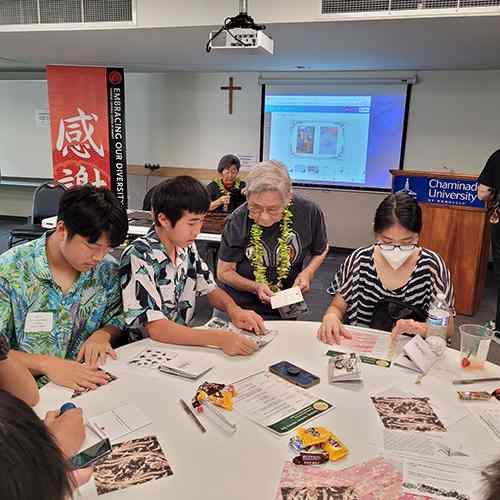
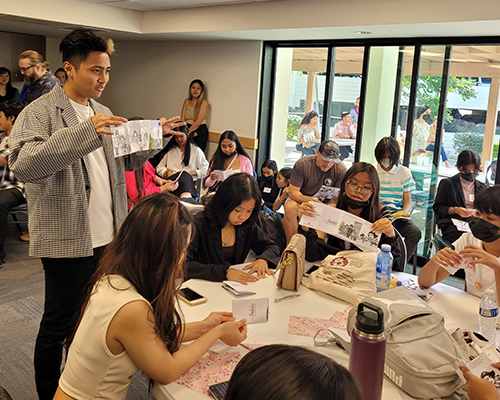
Guanlin Gao, Ph.D., likes to play games. And during the recent National Association of Economic Education (NAEE) Conference at the Federal Reserve Bank of St. Louis, the Chaminade Economics associate professor and Director of Economic Education Center for Excellence devoted part of her presentation playing the Public Goods Game (PGG), in which players are given tokens—in this case Kona coffee beans—and given the opportunity to anonymously allocate them in either private or public funds.

“The purpose of the game is to let participants experience the indigenous culture through a hands-on game,” Gao explains. “The game is also related to the shared natural resources and land management of ahupua‘a, where people have shared responsibility and contribute to the common good with their expertise.”

This fundamental economic game has become a classic laboratory environment for studying collective group decisions in which participants decide how much to contribute to a common pool. The countervailing effect, however, is that there is an incentive for group members to “free-ride” on individuals who contribute positive amounts to the common pool. 

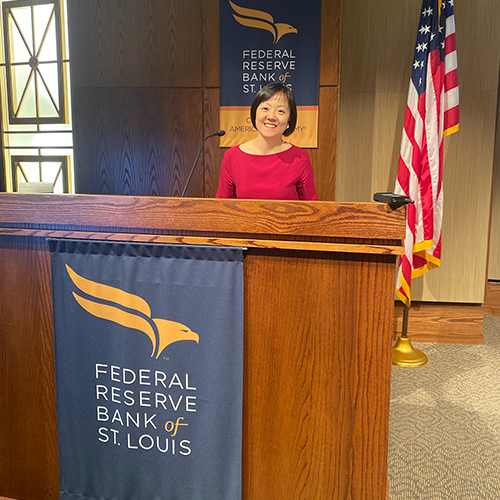
Guanlin Gao presents at the National Association of Economic Education Spring Conference at the Federal Reserve Bank of St. Louis

Those who invested in the private fund could keep the funds, and divide the shares among its members. However, for those who invested in the public fund, they could either share the return among all the groups or simply keep the yield within their own group.

“On the East Coast, players would largely invest in private funds,” Gao says. “But in Hawaii, most players contribute to public funds, which evenly distributes the return among all members. We have a more inclusive culture in Hawaii, as opposed to individualism.”

The NAEE’s three-day Spring Professional Development Conference was attended by economic educators at the state and federal level, as well as educational institutions that house the equivalent to Chaminade’s Economic Education for Excellence. One of NAEE’s primary missions is to provide professional development programs and training for educators to promote economics, personal finance and entrepreneurial education in the classroom.

“Right now, the country is having a movement about economic literacy, and it starts at an early age,” Gao says. “We want the younger generation to have a foundational understanding of personal finance and economics. We want to provide them the tools they need to make informed financial decisions, and create a better life for themselves and for those around them.”

The overall goal of the three-day conference was to promote economic and personal financial education from K-12 through college. Various departments of education around the country already stipulate that students take an economics or personal financial class in order to graduate. Gao is working on this with Hawaii Department of Education but, in the meantime, she’s sharing her knowledge with other teachers.

“I wanted the participants to walk away knowing more about the unique, yet diverse cultures, in this country, and promote economics and personal finance education in a way that relates and speaks to the populations we serve,” Gao notes. “I also talked about the traditions of sharing, not owning in Hawaii (for example, abundance means we have a lot to share, not how much we own), and why the conventional economic assumptions of ‘everyone is self-interested’ and ‘the only goal for a firm is to maximize profit’ do not resonate with our students’ identities and beliefs.”

Consider the Facts*

Many young people lack the basic financial knowledge and skills to prosper in life. Like many educators, the Council for Economic Education cares about equipping students with the knowledge they need to improve their futures.

40% of Americans have less than $300 in savings
24%
of Millennials demonstrate basic financial literacy
50%
of America’s youth will earn less than their parents

2 Million+
Students reached by CEE programs and teachers
Over 50,000
Teachers reached worldwide
1,000+
Lessons, guides & activities for teachers

*Council for Economic Education

Posted by: University Communications & Marketing Filed Under: Business & Communication, Diversity and Inclusion, Education, Faculty, Homepage Tagged With: Business Administration, Economic Education Center for Excellence

I Go To College

February 17, 2023

Fifth-Graders Attend Classes and a Mock Graduation Ceremony

The excitement was palpable as 254 fifth-graders from Catholic schools across the islands descended on campus to participate in the inaugural “I Go To College” event. Gathering at the Sullivan Family Library Lawn, 20 students from St. Theresa Honolulu were playing cornhole, spike ball and Jenga, as they waited for fellow students to arrive from St. Catherine, St. Anthony’s on Maui, St. Theresa Kauai, Holy Family Catholic Academy, Mary Star of the Sea, Our Lady of Good Counsel, Saint Louis, St. John Vianney, St. Joseph Parish School, and St. Joseph in Hilo. Chaminade President Dr. Lynn Babington welcomed the students, their teachers and chaperones to campus.

“This is all they could talk about yesterday and today on the bus,” said St. Theresa Honolulu fifth-grade teacher Alyssa Yabes of the students. “Some of them were even saying that they were going to graduate from college even before their older siblings.”

Started approximately 15 years ago on the mainland, the “I Go To College” program aims to expose 9-12-year-old students to higher education, even before they step onto a middle school campus. According to Llewellyn Young, Ph.D., superintendent of Hawaii Catholic Schools, this type of early exposure encourages these fifth graders to start thinking about attending college.

“I’ve seen the anecdotal results of these visits,” said Young, a former dean at Arizona Western, where “I Go To College” visits have taken place since 2010. “We want these kids to see that going to college isn’t such a far-fetched idea. It is achievable.”

Sitting across from each other during “What’s for Dinner? Setting an Interfaith Table” with Sister Malia Wong, Ph.D., Keslen Carroll and Julia Carlos from Holy Family Catholic Academy were enthusiastic about being on campus, both expressing that they plan to attend college.

Keslen Carroll receives her diploma from Drs. Lynn Babington and Lance Askildson during a mock commencement at Mamiya Theatre.

“This is going to be a good day,” said Carlos, with a wide smile. “I’m not sure where I want to go college, but maybe Idaho University because I like the snow.”

A seven-year longitudinal study* of a college prep program for middle school students showed that “college visits were an integral part of the program.” Students who went on a campus visit had more positive perceptions of college than those who did not. Research also shows the importance of starting college and career planning, and awareness in middle school. Early exposure to a college campus makes a difference, especially among first-generation college-bound, and other underrepresented groups, which are an integral element to increase college enrollment and diversity on campus.

“We’re trying to make the transition from grade school to university as seamless as possible,” said Dr. Janet Davidson, Chaminade Vice Provost and Academic Affairs Professor, who helped organize the day’s event. “We’re hoping that these kids will continue with their education and with their Catholic journey.”

Before setting off on their campus tour, students were divided into eight groups, offering a more intimate setting to simulate the typical Chaminade class size. Class topics varied from “Landing on the Moon on Mars—An Engineering Design Challenge” and EDventures in Science: Water is Life” to “Agriculture and Food Waste” and “Pocket Sharks & Water Bears: An Introduction to Biodiversity.”

“By the time they’re in grade eight or nine, it’s almost too late to spark their interest in college,” Young said. “We’re collaborating with Chaminade in a way that we’ve never collaborated in the past. When I approached Drs. Babington and Askildson about ‘I Go to College,’ they were thrilled, and immediately said yes. This is our pilot year and we’re already talking about how to refine it for next year.”  

Students ended the day with a “graduation” ceremony at Mamiya Theatre with Dr. Lynn Babington and Chaminade Provost Dr. Lance Askildson presenting them with certificates. 

“You are now part of our Silversword ‘ohana,” Babington told students. “I hope you learned a lot after completing your first full day of college.” 

*Research in Middle Level Education, Rich A. Radcliffe & Liz C. Stephens, 2008

Fifth-graders attended classes, toured the campus and participated in a mock Commencement during “I Go To College” event, which aims to expose 9-12-year-old students to higher education.

Posted by: University Communications & Marketing Filed Under: Campus and Community, Catholic, Diversity and Inclusion, Early College, Homepage, Institutional Tagged With: Campus Event, Marianist

  • « Go to Previous Page
  • Page 1
  • Interim pages omitted …
  • Page 11
  • Page 12
  • Page 13
  • Page 14
  • Page 15
  • Interim pages omitted …
  • Page 23
  • Go to Next Page »

Footer

Chaminade University Logo

3140 Waialae Avenue
Honolulu, Hawaii 96816

Contact Us
Phone: (808) 735-4711
Toll-free: (800) 735-3733

facebook twitter instagram youtube linkedin

Visit

  • Plan Your Visit
  • Campus Map (PDF)
  • Events

Resources

  • Campus Security
  • Student Consumer Information
  • Concerns, Feedback, and Reporting
  • Institutional Review Board
  • Title IX / Nondiscrimination Policy
  • Compliance
  • Emergency Information
  • Careers
  • Institutional Statement

People

  • Students
  • Parents
  • Alumni
  • Faculty & Staff

Policy

  • Privacy Policy
  • Terms and Conditions of Use


© Chaminade University of Honolulu