• Skip to primary navigation
  • Skip to main content
  • Skip to footer
Chaminade University of Honolulu

Chaminade University of Honolulu

  • VISIT
  • APPLY
  • GIVE
  • STUDENTS
  • PARENTS
  • ALUMNI
  • FACULTY/STAFF
  • Admissions
    • Admissions Home
    • Undergraduate Students
      • First-Year Students
      • Transfer Students
      • Admitted Students
    • Graduate Students
    • Flex Online Undergraduate Program
    • Military Students
    • Non-Degree/Visiting Students
    • Experiential Honors Program
    • Early College Program
    • New Student Orientation
  • Tuition & Aid
    • Financial Aid Home
    • Tuition & Expenses
    • Federal Updates & Changes
    • Scholarships
    • $5,000 Graduate Scholarship
    • VA Education Benefits
    • Net Price Calculator
  • Academics
    • Academics Home
    • Academic Programs
    • Office of Student Success
      • Academic Advising
      • Records and Registrar
    • Kōkua ʻIke (Support Services)
      • ADA Accommodations
      • Career Services
      • Proctoring Services
      • Tutoring Services
    • Sullivan Family Library
    • Undergraduate Research & Pre-Professional Programs
    • Commencement
  • Campus Life
    • About Campus Life
    • Student Engagement
    • Student Government Association
    • Residence Life and Housing
      • Summer Conference Housing
    • Health Services
    • Marianist Leadership Center
    • Counseling Center
    • Campus Ministry
    • Campus Security
    • Dining Services
    • Bookstore
  • Athletics
  • About
    • Chaminade University News
    • Our Story
    • Leadership
    • Chaminade University Strategic Plan 2024-2030
    • Mission & Rector
    • Association of Marianist Universities
    • Facts & Rankings
    • CIFAL Honolulu
    • Accreditation & Memberships
    • Montessori Laboratory School
Search
×

Search this web site

Data Science

Cybersecurity Workshop

December 8, 2023

Expert warns of maintaining healthy online hygiene

Similar to what you would hear at a dentist office, Liam Wesley dispensed advice about the importance of daily hygiene during a Cybersecurity Workshop at the Data Science Center in Tredtin Hall. But for the cybersecurity expert, this means never using the same username nor the same password ever! Just like you would never keep using the same strand of floss.

In an era dominated by digitization, Wesley described the importance of robust cybersecurity measures that cannot be overstated. As online users navigate an increasingly interconnected world, the guardians of our digital realm are facing new challenges and adapting strategies to protect against evolving cyber threats. Wesley is among them fighting the digital perils.

The 90-minute Cybersecurity Workshop was hosted by the National Science Foundation ALL-SPICE Alliance, which includes the United Nations CIFAL CENTER of Honolulu, Information Technology and Services Department (senior director Jules Sukhabut), the Networking Department (director Joseph Rosario), Data Science, Analytics and Visualization Program (director Rylan Chong, Ph.D.) and the Computer Science Department.
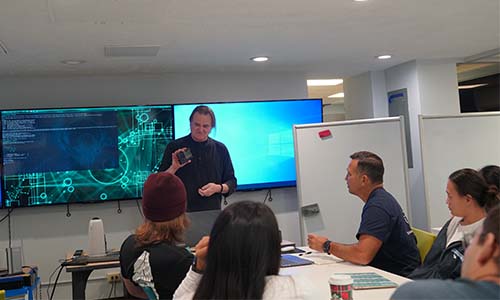
Liam Wesley—a penetration tester and cybersecurity engineer with High Tech Hui, LLC and Cyberruptive—demonstrated some of the tools that professional hackers keep in their arsenal.

“We brought in Liam to demonstrate real cyberattacks, and discuss how a student can protect themselves for educational purposes and build awareness,” said Chong, Co-Principal Investigator of the National Science Foundation’s Alliance Supporting Pacific Impact through Computational Excellence (ALL-SPICE) grant. “Joe and I plan to pilot this cybersecurity workshop to Natural Sciences and Mathematics students to gauge interest. This will help us understand if there is interest for future workshops, larger workshops and/or a need for a cybersecurity course or program.”

Cybersecurity experts, like Wesley—a penetration tester and cybersecurity engineer with High Tech Hui, LLC and Cyberruptive—warn of the escalating sophistication of cyber threats, ranging from ransomware attacks that cripple essential services to targeted phishing campaigns exploiting the remote work landscape. The proliferation of Internet of Things (IoT) devices—AI voice assistants like the Amazon Echo and Google Home—coupled with the rise of artificial intelligence in cyberattacks, adds a layer of complexity to the battlefield.

In the face of these evolving threats, organizations are doubling down on best practices to fortify their defenses. This includes regular employee training to recognize and thwart phishing attempts, implementing multi-factor authentication, and keeping software and systems up-to-date with the latest security patches.

“Patching is absolutely necessary,” Wesley said. “But wait a few days to avoid the potential for buffer overflow, which are memory storage regions that temporarily hold data while it is being transferred from one location to another.”

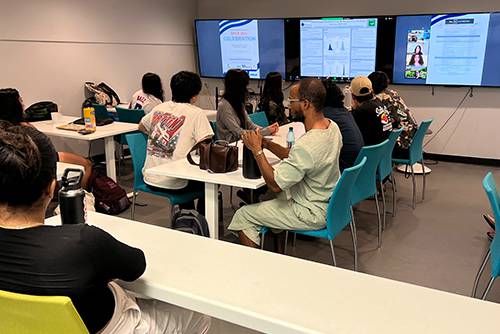
Initially limited to Rosario’s computer science networking class, the workshop was eventually opened to all Natural Sciences and Mathematics students due to the importance of the topic and the large interest from Chong’s previous presentation on the topic.

One of the workshop’s primary goals was to bring awareness and introduce education innovation. Chong explained that the topic is very important for the University’s DSAV, CS and NSM students, as many of them are doing research, working with data and sensitive data at various organizations for jobs and internships, and using computers.

“Instead of traditionally just bringing in someone to talk about cybersecurity in general, our goal was to make this relevant to the students to build awareness, address on the national security level the lack of cybersecurity education in schools, and an approach to work on better securing our campus,” Chong said. “In addition, we are planning to take an innovative educational approach by actually demonstrating how easy it is to hack and simulate how bad a cyberattack can be to an organization.”

The landscape of cybersecurity is indeed dynamic and ever-evolving. Experts agree that a collaborative, proactive approach—comprising technological innovation, regulatory compliance and ongoing education—is essential to safeguarding our digital world against the relentless tide of cyber threats.

“There was a lot of information, which was hard to keep up with,” said data science and visualization major LaVelle White ’26. “He explained pretty well how hackers get into systems, even though I can’t hack, but I understood the concept.”
Posted by: University Communications & Marketing Filed Under: Campus and Community, Center for Strategy and Innovation, CIFAL Honolulu, Homepage, Innovation, Institutional, Natural Sciences & Mathematics Tagged With: Campus Event, Data Analysis & Visualization, Data Science, Guest Speakers

SPICE Institute Peppered with Data

July 5, 2023

Monthlong seminar focuses on helping students understand data 

Data science continues to evolve as one of the most promising and in-demand disciplines, and budding data scientists are all too happy to explore the field … one byte at a time. Just ask Rylan Chong, Ph.D., Chaminade’s Data Science Program Director.

“Chaminade received approval in 2018 to launch a Data Science major, which was the first of its kind in Hawaii,” Chong says. “And we had our first cohort of 40-50 students in 2019. Now our classes are practically maxed out each semester.”

This summer, 35 students participated in the Supporting Pacific Indigenous Computing Excellence (SPICE) Data Science Summer Institute—from June 2-30—marking the largest number of participants since SPICE’s inception five years ago. Funded by a National Science Foundation grant, and in partnership with the Texas Advanced Computing Center, SPICE aims to level the playing field for Native Hawaiian and Pacific Islander (NHPI) students, who are woefully underrepresented in science, technology, engineering and math (STEM) fields, and specifically cutting-edge data science.

Of the 35 SPICE Data Science Institute participants, 19 of them were Silverswords.
Of the 35 SPICE program participants, 19 of them were Silverswords.

“We want to advance computing and data for social change and justice,” says Chong, who graduated with a bachelor’s in Computer Science from Chaminade in 2010, and with a doctorate in Information Security from Purdue University of West Lafayette in 2018. “We want to work with our community partners and upscale people’s knowledge about the use of data.”

SPICE participants include 22 undergraduate students from Hawaii, including 19 from Chaminade University. The remaining eight undergraduates hail from the Northern Marianas College (5), Mount Mercy University in Iowa, University of Portland and Guam Community College. Five undergraduate student mentors also were involved.

“Not to sound cliché, but data science is everywhere,” says Biology Assistant Professor Chrystie K. Naeole, Ph.D. “Students get to mesh science with data science, and to look at disparities among Native Hawaiians and Pacific Islanders.”

With one of the largest wealth gaps in the nation, high rates of incarceration, and high rates of illness and health disparity, Hawaii has a compelling need to address social justice issues. Students of Hawaiian descent have something they want to fix because they see the inequality every day in their families and their communities, from health and homelessness to the environment and sustainable energy.

Of the 35 SPICE Data Science Institute participants, 19 of them were Silverswords.
Participants collaborated on research projects even during lunch.

“Most people have a passion. Most people care about something significant, something that they have a personal connection to,” says Kelly Gaither, director of Health Analytics at TACC and Associate Professor in Women’s Health at the Dell Medical School. “When you have a personal connection, it’s like a glue. It allows other concepts that you need to stick. In the absence of that glue, students may not realize they’d be happy working in computer science or data science because of the way it’s taught and presented to them.”

Chong believes we already apply data science in our daily routines. We compare prices, for example, when we’re shopping for groceries. We’ll shop at stores that offer better deals. Think of Longs Drugs on a Sunday or Safeway on $5 Fridays. We compare quantity and quality, a generic brand versus brand name.

“You can apply data science to every field—education, healthcare and mental health, environment science and climate change, and criminal justice,” Chong explains. “It’s not just about crunching numbers, but ensuring the numbers reflect different viewpoints and getting those numbers into the right hands.”

A 2022 Chaminade University alumna with a degree in Data Science, Analytics and Visualization and one-time SPICE participant, Zoey Kaneakua is now a data analyst with the Department of the Attorney General’s Crime Prevention and Justice Assistance Division. And her job: To monitor crime statistics in Hawaii and to share the data with the Federal Bureau of Investigation’s National Incident-Based Reporting System (NIBRS), an incident-based reporting system in which law enforcement collects data on each crime occurrence.

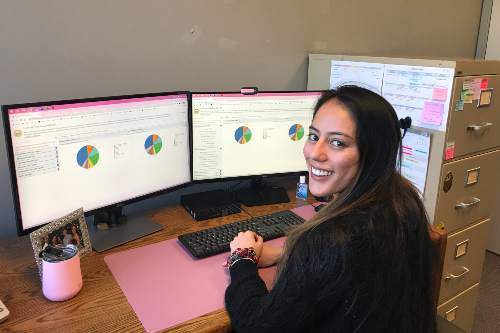
Zoey Kaneakua '22 at her computer
Zoey Kaneakua ’22 now works for the Department of the Attorney General’s Crime Prevention and Justice Assistance Division

“That was my first independent research involving juvenile justice,” recalls Kaneakua of her participation in SPICE during her junior year. “And I think I built my first dashboard in three days using Python (a high-level, general-purpose programming language).”

Like Artificial Intelligence (A.I.) of the past, data science was barely mentioned a decade ago in scientific circles. Now it’s everywhere. In the same way that A.I. is an umbrella term for intelligence, Data Science is an umbrella term for insights from data.  Sometimes these two terms appear to be in conflict or competition, but this is not the case. The field of data and machine intelligence is vast and involves everything from understanding data to helping computers learn from the data and solve problems automatically using their learnings. Arguably, both Data Science and A.I. are critical for businesses and maintain a complicated symbiotic relationship.

“The underlying theme of SPICE is about building capacity and learning communities in the Pacific to harness the power of technology and data to address challenges,” Chong says, borrowing from the National Science Foundation’s Harnessing the Data Revolution initiative. “We focus on social aspects, applied ethics and responsibility working with people and data.”

In their final projects, SPICE participants studied various issues, from Indo-Pacific Resilience and Hawaii Biodiversity to Tax and Housing Equity and Health.

“All their projects were based on the United Nations’ 17 Sustainable Development Goals,” Chong said. “These students upskilled in analytics, research and programming. We also had a lot of firsts this year. To name a few, it included an opportunity to use the TACC supercomputers at the University of Texas at Austin; we had technical directors who joined us in helping on sponsored projects; and three students presented their projects in their preferred or native language that included Spanish, Carolinian and Native Hawaiian.”

Posted by: University Communications & Marketing Filed Under: Center for Strategy and Innovation, CIFAL Honolulu, Featured Story, Homepage Tagged With: CIFAL, Data Analysis & Visualization, Data Science, Research

Community Service

January 11, 2023

Making a difference through data science and service

Community service has always been a big part of Katherine Gonzalez’s life. 

Latinx Club

And her passion for making a difference followed her to Chaminade. It’s why she jumped at the opportunity to start a Latinx Club at the university to celebrate her culture with others, and why she was central to an effort to make care packages for the homeless during the pandemic. And it’s what ultimately landed her in data science, where she found an innovative way to serve others.

“Service is what being a good citizen means,” she said, in a recent interview. 

Gonzalez, who is slated to graduate in 2023, is originally from Los Angeles.  

She’s majoring in Criminology and Criminal Justice with a minor in Data Science but found Chaminade through her interest in Forensic Science. Gonzalez quips that she switched after a grueling semester of Chemistry, but she also found Criminology and Criminal Justice more in line with her interests in public policy and social justice.

During her freshman year at the university, Gonzalez kept her schedule busy. In addition to launching the Latinx Club, she was in student government and joined the Residence Hall Association. She said club activities helped her from getting homesick and gave her the chance to strike up new friendships.

It was in the summer before her sophomore year that she first learned the power of data science. 

One of her mentors, Data Science Program Director Dr. Rylan Chong, encouraged her to participate in Chaminade’s exciting hands-on collaboration with the Texas Advanced Computing Center. The program is called Supporting Pacific Indigenous Computing Excellence (SPICE) and challenges participants to use data science methodology to interpret, communicate and visualize big data sets in new ways.

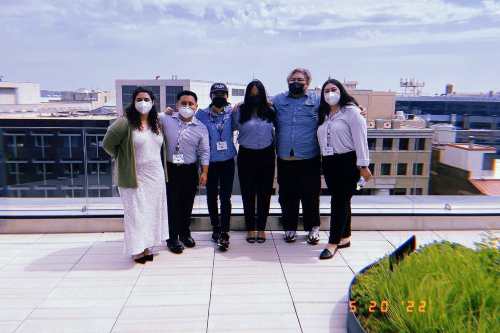
Katherine Gonzalez '23 in Washington DC for SPICE
Katherine Gonzalez ’23 (left) with her colleagues in Washington DC for Advanced Computing for Social Change where she served as a mentor.

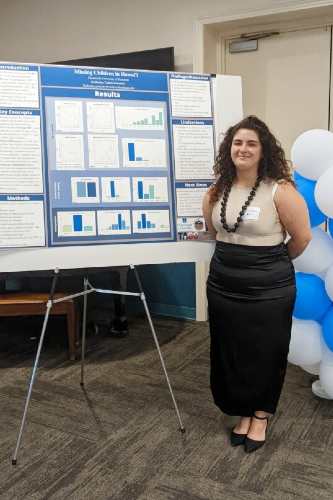
Students like Gonzalez walk away with a new appreciation of just how instrumental data can be in educating and informing communities—and helping to drive positive change. For SPICE, Gonzalez dove into data around missing children in Hawaii. She also tackled a project through the Chaminade Summer Research Institute that looked at health and wellness trends among foster children in the islands.

Almost immediately, she was hooked.

“People think coding is so hard, but it’s like everything. Once you learn it, it becomes more manageable,” she said, adding that she was honored in her sophomore year to continue her studies by participating in the Advanced Computing for Social Change Institute through Chaminade.

Like her other data science work, the program had a strong community service focus. And she said it prepared her for a new challenge in her junior year: to serve as a peer mentor for that initiative along with the Pacific Region Data Science Challenge, a competition with students from around the country. 

Katherine Gonzalez '23 with her poster

Gonzalez said helping other students built her confidence—and her passion for data science studies. “It’s just the best feeling to teach other people and help other people do things they never thought they could accomplish,” she said. “I realized that mentoring also helps you build your own skills.”

As a senior, Gonzalez is as busy as ever while looking forward to her next steps after graduation. In addition to participating in Campus Ministry, her Latinx Club and Chaminade’s Civic Engagement Club, Rodriguez is a peer mentor for a freshman orientation class and an assistant in the residence hall.

She also has an active internship with Dr. Janet Davidson, vice provost for Academic Affairs and Criminology and Criminal Justice professor, to provide data analysis on human trafficking. She said the work has given her a better understanding of what she wants to do after college.

First off, she said, she wants to attend graduate school to hone her coding skills.

And then she hopes to bring those skills to bear and drive positive change.

“I want to be able to help people,” Gonzalez said. “And this is a way that I can help in a big way.”

Posted by: University Communications & Marketing Filed Under: Behavioral Sciences, Homepage, Natural Sciences & Mathematics, Student Life, Students Tagged With: Criminology and Criminal Justice, Data Science

Data Mining

December 21, 2022

Alumna sifts through databases to produce Hawaii’s Uniform Crime Reporting

Zoey Kaneakua '22

For most of us, a dashboard primarily indicates a vehicle’s rate of speed, RPMs, engine temperature, gas gauge, mileage and maybe even a personal playlist. However, for Zoey Kaneakua ’22, an instrument panel means something completely different. A 2022 Chaminade University alumna with a degree in Data Science, Analytics and Visualization (DSAV), the 22-year-old Kauai native implements dashboards to measure crime statistics in Hawaii.

“In my sophomore year, I considered leaving Chaminade because I wasn’t enjoying my choice of major,” recalls Kaneakua, a recipient of the Ho‘oulu Scholarship, which is awarded to Native Hawaiian students pursuing a career in Science, Technology, Engineering and Mathematics (STEM). “Then my mom suggested that I major in data science, which I wasn’t sure about, but I’m glad I listened to her. She was right.”

In middle school, Kaneakua developed an interest in computer coding just so she could personalize her Tumblr profile. Data science, though, was not in her purview nor in her future. But forensics was, or so she thought. Now she’s a self-described “research geek,” who prefers math over the arts, and enjoys designing dashboards with custom colors and functions.

“I really grew an interest in juvenile justice and criminal justice data when I was at Chaminade,” Kaneakua asserts. “I wanted to use data science—using statistics and computer science—to make it more understandable, interactive and accessible to the public.” 

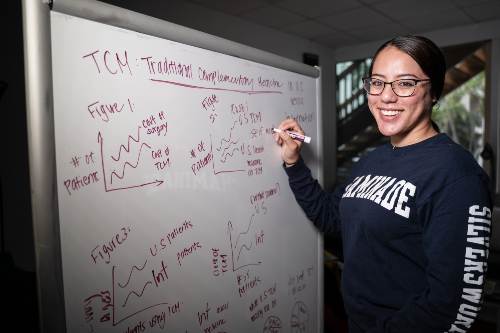
Zoey Kaneakua '22

Kaneakua was the ideal candidate for the Data Science program, which encourages students to work in grassroots and community organizations, a fundamental principle in the pedagogical approach at Chaminade, which the National Science Foundation (NSF) INCLUDES Alliance selected to lead a groundbreaking $10 million grant project aimed at creating new opportunities in STEM and data science careers for historically underrepresented populations across Hawai‘i and the Pacific Region.

“You can apply data science to every field—education, healthcare and mental health, environmental science and climate change, and criminal justice,” explains Dr. Rylan Chong, director of Chaminade’s Data Science program. “It’s not just about crunching numbers, but ensuring the numbers reflect different viewpoints and getting those numbers into the right hands.”

Sitting in front of two screens at her office in the Department of the Attorney General’s Crime Prevention and Justice Assistance Division, Kaneakua demonstrates how she monitors and reports crime statistics in Hawaii and then uploads the data to the Federal Bureau of Investigation’s National Incident-Based Reporting System (NIBRS), an incident-based reporting system in which law enforcement collects data on each crime occurrence.

“When I was in school, all my research was in criminal justice,” Kaneakua says. “And I was especially interested in looking at juvenile justice.”

Zoey Kaneakua '22 at her computer

Ironically, the crime reports that Kaneakua once poured over are now her kuleana (responsibility). She also now understands how there could be discrepancies in the numbers. Hired in September as a data analyst with the Crime Prevention and Justice Assistance Division, the former Silversword is now the point person, to whom police departments on Oahu, Maui, Hawaii Island and Kauai submit their monthly crime reports. Citing her education at Chaminade—and specifically her mentor Dr. Chong—as reasons for being in her current position, Kaneakua points out that she wasn’t even aware that this position was open.

“This was one of the hardest jobs to pursue because the state requires any new hires to have at least one-year experience,” Chong says. “In Zoey’s case, she needed at least one year of experience in both data science and criminal justice since she was filling the role of a database specialist and a data analyst.”

In her junior year, Kaneakua joined aspiring data scientists from across Hawaii and the mainland to participate in Chaminade’s monthlong Supporting Pacific Indigenous Computing Excellence (SPICE) Data Science Summer Institute. 

“That was my first independent research involving juvenile justice,” Kaneakua says. “And I think I built my first dashboard in three days using Python (a high-level, general-purpose programming language).”

For her next project, Kaneakua participated in C4C (Computing for Change), looking at domestic violence across the U.S., and trying to make sense of the data and its limitations. Today, she works on real-time projects, which allow her to use all the skills and knowledge that she learned and honed while attending Chaminade.

“None of this would have been possible without Rylan,” says Kaneakua in praise of Chong. “He believed in me and helped me navigate and find my niche. I am eternally grateful for this opportunity and I am proud to represent Chaminade’s DSAV program as I continue to conduct criminal justice research in Hawaii.”

Posted by: University Communications & Marketing Filed Under: Alumni, Featured Story, Natural Sciences & Mathematics Tagged With: Criminology and Criminal Justice, Data Science

Harnessing the Data Revolution Through a $10 Million Grant

September 2, 2022

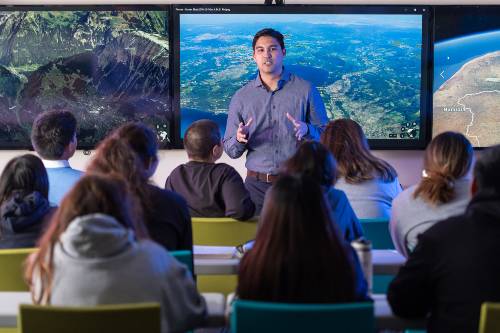
Data science class

Dr. Rylan Chong, director of Chaminade’s Data Science program, calls it nothing less than historic.

In early August, the National Science Foundation (NSF) INCLUDES Alliance selected Chaminade University to lead a groundbreaking $10 million grant project aimed at creating new opportunities in STEM and data science careers for historically underrepresented populations across Hawai‘i and the Pacific Region.

The grant announcement, Chong said, is one of those moments that educators will look back on in a decade or so and recognize as a turning point—the beginning of new initiatives that opened doors for students, the institutions that serve them, and nonprofit and business communities in the region.

“This is about leveling up, addressing capacity in the workforce and making sure our low-income and underrepresented students have an opportunity to bring their perspectives to data science,” Chong said, adding that welcoming diverse populations into data science will ensure their voices are heard.

“You can apply data science to every field—education, healthcare and mental health, environment science and climate change, and criminal justice,” he said. “It’s not just about crunching numbers but ensuring the numbers reflect different viewpoints and getting those numbers into the right hands.”

That’s why the Data Science program at Chaminade doesn’t just want to prepare students for competitive careers at the Googles and Amazons of the world. “We also want to find opportunities for students working in grassroots and community organizations, being able to contribute to projects they’re interested in while making a difference to the places where they live,” Chong said.

The competitive NSF grant is one of the largest Chaminade has ever received and reflects the strong data science work and foundational programs already in place at the University.

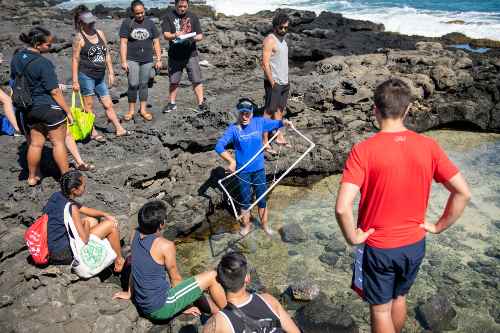
environmental sciences class at Makapuu

With the transformative funding, Chaminade’s United Nations-affiliated CIFAL Honolulu Center will spearhead the launch of the university’s new Alliance Supporting Pacific Impact through Computational Excellence (ALL-SPICE) with a consortium of partners, putting a strong emphasis on leadership for sustainable development and efforts aimed at tackling the growing impacts of climate change.

“Chaminade University is really quite honored to lead this important initiative charged with empowering STEM leaders for tomorrow from across Hawai‘i and the Pacific, equipping them with the cutting-edge tools they need to drive sustainable development projects,” said President Lynn Babington, PhD.

“This grant is part of a collective and exciting effort to meet a pivotal moment in our history by expanding opportunities to a new generation of change-makers. Our mission of service is foundational to everything we do at Chaminade and so we are proud to drive a culturally informed initiative ultimately designed to help build healthier, more resilient and socially just communities.”

The first ALL-SPICE programming and opportunities launched in the Fall.

Dr. Helen Turner, research director of the Chaminade United Nations CIFAL Honolulu Center and a professor of Biology, is principal investigator for ALL-SPICE along with Chong. She said the funding will focus on three central efforts: bolstering training and educating, conducting data science research on sustainable development projects, and building capacity (including infrastructure) for data analytics in Hawai‘i and the Pacific.

“This work takes a village,” Turner said, adding the grant was the result of years of collaboration between Chaminade and other institutions to step up programming and underscore the importance of data science to the community. The Chaminade-led consortium includes the University of Hawaii Data Science Institute, East-West Center and the Texas Advanced Computing Center (TACC).

“The National Science Foundation identified the power of data analytics for education, research and industry. They use this phrase ‘harnessing the data revolution’ because right now we are all swimming in an ocean of data,” Turner said. “We can either drown as individuals, communities and society or we can swim and surf that wave—take data and turn it into wisdom, knowledge and action-based plans.”

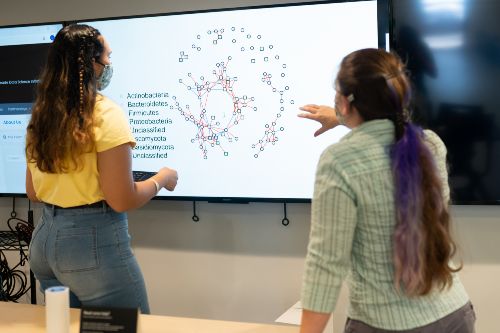
Data science student looking at data

Turner said that’s exactly what the Data Science program at Chaminade is focused on.

And the grant will exponentially increase that work, expanding opportunities to more students, community leaders and institutions so they can use data for the greater good. “Data and social justice go hand and hand. To me, it’s a very obvious and beautiful linkage,” Turner said.

For example, she says that health inequities are fundamentally a data problem—failing to get the right resources to the right people or not fully understanding the root causes for gaps in care. Environmental problems, economic development, educational gaps can be approached similarly.

“Because a big piece of this is meeting the needs of the community,” she added. “No university in the United States can keep up with the pace of demand for data scientists. We want our students to succeed, but we also don’t want our own organizations in Hawai‘i to be left behind.”

That’s why the grant will, in part, fund research or hands-on internships for students. Already, Chaminade students in data science are working on a plethora of important projects—looking at everything from maternal mortality in Pacific populations to recidivism in Hawai‘i.

“If you ask what is a data scientist, the answer is everything,” she said. “With data science, students undoubtedly can follow their personal passions and make a positive impact. This is ultimately a vehicle for students’ passions to change the world. It’s also about democratizing our relationship with data.”

CIFAL Honolulu Executive Director and Dean of the School of Natural Sciences and Mathematics Dr. Gail Grabowsky said data visualization and interpretation are a central focus of the grant’s programming. That’s because it’s not enough to analyze the data. Helping the community (especially non-data scientists) understand what the data says is just as important.

“We think data alone will change the world and it won’t,” said Grabowsky, who is also dean of the School of Natural Sciences and Mathematics at Chaminade. “What will change the world is many people working together on shared goals, using data along the way to inform policy and guide next steps.”

She added that CIFAL Honolulu envisions the Pacific Ocean as a “connector,” helping to spur conversations around both modern approaches and traditional knowledge and practices. Indigenous ways of knowing, Grabowsky added, could also bring about new perspectives and questions.

Dr. Lance Askildson, Chaminade provost, called the grant and its potential impact “incredibly significant.” He added, “This is really about creating a network of institutions across the Pacific, of which Chaminade is the lead, to provide education, training and research.”

He said a key part of the funding is working with community stakeholders to help them tell their own community stories with data. “Particularly here in the West, there is a tremendous amount of data being collected on us at all times of the day,” he said. “Being in control of your data is just like being in control of your Facebook profile—it’s a chance to tell a story with greater integrity that prioritizes your needs.”

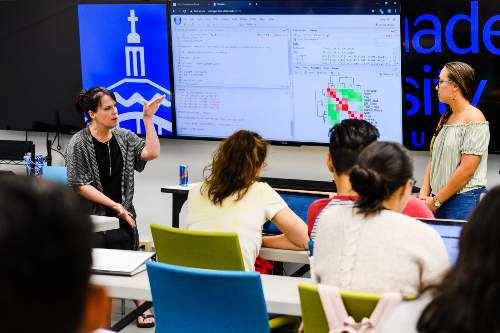
data science class

ALL-SPICE co-Principal Investigator Dr. Kelly Gaither, the director of health analytics at TACC and a professor of Maternal Health at the Dell Medical School at the University of Texas at Austin, first started hearing about Chaminade’s work in data science in 2005 as part of a grant review committee.

What struck her the most, she said, is there was no tension between the pursuit of data science and traditional Hawaiian and Pacific knowledge and ways of knowing. “Chaminade was really trying to chop down any notion that Hawaiian science is not science,” she said. “This is the true definition of capacity building. Chaminade is really leading this, one community stakeholder and one student at a time.”

Gaither added she’s especially excited about the workforce opportunities the grant has to offer.

“We can dream big, peacefully coexist and all move forward,” she said. “That’s what is possible.”

Posted by: University Communications & Marketing Filed Under: Campus and Community, CIFAL Honolulu, Diversity and Inclusion, Featured Story, Innovation, Institutional, Natural Sciences & Mathematics Tagged With: Data Science, Grants

Chaminade University Receives $10 Million Grant for United Nations Sustainability Center

August 18, 2022

The National Science Foundation (NSF) selected Chaminade University to lead a groundbreaking $10 million, five-year grant project to create new leadership pathways into data science careers for students and working professionals across Hawaii and the Pacific region.

The grant is part of a comprehensive $39 million effort to establish four new NSF INCLUDES Alliances nationwide designed to bolster diversity and inclusion in scientific leadership, innovation and discovery.

With the help of the transformative funding, Chaminade University’s new United Nations sustainability center, CIFAL Honolulu, and Data Science program will spearhead the launch of the university’s new Alliance Supporting Pacific Impact through Computational Excellence (ALL-SPICE). Working with a consortium of partners, ALL-SPICE will focus on the application of data analytics to solve critical sustainability issues and promote sustainable development across the Pacific region. The program will also focus on workforce development, providing opportunities for skills building in data science to meet employer needs in this high-demand field.

The first Alliance programming will begin this September.

“Chaminade University is honored to lead this important initiative charged with empowering STEM leaders for tomorrow from across Hawaii and the Pacific, equipping them with the cutting-edge data analytics skills they need to drive sustainable development,” said Chaminade President Dr. Lynn Babington.

“This grant is part of a collective and exciting effort to meet a pivotal moment in our history by expanding opportunities to a new generation of change-makers. This program is founded in our mission of serving community needs and building d healthier, more resilient and socially just communities in Hawaii and the Pacific region.”

CIFAL Honolulu Executive Director Dr. Gail Grabowsky said ALL-SPICE will be “laser-focused” on data science as critical to helping Hawaii and Pacific region communities meet their sustainable development goals, including bolstering renewable energy, reducing inequality and forming sustainable communities.

“This project is about putting Pacific data in Pacific hands to effect regional change and develop the capacity for data-driven decision support,” Grabowsky said. “Our communities are facing big challenges and so this alliance is about helping tomorrow’s Hawaii and Pacific leaders to find big solutions.”

Dr. Helen Turner, research director of Chaminade’s CIFAL Honolulu Centre, is the principal investigator for ALL-SPICE along with Data Science Director Dr. Rylan Chong. She said the Data Science program at Chaminade has taken a community-focused approach from the start.

“Our data science faculty has a portfolio approach to data science education that meets students, working professionals and community members where they are to offer academic, training and informal learning programs,” she said. “NSF recognized the potential of applying this strategy across our Pacific region with a focus on using data analytics to promote sustainable development goals.”

The ALL-SPICE Alliance will have three central functions:

  • Offering training and education programs;
  • Conducting data science research on sustainable development;
  • And building capacity for data analytics, including with cyber infrastructure.

The Chaminade University-led consortium includes the University of Hawaii, East-West Center and the Texas Advanced Computing Center.

# # #

Chaminade University of Honolulu believes in the power of education to drive positive change, broaden perspectives, and deepen our understanding of one another. With an emphasis on transformative service-learning experiences, we prepare students to serve as tomorrow’s leaders, inspiring and challenging them to use their minds and their hearts to help build stronger and more just communities. We are proud to serve as Hawai‘i’s only Marianist university and rely on these values to guide us in delivering a high-quality education with an individualized approach and a focus on excellence, innovation, and change. Established in 1955, we offer more than 30 undergraduate and graduate programs, including doctoral degrees in education, psychology, and nursing practice. Learn more at chaminade.edu.

Posted by: University Communications & Marketing Filed Under: Campus and Community, CIFAL Honolulu, Diversity and Inclusion, Featured Story, Institutional, Natural Sciences & Mathematics, Press Release Tagged With: Data Science, Grants

  • « Go to Previous Page
  • Page 1
  • Page 2
  • Page 3
  • Page 4
  • Go to Next Page »

Footer

Chaminade University Logo

3140 Waialae Avenue
Honolulu, Hawaii 96816

Contact Us
Phone: (808) 735-4711
Toll-free: (800) 735-3733

facebook twitter instagram youtube linkedin

Visit

  • Plan Your Visit
  • Campus Map (PDF)
  • Events

Resources

  • Campus Security
  • Student Consumer Information
  • Concerns, Feedback, and Reporting
  • Institutional Review Board
  • Title IX / Nondiscrimination Policy
  • Compliance
  • Emergency Information
  • Careers
  • Institutional Statement

People

  • Students
  • Parents
  • Alumni
  • Faculty & Staff

Policy

  • Privacy Policy
  • Terms and Conditions of Use


© Chaminade University of Honolulu