• Skip to primary navigation
  • Skip to main content
  • Skip to footer
Chaminade University of Honolulu

Chaminade University of Honolulu

  • VISIT
  • APPLY
  • GIVE
  • STUDENTS
  • PARENTS
  • ALUMNI
  • FACULTY/STAFF
  • Admissions
    • Admissions Home
    • Undergraduate Students
      • First-Year Students
      • Transfer Students
      • Admitted Students
    • Graduate Students
    • Flex Online Undergraduate Program
    • Military Students
    • Non-Degree/Visiting Students
    • Experiential Honors Program
    • Early College Program
    • New Student Orientation
  • Tuition & Aid
    • Financial Aid Home
    • Tuition & Expenses
    • Federal Updates & Changes
    • Scholarships
    • $5,000 Graduate Scholarship
    • VA Education Benefits
    • Net Price Calculator
  • Academics
    • Academics Home
    • Academic Programs
    • Office of Student Success
      • Academic Advising
      • Records and Registrar
    • Kōkua ʻIke (Support Services)
      • ADA Accommodations
      • Career Services
      • Proctoring Services
      • Tutoring Services
    • Sullivan Family Library
    • Undergraduate Research & Pre-Professional Programs
    • Commencement
  • Campus Life
    • About Campus Life
    • Student Engagement
    • Student Government Association
    • Residence Life and Housing
      • Summer Conference Housing
    • Health Services
    • Marianist Leadership Center
    • Counseling Center
    • Campus Ministry
    • Campus Security
    • Dining Services
    • Bookstore
  • Athletics
  • About
    • Chaminade University News
    • Our Story
    • Leadership
    • Chaminade University Strategic Plan 2024-2030
    • Mission & Rector
    • Association of Marianist Universities
    • Facts & Rankings
    • CIFAL Honolulu
    • Accreditation & Memberships
    • Montessori Laboratory School
Search
×

Search this web site

Data Science

Data and Design: A Powerful Storyteller

December 16, 2020

Majoring in data science means you spend a lot of your time combing through data, learning to use coding software, digitally mapping data and analyzing results. But at Chaminade University, it also means learning how to tell a story, understanding color theory, learning how to use design software and understanding the principles of visual communication.

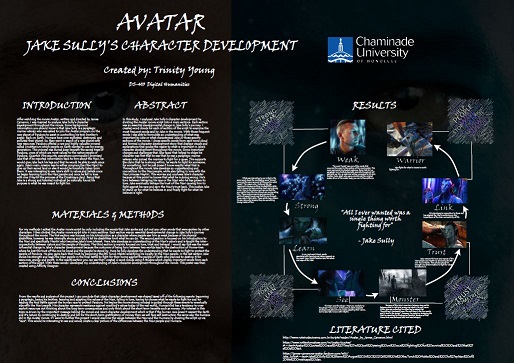
Digital Humanities Avatar presentation

Data Science 403: Digital Humanities is a new interdisciplinary course taught by Dr. Junghwa Suh, associate professor of environmental + interior design and Dr. Laura Tipton, assistant professor of data science, that all data science majors at Chaminade are required to take. The course merges the fields of humanities and data science, and teaches students how to turn data into meaningful, visual stories and relate it back to various dimensions of human living.

“We wanted to challenge the more analytic students in the course to think more creatively, both in their presentations and in their topics of study,” says Dr. Suh. “We wanted to show that not every data science analysis is based on a scientific study, sometimes we use data science to analyse classic literature or song lyrics.”

For many of the students, this was their first foray into the humanities and they weren’t quite sure what to expect.

“At the beginning of the semester, I interpreted digital humanities solely as studying the history of data science and technology,” says Trinity Young, a fourth-year student. “But now, after taking this course, I better understand that digital humanities is the study of applying data and technology to analyze and better understand human society and culture.”

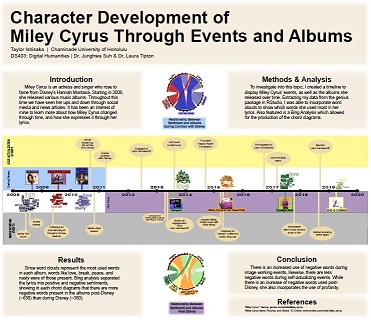
Digital Humanities Miley Cyrus presentation

In the first iteration of the course this past fall semester, each student was tasked with choosing a topic for a semester-long project that either brings them happiness or sparks their interest and passion. They then spent the first-half of the semester collecting and analyzing data, and the second half of the semester learning to develop a visually appealing story out of the data and present their findings. 

“[This course] really gave me another perspective in this area and allowed me to see the story behind everything,” says Taylor Ishisaka, a third-year student who used the project to explore how Miley Cyrus’s character has developed throughout various events and albums. “As of now, I truly think that it is necessary to have previous knowledge in humanities in order to understand the digital world better.”

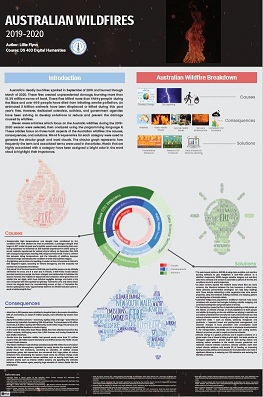
Digital Humanities Australian Wildfires

Lilianna Flynn, a senior who is majoring in business administration and minoring in data science, did her project on the recent Australian wildfires. She used data visualizations and word clouds to determine the causes and consequences of the wildfires and to identify solutions. 

“I believe my word clouds were my best visual aid,” says Flynn. “They displayed the most important words and gave the readers a basic understanding of the news articles.”

But her favorite part was seeing how creative her fellow classmates were in choosing their topics.

“My favorite part of the semester was listening to everyone’s presentations,” says Flynn. “Everyone had different ways of analyzing their data and unique presentation designs. Now, I believe design is even more important to communicate data visualizations effectively.” 

While the course was fun and meaningful for the students, the professors also had a good time with it. 

“I was really excited when I saw this course listed as part of the data science curriculum because it gave me a chance to highlight some of my “passion project” research areas, including dance history and mythology,” says Dr. Tipton. “And it gave me a chance to see what non-science interests the students have.”

On the other side, Dr. Suh was excited to take a dive into the sciences. “I have always wanted to teach a course where science meets art and design, and vice versa,” she says. “I usually don’t have a chance to meet students from other disciplines, so it was great interacting with the data science students.”

The pair is now brainstorming ways to expand the course in the future.

“Now I’m excited to see where this collaboration goes and how we can include students from other majors, like design and other humanities, next year,” says Dr. Tipton.

Posted by: University Communications & Marketing Filed Under: Featured Story, Humanities, Arts & Design, Natural Sciences & Mathematics Tagged With: Data Science, Environmental + Interior Design

New Data Science Scholarships

September 3, 2020

Chaminade University recently received a $1M grant from the National Science Foundation (NSF) to provide 20 scholarships for new first-year and transfer students who are majoring in data science.

Data science is one of the most in-demand and fastest growing careers in the Pacific region. As industries collect more data, they need more people who can analyze and interpret those data. This new program is part of a larger initiative to build a cohort of data science professionals in the Pacific to help support decision-making across Hawaii’s economic sectors.

“This program is all about access to high-paying in-demand jobs,” says Dr. Alexander Stokes, assistant professor at Chaminade University. “Every business sector in Hawaii, from healthcare to finance to energy and nonprofits, needs professionals in data analytics to provide decision support.”

Data science students at Chaminade participate in hands-on, project-based courses and internships that use real data provided by local businesses, agencies and community organizations. In addition to learning the necessary technical skills like coding and data visualization, students also learn about decision-making, data ethics and how to communicate complex datasets in a clear and concise way, ensuring they are well-versed in all aspects of the career.

“This project will empower students from across the region to find data-driven solutions to challenges in Hawaii and the Pacific region,” says Dr. Helen Turner, vice president for Strategy and Innovation at Chaminade University. “The Pacific faces unique challenges, and we need local students who can use local data to help us understand and address those challenges.”

The grant is part of NSF’s Scholarships in STEM (S-STEM) program, which seeks to increase the number of low-income academically talented students with demonstrated financial need who earn degrees in STEM fields. The scholarships will be available for new students who are majoring in data science, and preference will be given to students from Hawaii and the Pacific region who meet academic and financial requirements.

The new project aims to accomplish three things: 1) Mitigate the financial and academic barriers for low-income students from the Pacific; 2) acknowledge and address the cultural and non-academic barriers these students face when pursuing an education in STEM; and 3) develop new ways of teaching and supporting student needs, strengths and cultural expectations.

“There is a national need for well-educated STEM professionals from diverse backgrounds and experiences,” says Dr. Lynn Babington, president of Chaminade University. “The support from NSF will help strengthen the career pathway for low-income students and will ensure these future STEM workers receive a high-quality, values-driven education.”

Applications will be reviewed by a panel of Chaminade faculty members and students who are selected to participate in the program will receive a $10,000 per year scholarship. Program participants will also have access to academic navigators, cultural programming, life coaching, professional tutoring, paid internships, retreats and careers preparation.

/Honolulu Star-Advertiser article (9/28/20) >>

Posted by: University Communications & Marketing Filed Under: Diversity and Inclusion, Featured Story, Institutional, Natural Sciences & Mathematics Tagged With: Data Science, Scholarship

Data Science National Competition

January 30, 2020

Chaminade’s data science program made another strong showing recently at a national competition aimed at challenging young people to use computing for positive social change.

And students and faculty members say they’re already gearing up for the next challenge.

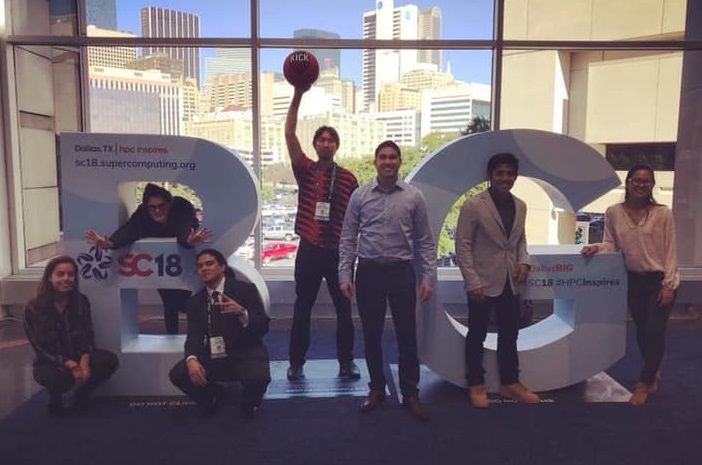
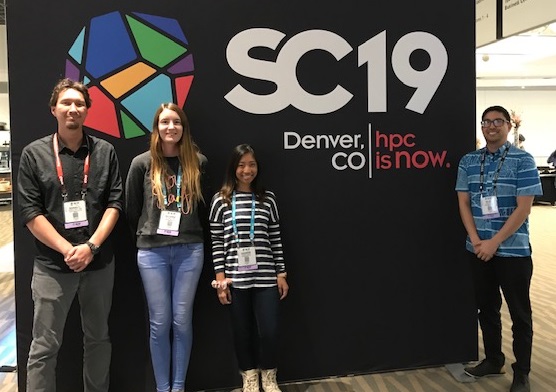
Students at Computing4Change in Denver, Colorado
First cohort (L-R): Sophia Riffo-Jenson, Clara-Nathele Trainer, Nainoa Norman Ing, Kahoalii Keahi-Wood, Rylan Chong, Hoano Rosario & Skye Haraga

Three Chaminade students were among 25 undergraduates from around the country to participate in the most recent Computing4Change challenge in Denver. Over three days in November, participants worked in small teams to use data analysis, computational thinking, and the latest data science tools to see how computing can be a driver for social good.

In this case, they sought to better understand the causes of infant mortality.

Dr. Rylan Chong, a data scientist and postdoctoral researcher at Chaminade, accompanied students to the challenge and a connected data science conference. He said Chaminade has actually sent three separate cohorts of students to the competition since the University launched its data science program in fall 2018 as a first-of-its-kind offering in Hawaii.

And Chong said the program is preparing to send its next cohort in July.

He said the gatherings not only help students apply their learning, but offer them vital opportunities beyond the classroom, from internships to networking that could lead to jobs.

Students at Computing4Change in Denver, Colorado
Third cohort (L-R): Kahoalii Keahi-Wood, Lillianna Flynn, Casandra Tanare, Rylan Chong

“From a curriculum standpoint, participating in these events, students experience an exciting hands-on opportunity to work in a multidisciplinary team with mentors to make an impact on a real-world problem, interact with a supercomputer and big datasets, and get exposed to and apply the latest data science technologies and approaches,” Chong said, in an email.

The challenges, which are sponsored by the Association for Computing Machinery’s Special Interest Group on High Performance Computing, also give students the chance to stretch their leadership muscles. Chong said Chaminade students frequently serve as leaders in their teams.

Chenoa Faletoi was one of the students who participated in this year’s cohort. She said the challenge was high pressure – and a great test of her skills. “I would say the biggest takeaway was knowing the difference between data and information,” she said, adding that the competition also solidified her choice to switch to the data science major.

“Data science is everywhere and can be applied in all fields,” Faletoi said. “In my perspective, I have opened up more opportunities. I am not limited to a specific area of work because data science involves technology and technology is evolving and being incorporated in all fields.”

Student Maria Fratinardo also competed in the challenge.

She said at the end of the three days, she was “super proud” about what she’d accomplished. “It’s made realize that I want to be able to use my skills to help people,” Fratinardo said, adding that she’s interested in focusing on applying data science in healthcare. “I’m learning how to find raw data in order to answer questions to problems that we are currently facing.”

Posted by: University Communications & Marketing Filed Under: Featured Story, Natural Sciences & Mathematics, Students Tagged With: Data Science

  • « Go to Previous Page
  • Page 1
  • Page 2
  • Page 3
  • Page 4

Footer

Chaminade University Logo

3140 Waialae Avenue
Honolulu, Hawaii 96816

Contact Us
Phone: (808) 735-4711
Toll-free: (800) 735-3733

facebook twitter instagram youtube linkedin

Visit

  • Plan Your Visit
  • Campus Map (PDF)
  • Events

Resources

  • Campus Security
  • Student Consumer Information
  • Concerns, Feedback, and Reporting
  • Institutional Review Board
  • Title IX / Nondiscrimination Policy
  • Compliance
  • Emergency Information
  • Careers
  • Institutional Statement

People

  • Students
  • Parents
  • Alumni
  • Faculty & Staff

Policy

  • Privacy Policy
  • Terms and Conditions of Use


© Chaminade University of Honolulu