• Skip to primary navigation
  • Skip to main content
  • Skip to footer
Chaminade University of Honolulu

Chaminade University of Honolulu

  • VISIT
  • APPLY
  • GIVE
  • STUDENTS
  • PARENTS
  • ALUMNI
  • FACULTY/STAFF
  • Admissions
    • Admissions Home
    • Undergraduate Students
      • First-Year Students
      • Transfer Students
      • Admitted Students
    • Graduate Students
    • Flex Online Undergraduate Program
    • Military Students
    • Non-Degree/Visiting Students
    • Experiential Honors Program
    • Early College Program
    • New Student Orientation
  • Tuition & Aid
    • Financial Aid Home
    • Tuition & Expenses
    • Federal Updates & Changes
    • Scholarships
    • $5,000 Graduate Scholarship
    • VA Education Benefits
    • Net Price Calculator
  • Academics
    • Academics Home
    • Academic Programs
    • Office of Student Success
      • Academic Advising
      • Records and Registrar
    • Kōkua ʻIke (Support Services)
      • ADA Accommodations
      • Career Services
      • Proctoring Services
      • Tutoring Services
    • Sullivan Family Library
    • Undergraduate Research & Pre-Professional Programs
    • Commencement
  • Campus Life
    • About Campus Life
    • Student Engagement
    • Student Government Association
    • Residence Life and Housing
      • Summer Conference Housing
    • Health Services
    • Marianist Leadership Center
    • Counseling Center
    • Campus Ministry
    • Campus Security
    • Dining Services
    • Bookstore
  • Athletics
  • About
    • Chaminade University News
    • Our Story
    • Leadership
    • Chaminade University Strategic Plan 2024-2030
    • Mission & Rector
    • Association of Marianist Universities
    • Facts & Rankings
    • CIFAL Honolulu
    • Accreditation & Memberships
    • Montessori Laboratory School
Search
×

Search this web site

Campus Event

New Student Orientation

August 21, 2023

Incoming class of freshmen familiarize themselves with campus resources

Across the nation, thousands of freshmen will mark a rite of passage this month, standing in that liminal space between what lies behind and what awaits ahead—between the familiar past and the unpredictable future. As Davis and Rian Wakefield helped their daughter, Shalei Parong, check in to the Hale Pohaku dormitory during New Student Orientation, they felt a mix of emotions: sadness, worry and excitement.

“At least she’s close to home,” said Davis Wakefield, a firefighter with the Hawaii Fire Department based in Kona. “This is her choice to come here, and we support her decision; it’s a new chapter of her life.”

Writing their own stories was a key theme in Chaminade President Dr. Lynn Babington’s welcoming message to incoming students during the Academic Convocation at the Mamiya Theater. Another one of her keynotes involved the principles of a holistic, Marianist education, focused on service, justice, peace, adaptation and change.

“You’ve chosen to attend a warm and welcoming liberal arts University,” Babington told students. “You will form bonds here, and you’ll delve new ways of thinking and discerning who you are and who you want to be.”

Students write their names on tags.
Incoming freshmen received a lanyard for their student ID cards.
Checking in for New Student Orientation.
Signing in for New Student Orientation.
Waiting for the app Canva to open.
Faculty members stood outside of Mamiya Theater.
Chaminade President Dr. Lynn Babington to address students.
It was a full house at Mamiya Theater.
Trying to navigate the Kalaepohaku campus.
Faculty members gather for the Academic Convocation.
Fr. Chris Wittmann led the group in prayer.
Chaminade President Dr. Lynn Babington and faculty members welcomed new students during the Academic Convocation.
Chaminade Provost Lance Askildson explained that higher education is an intellectual exercise in application and reflection. 
Students applaud the words of Dr. Lance Askildson.
Chaminade Student Government Association President, Pamela Oda, advised new students not to fear change.
Students walk out of Mamiya Theater after Convocation.
A group of freshmen explored the Kalaepohaku campus.
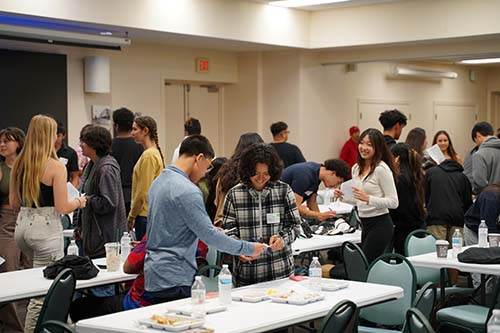
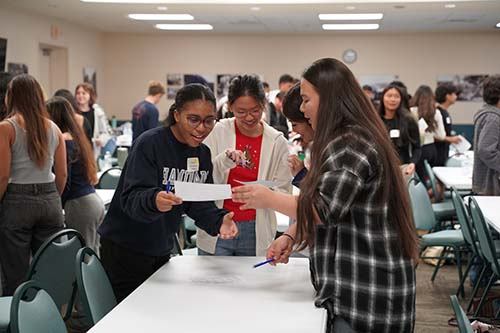
Learning about campus resources.
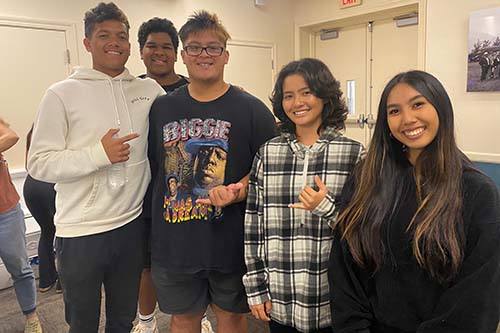
Orientation leaders flash their shaka of approval.

Mandatory for all freshmen and transfers, the New Student Orientation (NSO) is designed to acquaint new students with the campus and the many available campus resources that enhance both academic success and personal development. Orientation activities focus on several important areas, including the curriculum, academic advising, college success, scholarships and financial aid, campus activities, student services, student organizations, Silversword Spirit and campus facilities.

“As I look into the audience, I see the many incoming college students who are unsure about what the future holds, already starting to feel homesick, thinking whether you made the right decision or not,” said Chaminade Student Government Association President Pamela Oda in her address to fellow students at the Academic Convocation. “College is a chapter in your life that involves the word that many people dread—change. Be open to the change and new experiences, don’t fight it!”

Freshman Jordan Ponsar ’27 said he was “stoked” when he was offered a soccer scholarship to attend Chaminade. The Long Island, N.Y., native was quick to make friends on move-in day, helping resident assistants, Kelsey Sablan ’23 and Micah Sanders ’24 at the check-in desk in the lobby of Hale Pohaku co-ed dorm.

“I’m going to make the most of my four years here,” said Ponsar, flashing the shaka sign. “This is all new so I look forward to all the future opportunities and experiences.”

In his opening comments, Senate Faculty President Dr. David Carter rhetorically asked, “Do you know what you’ve gotten yourselves into?” His question elicited some nervous laughter from the audience, but his answer was simple. “You’ve enrolled in a university where we want to get to know you,” said the Director and Professor of Forensic Sciences. “Being in the classroom with students is my happiest time of the week. I hope you learn from me as much as I learn from you.”

Navigating a successful collegial life is not always easy, especially during freshman year when everything seems foreign and unfamiliar. Yet Chaminade’s ‘ohana spirit provides a comfortable and safe environment that makes it easier for students to explore. Students are encouraged to step out of their comfort zones, to be curious, to embrace adaptation and to try something new. 

“You are here because we see in you the potential for transformation through higher education and the opportunity to live an examined life in service to yourself and your community,” said Dr. Lance Askildson, Chaminade Provost and Chief Academic Officer. “This is, in truth, an exhilarating yet also quite challenging inflection-point in your life.  You will struggle and even fail at times to achieve your goals—and that is OK. We are all here, as a community of faculty, staff and administrators, to support you and your journey.”

In her concluding remarks, Oda offered some sage advice. “As you start this new chapter in life, be open to experiencing new things and opportunities because you never know what could happen,” she advised. “As you meet new people, keep in mind that everyone comes from different walks of life and may not have experienced the same things you have. Each of you has your own unique story, embrace it. Once again, welcome to the Silversword ‘Ohana and SWORDS UP!”   

Posted by: University Communications & Marketing Filed Under: Campus and Community, Diversity and Inclusion, Featured Story, Homepage, Institutional, Student Life, Students Tagged With: Baseball, Campus Event

Celebrity Emcee

August 16, 2023

’96 alumna and former Miss Universe to host Silversword Reunion

How a young wahine who rode the #53 Bus from Pearl City every day to get to school landed on the international stage is a Cinderella story. At 26 years old and 128 days, Brook Meahealani Lee became the then-oldest woman to be crowned Miss Universe in 1997. It was as much a surprise to her, as it was to a worldwide audience of more than 600 million viewers.

“It was a lot to process at the time,” said Lee, a ’96 alumna who majored in English with a minor in Communication. “One moment I was in Shreveport, Louisiana, the next I’m in Miami, Florida. Next was Toronto, Canada and then back to Los Angeles. It was a whirlwind that year.”

Of mixed Hawaiian, Korean, Dutch, English, French, Portuguese and Chinese ancestry, Lee became the first indigenous person and Asian American to wear the crown. It was a sparkling moment, for sure, preceded only by equally memorable answers to two of the Miss Universe Final questions.

However, before getting to what made Lee’s remarks so memorable, there’s a bit of backstory. At that time, Lee’s predecessor, Miss Universe 1996, Alicia Machado, came under public scrutiny for her weight gain, drawing considerable press attention. So when host George Hamilton asked, “Miss Universe has recently been the subject of a lot of press attention about her weight. If this happened to you, how would you handle it?”  

Lee perfectly offered up one of the best answers in pageant history. “I would take a good hard look at myself and I’d look from the inside out and I’d know that I was the same girl that was crowned that day,” Lee said. “So if I go up or go down—I get taller, I get shorter. My nose gets bigger… smaller. I’m still who I was when that crown was on my head and I’m a good representative no matter what.”

Yet, it was her response to the Miss Universe Final Question #3 that drew the loudest cheers and hysterical laughter from the audience and Hamilton. If social media existed then, her answer surely would have gone viral. And not for the unfortunate reasons most pageant answers make the social media rounds these days—Lee’s was amusing, frank and completely authentic in a very Hawaiian sense.

Asked: “If there were no rules in your life, for one day, and you could be outrageous, what would you do?” Lee unhesitatingly responded with: “I would eat everything in the world. You do not understand. I would eat everything twice.”

“It was a little bit of a jab at the President of Miss Universe Organization, who was the one who criticized the weight gain of my predessor,” said Lee, recalling that moment on stage. “But I don’t think he ever got it.”

Prior to winning Miss Hawaii USA and then being crowned Miss USA, Lee had minimal pageant experience. She said the first Miss Hawaii Competition she competed in, she lost big time. She would go on to win the title in 1997, which earned her a scholarship to Chaminade University. Walking through Henry Hall, Lee reminisced about her time on campus, pointing out Room 227 as the classroom where she sat for her English classes.

“I feel like I’m Jane Jetson; everything is so new,” quipped Lee, who will emcee the Silversword Reunion in October. Gesturing to the Sullivan Family Library, she pointed out that it didn’t exist when she was around, nor did the Athletics Coaches’ Office Complex below the parking structure.

While a lot has changed and improved since Lee’s time at Chaminade, some things remain the same. The Kalaepohaku campus is still as inviting, and students still need to climb all the steps to reach “Mount Kiefer.”

Brook Lee with her son Fynnegan, daughter Bailey and husband Tory Mell.

After her reign as Miss Universe, Lee made several cameo appearances in movies and television shows, and has hosted many television shows in Asia and the United States. She has also been a judge at Miss USA and Miss Universe pageants, and served as a color commentator for past Universe Pageants.

After permanently returning to Oahu from Los Angeles three years ago, Lee now juggles her time between being a mother of two, a supportive spouse and three gigs. She is the host of KHON2’s “Modern Wahine Hawaii;” she is the co-host for the Podcast “It’s a Hawaii Thing;” and she dances hula at Halekulani’s House Without a Key.” She also believes in service to the community, taking on the Artistic Director role with the Hawaiian Music Hall of Fame, where she produces the annual Lei of Stars installation of Hawaiian Music Hall of Fame inductees, and serves as the secretary for the nonprofit BEHawaii.

“My work with BEHawaii has been deeply meaningful as we started around a simple dining room table in Kapālama committed to elevating musicians in Hawaii and branching out in ways I would have never imagined,” Lee said. “BEHawaii is committed to finding solutions for our Lāhui in diverse ways, and holding fast to our Kūpuna and their wisdom.”

The group also launched the Lei Poinaʻole Project, which aims to revitalize, strengthen and support the Hawaiʻi lei industry. Lei Poina‘ole means “the never forgotten lei,” and the project is committed to this vision, so that the Hawaiʻi lei industry and its people are never forgotten.

To increase awareness and generate demand for locally grown flowers, materials, and lei, program leaders said the message is simple: “When you buy locally produced lei, you are nourishing our ʻāina, supporting Hawaiʻi farmers, preserving local traditions, and sharing aloha throughout our community.”

And aloha is what Lee has shared and breathed ever since she was a keiki riding the #53 Bus to school.    

Posted by: University Communications & Marketing Filed Under: Alumni, Campus and Community, Homepage, Humanities, Arts & Design Tagged With: Alumni, Campus Event, Communication, English

Making Dollars & Cents

August 4, 2023

Demystifying Financial Literacy

Chaminade president Dr. Lynn Babington is flanked by, from left, Andrew Rosen, president and CEO of Hawaii State FCU, Greg Young, president and CEO of HawaiiUSA, Dr. Annette Santos, interim dean, School of Business and Communication, and Dr. Guanlin Gao, director of Chamiande’s Economic Education Center for Excellence and associate professor.

For a couple of hours on a Tuesday morning, Hale Hoaloha’s R301 became a trading floor, with buyers and sellers brokering deals during a stock market simulation game. Waving a card in the air—like a trader would do on a Stock Exchange—Waipahu High School Career and Technical Education (CTE) teacher Russell Park walked around the room, booming, “Who’s selling? I’m buying!” The exercise was all part of the Economics and Personal Finance Literacy Summer Institute, led by Dr. Guanlin Gao, Director of Chamiande’s Economic Education Center for Excellence and an Associate Professor of Economics with the School of Business and Communication.

“No takers,” said Park, after the first round. “What I’ve learned so far I wish I had known years ago. I have also realized the importance of sharing this information with kids—to prepare them for the real world.”

According to Gao, this summer institute offers students essential knowledge and skills on how to allocate limited resources they have in life, such as time and money, in the most efficient way to satisfy their wants and needs. It also prepares them to better understand and respond to the events that shape their economic environment and financial well-being.

“We’re all natural-born economists,” said Gao, while looking around the classroom. “You might not just realize it … for now.”

Initially intimidated by graphs and charts, DJ Woodard of Waianae High School, grew comfortable with the classes after the first day. On the trading floor, she used her savvy and some recently-learned buzz terms to clinch a deal and made a profit.   

Dr. Gao's Economics and Personal Finance Literacy Summer Institute curriculum included such topics as market operations and government interventions, environmental economics, personal finance education and financial wellness.
Dr. Gao’s Economics and Personal Finance Literacy Summer Institute curriculum included such topics as market operations and government interventions, environmental economics, personal finance education and financial wellness.

“This shows us how to give our students a financial foundation,” says Woodard, a transition coordinator. “It gives them exposure to financial literacy, such as budgeting and saving.”

According to Gao, this institute is taught in a combination of lectures (with an emphasis on real-life examples and situations), in-class games and group activities, hands-on projects and field classes. The curriculum includes the economics and personal finance concepts based on the Hawaii Department of Education (HDOE) Social Studies Common Core standards, including such topics as market operations and government interventions, environmental economics, personal finance education and financial wellness. 

“I wish this was available when I was young,” Woodard lamented. “I would have had a better financial foundation. But I guess at 60 years old, it’s never too late.”

Through the training, participating teachers received access to teaching resources, including ready-to-adopt lesson plans—which Woodard said she plans to use—and one-on-one assistance in adopting and adapting lesson plans for specific grade levels.

A 10th grade health teacher at Farrington High School, Jan Halpenny was part of the first cohort from last year’s institute. So, too, was Kalelani Ogata, a special needs teacher at Abraham Lincoln Elementary School.

“Students are so ill-prepared financially,” said Halpenny, who attended this year’s luncheon finale. “They don’t even understand the most basic of finances, such as supply and demand.”

Hale Hoaloha’s R301 became a trading floor, with buyers and sellers brokering deals during a stock market simulation game.

For her part, Ogata set up a class store, where the only accepted currency is good behavior. “These are special need 3- to 5-year-old kids,” she said. “They learn to count, and they quickly learn that needs and wants aren’t the same thing. The kids go home excited to talk about what they learned.”

The Nation’s Report Card on Financial Literary gave Hawaii a D grade, but cited some significant accomplishments, including the establishment and maintenance of a financial literacy website by the HDOE. Available is the HDOE Standards with Opportunities to Integrate Financial Literacy Concepts with financial literacy concepts matched to multiple English Language Arts, Mathematics, CTE, Social Studies and Science standards for K-12. The website also provides robust financial literacy resources and programs for teachers to help implement financial literacy instruction in their classrooms. In 2021, Hawaii’s legislature passed a resolution “urging the Department of Education to coordinate with the Department of Commerce and Consumer Affairs to implement a graduation requirement of at least a half credit in financial literacy during the junior or senior year.”

However, according to the report, although Hawaii has made efforts toward increasing its financial literacy instruction, mainly through establishing the Hawaii Public Schools Financial Literacy Task Force, it still receives a “D,” as it does not provide any substantial financial literacy instruction.

“We know we have work to do when it comes to financial literacy in Hawaii, but we are proud to be making a difference and serving as a hub for economics education,” Gao said. “Financial literacy doesn’t have to be hard and unreachable. In fact, financial literacy should be accessible to everyone.”

Posted by: University Communications & Marketing Filed Under: Business & Communication, Campus and Community, Homepage, Institutional Tagged With: Campus Event, Grants, Guest Speakers

People, Planet and Prosperity

June 21, 2023

Three-day conference sharply focused on issues of sustainability

We can no longer use the NIMBY (not in my backyard) argument when it comes to advancing future projects. We’ve arrived at a hinge moment when solving our biggest problems—from environmental to social—means we need to start saying YIMBY, yes to some things: from solar panels and wind turbines to battery production and lithium extraction to universal basic income and food security. These are challenges for sure, but left unaddressed, the consequences could spell disaster, as discussed during a three-day conference sponsored by Chaminade University’s CIFAL Center of Honolulu.

On the final day of the People, Planet and Prosperity for a Sustainable Future symposium, Dr. Gail Grabowsky addressed the United Nations Institute for Training and Research’s  (UNITAR) Agenda 2030 for Sustainable Development and its corresponding 17 Sustainable Development Goals (SDG), which cover a vast range of subjects that impact all of us.

“I’ve been steeped in environmental studies for more than 25 years,” said Grabowsky, Chaminade’s Dean of the School of Natural Sciences & Mathematics and Executive Director of CIFAL Honolulu during her keynote address to attendees. “And a year and a half into establishing CIFAL Honolulu, we’ve brought sustainability into people’s consciousness. And we’ve sponsored more than 50 events.”

The CIFAL Global Network is composed of 32 International Training Centers for Authorities and Leaders, all coordinated by UNITAR’s Social Development Program. The strategic locations of the 32 centers, which can be found across Asia, Oceania, Africa, Europe, the Americas and the Caribbean, ensure a global outreach. Each CIFAL—a French acronym for Centre International de Formation des Autorités/Acteurs Locaux (International Training Centers for Local Authorities and Local Actors)—outpost provides innovative training and serves as a hub for the exchange of knowledge among government officials, the private sector and civil society. 

Chaminade President Dr. Lynn Babington with Hawaii Gov. Joshua Greene during the People, Planet and Prosperity Conference.
Chaminade President Dr. Lynn Babington with Hawaii Gov. Josh Green during the People, Planet and Prosperity Conference.

In his keynote address, Hawaii Gov. Josh Green pledged to generate billions of dollars from philanthropy and outside investment to make Hawaii the first state to become fully reliant on clean energy. It’s a familiar stance that Green has taken since he introduced a slew of major climate policy initiatives earlier this year, including a recommitment to the U.S. Climate Alliance and the establishment of a Climate Advisory Panel.

“We have so many people in this room, find a project that will help Hawaii, help us with health care, help us with the environment,” Green told attendees. “I will bring in investors from across the globe because they are interested in Hawaii, but we will still need to do the job.  Be ready. It should be a dynamic few years.”

The presentations indeed reflected this dynamicism, featuring such diverse topics as “Teaching the Importance of the Ocean to Fight Climate Change,” “The First Statewide Initiative to Connect All Public Universities to Advance PK-12 Climate Literacy, Justice and Action,” “Innovation and Sustainability: The Negative Impact of the Protectionist Leadership Style” and “Food Insecurity.”

“Being part of the UN, we bring awareness to sustainable issues, and train people to get involved and to act on sustainability,” Grabowsky said. “We support economic sustainability in the context of still maintaining an aesthetic environment.”

As the only CIFAL Center in the Pacific, the Chaminade campus is part of a region that includes China, Korea, the Philippines and Australia. The CIFAL Network focuses on topics within four thematic axes: Urban Governance and Planning, Economic Development, Social Inclusion and Environmental Sustainability. Each center is locally managed by a host institution, with UNITAR providing academic content, technical support and quality assurance measures for their training activities. This allows each CIFAL to prioritize action in specific thematic axes, depending on local needs and priorities.

“The basic lesson of the Sustainable Development Goals is that human hopes, human aspirations, human fears are all interconnected,” said United Nations Assistant Secretary-General and executive director for UNITAR, Nikhil Seth, during last November’s “XIX Steering Committee Meeting of The CIFAL Global Network at Chaminade.  “You can’t separate them and follow them in discreet ways. The SDGs are like an umbrella of issues and almost everything you can possibly think of are probably covered in the 17 SDGs.”

And that includes Grabowsky’s pet project, “Pono Popoki Project: Malama Management of Free-Roaming Felines.” “Cats can be good for people’s mental health, which is Goal 3 of the SDGs,” said Grabowsky, pointing to a colorful chart that depicts all the SDGs. “And it also teaches our students biology and wildlife conservation.”

Posted by: University Communications & Marketing Filed Under: Campus and Community, CIFAL Honolulu, Diversity and Inclusion, Featured Story, Homepage, Innovation, Institutional Tagged With: Campus Event, CIFAL, Guest Speakers

Commencement Address

May 15, 2023

Kauai Mayor Derek Kawakami ’01 delivers keynote speech

She had him at Chaminade. For many senior high-school students, trying to determine where to attend college depends on several factors: cost, location, size, personal interests, campus life, graduation rates and the potential return on investment. However, for Kauai Mayor Derek Kawakami ’01, the primary reason he chose Chaminade University was simple—he met a girl.

“I know it sounds shallow, but it’s the truth,” said Kawakami, this year’s 65th Commencement keynote speaker. “But knowing what I know now about Chaminade, I would have chosen it 1,000 times over any college in the country.”

The son of the late Charles and Arlene Kawakami, Mayor Kawakami is a third-generation Kaua‘i resident, and is now serving his second term as the Garden Isle’s chief executive officer. Having shepherded the island through a once-in-a-century pandemic and now through recovery, Kawakami does not shy away from the necessary hard work of what he calls, “the people’s business.” The physically fit 46-year-old is a no-nonsense-type of leader who likes to roll up his sleeves, get into his steel-toe-capped boots and don his hard hat at the drop of a dime.

During COVID, he was forced to make a series of difficult—and, at times, unpopular—decisions, including lockdowns, turning public camp sites into Safe Zones to prevent the spread of the virus, enforcing mandatory vaccine mandates and curfews, and instituting strict protocols and safety measures. Yet, through it all, he became widely known, erroneously by the way, as the TikTok mayor. A 30-second clip that he posted went viral on Instagram and not the aforementioned social media site. In the video, he performs an amusing dance and a card trick, then encourages people to wash their hands. It was all an effort, he said, to break the monotony of staying home.

With his wife Monica by his side, Kauai Mayor Derek Kawakami was sworn in for his first term by Kaua‘i Circuit Judge Randal Valenciano. (Photos courtesy County of Kauai)
Mayor Kawakami welcomed 11 new firefighters with the Kauai Fire Department. (Courtesy of County of Kauai)
Mayor Kawakami enjoys meeting and greeting his constituents from across the island. (Photo courtesy of Friends of Derek Kawakami)
The Twitter video that went viral.
Mayor Kawakami knew from a young age that he wanted to serve the people of Kauai. (Photo courtesy of Amanda C. Gregg)
Members of Mayor Kawakami’s cabinet.
Mayor Derek Kawakami during a groundbreaking ceremony.
Mayor Derek Kawakami during a groundbreaking ceremony. (Photo courtesy of Friends of Derek Kawakami)
Monica and Derek Kawakami enjoy participating in community events, including the long-running Taste of Hawaii.

“I have to say my wife put me up to it and my daughter instigated it,” Kawakami chuckled. “We just wanted to help people get through some tough times, we wanted to do it together, and at the end of the day, we wanted people to feel like they mattered and that we cared about them.”

He attributes this empathy as one of the values he learned while completing his bachelor’s degree at Chaminade, where his now-wife, Monica nee DeBusca Lizama, also graduated with an undergraduate degree in 2001 and a master’s in education in 2003. A self-described average “C” student, Kawakami evoked the memory of several Chaminade professors, who made an impact in his life, during his commencement address.

One such individual was the late Marlene Baker, who enjoyed a 45-year career in the Students Success and Records office. Kawakami said he would bring Kauai cookies to her so that she would build him a favorable schedule, quipping that was probably his first sign of being a politician. Henry Gomes, or “Uncle Henry” as Kawakami affectionately refers to the late revered professor, would talk to him about “country-kine things,” and made him feel like it was perfectly OK to just be him. Then there was recently retired Yukio Ozaki, who opted not to cancel an art class, even though enrollment plummeted from 15-20 students to a lone Kawakami overnight.

“Now that I have 20/20 hindsight vision, what I’m about to say is the last thing my professors would want to hear,” Kawakami said. “As the sands of time have passed, some of the knowledge, some of the details of the countless hours of classroom lessons, lectures and knowledge have faded. But what has remained is how the power of the human element can change the trajectory of one person’s life. All it takes is just one person. One person that believes in someone and is willing to invest time, effort and kindness can uplift a community.”

It’s with this indomitable spirit that helps inform Kawakami’s leadership. He cited three principles that he follows: 1) Act in good faith, which helps build trust; 2) always act with the community’s best interest; and 3) establish a sound, prudent process of decision making.

“Not everyone will agree, but I can defend my position,” Kawakami asserted. “Compromise is an art, and by compromise, I don’t mean consensus, which, when I hear, often tells me that things are not going to move forward.”

Life for Kawakami has certainly had a forward momentum. When he graduated from Chaminade, his first job was a grocery clerk for Longs Drugs Kaimuki. The pay was $200 per week, and his duties included sweeping the floors, stocking the shelves and racks with those familiar yellow books, and whatever needed to be done.

“I had to put my business degree to work,” Kawakami said. “I started at the entry level, but that’s how I thought it would work. Just because I had a degree didn’t mean I was going to start at a higher level. My degree was supposed to give me the tools to get to that next level, and it did.”

One day, he received a call from his dad, asking him to come home to help out in their own grocery store. His dad told him If he could work at Longs, then certainly he can work at the family’s own enterprise. However, there was one problem: Monica was pursuing her master’s, and she wasn’t about to quit and return to Kauai. So, she proposed an ultimatum: He had to marry her.

“I went to Kahala Mall and applied for a loan, which was my first loan ever,” Kawakami recalled. “I qualified for $9,000—which was big bucks back then for me who was making $200 a week—and I went upstairs to a diamond specialist, and chose an engagement ring.”

Married now to Monica for 20 years, the couple has two children, Hailee and Christopher. A dedicated family man, Kawakami praises his family for their support throughout his two terms as Kauai’s Mayor, as well as his years of service on the State Legislature. He also credits his experience at Chaminade as helping shape his style of leadership.

“I have a lot of clear memories of my time at Chaminade, and the people who made an impact on my life; the faculty and staff truly cared for us,” Kawakami said. “I gained a worldly view of different cultures, and how to appreciate our differences.”

And despite all the pressures of governing, Kawakami said, from a pressure standpoint, being the Commencement keynote speaker was a big one.

“If I were to go back to my 20- or 21-year-old self, and be told that I was going to be the Commencement speaker at Chaminade one day, I would have said ‘Get out of here!’” Kawakami said. “I never imagined a picture in which I would be in a position speaking to the graduating class and their families. I’m grateful for this opportunity to come back around and to be part of this Commencement.”

Kauai Mayor Derek Kawakami ’01 shared his memories of Chaminade while a student majoring in business administration.

Posted by: University Communications & Marketing Filed Under: Alumni, Campus and Community, Diversity and Inclusion, Featured Story, Homepage, Institutional Tagged With: Campus Event, Commencement, Guest Speakers

Congratulations to the Class of 2023

May 10, 2023

Inspiring words from Dr. Lynn Babington, Kauai Mayor Derek Kawakami and Selected Student Speakers

In his opening remarks to graduating students, Kauai Mayor Derek Kawakami ’01, reflected on his time on campus with his wife Monica and his own commencement. “As I look out into the sea of graduates, I see my own reflection in you,” said the 2001 Chaminade alumnus. “It makes me realize how quickly time goes by. But time is just a measurement, until it is filled with very special people who make tremendous impacts in our lives. And today, on this beautiful occasion, as you generously give me your time, each of you becomes a part of my life as well.”

The Commencement ceremony began with a special invocation from Fr. Martin Solma, Chaplain and Special Assistant to the President at Chaminade. President Dr. Lynn Babington then addressed graduates, acknowledging their accomplishments and sacrifices—especially in the face of global uncertainty.

Chaminade President Dr. Lynn Babington addresses graduates at Commencement.

“One of the distinguishing features of a Marianist education is a focus on adaptation and change—skills critically important in today’s challenging world,” Babington exhorted. “You have certainly become more comfortable with navigating the unknown. The ability to work with ambiguity means you’ll be able to face uncertainties, adapt to change and be flexible as the mysteries of life unfold.”

For many graduates, the ceremony is a time of reflection, pride and perseverance, especially with this particular graduating class, which endured a once-in-a-century pandemic, Covid protocols and restrictions, social distancing and a pivot to an online schedule before transitioning to a hybrid model.

“We’re all here today together, making it across that finish line,” said undergraduate speaker Eri Leong. “Through fears and failures, exams and assignments, break-ups and breakdowns, even through a global pandemic, no hurdle was high enough to keep us from walking this stage. Instead, we emerged triumphant over every adversity under the sun. And we’ll carry that unwavering resolve into the abundant opportunities that lie ahead.”

In Simon Bronner’s 1990 book “Piled Higher and Deeper: The Folklore of Student Life,” a chapter devoted to graduation explores how commencement has been celebrated across campuses and throughout the years.

According to the book, some colleges host 100-day countdowns to commencement, with a number of graduation-themed activities. At other schools, graduating seniors leave wills to underclassmen. Some institutions celebrate graduation with a balloon launch to symbolize students moving upward, while others have held ceremonial bonfires where seniors burn course materials or early drafts of their senior theses. 

However, even with variation from campus to campus, the commencement ceremony itself remains very much a traditional event, a punctuation point to the collegiate experience with many customs deeply rooted in history, including the caps and gowns, university mace, and guest and student speakers.

“Commencements are a time to join as a community to celebrate the work of our faculty and staff who have supported you throughout your years of study with us, and we celebrate new beginnings,” Babington said in in her address to students. “You are leaving Chaminade University to go out and engage in the world as professionals, as neighbors, as citizens.”

Graduating with a Master of Arts in Teaching, Todd Sibley was selected by his peers to be the evening’s graduate speaker. Immediately preceding the pandemic, the native Californian worked as a social worker for a Hawaii nonprofit organization. When COVID spread across the islands, Sibley lost his job, and he decided to pursue his master’s in teaching social studies in secondary schools.

“Graduates, we have proven ourselves to be resilient, resourceful and resistant to giving up,” Sibley asserted. “The global pandemic would have been an easy excuse to have quit on ourselves and our dreams, but we didn’t. We persevered no matter the obstacle because that’s what we faced—obstacles not barriers.”

As Kauai Mayor during the pandemic, Kawakami confronted his own difficult decisions, turning camp grounds into Safe Zones, ordering shut downs and unpopular vaccine mandates. And through it all, he thought only of his constituents, responding to their needs in the most dire of times.

“What I got most out of my time at Chaminade wasn’t the correct way to structure a sentence or what I gained out of my statistics class; it wasn’t what I gained out of a book,” Kawakami said.  “It was the importance of the human element, and the power that simple random acts of kindness can shape the future of one person’s life. That although certain things will fade overtime, the people who cared, the ones that shared, the ones that believed, and made you believe in yourself, will remain with you.

“I feel incredibly grateful to witness this commencement of your next step,” he concluded. “Fair winds and following seas, always be caring and always be trustworthy. Congratulations to this beautiful graduating class of Chaminade University!”

Dr. Lynn Babington presents diploma to graduating student
Student Athlete
Graduating Students
Father Chaminade
Sarah Robertson is all smiles, even with crutches
Janine Abad posed with her family and friends.
MBA graduate Jeremiah Bautista poses with family and friends.
Provost Dr. Lance Askildson
Keynote speaker Kauai Mayor Derek Kawakami
Graduate speaker Todd Sibley
Undergraduate student speaker Eri Leong
A promising message on a mortarboard
Emcee Kaipo Leopoldino
All smiles and laughs
BSN graduates with Student Athlete
Graduates' family and friends attended the Chaminade Commencement at the Waikiki Shell on May 6.
Graduates’ family and friends attended the Chaminade Commencement at the Waikiki Shell on May 6.

Posted by: University Communications & Marketing Filed Under: Alumni, Campus and Community, Diversity and Inclusion, Featured Story, Homepage, Institutional Tagged With: Alumni, Campus Event, Guest Speakers

  • « Go to Previous Page
  • Page 1
  • Interim pages omitted …
  • Page 9
  • Page 10
  • Page 11
  • Page 12
  • Page 13
  • Interim pages omitted …
  • Page 18
  • Go to Next Page »

Footer

Chaminade University Logo

3140 Waialae Avenue
Honolulu, Hawaii 96816

Contact Us
Phone: (808) 735-4711
Toll-free: (800) 735-3733

facebook twitter instagram youtube linkedin

Visit

  • Plan Your Visit
  • Campus Map (PDF)
  • Events

Resources

  • Campus Security
  • Student Consumer Information
  • Concerns, Feedback, and Reporting
  • Institutional Review Board
  • Title IX / Nondiscrimination Policy
  • Compliance
  • Emergency Information
  • Careers
  • Institutional Statement

People

  • Students
  • Parents
  • Alumni
  • Faculty & Staff

Policy

  • Privacy Policy
  • Terms and Conditions of Use


© Chaminade University of Honolulu