• Skip to primary navigation
  • Skip to main content
  • Skip to footer
Chaminade University of Honolulu

Chaminade University of Honolulu

  • VISIT
  • APPLY
  • GIVE
  • STUDENTS
  • PARENTS
  • ALUMNI
  • FACULTY/STAFF
  • Admissions
    • Admissions Home
    • Undergraduate Students
      • First-Year Students
      • Transfer Students
      • Admitted Students
    • Graduate Students
    • Flex Online Undergraduate Program
    • Military Students
    • Non-Degree/Visiting Students
    • Experiential Honors Program
    • Early College Program
    • New Student Orientation
  • Tuition & Aid
    • Financial Aid Home
    • Tuition & Expenses
    • Federal Updates & Changes
    • Scholarships
    • $5,000 Graduate Scholarship
    • VA Education Benefits
    • Net Price Calculator
  • Academics
    • Academics Home
    • Academic Programs
    • Office of Student Success
      • Academic Advising
      • Records and Registrar
    • Kōkua ʻIke (Support Services)
      • ADA Accommodations
      • Career Services
      • Proctoring Services
      • Tutoring Services
    • Sullivan Family Library
    • Undergraduate Research & Pre-Professional Programs
    • Commencement
  • Campus Life
    • About Campus Life
    • Student Engagement
    • Student Government Association
    • Residence Life and Housing
      • Summer Conference Housing
    • Health Services
    • Marianist Leadership Center
    • Counseling Center
    • Campus Ministry
    • Campus Security
    • Dining Services
    • Bookstore
  • Athletics
  • About
    • Chaminade University News
    • Our Story
    • Leadership
    • Chaminade University Strategic Plan 2024-2030
    • Mission & Rector
    • Association of Marianist Universities
    • Facts & Rankings
    • CIFAL Honolulu
    • Accreditation & Memberships
    • Montessori Laboratory School
Search
×

Search this web site

Campus Event

Cybersecurity Workshop

December 8, 2023

Expert warns of maintaining healthy online hygiene

Similar to what you would hear at a dentist office, Liam Wesley dispensed advice about the importance of daily hygiene during a Cybersecurity Workshop at the Data Science Center in Tredtin Hall. But for the cybersecurity expert, this means never using the same username nor the same password ever! Just like you would never keep using the same strand of floss.

In an era dominated by digitization, Wesley described the importance of robust cybersecurity measures that cannot be overstated. As online users navigate an increasingly interconnected world, the guardians of our digital realm are facing new challenges and adapting strategies to protect against evolving cyber threats. Wesley is among them fighting the digital perils.

The 90-minute Cybersecurity Workshop was hosted by the National Science Foundation ALL-SPICE Alliance, which includes the United Nations CIFAL CENTER of Honolulu, Information Technology and Services Department (senior director Jules Sukhabut), the Networking Department (director Joseph Rosario), Data Science, Analytics and Visualization Program (director Rylan Chong, Ph.D.) and the Computer Science Department.
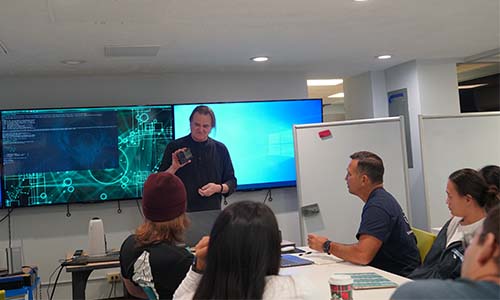
Liam Wesley—a penetration tester and cybersecurity engineer with High Tech Hui, LLC and Cyberruptive—demonstrated some of the tools that professional hackers keep in their arsenal.

“We brought in Liam to demonstrate real cyberattacks, and discuss how a student can protect themselves for educational purposes and build awareness,” said Chong, Co-Principal Investigator of the National Science Foundation’s Alliance Supporting Pacific Impact through Computational Excellence (ALL-SPICE) grant. “Joe and I plan to pilot this cybersecurity workshop to Natural Sciences and Mathematics students to gauge interest. This will help us understand if there is interest for future workshops, larger workshops and/or a need for a cybersecurity course or program.”

Cybersecurity experts, like Wesley—a penetration tester and cybersecurity engineer with High Tech Hui, LLC and Cyberruptive—warn of the escalating sophistication of cyber threats, ranging from ransomware attacks that cripple essential services to targeted phishing campaigns exploiting the remote work landscape. The proliferation of Internet of Things (IoT) devices—AI voice assistants like the Amazon Echo and Google Home—coupled with the rise of artificial intelligence in cyberattacks, adds a layer of complexity to the battlefield.

In the face of these evolving threats, organizations are doubling down on best practices to fortify their defenses. This includes regular employee training to recognize and thwart phishing attempts, implementing multi-factor authentication, and keeping software and systems up-to-date with the latest security patches.

“Patching is absolutely necessary,” Wesley said. “But wait a few days to avoid the potential for buffer overflow, which are memory storage regions that temporarily hold data while it is being transferred from one location to another.”

Initially limited to Rosario’s computer science networking class, the workshop was eventually opened to all Natural Sciences and Mathematics students due to the importance of the topic and the large interest from Chong’s previous presentation on the topic.

One of the workshop’s primary goals was to bring awareness and introduce education innovation. Chong explained that the topic is very important for the University’s DSAV, CS and NSM students, as many of them are doing research, working with data and sensitive data at various organizations for jobs and internships, and using computers.

“Instead of traditionally just bringing in someone to talk about cybersecurity in general, our goal was to make this relevant to the students to build awareness, address on the national security level the lack of cybersecurity education in schools, and an approach to work on better securing our campus,” Chong said. “In addition, we are planning to take an innovative educational approach by actually demonstrating how easy it is to hack and simulate how bad a cyberattack can be to an organization.”

The landscape of cybersecurity is indeed dynamic and ever-evolving. Experts agree that a collaborative, proactive approach—comprising technological innovation, regulatory compliance and ongoing education—is essential to safeguarding our digital world against the relentless tide of cyber threats.

“There was a lot of information, which was hard to keep up with,” said data science and visualization major LaVelle White ’26. “He explained pretty well how hackers get into systems, even though I can’t hack, but I understood the concept.”

Posted by: University Communications & Marketing Filed Under: Campus and Community, Center for Strategy and Innovation, CIFAL Honolulu, Homepage, Innovation, Institutional, Natural Sciences & Mathematics Tagged With: Campus Event, Data Analysis & Visualization, Data Science, Guest Speakers

Community Garden

November 28, 2023

Students tend to the māla as part of EN102

Pushing a wheelbarrow in the māla, Zachary “Pono” Narcisco was learning how to garden—not exactly what he had in mind when he enrolled in his English class. The “cultivating” effort is all part of Dr. Koreen Nakahodo’s mandatory service-learning component of her EN102 Composition and Rhetoric course.

“We have to do at least six hours of service learning,” said Narcisco, a freshman and an aspiring nurse. “Dr. Nakahodo asked us to write about our experience at the māla, and what value we can bring out from gardening.”

Many universities offer some form of service-learning, which is an educational approach that combines community service with academic learning to provide students with a holistic and hands-on learning experience. This experiential learning approach also helps students deepen their understanding of course material and how it applies to the everyday world.

“Unlike community service—which might include something like a one-day beach clean-up and then you go home—service learning directly connects service-to-course content,” said Mitch Steffey, Chaminade’s Associate Director of Service Learning and Community Engagement Service. “Learners try to apply aspects of the course while simultaneously working to satisfy the needs of the community.”

Nakahodo’s pedagogical approach to teaching is based on three principles: place, space and transactional writing. For this Fall’s EN102, she initially themed it “Food Insecurity,” which would have involved Christina Klimo, University of Dayton’s Write Place Coordinator with the Office of Learning Resource.

“Two years ago, we met while participating in the Marianist Educational Associates formation program, and we shared similar ideas,” said Nakahodo, who has taught at Chaminade since 1998. “Then we started having weekly Zoom meetings and it just progressed from there.”

After numerous Zoom conference calls, Nakahodo and Klimo had coordinated to collaborate on a course this term that would be based on the two universities’ community gardens, hence the theme. The first session was hosted by Silverswords who held up their laptops to capture the views of Diamond Head and the ocean to show the UD students.

“It was a get-to-know-each-other meeting,” Nakahodo said. “The second session was going to be hosted by UD and the third session would have been a collaborative effort. But unfortunately, Christina got sick and we had to postpone the session.”

Shoveling mulch into the wheelbarrow, sophomore Maka‘ala Ng said it’s difficult to grow plants and vegetables in this garden because of the quality of the soil, but they’ll persist, as long as students keep helping to tend the garden.

“When vegetables do start growing, we’re going to give them away,” said Ng, an Environmental Science and Environmental Studies double major. “Right now, we’re planting corn, peas, cucumbers and indigenous plants. We also apply three different methods to compost waste: tumbler, which looks like a cement mixer; vermicomposting or worm farm composting; and in-ground composting.”

 Steffey has spearheaded the garden endeavor for the past couple of years with the help of students like Narcisco and Ng, and professors like Nakahodo who want to address the disconnection between island residents living in today’s fast-paced, consumer-oriented society and their lack of awareness of food origins and production.

“Eighty-five to 90 percent of our food is imported,” Steffey said. “We need policies and actions to increase the amount of locally grown food consumed by Hawaii’s residents. And we’re trying to do our own little part for our community.”

Posted by: University Communications & Marketing Filed Under: Campus and Community, Featured Story, Institutional, Service Learning, Students Tagged With: Campus Event, Service Learning

I Go 2 College

November 17, 2023

Fifth graders experience campus life for a day

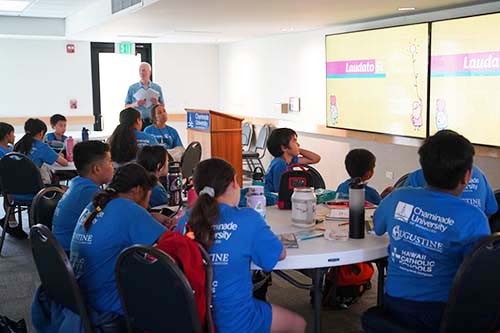
Trying to explain Pope Francis’s Laudato Si’ (“Praise be to you,” a quotation from St. Francis of Assisi’s “Canticle of the Creatures”) to 12-year-old kids in a university environment is no easy task. Yet, Bro. Ed Brink, S.M. comfortably stood in front of a group of Sacred Hearts Academy, and St. Theresa and St. Elizabeth students and started his discussion with a simple question: have you ever received a birthday card in the mail? 

Raising her hand, Charlie Yim screamed out “from my auntie.” Sitting next to Yim, fellow Lancer, Camryn Abe, echoed the same response. In fact, every student had received a card, either from an auntie or a grandparent. Some even said they had received letters, which was the perfect segue for Brink to ask his second question: Why do we send cards and letters?

Surely enough, students answered with “to let us know they care for us and they love us.” It was a response that could not have been any better scripted than if Brink had pre-written the answer himself. After all, the Pope’s 184-page encyclical letter—Laudato Si’— focuses on care for the natural environment and all people, as well as broader questions of the relationship among God, humans and the Earth. The encyclical’s subtitle, “Care for Our Common Home,” reinforces these key themes.

Bro. Ed Brink teaches fifth graders about Laudato Si.

“Pope Francis’ encyclicals are letters to the people,” said Brink, Vice President of Mission and Rector. “They are letters to show his care and love for the people. Earth is God’s gift to us, and it belongs to everyone, but it needs our protection and immediate attention.”

After shuffling slides of a PowerPoint presentation, Brink handed out sheets of a word search puzzle that contained vocabulary that directly pertained to the environment and sustainability. Working together in groups of seven, students eagerly searched for words in the puzzle, circling “recycle” along a diagonal path and “earth” along a vertical column.

The exercise wasn’t lost on the students who were part of a cohort of 166 fifth graders who visited campus to experience college life. Now in its second year, “I Go 2 College” is a partnership between Chaminade University and Hawaii Catholic Schools.

“The I Go 2 College event exceeded my expectations,” said Llewellyn Young, Ph.D., superintendent of Hawaii Catholic Schools. “Our preliminary surveys showed that all stakeholders including teachers, parents and students were very satisfied with the experience.  

“Anecdotally, several parents called my office when we did our first event last spring to tell me that they thought the program was brilliant and inspiring,” Young continued. “Parents spoke with such enthusiasm. One parent told me that her son talked about it for a few weeks. He never mentioned college before the experience, but now he can’t wait to go.”

St. Theresa students, Heaven Lee and Katelin Nitta, and Sacred Hearts’s Lauren Schofield and Kiara Cruz all plan to attend university, and Chaminade may be their choice. The four fifth graders said this college experience was “fun—even with all the up-and-down hikes.” 

Attending for a second year, St. Theresa fifth-grade teacher Alyssa Yabes said last year’s students “really enjoyed it a lot.” “They kept talking that they loved going to college,” she said. “All the hiking, they told me, was worth it.”  

Started approximately 16 years ago, the “I Go To College” program aims to introduce 9-12-year-old students to higher education, even before they step onto a middle school campus. “The purpose of this program is to expose the students to college life at an early age and to provide them with a day that is fun and eye-opening,” said Kim Baxter, Director of Early College programs at Chaminade. “Additionally, one benefit to offering visit opportunities for younger students is that when they return as juniors or seniors, the students will be better prepared to participate in traditional campus visit programs.”

Posted by: University Communications & Marketing Filed Under: Campus and Community, Catholic, Early College, Education, Homepage, Institutional Tagged With: Campus Event, Early College Experience, Early Education

Amy Thompson of Mattel

November 3, 2023

’98 alumna shares her role with a leading global toy company

A word of advice from Amy Thompson: be open. Open to new ideas. Open to diversity. And open to equality and inclusion. As executive vice president and chief people officer for Mattel, the ’98 Chaminade alumna oversees all global human resources functions, including compensation and benefits, organizational design and leadership development for the company.

Speaking virtually to students during the Dean’s Speaker Series, Thompson shared her impressive employment history. Before joining Mattel, she served as chief people officer for TOMS Shoes, where she successfully developed and implemented organizational plans to scale the company globally by elevating talent and direct-to-consumer capability. She also founded TOMS Leading Ladies, an organization dedicated to empowering and inspiring women leaders.

Prior to TOMS, she held several global HR leadership roles at Starbucks Coffee Company, as well as led HR teams and departments at Ticketmaster Corporation and Citysearch.com.

Amy Thompson addressed students during the Dean’s Speaker Series.

“I believe my formative experiences, including at Chaminade, shaped my future,” Thompson told attendees. “I came to Chaminade on a full athletic scholarship and, as an athlete, you have to be disciplined.”

The Dean’s Speaker Series is designed to bring private, nonprofit and public sector leaders who have achieved recognition in their respective fields to share their expertise and insights on a broad range of timely issues, as well as share the highlights, challenges and turning points of their individual career paths.

“The Speaker Series is intended to extend classroom learning,” said School of Business and Communication Interim Dean Annette Santos. “It’s a co-curricular experience where the integration between theory and practice is reinforced and realized.”

Another intention of the forum is to bring a diversity of social, cultural, economic and other business-related perspectives to the Chaminade community in order to engage in ways that inform and encourage sustainable business for good. 

“One of Mattel’s external recognitions that I’m really proud of is its standing with the Human Rights Campaign,” Thompson said. “In 2022, for the fourth year in a row, Mattel received a perfect score of 100 on the Human Rights Campaign Foundation’s Corporate Equality Index, the nation’s foremost benchmarking survey that measures corporate policies and practices related to LGBTQ+ workplace equality.’”

As chief people officer, Thompson is guided by several key questions: “Do employees feel supported? Can they be authentic? Do they feel that they belong?”

“We have three values that are foundational to Mattel,” Thompson pointed out in her PowerPoint slide. “Collaboration, Innovation and Execution, which leads to our pillars of leadership: build and drive culture, manage performance, support career growth, promote wellbeing and growth mindset.”

School of Business and Communication Senator and Intern, and United Nations Association of Chaminade University (UNAC) President, Jasmine Mondelo could clearly sense that Thompson immensely cares for Mattel’s culture and talent. She also believes that Mattel offers a prime business model that fosters and values employee relations.

“As a college student who will set out on my own career path after graduation, Amy Thompson and Mattel’s message of inclusivity, fairness and commitment to personal and professional growth is inspiring to me,” said Mondelo after attending the lecture. “Wherever I work, I would want to feel valued and respected as an employee, motivated to achieve success for myself and the company, and capable of continuously improving myself.”

Santos hopes that students will have several takeaways after attending and listening to these guest speakers. “1) I hope that students would be inspired by the personal and professional journey of the featured speakers in ways that enhance their educational experience,” she said. “2) Understand that personal and professional growth is a process that involves challenges and turning points on the way to wins and transformation; and 3) this event also provides opportunities for students to build their network, possibly creating meaningful connections with speakers or those in attendance.” 

Posted by: University Communications & Marketing Filed Under: Alumni, Business & Communication, Campus and Community, Homepage, Institutional, Students Tagged With: Alumni, Campus Event, Guest Speakers

God’s Mechanics

October 11, 2023

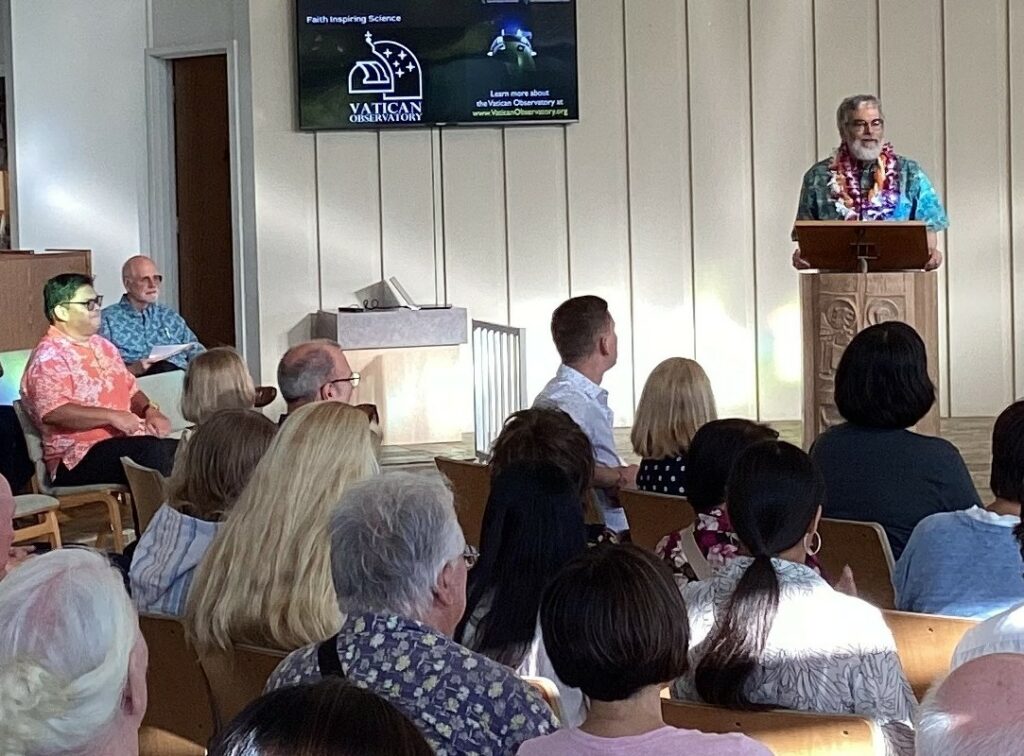
There was time for one more question before the close of the Marianist Lecture. Chaminade student Noelani Tugaoen stood up and politely asked, “How are we able to foster the dialogue of faith and science with those who are younger and don’t have any experience with the religious world?” 

Lecturer Bro. Guy Consolmagno, S. J. half-smiled before laughing and saying, “Boy, I wish I knew the answer to that.”  The audience then joined him in light laughter. 

As the Director of the Vatican Observatory and President of the Vatican Observatory Foundation, Consolmagno clearly knows the answers to most any question that comes his way.  A native of Detroit, Michigan, he earned undergraduate and masters’ degrees from MIT, and a Ph. D. in Planetary Science from the University of Arizona; he was a postdoctoral research fellow at Harvard and MIT, served in the US Peace Corps (Kenya), and taught university physics at Lafayette College before entering the Jesuits in 1989. 

Yet on October 8th in the Mystical Rose Oratory as part of the Marianist  Lecture Series, he humbly replied that he didn’t know the answer to Tugaoen’s question.

His lecture, “God’s Mechanics: How Scientists and Engineers Make Sense of Religion,” however, was packed with answers to lofty questions about science, astronomy, commonalities and differences between different religions, and – ultimately – what “believing in God gets you.” He also delved into ways that “techies” deal with why so many religions exist in our world today. 

He opened his talk by playing a video from the Vatican Observatory, and then he dove head first into how scientists and engineers make sense of religion. His full talk can be viewed here. 

At the Vatican Observatory since 1993, Consolmagno’s research has explored connections between meteorites, asteroids, and the evolution of small solar system bodies, observing Kuiper Belt objects with the Vatican’s 1.8 meter telescope in Arizona, and applying his measure of meteorite physical properties to understanding asteroid origins and structure. 

Consolmagno also spoke with Chaminade Scholars on October 6 during lunch. The conversation was lively and insightful with much mutual respect between Consolmagno and the students. At the end of the presentation, Consolmagno was presented with the Mackey Award for Catholic Thought, given to a speaker per year. This award is given to those who help continue the Marianist charism and make a difference in the community.

The Marianist Lecture series is sponsored by Chaminade University, Marianist Center of Hawaii and St. Louis School with the next installment of the series on February 18, 2024 featuring Dr. Steve Neiheisel who will focus on Catholics in the public square during an election year.   

Posted by: University Communications & Marketing Filed Under: Campus and Community, Catholic, Featured Story Tagged With: Campus Event, Guest Speakers, Marianist, Marianist Lecture

Association of Marianist Universities

September 28, 2023

Advancing Marianist and Catholic values in higher education

In his seminal book, “A New Fulcrum: Marianist Horizons Today,” the late Fr. David Fleming posed: “What Makes University Education ‘Marianist’?” One of the potential answers perhaps lies in the synthesis of faith and reason, a hallmark of Catholic and Marianist education. It’s about fostering a community of learners who not only excel academically, but who also grow spiritually, morally and ethically. It’s about instilling in students a deep sense of social responsibility and a commitment to making the world a better place.

“In terms of the relationship between faith and reason, I adhere to Pope John Paul II’s 1998 Encyclical Letter ‘Fides Et Ratio,'” in which he describes Faith and Reason as two wings on which the human spirit rises to the contemplation of truth,” answered Chaminade President Dr. Lynn Babington, when asked about her understanding of the relationship between faith and reason in an interview with the Association of Catholic Colleges and Universities. “In other words, the Catholic intellectual tradition at the heart of a Catholic university presupposes the harmonious existence between faith and reason. It’s a relationship that is not static because both faith and reason are involved in a mutual search for and reception of meaning and truth.”

Bro. Tom Giardino addresses Flyer alumni during a University of Dayton award ceremony. ©Briana Snyder, Knack Video + Photo

For Association of Marianist Universities (AMU) Executive Director Bro. Thomas Giardino, Fleming’s question could serve as a catalyst for conversations that are needed today in order to develop and advance the mission and identity of Marianist and Catholic higher education.

“Since the Marianist educational tradition is a person-centered charism [gift] with a mission strategy, when this reality is felt by students, staff and faculty then that university education is alive with the Marianist sensibilities,” said Giardino in an email response. “This means that the university community experiences that they individually matter, that relationships matter, that the world matters, and that there is a relationship between their education and their encounter with our world. For this to happen, there needs to be a critical mass of persons who are in the community, not simply for transactional relationships, but for transformational relationships; that is, it touches the meaning and purpose of their identity, what they live for.”

In today’s society, where knowledge is abundant but wisdom is scarce, Catholic and Marianist universities face pressing issues. One such issue is the challenge of maintaining their distinct identity and values in a rapidly changing world. The secularization of higher education and the prevailing culture of individualism pose threats to the unique mission of these universities.

Another pressing issue is the need for inclusivity and diversity. As society becomes more pluralistic, Catholic and Marianist universities must ensure that their campuses are welcoming to people of all backgrounds and faiths. They should strive to create an environment where open dialogue and respectful exchange of ideas can flourish.

AMU plays a crucial role in addressing these challenges. It serves as a platform for collaboration and shared learning among Catholic and Marianist universities. It fosters a sense of solidarity and unity among these institutions, helping them preserve their core values while adapting to the demands of the modern world.

“The Association of Marianist Universities provides a structure for the three Marianist Universities to share ideas and programming to strengthen the Marianist identity of each of the universities,” said Bro. Ed Brink, Chaminade’s Vice President of Mission and Rector. “Through the work of AMU, there are regular meetings (usually via Zoom) of people from each of the universities that have similar jobs.”

In 2005, members from Chaminade University, University of Dayton and St. Mary’s University of San Antonio responded to the call from AMU Board to build a partnership among members of the Society of Mary, the sponsoring religious body. It would invite a cadre of lay collaborators, who would together sustain and renew the mission and identity that was Catholic, and that embodied the Marianist educational tradition.  

Since then, faculty, staff and administrators have been invited each year to deepen their understanding of and their commitment to the traditions and beliefs that make each respective university a Catholic and Marianist community.

Bro. Ed Brink teaches the fundamentals of Marianist values.

“In the summer of 2022, AMU held a symposium during which more than 100 people from the three universities gathered to reflect on the unique contributions that Marianist Universities make within American higher education, and to envision possibilities for the future,” Brink said. “Whenever AMU gathers people from the three universities together, we are reminded that we are part of a bigger mission.  While we all take pride in our own work, we are able to see that we are working on a project that goes well beyond our own institution and campus walls.”

In a world marked by division and polarization, the three Marianist/Catholic universities promote a message of unity and common purpose. They produce graduates who are not only academically competent but also compassionate, ethical and dedicated to making a positive impact on society.

In a world hungry for meaning and purpose, the Association of Marianist Universities serves as a guiding light. It reminds us that education is not just about acquiring knowledge; it’s about becoming better human beings. It underscores the enduring relevance of Catholic and Marianist principles in today’s society, where the search for truth, goodness and justice remains as vital as ever.

“Our faculty and staff already embrace and appreciate the values of providing a quality education, and an education for service, justice, peace, adaptation and change,” Babington said. “They may not necessarily have a religious affiliation, but they do believe in an equal and just society, which is what we impart to our students.”

Posted by: University Communications & Marketing Filed Under: Campus and Community, Catholic, Diversity and Inclusion, Homepage, Institutional Tagged With: Campus Event, Guest Speakers, Marianist

  • « Go to Previous Page
  • Page 1
  • Interim pages omitted …
  • Page 11
  • Page 12
  • Page 13
  • Page 14
  • Page 15
  • Interim pages omitted …
  • Page 21
  • Go to Next Page »

Footer

Chaminade University Logo

3140 Waialae Avenue
Honolulu, Hawaii 96816

Contact Us
Phone: (808) 735-4711
Toll-free: (800) 735-3733

facebook twitter instagram youtube linkedin

Visit

  • Plan Your Visit
  • Campus Map (PDF)
  • Events

Resources

  • Campus Security
  • Student Consumer Information
  • Concerns, Feedback, and Reporting
  • Institutional Review Board
  • Title IX / Nondiscrimination Policy
  • Compliance
  • Emergency Information
  • Careers
  • Institutional Statement

People

  • Students
  • Parents
  • Alumni
  • Faculty & Staff

Policy

  • Privacy Policy
  • Terms and Conditions of Use


© Chaminade University of Honolulu