• Skip to primary navigation
  • Skip to main content
  • Skip to footer
Chaminade University of Honolulu

Chaminade University of Honolulu

  • VISIT
  • APPLY
  • GIVE
  • STUDENTS
  • PARENTS
  • ALUMNI
  • FACULTY/STAFF
  • Admissions
    • Admissions Home
    • Undergraduate Students
      • First-Year Students
      • Transfer Students
      • Admitted Students
    • Graduate Students
    • Flex Online Undergraduate Program
    • Military Students
    • Non-Degree/Visiting Students
    • Experiential Honors Program
    • Early College Program
    • New Student Orientation
  • Tuition & Aid
    • Financial Aid Home
    • Tuition & Expenses
    • Federal Updates & Changes
    • Scholarships
    • $5,000 Graduate Scholarship
    • VA Education Benefits
    • Net Price Calculator
  • Academics
    • Academics Home
    • Academic Programs
    • Office of Student Success
      • Academic Advising
      • Records and Registrar
    • Kōkua ʻIke (Support Services)
      • ADA Accommodations
      • Career Services
      • Proctoring Services
      • Tutoring Services
    • Sullivan Family Library
    • Undergraduate Research & Pre-Professional Programs
    • Commencement
  • Campus Life
    • About Campus Life
    • Student Engagement
    • Student Government Association
    • Residence Life and Housing
      • Summer Conference Housing
    • Health Services
    • Marianist Leadership Center
    • Counseling Center
    • Campus Ministry
    • Campus Security
    • Dining Services
    • Bookstore
  • Athletics
  • About
    • Chaminade University News
    • Our Story
    • Leadership
    • Chaminade University Strategic Plan 2024-2030
    • Mission & Rector
    • Association of Marianist Universities
    • Facts & Rankings
    • CIFAL Honolulu
    • Accreditation & Memberships
    • Montessori Laboratory School
Search
×

Search this web site

Homepage

Cultivating Sustainable Entrepreneurs

January 15, 2025

What’s the best way to teach students to lead in sustainable ways?

For Mariane Uehara, the answer is simple: By doing.

Uehara is the sustainability innovation coordinator at Chaminade and teaches ENV 490: Sustainability Innovation.

Over the Fall term, she challenged her students to partner with local organizations and help them find environmentally-friendly practices that also made business sense. They didn’t stop there. Working in teams, the students launched new initiatives, created materials, even drew up business plans, walking away with invaluable experience.

“The goal is for students to discover both the challenges and opportunities of applying entrepreneurship and sustainability in collaboration with established local businesses,” Uehara said.

“This experience is designed to boost their self-esteem and confidence, empowering them to step into the ‘real world’ as professionals who share their unique ideas and take on the responsibility of turning those ideas into impactful, sustainable actions.”

Lyle Takenaka ‘24 and his group partnered with Talk Kaimuki, a popular coffee shop, to weave sustainable practices into day-to-day operations. They brainstormed “lots of great ideas,” he said, but ultimately decided to create QR codes that customers can scan to get facts about waste, sustainability tips, and information on locally-sourced items, plus some trivia and deals.

Takenaka said Talk Kaimuki’s main concern was cutting down on takeout cups for dine-in patrons.


Never miss a post! Follow Chaminade University on Facebook and Instagram.


“This project showed me businesses want to and are willing to find ways to become more sustainable,” Takenaka said, noting that working with Talk Kaimuki’s owner was eye-opening.

“Plus, we got hands-on experience into how a successful business is run.”

Takenaka added that he was particularly grateful for the feedback his team received. “By being able to work with a successful business, we had a unique opportunity to put a plan into action. We got real-world experience that will be of benefit in our future careers.”

The best part? “We were able to make the world a better place,” Takenaka said.

Uehara said students also worked with Bess Press and Keep It Simple, a zero-waste business.

For Bess Press, students helped design an innovative “Bess Bucks” system aimed at giving gently-used books a second, third or even fourth life.

Uehara’s course is supported with a federal grant, which also goes to other sustainable entrepreneurship work at Chaminade. She said she’s grateful to give students the opportunity to “expand on their ‘why’” and search for ways to make a positive difference.

The course ended with a series of presentations from students on their projects, giving them the chance to showcase their work.

ENV 490 was developed as part of the ‘Inana Innovators Program at Chaminade, which Uehara said was designed to “develop a robust pathway to entrepreneurship and bridge the gap between academic and professional life.” Uehara added, “This gives students the opportunity to become creators or interns, receiving a stipend to further develop their ideas and gain skills.”


The ‘Inana Innovators program is funded by MBDA grant #MB22OBD8020275-T1. You can reach Principal Investigator Dr. Helen Turner at [email protected].
Posted by: University Communications & Marketing Filed Under: Campus and Community, CIFAL Honolulu, Featured Story, Homepage, Innovation Tagged With: Sustainability

Silverswords Shine in Data Science Challenge

January 10, 2025

“Absolutely amazing.”

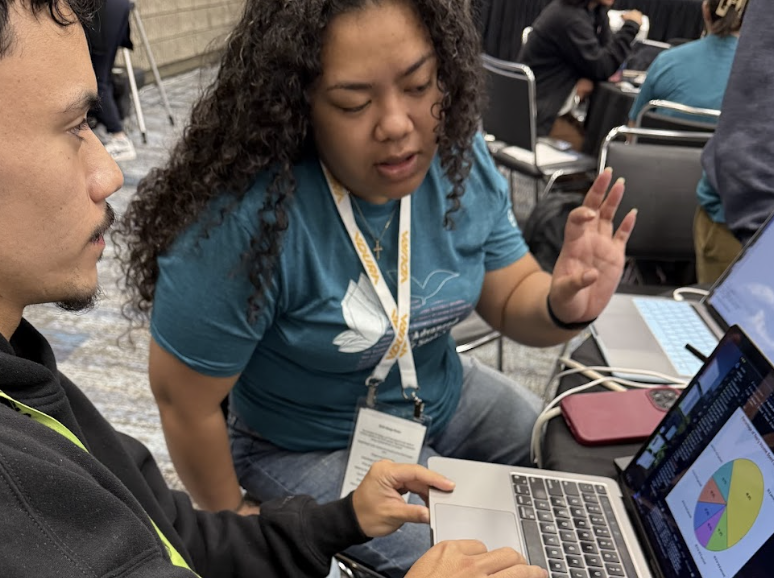
That’s how Rylan Chong, Ph.D., director of Chaminade’s Data Science Program, described the University’s showing in the most recent Advanced Computing for Social Change Challenge. Five Silverswords participated in the event, held in Atlanta from Nov. 16 to Nov. 21, joining students from across the country for a bootcamp-type experience full of learning and camaraderie.

It’s the sixth year Chaminade students have participated, using their skills in data analysis, computational thinking and the latest techniques in data visualization to explore a social challenge and consider data-informed solutions. A key component of the challenge is a presentation so participants can learn how to effectively communicate their findings to the general public.

Tallen Vidal ‘28, who is majoring in Data Science, became the first freshman to complete the challenge. In his project, he focused on the impact of COVID-19 on the homeless population of Oahu and put together recommendations aimed at better protecting the vulnerable group.

While Vidal is just beginning his university journey, he is already inspired about how he might deploy data science for the public good. “I believe data science can prove to be a powerful driver for social change because of how informative the data can be,” Vidal said.


Never miss a post! Follow Chaminade University on Facebook and Instagram.


He noted that quality, trustworthy data is important for creating strategies to “attack the problems of today, which gives us a clearer plan for the mission of tomorrow. It can also be used to spread awareness so that more people can understand the presence of various social problems.”

Chong said the advanced computing challenge begins with participants selecting a research question and collecting key figures from large publicly-available data sets. From there, they use the Texas Advanced Computer Center supercomputer to analyze it and produce results.

He noted the challenge also stresses community connections, which is why several students previously presented their projects in Hawaiian to a large audience of scientists, engineers and statisticians. At the most recent event, Olynann Taase ‘25 presented her research in Samoan.

Students in the challenge tackle a social problem—and then seek to use data to help craft solutions.

Chong was also particularly proud of participants Anson Ekau ‘25 and Berylin Lau ‘26, who completed their own work while also looking for ways to help their peers. Lau focused her project on cultural identity while Ekau worked on a project about Hawai’i’s economic challenges.

And in another bright spot for Chaminade, Dae’Onna Butler ‘27 was offered the honor of presenting her project first “because of her advanced analytics, research project and spectacular practice presentation,” Chong said.

“She went into the presentation helping other students understand the expectations, demonstrating confidence, and setting the tone.

Two Chaminade students—Upumoni Logologo ‘25 and Kole Nagai ‘25—also attended the challenge as mentors after having previously participated. Over the week, they guided students with their research, helped them with computer coding and gave pointers on presentations.

“Data science has the potential to significantly impact social change by providing insights and evidence-based solutions to complex societal problems. By analyzing data, we can identify patterns, predict trends, and propose data-driven interventions that have the capacity to address issues such as inequality, public health challenges, and environmental sustainability,” said Logologo, adding the challenge is not only a learning opportunity but a chance to network with organizations.

Vidal said while the challenge was tough, he walked away with new confidence, ideas and inspiration.

“My favorite part of the event was getting to meet and talk to other students who were from all over the country,” he said, adding that he hopes to stay in touch with them. “I was able to learn so much about each and every one of their cultures and places they are from.”

Posted by: University Communications & Marketing Filed Under: Featured Story, Homepage, Innovation, Students Tagged With: Data Science

Faculty Embrace Learning Opportunities

January 8, 2025

Learning isn’t just for students.

In fact, James Heller Sutton’s primary mission as Chaminade’s assistant provost for Faculty Development is helping faculty members learn how to take their teaching skills to the next level.

And Faculty Learning Communities at the University are designed to make that happen, offering collaborative environments for faculty members to engage with one another around teaching and learning.

The faculty learning communities program was launched at Chaminade in Fall 2022 and has matured and grown since then, offering faculty members outlets to learn about everything from advances in educational technology to yoga to Hawai’i history (complete with walking tours). One of the newest FLCs will tackle generative AI.

Groups are typically kept small—with 12 faculty members or less—and together they tackle semester- or year-long projects together.

“These communities are structured to promote active participation and the exchange of ideas among faculty,” Sutton explained.

FLCs focus on four primary categories: Teaching, scholarship, service and social activities or wellness. Each group of faculty members gather for a variety of activities aimed at fostering collaboration, professional development and community-building, Sutton said.

“It gives those faculty who really want to explore a topic deeply the opportunity to do that,” Sutton said.


Never miss a post! Follow Chaminade University on Facebook and Instagram.


Koreen Nakahodo, Ph.D., who teaches English at Chaminade, led a faculty learning community whose members read and analyzed Laudato Si, an encyclical from Pope Francis focused on caring for the environment.

She has also participated in several more FLCs, from a Catholic intellectual tradition reading group to a hands-on learning effort to create an aquaponic pond on campus.

Hiking has been one of the wellness activities undertaken by FLCs. Here, Chaminade faculty members pose during a break on a hike.

“The FLCs allow me to connect with other colleagues through common interests or academic pursuits,” Nakahodo said. “We are all so busy that it is an opportunity for us to take some time to learn from each other or serve the community. The FLCs allow us to break those silos.”

That’s music to Sutton’s ears.

He said the end goal of the effort is to create a “stronger, more connected faculty community, drive innovation in teaching and learning practices, and support the personal and professional development of faculty members”—and to have some fun along the way.

Sutton added that each FLC has a liaison from Chaminade’s Center for Teaching and Learning, ensuring not only that the group has the resources they need but also that they’re able to make key professional development connections aimed at elevating their practice.

“The activities within the FLCs support faculty in becoming better teachers and mentors by providing a structured, supportive space for reflection, collaboration, and feedback,” Sutton said, noting FLCs are also interdisciplinary so faculty members from across campus build relationships.

“By engaging in discussions with colleagues from diverse disciplines and perspectives, faculty expand their professional networks, learn from each other’s experiences, and gain fresh insights into teaching and mentoring. This cross-disciplinary collaboration ultimately enriches their own practices, making them more adaptable and innovative educators.”

Posted by: University Communications & Marketing Filed Under: Faculty, Featured Story, Homepage Tagged With: Center for Teaching and Learning

Study Underscores Importance of Student Engagement

December 26, 2024

For the past 12 years, Professor Tracy Trevorrow, Ph.D.—director of the Center for Medical Psychology at Chaminade—has been surveying university students on their sleep and health habits. His latest research, in partnership with other university sleep centers, underscores the importance of campus support and engagement activities to help students thrive.

Trevorrow is a co-author on the study, which looked at causes for insomnia in college students. The research, conducted with Oregon State University and fellow collaborator Harvard University, included more than 1,000 undergraduates and found students who reported 8 to 10 hours of screen time daily had an increased likelihood of insomnia.

But the study also looked at the connection between social interactions and trouble sleeping, finding students who reported higher levels of loneliness were more likely to have trouble with insomnia—irrespective of their daily screen time amounts.

Trevorrow said the study, which included 227 participants from Chaminade, puts a spotlight on the success and leadership programs that help students remain engaged—and feel supported—as they pursue their undergraduate degrees.


Never miss a post! Follow Chaminade University on Facebook and Instagram.


“It’s very important to appreciate how important good sleep is to health, a sense of wellbeing and to learning,” Trevorrow said. “Although this is just a single study, it appears that social connectedness among students is important for getting adequate sleep in addition to being careful about excessive screen time.”

The study was published in the Journal of American College Health, and Trevorrow expects to expand surveys to further explore students’ sense of social connectedness and daily screen time. Trevorrow added the study underscores the importance of Chaminade’s “many opportunities for students to develop friendships and social connections through clubs, sports, student government, and campus events.” He noted the University’s robust counseling program is also important—as is continuing to develop new engagement activities.

“This study highlights the importance of keeping a lifestyle balance” and prioritizing friendships and a sense of belonging, Trevorrow said.

“Feeling socially connected helps students manage the challenges of college life, and also appears to improve sleep.”

As for screen time, Trevorrow recommends keeping it to less than eight hours a day.

Posted by: University Communications & Marketing Filed Under: Behavioral Sciences, Campus and Community, Featured Story, Homepage Tagged With: Research

Team Building with a Mission

December 20, 2024

Every semester, Chaminade’s Office of Enrollment Management and Student Success tackles a service project together. On Dec. 17, they ventured out for their latest volunteering effort—a clean-up of Palolo Stream.

Over the course of the day, some 19 staff members collected 197.2 pounds of trash that would have ended up in the ocean.

The stream runs through Chaminade’s campus on its way to Waikiki, and the volunteers found everything from tires to plastic bottles.

Jennifer Creech, vice president for Enrollment Management and associate provost for Student Success, said her group was delighted to leave the stream cleaner than they found it. Students regularly venture into the stream in the area for class projects.

“We have a shared responsibility to be stewards of the resources and care for the land,” Creech said.

“While the students and the classes use this area as an active learning space, we believe it is important to do our part to maintain a beautiful and clean entrance to welcome others into our community.”


Never miss a post! Follow Chaminade University on Facebook and Instagram.


Creech said taking on a service learning project as a team is a no-brainer: It’s fun with a mission.

The volunteer effort was coordinated with the assistance of Jon Watase MBA ’24, who is director of ‘āina-based learning at Saint Louis School.

Creech said Watase does an “outstanding job coordinating the efforts and incorporating educational components, ensuring we all leave with a deeper understanding and a stronger sense of commitment to caring for this special place.”

Posted by: University Communications & Marketing Filed Under: Campus and Community, Featured Story, Homepage Tagged With: Environment

Sparking Sustainability Innovation in Students

December 19, 2024

A cutting-edge program at Chaminade aimed at sparking innovation in students through sustainability entrepreneurship opportunities was selected to receive a $300,000 non-competitive increase in its federal grant, underscoring the importance of the effort and its impact in the community.

The ’Inana Innovators Program was originally funded with $600,000 in 2022 from the Minority Business Development Administration and the additional funding allows the program to be extended through 2025.

Principal Investigator Helen Turner, Ph.D., professor of Biology and research director at Chaminade’s CIFAL Honolulu Center, said the program is focused on attracting the next generation to sustainability-focused tech opportunities and growing the innovation sector in Hawai’i and the Pacific Islands.

“When you look at the long-term goals for Hawai’i’s economy, there are a lot of conversations about the defense sector, tourism, agriculture—those traditional mainstays,” Turner said.

“In addition to growing large new sectors like clean energy and aquaculture, we need to focus on developing individual entrepreneurs. Growing the innovation sector means starting early—with programs that teach both the mechanics of entrepreneurship and build the confidence to try.”

Federal funding for the ’Inana Innovators Program covers student compensation for innovation internships, entrepreneurship courses, and other salary support and activities.


Never miss a post! Follow Chaminade University on Facebook and Instagram.


Mariane Uehara, ’Inana Innovators sustainability entrepreneurship coordinator at Chaminade, said participating students are excited about bringing new solutions to longstanding sustainability challenges, from climate change to the proliferation of plastic waste. In addition to courses and internships, the program offers valuable opportunities for students to get mentorship from industry experts.

Students are even challenged to create their own apps to showcase their work.

“Sustainability and entrepreneurship are big words,” Uehara said, adding, “The only way to get these things done is by doing it. Entrepreneurship is about having courage and excitement to solve problems. The tools and skills to do that, that’s what we want to teach and spark.”

Program participant Kyle-Jacob La’akea Gamiao ‘26 is working to develop an app called Lāʻau Friends. He said users will be able to use the app to identify native plants, get details on cultural protocols and practices, and serve as a platform to share stories and indigenous knowledge.

“The main goal is to do all of this in a fun and interactive way that entices not only our target demographic—children and educators—but people of all ages and places,” he said. “The app will function as a way to preserve Hawaiian culture, inform others about ways to take care of the ‘āina, and serve as a possible framework for other parts of the Pacific to use as well.”

Gamiao said during the Fall semester, his work with the ’Inana Innovators Program included everything from developing an AI chatbot to animating a character for his app to learning about how to attract sustainable funding for a project.

“I’ve learned how to be flexible but ethical in how I solve problems that approach me,” he said. “I’ve learned how to work with others and to outsource during the ideation process. I’ve also learned to balance flexibility and determination.”

Gamiao is pursuing a degree in Environmental Science and hopes to go on to graduate studies.

He also plans to continue developing Lāʻau Friends.

For Uehara, the ’Inana Innovators Program is about showing all students—from many different backgrounds—that they have the power to apply their talents and skills to society’s shared sustainability challenges.

“All of us could use an entrepreneurial mindset,” she said.


The `Inana Innovators program is funded by MBDA grant #MB22OBD8020275-T1. You can reach Principal Investigator Dr. Helen Turner at [email protected].

Posted by: University Communications & Marketing Filed Under: CIFAL Honolulu, Featured Story, Homepage, Innovation Tagged With: CIFAL Center, Innovation, Office of Sponsored Programs

  • « Go to Previous Page
  • Page 1
  • Interim pages omitted …
  • Page 24
  • Page 25
  • Page 26
  • Page 27
  • Page 28
  • Interim pages omitted …
  • Page 42
  • Go to Next Page »

Footer

Chaminade University Logo

3140 Waialae Avenue
Honolulu, Hawaii 96816

Contact Us
Phone: (808) 735-4711
Toll-free: (800) 735-3733

facebook twitter instagram youtube linkedin

Visit

  • Plan Your Visit
  • Campus Map (PDF)
  • Events

Resources

  • Campus Security
  • Student Consumer Information
  • Concerns, Feedback, and Reporting
  • Institutional Review Board
  • Title IX / Nondiscrimination Policy
  • Compliance
  • Emergency Information
  • Careers
  • Institutional Statement

People

  • Students
  • Parents
  • Alumni
  • Faculty & Staff

Policy

  • Privacy Policy
  • Terms and Conditions of Use


© Chaminade University of Honolulu