
• Skip to primary navigation
  • Skip to main content
  • Skip to primary sidebar
  • Skip to footer
Chaminade University of Honolulu

Chaminade University of Honolulu

  • VISIT
  • APPLY
  • GIVE
  • STUDENTS
  • PARENTS
  • ALUMNI
  • FACULTY/STAFF
  • Admissions
    • Admissions Home
    • Undergraduate Students
      • First-Year Students
      • Transfer Students
      • Admitted Students
    • Graduate Students
    • Flex Online Undergraduate Program
    • Military Students
    • Non-Degree/Visiting Students
    • Experiential Honors Program
    • Early College Program
    • New Student Orientation
  • Tuition & Aid
    • Financial Aid Home
    • Tuition & Expenses
    • Federal Updates & Changes
    • Scholarships
    • $5,000 Graduate Scholarship
    • VA Education Benefits
    • Net Price Calculator
  • Academics
    • Academics Home
    • Academic Programs
    • Office of Student Success
      • Academic Advising
      • Records and Registrar
    • Kōkua ʻIke (Support Services)
      • ADA Accommodations
      • Career Services
      • Proctoring Services
      • Tutoring Services
    • Sullivan Family Library
    • Undergraduate Research & Pre-Professional Programs
    • Commencement
  • Campus Life
    • About Campus Life
    • Student Engagement
    • Student Government Association
    • Residence Life and Housing
      • Summer Conference Housing
    • Health Services
    • Marianist Leadership Center
    • Counseling Center
    • Campus Ministry
    • Campus Security
    • Dining Services
    • Bookstore
  • Athletics
  • About
    • Chaminade University News
    • Our Story
    • Leadership
    • Chaminade University Strategic Plan 2024-2030
    • Mission & Rector
    • Association of Marianist Universities
    • Facts & Rankings
    • CIFAL Honolulu
    • Accreditation & Memberships
    • Montessori Laboratory School
Search
×

Search this web site

Scholar: Catholic Bioethics Must Evolve

October 16, 2024

Dr. Therese Lysaught is an influential voice in Catholic healthcare

Dr. Therese Lysaught, professor at the Neiswanger Institute for Bioethics and Health Care Leadership at Loyola University Chicago, argues Catholic bioethics must embrace the fullness of the Catholic social tradition and pay more attention to ethical dimensions of healing that are relevant to people’s lives.

Addressing attendees at the latest Marianist Lecture, which was held Oct. 13 at the Mystical Rose Oratory, Lysaught also said a broadened Catholic bioethics has the ability to play a critical role in society.

In an introduction before the lecture, Chaminade’s Dr. Dustyn Ragasa applauded Lysaught’s encyclopedic knowledge of Catholic bioethics and the healthcare system while also praising her for a “big heart and unwavering compassion and commitment” to help patients.
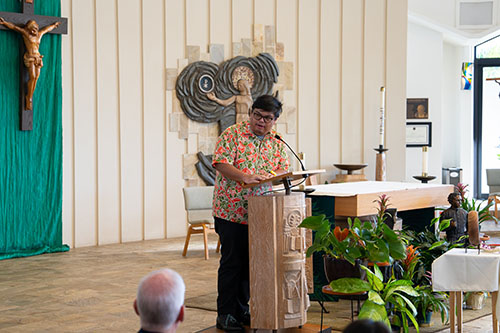
Dr. Dustyn Ragasa praised Dr. Therese Lysault for her unwavering commitment to help the poor and ill.

“In her work, she holds theology, medicine, ethics and bioethics in profound dialogue,” said Ragasa, director of the Pastoral Theology master’s degree program.

“She’s addressed such issues as the anointing of the sick, gene therapy, genetics, human embryonic cell research, end of life, neuroscience, global health, bioethics and social justice.”

In her lecture, titled “Catholic Bioethics: Catholic Social Tradition and Human Flourishing,” Lysaught detailed three different healthcare scenarios: One involved a Guatemalan man with kidney failure, the second was an elderly Black suffering from end-stage congestive heart failure, and the third involved an 8-year-old gunshot victim.

“Open up any textbook or journal on Catholic bioethics and you will find no mention of such scenarios or of a myriad of similar issues,” Lysault said. “They don’t count as topics for Catholic bioethical analysis.”

Yet they need to be, she said.

Lysault added Catholic bioethics must incorporate a broader analysis of poverty, race and ethnicity.


Never miss a post! Follow Chaminade University on Facebook and Instagram.


She also argued that the Catholic social tradition could help expand and re-orient Catholic bioethics around a foundation of caring for the sick and approaching the moral dimensions of health and medicine.

Lysault asserted the COVID pandemic exposed many bioethical questions like: How should few effective treatments, such as ventilators, be allocated to patients? How should scarce protective equipment be allocated among frontline healthcare workers? Could patients’ advance directives be overridden?
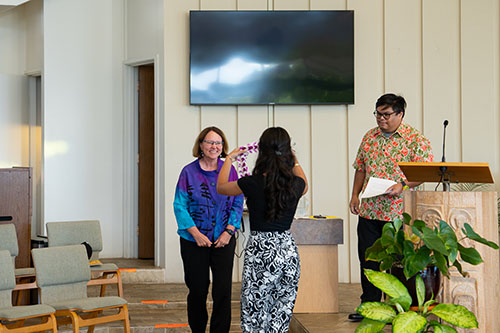
Dr. Therese Lysault was presented with a lei after Dr. Dustyn Ragasa introduced her to the audience.
Dr. Therese Lysault was presented with a lei from Emmalee Bugado after Dr. Dustyn Ragasa introduced her to attendees.

According to Lysault, there was nothing in the literature of Catholic bioethics to address these questions.

And four years later, she added, while secular bioethics has begun to attend to these questions, you’ll still find almost nothing in the Catholic bioethics literature about these issues.

Tackling questions such as these “will require the theoretical and practical tools of social analysis in the Catholic social tradition,” she concluded.

In her address, Lysaught also touched on a 2022 study in which researchers interviewed 10 kupuna from rural Hawaii communities about their experiences with healthcare barriers. When asked what advice they had for providers about how to improve healthcare for Native Hawaiians, the elders did not list the standard bioethical principles or any of the principles of Catholic bioethics, Lysault said.

“Rather, they appreciated providers who, to quote, ‘took the time to talk story and to get to know them as people and community members,’” Lysault said.

“They appreciated providers who shared information about themselves.”

At the end of her lecture, Lysault was presented with the Mackey Award for Catholic Thought, which honors scholarly, community and faith leaders whose body of work advances the spirit and educational mission of the Society of Mary and the Marianist Family.

Presenting her with an ‘umeke, Chaminade Student Engagement Coordinator Andrew Ancheta told Lysault the significance of the koa bowl in Hawaiian culture and remarked, “Today, you filled it with spiritual and intellectual food.”

Share this:

  • Click to share on X (Opens in new window) X
  • Click to share on Facebook (Opens in new window) Facebook
  • Click to share on LinkedIn (Opens in new window) LinkedIn

Posted by: University Communications & Marketing Filed Under: Catholic, Homepage, Institutional Tagged With: Campus Event, Catholic, Marianist Lecture

Primary Sidebar

Recent Posts

  • Chaminade celebrates Founders’ Week 2026January 29, 2026
  • Education has long been challenged by new technology. The key is new adopting new tactics, said Provost Lance Askildson.
    Ending the AI ‘Arms Race’: An Interview with Provost Lance AskildsonJanuary 27, 2026
  • Chaminade University forensic sciences lab secures last remains of Saint Marianne of Moloka‘iJanuary 23, 2026
  • Hawai‘i Public Radio star shares career tips with aspiring entrepreneursJanuary 23, 2026
  • $1.25 million grant for early intervention educationJanuary 12, 2026
  • Opening Doors to Early CollegeDecember 12, 2025
  • Student Surfboard as ArtDecember 5, 2025

Footer

Chaminade University Logo

3140 Waialae Avenue
Honolulu, Hawaii 96816

Contact Us
Phone: (808) 735-4711
Toll-free: (800) 735-3733

facebook twitter instagram youtube linkedin

Visit

  • Plan Your Visit
  • Campus Map (PDF)
  • Events

Resources

  • Campus Security
  • Student Consumer Information
  • Concerns, Feedback, and Reporting
  • Institutional Review Board
  • Title IX / Nondiscrimination Policy
  • Compliance
  • Emergency Information
  • Careers
  • Institutional Statement

People

  • Students
  • Parents
  • Alumni
  • Faculty & Staff

Policy

  • Privacy Policy
  • Terms and Conditions of Use


© Chaminade University of Honolulu