• Skip to primary navigation
  • Skip to main content
  • Skip to footer
Chaminade University of Honolulu

Chaminade University of Honolulu

  • VISIT
  • APPLY
  • GIVE
  • STUDENTS
  • PARENTS
  • ALUMNI
  • FACULTY/STAFF
  • Admissions
    • Admissions Home
    • Undergraduate Students
      • First-Year Students
      • Transfer Students
      • Admitted Students
    • Graduate Students
    • Flex Online Undergraduate Program
    • Military Students
    • Non-Degree/Visiting Students
    • Experiential Honors Program
    • Early College Program
    • New Student Orientation
  • Tuition & Aid
    • Financial Aid Home
    • Tuition & Expenses
    • Federal Updates & Changes
    • Scholarships
    • $5,000 Graduate Scholarship
    • VA Education Benefits
    • Net Price Calculator
  • Academics
    • Academics Home
    • Academic Programs
    • Office of Student Success
      • Academic Advising
      • Records and Registrar
    • Kōkua ʻIke (Support Services)
      • ADA Accommodations
      • Career Services
      • Proctoring Services
      • Tutoring Services
    • Sullivan Family Library
    • Undergraduate Research & Pre-Professional Programs
    • Commencement
  • Campus Life
    • About Campus Life
    • Student Engagement
    • Student Government Association
    • Residence Life and Housing
      • Summer Conference Housing
    • Health Services
    • Marianist Leadership Center
    • Counseling Center
    • Campus Ministry
    • Campus Security
    • Dining Services
    • Bookstore
  • Athletics
  • About
    • Chaminade University News
    • Our Story
    • Leadership
    • Chaminade University Strategic Plan 2024-2030
    • Mission & Rector
    • Association of Marianist Universities
    • Facts & Rankings
    • CIFAL Honolulu
    • Accreditation & Memberships
    • Montessori Laboratory School
Search
×

Search this web site

Catholic

Celebrating Our Founders and Heritage Awardees

April 13, 2022

As part of Founders’ Week celebrations, three extraordinary members of the Chaminade University ‘ohana were recognized with Heritage Awards for their tireless work to put Marianist values into action.

Dr. Elizabeth Park, Celine Mesiona-Perez and Stacey Higa pose for a photo after receiving their Heritage Awards

Dr. Elizabeth Park, director of Early Childhood and Montessori programs and the Castle Teacher Resource Activity Center, was the recipient of the Chaminade Award in recognition of her work to embrace the Catholic intellectual tradition and seek out ways to promote social justice and peace.

The Marianist Award was presented to Chaminade Communications Manager Stacey Higa, who was recognized for her strong commitment to the Marianist value of family spirit and for her work to build a collaborative community centered around openness, hospitality, graciousness and faith.

And finally, Celine Mesiona-Perez was named the recipient of the Founders’ Award, presented to a student who demonstrates generosity and respect for others, serves as an exemplary role model for the community, and is engaged in service to others, especially those who are disadvantaged.

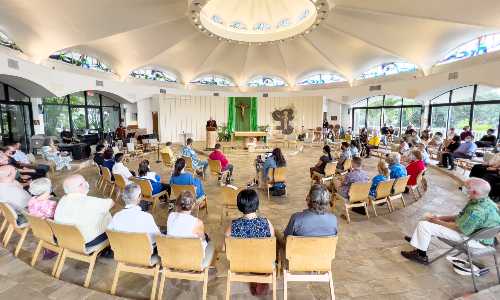
The honorees were recognized at a special ceremony on April 6 following the Founders’ Day Mass at Mystical Rose Oratory. The event was the culmination of a series of gatherings meant to celebrate not only the founders of the Marianist family—including the university’s namesake—but the characteristics of a Marianist education and the values and mission that are central to Chaminade’s identity.

Other events included a lei draping ceremony and prayer service, an exhibition of works from the Marianists & the Arts series of workshops, and International Extravaganza—a hugely popular showcase of cultural performances put on by student clubs that coincided with Father Chaminade’s birthday.

Dr. Elizabeth Park with her Chaminade Award certificate with Dr. Babington posing for a photo

The Rector’s Office presents the Heritage Awards, which are meant to celebrate the special contributions of a faculty member, support staff member and student who embody Marianist values.

Those who nominated Park for the Chaminade Award highlighted her collaborative spirit, tireless commitment to drive positive change, and her belief in her students and in the university’s mission.

“Dr. Park has been, and continues to be, a valued member of the Chaminade faculty and an exceptionally motivated and caring professor,” wrote Dr. Dale Fryxell, dean of the School of Education and Behavioral Sciences, in nominating her for the award. “The impact that Dr. Park is making at Chaminade, in her profession, in the community and internationally can clearly be seen.”

Park said she was humbled and honored when she learned she would be receiving the award.

She added that Marianist values resonate with her and with the work she does to bolster early education opportunities. “To educate in the family spirit and for service, justice and peace is to be mindful and work as a community,” she said, adding that Marianist values like peace education and educating for adaptation and change are woven into the Early Childhood Education curriculum. “We respect and support each other but also stand up for each other in the face of injustice.”

Park also said that at Chaminade she has learned to “grow and embrace my calling in life.”

Stacey Higa with her Marianist Award certificate with Dr. Babington posing for a photo

Marianist Award nominations for Higa came in from across the university—from Chaminade administrators, fellow support staff and faculty members. Lisa Furuta, vice president of University Communications and Marketing (UCM), wrote that Higa is always up for a challenge in service to Chaminade’s mission and its Marianist values and embraces a collaborative spirit to get things done.

“There are those who run away from a fire and those who run into the flames. Stacey would invariably do the latter if given the choice. However, it is her magnetic and ‘one team’ personality that draws others into the charge with her,” Furuta wrote, adding Higa is “indispensable” to her colleagues.

Furuta also wrote if your day is off to a slow start or if you are feeling down, “your best prescription would be to visit Stacey for a dose of positivity and optimism. Stacey has created a palpable feeling of warmth and enduring faith here on campus … and makes others feel instantly welcome.”

Higa said she was moved by the recognition. She added as a member of the Communications and Marketing Department, she is not only proud to belong to such a special community but “see firsthand all the amazing work and community impacts that our faculty, staff, students and alumni do every day.”

“I get to see our Marianist values alive,” she said. “I am so excited and honored to be part of this community where values and the family spirit are important. This award isn’t just a reflection of me, but also my colleagues in UCM because we truly work as a team and try to be good collaborators and partners with other university departments.”

Celine Mesiona-Perez with her Founders' Award certificate with Dr. Babington posing for a photo

Mesiona-Perez, who received the Founders’ Award, is pursuing a Forensic Science degree with a Chemistry minor. She is also very active on campus, including in Campus Ministry, student government and several clubs. Faculty members and staff who nominated Mesiona-Perez said she is not only a positive role model to her fellow students but to everyone in the Chaminade community.

“Her presence in the classroom environment is always underpinned by honest, genuine interactions,” Dr. Katelynn Perrault, an associate professor of Forensic Sciences and Chemistry, wrote to the Heritage Awards Committee. “She is concerned with being a voice for those who do not always have the ability to represent their own. It is a pleasure to have someone in our program with admirable qualities like this.”

Mesiona-Perez said she has found a “home away from home” at Chaminade and was floored by the special recognition. “The family that I have found here is made up of countless individuals who endlessly influence, equip and inspire me to be the best leader that I can be,” she said.

At Chaminade, Mesiona-Perez added, she has been able to pursue her love for STEM, strengthen her Christian faith, and deepen her passion for servant leadership. “In everything that I do, I desire to share the love that I have so gracefully received my Heavenly Father unto them,” she said, adding that she wants “others to feel at home, accepted, with a sense of belonging” at Chaminade—just as she is.


Founders’ Week Recap Video

Posted by: University Communications & Marketing Filed Under: Campus and Community, Catholic, Featured Story Tagged With: Heritage Awards, Marianist

Welcoming the Diaconate Formation 2022 Cohort

April 5, 2022

Diaconate formation 2022 cohort with faculty and staff

On a quiet Saturday in March, a group of people from all walks of life gathered at Chaminade’s Mystical Rose Oratory to begin a five-year journey of academic, spiritual and pastoral formation aimed at preparing them for life as a deacon—or a deacon’s wife—in the Catholic Church.

Nearly 40 people attended the diaconate candidate orientation, including 22 program participants.

Dr. Dustyn Ragasa, director of the Master of Pastoral Theology program at Chaminade and an assistant professor of Religious Studies, said the newest diaconate cohort includes 10 couples and two single men. They are members of the military and law enforcement, teachers and professors, health care professionals, and business owners. “Each one brings along with them a wealth of practical experience that enables them to do theology in their own unique ways,” Ragasa said.

“Some candidates come to us with previous theological training and others are learning the fundamentals of disciplined theological inquiry. Some are lifelong Catholics and others are recent converts to the faith. This mosaic of perspectives enriches the learning experience as a whole.”

The March 12 orientation was the first held at the Mystical Rose Oratory—what Ragasa said underscores the strong partnership between the Diocese of Honolulu and Chaminade. Participants in the Diocese of Honolulu’s permanent diaconate formation program can opt to also pursue a graduate certificate, Master of Pastoral Theology or Religious Studies bachelor’s degree at Chaminade. Three women and six diaconate candidates across cohorts are currently pursuing a Master of Pastoral Theology at the University. Ragasa stressed that the degree also welcomes laymen and laywomen.

The role of deacon is an “ancient” one in Catholicism, Ragasa said, and described in the Bible.

Both married and single men can serve as deacons, and married men participate in the diaconate formation program with their wives. After being ordained, deacons serve their communities and the Church in many ways, Ragasa said. “Theirs is the responsibility to proclaim the gospel and to preach,” he said. “They also have the capacity to baptize, to distribute holy communion, to perform marriages, to officiate over funerals, to lead prayer and to take on leadership roles in their communities.”

But unlike priests and bishops, deacons hold “day jobs” in a long list of fields—from education to healthcare to engineering to social service. What unites them, Ragasa said, is simple: “It is expected that deacons will uplift and care for those around them regardless of the work they undertake.”

Diaconate formation 2022 cohort with faculty and staff

Participants complete the diaconate formation program in cohorts, dedicating three years to intellectual and academic growth and two years to intense spiritual reflection and pastoral work. Along the way, they’re mentored by those who completed the program and are now ministering in parishes.

Deacon Michael Weaver, MPT ‘14, a lecturer of Historical and Political Studies at Chaminade, attended the orientation with his wife to speak to participants and said a central element of the formation program is to help a candidate determine if becoming a deacon is their calling.

“Through both personal prayer and competent spiritual direction, together with academic and professional formation, each person discerns if such a vocation is truly present for him,” he said. “The core effect, I think, is to discover who you really are as a person and a believer. You develop confidence that manifests itself in a willingness to preach the Gospel and represent the Church in the world.”

The seeds for the strong partnership between Chaminade and the diaconate program were planted more than a decade ago, Ragasa said, and the Diocese of Honolulu has since garnered national attention for its commitment to a high quality of theological and academic preparation for its candidates.

“Honolulu is one of the very few dioceses that boasts this level of partnership with its local university,” Ragasa added. “Having local professors who understand our cultures, who sit in the pews enables them to address the specific educational needs of men and women ministering in our unique island context.”

The group of candidates that met on campus in March is part of cohort 11, and their academic preparation program officially began in April. Ragasa said the orientation was designed to both help candidates feel comfortable at Chaminade and familiarize them with resources at the University.

Bro. Edward Brink, vice president for mission and rector at the University, welcomed candidates and their wives to campus with an opening prayer and explained the rich history of Marianists in Hawaii. His talk touched on key hallmarks of Marianist education—including a mission to serve others—and encouraged cohort members to take an active part in campus life and the Chaminade family.

Participants also got a tour of the Sullivan Family Library and its vast collection.

Dr. Cheryl Edelson, dean of the School of Humanities, Arts and Design, also welcomed the program candidates at the orientation and spoke about the importance of the humanities in the Catholic intellectual tradition. She also invited cohort members to participate in school programming.

Fr. Martin Solma, Chaminade chaplain, closed the day with a touching closing rite for candidates and their wives. Ragasa said the commissioning liturgy—meant to prepare program candidates for the significant journey ahead—was the highlight of the day and a “fitting way to recognize the beginning of formation, with prayer and reflection.”

Posted by: University Communications & Marketing Filed Under: Campus and Community, Catholic, Featured Story, Humanities, Arts & Design, Institutional Tagged With: Marianist

Marianists and the Arts Program

March 28, 2022

An exciting year-long workshop series at Chaminade is seeking to help tell the rich stories of the University and its Marianist founders through art in a bid to give participants an engaging and hands-on way to appreciate the institution’s sense of place—and reflect on their own place in it.

Each Marianists & the Arts workshop approaches Chaminade’s history through a different field of study or craft, from Olelo Hawaii to ceramics to digital art to woodworking. And when each workshop ends, participants walk away with their own hand-crafted “artifact” that helps tell Chaminade’s story.

The series was developed by Sr. Malia Wong, a Humanities, Arts and Design senior lecturer.

Wong said each of the Marianists & the Arts workshops include a presentation based on readings and a unique “creating session that’s focused on bringing a part of the story to a contemporary audience.”

In launching the workshop series, Wong was able to secure a grant from the Marianist Sponsorship Ministries Foundation for supplies and other costs. Additionally, she recruited a number of Chaminade faculty members and staff who were delighted to help tell Chaminade’s story in a new way.

Kumu Kahi Renauld teaching olelo as part of the Marianist and the Arts program

Wong said that by the end of each workshop, participants walk away with insight into “one or more parts of the history of Chaminade through the vision, dreams, struggles and successes, faith and humanity, and values of the first Marianists as represented by the artifact produced.”

In one recent workshop, Kumu Keahi Renauld explored the life and contributions of Bro. Oliver Mahealani Aiu—a Native Hawaiian who went away to study and then returned to serve his community. He said the participants considered how language and culture are intertwined, and how Olelo Hawaii plays a relevant and important role in the story of the Marianists and Chaminade today.

“We all need to realize the power of our words in everyday life,” Renauld said.

Dr. Junghwa Suh teaching a Marianist & the Arts workshop

Dr. Junghwa Suh, a professor in the Environmental + Interior Design program, used digital arts to illuminate the contributions of Bro. Joseph Becker, who helped to found Chaminade and wrote its alma mater. For her workshop, she tasked participants with visualizing the emotions of the lyrics.

Suh said she jumped at the chance to lead the workshop because she wanted to learn more about Chaminade’s founders. She added that giving participants the freedom to interpret emotions in art and then incorporate their perspectives is powerful. “These activities are designed to reflect on who and where they are in the story of our founders and journey, and learn about the University,” she said.

International Studies student Marl-John Valerio attended a Marianists & the Arts workshop that focused on the legacy of Bro. Bertram Bellinghausen, the first president of what would later become Saint Louis School. Attendees reflected on his life and work as they tackled a ceramics project.

“What I enjoyed most about the workshop was the process. Shaping and forming the art that you envisioned was difficult for a novice like me,” Valerio said. “My biggest takeaway is that mistakes are OK. You can envision what you may want in life but sometimes it won’t work out as you thought.”

Chaminade student working on a ceramics piece during the Marianist & the Arts workshop

Devin Oishi, a Fine Arts professor at Chaminade, led the ceramics workshop. In addition to helping students to make pinch pots or slab pieces, he created a collaborative piece with participants. “I threw a large base on the potter wheel and students, staff and friends then added coils as a mirror of how Chaminade developed, with a foundation and generations contributing to the legacy,” he said.

Oishi said he wants attendees to think of themselves as “the next layer of stones being added to the foundation” of Chaminade and members of a strong ‘ohana contributing to society in a meaningful way.

Kumu Kahoalii Keahi-Wood, a cultural engagement specialist in the School of Natural Sciences and Mathematics, led workshops on campus la’au, or vegetation, and the teachings of Marianist Father Joseph Priestley. Keahi-Wood said he sought to underscore how Priestley, who was Native Hawaiian, embraced Marianist values without losing his cultural identity.

“In this workshop, we explored the values and steps required to be a practitioner, protocols involved in picking plants, carrying out healing, and basic chants that can be done to refocus your mind,” Keahi-Wood said. “We also take a look at plants that are found on campus and viewed for healing.”

Kahoalii Keahi-Wood instructing his Marianist & the Arts workshop

And the takeaway from the gathering? It’s simple.

“You don’t need to lose your traditions to follow Marianist ones. There is overlap,” Keahi-Wood said.

Dr. Dale Fryxell, dean of the School of Education and Behavioral Sciences, said he was honored to participate in the Marianists & the Arts series. He led a workshop focused on woodworking and the life of Father Stephan Tutas, who served as director of the Marianist community in Honolulu, taught at Saint Louis School, and was a professor and administrator at Chaminade before leaving the islands.

Fryxell said Tutas is well-known for his reflections, including his writings on an “attitude of gratitude.”

Workshop participants turned and assembled their own pen out of koa wood on a lathe.

“What better way to start each day than to use the pen that they created, to learn and write about things they are passionate about and will hopefully lead them to become leaders that will inspire others, just as Father Tutas did?” said Fryxell, who previously owned and operated a woodworking business.

Dr. Dale Fryxell watches a student woodwork during the Marianist & the Arts program

Fryxell said Tutas also wrote about “turning points in our lives,” and so he encouraged participants to consider the connection between these critical moments and the turning of an object on a lathe. “Often when you start to create something on the lathe, you may have an idea about what it will turn out to be. But in the process, it may end up completely different—similar to many of life’s journeys,” Fryxell said.

That was the big lesson that Nursing student Taylor Crawford walked away with.

“I need to have more patience as life has many turns,” she said, adding she hopes to take more workshops. “I enjoyed being creative and making something linked to the people we learned about.”

Charlie Clausner, MBA ’21, attended the workshop on Olelo Hawaii. He said he chiefly wanted to add to his Hawaiian language skills. But along the way, he said, he also “gained a deeper foundation of the Hawaiian language and learned a lot about some Chaminade classmates and the university.”

In addition to the various workshops, Bro. Edward Brink and Bro. Thomas Jalbert offered a walking tour of the Chaminade campus where participants learned of the University’s history and heard stories of the Marianists.

Posted by: University Communications & Marketing Filed Under: Campus and Community, Catholic, Faculty, Featured Story, Institutional, Student Life Tagged With: Marianist

Catholic Intellectual Life

March 25, 2022

Fr. Dennis Holtschneider speaking to the Chaminade community about the Catholic Intellectual Life

Chaminade University is part of a rich Catholic intellectual tradition that not only seeks to educate and inform but also ask tough questions, prompt opportunities for reflection, create space for new ideas and assist the next generation of leaders in looking for ways to build a more peaceful and just world, said renowned Catholic education leader Fr. Dennis Holtschneider in a recent talk at the university.

“Higher education is complex and rarely possible without the assistance of charitable donations. We do it as a gift to the world. Why? Because ideas matter,” Holtschneider, president of the Association of Catholic Colleges and Universities, told attendees at the March 15 address at Chaminade.

“Our graduates are gifts to a world that needs that gift for its improvement.”

Holtschneider’s talk was entitled “The Core of Catholic Intellectual Life,” and he spoke to university administrators, faculty members, staff, and others about the importance of embracing and admiring the intellectual, creative, teaching, and human development work that happens every day at the university.

Catholic universities, he noted, serve many roles. As a home for evangelization through campus ministries. As a place to offer opportunities to those from disadvantaged backgrounds. But first and foremost, Holtschneider said, “they’re in service of the intellectual life where ideas matter.”

And as the largest non-governmental provider of higher education in the world, he added, there is no shortage of ideas at Catholic universities. He pointed to just a few of the impressive projects happening at these institutions, from advancements in medicine to breakthroughs in economics or political theory.

“We prepare the next generation of teachers, social workers, nurse practitioners, business leaders, accountants, political advisers, communication professionals, counselors, scholars and more,” he said.

And this modern landscape of education is no “accident of history,” Holtschneider added, “but an expression of a Church that has welcomed, built, and supported the intellectual life for millennia. This is important work for us. This is one of our ministries. Now make no mistake, it’s a fray. If you hire an organization of independent thinkers, you get a lot of independent thought.”

In other words, he said, intellectual work means “intellectual upset.”

Beverly Sandobal, Shana Tong, Mandy Thronas-Brown, Bishop Larry Silva, Fr. Dennis Holtschneider, Dr. Lynn Babington, Dr. Scott Schroeder, Cynthia McIntyre, Bro. Edward Brink, and Margaret Rufo

It means debate. Disagreement. Growth. Reflection. And it means change.

Holtschneider pointed to the many scholars at Catholic institutions who helped present new ideas whose time had come. They were and are at the forefront of the civil and women’s rights movements, of the push to end poverty and of the monumental work to address the climate change crisis.

“It’s not a set of ideas. It’s a project. Catholic intellectual life is a project,” he said.

And importantly, Holtschneider said, while scholars in the Catholic intellectual tradition have no predetermined answers, they do have non-negotiable starting places that reflect a common set of values and ideals. “Our vocation as educators is to prepare the next generation, hoping they might even improve upon the world as we know it now. If that’s all we did, it would be enough,” he said.

“We care that our students become experts in the fullest sense of their chosen professions. We also care about who they become as they spend a life wielding the education that we have given them. We explore things with them and how they’re thinking about the world. We may not be ethics professionals all of us, but we dare not avoid ethics when teaching if we care about our students’ lives ahead.”

Holtschneider himself speaks as a Catholic scholar who believes strongly that robust academic environments help to drive positive change. He received a doctoral degree in administration, planning and policy from Harvard University, holds eight honorary degrees, and serves as a member of the faculty at several higher education leadership programs, including at Harvard and Boston universities.

“Nothing is more powerful than an idea that breaks through and changes everything,” he said.

Fr. Dennis Holtschneider speaking to Chaminade faculty and staff

Holtschneider’s presentation at Chaminade was part of a series of lectures that were made possible through the Association of Marianist Universities. He is set to speak at Chaminade’s sister universities—the University of Dayton in Ohio and St. Mary’s University in Texas—later this year.

After his presentation at Chaminade, attendees were given a chance to follow up with questions or reflections. Several people said they were moved and inspired by Holtschneider’s message and wanted to seek out ways to share it with a broader audience. Holtschneider applauded those efforts while noting that the intellectual tradition offers a pathway without a set endpoint or destination.

He called the process of searching out ideas “humbling” and full of exciting discoveries.

And it’s not just scholars on that journey; students are there, too.

“We ask them to look long and hard at the world for four years. But we also ask them to look long and hard at themselves and think about how they want to be actors in that world, about what they will value, what they will fight for in their lifetimes, and what they will work for,” he told attendees.

“Most importantly, we give them questions that matter and to think about in the lifetime ahead. And that is the Catholic intellectual tradition. All of it. Not a pre-determined answer that one generation passes onto the next but a constant searching for what’s true, what’s good and what’s holy.”

Posted by: University Communications & Marketing Filed Under: Catholic, Featured Story, Institutional Tagged With: Guest Speakers

Bishop Robert McElroy Discusses a Synodal Church

March 10, 2022

In late 2021, Pope Francis called on the whole of the Catholic Church to embark on a two-year journey of reflection, profound renewal, and transformative reform that seeks to touch every element of ecclesiastical life and drive an ongoing process of reflection among Catholics worldwide.

Bishop Robert McElroy speaking during the Chaminade Marianist Lecture

As Most Reverend Robert McElroy, Bishop of San Diego, explained in a recent Marianist Lecture at the Mystical Rose Oratory, this process of “synodality” is not about issuing new documents from Rome but embracing change together. It is, he added, “a continuing call to reform within the life of the Church.”

Bishop McElroy acknowledged that the term “synodality” is confusing and has been misunderstood.

And so, in unpacking it during his lecture on February 27, Bishop McElroy first noted that the concept of synod is not new but rather ancient and refers to a “coming together” or a religious assembly. “Pope Francis is calling for a moment of rediscovering, of going back and rediscovering part of our tradition,” he said.

In outlining the “architecture of synodality” at both the parish and personal level, Bishop McElroy said the process presents several key themes. Among them: that synodality “points to the reality that the whole people of God are engaged and journeying together in the life of the Church” and also demands a “constant state of discernment”—seeking answers as part of a community and in dialogue.

Bishop McElroy also underscored the importance of “authentic listening” and empowering diverse voices.

“A synodal church is a humble and honest church,” he said. “A synodal church seeks to discern its woundedness and embrace reform. Its holiness is exemplified by humility. A synodal church seeks a healthy decentralization in its structure and life. Practices that exclude groups must be rejected.”

Bishop McElroy continued, “Pope Francis has called us to transform the life of the Church and in turn the life of the world.” And that work—the process of reflection, listening and mission—“is not the work of a moment, but the work of a lifetime. At this moment, it is our work and is our mission.”

Bishop Robert McElroy speaking during the Chaminade Marianist Lecture

The global conversations on synodality in the Catholic Church will culminate with an international gathering in October 2023, during which church leaders will seek to explore key themes identified at dioceses. Bishop McElroy, however, cautioned against thinking of the dialogue as something that ends there. “This notion of synodality is a process of conversation. It doesn’t end at a particular time,” he said.  

Bishop McElroy delivered his address before an audience both online and in person, and then participated in a question-and-answer session to clarify key points or explore new ones. The talk was presented as part of the ongoing Marianist Lecture series, sponsored by the Marianist Center of Hawaii, Chaminade University and Saint Louis School, and designed to foster inclusive and robust dialogue.

Following his address, Bishop McElroy was presented with the Mackey Award for Catholic Thought.

Several attendees at the lecture thanked Bishop McElroy for helping them to understand the concept of synodality. They also wondered aloud about next steps, including what they could do to participate in the conversation and encourage their fellow parishioners to do the same.

“I think what stuck out most to me was the real inward focusing of it, about listening, changing our stance as a church to be more humble and just more understanding,” said Sebastian Conway-Phillips.

Another attendee, Our Lady of Good Counsel School Principal Chantelle Enos-Luarca, said the faculty and staff members at her campus participated in a robust dialogue as part of the process of synodality.

“We have some great ideas … but what’s next?” she asked.

Bishop McElroy responded, “I think the most important consequences are the conservations that occur at the local level. All of these parishes, there are certain things that come up that are good things to do.” He added that there’s no need to wait on implementing those good ideas. “Do them now,” he said.


Watch the entire Marianist Lecture below.

Posted by: University Communications & Marketing Filed Under: Campus and Community, Catholic, Featured Story Tagged With: Guest Speakers, Marianist

Chaminade Students ‘Build Bridges’ with Pope Francis

March 1, 2022

College students with Pope Francis on Zoom

It’s not every day that a Zoom meeting is also a once-in-a-lifetime opportunity.

But then, it’s also not every day that your virtual meeting features Pope Francis.

That’s exactly what two Chaminade students got the chance to experience recently. The historic encounter with the Pope was part of a dialogue with students from North, Central and South America on the economic and environmental pressures contributing to migration and displacement.

Chaminade junior Alycia Tausaga, who is majoring in Environmental Science, and senior Joseph Durocher, a Biochemistry major, were part of a group of about 20 students in the West and Pacific Region. In total, the Pope met with about 100 students from across the three regions during the virtual meeting on February 24.

Tausaga said she felt inspired after listening to the Pope speak directly to her group.

Alycia Tausuga participating in the Building Bridges event with Pope Francis

“He took his time out to come to this historic encounter and to listen to what university students have to say and provide encouragement for the youth,” Tausaga said. “It was such a good opportunity to build the bridge, and it also allowed me to connect with other students from around the globe.”

The meeting was organized as part of an initiative called Building Bridges. University students were challenged to come together to seek ways to overcome the walls separating the peoples and cultures of South, Central and North America and provide opportunities for authentic dialogue and leadership.

Chaminade’s Rector and VP for Mission Bro. Edward Brink learned about the program after reading an article in the National Catholic Reporter. He reached out to Loyola University Chicago and was able to secure spots for two Chaminade representatives in a group of students from Catholic universities in the West and Pacific. Loyola University Chicago hosted the event in collaboration with the Argentinian theologian, Emilce Cuda, the head of the office of the Pontifical Commission for Latin America, who asked the Pope to participate.

Tausaga and Durocher were selected because of their interest in climate change.

Joseph Durocher participating in the Building Bridges event with Pope Francis

Durocher, who is a Ho’oulu Scholar, said students in the group coordinated before the meeting to discuss key issues and put together a presentation. “People are already aware that are migration and environmental issues,” he said. “This was about starting actual change.”

He added that he felt honored and “very special” to have been included in the dialogue.

“We have to stop just talking and not doing anything,” he said.

Tausaga, who is a National Science Foundation S-STEM Scholar at Chaminade, said as a Pacific Islander she’s seen the impacts of climate change firsthand. She said the meeting with the Pope reminded her of a well-known Hawaiian proverb: Huli ka lima i lalo or “turn the hand down.” In other words, instead of turning your palms out expecting something from others, turn them down and get to work in the soil.

“Turn your hands down to give and to work in the community,” said Tausaga. “Have heart and compassion for others. Be the voice to allow others to bring about change. That’s what this meeting with the Holy Father really highlighted for me. It strikes at the heart.”


Building Bridges Recording

Media Coverage

Posted by: University Communications & Marketing Filed Under: Catholic, Featured Story, Students Tagged With: Marianist

  • « Go to Previous Page
  • Page 1
  • Interim pages omitted …
  • Page 9
  • Page 10
  • Page 11
  • Page 12
  • Page 13
  • Interim pages omitted …
  • Page 18
  • Go to Next Page »

Footer

Chaminade University Logo

3140 Waialae Avenue
Honolulu, Hawaii 96816

Contact Us
Phone: (808) 735-4711
Toll-free: (800) 735-3733

facebook twitter instagram youtube linkedin

Visit

  • Plan Your Visit
  • Campus Map (PDF)
  • Events

Resources

  • Campus Security
  • Student Consumer Information
  • Concerns, Feedback, and Reporting
  • Institutional Review Board
  • Title IX / Nondiscrimination Policy
  • Compliance
  • Emergency Information
  • Careers
  • Institutional Statement

People

  • Students
  • Parents
  • Alumni
  • Faculty & Staff

Policy

  • Privacy Policy
  • Terms and Conditions of Use


© Chaminade University of Honolulu