• Skip to primary navigation
  • Skip to main content
  • Skip to footer
Chaminade University of Honolulu

Chaminade University of Honolulu

  • VISIT
  • APPLY
  • GIVE
  • STUDENTS
  • PARENTS
  • ALUMNI
  • FACULTY/STAFF
  • Admissions
    • Admissions Home
    • First-Year Students
    • Transfer Students
    • Graduate Students
    • Flex Online Undergraduate Program
    • Military Students
    • Non-Degree/Visiting Students
    • Experiential Honors Program
    • Early College Program
    • New Student Orientation
  • Tuition & Aid
    • Financial Aid Home
    • Tuition & Expenses
    • Federal Updates & Changes
    • Scholarships
    • $5,000 Graduate Scholarship
    • VA Education Benefits
    • Net Price Calculator
  • Academics
    • Academics Home
    • Academic Programs
    • Office of Student Success
      • Academic Advising
      • Records and Registrar
    • Kōkua ʻIke (Support Services)
      • ADA Accommodations
      • Career Services
      • Proctoring Services
      • Tutoring Services
    • Sullivan Family Library
    • Undergraduate Research & Pre-Professional Programs
  • Campus Life
    • About Campus Life
    • Student Engagement
    • Student Government Association
    • Residence Life and Housing
    • Health Services
    • Marianist Leadership Center
    • Counseling Center
    • Campus Ministry
    • Campus Security
    • Dining Services
    • Bookstore
  • Athletics
  • About
    • Chaminade University News
    • Our Story
    • Leadership
    • Chaminade University Strategic Plan 2024-2030
    • Mission & Rector
    • Association of Marianist Universities
    • Facts & Rankings
    • CIFAL Honolulu
    • Commencement
    • Accreditation & Memberships
    • Montessori Laboratory School
Search
×

Search this web site

Alumni

Medical School Journey

January 17, 2024

Rachel Arakawa enters her final year at George Washington

She’s more accustomed to dispensing medicine than she is advice. So, when asked what she would advise students to expect when they’re in medical school, Rachel Arakawa ’20 offered this simple suggestion: “Keep focus on your goals. And remember, you are just as qualified as anyone there.”

During a casual information session with students enrolled in Dr. Amber Noguchi’s HP 390 class–Advanced Topics in Health Professions Preparation—Arakawa shared her journey to George Washington University’s School of Medicine and Health Sciences. Like many freshmen who entered college amid a global pandemic in 2020, the former Silversword soccer and tennis player had to decide whether to stay home or move to Washington D.C.

“Even though all my courses were going to be online, I decided anyway to move to D.C.,” said Arakawa, who hopes to do her residency either in the Maryland–Virginia area or on the west coast. “That first year was really tough because it was my first time being away from home, and I had six to eight hours of online lectures every day, and then another two to three hours of reviewing the previous day’s content. We covered everything I learned as an undergraduate in two months.”

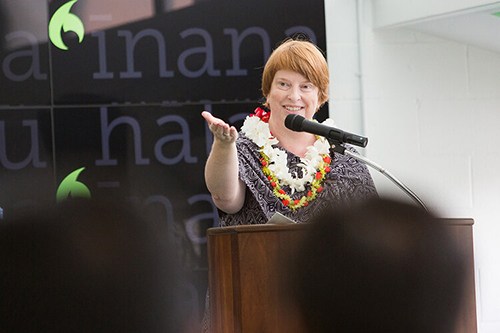
Chaminade President Dr. Lynn Babington welcomed Rachel Arakawa '20 back to campus this month for an informal discussion with students.
Chaminade President Dr. Lynn Babington welcomed Rachel Arakawa ’20 back to campus this month for an informal discussion with students.

Discipline and academic rigor, though, weren’t new to Arakawa. At the beginning of her sophomore year, the Kaneohe native decided to formally enter into an Articulation Agreement between Chaminade and George Washington University’s School of Medicine and Health Sciences.

At its essence, an articulation agreement document is a formal arrangement between two colleges or universities, outlining a structured transfer plan for specific program offerings. Depending on the program and degree, students have the opportunity to initiate their path towards advanced studies as undergraduates. This involves building a robust academic record and fulfilling prerequisites during their time at Chaminade. The agreement benefits students by guaranteeing the transfer of all completed classes (credits) and providing a clear pathway for ongoing academic progression.

Students who want to take advantage of participating in an articulation agreement, for example with George Washington University, should apply in January of their sophomore year. “This timeline avoids any gap year between undergraduate and graduate programs,” Noguchi noted. “Applicants are required to have spent two years (four semesters) in an undergraduate program of the contractual college and to have completed approximately 60 semester hours of course work by the end of the semester during which they apply.”

Articulation agreements streamline the transfer process for everyone involved. This will help alleviate the stress surrounding the application process, the credit transfer process, and several other issues students might encounter when applying to a graduate program. By simplifying this process with transfer agreements, it is beneficial to all parties involved.

Third year bio-medical major, Joshua Dumas ’25, plans to go to med school even though he didn’t pursue an articulation agreement. The aspiring physician’s decision was based on his preference to attend a school on the west coast so he can be closer to Hawaii and family.

“I was studying all winter break for the MCATs, but I decided to wait until I was better prepared,” said Dumas, a Regent Scholarship awardee and COPE Health Scholar with Adventist Health Castle. “It was inspiring to hear how her Chaminade experience helped her in med school, as I am sure it will help me.”

Now in her fourth year and two of three medical licensing exams behind her, Arakawa has applied to various residency programs and received 20 interviews. Her choice of post-graduate training will be in emergency medicine, a specific area that she has been interested in ever since she started her academic track in the health field.

“I did a lot of event medicine, like at concerts and marathons, and I really enjoyed it,” Arakawa told the students. “I get to look at trauma, but it’s not for everyone. You’ll have to find your own passion and specialty.”

Asked by sophomore Ku‘ulei Koko ’26 if she ever experienced the impostor syndrome, Arakawa unhesitatingly answered yes. “I am a first-generation medical student and the only Hawaiian–Japanese in my class,” Arakawa added. “Some of the other students were also more familiar with the social cues and mores of the medical field since they weren’t first gen. But, I overcame impostor syndrome by not comparing myself with others, and got involved with activities that I liked.”

Healthcare is indeed the perfect complement to Chaminade University’s mission. As a Marianist institution, faculty members educate their students to embrace adaptation and change, family values and community service, which are all core components of our healthcare system. And as a liberal arts school, Chaminade ensures that graduates have a wide breadth of knowledge and are able to think critically across a range of disciplines.

“I learned a lot during my years at Chaminade years—inside and outside of the classroom,” Arakawa said. “The small class sizes and the supportive faculty helped shaped my belief in serving the community and being an empathetic individual that can make a transformational impact.”  

Posted by: University Communications & Marketing Filed Under: Alumni, Homepage, Institutional, Natural Sciences & Mathematics, Undergraduate Research & Pre-Professional Programs Tagged With: Alumni, Guest Speakers, Transformation

‘Native Voices’

January 4, 2024

Traveling exhibit makes its first Hawaii stop at Sullivan Family Library

Among medical librarians, the “Native Voices: Native Peoples Concepts of Health and Illness” art exhibit is its own version of Taylor Swift’s “The Era Tours,” having traveled across the U.S. for more than a decade now. Officially opened at the U.S. National Library of Medicine (NLM) on October 5, 2011, the multi-media interactive exhibition explores the interconnectedness of wellness, illness and cultural life for Native Americans, Alaska Natives and Native Hawaiians.

With a keen and long-held desire to help improve public understanding of Native American health challenges and honor the culture, tradition and healing ways of Native Peoples, Donald A.B. Lindberg M.D. (National Library of Medicine’s director from 1984-2015) interviewed more than 80 Native American health and community leaders, resulting in over 250 video clips, the largest such collection of Native American videos known to exist.

While the exhibition’s usual iPad stands didn’t make the trip to Hawaii, you can still watch the videos online. The traveling exhibition that’s on display at Sullivan comprises six free-standing banners: the title banner introduces the exhibition; and each of the other five banners focuses on one of the main themes of Individual, Community, Nature, Tradition and Healing. The categories touch upon such topics as Native views and definitions of health and illness, Native views of land, food, community, the earth/nature, and Spirituality as they relate to Native health and illness, and contemporary and historical roles of traditional healing in Native Hawaiian, Alaska Native and Native American cultures.

Krystal Kakimoto stands in front of the free-standing panels that make up “Native Voices: Native Peoples Concepts of Health and Illness.”

“I think this exhibit will resonate with Chaminade students, and the community in general, because they might see parts of themselves reflected back to them in the panels of the exhibit,” says Krystal Kakimoto, ’22 (MBA), Sullivan Family Library’s liaison librarian and director of library technical services. “For too long, Native knowledge surrounding health has been dismissed. This exhibit gives viewers a chance to reflect and critically think about health and wellness while learning about the resilience and adaptation to change inherit to Native communities.”

Stories drawn from both the past and the present examine how the determinants of health for Native Hawaiians, Alaska Natives and American Indians are tied to community, the land and spirit. Through personal interviews, Native Peoples describe how individual and community wellness were affected by the political and cultural events of the 19th and 20th centuries. Individual reflections show the impact of epidemics, federal legislation, the loss of land and the inhibition of culture on the health of Native individuals and communities today. Collectively, these stories convey how Native people use both traditional and Western methods to enhance wellness, ultimately presenting an inspiring account of renaissance, recovery and self-determination.

Indeed, indigenous art often serves as a powerful medium for expressing cultural values, beliefs and experiences related to health and illness. Many indigenous cultures also hold holistic views of health that encompass physical, mental, spiritual and community well-being. “Native Voices” lays bare these interconnected aspects, emphasizing the importance of balance and harmony.

“I think the special twist on the Native part is that it’s so embedded in the land,” says one of the exhibit’s early key collaborators Marjorie Mau, M.D., physician and Chair of the Department of Native Hawaiian Health at the John A. Burns School of Medicine, in one of the 250 video clips. “It’s like if the land is abused or misused or not cared for, the people are reflected by that. Hopefully, future generations will understand at least when Native people are talking about who they are, and how they can take ownership of their wellness, that they’ll understand their wellness can spring from their homeland and from where they come from.”

“Native Voices: Native Peoples Concepts of Health and Illness” will be on display at the Sullivan Family Library until January 19.

“Chaminade University connects academic learning with the local community, environment and culture, creating a unique college experience for our students,” says Kakimoto, chairwoman of the Hawaii-Pacific Chapter of the Medical Library Association, an organization of consisting of professional librarians, individuals and institutions in health sciences libraries. “This philosophy takes learning beyond the traditional classroom and aims to make learning more relevant, engaging and applicable to the real world. I hope this exhibit continues our tradition of place-based learning to contextualize health in relation to the ʻāina.”

Posted by: University Communications & Marketing Filed Under: Alumni, Campus and Community, Homepage, Institutional, Nursing & Health Professions Tagged With: Art Exhibit, Campus Event, Office of Health Professions Advising and Undergraduate Research

Senate Confirmation

December 12, 2023

Shanlyn Park ’91 confirmed in a bipartisan vote

The District of Hawaii has its first Native Hawaiian woman to serve on the federal bench as a district court judge. Shanlyn Park ’91 is a current state court judge and former federal public defender. She was nominated for the judgeship on September 27, and sat for her hearing before the Senate Judiciary Committee on October 4. She was confirmed on November 30.

In a bipartisan U.S. Senate vote, Shanlyn Park ’91 was confirmed as the first Native Hawaiian woman to serve on the federal bench as a district court judge.

“Judge Park’s unique combination of experience, tenacity and genuine kindness will be a huge asset to the federal bench,” said Chief U.S. District Judge Derrick K. Watson in a released statement. “We are excited to have her join us as our colleague in 2024.”

Park was confirmed on a bipartisan vote of 53-45. The lifetime appointment is particularly significant in terms of representation as Native Hawaiians comprise 21.8 percent of the population in the district where she will preside.

Born and raised in Hawaii, Park has been a state circuit court judge since 2021. She previously worked in private practice and at the Office of the Federal Public Defender for the District of Hawaii. While a practicing attorney, she has also represented individuals on a pro bono basis, including cases of employee discrimination.

In a joint statement, U.S. Sen. Brian Schatz and U.S. Sen. Mazie Hirono applauded Park’s confirmation, saying she “led a distinguished career dedicated to public service.”

“She has exhibited a commitment to justice, fairness and impartiality throughout her career, and is highly qualified to serve on the U.S. District Court,” the senators said. “As the first Native Hawaiian woman to serve as a federal district court judge, Judge Park’s confirmation reflects the Biden-Harris Administration’s commitment to building a federal judiciary that reflects the diversity of our communities.”

Park was the second Hawaii judge to be confirmed in November. The Senate also voted to confirm Micah Smith, a federal prosecutor, to a district court judgeship. Appointed under Article III of the U.S. Constitution, federal district court judges are nominated by the president, confirmed by the U.S. Senate and serve lifetime appointments upon good behavior.

Both Park and Smith fit into President Joe Biden’s broader goal of diversifying the federal judiciary.

“They have the legal acumen as well as the character and temperament required to fulfill the duties of US District Court judges,” Sen. Schatz (D-HI) said at the September 27 hearing. “It’s for these reasons that I’m proud to support their nominations to the federal bench.”

Park is expected to fill the seat currently held by U.S. District Court Judge Leslie Kobayashi, who is expected to go on senior status in October 2024. “Judge Park’s credentials are impressive by any measure, Schatz said. “But the historic nature of her nomination should not be lost on anyone.”

Schatz added that Park has a commitment to equal justice and has spent two decades as a public defender “giving voice to those most in need.”

“She represented low-income defendants on a variety of complex cases, earning a reputation among colleagues and opposing counsel alike as a highly-skilled, compassionate and solutions-oriented attorney,” Schatz said. “And she has brought her integrity and sound judgment to the bench since becoming a state court judge in 2021.

Smith will fill the seat currently held by U.S. District Court Judge J. Michael Seabright, who will go on senior status in January.

Appointed under Article III of the U.S. Constitution, federal district court judges are nominated by the president, confirmed by the U.S. Senate and serve lifetime appointments upon good behavior.

Posted by: University Communications & Marketing Filed Under: Alumni, Diversity and Inclusion, Featured Story, Institutional, Press Release Tagged With: Alumni, Honors and Awards

Early Childhood Education

November 30, 2023

Flex program allowed Sienna Delano to work in a classroom and as a fairytale character

She has been Snow White. She has dressed up as Belle. And Sienna Delano ’23 has even donned on the wings of Tinkerbell. Her ultimate princess fairytale, though, came true in May when she slipped into her blue gown and sashayed across the stage to receive her Chaminade University bachelor’s degree at the Waikiki Shell. But, it has not always been an animated Disney fantasy world for the Kapolei resident.

“When I was in high school, I was dealing with health issues that impeded me from actually attending school,” says Delano, who received a B.S. in Early Childhood Education. “The underlying problem was gastritis, which caused me to pass out a lot, and I was throwing up everything I ate. I really hit rock bottom, but I used my mind to heal myself.”

And it worked with the help of her parents, Ken and Jacqueline, who are both psychologists. Delano ended up getting her high school degree online with Penn Foster. And when she finished her last class at 10 p.m., she recalled waking her parents up and screaming “I just finished.” She was only 16 years old, but this self-described “hustler” has always been somewhat of a wunderkind.

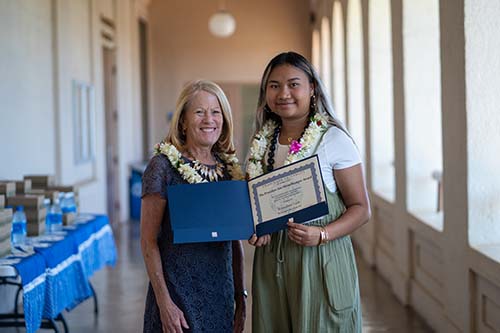
Chaminade University president, Dr. Lynn Babington, presented Sienna Delano with her bachelors degree.

“Even though I got better, I was already enrolled in Chaminade’s Flex program, and I decided to stay with it,” Delano says. “Plus, I didn’t have my driver’s license then, and even though I do have my license now, I still don’t really like to drive.”

Chaminade’s Early Childhood Education (ECE) bachelor’s degree is aligned with state requirements and National Association for the Education of Young Children standards. The ECE major is flexible, and is offered through online courses that allow students to fit instruction into a busy schedule.

“We did some surveys and early childhood educators indicated that their life situations don’t allow them to take in-person courses,” says Dr. Elizabeth Park, associate professor and director of the Early Childhood and Montessori programs. “So what we did was really spend the energy and time to design robust online courses, so that we could really meet the needs of our educators.”

Delano understands the importance of early childhood education, and how it lays the groundwork for a child’s lifelong learning journey, contributing to their intellectual, social and emotional development. The positive experiences and skills acquired during these formative years create a strong foundation for success in school and in life.

“I started the Flex program in 2020 and my goal was to become an early childhood educator in a couple of years,” Delano says. “I really liked Chaminade’s online modules, which allowed me to set my own pace.”

Delano decided she wanted to become a second or third grade teacher because she enjoys reading to kids, a skill that she cultivated and strengthened while working at Storybook Entertainment Hawaii, which primarily provides character entertainment for private parties.

“I’ve always loved reading,” Delano says. “When I was young, I would read with my dad in a green chair that was designated for reading. I’ve probably read six to seven books this year alone.”  

Delano’s parents have always stressed to her and her three sisters the importance of the mind and how to best use it to their advantage. She believes in the importance of using one’s mind lies in its transformative impact on personal development, cognitive abilities, emotional well-being and the overall quality of life.

“Even though I didn’t have the in-person campus experience, I was still able to create  a lot of memories online,” says Delano, who will finish her student-teaching requirement at Kapolei Elementary School in December. “We would have ‘Session Rooms’ and ‘Workspaces” where we could post our ideas and have peer interaction.

“Sr. Malia Wong even had us submit videos of ourselves so it felt like we knew each other,” Delano adds. “She made me cry … in a good way. She called me an inspiration and said to me ‘Maybe I’ll see you as a princess.’”

Posted by: University Communications & Marketing Filed Under: Alumni, Education, Homepage, Institutional Tagged With: Alumni, Early Education, Elementary Education

Hogan Speaker Series

November 16, 2023

Panelists share their insights into entrepreneurship

What guides you? How do you find mentors? How do you overcome failure? What advice would you give your younger self?

These questions and many more were posed to three diverse and accomplished community leaders who served as panelists during the Hogan Entrepreneurial Leadership Program speaker series on Nov. 15 in a packed Keifer Hall Room 9. Panelists Haelee Tallett ’18, Shane Hanson ’16 and Julie Morikawa navigated the questions with ease and decorum, freely sharing their personal and professional experiences with students, alumni and faculty, all eager to soak in knowledge and insight. 

Tallett is the founder, owner and lead designer of Ocean Creations, which she started as an online business and now has several brick-and mortar-locations. Alumnus Shane Hanson is founder and owner of Freedom Fiduciaries. Morikawa, a hospitality industry executive, is the president of non-profit ClimbHi, which creates bridges between high school and college students from education to career paths, and is dedicated to workforce development in Hawaii.

Hogan program director Roy Panzarella opened the discussion by asking the panel, “What is your ‘Why?’” or “Why do what you do?” 

Hanson shared that being an entrepreneur is something innate, that he would rather work 80 hours for himself than 40 hours for another corporation. He also shared that he came to Chaminade to play basketball and eventually participated in a competiton in which student groups created their own products and marketing plans. The fulfilling and exciting experience has remained with him and sparked his entrepreneurial spirit. 

Being an entrepreneur is more important than being a jewelry designer to Hallett. While her company’s product is jewelry, what really motivates her is bringing a sense of confidence and beautiful design to customers who wear or give jewelry as gifts. Jewelry is the means to achieving that goal of the entrepreneurial journey of ideation to product to customer satisfaction. 

When asked how to create sustainable products that are not as profitable, Morikawa replied, “Why do they have to be separate, sustainability and profitablity?” She described a federal grant that ClimbHi recently received that involves partnering with local environmental and sustainability-focused organizations to maintain and improve an important ahupuaʻa (land division) on Oʻahu.

The 90-minute panel discussion served its purpose. The community leaders on the panel thoughtfully answered questions. Students respectfully asked questions. And all left the room with an understanding and insight into how following one’s dream is what it takes to be fulfilled and to have a meaningful impact.

The next Hogan Program speaker will be Gary Hogan on Wednesday, Nov. 29 from 6 to 7:30 p.m. in Kiefer Hall Room 9. Hogan is the CEO of Hogan Hospitality Group and Hawaiian Hotels & Resorts, as well as CEO and Board Chair of Pleasant Travel Service. 

Posted by: University Communications & Marketing Filed Under: Alumni, Business & Communication, Featured Story, Hogan Entrepreneurial Program, Institutional, Students Tagged With: Guest Speakers, Hogan Entrepreneurs Program, Master of Business Administration, School of Business and Communication

Amy Thompson of Mattel

November 3, 2023

’98 alumna shares her role with a leading global toy company

A word of advice from Amy Thompson: be open. Open to new ideas. Open to diversity. And open to equality and inclusion. As executive vice president and chief people officer for Mattel, the ’98 Chaminade alumna oversees all global human resources functions, including compensation and benefits, organizational design and leadership development for the company.

Speaking virtually to students during the Dean’s Speaker Series, Thompson shared her impressive employment history. Before joining Mattel, she served as chief people officer for TOMS Shoes, where she successfully developed and implemented organizational plans to scale the company globally by elevating talent and direct-to-consumer capability. She also founded TOMS Leading Ladies, an organization dedicated to empowering and inspiring women leaders.

Prior to TOMS, she held several global HR leadership roles at Starbucks Coffee Company, as well as led HR teams and departments at Ticketmaster Corporation and Citysearch.com.

Amy Thompson addressed students during the Dean’s Speaker Series.

“I believe my formative experiences, including at Chaminade, shaped my future,” Thompson told attendees. “I came to Chaminade on a full athletic scholarship and, as an athlete, you have to be disciplined.”

The Dean’s Speaker Series is designed to bring private, nonprofit and public sector leaders who have achieved recognition in their respective fields to share their expertise and insights on a broad range of timely issues, as well as share the highlights, challenges and turning points of their individual career paths.

“The Speaker Series is intended to extend classroom learning,” said School of Business and Communication Interim Dean Annette Santos. “It’s a co-curricular experience where the integration between theory and practice is reinforced and realized.”

Another intention of the forum is to bring a diversity of social, cultural, economic and other business-related perspectives to the Chaminade community in order to engage in ways that inform and encourage sustainable business for good. 

“One of Mattel’s external recognitions that I’m really proud of is its standing with the Human Rights Campaign,” Thompson said. “In 2022, for the fourth year in a row, Mattel received a perfect score of 100 on the Human Rights Campaign Foundation’s Corporate Equality Index, the nation’s foremost benchmarking survey that measures corporate policies and practices related to LGBTQ+ workplace equality.’”

As chief people officer, Thompson is guided by several key questions: “Do employees feel supported? Can they be authentic? Do they feel that they belong?”

“We have three values that are foundational to Mattel,” Thompson pointed out in her PowerPoint slide. “Collaboration, Innovation and Execution, which leads to our pillars of leadership: build and drive culture, manage performance, support career growth, promote wellbeing and growth mindset.”

School of Business and Communication Senator and Intern, and United Nations Association of Chaminade University (UNAC) President, Jasmine Mondelo could clearly sense that Thompson immensely cares for Mattel’s culture and talent. She also believes that Mattel offers a prime business model that fosters and values employee relations.

“As a college student who will set out on my own career path after graduation, Amy Thompson and Mattel’s message of inclusivity, fairness and commitment to personal and professional growth is inspiring to me,” said Mondelo after attending the lecture. “Wherever I work, I would want to feel valued and respected as an employee, motivated to achieve success for myself and the company, and capable of continuously improving myself.”

Santos hopes that students will have several takeaways after attending and listening to these guest speakers. “1) I hope that students would be inspired by the personal and professional journey of the featured speakers in ways that enhance their educational experience,” she said. “2) Understand that personal and professional growth is a process that involves challenges and turning points on the way to wins and transformation; and 3) this event also provides opportunities for students to build their network, possibly creating meaningful connections with speakers or those in attendance.” 

Posted by: University Communications & Marketing Filed Under: Alumni, Business & Communication, Campus and Community, Homepage, Institutional, Students Tagged With: Alumni, Campus Event, Guest Speakers

  • « Go to Previous Page
  • Page 1
  • Interim pages omitted …
  • Page 6
  • Page 7
  • Page 8
  • Page 9
  • Page 10
  • Interim pages omitted …
  • Page 25
  • Go to Next Page »

Footer

Chaminade University Logo

3140 Waialae Avenue
Honolulu, Hawaii 96816

Contact Us
Phone: (808) 735-4711
Toll-free: (800) 735-3733

facebook twitter instagram youtube linkedin

Visit

  • Plan Your Visit
  • Campus Map (PDF)
  • Events

Resources

  • Campus Security
  • Student Consumer Information
  • Concerns, Feedback, and Reporting
  • Institutional Review Board
  • Title IX / Nondiscrimination Policy
  • Compliance
  • Emergency Information
  • Careers
  • Institutional Statement

People

  • Students
  • Parents
  • Alumni
  • Faculty & Staff

Policy

  • Privacy Policy
  • Terms and Conditions of Use


© Chaminade University of Honolulu