• Skip to primary navigation
  • Skip to main content
  • Skip to footer
Chaminade University of Honolulu

Chaminade University of Honolulu

  • VISIT
  • APPLY
  • GIVE
  • STUDENTS
  • PARENTS
  • ALUMNI
  • FACULTY/STAFF
  • Admissions
    • Admissions Home
    • Undergraduate Students
      • First-Year Students
      • Transfer Students
      • Admitted Students
    • Graduate Students
    • Flex Online Undergraduate Program
    • Military Students
    • Non-Degree/Visiting Students
    • Experiential Honors Program
    • Early College Program
    • New Student Orientation
  • Tuition & Aid
    • Financial Aid Home
    • Tuition & Expenses
    • Federal Updates & Changes
    • Scholarships
    • $5,000 Graduate Scholarship
    • VA Education Benefits
    • Net Price Calculator
  • Academics
    • Academics Home
    • Academic Programs
    • Office of Student Success
      • Academic Advising
      • Records and Registrar
    • Kōkua ʻIke (Support Services)
      • ADA Accommodations
      • Career Services
      • Proctoring Services
      • Tutoring Services
    • Sullivan Family Library
    • Undergraduate Research & Pre-Professional Programs
    • Commencement
  • Campus Life
    • About Campus Life
    • Student Engagement
    • Student Government Association
    • Residence Life and Housing
      • Summer Conference Housing
    • Health Services
    • Marianist Leadership Center
    • Counseling Center
    • Campus Ministry
    • Campus Security
    • Dining Services
    • Bookstore
  • Athletics
  • About
    • Chaminade University News
    • Our Story
    • Leadership
    • Chaminade University Strategic Plan 2024-2030
    • Mission & Rector
    • Association of Marianist Universities
    • Facts & Rankings
    • CIFAL Honolulu
    • Accreditation & Memberships
    • Montessori Laboratory School
Search
×

Search this web site

University Communications & Marketing

In Real Life

December 2, 2022

Live performances return to the stage at Vi and Paul Loo Theatre
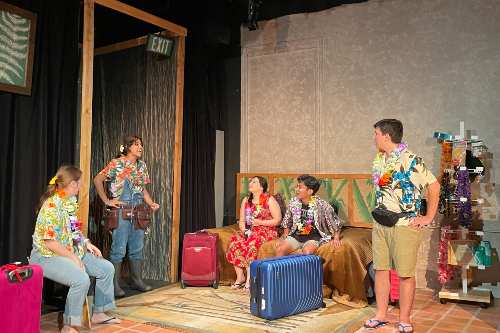
When Things Could Go Wrong play

Luckily, nothing went awry with the recent production of “Things Go Wrong” at the Vi and Paul Loo Theatre. Written by second-year communications major Garrett Hill, the play was flawlessly staged by 13 students and a 2021 alumnus, who is now a full-time surgical intensive care unit nurse. While this may not have been the first student-driven production at Chaminade, it is the first one in a decade, according to Performing Arts assistant professor Christopher Patrinos.

“It was a full house every night,” says Patrinos, who is also the program’s disciplinarian coordinator. Gesturing towards different parts of the “Black Box Theatre,” Patrinos describes the stage layout for the limited five-show performance, with the hotel bar in one corner and the front lobby in another, and a hotel room toward the back.

“We started in a tennis-court-style stage layout (the stage in the middle, flanked by audience members on each side), but as we workshopped the play, we discovered that it would be better as a proscenium stage, which is perhaps the most readily recognizable.”

When Things Could Go Wrong play

With the success of “Things Go Wrong,” Patrinos has ambitions to encourage more student-driven plays, explaining that the production process empowers students to make creative and artistic decisions, from stage design and lights to sound and architecture.

“This is what would make Chaminade a unique stagecraft program,” asserts Patrinos, a Silversword alumnus who went on to attain his MFA at the University of Hawaii at Manoa. “I’ve worked with some great playwrights and directors, but they’ve all been graduate students; our productions would be led by undergraduates.”

Since assuming the role as assistant professor three years ago, Patrinos has bolstered the program and received the support of colleagues Claire Paul (Performing Arts Professor/Technical Director), Tim Carney (Music Professor) and Allison Francis (English Professor). Together, they have fostered a cohesive student theatre community that includes majors from every discipline, whether it be from nursing and business to English and forensics.

“I drive a lot of these projects but I want it to be a collective decision,” Patrinos says. “We’re ambitious and we have a lot of goals.”

One of them is to bring back the summer theatre program, which was initiated in the Spring of 2015 by David Coleman, Ph.D., former Dean of Arts and Humanities. “It has been a project of mine for the past four years,” Patrinos says. “Chaminade definitely needs some type of performing arts curriculum during the summer.”

Patrinos also realizes that students truly have an appetite for the performing arts, as proven by the sold-out shows of “Things Go Wrong.”

“It’s been almost two years since our last in-person production,” Patrinos says. “Seventy-five percent of the audience members were students and of that number, 75 percent were first-time theatergoers. There was a lot of enthusiasm surrounding this production and there were also a lot of nerves since only three of the cast members had any theatre experience.”
Posted by: University Communications & Marketing Filed Under: Campus and Community, Featured Story, Humanities, Arts & Design Tagged With: Performing Arts

Chaminade University and United Nations Host Pacific Regional Sustainability Conference

November 29, 2022

Chaminade University and the United Nations will host a ground-breaking regional sustainability conference this week at the university campus to discuss climate change and the potential impacts to the Pacific region.

The “XIX Steering Committee Meeting Of The CIFAL Global Network” runs from Wednesday, November 30 to Friday, December 2, with the three-day conference bringing together world and local community leaders on goals, education and solutions to the global warming crisis. It will include seminars and workshops by experts from the United Nations and others around the world on climate change, global warming and sustainability.

This regional conference hosted by Chaminade University follows the UN COP 27 Climate Change Summit held earlier this month in Egypt, in which 200 participating countries came together to help resolve the climate change issue.

Seminars and workshops will allow timely and important discussions on a variety of topics related to leadership, health and wellbeing, education, and sustainability in Hawai‘i as well as the United Nations’ Sustainable Development Goals. These goals include climate action, advocating for the oceans, reducing inequalities, and developing programs that pursue peace, justice and strong institutions.

Conference attendees will participate at this week’s Hawaii conference either in-person or virtually. The conference will kick off with an evening reception on Tuesday, November 29 at the university with opening remarks by event co-organizers United Nations Assistant Secretary-General and UNITAR executive director Nikhil Seth and Chaminade University provost Dr. Lance Askildson. Hawaii Governor-Elect Dr. Josh Green is also scheduled to speak during the opening reception.

Earlier this year, Chaminade and the United Nations launched a new Pacific region training and research center to provide leadership development opportunities to tackle these urgent global issues. The university’s Centre International de Formation des Autorités et Leaders (CIFAL) Honolulu is the first and only one of 24 international United Nations Institute for Training and Research (UNITAR) centers to represent the Pacific area.

The Pacific region training center will provide innovative leadership development opportunities and tackle issues such as climate change, poverty, clean water and energy and other urgent global issues. The university’s CIFAL Honolulu Center is the only international United Nations Institute for Training and Research (UNITAR) center located in the Pacific region.

“Our school is honored to partner with the United Nations in hosting this exciting, groundbreaking conference to deal with the critical and timely issue of climate change,” said Chaminade University president Dr. Lynn Babington. “Our state has been an amazing leader in studying climate change and in innovating solutions that include using indigenous knowledge and practices along with new technologies. Sharing these ideas with the rest of the world will only benefit all of us in dealing with this global crisis.”

Tuesday’s reception from 5 p.m. to 8 p.m. and Friday’s sessions from 11 a.m. to 1 p.m. are open to the public. To learn more about the new Chaminade United Nations learning center, go to: chaminade.edu/cifal-honolulu.

# # #

About Chaminade University
Chaminade University of Honolulu believes in the power of education to drive positive change, broaden perspectives and deepen our understanding of one another. With an emphasis on transformative service-learning experiences, we prepare students to serve as tomorrow’s leaders, inspiring and challenging them to use their minds and their hearts to help build stronger and more just communities. We are proud to serve as Hawai‘i’s only Marianist university, and rely on these values to guide us in delivering a high-quality education with an individualized approach and a focus on excellence, innovation and change. Established in 1955, we offer more than 30 undergraduate and graduate programs, including doctoral degrees in education, psychology and nursing practice. Learn more at chaminade.edu.

UNITAR CIFAL Honolulu Center at Chaminade University
CIFAL Honolulu Center is part of the United Nations Institute for Training and Research (UNITAR). It is the 21st international training and research center of the CIFAL Global Network and the only center located in the Pacific Region. CIFAL Honolulu aspires to empower Pacific peoples to create a sustainable future that reflects their values and the priorities of their communities.

Posted by: University Communications & Marketing Filed Under: Campus and Community, CIFAL Honolulu, Diversity and Inclusion, Featured Story, Innovation, Institutional, Press Release

Chaminade Graduate Wins NIH Director’s Award

November 28, 2022

Chloe Talana '20 headshot

Since entering the National Institutes of Health (NIH) post-baccalaureate program in 2020, Chloe Talana has confirmed her passion for biomedical research. The Chaminade alumna has always been ambitious and determined, aspiring to earn medical and doctoral degrees, concurrently. A scientist at heart ever since she attended Farrington High School’s Health Academy, Talana’s interest in science and therapeutics stem from her passion for medicine.

But her career aspirations have changed. Now she’s committed to solely pursuing her doctoral degree.

“When I started my undergraduate at Chaminade, I wanted to be a physician,” Talana admits. “But my experience at NIH has confirmed that I firmly want to be a biomedical researcher.”

During her undergraduate studies at Chaminade, Talana gained the full confidence of faculty members, especially Dr. Michael Weichhaus, who strongly encouraged her to seek research opportunities beyond his lab. Talana’s first research opportunity involved a summer program at Johns Hopkins University, where she studied blood samples from HIV infected individuals to document how their immune cells function.  After her project, she was only one of eight students selected out of a cohort of 103 to be named best poster presentation at the Annual Biomedical Research Conference for Minority Students. She also received the President Sue Wesselkamper Prize for being an outstanding student at Na Liko Na’auao, Chaminade’s annual undergraduate research conference.

“Professor Weichhaus helped me navigate the entire process and prepared me for what to expect,” Talana says. “In fact, the entire Chaminade community has significantly supported me in many ways, and provided me with amazing resources, without which I would never have been able to experience some of the incredible things that I was able to do.”

In the summer of 2019, Talana returned to the mainland. This time, she secured a spot with a research team studying Hepatitis C in a lab at New York University’s School of Medicine. She was fortunate enough to present her findings during a national conference alongside other undergraduates selected for the prestigious Leadership Alliance program. The Leadership Alliance comprises 35 institutions, including such universities as Chaminade, Harvard, Yale and Stanford. The Alliance allows students to gain access to valuable research, mentoring and career development opportunities. 

“It was both an honor and an invaluable experience to share my data with peers,” Talana says. “The occasion affirmed that I was on the right path and helped boost my confidence.”

Talana has come a long way. 

A 2021 NIH Director’s Award winner, she was recognized for her outstanding efforts in the pursuit of efficacious vaccines to prevent COVID-19. And while the rest of the globe took a pause during the pandemic, Talana and her fellow researchers never stopped, knowing the severity of COVID and its lethal spread around the world.

“It’s important that ongoing data is produced,” Talana asserts. “We know that viruses evolve and COVID is no different.”

In a virtual NIH Directors Award Ceremony, then-director Francis Collins, M.D., Ph.D., addressed the 3,263 awardees, congratulating them for their achievements and their outstanding commitment to excellence, public health and the NIH mission.

“Moving forward, amazing progress has been made in vaccines, therapeutics and diagnostics,” said Collins in his video message. “The public health emergency we face today has brought unprecedented challenges. Still, we know that our staff is the best equipped in the world to find innovative solutions to save countless lives.”

Talana takes pride in knowing that the cutting-edge biomedical research performed at the Dale and Betty Bumpers Vaccine Research Center (VRC) at the National Institute of Allergy and Infectious Diseases (NIAID) serves the American people, as well as communities and individuals around the globe. Her endeavors—then and today—have reinforced the idea that the role of a biomedical researcher is just as vital as that of a physician.

“Physicians prescribe medicine,” Talana says. “But biomedical researchers have front-row seats to diseases. So the research we do and the data we collect also saves lives.”

The NIH post-baccalaureate program has exposed Talana to a rich biomedical research experience. It has also left her with a deep understanding of how scientific investigation works and what it entails.  

“The NIH has definitely helped a lot in my decision process,” says the ambitious 25-year-old researcher. “I now know that I want to pursue my Ph.D. in biomedical research.”

Talana is currently applying to some of the nation’s most competitive biomedical research programs, hoping to land a spot that will further allow her to continue her research interests.

“My parents instilled in me an unwavering curiosity,” Talana asserts. “They’ve been encouraging and supportive of all my decisions. And they’ve always told me to do what makes me happy.”

It’s the pursuit of a Ph.D. that makes Talana the happiest.

Posted by: University Communications & Marketing Filed Under: Alumni, Featured Story, Natural Sciences & Mathematics

Chaminade University Awarded $600,000 Federal Grant

November 22, 2022

Chaminade University of Honolulu was among seven minority educational institutions that received $1.75 million in grants from the Minority Business Development Agency (MBDA). The monies are part of an expanded pilot program to support entrepreneurship for undergraduate students.

“This marks another proud achievement and win for our faculty members,” says Chaminade University of Honolulu president Lynn Babington. “Principal Investigator, Dr. Helen Turner, and a supportive leadership team shepherded this grant through a rigorous vetting process, and deserve all the recognition for bringing this nationally competitive award to the university.”

Submitted to the MBDA’s Minority Colleges and Universities Grant Competition, the award will allow Chaminade to develop the “‘Inana Sustainability Entrepreneurship Program,” which aims to spark minority entrepreneurial innovation among Hawaii-Pacific undergraduates.

“As a Native Hawaiian Serving Institution, Chaminade University of Honolulu’s proposal demonstrated a comprehensive understanding of the mission and goals of MBDA, and the requirements of the Federal Funding Opportunity Announcement,” says Donald R. Cravins, Jr., Under Secretary of Commerce for Minority Business Development, in a prepared statement. “In addition, their application presented evidence of the expertise and community resources necessary to meet these goals.”

The Minority Colleges and Universities pilot program will help fund the development of curricula, pilot courses, seminars, and replicable products and tools that address inclusive innovation, entrepreneurship and general economic development.  The award is worth $600,000, funded annually over a two-year span.

“The ‘Inana program is highly collaborative and builds on foundations laid by Chaminade’s more-than-20-year history of promoting business and entrepreneurship,” Dr. Turner says. “`Inana will bring together our new UN Sustainability Center, our outstanding School of Business and Communication, and the highly regarded Hogan Entrepreneurs Program, as well as our Marianist Leadership Center and Experiential Honors program. Together we will laser-focus on supporting the next generation of sustainability focused entrepreneurs for Hawaii and our Pacific region.”

# # #

Chaminade University of Honolulu believes in the power of education to drive positive change, broaden perspectives and deepen our understanding of one another. With an emphasis on transformative service-learning experiences, we prepare students to serve as tomorrow’s leaders, inspiring and challenging them to use their minds and their hearts to help build stronger and more just communities. We are proud to serve as Hawai‘i’s only Marianist university, and rely on these values to guide us in delivering a high-quality education with an individualized approach and a focus on excellence, innovation and change. Established in 1955, we offer more than 30 undergraduate and graduate programs, including doctoral degrees in education, psychology and nursing practice. Learn more at chaminade.edu.

Posted by: University Communications & Marketing Filed Under: Business & Communication, CIFAL Honolulu, Diversity and Inclusion, Featured Story, Hogan Entrepreneurial Program, Innovation, Press Release

Environmental + Interior Design’s new program coordinator challenges students to think outside the box

November 4, 2022

The essence of interior design will always be about people and how they live. It is about the realities of what makes for an attractive, civilized, meaningful environment, not about fashion or what’s in or what’s out.
– Albert Hadley

Matthew Higgins with students

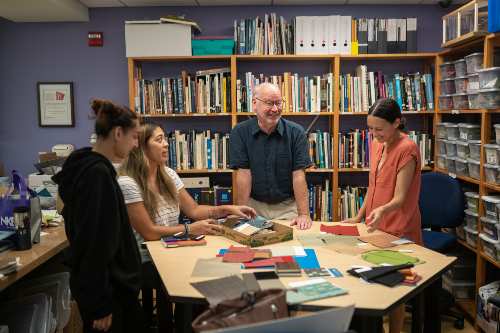
Working with his students, Tina-Marie Dust, Alyssa Hofilena and Amisha Singh, on the interior space of a Chinatown restaurant, Matthew Higgins carefully reviewed their choices of color and textiles, reminding them that a room is a behavioral space that sets the mood.

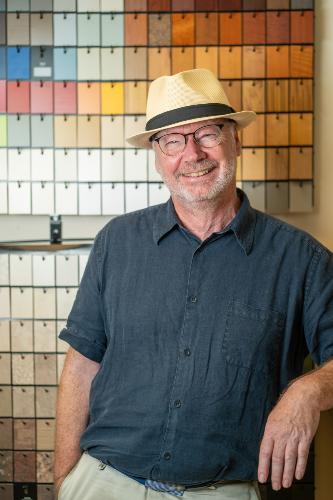
Higgins started at Chaminade University as a visiting professor with the Environmental + Interior Design program a year ago and only recently accepted the position as its program coordinator. In his new role, he will help set the vision for the department and ensure that it retains its Council for Interior Design Accreditation (CIDA) accreditation.

“I never take anything for granted,” says Higgins, referring to the program’s CIDA accreditation. “It’s a rigorous process, which requires a three-day on-site review by a visiting team to determine whether a program meets the standards for interior design education.” 

A significant element in this peer review process is evaluating student work to determine achievement levels as an indicator of the adequacy of the required curriculum. Additional factors include academic and professional qualifications of the faculty in relation to the purposes and objectives of the program; adequacy of the facilities for the educational program; administrative structure of the program and its relationship to the institution as a whole; and program assessment methods, and the program’s continued development and improvement as a result of assessment.

“The scope of design has expanded and much broader now,” Higgins explains. “Here at Chaminade, the program added ‘Environmental’ to the curriculum in attempt to breakdown barriers, and to think beyond windows and doors.”

A licensed Realtor, Ruth Simmons decided to attain her BFA at the university, citing that she wanted to be able to offer her clients interior design recommendations. “I see it as complementing my skills as a Realtor,” she says. “The more you can provide your clients, the better.”

Also in their last semesters, Angela Huber and Laura Flor both hope to land jobs with an interior design firm when they graduate. The two seniors agreed that they’ve learned real-world skills that will help them execute the design process.

Matthew Higgins, E+ID program coordinator

“Students can consider a room as behavioral space and change the mood of that room with interior design,” Higgins explains. “They can play with different materials, forms and hues. They get a really good grounding on the principles of interior design in this program.”

Higgins also appreciates the fact that Chaminade students are working toward a BFA (Bachelor’s of Fine Art) instead of a BA, distinguishing that the former demands more diligence and detail, and encompasses a host of topics, including color theory, textiles, sustainability in design, the history of furniture and much more.

“Chaminade has the only CIDA-accredited interior design program in Hawai‘i,” Higgins points out. “And, if for some reason, you didn’t want to stay in Hawaii, the next closest programs are in California or Japan.”

Posted by: University Communications & Marketing Filed Under: Faculty, Featured Story, Humanities, Arts & Design Tagged With: Environmental + Interior Design

Annual Ceremony Anoints the Hands of Healthcare Workers, Nursing Students

November 3, 2022

“There may come a time when recovery lies in the hands of physicians, for they too pray to the Lord that he grant them success in diagnosis and in healing for the sake of preserving life.”

Ecclesiasticus 38:1-4,6-10,12-14

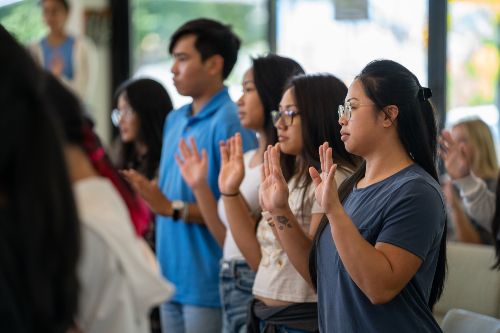
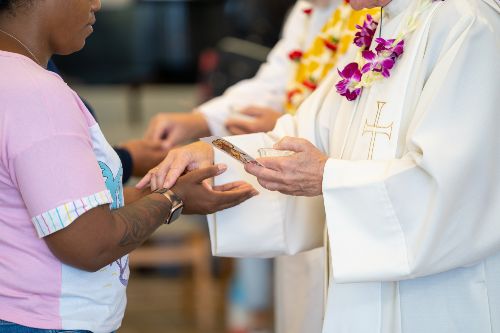
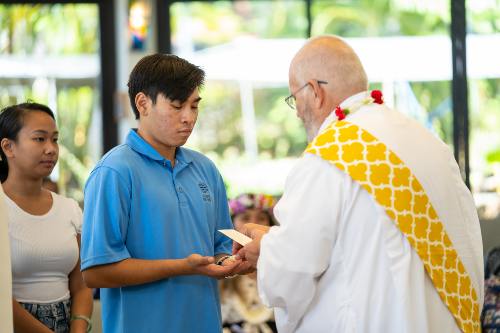
Blessing of hands at the Mystical Rose Oratory

In the book of Ecclesiasticus, it is said, “to honor physicians for their services, for the Lord created them.” The same could be said for students who seek a career in the medical field, and for all caregivers and those working in the medical profession. Sponsored by Campus Ministry, the annual St. Luke’s Blessing at the Mystical Rose Oratory honors these students by anointing their healing hands.

“Let us pray for all healthcare workers and those preparing for the healthcare profession,” said School of Nursing Professor Edna Magpantay-Monroe, in her closing prayer. “That their healing hands might bring comfort, hope, reassurance and joy to all those whom they serve.”

University chaplain Rev. Marty Solma, S.M., presided over the blessing, noting that this is a wonderful opportunity every year to honor those who embrace a life of service through healthcare nursing and to receive an anointment of their hands to recognize the importance that hands are in this critical profession. He then rhetorically asked, why is it that we bless the hands of medical professionals?

“It’s a tradition in in a number of churches in our Catholic tradition,” he replied. “It recognizes that of all the tools you have available to you, your hands will serve your patients directly and most personally. Medicine is important; surgery is often needed. But it’s your hands that will bring tenderness and care, and comfort and reassurance.

St. Luke was indeed blessed with the gift of healing. Deemed the first Christian physician on record and the Patron of the Medical Profession, Luke has influenced thousands of healthcare workers who have followed in his footsteps.

In his letter to the Colossians, St. Paul describes Luke as “the beloved physician,” (Colossians 4:14). In Lives of Illustrious Men, written circa A.D. 393, St. Jerome refers to him as “a physician of Antioch.”

Believed to be the author of the Gospel that bears his name, as well as of the Acts of the Apostles, Luke’s profession as a doctor is apparent in his writings. He includes more miracles of physical healing than any of the other Gospels, 13 compared to 12 in Matthew, 11 in Mark and only two in John. He uses more medical terms than any other New Testament writer. His description of the ailing reveals a knowledge of medicine that is absent in the other Gospels, using such precise medical terms as “dropsy” (Luke 14: 1-6), fever and dysentery.

“It’s my honor to participate in this very important ceremony to bless the hands of our nursing and healthcare professional students, and any of you who may be practicing nurses or other healthcare professionals,” said Chaminade University president, Dr. Lynn Babington. “The professionalism, care and compassion inherent in your profession are strengthened by this blessing. It also symbolizes commitment to your patients.”

Posted by: University Communications & Marketing Filed Under: Campus and Community, Catholic, Featured Story, Nursing & Health Professions

  • « Go to Previous Page
  • Page 1
  • Interim pages omitted …
  • Page 55
  • Page 56
  • Page 57
  • Page 58
  • Page 59
  • Interim pages omitted …
  • Page 150
  • Go to Next Page »

Footer

Chaminade University Logo

3140 Waialae Avenue
Honolulu, Hawaii 96816

Contact Us
Phone: (808) 735-4711
Toll-free: (800) 735-3733

facebook twitter instagram youtube linkedin

Visit

  • Plan Your Visit
  • Campus Map (PDF)
  • Events

Resources

  • Campus Security
  • Student Consumer Information
  • Concerns, Feedback, and Reporting
  • Institutional Review Board
  • Title IX / Nondiscrimination Policy
  • Compliance
  • Emergency Information
  • Careers
  • Institutional Statement

People

  • Students
  • Parents
  • Alumni
  • Faculty & Staff

Policy

  • Privacy Policy
  • Terms and Conditions of Use


© Chaminade University of Honolulu