• Skip to primary navigation
  • Skip to main content
  • Skip to footer
Chaminade University of Honolulu

Chaminade University of Honolulu

  • VISIT
  • APPLY
  • GIVE
  • STUDENTS
  • PARENTS
  • ALUMNI
  • FACULTY/STAFF
  • Admissions
    • Admissions Home
    • Undergraduate Students
      • First-Year Students
      • Transfer Students
      • Admitted Students
    • Graduate Students
    • Flex Online Undergraduate Program
    • Military Students
    • Non-Degree/Visiting Students
    • Experiential Honors Program
    • Early College Program
    • New Student Orientation
  • Tuition & Aid
    • Financial Aid Home
    • Tuition & Expenses
    • Federal Updates & Changes
    • Scholarships
    • $5,000 Graduate Scholarship
    • VA Education Benefits
    • Net Price Calculator
  • Academics
    • Academics Home
    • Academic Programs
    • Office of Student Success
      • Academic Advising
      • Records and Registrar
    • Kōkua ʻIke (Support Services)
      • ADA Accommodations
      • Career Services
      • Proctoring Services
      • Tutoring Services
    • Sullivan Family Library
    • Undergraduate Research & Pre-Professional Programs
    • Commencement
  • Campus Life
    • About Campus Life
    • Student Engagement
    • Student Government Association
    • Residence Life and Housing
      • Summer Conference Housing
    • Health Services
    • Marianist Leadership Center
    • Counseling Center
    • Campus Ministry
    • Campus Security
    • Dining Services
    • Bookstore
  • Athletics
  • About
    • Chaminade University News
    • Our Story
    • Leadership
    • Chaminade University Strategic Plan 2024-2030
    • Mission & Rector
    • Association of Marianist Universities
    • Facts & Rankings
    • CIFAL Honolulu
    • Accreditation & Memberships
    • Montessori Laboratory School
Search
×

Search this web site

University Communications & Marketing

Chuuk Commencement Ceremony

August 1, 2023

CCPI graduates give back to Federated States of Micronesia communities

Chuuk has been previously called many names—officially and unofficially. It was previously named Truk until 1990, and labeled as the Imperial Japan’s “Gibraltar of the Pacific” and even the Pearl Harbor of the Japanese during World War II. But today, the tiny island of just 49 square miles—smaller than Haleakala National Park—is known as one of the four states that comprises the Federated States of Micronesia (FSM); the others being Kosrae, Pohnpei and Yap.

Chuuk is also where Chaminade University entered into a Memorandum of Agreement with the Caroline College and Pastoral Institute (CCPI) in Weno. Since 2010, Chaminade has played an outsized role in educating not only Chuukese, but also island residents in the five different regions within Chuuk State—Northern Nomwoneas, Southern Nomwoneas, Faichuuk, Mortlocks and Northwest.

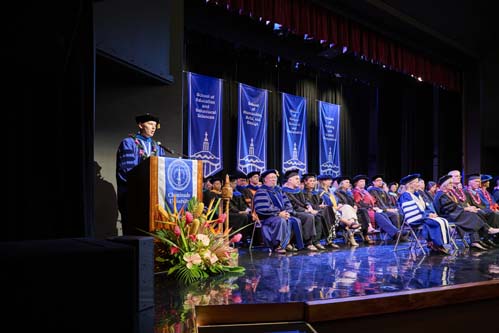
Graduates during the Commencement Ceremony at CCPI in Weno.

In his opening remarks during the CCPI Commencement Ceremony, Chaminade Provost and Senior Vice President, Lance Askildson, Ph.D., told the graduates that this moment is a recognition of both their success in completing their college degree, and an important inflection point in their lives and the future possibilities that are now available to them.

“Now is the time to reflect upon not only how far you have come, but why you began this important journey in the first place,” Askildson remarked. “Your degree means more opportunity and independence; more career and professional advancement possibilities; greater financial autonomy and self-determination; and the potential for new responsibility and leadership in both your professional and civic lives.”

In total, 11 students earned their Bachelor of Arts in Elementary Education (BAEEO) and 49 graduated with their Associate of Arts in Liberal Arts (AALA) this year. It’s a noteworthy achievement, given some of the obstacles that students have had to overcome.

“Many of our students lack the necessary technology or internet access to participate and complete their courses,” said LJ Rayphand, Dean of Outreach Education at CCPI. “CCPI and Chaminade provide the technology and the physical spaces that our students can access and participate in their courses. 

“Even though these are online courses, a distance course facilitator is assigned to each of the classes to provide additional support to both students and instructors,” Rayphand added. “Evening transportation is also provided to afternoon/evening students who reside outside of town.”

Caroline Islands Bishop Julio Angkel addresses graduates during the Commencement Ceremony.
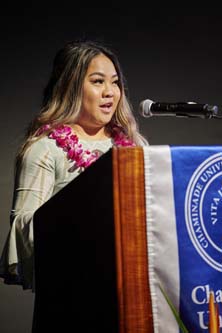
Caroline College and Pastoral Institute President Fr. Rosendo Rudolf addresses graduates during the Commencement Ceremony.

Chaminade’s support of CCPI for the past 13 years has helped, not only increase the number of individuals with college degrees, but also produce knowledge and skillful individuals who contribute to the local economy. Most of the graduates now work with the Chuuk State Department of Education as classroom teachers, specialists and program coordinators. And a good number of them have been hired in health-related fields, social services, finance, legal services and, of course, the private sector, like United Airlines.

“As a developing state or nation, these new graduates have a lot to offer to their community, the state of Chuuk and to FSM as a whole,” Rayphand said. “They will fill job opportunities that will make a huge difference in our community. Many of them work on the frontlines in areas that matter most to our people and our places in Micronesia.”

In his closing remarks, Askildson shared a quote from the personal journal of American poet and environmental writer, Ralph Waldo Emerson, who once wrote, “The things taught in schools and colleges are not an education, but the means to an education.”

“What Emerson meant was that a true education is not (only) what you learn with us, it’s what you learn about yourselves and take with you to embark upon a lifetime of learning and growth thereafter,” Askildson said. “That is the legacy that we gift to you today … and one that will continue your human journey to greater insights and contributions far into the future. In you, we invest our great hope and aspirations for your success and a better future for us all!”

Posted by: University Communications & Marketing Filed Under: Alumni, Catholic, Education, Homepage, Institutional Tagged With: Caroline College and Pastoral Institute, Chuuk, Elementary Education, Partnership

Silversword Reunion Blooms

July 31, 2023

Criminal Justice alumni reunite at Vi and Paul Loo Student Center

Dr. Greg Mark makes it clear that Criminal Justice reunions involve more than just those who may have been one-time dorm mates or who may have taken classes together. Because attendees come from varied disciplines with different majors, the event holds a lot more meaning and makes for a qualitatively powerful experience, according to Mark.

“There’s lots of spirit and camaraderie,” says Mark, a former Criminal Justice professor with Chaminade from 1977-1989. “I’ve been involved with a couple of reunions, one eight years ago at The Willows and a second on campus, which took place right before COVID.”

When Mark taught at Chaminade, the program was called Justice Management until he took over the chairmanship of the department. Because he obtained his doctorate in Criminology—a degree not many people in the country held at the time—and simultaneously taught Ethnic Studies, the then young 20-something-year-old professor decided to change the name to Criminal Justice, which was more accurately reflective of what they were teaching at Chaminade.

Dr. Babington welcomed Criminal Justice alumni and faculty back to campus.
Chaminade President Lynn Babington, Ph.D., welcomed Criminal Justice alumni and faculty, including, from left Pulasi “Sam” Puletasi, Frank Okamura, Kevin Shimoda and Dr. Greg Mark.

“I took fragments of Management Justice and developed a criminology curriculum,” says Mark, who recently attended a Criminal Justice mini reunion held at the Vi and Paul Loo Student Center on campus. “It was a very exciting time to be part of the Chaminade faculty.”

A Criminal Justice major who graduated in 1986, Frank Okamura remembers taking Mark’s Criminal Justice Agencies class and describing him as fair and just like “one of us.” This may be true since some of the students—like Okamura, already a father of two and working as a U.S. Customs Service Inspector and bartender—were closer in age to Mark.  

“I think he (Mark) felt sorry for me because he named me ‘Outstanding Student’ or something like that,” laughs Okamura, who also attended the recent reunion on campus and had a chance to spend some time with his former professor. “I really enjoyed his class, which provided me a better understanding of the different law enforcement agencies.”

A tight-knit group, Criminal Justice alumni members will often socially meet either for lunch or dinner, reminiscing about their days as Silverswords, updating each other on their kids and grandkids, and their achievements since graduation.   

“During my time at Chaminade, we did so many things together, which brought us closer together,” says Mark, referring to students and faculty. “There was a lot of aloha among people in the department and it was a dynamic time.”

At the mini reunion, Okamura was impressed that Chaminade President, Dr. Lynn Babington,  had showed up to welcome them back to campus, making them all feel like they were home.

“Chaminade provided me with a path that I would have never known,” says the 62-year-old retiree and grandfather of five grandkids. “Whenever I needed help, my professors were always there; they were always so supportive and attentive. I am just so appreciative and grateful for my time there.”

Asked if they plan to attend the October Silversword Reunion, Okamura and Mark unhesitatingly said “Yes.” “It will be another chance to talk about each other and some of the work we did together,” Mark says. “Teaching at Chaminade was a great experience. It’s where I grew up professionally, and it’s where I developed my academic and administrative skills.”

Posted by: University Communications & Marketing Filed Under: Alumni, Behavioral Sciences, Education, Featured Story Tagged With: Alumni, Criminology and Criminal Justice, Master of Science in Criminal Justice Administration

The Future of AI

July 27, 2023

LnRiLWJ1dHRvbntjb2xvcjojZjFmMWYxfS50Yi1idXR0b24tLWxlZnR7dGV4dC1hbGlnbjpsZWZ0fS50Yi1idXR0b24tLWNlbnRlcnt0ZXh0LWFsaWduOmNlbnRlcn0udGItYnV0dG9uLS1yaWdodHt0ZXh0LWFsaWduOnJpZ2h0fS50Yi1idXR0b25fX2xpbmt7Y29sb3I6aW5oZXJpdDtjdXJzb3I6cG9pbnRlcjtkaXNwbGF5OmlubGluZS1ibG9jaztsaW5lLWhlaWdodDoxMDAlO3RleHQtZGVjb3JhdGlvbjpub25lICFpbXBvcnRhbnQ7dGV4dC1hbGlnbjpjZW50ZXI7dHJhbnNpdGlvbjphbGwgMC4zcyBlYXNlfS50Yi1idXR0b25fX2xpbms6aG92ZXIsLnRiLWJ1dHRvbl9fbGluazpmb2N1cywudGItYnV0dG9uX19saW5rOnZpc2l0ZWR7Y29sb3I6aW5oZXJpdH0udGItYnV0dG9uX19saW5rOmhvdmVyIC50Yi1idXR0b25fX2NvbnRlbnQsLnRiLWJ1dHRvbl9fbGluazpmb2N1cyAudGItYnV0dG9uX19jb250ZW50LC50Yi1idXR0b25fX2xpbms6dmlzaXRlZCAudGItYnV0dG9uX19jb250ZW50e2ZvbnQtZmFtaWx5OmluaGVyaXQ7Zm9udC1zdHlsZTppbmhlcml0O2ZvbnQtd2VpZ2h0OmluaGVyaXQ7bGV0dGVyLXNwYWNpbmc6aW5oZXJpdDt0ZXh0LWRlY29yYXRpb246aW5oZXJpdDt0ZXh0LXNoYWRvdzppbmhlcml0O3RleHQtdHJhbnNmb3JtOmluaGVyaXR9LnRiLWJ1dHRvbl9fY29udGVudHt2ZXJ0aWNhbC1hbGlnbjptaWRkbGU7dHJhbnNpdGlvbjphbGwgMC4zcyBlYXNlfS50Yi1idXR0b25fX2ljb257dHJhbnNpdGlvbjphbGwgMC4zcyBlYXNlO2Rpc3BsYXk6aW5saW5lLWJsb2NrO3ZlcnRpY2FsLWFsaWduOm1pZGRsZTtmb250LXN0eWxlOm5vcm1hbCAhaW1wb3J0YW50fS50Yi1idXR0b25fX2ljb246OmJlZm9yZXtjb250ZW50OmF0dHIoZGF0YS1mb250LWNvZGUpO2ZvbnQtd2VpZ2h0Om5vcm1hbCAhaW1wb3J0YW50fS50Yi1idXR0b25fX2xpbmt7YmFja2dyb3VuZC1jb2xvcjojNDQ0O2JvcmRlci1yYWRpdXM6MC4zZW07Zm9udC1zaXplOjEuM2VtO21hcmdpbi1ib3R0b206MC43NmVtO3BhZGRpbmc6MC41NWVtIDEuNWVtIDAuNTVlbX0gLnRiLWJ1dHRvbltkYXRhLXRvb2xzZXQtYmxvY2tzLWJ1dHRvbj0iN2YxZDIyNzVmOWFiZGNlZWY4NmM1ZDFiOGZhMjdkM2IiXSB7IHRleHQtYWxpZ246IGluaXRpYWw7IH0gLnRiLWJ1dHRvbltkYXRhLXRvb2xzZXQtYmxvY2tzLWJ1dHRvbj0iN2YxZDIyNzVmOWFiZGNlZWY4NmM1ZDFiOGZhMjdkM2IiXSAudGItYnV0dG9uX19saW5rIHsgYmFja2dyb3VuZC1jb2xvcjogcmdiYSggMTQsIDMyLCAxNjQsIDEgKTtmb250LXdlaWdodDogcmVndWxhcjsgfSAudGItYnV0dG9uW2RhdGEtdG9vbHNldC1ibG9ja3MtYnV0dG9uPSI3ZjFkMjI3NWY5YWJkY2VlZjg2YzVkMWI4ZmEyN2QzYiJdIC50Yi1idXR0b25fX2ljb24geyBmb250LWZhbWlseTogZGFzaGljb25zOyB9IC50Yi1idXR0b25bZGF0YS10b29sc2V0LWJsb2Nrcy1idXR0b249IjdmMWQyMjc1ZjlhYmRjZWVmODZjNWQxYjhmYTI3ZDNiIl0gLnRiLWJ1dHRvbl9faWNvbjo6YmVmb3JlIHsgY29udGVudDogJ1xmNTIyJzsgfSBAbWVkaWEgb25seSBzY3JlZW4gYW5kIChtYXgtd2lkdGg6IDc4MXB4KSB7IC50Yi1idXR0b257Y29sb3I6I2YxZjFmMX0udGItYnV0dG9uLS1sZWZ0e3RleHQtYWxpZ246bGVmdH0udGItYnV0dG9uLS1jZW50ZXJ7dGV4dC1hbGlnbjpjZW50ZXJ9LnRiLWJ1dHRvbi0tcmlnaHR7dGV4dC1hbGlnbjpyaWdodH0udGItYnV0dG9uX19saW5re2NvbG9yOmluaGVyaXQ7Y3Vyc29yOnBvaW50ZXI7ZGlzcGxheTppbmxpbmUtYmxvY2s7bGluZS1oZWlnaHQ6MTAwJTt0ZXh0LWRlY29yYXRpb246bm9uZSAhaW1wb3J0YW50O3RleHQtYWxpZ246Y2VudGVyO3RyYW5zaXRpb246YWxsIDAuM3MgZWFzZX0udGItYnV0dG9uX19saW5rOmhvdmVyLC50Yi1idXR0b25fX2xpbms6Zm9jdXMsLnRiLWJ1dHRvbl9fbGluazp2aXNpdGVke2NvbG9yOmluaGVyaXR9LnRiLWJ1dHRvbl9fbGluazpob3ZlciAudGItYnV0dG9uX19jb250ZW50LC50Yi1idXR0b25fX2xpbms6Zm9jdXMgLnRiLWJ1dHRvbl9fY29udGVudCwudGItYnV0dG9uX19saW5rOnZpc2l0ZWQgLnRiLWJ1dHRvbl9fY29udGVudHtmb250LWZhbWlseTppbmhlcml0O2ZvbnQtc3R5bGU6aW5oZXJpdDtmb250LXdlaWdodDppbmhlcml0O2xldHRlci1zcGFjaW5nOmluaGVyaXQ7dGV4dC1kZWNvcmF0aW9uOmluaGVyaXQ7dGV4dC1zaGFkb3c6aW5oZXJpdDt0ZXh0LXRyYW5zZm9ybTppbmhlcml0fS50Yi1idXR0b25fX2NvbnRlbnR7dmVydGljYWwtYWxpZ246bWlkZGxlO3RyYW5zaXRpb246YWxsIDAuM3MgZWFzZX0udGItYnV0dG9uX19pY29ue3RyYW5zaXRpb246YWxsIDAuM3MgZWFzZTtkaXNwbGF5OmlubGluZS1ibG9jazt2ZXJ0aWNhbC1hbGlnbjptaWRkbGU7Zm9udC1zdHlsZTpub3JtYWwgIWltcG9ydGFudH0udGItYnV0dG9uX19pY29uOjpiZWZvcmV7Y29udGVudDphdHRyKGRhdGEtZm9udC1jb2RlKTtmb250LXdlaWdodDpub3JtYWwgIWltcG9ydGFudH0udGItYnV0dG9uX19saW5re2JhY2tncm91bmQtY29sb3I6IzQ0NDtib3JkZXItcmFkaXVzOjAuM2VtO2ZvbnQtc2l6ZToxLjNlbTttYXJnaW4tYm90dG9tOjAuNzZlbTtwYWRkaW5nOjAuNTVlbSAxLjVlbSAwLjU1ZW19IH0gQG1lZGlhIG9ubHkgc2NyZWVuIGFuZCAobWF4LXdpZHRoOiA1OTlweCkgeyAudGItYnV0dG9ue2NvbG9yOiNmMWYxZjF9LnRiLWJ1dHRvbi0tbGVmdHt0ZXh0LWFsaWduOmxlZnR9LnRiLWJ1dHRvbi0tY2VudGVye3RleHQtYWxpZ246Y2VudGVyfS50Yi1idXR0b24tLXJpZ2h0e3RleHQtYWxpZ246cmlnaHR9LnRiLWJ1dHRvbl9fbGlua3tjb2xvcjppbmhlcml0O2N1cnNvcjpwb2ludGVyO2Rpc3BsYXk6aW5saW5lLWJsb2NrO2xpbmUtaGVpZ2h0OjEwMCU7dGV4dC1kZWNvcmF0aW9uOm5vbmUgIWltcG9ydGFudDt0ZXh0LWFsaWduOmNlbnRlcjt0cmFuc2l0aW9uOmFsbCAwLjNzIGVhc2V9LnRiLWJ1dHRvbl9fbGluazpob3ZlciwudGItYnV0dG9uX19saW5rOmZvY3VzLC50Yi1idXR0b25fX2xpbms6dmlzaXRlZHtjb2xvcjppbmhlcml0fS50Yi1idXR0b25fX2xpbms6aG92ZXIgLnRiLWJ1dHRvbl9fY29udGVudCwudGItYnV0dG9uX19saW5rOmZvY3VzIC50Yi1idXR0b25fX2NvbnRlbnQsLnRiLWJ1dHRvbl9fbGluazp2aXNpdGVkIC50Yi1idXR0b25fX2NvbnRlbnR7Zm9udC1mYW1pbHk6aW5oZXJpdDtmb250LXN0eWxlOmluaGVyaXQ7Zm9udC13ZWlnaHQ6aW5oZXJpdDtsZXR0ZXItc3BhY2luZzppbmhlcml0O3RleHQtZGVjb3JhdGlvbjppbmhlcml0O3RleHQtc2hhZG93OmluaGVyaXQ7dGV4dC10cmFuc2Zvcm06aW5oZXJpdH0udGItYnV0dG9uX19jb250ZW50e3ZlcnRpY2FsLWFsaWduOm1pZGRsZTt0cmFuc2l0aW9uOmFsbCAwLjNzIGVhc2V9LnRiLWJ1dHRvbl9faWNvbnt0cmFuc2l0aW9uOmFsbCAwLjNzIGVhc2U7ZGlzcGxheTppbmxpbmUtYmxvY2s7dmVydGljYWwtYWxpZ246bWlkZGxlO2ZvbnQtc3R5bGU6bm9ybWFsICFpbXBvcnRhbnR9LnRiLWJ1dHRvbl9faWNvbjo6YmVmb3Jle2NvbnRlbnQ6YXR0cihkYXRhLWZvbnQtY29kZSk7Zm9udC13ZWlnaHQ6bm9ybWFsICFpbXBvcnRhbnR9LnRiLWJ1dHRvbl9fbGlua3tiYWNrZ3JvdW5kLWNvbG9yOiM0NDQ7Ym9yZGVyLXJhZGl1czowLjNlbTtmb250LXNpemU6MS4zZW07bWFyZ2luLWJvdHRvbTowLjc2ZW07cGFkZGluZzowLjU1ZW0gMS41ZW0gMC41NWVtfSB9IA==
Lance Askildson

Provost Lance Askildson joins KHPR’s Bytemarks Cafe to discuss AI and ChatGPT

Listen

References:

Lance Askildson: Here is why ChatGPT can never replace writers, educators or humans in general

How Is ChatGPT’s Behavior Changing over Time?

Over just a few months, ChatGPT went from correctly answering a simple math problem 98% of the time to just 2%, study finds

Posted by: University Communications & Marketing Filed Under: Innovation

NOAA B-WET Grant

July 25, 2023

Managing Hawaii’s Watersheds

The first field site to Paiko Lagoon provided a chicken-skin moment when a longtime resident of the area, Kai Hoshijo, a volunteer crew member with the Polynesian Voyaging Society and the Maunalua Fishpond Heritage Center, reminisced about the stories of her youthful days spent at the Wildlife Sanctuary in East Oahu, evoking a navigator mindset of observance and respect for the ‘aina (land).

“Kai grew up in Niu Valley and was telling a story in context of the sanctuary’s meaningful location,” recalls Katrina Roseler, Ph.D., shuddering while she remembered that exact moment. “It was the perfect start to our two-week workshop, demonstrating the reverence of place.”

Thanks to a grant from the National Oceanic and Atmospheric Administration (NOAA), Roseler and Environmental Sciences assistant professor, Lupita Ruiz-Jones, Ph.D., were able “to enhance the capacity of Hawaii’s secondary science teachers to engage their students in ahupua’a education and cultivate stewardship.” Ahupua’a is a Hawaiian term for a large traditional socioeconomic, geologic and climatic subdivision of land, which consists most frequently of a slice of an island that went from the top of the local mountain (volcano) to the shore, often following the boundary of a stream drainage.

Cultural Engagement Specialist, Kahoalii Keahi-Wood points out limu near the shoreline of Diamond Head.

The summer workshops align with NOAA’s Bay Watershed Education (B-WET) initiative, an environmental education program that promotes place-based experiential learning for K–12 students and related professional development for teachers.

“We had our own play on acronyms with B-WET,” says Roseler, the grant’s Co-Principal Investigator. “We appropriately named our program M2M:WET, which stands for Mauka to Makai: Watershed Experience for Teachers.”

Much like B-WET, M2M:WET aims to foster the growth of new, innovative programs, and encourages capacity-building and environmental education partnerships.

During the field experience, teachers explored two primary questions: 1) How do we determine the health of our watersheds (ahupua‘a); and 2) How can educators engage students in thinking critically about the flow of water and cultivate a sense of stewardship for Hawaii’s watersheds?”

“My observation of the participating teachers was that they were super excited and nerdy in a positive science way,” says Ruiz-Jones, the grant’s other Co-Principal Investigator. “They were like kids on field trips, and eager to use some of the equipment we provided, like the GoPro, water test kits and water loggers, which is an instrument that automatically and continuously records fluctuations in water level.”

Participants visited Lyon Arboretum for one of their many workshops.
Participants visited Lyon Arboretum for one of their many field trips.

The outcome of the workshops helped inform teachers how to bring their field experiences into the classroom and their curriculum. They gained skills in environmental data collection, lab protocols, data analyses and data visualization. Water samples were gathered at the various sites and analyzed for nitrogen compounds, sulfate, phosphate and silica, using an automated spectrophotometry, as well as SEAL AQ400 chemistry and equipment. And they also collected water temperature data with the HOBO Tidbit temperature logger and learned how to use readily available water test kits.

Among the 16 K-12 teachers, Christina Chan of Highlands Intermediate School says she decided to participate in the program because she focuses on watersheds, which is one of her primary foci for her CTE (Career and Technical Education) class next year.

Chan adds that she learned about the use of five different field sites for studying the watershed; how to use a HOBO, GoPro and other devices for sampling water in the watershed; different pedagogy and Understanding by Design models; and making connections with other teachers and ideas on how to share watershed information.

Hanalani Schools’ Jessica Mountz opted in because she wanted to connect with other science teachers on Oahu and the Neighbor Islands, reasoning that in her 20 years of teaching, she found that collaboration with other teachers has been the most valuable tool in her professional growth.

Participants learned how to collect data during the M2M:Mauka to Makai workshops.
Participants learned how to collect data during the workshops.

“At the end of each day, I went home with so many lesson ideas my head was sometimes spinning,” says the high school science teacher. “From Wayfinding/ Navigation to Ahupuaʻa of Hawai’i, I plan on developing curriculum for my Biology and Advanced Placement Biology students that not only meets Science Standards (Next Generation Science Standards and College Board), but incorporates Hawaiian culture and empathy.  I look forward to continuing conversations and collaboration, not only with the other science teachers from the M2M:WET workshop, but with the faculty/staff at Chaminade University, Huli, and Maunalua Fishpond Heritage Center.”

Since its inception in 2002, 929 B-WET grants have been awarded for a total of $117 million.  The B-WET program currently serves seven regions of the country: California, Chesapeake Bay, Great Lakes, Gulf of Mexico, Hawaii, New England and the Pacific Northwest. Regional B-WET programs provide tailored grantee support and capacity building. This allows B-WET to include place-based STEM resources and expertise, and respond to local education and environmental priorities.

“The goal is to provide support for our K-12 science teachers so they can teach their students to become the future stewards of the land,” says Ruiz-Jones, with Roseler adding that they “hope to engage the students to appreciate the mauka to makai value of their ahupua‘a.”

Posted by: University Communications & Marketing Filed Under: Campus and Community, CIFAL Honolulu, Education, Homepage, Institutional, Natural Sciences & Mathematics Tagged With: CIFAL Center, Elementary Education, Environmental Studies, Grants

Staff, Faculty Attend MEA Formation

July 24, 2023

Attendees pledge to uphold Marianist-Catholic mission

After 19 years of working at Catholic higher education institutions, Jennifer Creech felt she was finally ready to commit. Her eyes lighting up as she spoke about her recent formation as a Marianist Educational Associate (MEA), the Vice President for Enrollment Management and Student Success was eager to share her experience.

MEA Formation participants included, from left, Frederique Kandel, Ph.D., Father Martin Solma, Jennifer Creech, and Drs. Janet Davidson, Darren Iwamoto, Dustyn Ragasa, and David Carter. Missing is Dr. Tom Buning.

“Selfishly, this was for me,” Creech said of the formation retreat. “I often attend conferences for professional reasons, but going through the formation was personal. I wanted to learn how to be a better person to my team and our students, and the meaning and value of our Marianist mission.”

In 2005, members from Chaminade University, University of Dayton and St. Mary’s University of San Antonio responded to a call from the Association of Marianist Universities (AMU) Board to build a partnership among members of the Society of Mary, the sponsoring religious body. It would invite a cadre of lay collaborators, who would together sustain and renew the mission and identity that was Catholic, and that embodied the Marianist educational tradition. 

Since then, faculty, staff and administrators have been invited each year to deepen their understanding of and their commitment to the traditions and beliefs that make each respective university a Catholic and Marianist community.

“I’ve always believed in our mission,” said Darren Iwamoto, who also attended the formation at the University of Dayton. “The formation experience helped me to focus in what I do and not work blindly.”

The seven-day formation program consisted of readings, reflections and sharing of insights. Each participant received a binder that was divided by presentations, which covered a variety of topics, from Vocational Stories and the Catholic Story to the Marianist Story and the Catholic Intellectual Tradition.

Opening her binder, Creech flipped through the colored tabs before stumbling upon a note card that contained some of her thoughts, writing down such key words as “living and working with intention, love, grace, transparency, access, persistence, empathy and understanding.”

“We are privileged in our roles, which are not self-serving,” Creech asserted. “Our mission is to empower others, to be part of a team and to advocate for our students.”

Following the initial retreat, the MEAs will then meet once a month from September to May to continue their formation by developing, strengthening and advancing the Catholic and Marianist philosophy of education.  At the end of the academic year during a special service, the MEAs will make a public commitment to sustain and enrich the University’s Catholic and Marianist character. 

Staff and faculty from Chaminade and University of Dayton gather for dinner at an outdoor patio.
Staff and faculty from Chaminade University, University of Dayton and St. Mary’s gather for an early-evening dinner at an outdoor patio.

“The Marianist Charism is a combination of faith, following Mary, community, mission and inclusivity,” Iwamoto explained. “The Charism informs how, as educators, we inspire our students and how we collaborate with our peers.”

Other Chaminade participants included Drs. Janet Davidson, David Carter, Frederique Kandel and Tom Buning.  

To ensure that Marianist universities sustain a strong Catholic and Marianist mission and identity, three vital tasks need to be accomplished, according to the Association of Marianists Universities (AMU).  First, there must be a significant number of people who are employed at the universities, and who are steeped in and appreciate the Catholic and Marianist traditions of education.  Second, these individuals must have the capacity and willingness to work together to incorporate these traditions into the culture of Marianist universities. Third, these persons would be committed to adapt and transform the traditions so that Marianist universities forge an engaging response to the challenges facing American higher education while contributing to the task of working toward global justice, so integral to the Marianist charism.

MEAs are lay persons who are, first of all, employees of the campus community who are hired to perform in a professional role in the work of Marianist higher education. Associates make an intentional choice to use that professional role to partner with the Marianist vowed religious on campus to strengthen the Catholic and Marianist mission and identity.  All MEAs are committed to using their sphere of influence to strengthen the Catholic and Marianist mission and identity in ways that are effective and appropriate. MEAs are committed to a journey of personal and professional growth in understanding and embracing the gift of the Marianist charism.

“The whole week I had what I call ‘God sightings,’” Creech said. “I don’t know how to describe it. It’s like love, you know it’s there, but it’s difficult to explain. The more you trust it, the more you hear it.”

Posted by: University Communications & Marketing Filed Under: Catholic, Diversity and Inclusion, Homepage, Institutional Tagged With: Catholic, Formation, Marianist

Campus Romance Endures

July 21, 2023

Emily Palmer and Jason Perez enjoy life together after Chaminade

Her mom, Erinn Palmer ’81, graduated from Chaminade University. So, too, did her dad, Ron Palmer ’81. So a visit to the Kalaepohaku campus in 2010 easily convinced Emily Palmer ’17 that Chaminade University was the right fit. Meanwhile, Jason Perez’s ’18 reason to become a Silversword was so he could join his sister, Christela Perez ’19, on her journey to Hawaii.

“We met through my sister,” says Perez of his initial encounter with Palmer. “They were already close friends and because I’m close with my sister, I was always hanging around them.”

The young couple would eventually begin dating, and seeing each other every day. They would frequent the Sullivan Family Library’s lanai to study, preferring it over other outdoor areas because of its serenity and proximity to research literature.

Emily Palmer and Jason Perez constantly walked along Waialae Avenue.

Yet, what makes Palmer’s and Perez’s students-to-husband-and-spouse fairytale story is its rarity. Pew Research Center data reveals that when it comes to marriage after graduation, 28 percent of married graduates attended the same university as their spouse. But that percentage precipitously plummets to two percent when it comes to marriages between college sweethearts, according to researchers with CreditDonkey, a personal finance website.

This statistic highlights the fact that, while many college students may find themselves in romances, the chances of those relationships lasting into marriage are slim. It also serves as a reminder that college affairs can often be fleeting, and that it is important to be mindful of the potential for heartbreak.

However, because Chaminade has a nurturing environment and is rooted in community—which is the resounding sentiment echoed across the campus—students can be reassured that they will receive the necessary support. It’s not uncommon for this phrase—the prided, capital-c Community—to be interchanged with an even stronger word: ’Ohana.

Aside from the broader, communal ‘ohana that Chaminade fosters, it also often provides the backdrop to the infinite beginnings of new families, flesh and blood. Families like that of Palmer and Perez, and their 3-year-old son, Raiden.

“Maybe he’ll be the next generation to attend Chaminade,” jokes Palmer, who received her BS in Biochemistry, and is presently pursuing a pharmacology degree from Touro University California. “It was such a good choice for me to move away from California to attend university in Hawaii.”

Emily Palmer and Jason Perez are parents to 3-year-old Raiden.

Graduating with a bachelor’s degree in Communications Mass Media, Perez’s greatest takeaway while at Chaminade was the university’s diverse student population and its ability to bring people together.

“I still communicate with a lot of my classmates,” said Perez, who, along with Palmer, attended a Chaminade alumna event at Pitch Sports Bar at SALT at Our Kakaako earlier this year. “I really liked the different clubs, which were welcoming and inclusive.”

When Palmer’s education began at Chaminade, she was a shy, reserved teenager, and barely spoke out. But the four years she spent on campus transformed her from a meek 18-year-old teen to a confident young woman.

“I can speak out for myself now,” Palmer asserts. “I have my own voice and independence; I am a woman hear me roar!”

During her sophomore year, Palmer became an Admissions Department Telecounselor, entering prospective students’ data into the university computer system, maintaining contact with them to update their student status, and conducting campus tours of the university for incoming students and their families.

“Choosing Chaminade allowed me to be out on my own,” Palmer says. “It was a safe place where faculty, staff and peers would come to my aid if I ever needed it. It felt truly like ‘ohana.”

Perez says he became more worldly, especially as a staff writer with the Chaminade Silversword student newspaper, where he covered hot-button, controversial issues like the U.S. presidency, immigration and reform. “I liked the fact that the students all came from different walks of life and many from interracial families,” adds Perez, who is now the lead brewer for Heretic Brewing Company in Fairfield, Calif. “It felt so comfortable; it felt like being at home.”

Posted by: University Communications & Marketing Filed Under: Alumni, Business & Communication, Campus and Community, Featured Story, Natural Sciences & Mathematics Tagged With: Alumni

  • « Go to Previous Page
  • Page 1
  • Interim pages omitted …
  • Page 42
  • Page 43
  • Page 44
  • Page 45
  • Page 46
  • Interim pages omitted …
  • Page 148
  • Go to Next Page »

Footer

Chaminade University Logo

3140 Waialae Avenue
Honolulu, Hawaii 96816

Contact Us
Phone: (808) 735-4711
Toll-free: (800) 735-3733

facebook twitter instagram youtube linkedin

Visit

  • Plan Your Visit
  • Campus Map (PDF)
  • Events

Resources

  • Campus Security
  • Student Consumer Information
  • Concerns, Feedback, and Reporting
  • Institutional Review Board
  • Title IX / Nondiscrimination Policy
  • Compliance
  • Emergency Information
  • Careers
  • Institutional Statement

People

  • Students
  • Parents
  • Alumni
  • Faculty & Staff

Policy

  • Privacy Policy
  • Terms and Conditions of Use


© Chaminade University of Honolulu