• Skip to primary navigation
  • Skip to main content
  • Skip to footer
Chaminade University of Honolulu

Chaminade University of Honolulu

  • VISIT
  • APPLY
  • GIVE
  • STUDENTS
  • PARENTS
  • ALUMNI
  • FACULTY/STAFF
  • Admissions
    • Admissions Home
    • Undergraduate Students
      • First-Year Students
      • Transfer Students
      • Admitted Students
    • Graduate Students
    • Flex Online Undergraduate Program
    • Military Students
    • Non-Degree/Visiting Students
    • Experiential Honors Program
    • Early College Program
    • New Student Orientation
  • Tuition & Aid
    • Financial Aid Home
    • Tuition & Expenses
    • Federal Updates & Changes
    • Scholarships
    • $5,000 Graduate Scholarship
    • VA Education Benefits
    • Net Price Calculator
  • Academics
    • Academics Home
    • Academic Programs
    • Office of Student Success
      • Academic Advising
      • Records and Registrar
    • Kōkua ʻIke (Support Services)
      • ADA Accommodations
      • Career Services
      • Proctoring Services
      • Tutoring Services
    • Sullivan Family Library
    • Undergraduate Research & Pre-Professional Programs
    • Commencement
  • Campus Life
    • About Campus Life
    • Student Engagement
    • Student Government Association
    • Residence Life and Housing
      • Summer Conference Housing
    • Health Services
    • Marianist Leadership Center
    • Counseling Center
    • Campus Ministry
    • Campus Security
    • Dining Services
    • Bookstore
  • Athletics
  • About
    • Chaminade University News
    • Our Story
    • Leadership
    • Chaminade University Strategic Plan 2024-2030
    • Mission & Rector
    • Association of Marianist Universities
    • Facts & Rankings
    • CIFAL Honolulu
    • Accreditation & Memberships
    • Montessori Laboratory School
Search
×

Search this web site

Marianist

MEA Formation

May 31, 2024

Silverswords Commit to Being Marianist Education Associates

In 2005, members from Chaminade University, University of Dayton and St. Mary’s University of San Antonio responded to the call from Association of Marianist Universities Board to build a partnership among members of the Society of Mary, the sponsoring religious body. It would invite a cadre of lay collaborators, who would together sustain and renew the mission and identity that was Catholic, and that embodied the Marianist educational tradition. 

Since then, faculty, staff and administrators have been invited each year to deepen their understanding of and their commitment to the traditions and beliefs that make each respective university a Catholic and Marianist community. Now known as the Marianist Educational Associates Formation, participants engage in a comprehensive program that includes readings, reflections and the sharing of insights.

“The program was well received and there was a lot of positive energy,” said Chaminade’s Chaplain and Special Assistant to the President, Fr. Martin Solma, of the varying talks and events during this year’s Formation at Chaminade, which last hosted the weeklong event in 2015. “Even all the rain was minor compared to the great presentations.”

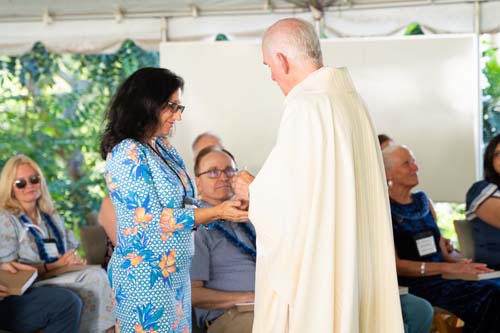
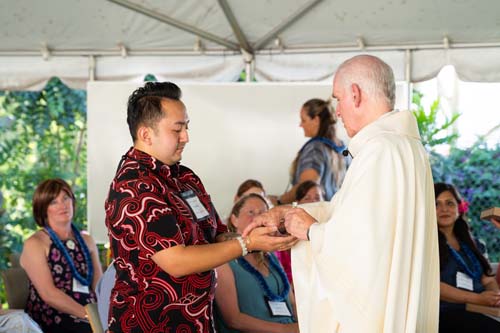
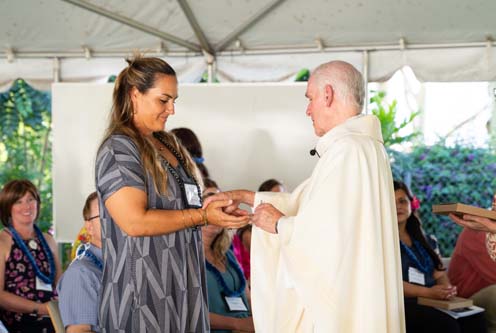
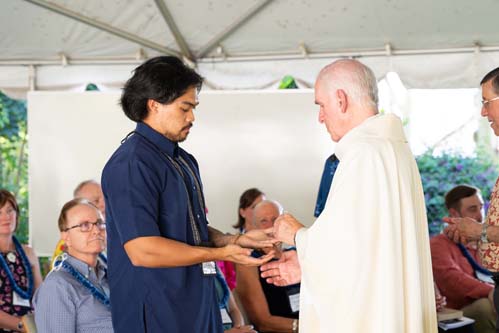
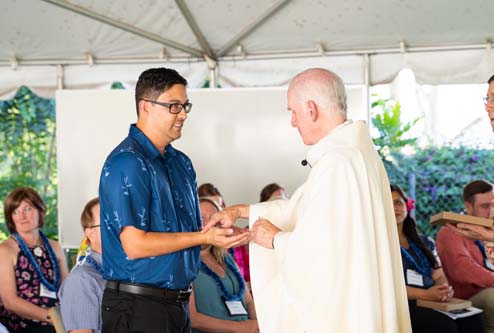
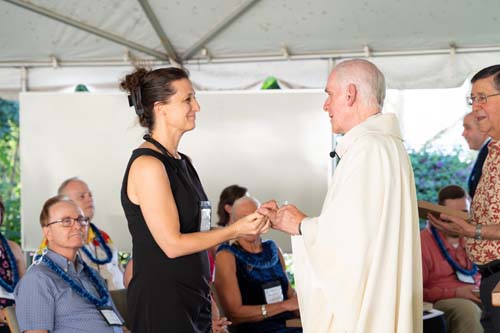
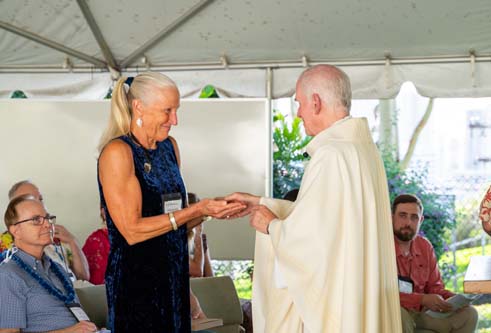
  • As part of the MEA Formation rituals, Fr. Martin Solma annoints the hands of Dr. Cheryl Edelson.
  • As part of the MEA Formation rituals, Fr. Martin Solma annoints the hands of Pono Riddle.
  • As part of the MEA Formation rituals, Fr. Martin Solma annoints the hands of Kahala Kabalis Hoke.
  • As part of the MEA Formation rituals, Fr. Martin Solma annoints the hands of Andrew Ancheta.
  • As part of the MEA Formation rituals, Fr. Martin Solma annoints the hands of Dr. Rylan Chong.
  • As part of the MEA Formation rituals, Fr. Martin Solma annoints the hands of Dr. Abby Halston.
  • As part of the MEA Formation rituals, Fr. Martin Solma annoints the hands of Dr. Gail Grabowsky.

In all, 27 staff, faculty and administrators—of which seven hailed from Chaminade—from the three Marianist Catholic universities participated in this year’s Formation. New Marianist Educational Associates now include Student Engagement Coordinator Andrew Ancheta ’21; Data Science Director and Assistant Professor Rylan Chong, Ph.D., ’10; School of Humanities, Arts and Design Dean Cheryl Edelson, Ph.D.; School of Natural Sciences and Mathematics Dean Gail Grabowsky, Ph.D.; Psychology Associate Professor, and Marriage and Family Counseling Clinical Director Dr. Abby Halston, MS ’05, Ed.D. ; Women’s Volleyball Head Coach Kahala Kabalis Hoke ’05, MS ’07; and Student Success Associate Director Pono Riddle ’18, MEd’ 21.

The inspiration for the Marianist Educational Associates (MEAs) stems from Blessed William Joseph Chaminade, the founder of the Marianists, who urged members and communities within the Marianist Family to engage in “dialogues of faith and culture.”

Chaminade recognized the need for conversation and action in response to the new social and cultural environment shaped by the French Revolution. He believed that examining this new world through the lens of a critically informed faith would help people understand the profound needs of the human heart and strengthen their personal commitment to the Christian faith. The MEAs draw their inspiration from this core element of our early tradition.

Posted by: University Communications & Marketing Filed Under: Alumni, Campus and Community, Catholic, Diversity and Inclusion, Featured Story, Institutional Tagged With: Alumni, Campus Event, Marianist

Golden Pine ‘apple’ Award

May 30, 2024

Teacher and Administrator of the Year Announced

In April, Sacred Hearts School Principal Tonata Lolesio received the coveted 2024 National Catholic Educational Association (NCEA) Lead, Learn and Proclaim Award, only one of 11 recipients chosen nationwide for their work upholding Catholic Education and Faith formation to the highest standards. A month later, the longtime Valley Isle educator was named Hawaii Catholic Schools’ Teacher of the Year, bestowing upon her the Golden Pine”apple” Award during a special Recognition Ceremony at Natsunoya Tea House on Oahu.

“Her dedication to teaching the whole student has profoundly impacted both Sacred Hearts School and the broader Lahaina community,” said Dr. Dale Fryxell, Dean of School of Education and Behavioral Sciences, when announcing Lolesio’s name. “One standout example of her commitment occurred in the aftermath of the devastating Lahaina fire, where she established a pop-up school at Sacred Hearts Mission Church in Kapalua, providing continuity of education and emotional support for her students and welcoming displaced children from the wider community.”

“We came together during a time of crisis to help students and families,” Lolesio told the Hawaii Catholic Herald. “It is our Catholic calling and mission. These experiences, especially my first two years as principal, have taught me much about entrusting my work and plans to God for his guidance and protection. It is ultimately his school, I am his servant in providing for its needs.”

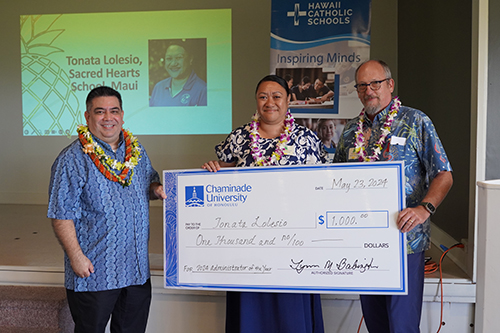
  • Llewellyn Young, Ph.D., superintendent of Hawaii Catholic Schools, left, and Chaminade's School of Business and Behavioral Sciences Dean, Dr. Dale Fryxell, present $1,000 check to Hawaii Catholic Schools’ Teacher of the Year winner Tonata Lolesio
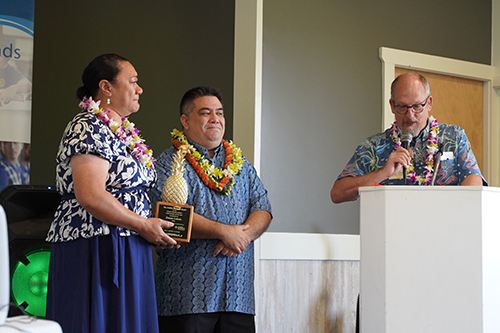
  • Chaminade School of Education and Behavioral Sciences Dean Dr. Dale Fryxell says a few congratulatory words to Sacred Hearts School Principal Tonata Lolesio after she received her Pineapple Award, as Llewellyn Young, Ph.D., superintendent of Hawaii Catholic Schools listened in.
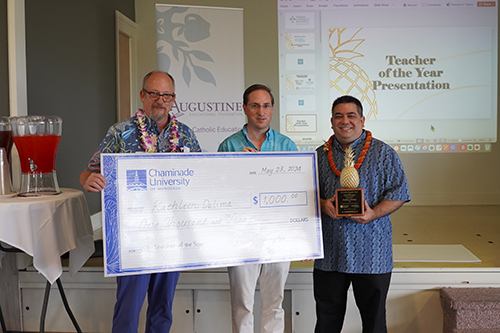
  • St. Anthony School Head of School Maui David Kenney, center, accepted the prize money for preschool teacher Kathleen DeLima from Llewellyn Young, Ph.D., right, superintendent of Hawaii Catholic Schools and Chaminade School of Education and Behavioral Sciences Dean Dr. Dale Fryxell.

With the support of John C. and Mary Lou Brogan, The Augustine Educational Foundation, Hawaii Catholic Schools and Chaminade, the Teacher of the Year and the Administrator of the Year awards recognize excellence in outstanding teachers/specialists and administrators within the Catholic Schools in the State of Hawaii.

“The Golden Pine’apple’ celebrates the best of Catholic education by recognizing talented, service-oriented and faith-filled professionals within the ranks of our Catholic schools,” said Llewellyn Young, Ph.D., superintendent of Hawaii Catholic Schools. “The apple has long been associated with education and wisdom. For our Catholic schools, we use the Pine’apple” to place a cultural spin on the uniqueness of Hawaii and the special roles of our teachers and administrators.”

For the past four decades, St. Anthony School on Maui preschool teacher Kathleen DeLima has demonstrated her dedication to the spiritual development of her students through her incorporation of prayer, song and storytelling into her lessons, nurturing their faith and understanding.

“She is such a great person who has passed on so much wisdom to me, and has really shared so much of the Catholic Faith with all of our staff,” said St. Anthony School Preschool Director Kim Smith. “She is a pillar to St. Anthony Church and School. Not only has she made a significant impact academically but also spiritually. An award like this 100 percent boosts our moral and pride in being recognized for the dedication and work put into the children.”

The Golden Pine”apple” Award—otherwise known as the Golden Apple Award on the mainland—holds significant prestige in the field of Catholic education in Hawaii, serving as a symbol of excellence and dedication among educators. It’s designed to honor outstanding teachers who exhibit exemplary performance in their field. Recipients are recognized for their commitment to teaching, innovative methods and positive impact on students.

“Each year, a panel of distinguished professors reviews each nominee,” Young explained. “Scores are tallied by Chaminade’s School of Education and Behavioral Sciences under the leadership of Dr. Dale Fryxell, and the winners are selected to be presented with the awards at the Hawaii Catholic Schools End-of-the-Year Recognition Luncheon.”

Teachers who receive the Golden Pineapple Award are often those who have made a substantial impact on their students’ learning experiences. This recognition highlights the importance of student-centered teaching and the positive outcomes of effective education. The award also brings attention to the critical role that teachers play in shaping future generations. It further raises public awareness about the importance of quality education, and the need to support and invest in educators.

Posted by: University Communications & Marketing Filed Under: Catholic, Diversity and Inclusion, Education, Homepage, Institutional Tagged With: Catholic, Hawaii Catholic Schools Teacher of the Year, Honors and Awards, Marianist

Baccalaureate Mass

April 29, 2024

As a Catholic, Marianist University, a vital part of graduation weekend is the celebration of the Baccalaureate Mass. This year’s Mass for the Class of 2024 will take place on Friday, May 3, at 6 p.m. at the Mystical Rose Oratory.

“This celebration is an opportunity for our Chaminade ‘ohana to come together in thanksgiving and prayer to honor and thank God for the blessings given to the Fall 2023 and Spring 2024 graduating students and to their families,” says Fr. Chris Wittman, S.M. “It’s a way to celebrate our graduates in context of faith, and acknowledging that God has been part of this experience.”

The Baccalaureate Mass holds a special significance in the culmination of a student’s academic journey. It’s a time for reflection, gratitude and spiritual connection as graduates prepare to embark on the next chapter of their lives. Chaminade’s tradition of hosting this Mass underscores the importance of faith and community in the educational experience. It’s a meaningful way to honor the achievements of the graduating class, and to acknowledge the support of their families and loved ones.

Graduating students are honored during the Baccalaureate Mass at Mystical Rose Oratory.

Steeped in history within Catholic education, the Baccalaureate Mass date back centuries, and its origins can be traced to medieval universities in Europe, where it served as a religious ceremony for graduating students. The term “baccalaureate” itself is derived from the Latin “baccalaureatus,” which originally referred to the laurel berries (baccalaureus) worn by graduates in ancient times.

The Baccalaureate Mass serves several purposes:

  • Spiritual Reflection: It allows graduates to reflect on their academic journey within the framework of their faith. The Mass provides a moment of prayerful contemplation, giving thanks for the gifts of knowledge, growth and community experienced during their time at the institution.
  • Blessing and Sending Forth: The Mass invokes God’s blessings upon the graduating class as they prepare to enter the next phase of their lives. It serves as a formal commissioning, sending forth graduates with the support and encouragement of their faith community.
  • Celebration of Achievement: In addition to its religious significance, the Baccalaureate Mass is a celebration of academic accomplishment. It honors the hard work, dedication, and perseverance of students who have successfully completed their studies.
  • Community Gathering: The Mass brings together students, faculty, staff, families, and alumni in a spirit of unity and fellowship. It reinforces the sense of belonging and connection within the school community, fostering bonds that extend beyond graduation.
  • While the format and traditions associated with the Baccalaureate Mass may vary from one Catholic institution to another, its fundamental purpose remains consistent—to recognize the holistic development of students, encompassing both intellectual and spiritual growth, as they transition to the next stage of their lives.

Posted by: University Communications & Marketing Filed Under: Campus and Community, Catholic, Featured Story, Institutional Tagged With: Baccalaureate Mass, Campus Event, Catholic, Marianist

International Education Week

April 18, 2024

Student clubs share ethnic cuisines and dances

With Chaminade’s diverse population, it’s only fitting that the University would celebrate International Education Week (April 8-12). Inspired by the United Nations Educational, Scientific and Cultural Organization’s World Day for Cultural Diversity for Dialogue and Development, the series of campus events featured a melting pot of flavors, starting with the Spring 2024 Taste of Culture.

The Filipino Club served one of the national dishes of the Philippines—lechon, crispy roast pork.

“Our University is a mosaic of talents, backgrounds and experiences, and it is this diversity that makes our community truly exceptional,” says Chaminade President Lynn Babington, Ph.D. “International Education Week allows us to celebrate not only the richness of the world’s cultures, but also the essential role of intercultural dialogue for achieving peace and sustainable development.”

Participating clubs at this year’s Sixth Annual Taste of Culture included the TaoTao Marianas Club, World of Dance, Accounting Club, Office of Student Engagement, Chaminade Student Government Association, Micronesian Club, Lumana‘i O Samoa, Student Organization of Latinx, The Filipino Club, Office of the President, Chemistry Club and Restauranteers Club.

Observing cultural week not only offers the Kalaepohaku community a chance to experience the diverse cultures of our student body, but it also facilitates the dismantling of stereotypes while fostering mutual comprehension and acceptance. Through the International Extravaganza, students and local residents can listen to the musical rhythms, watch the graceful dances, and enjoy the traditional attire and unique customs of various cultures, cultivating a profound admiration for our campus diversity and fostering cross-cultural empathy.

“As advisors for The Filipino Club, Bro. Allen (Pacquing) and I ensure that the students are constantly receiving the support they need, ensuring that our activities run smoothly,” says Maritel Suniga, payroll specialist in the Business Office. “They put 100 percent of their time and energy into practicing the traditional tinikling dance, often rehearsing late into the night to perfect their moves.”

Wearing a traditional barong tagalog, Christian Raquepo’s first-time experience at Taste of Culture and International Extravaganza was memorable. “These events are a testament to Chaminade’s value of education in the ‘ohana spirit and inclusivity,” said the Silversword freshman. “As a proud first generation Filipino-American, representing my culture in food and dance with our University community makes me proud of my cultural heritage.”

In addition to The Filipino Club, other participants included Ka Ipu Kukui Me Ka ‘ie ‘ie (Hawaiian Club), Lumana‘’i O Samoa and the Taotao Marianas Club.

“Cultural events allow me to be proud of who I am as a descendant of Filipino immigrants,” Raquepo said. “Dressing up in our cultural attire was my favorite moment.”

Posted by: University Communications & Marketing Filed Under: Campus and Community, Diversity and Inclusion, Homepage, Institutional Tagged With: Alumni, Campus Event, Marianist

Higher Education in Prison

March 15, 2024

Program helps with reintegration into community

Drs. Janet Davidson and Lynn Babington share a light-hearted moment. Seated next to them is Mark Patterson, Chair Hawaii Correctional Oversight Commission and Hawaii Youth Correctional Facility, Warden.

It was the best news that Dr. Janet Davidson could have ever received on a Friday morning. After receiving an email message from Gabrielle Schechter, Health Policy Advisor with the Office of U.S. Senator Brian Schatz, Chaminade’s Vice Provost for Academic Affairs and a leader in criminology couldn’t believe what she was reading.

“I had to ask Jacki (Sanqui) to come to my office and read the message to make sure that I was reading it correctly,” said Davidson, who has spearheaded Chaminade’s Higher Education in Prison program. “She told me this was really great news and I was reading it correctly. The note said, ‘Your Higher Education in Prison Program earmark request to Senator Schatz’s office for FY24 was funded at $1.5 million!’ I was shocked.”

With the successful graduation of the pilot class, the second cohort of students from Halawa Correctional Facility includes 11 inmates, three more than the inaugural graduating class. Studies have clearly shown that higher education in prisons offers a multitude of benefits, particularly concerning re-entry into society and reducing rates of recidivism. Research further indicates that individuals who participate in educational programs while incarcerated are significantly less likely to return to prison upon release. Specifically, those who attain an associate’s degree have notably improved odds of successfully re-integrating into society compared to their counterparts without such credentials.

Yet, in our legal system and legislative practices, mass incarceration remains deeply entrenched. Despite efforts over the past half-century, initiatives such as the war on drugs have failed, leading to a troubling escalation in sentencing, probation and pretrial incarceration. But there is hope. In March, the U.S. Senate passed the second half of a bipartisan government funding bill that includes $31.8 million in new congressionally directed spending, also known as earmarks, secured by U.S. Senator Brian Schatz (D-Hawai‘i), chair of the Senate Appropriations Subcommittee on Transportation, Housing and Urban Development. The new funding follows nearly $400 million in earmark funding for Hawaii secured by Schatz in the first half of the appropriations deal signed into law earlier this month. Chaminade University of Honolulu was awarded $1.5 million, which will be used to build capacity of the prison education program.

“At Chaminade, one of our primary Marianist values is to advocate for social justice for transformative change,” says Chaminade President Lynn Babington, Ph.D. “We support a rehabilitation-through-education narrative, which we know is essential to incarcerated individuals finding a pathway to a second chance and a better future.”

Last year's first graduating class attended a commencement ceremony at Halawa Correctional Facility.
Chaminade President Dr. Lynn Babington congratulated graduates during a commencement ceremony at Halawa Correctional Facility.

Hawaii’s correctional facilities epitomize the challenges the state face, grappling with chronic overcrowding and deteriorating conditions. In 1978, Hawaii’s incarceration rate stood at one per 1,000 people. Since then, national rates have skyrocketed, with Hawaii’s incarceration rate at 439 per 100,000 people (including prisons, jails, immigration detention and juvenile justice facilities), meaning that it locks up a higher percentage of its people than almost any democratic country on earth, according to the non-profit, non-partisan Prison Policy Initiative, whose research and advocacy is at the center of the national conversation about criminal justice reform and over-criminalization.

Following its re-designation, the Hawaii Department of Corrections and Rehabilitation underscored the importance of transitioning away from punitive justice, making rehabilitation a core aspect of its mission. With a staggering 95 percent of incarcerated individuals eventually returning to society, this shift is deemed crucial for achieving successful reintegration. As part of its restructuring, law enforcement functions previously under Department of Public Safety were transferred to a newly established Department of Law Enforcement. The move reflects a broader commitment to address the root causes of criminal behavior and promote long-term societal wellness. By prioritizing rehabilitation and reintegration programs, the Department of Corrections and Rehabilitation aims to create safer communities and support individuals in their journey toward positive change.

“The motto for our department is ‘He Au Hou,’ which means ‘a new era,’” said Tommy Johnson, Director of the new Department of Corrections and Rehabilitation, which re-establishes the Hawaii Department of Public Safety. “We’re able to focus our full attention, resources, and energy on rehabilitation and restoration to support those in our custody and care. We envisioned this over two years ago and it’s exciting to see this coming to fruition. We may not see changes occur overnight. We know there is always room for improvement, but I’m confident we’re headed in the right direction.”

Chaminade Vice Provost for Academic Affairs, Dr. Janet Davidson, addressed graduates during last year's commencement ceremony at Halawa Correctional Facility.
Chaminade Vice Provost for Academic Affairs, Dr. Janet Davidson, addressed graduates during last year’s commencement ceremony at Halawa Correctional Facility.

Davidson shares Johnson’s optimism, and she hopes to expand Chaminade’s Higher Education in Prison program to include an interdisciplinary bachelor’s degree program and a new women’s program at Women’s Community Correctional Center. The commitment to these educational programs reflects a fundamental paradigm shift towards a justice system focused on rehabilitation rather than punitive measures. By providing access to education, prisons foster a culture that prioritizes personal growth and skill development, ultimately empowering individuals to become productive members of society upon release.

This non-punitive approach not only benefits the individuals directly involved but also contributes to broader societal outcomes, including reduced crime rates and enhanced community safety. Embracing higher education within the prison system signifies a commitment to justice that extends beyond punishment, striving instead for meaningful rehabilitation and long-term societal transformation.

“I don’t know how to do life out there,” one of the Halawa students told Matthews, referring to re-entering society after being released from prison, adding that they feel that she talks to them, and that she understands them. Empathy is indeed a powerful message for those incarcerated, who often say they don’t “feel treated as human beings.”

“I feel like a ‘wounded healer,’” says Matthews, quoting a term coined by Shadd Maruna, Ph.D., the dean of the School of Criminal Justice at Rutgers University Newark. “Many prisoners and former inmates express a desire to receive mentoring from formerly incarcerated persons who are ‘making it’ in conventional society.”

Prison reentry is a complex process that requires comprehensive strategies involving legislation, regulations, support programs, and community involvement. By prioritizing rehabilitation and reintegration, society can help individuals leaving incarceration rebuild their lives and become productive members of society. Through concerted efforts and collaboration, we can bridge the gap between prison and society, paving the way for successful reentry and reducing recidivism rates in the long run.

Posted by: University Communications & Marketing Filed Under: Diversity and Inclusion, Education, Featured Story, Innovation, Institutional Tagged With: Andrew W. Mellon Foundation Grant, Education in Prison, Marianist, Second Chance Pell

Honorary Luncheon

February 15, 2024

Students share the meaning of their scholarships with donors

Her voice quivering with emotion as she described the meaning of being awarded a scholarship during an annual honorary luncheon for donors, Audrey Pilar ’24 cited her mom and dad for instilling a belief in herself, sharing her parents’ story as a young couple struggling to make ends meet but never giving up and wanting more for her and her brother. Graduating in May with a major in Forensic Sciences, and minors in Chemistry and Data Science, Analytics and Visualization, the Mililani native admitted that, without her Dr. Feung Lee and Mrs. Mew Sin Lee Endowed Scholarship, she probably would have had to work three or more part-time jobs just to pay her tuition.

“When my mom wanted to come to America to have a better life for me and her, she did,” Pilar said. “When my dad was belittled for having a young family, he and my mom hustled, got an education, and successfully raised my brother and me. What I am trying to get across here is that someone gave them a chance in their lives. Someone gave my mom and dad a chance to succeed in life, and they took it. This is what receiving a donor scholarship means to me. Hope and a chance for a better future.”

In the pursuit of higher education, many students face formidable barriers, with financial constraints being among the most prevalent. For many individuals from low- to even middle-income backgrounds, the dream of attending college or university often seems like an unattainable aspiration. However, scholarships serve as beacons of hope, illuminating pathways to academic success and unlocking doors to opportunities that would otherwise remain shut.

“This year, between individual and Foundation scholarships, we supported 332 students with over $2 million, for an average scholarship award of $6,100, which is huge,” said Chaminade President, Lynn Babington, Ph.D. “Today, you’ll hear some of these students’ stories, and you’ll get a sense about their ambitions, their areas of academic interest and what they may have overcome to get here.”

Scholarship Luncheon attendees include, standing from left, Edna Magpantay-Monroe, Michael Monroe, Tiannah Ohta and Genie Reutirez, and, seated from left, Bella Frasure, Alyssa Mori, and Keven and Diane Matsuura.
Scholarship Luncehon attendees include, standing from left, Edna Magpantay-Monroe, Michael Monroe, Tiannah Ohta and Genie Reutirez, and, seated from left, Bella Frasure, Alyssa Mori, and Keven and Diane Matsuura.
Scholarship Luncheon attendees include, standing from left, Jill Higashi, Kimberly Kameshige, Brianna Gutierrez Aceves and Easton DelaCruz, and, seated from left, Jeannine Wiercinski, Estelle Kelley, Jeannie Rolles and Chaminade President Dr. Lynn Babington.
Scholarship Luncehon attendees include, standing from left, Janice Glade, Peter Jan Ramos and Anastasia Tangatailoa, and seated from left, Leila Casison, Caitlin Bocobo and Paige Garcia.
Scholarship Luncehon attendees include, standing from left, William Bernaldez, Amber Milsap and Greg Lagapa, and seated from left, Natasha Flores, Nicole Tanabe and Kelsey Nakagawa.
Scholarship Luncehon attendees include, standing from left, Tyanna Hemmings, Leah Carrington and Kaimipono Abella, and seated from left, Keila Anderson, Tessa Stanley, Aniyah Hazen and Ana Isabel Aranda.
Scholarship Luncehon attendees include, standing from left, Adrienne Aquino, Katherine Liu, Erica Tiwari and Alani Meltel, and seated from left, Jessica Schlais, and David and Christne Arita.
Scholarship Luncehon attendees include, standing from left, Kendra Sia, Nicole Kegine, Aleeyah Lemons and Heidi Bow, and seated from left, Sally and Michael Coovert, and Susie and John Field Jr.
Scholarship Luncehon attendees include, standing from left, Debbie Ng Furuhashi, Michalla Burtado, Aloha Lei Garo, Bro. Alan Pacquing, Jodi-Anne Yoshida and Chaminade President Dr. Lynn Babington, and seated Bernard and Lolita Lum Hoy.
Debbie Ng Furuhashi and Cathy Ching share a laugh before the start of the Scholarship Luncheon.
Scholarship Luncehon attendees include, standing from left, Angelica Tangatailoa, Nathaniel Leomiti, Wayne Tanna, JD, and Jazzy Yasuda, and seated from left, Dorie Sanborn, Bro. Thomas Jalbert, Jasmine Mondelo and Pono Riddle.
Scholarship Luncehon attendees include, standing from left, Nagem Uiagalelei, Patricia Takamiya, Bro. Allen Pacquing and Richard Uiagalelei, and seated from left, Napua Rosehill, Carol Gouveia, Kawila and Kyla Castro.
Scholarship Luncehon attendees include, standing from left, Lauren Moriarty, Constance Keao, Huong Pham and Mame Hideyos, and seated from left, Alyssa Torres, Junelle Tangalin and Diane Peters-Nguyen.
Scholarship Luncehon attendees include, standing from left, Heather Kate Jarmillo, Marlon Francisco and Audrey Pilar and seated, from left, Kryzandreah Espanol, Tertia Freas, Elizabeth Hokada and Dr. Janet Davidson.

Seated with students, Adrienne Aquino ’26, Katherine Liu ’26, Erica Tiwari ’24 and Alani Meltel ’25, donors David and Christine Arita with daughter Jessica Schlais discussed each one’s goal, inspiring them to continue their education even long after they’ve graduated. The Aritas’ and Schlais’s American Floor and Home Foundation Scholarship is specifically earmarked for majors in the Environmental + Interior Design program.

An aspiring elementary education teacher, Aquino believes that early schooling provides a strong foundation for future learners. “Our graduation rates are getting lower and lower,” said the Kaneohe native. “We need more teachers if we want a better future for our keiki.”

Applauding Aquino for her dedication to becoming an elementary teacher, David Arita dispensed a bit of advice to her: “If you inspire them, they will always remember you,” he told her. “I still remember the teachers who made a major impact in my life, and I will never forget them.”

A sophomore Communication major, Easton DelaCruz ’26 has taken advantage of all the opportunities afforded to him since arriving on campus two years ago. He has been fortunate enough to engage in experiences that have enriched his education and broadened his perspective.

“Your commitment to financial assistance has allowed students like me to engage in transformative experiences, shaping us into well-rounded individuals prepared to contribute to society,” DelaCruz said in his address to donors. “With the wealth of past and current experiences, and the ones to come at Chaminade, I plan to return home and become a public servant to help my home become a better place for my parents’ generation, my generation and generations to come.”

In this landscape of financial uncertainty, scholarships emerge as powerful catalysts for change. These financial awards, often based on academic merit, financial need, or a combination of both, play a pivotal role in dismantling barriers to higher education. By providing financial assistance, scholarships enable deserving students to access resources, facilities and opportunities that would otherwise remain beyond their grasp.

Beyond financial assistance, scholarships also offer myriad opportunities for academic and personal growth. Many scholarship programs provide mentorship, networking opportunities and career development resources, empowering students to thrive both inside and outside the classroom. Furthermore, scholarships may fund internships, study abroad experiences and research projects, allowing students to broaden their horizons and cultivate valuable skills that enhance their employability and competitiveness in the job market.

“We know education transforms lives; our students set out to change the world, and they are making a difference,” said Babington. “Our reach is all over the world. And we are proud of our Chaminade students and alumni.”

Posted by: University Communications & Marketing Filed Under: Campus and Community, Diversity and Inclusion, Featured Story, Institutional, Students Tagged With: Honors and Awards, Marianist, Scholarship

  • « Go to Previous Page
  • Page 1
  • Page 2
  • Page 3
  • Page 4
  • Page 5
  • Interim pages omitted …
  • Page 9
  • Go to Next Page »

Footer

Chaminade University Logo

3140 Waialae Avenue
Honolulu, Hawaii 96816

Contact Us
Phone: (808) 735-4711
Toll-free: (800) 735-3733

facebook twitter instagram youtube linkedin

Visit

  • Plan Your Visit
  • Campus Map (PDF)
  • Events

Resources

  • Campus Security
  • Student Consumer Information
  • Concerns, Feedback, and Reporting
  • Institutional Review Board
  • Title IX / Nondiscrimination Policy
  • Compliance
  • Emergency Information
  • Careers
  • Institutional Statement

People

  • Students
  • Parents
  • Alumni
  • Faculty & Staff

Policy

  • Privacy Policy
  • Terms and Conditions of Use


© Chaminade University of Honolulu