• Skip to primary navigation
  • Skip to main content
  • Skip to footer
Chaminade University of Honolulu

Chaminade University of Honolulu

  • VISIT
  • APPLY
  • GIVE
  • STUDENTS
  • PARENTS
  • ALUMNI
  • FACULTY/STAFF
  • Admissions
    • Admissions Home
    • Undergraduate Students
      • First-Year Students
      • Transfer Students
      • Admitted Students
    • Graduate Students
    • Flex Online Undergraduate Program
    • Military Students
    • Non-Degree/Visiting Students
    • Experiential Honors Program
    • Early College Program
    • New Student Orientation
  • Tuition & Aid
    • Financial Aid Home
    • Tuition & Expenses
    • Federal Updates & Changes
    • Scholarships
    • $5,000 Graduate Scholarship
    • VA Education Benefits
    • Net Price Calculator
  • Academics
    • Academics Home
    • Academic Programs
    • Office of Student Success
      • Academic Advising
      • Records and Registrar
    • Kōkua ʻIke (Support Services)
      • ADA Accommodations
      • Career Services
      • Proctoring Services
      • Tutoring Services
    • Sullivan Family Library
    • Undergraduate Research & Pre-Professional Programs
    • Commencement
  • Campus Life
    • About Campus Life
    • Student Engagement
    • Student Government Association
    • Residence Life and Housing
      • Summer Conference Housing
    • Health Services
    • Marianist Leadership Center
    • Counseling Center
    • Campus Ministry
    • Campus Security
    • Dining Services
    • Bookstore
  • Athletics
  • About
    • Chaminade University News
    • Our Story
    • Leadership
    • Chaminade University Strategic Plan 2024-2030
    • Mission & Rector
    • Association of Marianist Universities
    • Facts & Rankings
    • CIFAL Honolulu
    • Accreditation & Memberships
    • Montessori Laboratory School
Search
×

Search this web site

Marianist

Heritage Awards

January 30, 2024

Honoring those who personify the Marianist Values

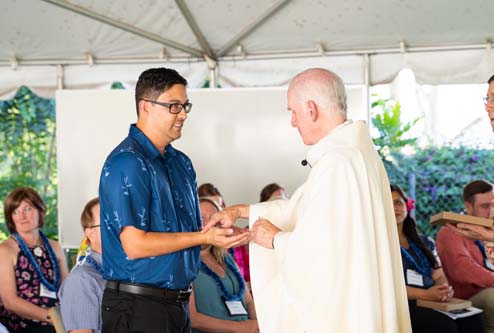
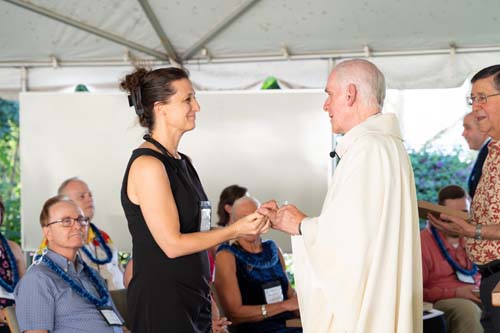
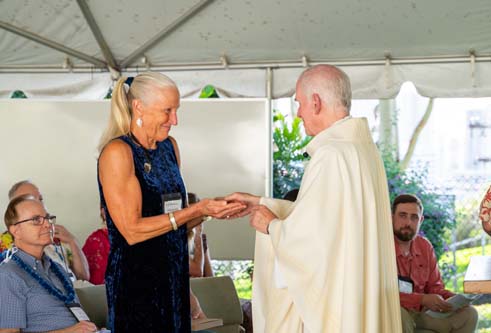
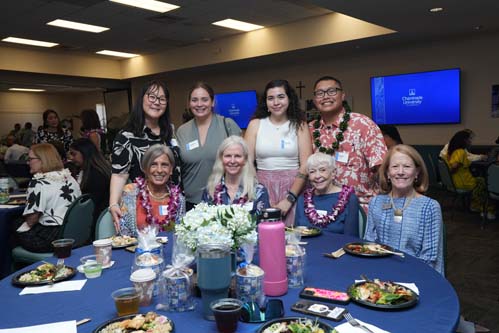
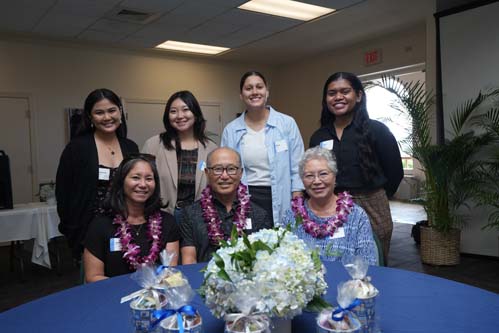
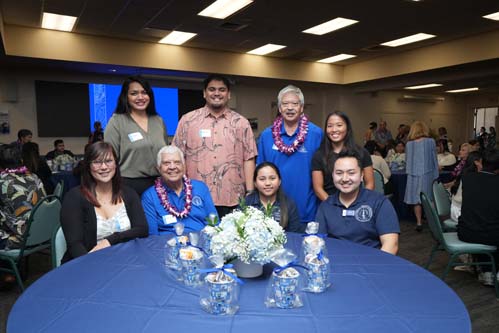
Overcome by emotion, tears cascaded down the cheeks of Victoria DelaCruz ’24 as Bro. Ed Brink named her as this year’s Founders’ Award winner, describing her traits of selflessness, commitment, hospitality, graciousness, faith and her family. A Chaminade Scholar majoring in Data Science, Analytics and Visualization (DSAV), DelaCruz ’24 exemplifies the Marianist education and values.

“Faith has been a part of her journey before coming to Chaminade,” said Brink, Vice-President of Mission and Rector. “This year, she joined the new Student Ministry Team and made a suggestion about having a praise and worship evening at the end of one of the meetings. Although it was one of the last ideas talked about at the meeting, it was one of the first events to move from an idea to an actual event. And that was because of Victoria’s commitment to it.”

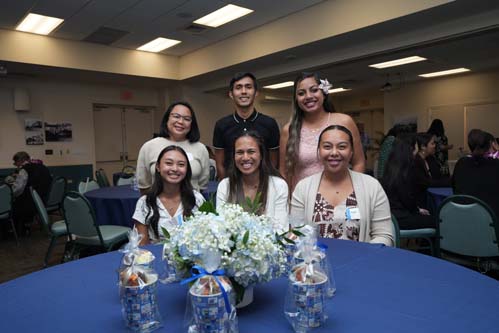
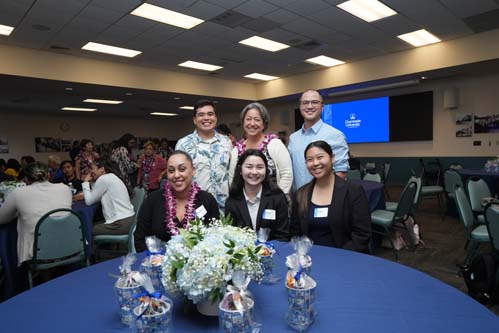
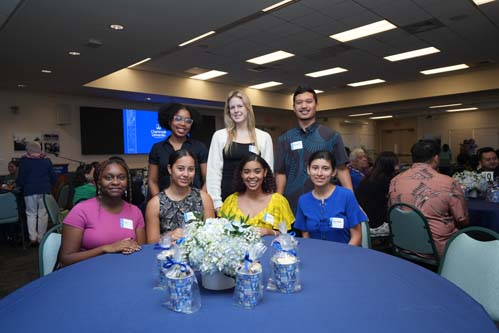
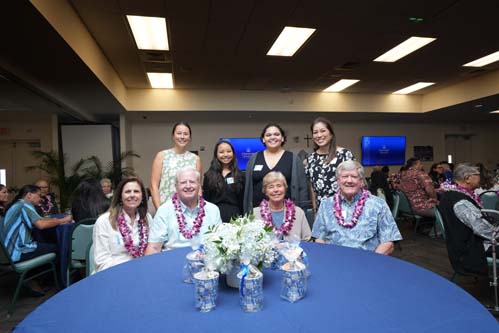
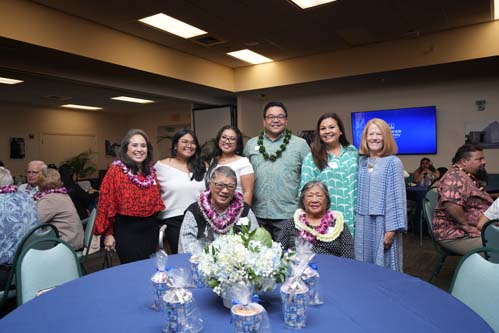
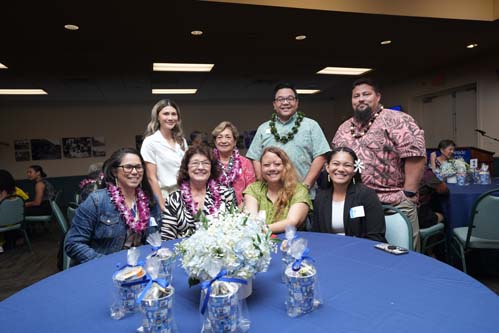
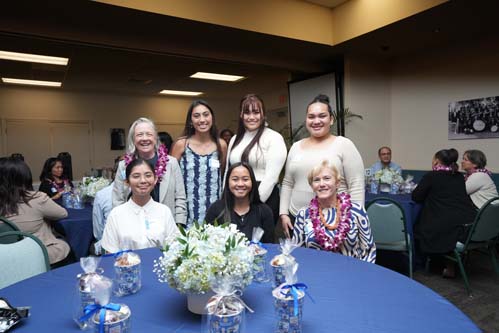
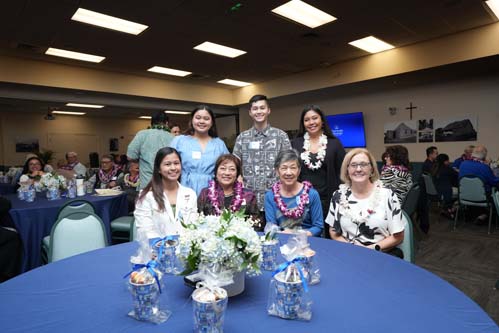
Every year during Founders’ Week, the Rector’s office presents the Chaminade Award, the Marianist Award and Founders’ Award to a faculty member, supporting staff member and student, respectively, who embodies the Marianist values.

His voice crackling at times while reading the achievements of the winners of the Heritage Awards, Brink announced the other two honorees: Chaminade Award recipient Dr. Janet Davidson, Vice Provost and professor of criminology, who was described by one of her nominators as resilient, reliable and consistent; and Amy Takiguchi, Director of Financial Aid, Marianist Award, whose efforts to help students go beyond and above a simple answer.

“It was a chicken-skin moment when Dr. Babington informed me of the award,” said Takiguchi ’02, an alumna who started her career at Chaminade as a student worker with Human Resources and has since moved up the ranks. “I have a great team and that’s what makes working here such a rewarding experience.”

For Davidson, the Chaminade Award is not an individual feat, but one that belongs to her team. “I am honored and humbled, but I don’t like the attention,” she said. “But I could have never done it alone. The accolades and attention I receive are because of a great supportive team that works collaboratively to accomplish a lot.”

In his presentation during a special mass ceremony to celebrate Founders’ Week, Brink said these awards are meant to remind all of us of the mission of this University, and the importance of trying to live out that mission on a daily basis. “We gather today to be inspired and to hopefully recommit ourselves to being the best member of this community that we can be,” he added. “Fr. Chaminade wanted those who got caught up in the work that he inspired to be ‘a spectacle’—to give witness to others of how a life based in faith and service could make a difference in the world.”

Posted by: University Communications & Marketing Filed Under: Campus and Community, Catholic, Homepage, Institutional Tagged With: Campus Event, Honors and Awards, Marianist

God’s Mechanics

October 11, 2023

There was time for one more question before the close of the Marianist Lecture. Chaminade student Noelani Tugaoen stood up and politely asked, “How are we able to foster the dialogue of faith and science with those who are younger and don’t have any experience with the religious world?” 

Lecturer Bro. Guy Consolmagno, S. J. half-smiled before laughing and saying, “Boy, I wish I knew the answer to that.”  The audience then joined him in light laughter. 

As the Director of the Vatican Observatory and President of the Vatican Observatory Foundation, Consolmagno clearly knows the answers to most any question that comes his way.  A native of Detroit, Michigan, he earned undergraduate and masters’ degrees from MIT, and a Ph. D. in Planetary Science from the University of Arizona; he was a postdoctoral research fellow at Harvard and MIT, served in the US Peace Corps (Kenya), and taught university physics at Lafayette College before entering the Jesuits in 1989. 

Yet on October 8th in the Mystical Rose Oratory as part of the Marianist  Lecture Series, he humbly replied that he didn’t know the answer to Tugaoen’s question.

His lecture, “God’s Mechanics: How Scientists and Engineers Make Sense of Religion,” however, was packed with answers to lofty questions about science, astronomy, commonalities and differences between different religions, and – ultimately – what “believing in God gets you.” He also delved into ways that “techies” deal with why so many religions exist in our world today. 

He opened his talk by playing a video from the Vatican Observatory, and then he dove head first into how scientists and engineers make sense of religion. His full talk can be viewed here. 

At the Vatican Observatory since 1993, Consolmagno’s research has explored connections between meteorites, asteroids, and the evolution of small solar system bodies, observing Kuiper Belt objects with the Vatican’s 1.8 meter telescope in Arizona, and applying his measure of meteorite physical properties to understanding asteroid origins and structure. 

Consolmagno also spoke with Chaminade Scholars on October 6 during lunch. The conversation was lively and insightful with much mutual respect between Consolmagno and the students. At the end of the presentation, Consolmagno was presented with the Mackey Award for Catholic Thought, given to a speaker per year. This award is given to those who help continue the Marianist charism and make a difference in the community.

The Marianist Lecture series is sponsored by Chaminade University, Marianist Center of Hawaii and St. Louis School with the next installment of the series on February 18, 2024 featuring Dr. Steve Neiheisel who will focus on Catholics in the public square during an election year.   

Posted by: University Communications & Marketing Filed Under: Campus and Community, Catholic, Featured Story Tagged With: Campus Event, Guest Speakers, Marianist, Marianist Lecture

Association of Marianist Universities

September 28, 2023

Advancing Marianist and Catholic values in higher education

In his seminal book, “A New Fulcrum: Marianist Horizons Today,” the late Fr. David Fleming posed: “What Makes University Education ‘Marianist’?” One of the potential answers perhaps lies in the synthesis of faith and reason, a hallmark of Catholic and Marianist education. It’s about fostering a community of learners who not only excel academically, but who also grow spiritually, morally and ethically. It’s about instilling in students a deep sense of social responsibility and a commitment to making the world a better place.

“In terms of the relationship between faith and reason, I adhere to Pope John Paul II’s 1998 Encyclical Letter ‘Fides Et Ratio,'” in which he describes Faith and Reason as two wings on which the human spirit rises to the contemplation of truth,” answered Chaminade President Dr. Lynn Babington, when asked about her understanding of the relationship between faith and reason in an interview with the Association of Catholic Colleges and Universities. “In other words, the Catholic intellectual tradition at the heart of a Catholic university presupposes the harmonious existence between faith and reason. It’s a relationship that is not static because both faith and reason are involved in a mutual search for and reception of meaning and truth.”

Bro. Tom Giardino addresses Flyer alumni during a University of Dayton award ceremony. ©Briana Snyder, Knack Video + Photo

For Association of Marianist Universities (AMU) Executive Director Bro. Thomas Giardino, Fleming’s question could serve as a catalyst for conversations that are needed today in order to develop and advance the mission and identity of Marianist and Catholic higher education.

“Since the Marianist educational tradition is a person-centered charism [gift] with a mission strategy, when this reality is felt by students, staff and faculty then that university education is alive with the Marianist sensibilities,” said Giardino in an email response. “This means that the university community experiences that they individually matter, that relationships matter, that the world matters, and that there is a relationship between their education and their encounter with our world. For this to happen, there needs to be a critical mass of persons who are in the community, not simply for transactional relationships, but for transformational relationships; that is, it touches the meaning and purpose of their identity, what they live for.”

In today’s society, where knowledge is abundant but wisdom is scarce, Catholic and Marianist universities face pressing issues. One such issue is the challenge of maintaining their distinct identity and values in a rapidly changing world. The secularization of higher education and the prevailing culture of individualism pose threats to the unique mission of these universities.

Another pressing issue is the need for inclusivity and diversity. As society becomes more pluralistic, Catholic and Marianist universities must ensure that their campuses are welcoming to people of all backgrounds and faiths. They should strive to create an environment where open dialogue and respectful exchange of ideas can flourish.

AMU plays a crucial role in addressing these challenges. It serves as a platform for collaboration and shared learning among Catholic and Marianist universities. It fosters a sense of solidarity and unity among these institutions, helping them preserve their core values while adapting to the demands of the modern world.

“The Association of Marianist Universities provides a structure for the three Marianist Universities to share ideas and programming to strengthen the Marianist identity of each of the universities,” said Bro. Ed Brink, Chaminade’s Vice President of Mission and Rector. “Through the work of AMU, there are regular meetings (usually via Zoom) of people from each of the universities that have similar jobs.”

In 2005, members from Chaminade University, University of Dayton and St. Mary’s University of San Antonio responded to the call from AMU Board to build a partnership among members of the Society of Mary, the sponsoring religious body. It would invite a cadre of lay collaborators, who would together sustain and renew the mission and identity that was Catholic, and that embodied the Marianist educational tradition.  

Since then, faculty, staff and administrators have been invited each year to deepen their understanding of and their commitment to the traditions and beliefs that make each respective university a Catholic and Marianist community.

Bro. Ed Brink teaches the fundamentals of Marianist values.

“In the summer of 2022, AMU held a symposium during which more than 100 people from the three universities gathered to reflect on the unique contributions that Marianist Universities make within American higher education, and to envision possibilities for the future,” Brink said. “Whenever AMU gathers people from the three universities together, we are reminded that we are part of a bigger mission.  While we all take pride in our own work, we are able to see that we are working on a project that goes well beyond our own institution and campus walls.”

In a world marked by division and polarization, the three Marianist/Catholic universities promote a message of unity and common purpose. They produce graduates who are not only academically competent but also compassionate, ethical and dedicated to making a positive impact on society.

In a world hungry for meaning and purpose, the Association of Marianist Universities serves as a guiding light. It reminds us that education is not just about acquiring knowledge; it’s about becoming better human beings. It underscores the enduring relevance of Catholic and Marianist principles in today’s society, where the search for truth, goodness and justice remains as vital as ever.

“Our faculty and staff already embrace and appreciate the values of providing a quality education, and an education for service, justice, peace, adaptation and change,” Babington said. “They may not necessarily have a religious affiliation, but they do believe in an equal and just society, which is what we impart to our students.”

Posted by: University Communications & Marketing Filed Under: Campus and Community, Catholic, Diversity and Inclusion, Homepage, Institutional Tagged With: Campus Event, Guest Speakers, Marianist

Spiritual Convocation

August 29, 2023

Academic year opens with ‘Red Mass’

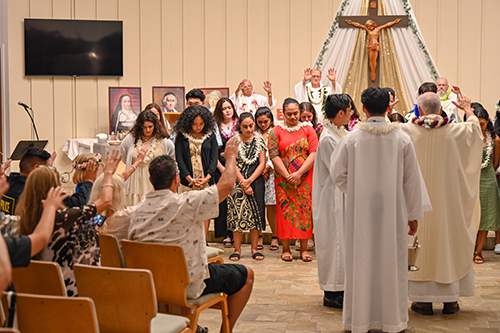
Faculty, students and staff filled the seats at the Mystical Rose Oratory to pray for guidance and wisdom at the Votive Mass of the Holy Spirit that traditionally marks the beginning of the academic year.

Presiding over the Fall Spiritual Convocation, Fr. Chris Wittmann S.M. explained the significance of the Mass, also known as “Red Mass,” which is celebrated annually in the Catholic Church for all members of the legal profession, regardless of religious affiliation: judges, lawyers, law school professors, law students and government officials, marking the opening of the judicial year.  

“At the beginning of an academic, legislation or judicial year, it is a longstanding tradition to call upon the Holy Spirit’s guidance, blessing and grace that will be needed for the year ahead,” Wittmann preached. “At a university like Chaminade, we are blessed with an abundance of resources and avenues to knowledge and skills, practical wisdom and application. But even at a university, we don’t have all the answers; and we never will.”  

Chaminade President Dr. Lynn Babington welcomed faculty, staff and students back to campus.

Such is the nature of a Marianist education, which cultivates students’ personal talents, nourishing the desire and acquiring the skills that will equip them to be learners all their lives. “Our faculty and staff already embrace and appreciate the values of providing a quality education, and an education for service, justice, peace, adaptation and change,” said Chaminade President Dr. Lynn Babington. “These are values that define my leadership, and they are consistent with the five pillars of the Marianist charism: faith, Mary, community, mission and inclusivity. We believe in an equal and just society, which is what we impart to our students.”  

During the Convocation, Chaminade’s Vice President of Mission and Rector, Bro. Ed Brink, outlined the genesis of the Marianist Educational Associates program. “In 2005, members from Chaminade University, University of Dayton and St. Mary’s University of San Antonio responded to a call from the Association of Marianist Universities (AMU) Board to build a partnership among members of the Society of Mary, the sponsoring religious body of the three universities,” he said. “It would invite a cadre of lay collaborators, who would together sustain and renew the mission and identity that was Catholic, and that embodied the Marianist educational tradition.”  

This past summer, seven Chaminade faculty and staff members participated in the MEA Formation, a seven-day program consisting of readings, reflections and sharing of insights. Asking them to stand in front of the congregation as he called out their names, Brink invited Drs. Darren Iwamoto, David Carter, Dustyn Ragasa, Frederique Kandel, Janet Davidson and Jennifer Creech, Vice President for Enrollment Management and Student Success, to come forward. (Dr. Tom Buning was unable to attend.)  

“These men and women are members of a community that is intentionally committed to strengthening and developing the Catholic and Marianist identity of this University,” Brink said. “I now ask you to make your commitment as a Marianist Educational Associate.”  

Afterwards, Brink acknowledged the 21 Chaminade staff members and faculty who made their first commitment in previous years, asking them to stand and renew their commitment as Marianist Educational Associates.  

In unison, the 21 MEAs pledged to strengthen, sustain and develop the Catholic and Marianist mission and identity of Chaminade University of Honolulu. They will continue to read, reflect, and collaborate with others to insure the continuation of the programs, processes and behaviors that make Chaminade a Catholic and Marianist University. And they promise to support others in growing in the knowledge and appreciation of the Catholic and Marianist traditions in order to embody and witness to these traditions and their benefit to the world.  

“So to students and other members of the faculty and staff, please, if you have questions about our charism, about the Marianist educational tradition, these people have given some time and energy to studying that,” Brink concluded. “They have thought deeply about how to incorporate that into their work. We’re all, as Fr. Chris said, still learning.”

Posted by: University Communications & Marketing Filed Under: Campus and Community, Catholic, Featured Story, Institutional Tagged With: Catholic, Marianist

Staff, Faculty Attend MEA Formation

July 24, 2023

Attendees pledge to uphold Marianist-Catholic mission

After 19 years of working at Catholic higher education institutions, Jennifer Creech felt she was finally ready to commit. Her eyes lighting up as she spoke about her recent formation as a Marianist Educational Associate (MEA), the Vice President for Enrollment Management and Student Success was eager to share her experience.

MEA Formation participants included, from left, Frederique Kandel, Ph.D., Father Martin Solma, Jennifer Creech, and Drs. Janet Davidson, Darren Iwamoto, Dustyn Ragasa, and David Carter. Missing is Dr. Tom Buning.

“Selfishly, this was for me,” Creech said of the formation retreat. “I often attend conferences for professional reasons, but going through the formation was personal. I wanted to learn how to be a better person to my team and our students, and the meaning and value of our Marianist mission.”

In 2005, members from Chaminade University, University of Dayton and St. Mary’s University of San Antonio responded to a call from the Association of Marianist Universities (AMU) Board to build a partnership among members of the Society of Mary, the sponsoring religious body. It would invite a cadre of lay collaborators, who would together sustain and renew the mission and identity that was Catholic, and that embodied the Marianist educational tradition. 

Since then, faculty, staff and administrators have been invited each year to deepen their understanding of and their commitment to the traditions and beliefs that make each respective university a Catholic and Marianist community.

“I’ve always believed in our mission,” said Darren Iwamoto, who also attended the formation at the University of Dayton. “The formation experience helped me to focus in what I do and not work blindly.”

The seven-day formation program consisted of readings, reflections and sharing of insights. Each participant received a binder that was divided by presentations, which covered a variety of topics, from Vocational Stories and the Catholic Story to the Marianist Story and the Catholic Intellectual Tradition.

Opening her binder, Creech flipped through the colored tabs before stumbling upon a note card that contained some of her thoughts, writing down such key words as “living and working with intention, love, grace, transparency, access, persistence, empathy and understanding.”

“We are privileged in our roles, which are not self-serving,” Creech asserted. “Our mission is to empower others, to be part of a team and to advocate for our students.”

Following the initial retreat, the MEAs will then meet once a month from September to May to continue their formation by developing, strengthening and advancing the Catholic and Marianist philosophy of education.  At the end of the academic year during a special service, the MEAs will make a public commitment to sustain and enrich the University’s Catholic and Marianist character. 

Staff and faculty from Chaminade and University of Dayton gather for dinner at an outdoor patio.
Staff and faculty from Chaminade University, University of Dayton and St. Mary’s gather for an early-evening dinner at an outdoor patio.

“The Marianist Charism is a combination of faith, following Mary, community, mission and inclusivity,” Iwamoto explained. “The Charism informs how, as educators, we inspire our students and how we collaborate with our peers.”

Other Chaminade participants included Drs. Janet Davidson, David Carter, Frederique Kandel and Tom Buning.  

To ensure that Marianist universities sustain a strong Catholic and Marianist mission and identity, three vital tasks need to be accomplished, according to the Association of Marianists Universities (AMU).  First, there must be a significant number of people who are employed at the universities, and who are steeped in and appreciate the Catholic and Marianist traditions of education.  Second, these individuals must have the capacity and willingness to work together to incorporate these traditions into the culture of Marianist universities. Third, these persons would be committed to adapt and transform the traditions so that Marianist universities forge an engaging response to the challenges facing American higher education while contributing to the task of working toward global justice, so integral to the Marianist charism.

MEAs are lay persons who are, first of all, employees of the campus community who are hired to perform in a professional role in the work of Marianist higher education. Associates make an intentional choice to use that professional role to partner with the Marianist vowed religious on campus to strengthen the Catholic and Marianist mission and identity.  All MEAs are committed to using their sphere of influence to strengthen the Catholic and Marianist mission and identity in ways that are effective and appropriate. MEAs are committed to a journey of personal and professional growth in understanding and embracing the gift of the Marianist charism.

“The whole week I had what I call ‘God sightings,’” Creech said. “I don’t know how to describe it. It’s like love, you know it’s there, but it’s difficult to explain. The more you trust it, the more you hear it.”

Posted by: University Communications & Marketing Filed Under: Catholic, Diversity and Inclusion, Homepage, Institutional Tagged With: Catholic, Formation, Marianist

Scholars at Sea

June 5, 2023

Students immerse themselves in culture and history

Seven days. Seven ports. And a lot of history, foreign cultures and sites to absorb in between. These were the main takeaways that Chaminade students, Remo Merlo, Hannah Dyer, Nicole Vontsolos and Kevin Dean, gleaned from their short-term study abroad program this past spring.

Organized by Kelly Treece, Ph.D., Director and Associate Professor of Criminology and Criminal Justice, and Lynn Haff, Director of Grants Development, the scholar-at-sea-like program offered students a glimpse into European, Islamic, Muslim, Jewish, Middle Eastern and Western Asian cultures. The seven-day itinerary aboard the Norwegian Jade embarked from Athens, Greece, and circled the Aegean, Marmara and Mediterranean seas, with Ports of Call in Kusadasi, Turkey; Patmos, Greece; Jerusalem (Ashdod) and Tel-Aviv (Haifa), Israel; and Limassol, Cyprus.

The ruins of Ephesus is 11 miles away from Kusadasi, Turkey, and it is one of the best preserved ancient cities of the world.

“We received a $13,000 Sidney Stern Memorial Trust grant, and we were all set to go in 2020 to Italy, Switzerland and Germany,” Treece says. “And then COVID happened.”

As travel restrictions began to relax in 2022, Treece charted a new course. This time would be different—in location and mode of travel. Also, rather than take a large cohort of students, who would have to pay their own way, Treece would use grant money to cover 90 percent of the program’s cost for four students: two females and two males.

“Coming out of COVID, we knew the students couldn’t afford to pay because they were still recovering from the economic impact of the pandemic,” Treece asserts. “We had limited funds, but we knew we could support four students.”

To qualify, each student was required to hold a current passport, to be in good academic standing and to write an essay explaining why he or she wanted to participate in this short-term study abroad, and how it would propel their future. The answers varied among the freshman, sophomore and two senior students. What was consistent, however, is that they all believed in the educational benefits of visiting different countries and gaining the exposure to foreign cultures.

“When Dr. Treece called and asked if I was still interested in going to Europe, I screamed, ‘Are you kidding me?’” recalls, Hannah Dyer, who was initially denied because she was a sophomore and preference was given to seniors. “It was my first time outside of the Americas so I was excited to see Europe and, technically, Western Asia because of Turkey.”

In preparation for the voyage, each student was assigned a country and tasked to create a travel brochure of sorts, providing details about the respective nation’s history, culture, socio-economic policies, political stability and religion.

“I learned more in the two weeks visiting each country than I would have learned in researching each one,” says freshman Remo Merlo. “They (Europeans) have such a different way of living, and we noticed this right away when we arrived in Athens.”

The Western Wall, also known as the “Wailing Wall” or the “Kotel,” is the most religious site in the world for the Jewish people.

Treece acknowledged her overall goal was cultural immersion for the students, allowing them to explore and develop their sense of curiosity and problem-solving skills. “I’ve chaperoned previous trips to London, England, when I was at another university, but those groups were much larger,” says the one-time police sergeant. “We brought together four complete strangers, and they formed a really tight-knit bond, each relying on the other for safety and awareness.”

And at no time was this more evident when they were in Israel. As peaceful protests choked the streets in Tel Aviv, Treece and Haff were stuck on a bus for several hours after returning from an excursion to Jerusalem. Meanwhile, Dyer and Vontsolos, who were on the same daytrip, had boarded an earlier bus, and only later learned of their chaperones’ predicament once they returned to the ship. 

“We were all texting them to see if they were OK,” Merlo says. “Dr. Treece reassured us they were fine, and everything was peaceful, which was another difference between what we saw in Tel Aviv and what we’ve seen in the U.S.”

Merlo and Dyer have already said they would definitely participate in a similar program should the opportunity again arise. “After college, I plan to move to Europe or Canada,” Merlo says. “And this trip even motivates me more to finish college early, and explore the next chapter of my life.”

Dyer returned to Hawaii on a traveling high, eager to take to the skies once again and return to Israel. “I wish I could have done more,” she says. “Visiting the different religious sights and learning about all the history was an immersive experience. 

“There were no emails and texts to respond to nor phones to answer,” Dyer adds. “We just all hung out and talked about what we were seeing and what we were experiencing. It was great just to hang out and unplug.”

Posted by: University Communications & Marketing Filed Under: Diversity and Inclusion, Institutional, Students Tagged With: Grants, Marianist, Study Abroad

  • « Go to Previous Page
  • Page 1
  • Page 2
  • Page 3
  • Page 4
  • Page 5
  • Page 6
  • Interim pages omitted …
  • Page 9
  • Go to Next Page »

Footer

Chaminade University Logo

3140 Waialae Avenue
Honolulu, Hawaii 96816

Contact Us
Phone: (808) 735-4711
Toll-free: (800) 735-3733

facebook twitter instagram youtube linkedin

Visit

  • Plan Your Visit
  • Campus Map (PDF)
  • Events

Resources

  • Campus Security
  • Student Consumer Information
  • Concerns, Feedback, and Reporting
  • Institutional Review Board
  • Title IX / Nondiscrimination Policy
  • Compliance
  • Emergency Information
  • Careers
  • Institutional Statement

People

  • Students
  • Parents
  • Alumni
  • Faculty & Staff

Policy

  • Privacy Policy
  • Terms and Conditions of Use


© Chaminade University of Honolulu