Over the summer, Chaminade Forensic Sciences Professor David Carter and colleague Carlos Gutierrez led a group of high schoolers in a not-so-typical hands-on activity. After some intensive instruction, the teens spent hours poring over a mock crime scene to find “human remains.”
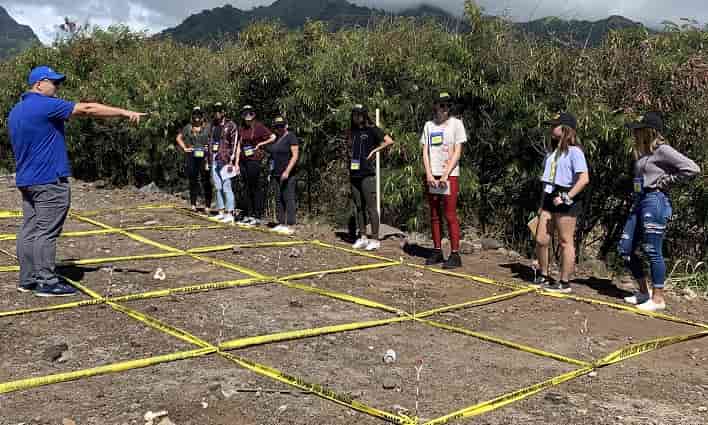
While the crime scene and remains weren’t real, the learning absolutely was.
And Carter believes the experience is also an innovative recruitment tool, helping students envision themselves in a forensic science career. “It’s neat for these students,” Carter said, “the hands-on activity, the experience with teamwork and documenting observations.”
The innovative exercise was part of the Maui Police Department’s 2019 CSI Camp, a unique week-long program of events aimed at giving high schoolers a taste for the work that criminal investigators do every day, from crime scene photography to blood stain pattern analysis.
Chaminade’s Forensic Sciences department has been participating in the camp for four years alongside representatives from the FBI, the Bureau of Alcohol, Tobacco, Firearms and Explosives, the Maui Police Department’s Criminal Investigation Division, and Maui’s Medical Examiner.
Tony Earles, an MPD crime scene investigator and evidence specialist, runs the program annually. He said students have come from across Hawaii and even the mainland to attend.
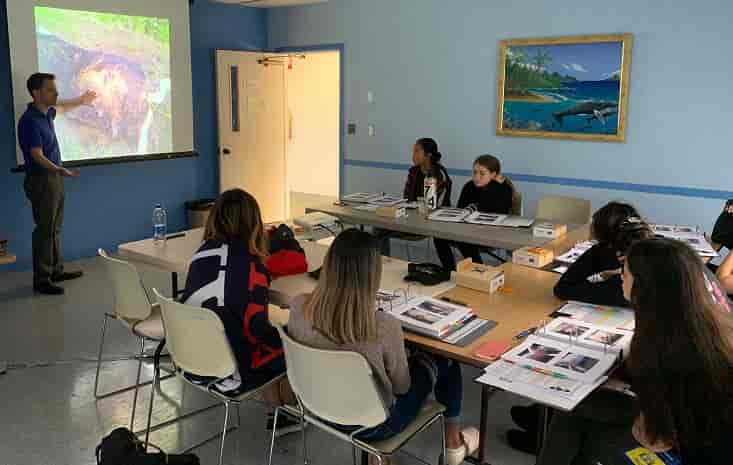
This year’s camp had 12 students selected after a competitive application process. Students submitted essays explaining their interest in the program and were required to submit letters of recommendation. And before the week even begins, the students go through training online.
“With the effect of CSI television shows, there’s a lot of interest in crime scene investigation careers,” Earles said, in an interview. “Of course, you can’t have kids in an actual crime scene.”
The CSI Camp is the next best thing.
“We try to cover everything – from what happens when the call is dispatched to 911, the investigation by the detective, beginning to end,” Earles said. “By the end of the week, the thing they always say is they would like to make it longer. They always say, ‘I learned so much.’”
Hands-on activities, like the one that Carter and Gutierrez lead, are particularly popular.
Maui Police Chief Tivoli Faaumu called this year’s CSI Camp, which ran from June 17 to 21, a “tremendous success” and said Chaminade’s presentation and hands-on activity triggered lots of questions and interest from students. “It is through collaborative efforts such as this Camp that we continue to inspire our youth to dedicate themselves to careers which support our community,” he said, in a letter to Chaminade Provost Dr. Lance Askildson.
Carter said he uses the camp to clue students in on what they need to do to pursue a career in forensic sciences. He also helps them understand the related offerings at Chaminade. But he’s quick to note that the University’s participation in the camp isn’t merely a recruitment tool.
It’s an opportunity to give back. “The camp is a really important community service,” he said. “It’s not at a high school or college campus, but a forensic science facility. And students participate in actual investigative work and experience being a scientist in the field.”
 “You can get very good information and quick answers for families,” according to Gutierrez, who earned a master’s degree in Forensic Sciences from Chaminade in 2016. “If the bone fragments are from a human, you go to the next step – DNA analysis.” But if the remains are from an animal, he said, the probe can stop there.
“Lots of police departments could use forensic microanthropology for crime scene investigations,” Gutierrez added. “That’s my goal – to spread the word.”
Along with spreading the word among Chaminade students, Gutierrez recently presented his research and conducted workshops at the third UCENM International Forensic Sciences Conference in Honduras, and at the fifth Forensic Sciences, Law and Public Safety International Conference in Acapulco, Mexico.
Before coming to Chaminade, Gutierrez served as director of a criminalistics laboratory in his native Chile, where he notably led efforts to identify victims of two massive disasters. One tragedy involved a deadly fire in 2007 at a hostel in Punta Arenas, and the other was a 2010 earthquake and tsunami that devastated the city of Constitution.
Two years ago, Gutierrez and his wife Ana Acuna founded Honolulu-based True Forensic Science, LLC with guidance from the
“You can get very good information and quick answers for families,” according to Gutierrez, who earned a master’s degree in Forensic Sciences from Chaminade in 2016. “If the bone fragments are from a human, you go to the next step – DNA analysis.” But if the remains are from an animal, he said, the probe can stop there.
“Lots of police departments could use forensic microanthropology for crime scene investigations,” Gutierrez added. “That’s my goal – to spread the word.”
Along with spreading the word among Chaminade students, Gutierrez recently presented his research and conducted workshops at the third UCENM International Forensic Sciences Conference in Honduras, and at the fifth Forensic Sciences, Law and Public Safety International Conference in Acapulco, Mexico.
Before coming to Chaminade, Gutierrez served as director of a criminalistics laboratory in his native Chile, where he notably led efforts to identify victims of two massive disasters. One tragedy involved a deadly fire in 2007 at a hostel in Punta Arenas, and the other was a 2010 earthquake and tsunami that devastated the city of Constitution.
Two years ago, Gutierrez and his wife Ana Acuna founded Honolulu-based True Forensic Science, LLC with guidance from the 

 Chaminade University of Honolulu today announced a grant of $1 million from the