After more than a century of absence from forensic science investigations, microbes are once again in the spotlight. And a new book by Associate Professor David Carter, director of Chaminade University’s Forensic Sciences Program, explains why.

“Forensic Microbiology,” edited by Dr. Carter and co-authored with two Chaminade graduate students, tells all about those tiny bugs. Specifically, the book details how microbes help scientists determine when a person died, how they died and where they were before they died.
“Using microbes is the hottest, trendiest, sexiest area of forensic science right now,” Dr. Carter says. “This is the thing everybody wants to know about because it’s new.”
Actually, the use of microbes in forensic science is both old and new. The new part involves cutting-edge technology that enables scientists to extract DNA evidence from microbes and sequence the material with a genetic analyzer.
The old part of using microbiology to solve crimes is really old. So old, in fact, that the practice far predates “CSI” TV shows and the invention of television itself.
“There were folks using microbes in the 19th Century as evidence,” Dr. Carter says, “and then people forgot about them for a hundred years. Now people are coming back to microbes and going: ‘Huh. Maybe this is worthwhile.’”
Although Dr. Carter emphasizes that microbes won’t replace more mundane forms of evidence – such as fingerprints, cell phone records, etc. – these tiny organisms do have “one huge advantage.”
“Microbes are present everywhere a human goes,” Dr. Carter says, “because they are always on you, they are always in you. And not all forms of evidence do that.”
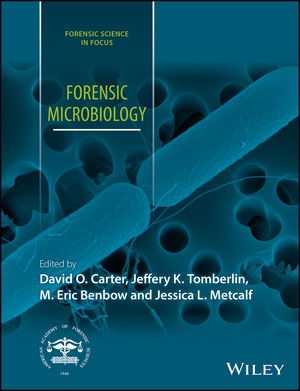
Dr. Carter’s book, which he describes as “the first of its kind,” provides a much-need resource for university students and forensic science professionals, including investigators, microbiologists and pathologists. Among those contributing to the book were leading scientists from America, the United Kingdom, France, Australia and other countries.
Helping Dr. Carter write the 424-page book was Emily Junkins, who graduated from Chaminade in 2016 with a master’s degree in forensic science. She’s currently pursuing a doctorate degree in microbiology at the University of Oklahoma.
“Being a co-author for two chapters in this book, and chapters in other books or manuscripts, has had a major impact on me pursuing a Ph.D.,” according to Junkins, who credits her Chaminade education with providing valuable opportunities for in-depth research.
“I would not be the scientist I am now without these opportunities,” says Junkins, who plans a career in academia as a professor and principal investigator focused on microbial biology.
Also serving as a book co-author was Whitney Kodama, who’s graduating from Chaminade this spring with a master’s degree in forensic science.
“I think this experience helped me gain a better understanding of the scope of my research project as well as insight into a field of forensics that I was not aware of before entering the program,” Kodama says.
“I also think this experience has helped the quality of my scientific writing,” adds Kodama, who recently accepted an investigator position with the City and County of Honolulu Department of the Medical Examiner.
“I learned that stepping out of your comfort zone and doing something that seems intimidating/difficult at first can only benefit you in the future,” Kodama says. “One can grow from these experiences, and I feel that has happened to me.”
Editing “Forensic Microbiology” with Dr. Carter were Dr. Jeffery K. Tomberlin from Texas A&M University’s Department of Entomology, Dr. M. Eric Benbow from Michigan State University’s Department of Entomology, and Dr. Jessica L. Metcalf from Colorado State University’s Department of Animal Sciences.
All royalties from book sales support student research projects of the American Academy of Forensic Sciences.
Chaminade University’s Division of Natural Science and Mathematics is accepting applications for its bachelor’s degree program in forensic sciences. This degree provides students with a wide range of graduate school and career options in the fields of law, medicine, veterinary medicine, dentistry and pharmacy.


 Experienced registered nurses volunteered their day and shared their expertise in a simulation environment. The registered nurses served as altruistic role models of the nursing profession and the nursing community of Hawaii for the students. Julie Gamboa, a passionate advocate who finds opportunities for students to practice critical situations that could never be practiced safely in the real world, coordinated the CMBC event.
 Matthew Labuguen, also a senior in the School of Nursing, felt that the day allowed him to understand better how to bridge together what he had learned from didactic into clinical practice. “I learned a new way of processing assessments and how to better approach situations such as organizing my information to figure out root causes so that I can effectively address problems in a safe and timely manner,” he recalled. “This experience allowed me to be a part of crisis situations and actively think things out without the worry of harming a patient or feeling incompetent. I appreciated and am grateful for this experience.”