
The evening of May 13 was a time of celebration for Chaminade University of Honolulu’s class of 2019 as family, friends, faculty and staff gathered at the Neal S. Blaisdell Arena for Chaminade’s 61st Commencement ceremony.
Following the Oli chant, a traditional Hawaiian welcome and blessing, delivered by Chaminade class of 2014 graduate Kaipo Leopoldino, university president Dr. Lynn Babington welcomed graduates and guests to celebrate the work of faculty, new beginnings and to reflect on changes in the university since its founding in 1955.
In her welcome, Dr. Babington highlighted one of the five Characteristics of a Marianist education that Chaminade, the only Catholic university in the state of Hawaii, emphasizes: educate for adaptation and change. These values and Chaminade’s commitment to service proved to be a consistent theme throughout the evening’s exercises leading up to the graduation of nearly 500 students from 25 undergraduate and six graduate degree programs.
Among the honored guests in attendance were Governor David Ige and his wife Dawn Amano-Ige, who gave the Commencement address.
“You made it,” Amano-Ige said as she began her speech. “You own it. This is your moment. Tonight is your night as we honor you and your achievements.”
Amano-Ige became the first lady of Hawaii in December 2014 when her husband was sworn in as Hawaii’s eighth governor. She has also been an alumna of Chaminade since 1986 when she graduated with her master’s degree in business administration. In her address, Amano-Ige bestowed a few pieces of wisdom on the soon-to-be graduates. She encouraged them to make the most of every opportunity they’re given, to be realistic when starting off in their careers and to take action in moments of uncertainty instead of holding back or withdrawing. The first lady, similarly to Dr. Babington, emphasized how valuable a Chaminade education is because of its values.
“You are so fortunate to be graduating from a place where diversity is celebrated in culture-based learning and where ethical leadership is the focus,” Amano-Ige said. “The rich combination of the two gives you the power to make a difference. When done collectively with your classmates, that power is multiplied to have a great impact on our community.”
Savannah Lyn Relox Delos Santos, the Undergraduate Speaker, delivered an equally impactful speech in which she conveyed the gratitude she feels toward the Chaminade community and her family.
Delos Santos, who earned her bachelor’s degree in business marketing, has spent her years at Chaminade serving as a peer mentor and tutor, student office assistant and president of the Residence Hall Association—all while excelling in her classes, working and volunteering.
She was also an active participant in Campus Ministry, student government and Chaminade’s Hogan Entrepreneurial Program. Her commitment to service and the university’s Marianist values earned her the prestigious Founders’ Award earlier this year. Delos Santos’ dream is to be the second and youngest Native Hawaiian fashion designer to present their work at New York Fashion Week and plans to move to the Philippines after graduation to pursue her professional goals and learn more about her roots.
“Our differential advantages are the Marianist values and the Aloha Spirit,” Delos Santos said. “We are the only university with both and we all live it in our Chaminade community. So embrace it, use it, because we are so blessed.”
Both Amano-Ige and Delos Santos were the first college graduates in their families and shared how education and Chaminade were significant contributors to who they are today.
And finally, after many semesters of hard work and sacrifice, the Chaminade class of 2019 turned its tassels and became alumni, forever part of the Chaminade family.
“Your passion, along with your education and experiences here at Chaminade, will be part of the sometimes messy but beautiful process we call life,” Amano-Ige said. “So tonight be jubilant, be proud, go out and celebrate—safely of course—the joy of your achievement. Tomorrow, your focus shifts to putting your college education to good use for your community, for our Hawaii, for the world and for generations to come.”
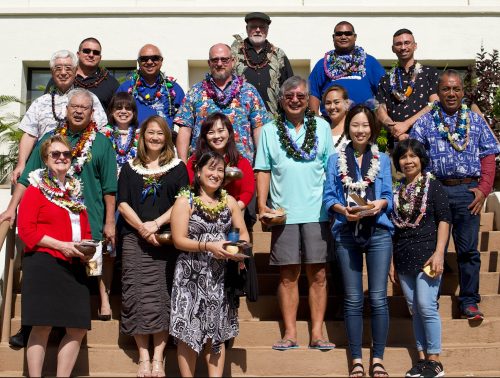 Faculty and staff members were recognized on Friday, December 7 for their incredible contributions and years of service at Chaminade University at the annual faculty and staff holiday luncheon.
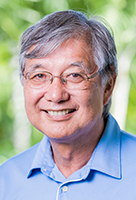 HONOLULU (December 17, 2018) – Dr. Michio “Mitch” Yamasaki, Chaminade University professor of historical and political studies, was recently elected chairman of the
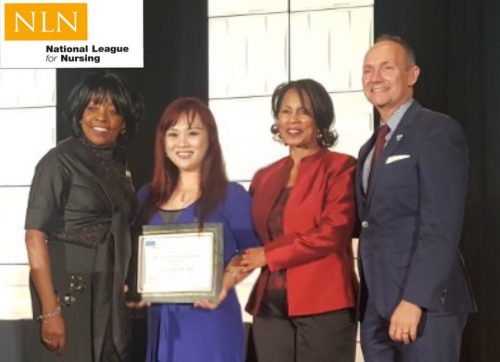 Congratulations to Eurina Cha, assistant professor in the Chaminade
 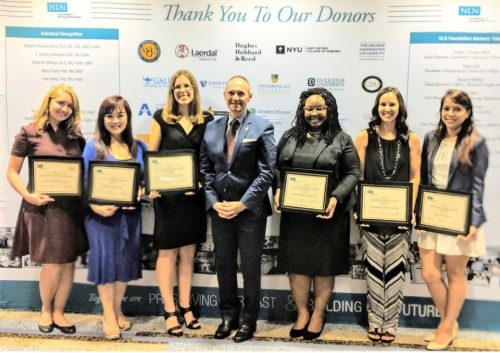 Eurina is currently in a Ph.D. program and writing her dissertation on cervical cancer perceptions, behaviors and challenges among Korean American immigrant women in Hawaii. Eurina is an Advanced Public Health nurse and has a strong passion for helping underserved populations and bringing diversity to nursing education.