• Skip to primary navigation
  • Skip to main content
  • Skip to footer
Chaminade University of Honolulu

Chaminade University of Honolulu

  • VISIT
  • APPLY
  • GIVE
  • STUDENTS
  • PARENTS
  • ALUMNI
  • FACULTY/STAFF
  • Admissions
    • Admissions Home
    • Undergraduate Students
      • First-Year Students
      • Transfer Students
      • Admitted Students
    • Graduate Students
    • Flex Online Undergraduate Program
    • Military Students
    • Non-Degree/Visiting Students
    • Experiential Honors Program
    • Early College Program
    • New Student Orientation
  • Tuition & Aid
    • Financial Aid Home
    • Tuition & Expenses
    • Federal Updates & Changes
    • Scholarships
    • $5,000 Graduate Scholarship
    • VA Education Benefits
    • Net Price Calculator
  • Academics
    • Academics Home
    • Academic Programs
    • Office of Student Success
      • Academic Advising
      • Records and Registrar
    • Kōkua ʻIke (Support Services)
      • ADA Accommodations
      • Career Services
      • Proctoring Services
      • Tutoring Services
    • Sullivan Family Library
    • Undergraduate Research & Pre-Professional Programs
    • Commencement
  • Campus Life
    • About Campus Life
    • Student Engagement
    • Student Government Association
    • Residence Life and Housing
      • Summer Conference Housing
    • Health Services
    • Marianist Leadership Center
    • Counseling Center
    • Campus Ministry
    • Campus Security
    • Dining Services
    • Bookstore
  • Athletics
  • About
    • Chaminade University News
    • Our Story
    • Leadership
    • Chaminade University Strategic Plan 2024-2030
    • Mission & Rector
    • Association of Marianist Universities
    • Facts & Rankings
    • CIFAL Honolulu
    • Accreditation & Memberships
    • Montessori Laboratory School
Search
×

Search this web site

University Communications & Marketing

Leadership Journey: A ‘Dream Come True’

October 1, 2024

This Chaminade graduate is excited to set the course for her alma mater, Sacred Hearts Academy

The new president of Sacred Hearts Academy is a familiar name there—and at Chaminade.

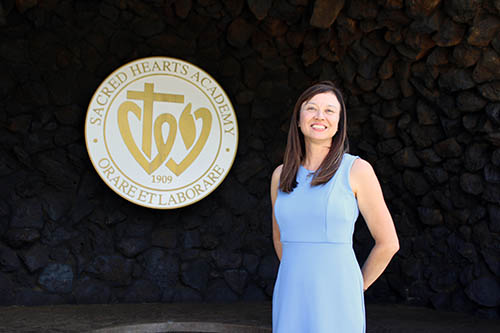
Brandy Ann Sato ’97, MAT ’02, Ph.D. has served in various roles at Sacred Hearts. She’s taught elementary to high school grades, held the vice principal position and became a board member in 2014.

Taking over the helm at the school, she said, is a “dream come true.”

“I’ve always had a special connection with the school,” she added.


Never miss a post! Follow Chaminade University on Facebook and Instagram.


An all-girls private Catholic school, Sacred Hearts Academy’s enrollment stands at close to 500.

Sato notes that faculty members mentor their students to become strong women.

In Sacred Heart’s boardroom, the words “Where Girls Who Aspire Become Women Who Inspire” stretch across the wall. Sitting in the boardroom on a recent day, Sato says that motto “says it all.”

After serving in previous roles with Sacred Hearts Academy, Dr. Brandy Sato is now the president of the private, all-girls school.

A Lancer alumni, Sato describes her peers of the Class of 1994 as “high achieving,” adding that some of her friends attended Harvard, Notre Dame and Georgetown universities.

She chose instead to stay home and attend Chaminade University—the only Catholic Marianist university in Hawaii.

Graduating first with her bachelor’s in History and Political Science, Sato then attained her Master’s of Art in Teaching with a concentration in Secondary Education. She later earned her Doctorate in Education at the University of Hawaii at Mānoa.

“If Chaminade had its doctor of education then, I would have stayed,” Sato said. “The experience at Chaminade taught me the importance of building lifelong relationships and service to the community.”

Sato said she understands that leading a private Catholic high school in Hawaii holds particular significance because of the unique cultural and religious diversity of the islands. She says balancing Catholic traditions and values with inclusivity and contemporary perspectives is key.

“Hawai’i’s population is notably diverse, with strong roots in Native Hawaiian traditions, Asian cultures, and Pacific Islander values,” Sato said. “A Catholic high school can build bridges by emphasizing universal values like respect, compassion and service, which resonate across different cultures.”

A focus on enrollment is among Sato’s top priorities.

“We provide an exceptional education,” Sato said. “We’re modernizing our education through technology, and we continue to develop a strong STEM curriculum.”

Aside from being “book smart,” Sacred Hearts students also have the opportunity to participate and serve in the community, as well as participate in various sports and a vibrant performing arts program.

Students also have the chance to opt into Chaminade’s Early College Program, allowing them to earn an associate’s degree in Liberal Arts without ever officially stepping into a classroom on campus.

“It’s a great opportunity for our students to learn in a college setting,” Sato said. “It’s certainly a beneficial partnership, and I believe we can further strengthen the EC Program.”

One of the intangibles that Sato likes to point out is Sacred Hearts faculty seek to make learning fun. “When the students can feel and see that joy, it makes it that much easier to teach them,” she said.

Posted by: University Communications & Marketing Filed Under: Alumni, Education, Featured Story Tagged With: Elementary Education, Master of Education, Secondary Education

Aspiring Teachers Get STEM Inspiration

September 30, 2024

Elementary Education students learn engaging strategies for teaching STEM

What does a girl who dreams about playing the drums have to do with science, technology, engineering and math (STEM)? A group of teachers-in-training at Chaminade learned the answer to that intriguing question—meant to challenge traditional divisions between subjects—as part of a recent workshop.

Some 16 day undergraduate students majoring in Elementary Education attended the 90-minute workshop with Karen Ansberry, co-author of the Picture-Perfect Science series and lead speaker.

The professional development opportunity, designed by Picture-Perfect STEM and funded through the Takatani Foundation and School of Education and Behavioral Sciences, was one of four workshops offered to students in September to help them think about new strategies for teaching STEM.

Madison Polendey ’25, who will begin her student teaching in Kaneohe Elementary School in January, said the workshops helped her re-imagine how to design STEM lesson plans that engaged students.


Never miss a post! Follow Chaminade University on Facebook and Instagram.


“These workshops helped me learn how to integrate math and reading into my STEM lessons,” she said.

Like that girl who aspires to play the drums.

Ansberry talked to workshop attendees about the female protagonist in “Drum Dream Girl: How One Girl’s Courage Changed Music,” which was inspired by the story of Millo Castro Zaldarriaga, a Chinese-African-Cuban girl who broke Cuba’s traditional taboo against female drummers.

Using the book, a lesson plan was designed to highlight the principles of sound and math.

In the exercise, students create their own drums, using empty coffee cans, Pringles tubes and other household items. The next step would be to add some confetti or rice in a bowl and seal the top. Once the drum is banged next to the bowl, the vibration of the sound causes the confetti or rice to move.

That action proves to students that sound is a type of energy made by vibration.

“Kids can add some rhythm into their banging, which will also teach them about math,” Ansberry explained to workshop attendees, who were delighted by the example. “Studies have shown that rhythm helps teach such mathematical concepts as fractions, ratios, and pattern.”

Chaminade senior Pūnohu Keahi said the workshops taught her how to better engage students, especially through the use of picture books, which helped her learn when she was younger.

With co-author Emily Morgan, Ansberry wrote the Picture-Perfect STEM series to offer teachers engaging pedagogical approaches for teaching young kids about STEM.

On the final day of the worokshop, students learned how to teach robotics to elementary kids, providing them with resources and lesson plans.
On the final day of the workshop, students learned how to teach robotics to elementary kids, providing them with resources and lesson plans.

“Future teachers didn’t have the skills to teach science,” said Ansberry, before the start of the final workshop. “And picture books didn’t really exist for the sole purpose of teaching STEM courses.”

Picture-Perfect STEM offers an approach to teaching that is designed to encourage students in STEM through a combination of inquiry-based learning and literacy. The approach integrates children’s literature with hands-on activities, promoting a deeper understanding of STEM concepts.

According to Chaminade Director of Teacher Preparation Programs and Associate Professor Katrina Roseler, Ph.D., Picture-Perfect STEM is particularly aligned with the Next Generation Science Standards (NGSS) and the 5E instructional model, making it a powerful tool for modern educators.

The 5E instructional model is a widely-used framework in science education that consists of five phases: Engage, Explore, Explain, Elaborate and Evaluate. The model is designed to facilitate active learning and help students construct their own understanding of scientific concepts. Picture-Perfect STEM complements the 5E model, making it an effective approach for teaching STEM concepts.

Roseler added that the NGSS are the K–12 science standards that guide educators in providing students with a science education that reflects the interconnected nature of science in the real world.

The goal is to engage students in Picture-Perfect STEM activities, which will inspire them to think critically and ask questions, connect ideas across different domains of science, and explore fundamental scientific concepts through both literature and hands-on experiments.

“This integration ensures that students not only learn scientific facts,” said Roseler, “but it also develops a deeper understanding of the scientific process and how it applies to the world around them.”

Posted by: University Communications & Marketing Filed Under: Education, Featured Story, Students Tagged With: Early Education, Elementary Education

Chaminade Scholars: Learning through Service

September 25, 2024

The Chaminade Scholars program stresses spiritual and leadership development

Nathaniel David ‘26 says while he enjoys his classes and professors, the learning that has resonated with him the most at Chaminade University has been out in the community—through service-learning and volunteer projects that helped him see how he can make a positive impact.

And a good number of those service-learning experiences, he said, were through the Chaminade Scholars Program, which stresses spiritual development, academic excellence and leadership. Student participants receive a scholarship, renewable for up to four years, and participate in mentorship and service opportunities geared toward personal growth.

“I found it really helpful to have a program that helps me grow in my faith and puts me to work as a servant of God and his people,” said David, an English major who is minoring in Education.

“My biggest takeaway from the Chaminade Scholars Program is that while it is about helping us grow in our faith, grow as an ’ohana, and grow into leaders, it’s really about serving our community as Chaminade students and followers of Christ,” David added.


Never miss a post! Follow Chaminade University on Facebook and Instagram.


Bro. Edward Brink, S.M., vice president for Mission and rector, said the Chaminade Scholars Program is geared toward students who are “engaged in their faith, engaged in service and want to keep those things happening while they’re at Chaminade.”

“Our hope is that while they’re in the program, they’re going to start to see that this way of serving people can continue beyond their school years,” he added.

In other words, Chaminade Scholars are encouraged to see service as a good habit for life.

That was exactly how the program impacted Vanessa Ignacio ‘18, an orthopedic clinical specialist practicing in Hilo. “For me, the Scholars program really helped me to excel at Chaminade,” she said. “I was able to focus on my academics while still being involved in the community.”

Ignacio said the Scholars service-learning project she remembers the most was when students prepared and served meals at a homeless shelter. Rather than handing out the food cafeteria-style, she said, students delivered meals to tables.

“You actually sit down at the table. You get to hear their stories and they got to hear mine,” Ignacio said, adding the Scholars program also gave her opportunities to learn from mentors—and learn alongside peers who shared a passion for service.

Brink said there are seven new and 22 returning Chaminade Scholars this school year.

The program was started about 20 years ago, tracing its roots to the importance of faith formation at Chaminade. Service-learning is a cornerstone of the program, and students are asked to commit to completing at least 15 hours of service each semester.

Chaminade Scholars volunteer to feed those in need during a recent service-learning opportunity.

In addition to serving the homeless, students also serve as tutors and mentors for youth.

Brink said many students find that they receive far more than they give through the program. “A first-year student comes in and they’re reserved, shy, but great heart. Not sure where they fit in,” he said. “They start doing this service and all of a sudden, it’s like they’re able to get out of their shell. They start taking on leadership roles. Experience in service builds confidence.”

David, the English major, called the Scholars service-learning projects “truly special.”

Because he is aiming to become a teacher, he’s focused his volunteerism at Hawaii public schools, including through a mentoring program at Farrington High. “I push myself to do well in school and my classes so I can help others do the same in the future, especially as an aspiring educator,” he said, adding that monthly luncheons for the program that include speakers have also helped him broaden his perspectives and learn about new ways to maximize his impact.

Honolulu Bishop Larry Silva spoke to the Scholars at a luncheon earlier this month aimed at congratulating new inductees to the program and celebrating returning students. David said he’s proud to be among those recognized as a Scholar—and looks forward to contributing even more.

He added that the Scholars program is also what helped him “tap into the rest of the faith community” at Chaminade. He is now serving as a part-time student minister, “using more of my time and talents to help build the faith even more here at Chaminade and to glorify God.”

Posted by: University Communications & Marketing Filed Under: Campus and Community, Featured Story Tagged With: Chaminade Scholars Program

Chaminade Lauded in ‘Best Colleges’ Rankings

September 23, 2024

Chaminade’s Nursing Program also ranked in the Best Undergraduate Nursing category

Chaminade University secured high marks for academic excellence, value and student life by two organizations that provide annual rankings of universities.

In the 2025 U.S. News & World Report “Best Colleges” rankings, Chaminade clinched the No. 21 spot for “best value” among regional universities in the West.

The publication also recognized Chaminade as No. 33 in best regional universities in the West.

And Chaminade’s Nursing Program ranked in the Best Undergraduate Nursing category.

“We are honored to be named among the best regional universities in the West by U.S. News & World Report and to be recognized for our strong commitment to affordability and exceptional value,” said Chaminade University President Lynn Babington, Ph.D.


U.S. News & World Report Rankings:

  • Regional Universities West: #33
  • Best Value – Regional Universities West: #21

Niche Rankings:

  • Best College Locations in Hawaii: #1
  • Colleges with the Best Student Life in Hawaii: #1
  • Safest College Campuses in Hawaii: #1
  • Best College Campuses in America: #28 (out of 1,373)

“Our world-class programs, service-oriented mission, and focus on leadership development and academic excellence prepare our students for success after graduation, ensuring they can maximize their potential for making a positive impact in Hawaii communities.”

Chaminade has consistently ranked high in the “best value” school category, with the university recently implementing its Hawaii Guarantee tuition program.

The initiative provides Hawai’i high school seniors entering as freshmen the same tuition rate as the University of Hawaii at Manoa’s annual resident undergraduate tuition.

The guarantee also includes an achievable pathway to graduate in four years.

The U.S. News & World Report rankings are based on up to 19 key indicators of academic quality, evaluating nearly 1,500 four-year bachelor’s degree-granting institutions across the nation.

These statistics reflect educational excellence and graduate outcomes as well as considerations that vary person-to-person, like campus culture, strength in specific majors, and financial aid offered.

In a separate college ranking, Chaminade was named No. 1 as best college location and for best student life in Hawaii, as well as the safest college campus in Hawai’i by Niche, a company that provides rankings for different aspects of the college experience based on a combination of data sets and reviews.

Nationally, Chaminade was ranked by Niche an impressive No. 28 out of 1,373 schools for the best college campuses in America.


Never miss a post! Follow Chaminade University on Facebook and Instagram.


Posted by: University Communications & Marketing Filed Under: Campus and Community, Featured Story, Institutional Tagged With: Academic Excellence, student life

Students Reflect on MBA Experience

September 18, 2024

Graduating cohort members are excited to apply their new skills

Embrace the process—and cherish the time you have with your cohort.

That was a common piece of advice members of the Professional MBA graduating class had for incoming MBA students at a special Aloha Event on campus. The Sept. 14 event provided incoming and outgoing students an opportunity to share laughs, stories and, of course, some pearls of wisdom.

After more than two decades of being in the hotel and entertainment industry, Connie Kramer ’25 decided to pursue her Professional MBA at Chaminade, saying it had been a lifetime goal.

“Being in the program jarred my interest in academia,” says Kramer, who hopes to continue her Chaminade education by pursuing a Doctor of Education in Organizational Leadership for Adaptation and Change. “It crept up on me, even though academia is in the fabric of my family.”

Designed in an innovative, accelerated format, the one-year Professional MBA aims to advance the skills of those who already have years of business experience in their respective industries. The degree puts a strong focus on strategic decision-making, career advancement and entrepreneurial innovation.

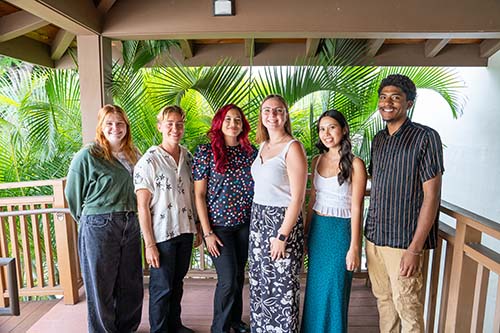
Completing the Professional MBA program are, from left, Jon Watase, Connie Kramer, Gustaf Soderholm, Jacob Murphy, Lauren Hamrick and Stacey Robinson.

Chaminade offers a Professional MBA along with a traditional two-year MBA program.

A defining feature of the 12-month curriculum is its “lockstep” structure, which means that all students take the required courses together—as a cohort. Lauren Hamrick ’25 said that helped her build her confidence, along with relationships that she hopes to keep as she advances her career.

“It’s amazing to look back to see what we’ve learned and how to apply those theories into real life circumstances,” she said.

A farmer and small business owner, Jon Watase ’25 said that with the help of the Professional MBA program, he was able to expand his website, grow his company’s presence and participate in the Made in Hawaii Festival. He also learned about accounting principles and strategic decision-making.

Learn more about Chaminade’s MBA programs by clicking here.

In a “Shark Tank”-style presentation, Watase even pitched his idea to a panel of professors and won a business competition. “I actually received funding, which helped my business grow,” Watase said.

“I couldn’t have done any of this without being a part of this cohort.”

Graduating students said one of the biggest benefits of the Professional MBA is its one-year timeframe.

Additionally, classes are held on alternating weeks and supplemented by online coursework, offering flexibility. “The faculty is amazing,” added Stacey Robinson ’25, adding that you can also learn lots from your peers “who will help you see the bigger picture.”

Another attractive selling point of the Professional MBA program is an international trip that’s full of hands-on learning opportunities. “The international field experience in Japan was the biggest seller for me,” said Kramer, who was recognized with the Outstanding Student Award. “We met with so many consequential leaders and had so many thought-provoking conversations.”


Never miss a post! Follow Chaminade University on Facebook and Instagram.

Posted by: University Communications & Marketing Filed Under: Business & Communication, Featured Story, Institutional Tagged With: Master of Business Administration, School of Business and Communication

‘We Need to Talk’: Scholar on Civil Discourse

September 11, 2024

Dr. Timothy Shaffer spoke on the importance of civil discourse in today’s polarizing times

As the nation marked the anniversary of 9/11, civil discourse scholar Dr. Timothy Shaffer led an engaging conversation at Chaminade to underscore the importance of disagreeing agreeably in polarizing times.

“We are navigating tensions in the past that are still unrecognizable,” Shaffer told a packed lecture hall of students, faculty and staff members and others. “What happens when rhetoric becomes reality?”

Shaffer, inaugural Stavros Niarchos Foundation (SNF) Chair of Civil Discourse and director of the SNF Ithaca Initiative in the Joseph R. Biden, Jr. School of Public Policy and Administration at the University of Delaware, said institutions of higher education offer spaces for sharing ideas, finding common ground, understanding new perspectives and even passionately disagreeing—with mutual respect.

In his lecture, “We Need to Talk: Civil Discourse in Partisan and Polarizing Times,” he told attendees engaging in differences is critical—even essential in a democracy—and that it is absolutely appropriate to challenge one another, as long as it’s done in a fair way. “We have what I call, weak civility, which provides us a code of polite conduct or mode of behavioral management,” Shaffer said.

WATCH THE FULL TALK HERE:


Never miss a post! Follow Chaminade University on Facebook and Instagram.


Strong civility, he added, is a “robust engagement of differences that includes dialogue and deliberation.”

Shaffer’s message resonated with the audience, especially in this election year.

Biology major Jason Edric Ulep ’27 said not everyone is going to agree, but it’s critical to understand where different people stand. “Civil discourse promotes the use of voice instead of resorting to physical violence and verbal abuse,” said Ulep, after attending the lecture. “We need civil discourse, as it aims to seek a middle ground and hopefully come to a common understanding or a solution to the problem.”

In his civil discourse leadership role, Shaffer works on a number of projects, which include annual convenings of faculty and students across the United States at the SNF Ithaca National Student Dialogue and research about the role of civil discourse within public affairs education.

Victoria Perrira ’27, a Criminology and Criminal Justice major, said she walked away from Shaffer’s lecture with a new appreciation of civil discourse. “I value truthfulness and was particularly interested in learning how to effectively navigate conversations around polarizing topics,” she said.

Dr. Timothy Shaffer discusses the importance of listening in his lecture themed, “We Need to Talk: Civil Discourse in Partisan and Polarizing Times.”

Shaffer said polarization isn’t new, but how we respond to each other can be. “We have a lack of public discourse,” he said, adding, “You need to create a space for democracy where you have agency. You can build a culture grounded in civil discourse even in these partisan and polarizing times.”

University President Lynn Babington, Ph.D., said the talk was particularly timely as the nation gears up for the presidential election.

“I believe the place of a university, an institution of higher learning, is to really provide the format, the environment for discourse to take a place,” she said.

“That’s our role. … We need, and our students need, to know how to have those important conversations. to listen carefully to people’s ideas and be able to respond to them in a very civil way.”

This lecture was sponsored by Chaminade University’s Office of Mission and Rector, the Association of Marianist Universities and the Marianist Leadership Center.

Posted by: University Communications & Marketing Filed Under: Campus and Community, Featured Story, Institutional Tagged With: Campus Event, Guest Speakers, Marianist

  • « Go to Previous Page
  • Page 1
  • Interim pages omitted …
  • Page 22
  • Page 23
  • Page 24
  • Page 25
  • Page 26
  • Interim pages omitted …
  • Page 150
  • Go to Next Page »

Footer

Chaminade University Logo

3140 Waialae Avenue
Honolulu, Hawaii 96816

Contact Us
Phone: (808) 735-4711
Toll-free: (800) 735-3733

facebook twitter instagram youtube linkedin

Visit

  • Plan Your Visit
  • Campus Map (PDF)
  • Events

Resources

  • Campus Security
  • Student Consumer Information
  • Concerns, Feedback, and Reporting
  • Institutional Review Board
  • Title IX / Nondiscrimination Policy
  • Compliance
  • Emergency Information
  • Careers
  • Institutional Statement

People

  • Students
  • Parents
  • Alumni
  • Faculty & Staff

Policy

  • Privacy Policy
  • Terms and Conditions of Use


© Chaminade University of Honolulu