
 Dr. Charissa Kahue BS Biology ’07 returned recently to her Chaminade University alma mater to meet with students of the HP 390–Advanced Topics in Health Professions Preparation class. The Office of Health Professions Advising and Undergraduate Research (OHPAUR) invited her to share on March 28 and March 31 about interprofessional healthcare and collaboration and then on life after Chaminade.
The Office of Health Professions Advising and Undergraduate Research regularly features guest speakers from health-professions schools and health professionals. These speakers are invited to share valuable information and insight with Chaminade students through its guest speaker series each semester. Also offered are HP 190 for first-year students and HP 390 for upper-division students. HP 390 addresses advanced topics regarding the preparations necessary for applying to schools of medicine or schools of other health professions.
Students were impressed and listened intently to Dr. Kahue, as she shared her experiences and clarified career pathways to success.
Chaminade student Ann-Janin Bacani said, “I was able to understand the importance of having a group of individuals from different disciplines that can communicate and work well with each other to work towards specific goals together.”
Another Chaminade student, Melissa Ponce, agreed. “In healthcare, it requires an entire team to make sure that the patient is well taken care of. Communication is highly substantial when deciding what treatment or procedure is best for the patient. However, before Dr. Charissa Kahue’s presentation, I had no idea the number of professionals needed to treat one patient,” she said.
Looking ahead to her personal career goals, Chaminade student Kaikeline McCarthy shared, “As a future healthcare professional, I can practice being a professional individual now, especially when I am at conferences, internships, and dealing with superiors.”
Stories of Dr. Kahue’s experiences at Chaminade as an undergraduate student, her transition to a two-year research experience for her post-baccalaureate, then entrance into Vanderbilt School of Medicine and her matched residency for the specialty of Otolaryngology inspired Bacani and Ponce.
 “Her decision to leave for medical school to grow and explore her options for her medical career pathway was one of the things that stood out because this is a decision that I will need to consider when it comes to applying and deciding whether or not I would want to leave home to attend medical school,” said Bacani.
Ponce asked Dr. Kahue, “Have you ever had any moments in your career where you told yourself that you couldn’t do it anymore, and if so, how’d you motivate yourself to keep going?”
Dr. Kahue shared that many medical students either drop out in the middle of medical school or decide to pursue a different career path after they graduated. Every medical student will go through doubts and challenges.
“A final thought that I took as words of wisdom was Dr. Kahue’s statements on perseverance and determination. Although there are obstacles that we may encounter during the pathway into the medical field, a strong mind and motivation will conquer,” Bacani said.
Dr. Kahue felt honored for the opportunity to give back to Chaminade and believed that she was where she was today because of the university. Through Chaminade’s network of partners, access to national conferences, and amazing faculty and administrators, she was able to gain access to opportunities that she did not know existed. “I was able to work under the guidance of prestigious researchers and present that work at conferences. I learned that an even greater emphasis was being placed on research experience in considering medical school applicants,” remarked Dr. Kahue in a Chaminade Quarterly interview.
Dr. Kahue graduated from Chaminade University in December 2007 and was distinguished with the honor of the Outstanding Biology Graduate of her class.While at Chaminade, she participated in summer research programs and presented her research at several national conferences. In the summer of 2006, Dr. Kahue participated in a Pediatric Oncology Education Program internship at St. Jude’s Children’s Research Hospital–Department of Biochemistry in Memphis, Tennessee. At St. Jude’s, she collaborated with a postdoctoral fellow on a research project involving novel drug therapy for imatinib-resistant chronic myelogenous leukemia. She collaboratively published with fellow researchers in the Journal of the American Society of Hematology in 2007 on the results of their hematological anti-cancer research. In 2007, Dr. Kahue participated in Yale’s Biomedical Sciences Training Program and Enrichment program. In 2007, she was honored by the Council on Undergraduate Research (CUR) along with nearly 80 other undergraduate students from across the nation for their undergraduate research, by presenting her work at the “Posters on the Hill” (Capitol Hill, Washington, D.C.) event.
After graduating from Chaminade, Dr. Kahue completed a post-baccalaureate research fellowship from 2008 to 2010 at the National Cancer Institute in Bethesda, Maryland under the mentorship of Dr. Ira Pastan. She graduated from Vanderbilt School of Medicine in Nashville, Tennessee in May 2014. In July 2014, she began her five-year residency program at Vanderbilt in otolaryngology/head and neck surgery.
The Office of Health Professions Advising and Undergraduate Research assists students who seeking advanced academic opportunities. It provides students with information and advising about careers they wish to pursue after graduation, guidance for planning their academic and professional timeline, and expertise to strengthen their applications to their desired program of study. Services include advising, test preparation, internship and shadowing opportunities, summer research programs, professional seminars, guest speaker engagements, and community service activities.
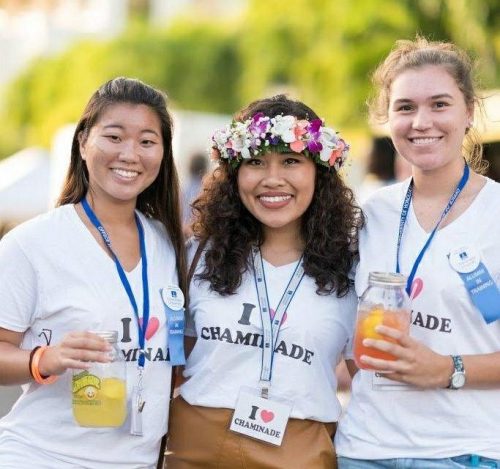
 Thursday evening’s Mocktails and Masterpieces event kindled the fire with bursts of creativity. With artist Jenny B. facilitating, alumni painted canvas masterpieces that they could take home. The alumni mingled and caught up with old friends. The familiar warmth of campus ‘ohana surged feelings of nostalgia and fanned their anticipation for Saturday.
 Outside of the Sullivan Family Library, a photo booth captured the memories of friendships and newly made friends. There was a ceramic pot sale setup by Fine Arts professor Yukio Ozaki, and the Campus Store offered Chaminade logo items for sale. Alumni like Teresa Fujino, MBA ’16 guided activities such as “DIY – Salty Scrubs,” where participants made bath scrubs. Kacie Cohen, MSCP ’13 and Darren Iwamoto, MSCP ’98 with Dale Fryxell, grant director of the E Ho‘opili No Na Haumana Project and interim dean of Education, manned the 110-AOK (Acts of Kindness) beading table.
 The Reunion Street Festival – Food Truck Rally had many memorable highlights, thanks to the collaboration of the Office of Alumni Relations and Residence Hall Association. Tasty smells from the food trucks permeated the air as people lined up in front of Hawaii’s favorite food trucks on Second Road. Chardonnay Pao, BA ’13, MBA ’15 and Cherie Ann Park, MSCP ’13 served various ono plates from Kapakahi Grindz. The Nalo Made Lemonade booth was a hit. Shawn Niwa Kadooka, BBA ’91 mentioned how happy she was to be a part of the event, and said it required two resupply runs. Also, depending on your appetite, you could also choose dishes from Prime Sandwiches or Chamorro Grindz or something refreshing from Tats Shaved Ice.
 “Featuring alum or alum related vendors is the best! It brings a sense of pride to the event knowing that Chaminade is investing and supporting alum businesses. I saw alum, current students, and employees coming to buy our product. The positive vibes were just on a whole other level of awesome,” Pao said. “Good music, ono food, and the use of Chaminade Dollars brought another sense of school spirit to the event.”
 During a more structured part of the evening, Aunty Susan Frank Kama, BS ’61 in her melodic voice started a Lei Aloha ‘oli that cued alums to form a line as Chaminade president Bro. Bernard Ploeger, SM was escorted to the lawn. The chant continued as alums showered Bro. Ploeger with lei, warm hugs, and bid him a fond farewell as he concludes his 23 years of service at Chaminade University.
 Then Micah G hit the stage and got the students, alumni, faculty, staff, and Marianists to get out of their seats and dance. The lawn in front of the library turned into a huge dance floor.
 Mahalo to all, especially the Alumni Reunion Committee Volunteers: Alice Kaahanui BA ’86, Bernard Lum Hoy, BA ’59, Lolita Lum Hoy, BS ’61, Christy Aiwohi, BBA ’87, David Dinh, MBA ’15, Heather Nakao, BS ’12, BA ’15, Jeannie Pinpin, BA ’05, BA ’07, Lois Nakamura, BA ’85, Linda Tavares, BS ’63 Michael “Pika” Ahakuelo, BA ’02, MBA ’11, Scott Kishimori, BBA ’87, Shayne Iwamoto, AA ’12, BS ’13, Susan Frank Kama, BS ’61, Sweetie Pacarro, BA ’89, Terrence Kong, BS ’89, MSCP ’03.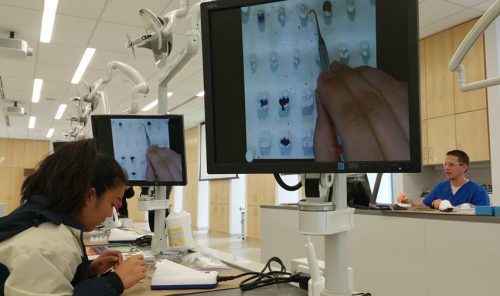
 Chaminade University students Vanessa Ignacio, Dexter Manglicmot and Adam Perez have set their eyes on becoming medical doctors. So, when offered the opportunity by the
  The students received overviews and demonstrations in a myriad of laboratories, including osteopathic skills, anatomy, ultrasound, and simulation skills laboratories throughout the campus. ATSU KCOM student ambassador and Chaminade alum Ryan Santos ’13 (BS Biology) helped answer the students’ questions and showed them around campus.
 For Perez, it was the anatomy lab. “It was beautiful to see their anatomy lab and see how the school goes through great measures to accommodate for the cadavers. It says a lot when you take care of people like that, even if they are dead…It was probably one of the best anatomy labs with the ventilation system and their practice of trying not to use too many chemicals,” he said.
 To expand graduate school and career opportunities, as well as encourage diversity for students from underrepresented and underserved populations, Chaminade’s
  During Dr. Ghee’s visit she met with students, faculty and staff at a poster reception and roundtable luncheon. Her keynote address, “Exploring the Unexplored,” encouraged students to pursue doctoral degrees.
 Among the Chaminade students who completed an SR-EIP internship is Dior-Ashton Teodosio. After graduating this spring with a bachelor’s degree in


